

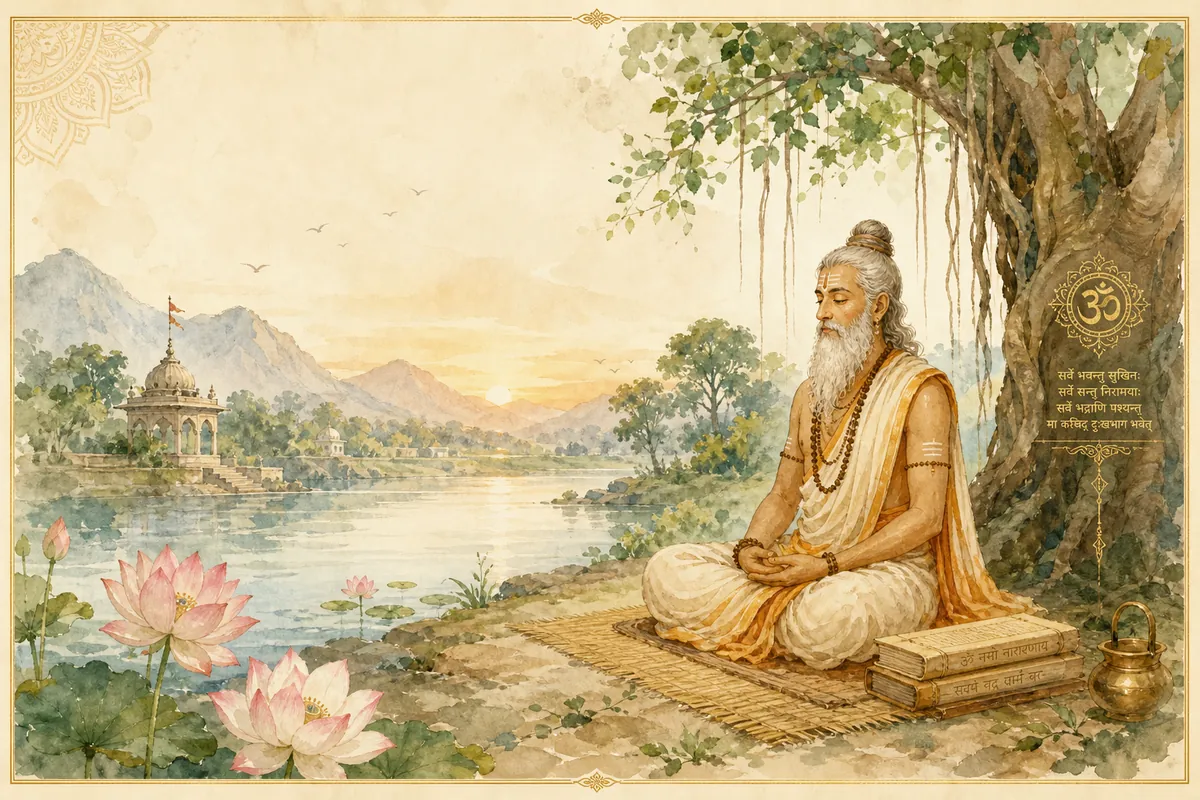
Laya Yoga
As you know, there are four levels of teaching—the outer, inner, secret, and transcendent. They correspond to charya, kriya, yoga-pada, and jnana-pada.
The outer level means charya-pada—everything related to the external dimension of Sanatana Dharma. At the outer level, we visit places of pilgrimage, observe festivals, attend Kumbh Melas, go to temples, and travel to India, Nepal, and Tibet. Since we have external karmas, this level is also necessary and has its own place. At the outer level, we study the culture of Sanatana Dharma, what a sadhu is, and what ethics is.
The inner level is our view. At the inner level, we need to study the philosophy of Advaita Vedanta. Over twelve years, we need to develop a stable philosophical vision of the world and learn to think as Shankara, Vasishtha, and Gaudapada thought, and understand how the world is described in the “Vivekachudamani,” the “Yoga Vasishtha,” and the “Tripura Rahasya.”
So that our mind does not tempt us, it should be as if a little Vasishtha or a little Dattatreya were sitting inside us, telling us on every occasion how to assess a situation and how to look at it. Until we have Vasishtha or Dattatreya in our heart, let him at least be in our mind. That is why we study philosophy and the Upanishads, so that we may become at least knowledgeable in the Dharma. We may not be saints in the Dharma, but let us be intelligent, learned, and well versed in it. Then samsara can no longer so easily pull the wool over our eyes, and therefore, over twelve years, we need to become highly skilled intellectual masters of Advaita Vedanta.
To do this, we simply need to study the source texts and develop structured Advaita Vedanta thinking for ourselves, not for others. Some may later choose the path of a scholar—within the worldwide community, there is an opportunity to become a scholar, to teach the philosophy of Advaita Vedanta, give lectures, and speak at congresses and at the Dharma Maha Sabha. Writing dissertations and books is also an important seva for the teaching, but that is for a select few. In general, we ourselves should become scholars for our own sake so as to master the philosophy of Advaita Vedanta well—this is the inner level.
When we travel to Kailash or the Kumbh Mela and visit temples, we go there with a well-established outlook on life and philosophy. Many ordinary people do not know Advaita Vedanta; even Hindus themselves, when you tell them about the four mahavakyas and explain them, say, “Oh, how remarkable! Where did you learn all this? We do not know it.”
The secret level means the teaching of Tantra, when we study yoga, winds, and channels, and yogic practices become our life. The transcendent level is the teaching of Anuttara Tantra, abiding in the natural state. Somewhere between them, between the secret and transcendent levels, lies Laya Yoga.
The Origin and Greatness of Laya Yoga
Therefore, after studying the basic teachings of yoga, we
