

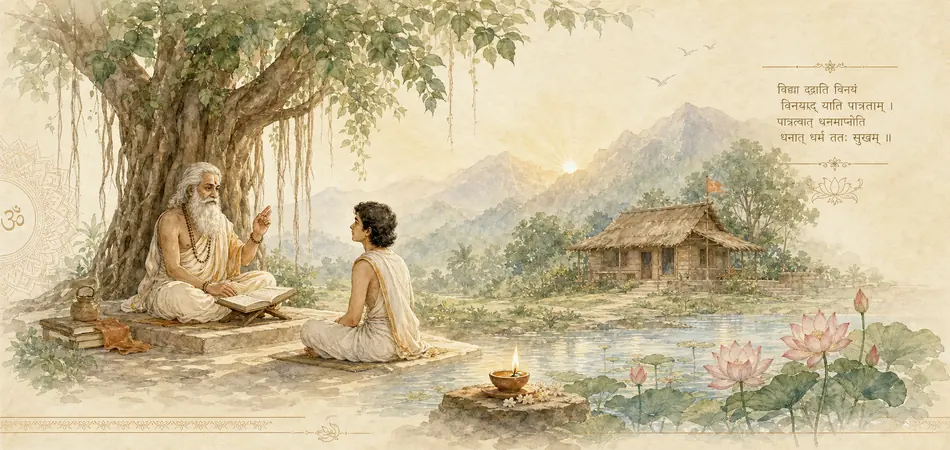
If you study the teaching attentively, you may discover that it is divided into five paths, or five yantras. They can also legitimately be translated as universes. The two main yantras are the yantra of wisdom, prajna-yantra, and the yantra of energy, shakti-yantra. Nada-yantra, the yoga of sound; jyoti-yantra, the yoga of light; and nidra-yantra, the yoga of dreams and sleep, are more complex and advanced practices for professional masters, and therefore in the first years they are usually not recommended for intensive practice. Nevertheless, if you enter the path of laya yoga in the tradition of the mahasiddhas, you should study all five yantras of laya yoga deeply.
When we say that we touch the great teaching and wish to realize ourselves through it, this means that, understanding the depth of this great teaching, we approach its study with complete seriousness. Since for us the teaching is the “blood of the heart,” the “heart in the chest,” and the “apple of the eye,” there is no other way than to approach its study very deeply. For us, the question of liberation and enlightenment is not yet the immediate issue, since this is a very great goal. Nevertheless, the question before us is: “How can we come closer to this state?” To come closer to it, we must become true professional masters of yoga. A master differs from an amateur in that he immerses himself deeply in the teaching, not overlooking the smallest details; he gives himself completely to its study, trying to reach the very heights. And since we understand that the teaching is something very valuable for us, from the very beginning (even if we are beginning students, lay practitioners) we must develop the approach of a professional master, not that of an amateur, when we study the teaching.
There are two sections of laya yoga: prajna-yantra and shakti-yantra. The first includes contemplation, the second—the management of inner energy in the tradition of the mahasiddhas. But first we will talk about what qualities a student should have when he enters the path of the teaching.
The Tradition of the Mahasiddhas
The tradition of laya yoga is at least five thousand years old, if counted from Avadhuta Dattatreya, since Dattatreya lived not in this yuga but in the previous one, which ended at least five thousand years ago. But the teaching of laya yoga itself took shape as an independent current about a thousand years ago. And at the origins of its foundation stood saints who were the greatest masters of meditation. Thus, to practice the teaching is nothing other than to become imbued with the spirit of these saints and to try to follow in their footsteps, to realize what they taught their disciples.
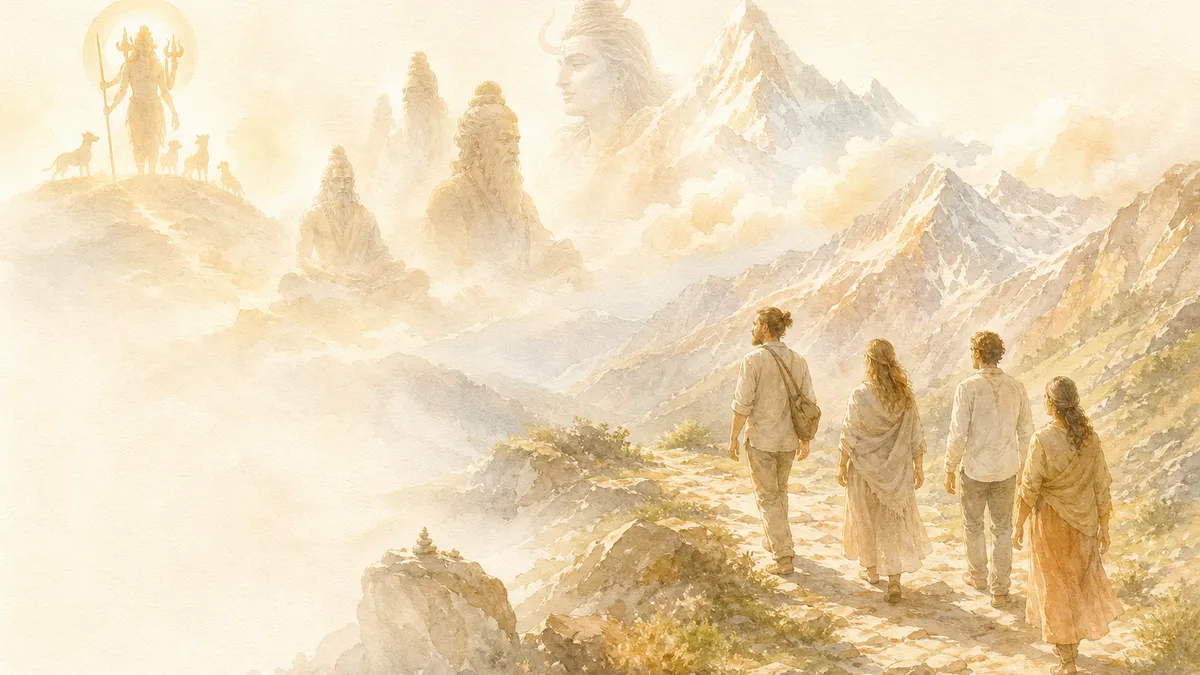
When we read the biographies of the holy mahasiddhas (for example, Dattatreya, Saraha, Matsyendranath, or Gorakshanath), we see that they were by no means ordinary people, but the greatest master-practitioners, who devoted their entire lives to spiritual practice (sadhana), possessed great magical powers and, most importantly, a great understanding of non-duality. Magical powers in themselves are not the goal we strive for. If they manifest, they are merely a flowering, a pleasant side effect, but no more than that.
Magical Powers and the Path of Wisdom
If we speak of magical powers, they are divided into two parts: kalpita-siddhis and akalpita-siddhis.
Kalpita are artificial magical powers, divine abilities that are also attained on other paths, for example as a result of sorcery or magic. Strictly speaking, this is not what interests us, because even a person who does not possess enlightened consciousness can have magical powers by subjugating spirits through rituals, making offerings, reciting mantras, or using potions. But what interests us is the evolution of consciousness, the most abstract and completely free attainment, the realization of advaita—non-duality. Therefore the saints say that a yogin who wishes to know reality has no need to chase after magical powers. This can become a distraction and a serious stumbling block.
Ramana Maharshi said the following on this subject:
“Those who possess magical powers (siddhis) desire wisdom (jnana), but those who possess jnana desire nothing more, because, having what they have, they have everything in its entirety.”
He also said that a person who greedily seeks siddhis but ignores the path of wisdom is like a poor man who begs a millionaire for a bowl of sour soup, although that millionaire could make him the richest person. Thus, the saints say that the true siddhi is the sole realization of the nature of Mind as such in its fundamental basis, or the realization of non-dual awareness.
If this realization becomes very deep, another kind of magical power manifests, called akalpita, that is, these are not artificial siddhis. In Christian terms, one might say that “this is from God,” but in Tantra as such and in Laya Yoga there are no such polar dilemmas (from God or from the devil), since in Advaita everything is divine and there is nothing outside the primordial nature of the Mind. Nevertheless, it is precisely this kind of perfection that is recognized in Laya Yoga as something worthy of consideration.
Guru Yoga. The Qualities of a Practitioner
According to tradition, before expounding the teaching, it is said what qualities a student must have in order to be able to practice the teaching. Often, when we hear about these qualities and project them onto ourselves, we see that we do not possess them. Nevertheless, this shows us our path of further spiritual growth, how we can change ourselves in order to become fully ready. The teaching assumes that we can set goals and work with them; otherwise we will never be ready. People are not born holy and perfect, but they become holy and perfect as a result of persistent work on themselves. Thus, while accepting and fully realizing our unreadiness, we nevertheless see that if we practice diligently, we can change and become ready to fully move to the level of mahasiddhas.
In fact, understanding one’s own unreadiness is an integral attribute of spiritual practice, a clarification of one’s own position and one’s own path of evolution. Every saint, not to mention an ordinary practitioner, is acutely aware of his own imperfection. And the more acutely he realizes this, the greater the aspiration to advance and purify himself that arises in him.
So, what are the qualities of a student who is able to fully follow the practice and realize enlightenment?
Freedom from Attachment to the World
The first quality is freedom from attachment to this world. Since the path of yoga is the path of liberation from illusions, we must, of course, cultivate such freedom from attachments to the material world when we practice, for this is precisely what we want to be liberated from. In itself, the material world is neither bad nor good; it is simply a given, but our attachment to it is bad. It is precisely because of this attachment that we are reborn. And yoga presupposes liberation from the cycle of births and deaths.
Freedom from attachments to this world means that we see this attachment; it is present, it is a fact, but we know that we can work with it, and therefore we gradually eliminate it through the methods of practice and contemplation. We do not accept it as something that can be left as it is; we cannot put up with it and understand that we must work with it. When we work with such attachment for years, it goes away, and then we acquire a free consciousness that makes us capable students.
Undivided Devotion to the Path of Liberation
The second quality of a student is undivided devotion to the path of liberation. If we analyze ourselves, then our devotion to the path of liberation is, of course, not so very undivided. It is always very useful to compare ourselves with the great saints who practiced in ancient times. They were either monks, or hermits, or avadhutas beyond all frameworks and definitions. And if for us this is unattainable at present, then at least our future perspective should develop precisely in this direction.
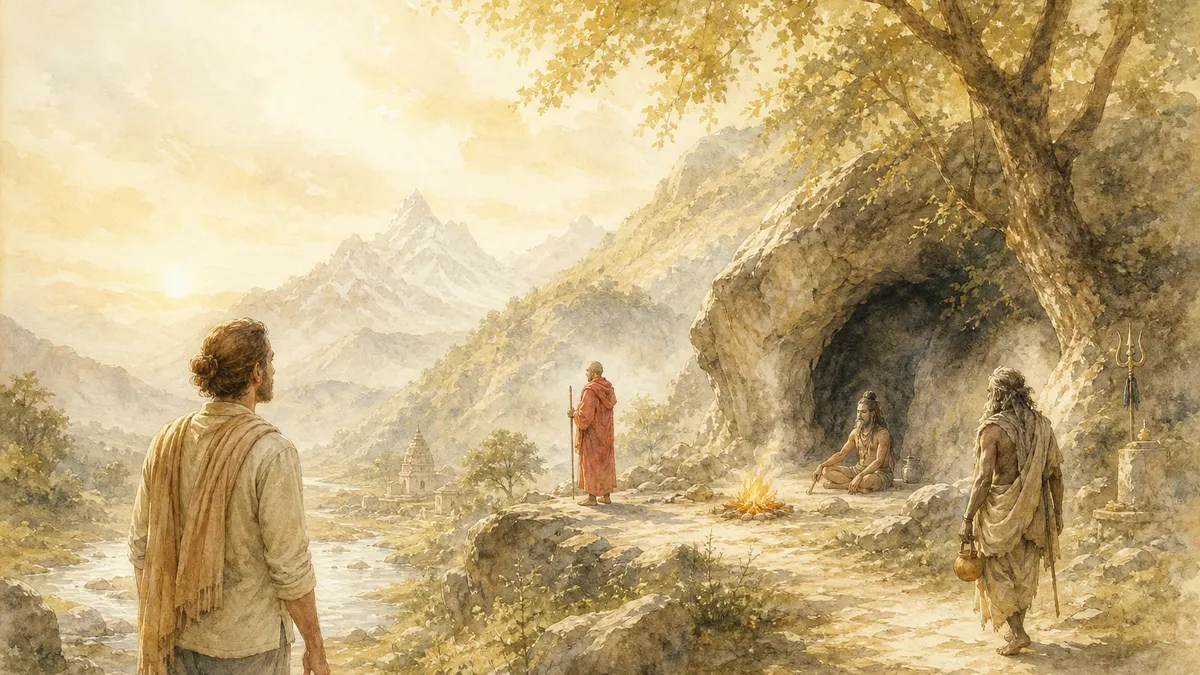
Hermits lived in the mountains, in caves, or in forests, continuously devoting themselves to spiritual practice. Avadhutas wandered from one place to another, being completely unattached, practicing “crazy wisdom,” remaining beyond all limitations, like a bird soaring in space. For us, this is still premature, since the level of an avadhuta presupposes samadhi and realization. If one tries to pose as an avadhuta without having undergone the appropriate training, it will bring nothing but obstacles. And you will not be able to wander like a naked madman in warm India during a cold winter. The third path is monasticism. Monasticism implies not only renunciation of ordinary social life, but also serious, competent, long-term (for years), very deep training in a group of like-minded people. This is something very favorable. And whichever of these paths we choose, in the future we can achieve success on any of them, provided we practice diligently.
Undivided devotion to the path of liberation through Laya Yoga means that we must understand the principle of impeccability and subordinate our entire life to this path. A yogi striving for liberation is like a good athlete who trains for results, for example, wants to set an Olympic record, and therefore subordinates his entire life to this one great goal. Such an athlete eats according to the rules, trains intensively, lives ascetically, observes restrictions, and works only for this goal; for its sake, he is ready to make enormous efforts. In the same way, we too must wholly subordinate ourselves to the path of liberation and train day and night if we want to obtain results. And if in the initial stages, while our attachments have not yet been purified, it is permissible to take a relaxed attitude toward spiritual life, then this is, of course, not permissible when we move away from the state of an amateur and transition to the state of a master. A master professional cannot allow himself to do anything unnecessary, become distracted, spend time on something else; he cannot allow himself to engage in anything extraneous apart from his great goal. And if we allow ourselves this, then we are not yet fit for the role of a master professional; we should think about how to move from a beginning amateur to a master professional. This applies to any sphere of human life, and all the more so to the path of liberation and yoga.
Connection with the Teacher
The next important quality of a disciple is the connection with the Teacher, unconditional trust in the Teacher, and the fulfillment of all his instructions. This principle is very important. If you read the sacred texts, you will see that the saints emphasize this. Since transmission comes from the Teacher, and many subtle nuances are also transmitted by the Teacher, not from books and not from one’s own understanding, the connection with the Teacher becomes extremely important.
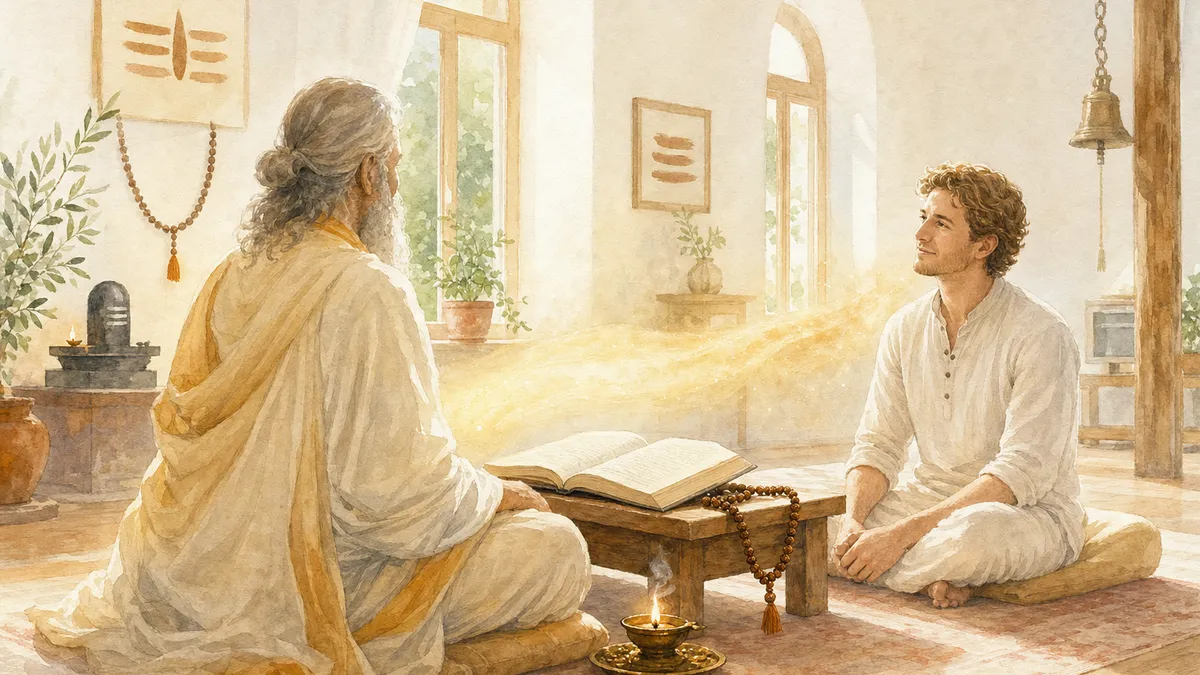
Of course, on the path of yoga, the Teacher is not recommended to be regarded as some kind of person with whom you establish a relationship. And this is not connected with any personal human relationships. This connection is deeply mystical. On the path of yoga, the Teacher is regarded as a symbol of all saints, a symbol of the natural state, the Clear Light. In fact, to be a disciple as the saints describe it means to offer body, speech, and mind to the Teacher with a request for help in liberation and to carry out all his instructions. But in reality this is not easy, because our “I” and our ego constitute a huge block from which it is not so easy to free oneself. To attain a true connection with the Teacher and the ability to fulfill all his instructions takes years.
