

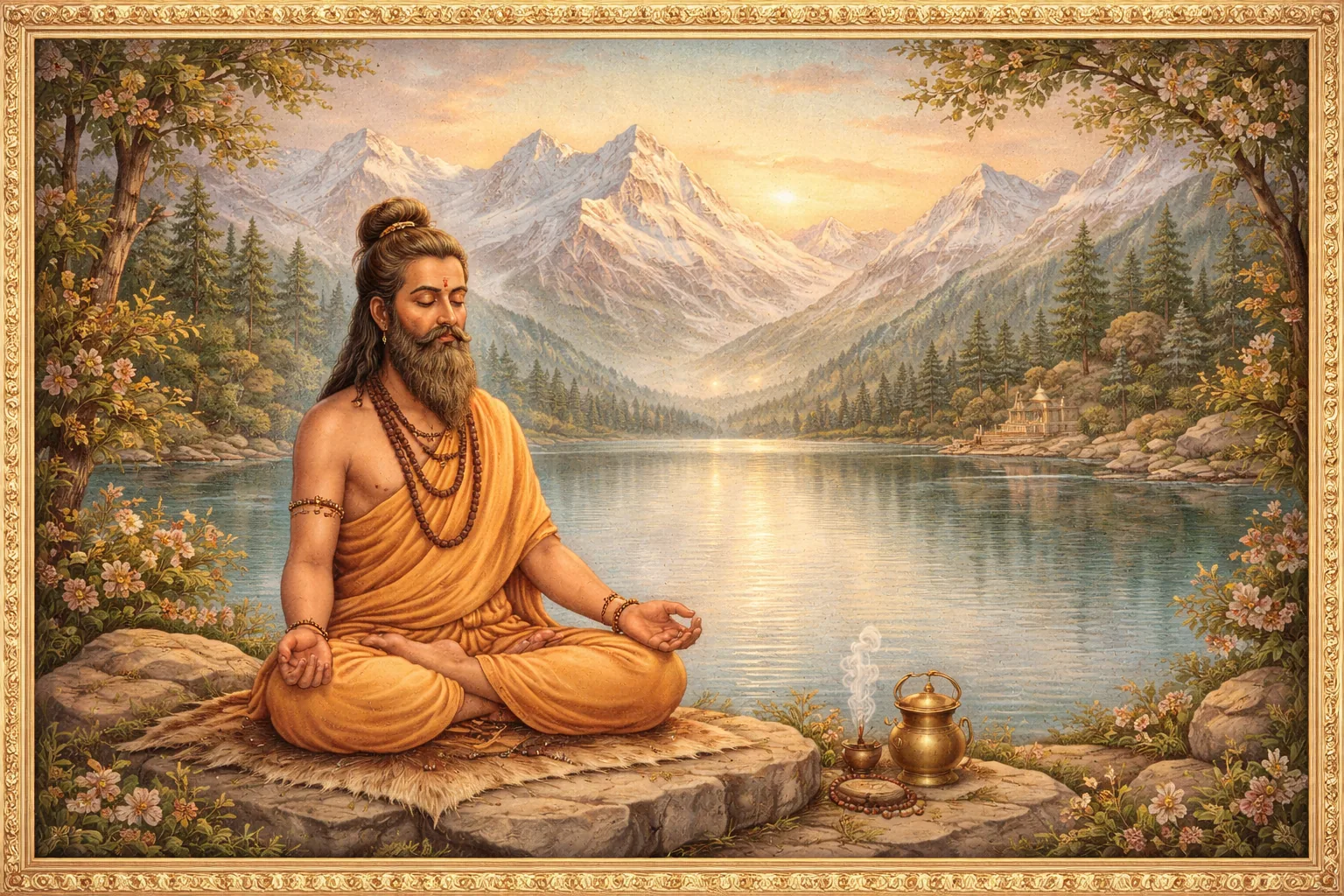
I hope that those gathered here are people who are sincerely interested in studying or becoming acquainted with the teaching of Laya Yoga, that this is not idle interest, not curiosity, but something deeper, since at such lectures we always discuss very serious topics concerning our life, our future, our vision of the world. Such topics are not to be joked about; they must be approached with the utmost sincerity and seriousness, because it is precisely at such moments in life that a new line of destiny, a new road of life, opens up to us, where we have a choice.
I do not consider myself a preacher and I am not trying to convince anyone of anything. That is the last thing I would want. I simply show that there is a choice, and what that choice will be is decided by the person himself.
When we become acquainted with such a teaching as the teaching of Laya Yoga, we become acquainted with the possibility of a different choice of vision or a different choice of worldview. Ultimately, the essence of all spiritual teachings is to transform one’s worldview.
When we speak of enlightenment and liberation, everything comes down precisely to the transformation of the worldview. If we are satisfied with the worldview we have and have no motives prompting us toward transformation, then, of course, there is no point in our seeking a spiritual life and looking for a way to change our worldview. But the question is that if we look deeply into ourselves, we will discover that we are not at all satisfied with the worldview we currently share.
Karmic Vision and the Tunnel of Reality
What is a worldview? It is a fundamental concept of the teaching of Laya Yoga. It is karmic vision (loka-drishti). The worldview determines the way of perception by which we perceive ourselves and reality.
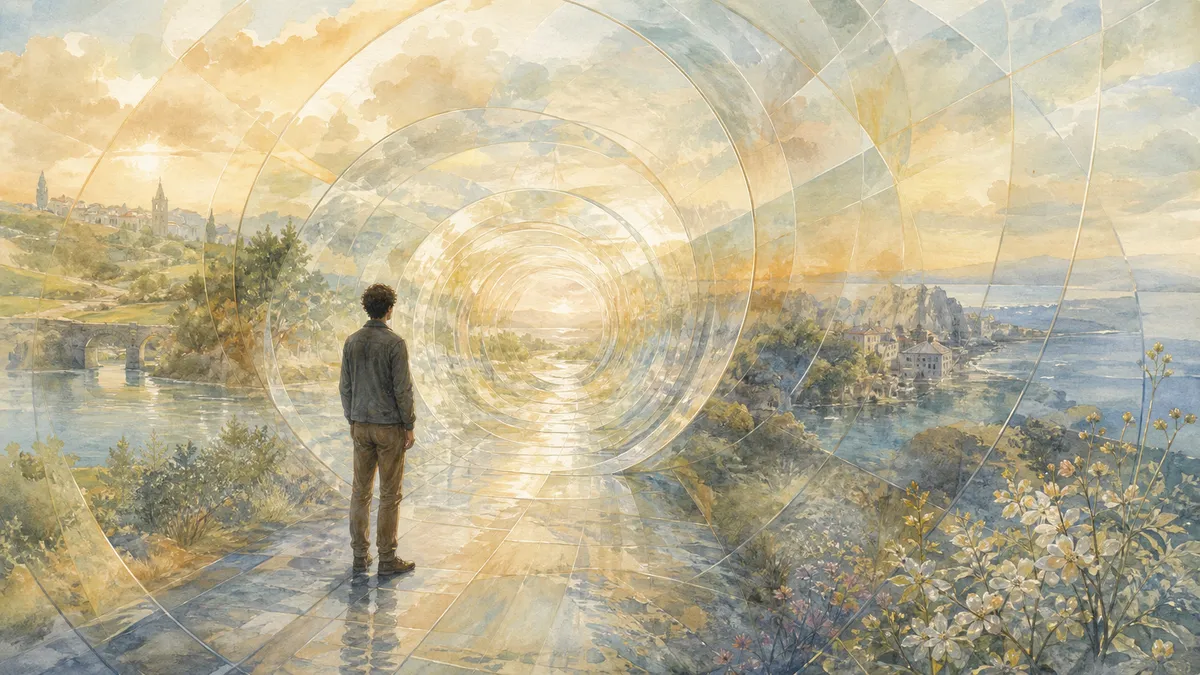
It is believed that the way of seeing the world that is inherent in us, living beings, the worldview that we have, is not the only worldview. One could say that we human beings each exist in our own individual tunnel of reality. This individual tunnel of reality is formed by our previous birth, upbringing, education, and many subtle things that we may not even fully realize. And the whole point is that we believe in this tunnel of reality just as strongly as religious people believe. Even someone who considers himself an atheist, in fact, believes in his atheistic worldview, believes in his atheistic tunnel of reality, and believes in it very strongly. One might say that every day he recites a kind of prayer: “I believe that there is day and night, that there is past and future; I believe that I am a human being; I believe in the world of human beings; I believe in my life, in my goals and plans.”
In fact, when teachers present various teachings, they often present spiritual teachings in a veiled form, saying: “This is not a religion. This has nothing to do with religion. It is simply yoga. It is simply tai chi exercises.”
I think this is a very superficial approach. When I am asked, “Is Laya Yoga a religion?”, I answer unequivocally: “Yes, it is a religion.” And if it were not a religion, there would be no reason to engage in it so seriously. It is simply that nowadays the concept of “religion” has largely been discredited and has lost its meaning. We see many problems that arise as a result of the collision of different tunnels of reality or different religious systems. But when we say that the teaching of Laya Yoga is a religion, we mean something much more subtle. The point is that true religion is the foundation on which everything in people’s lives stands: culture, science, civilization, and so on.
The Essence of the Teaching of Laya Yoga
If one were to formulate the teaching of Laya Yoga in a few words, perhaps the following phrase would be most fitting: “In view there is nothing to rely on; in meditation there is nothing to meditate on; in conduct there is nothing to observe.”
Whoever is able to decipher this phrase may understand the very heart of the teaching.
Once a Tibetan lama was asked: “Could you say in a few words what the essence of Buddhism is?” The teacher refused, but the questioner insisted, and then he said: “Very well, imagine that neither you nor this world actually exists.”
The essence of the teaching of Laya Yoga can be presented in a more positive way. It consists in the fact that there is a single manifold awareness that changes, manifesting in infinite forms and games. But by identifying ourselves with the body, with the personality, we do not recognize this awareness, and then false self-identification occurs: we establish another awareness — “I am a personality” or “I am the body.”
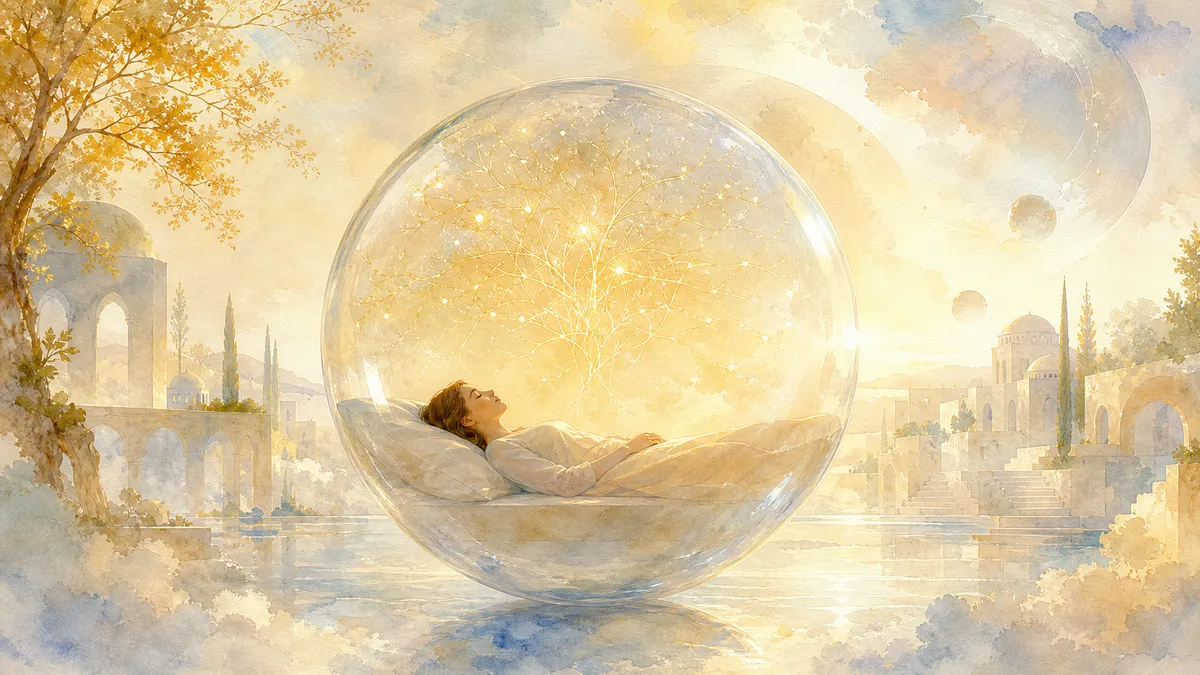
It is similar to a situation in which some unknown forces or demons were to implant subtle neuro-implants into all people, immersing the mind in a state of sleep by generating a virtual world, and all people, as a result, suddenly lost clarity and began to think that this virtual reality is something true.
From the point of view of the teaching of Advaita and other teachings, a person is like a being with an implanted neuro-implant. His own mind models a virtual reality that he accepts as something real.
Today, on the wall of one of the houses in the courtyard where I was staying, I saw an excellent inscription that shook me to the depths of my soul: “Santa Claus does not exist!” I was simply delighted. Obviously, some child, in a burst of enlightenment, had comprehended this truth, had discovered this “secret of the world” for himself.

In fact, all of us, living beings, are in roughly a similar position. What has long been clear to the gods is a shocking truth for us. For example, the gods see the world radically differently. It is believed that the gods, looking “through the clouds” at the actions of people, smile as they see how people’s plans collapse, how all their intentions are dispersed by powerful universal forces, seeing how short-lived people are, how they make short-sighted plans without taking into account all causes and consequences, how inexorable universal laws impose their circumstances on people. From the point of view of such a vision of the gods, we are like the same beings as children who discover astonishing truths, such as that Santa Claus does not exist.
The world as we perceive it is illusory. It is a projection, a mystification of our mind, of our karmic vision.
Two Types of Vision: Sacred and Profane
In this regard, it must be said that in the teaching there are two main types of vision: impure karmic vision (samsaric) and pure karmic vision. These are the sacred and profane dimensions.
The sacred dimension is inherent in the gods; the profane, in people. In the sacred dimension there are no causes and effects, no law of karma, no limitations; there are games there. In the sacred dimension, every living being is a deity, every deity creates its own universe and lives in it, establishing laws according to its intention. The pure sacred dimension is also called pure vision, Divya Loka, the abode of the gods.
In profane (conditioned) karmic vision, living beings are strictly subject to the laws of cause and effect. It is often called by the general term “samsara” or “the six worlds of samsara,” “the abode of sorrow and rebirths,” Mrityu Loka.
In the profane dimension, living beings are separated from the supreme Source. In the sacred dimension, living beings do not conceive of themselves outside the supreme Source.
In the profane dimension, living beings, being separate, are forced to live while constantly making mistakes, because their power of clarity is insufficient to understand the structure of the universe. In the sacred dimension, beings are endowed with great clarity. This clarity allows them to arrange their life so that it is continuously happy.
The gods, being in the sacred dimension, follow the universal laws (rita). And living beings, being in the profane dimension, in impure karmic vision, do not understand these universal laws; and even if they have some inkling of them, following them is far from easy.
The Great Transition into the Mandala of Pure Vision
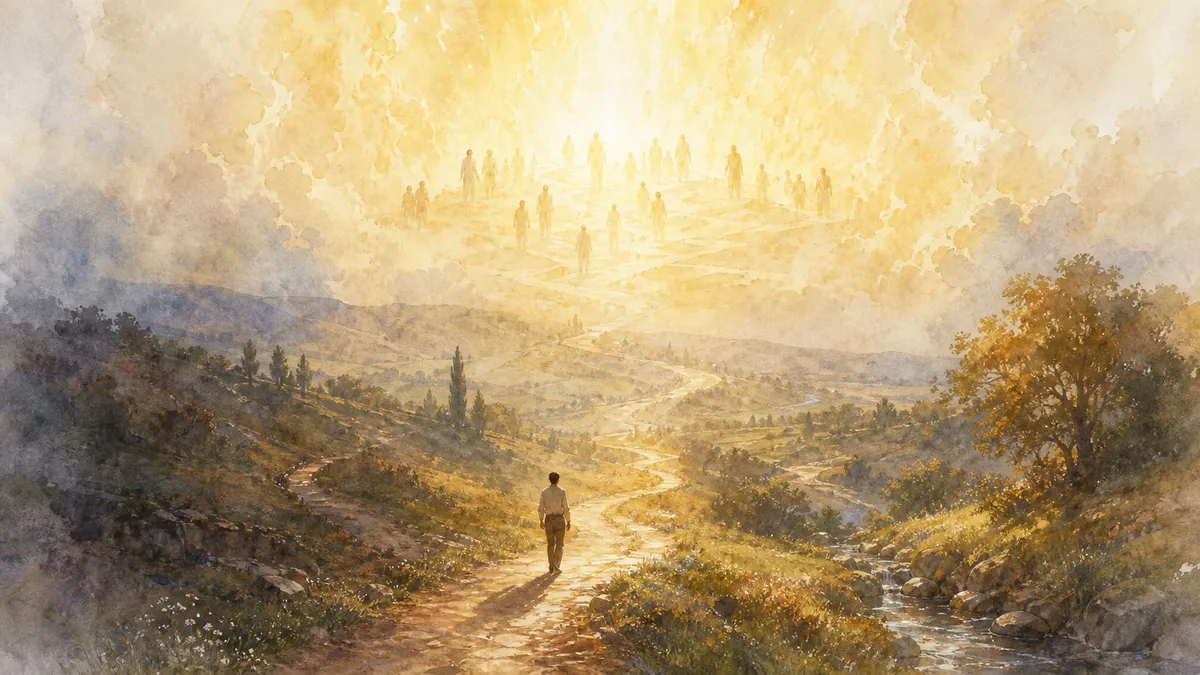
Spiritual practice consists in carrying out a transformation, that is, in passing from impure profane karmic vision into pure, sacred vision. In the terminology of yoga this is called “attaining liberation and enlightenment,” “realizing transformation,” “making the great transition.”
To begin with, one needs to reflect on one’s own future, on how we plan it.
For example, gods, as living beings possessing great clarity, can foresee the future, can plan and model it over very long periods of time, because they believe that the past and the future are a modification of their own consciousness. And if they are a modification of consciousness, this means that they can be influenced by the power of one’s mind.
Unlike the gods, people do not fully understand that time and space are a modification of consciousness; therefore, they do not realize that the past or the future can be positively influenced.
For example, how are we going to spend the next eighty years of life? And the next two hundred years of life? Or the next five hundred years of life? And yet five hundred years of life is only a small flash in the infinite flow of time. Even five billion years, from the standpoint of infinite time, is also a very small flash.
If we intend to become immortal, then what are we doing for this? And if we feel ourselves to be mortal, then to which world do we intend to go after death: to a higher one or a lower one? And if to a higher one, then what are we doing for this? What are our successes in this? How far have we succeeded in it? These are very serious questions. This is banal, sound worldly logic. Even a good businessman makes forecasts for his firm. But when it comes to their own destiny, people often show astonishing carelessness, not trying to calculate the options for their own “self.”
The religious way of posing the question is that we begin to look a little beyond those superficial things that surround us; we try to calculate options far beyond everyday reality.
Ancient Aryan Civilization and Sanatana Dharma
The Aryan Vedic civilization, the quintessence of whose teachings is Laya Yoga, is rooted in the beginningless past; therefore, it is called “Sanatana Dharma,” that is, the eternal dharma.
In the teachings of the Vedas there are no specific founders such as, for example, Christ in Christianity, Buddha in Buddhism, Muhammad in Islam. Nor is there a specific date for the emergence of the teaching. There is an boundless succession or chain of continuity of holy spiritual teachers, sages, rishis, and gods. If we try to trace this chain of continuity, we will go back into such boundless time that we will simply become lost in it. Vedic Aryan civilization is an entire culture. It is a civilization that brought together science, religion, technological achievements, psychology, medicine, and many other accomplishments.
The ancient Aryans are common ancestors for most of the races and civilizations inhabiting the world. The ancient Aryans possessed a colossal spiritual culture which, unfortunately, has come down to us now only in a very small measure. It is believed that they lived at the North Pole at a time when the great cooling and the ice age had not yet occurred. The Aryans possessed a very high culture, philosophy, and technology, and were like gods. They moved through space on vimanas, could visit the worlds of the gods, fold time and space, and moreover were immortal. They possessed incredible achievements in the field that we now call quantum physics.
When, as a result of cooling, the temperature in the region of the North Pole began to drop, the remnants of the ancient Aryans migrated southward, successively passing through and stopping in the territory of Russia’s polar region in the Murmansk area, the Volga region, and the Melitopol area. Then, migrating southward, some of them gave rise to the Indo-European branch (the peoples of present-day Europe). Another part merged with local tribes in the territories of modern Pakistan, Iran, and Afghanistan. Finally, a third part, mixing with the tribes in northern India, created a new civilization, rewrote the Vedas anew, and established sacred places. And thus the so-called Bharata-varsha (“Great Bharata”) appeared, that is, modern India, which has preserved the achievements of the ancient Aryan-Vedic civilization in the most integral form.
If we analyze the roots, we have a great deal in common with the ancient Aryans: from linguistic coincidences to the names of rivers.
For example, in the area where the monks now live, there are very interesting names: the Arya River, the Moksha River (which means liberation), Shivskoye, Kumarevka (from the word “kumar” — eternal virgin), Lake Sit, Rama, Kubja (a synonym of Kundalini). There are about two hundred names whose analogues can be found in the list of sacred sources mentioned in the Mahabharata. There are very curious studies about this.
Return to Lost Greatness
So, when we study the teaching of Laya Yoga, we are, in fact, turning to the ancient roots of our ancestors, to that lost former greatness which we, as an ancient human civilization, once possessed. Today the traditional religious point of view says that man is a fallen being. In general, one can agree with this. He is a fallen being, but not because he is sinful, but because he is divine, yet has lost his greatness.
At a certain stage, an error (bhranti) manifested, which led an entire civilization in a lower direction, toward a lower karmic vision. As a result of such an error, prabandha (integrity) was lost, that is, unity with the Supreme Source and holistic perception.
When certain changes occurred in the stream of consciousness, the world began to be perceived fragmentarily, partially, on the basis of mental images and impressions (vikalpas). Such fragmentary perception inevitably shifted an entire layer of the development of human civilization, significantly lowering it. Those who preserved their consciousness went into higher dimensions.
When we engage in spiritual practice, our task is to restore the lost integrity and remove this state of error.

The Structure of Consciousness and the Path to Wholeness
How can one describe the state of restoring wholeness? If we imagine our inner awareness, then within us as living beings there are sense organs (jnana-indriyas). There is also the conceptual mind (manas), through which we perceive the world.
Basically, our entire life is connected with the activity of the conceptual mind, which constantly evaluates and operates in the mode of acceptance and rejection (bad or good, like or dislike).
Above the conceptual mind exists intuitive consciousness (buddhi). Intuitive consciousness is subtler than the conceptual mind. It is connected with values, decision-making, free will, and freedom of choice. Buddhi can be likened to a concave spherical mirror. If it is directed toward the conceptual mind, it reflects only what the mind perceives through the five sense organs; but if this mirror is directed toward the higher “Self,” it begins to reflect the light of the transcendental, the light of the Absolute. Depending on the angle at which this mirror is positioned, whether it perceives the mind (manas) or the Atman (the higher “Self”), our karmic vision depends.
The ancient saints say: “It all depends on your level of awareness. The world is created by your karmic vision.”
It can be said that your entire life and destiny depend on the angle of rotation of this mirror.
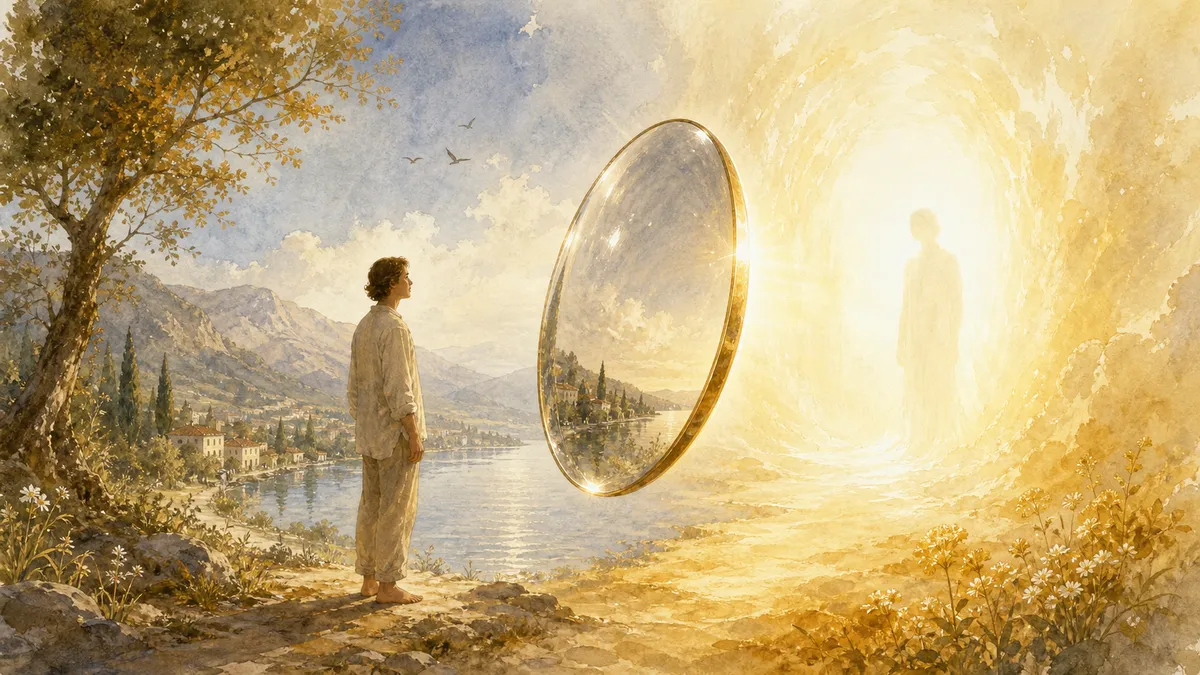
The teaching in this case is something that makes us see this mirror and learn how to rotate it correctly so as to derive benefit for ourselves and our life. The spiritual teacher is a kind of master of adjustment, a calibrator of this mirror, who helps regulate its angle of rotation.
The Practical Path of Unblocking Intuitive Awareness
So, how can one connect one’s perception and intuitive awareness with the higher “Self”?
As long as a person does not engage in spiritual practice, his buddhi (the channel of intuitive awareness) is blocked by the continuous stream of impressions coming from manas (the conceptual mind). Therefore, it is very important to unblock this channel of intuitive awareness.
Unblocking occurs through the pacification of the sense organs (indriyas) and the observance of elementary yogic principles, when we begin to control our anger, emotions, sexual life, diet—that is, through the manifestation of the simplest self-discipline. Until we have a certain potential for self-discipline, we will not be able to regulate the activity of the sense organs (indriyas), and therefore the buddhi channel will not open.
And when our sense organs have been sufficiently brought under control, the next stage begins—the purification and pacification of manas. Manas, as we have established, is the conceptual mind, and the property of the conceptual mind is evaluation, making judgments, and constant movement. For example, if you analyze your consciousness, you will see that thoughts are constantly being generated in your consciousness, and they have no end.
And you have two ways to build a relationship with these thoughts. The first way is to identify yourself with these thoughts and look at the world through thoughts. The second way is to self-liberate thoughts, not to follow them, but instead to abide in a more subtle awareness that lies beyond thoughts, to look at the world not through the prism of thinking, but through the prism of non-evaluative, choiceless awareness—intuitive thinking.
The purification and pacification of manas consists precisely in detaching one’s perception and separating this mirror, that is, intuitive awareness, from thinking itself. Until we have learned to separate the mirror of intuitive awareness (buddhi) from the conceptual mind (manas), we remain in great confusion, because thoughts mislead us. Any theories and concepts very strongly change our picture of the world. We have no inner center on which we could rely, with which we could develop further.
Acquiring Intuitive Awareness
When, through meditation and the practice of concentration and contemplation, we clearly understand the difference between manas and buddhi, are able to disidentify from thoughts, and become rooted in awareness, then we suddenly understand that intuitive awareness is a colossal treasure that we have discovered within ourselves. It is like a diamond that we have always had but did not see and did not use. Intuitive awareness continuously generates clarity and is its source. It is precisely thanks to this clarity that we can change our destiny, achieve our goals, live happily, and be successful both in worldly life and in spiritual life.
If we have found the channel of intuitive awareness (buddhi), then it is like finding the most precious diamond in our life, and now our entire life changes. We cease to be dependent on objects of the senses, on emotions, and on thinking. We discover the subtlest awareness, which in its essence is very creative, very deep, and which we can now boldly trust.
The Level of the Gods and Their Creative Powers
If we analyze the level of the gods, then the gods are very creative beings; they continuously generate clarity, and their clarity spreads in all directions in such a way that it creates for them a completely favorable, controllable habitat.
For example, unlike humans, the gods govern time and space, are immortal, have no human limitations, and even the smallest detail among them is brought to the highest level. The gods live in such a tunnel of reality where the universe is a kind of bioresonant environment, a mandala; that is, the outer world instantly responds to the volitional impulses of the gods, and therefore, by the power of their consciousness, they can create any reality they wish. This occurs thanks to their colossal clarity.
The gods, having a highly developed buddhi (intuitive awareness), are constantly nourished by their connection with the Higher Self. Thanks to this, they generate clarity and manifest various creative powers: the power of will, the power of creation, the power of maintenance, and the power of destruction, the power of concealment, or the power of manifesting the divine. They can also manifest the power of knowledge, the power of action, and so on.
The gods are much freer than humans.
The Essence of Liberation
If we speak about what the essence of liberation is, it lies in the very word “liberation.” It is the attainment of complete, absolute, total freedom in time, in space, and in actions.
If we take ourselves, human beings, we have not freedom, but limitations, and these limitations are very serious.
Limitations in Time
For example, we are limited by time in engaging in spiritual practice. We do not have very much time, so in a day we can set aside two to five hours for creativity and our spiritual practice; in retreat, at best, twelve hours. In principle, we are limited by the duration of our life, that is, we have rigid time frames. And one could say that, in terms of duration, human life is not very different from the life of a fruit fly, which lives on average 28 days in its own perception. This is how lack of freedom in time manifests.
But the gods, using their clarity, are very free in time, because time flows differently for them. They can slow it down, stop it; they can live for billions of kalpas. They live in an entirely different vision. For them, psychological or objective time does not exist as it exists in the human world, and therefore they have such a degree of freedom.
Limitations in Space
For example, everyone knows that most of people’s lives are connected with certain territories, and because of this there are many problems. But the gods have no limitations in space, because their consciousness is boundless and possesses colossal creative potential. It can generate as much space for life as desired, and therefore each god lives in his own universe. The gods never live or move in “flocks.” Each of them is a kind of creator, a deity residing at the center of a mandala, a universe personally created by him. It is his own boundless tunnel of reality, which he creates himself precisely thanks to his generative clarity and creative powers. That is, the gods live in their own tunnels of reality, sometimes forming creative alliances.
The gods are also not limited by the powers of action; they can freely manifest the powers of creation, preservation, dissolution, concealment, or manifestation of the divine. They can do all this because their clarity is continuously generated and can attract various universal forces on the basis of knowledge of universal laws.
The Spiritual Path
So, if we analyze it, the path of a living being, whatever religion he may follow, is the attainment of happiness. And by happiness we mean ever greater freedom: freedom in time, freedom in space, freedom in action, freedom in knowledge, freedom in the manifestation of will, and so on. In order to attain such boundless freedom, we overcome all limitations by purifying and pacifying manas.
The difference between humans and gods lies in the fact that the mirror of our mind, one might say, is set at a different angle, not at the proper degree. As soon as we begin to turn intuitive consciousness toward the higher “Self” or toward the Atman, we begin to think like the gods and gradually acquire their vision, and accordingly their powers, gradually freeing ourselves from those limitations that are inherent in us as humans.
Happiness as such does not exist in the human world; in principle, it is impossible to find it in this world, since it has certain limitations. Happiness is always connected with higher worlds. The attainment of absolute happiness means entering into such a vision of reality as is inherent in beings on the levels of higher worlds.
Thus, all this is connected with the purification and pacification of the mind and the activation of the channel of intuitive consciousness.
Penetration into the Atman
When intuitive consciousness is activated, its penetration into the supreme abode, into the Atman, takes place. That which is called the great or universal Foundation, God, the supreme Source, the Creator.
Penetration into the Atman means a radical change in karmic vision, the elimination of subject-object perception, and the complete overcoming of duality.
Until intuitive consciousness has merged and dissolved into the higher “Self,” even possessing the powers of the gods means nothing; even attaining physical immortality is not yet complete liberation, since limitations within duality, subject-object perception, still remain. And it is said that samsaric gods, even while living excellently and having many freedoms, are inferior in degree of freedom to the great rishis, holy yogis, and siddhas, since they are still, after all, within duality.
Thus, final liberation or the ultimate conquest of freedom is penetration into the higher “Self,” the merging of individual and intuitive consciousness with the Absolute.
When merging with the Absolute occurs, the individual “I” loses its illusions and false self-identification.
We all have a certain identification, for example, “I am I.” From the point of view of Advaita, this identification is a kind of illusion, a delusion, similar to a dream. Penetration into the absolute Truth consists in acquiring a new self-identification: “I am not the ‘I’ as a limited human being, but Brahman, the Absolute, God, the supreme Source.” When a new self-identification arises, all our old ideas and all our karmas begin to gradually disappear, to dissolve.
Liberation from Karmic Debts
From the beginningless past, we have accumulated quite many karmic debts and obligations. We all have certain karmic debts. These are causes and effects that stretch from the beginningless past and determine our present destiny. Our present destiny is only a small interval, a small chain, a small link in the great chain of causes and effects; these causes and effects were created over many thousands of rebirths. And quite many karmic debts have been accumulated: this may be a debt to the ancestors, to the spirits of the lineage, a debt to the gods connected with the performance of ritual offerings and prescribed activities, a debt to those whom we loved, to subordinates in service, a debt to animals that we ate not only in this life but also in past ones.
We have established many connections, and these connections have not disappeared anywhere. Our subtle body, at the level of the collective unconscious, at the level of archetypes and the causal body, holds all these debts in memory; they are all stored for the time being until they are realized and manifest in this life.
Sometimes it is very interesting to trace the various chains of manifestation of past incarnations in this life. Causes and effects manifest in a very complex way in this life. And everyone has accumulated enough such debts. It is considered that an incredibly great amount of time is needed to purify them. But the ancient rishis assert that all debts come to an end with penetration into the Atman and the realization of non-duality.
As soon as we unite intuitive consciousness with the higher “Self,” all these debts are annulled. It is like a person who lived in limited circumstances, but suddenly a messenger arrived and brought news that he was the son of a king. As soon as he realizes himself to be the son of a king or a prince, any claims or debts are automatically removed from him.
Contemplative Presence
Penetration into the Atman, from the point of view of Laya Yoga, is realized at the moment of a deep experience of contemplative presence.
Contemplative presence means that we are in vigilant naked awareness and discover within ourselves the subtlest layer of this intuitive awareness. When we discover it, we relax in it, let ourselves go, and little by little begin to trust it.
The discovery of this intuitive awareness and entry into contemplative presence is like the unveiling of a certain subtle melody within our consciousness that we had not heard before, but now have learned to hear. It would seem to be a very insignificant subtle melody; nevertheless, it changes everything in our life, and gradually we acquire a new vision of the world. Thanks to the direct introduction and explanation of the master, we gradually learn to work with this intuitive consciousness; it gains strength, and we begin to trust it.
There is detailed instruction on working with this intuitive awareness. When we comprehend the teaching, of course, it is very important to know these instructions and be guided by them.
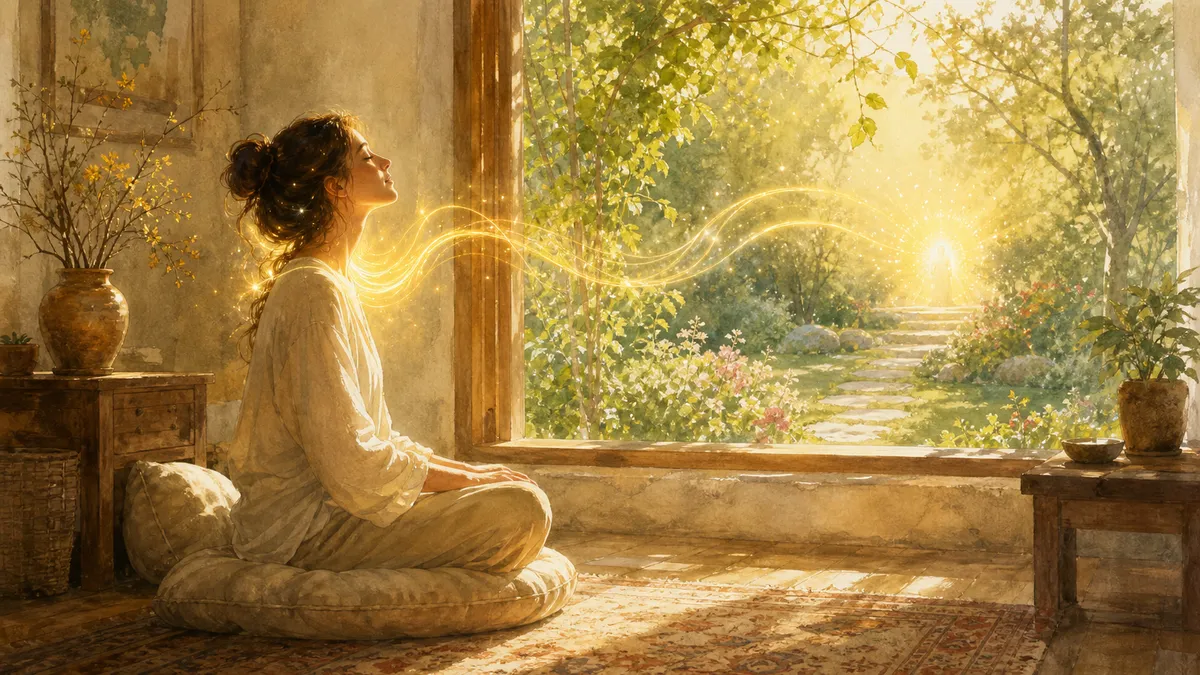
At the upcoming retreat, we will examine the teaching on the sixteen stages of the development of the moon of inner awareness. These are the sixteen steps in the arising and nurturing of presence up to the highest final stage — the transition into the status of Brahma, the creator of the universe.
At first, intuitive awareness is very subtle for us. It is something like a sprout that we must carefully cherish and nurture. But little by little it gains strength. Whether it manages to gain the necessary strength to accomplish the transformation and the “great transition,” or whether we will need to carry our practice over into the next life, depends on how we practice, behave, and study.
Five Ways of Spiritual Practice
In general, it is said that there are five ways of spiritual practice.
There are two worst ways of spiritual practice.
The most unfavorable way is when you practice and suffer harm from spiritual practice. Such practice, of course, should not be undertaken. For example, you make some mistake, violate the principles, and the universal forces punish you; your whole life is spent in problems.
The other worst way is to practice but still receive no benefit whatsoever. This means that you exert a great deal of effort, but fundamentally fail to understand something, and the truth eludes you despite your efforts.
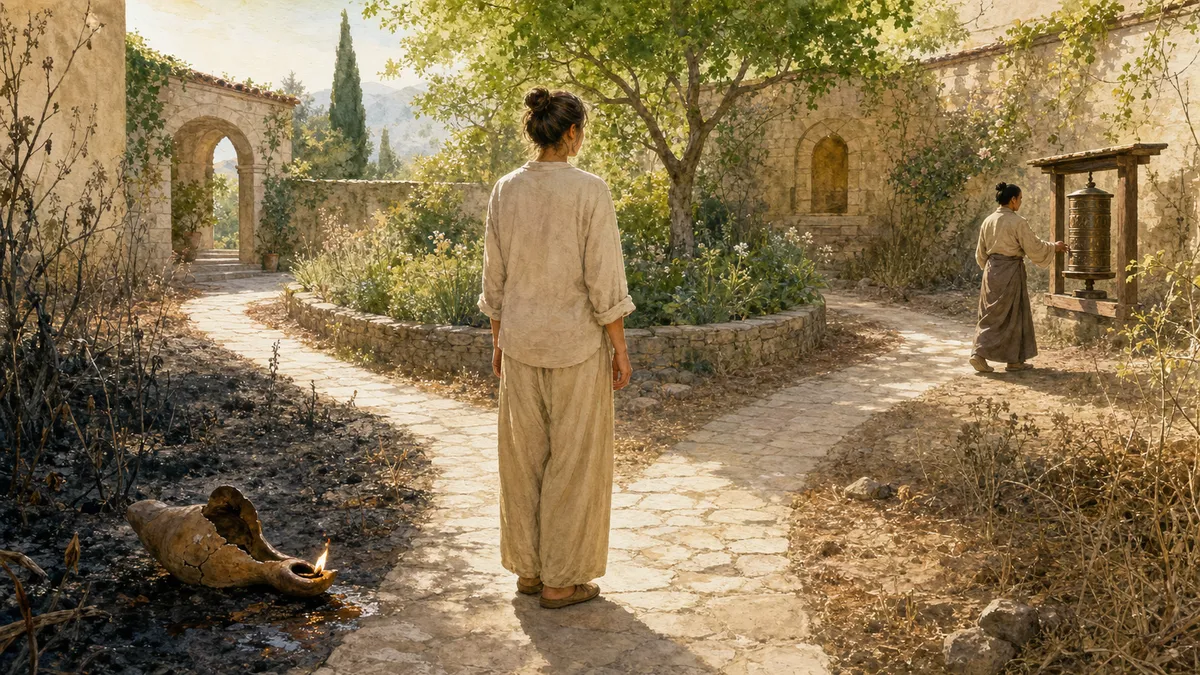
There are also two average ways to practice the teaching.
One can practice so as to receive a small benefit, that is, you practice, but the benefit from it is not great. For example, through practicing the teaching you can develop clarity, and it can help you become wealthy, build a worldly career, and gain great weight in society. I know practices that are guaranteed to produce one-hundred-percent results. If you practice them diligently, you can advance very seriously up the social ladder, but from the point of view of the teaching, the benefit from this is small; that is, it is not what the teaching could actually give. In other words, by practicing certain repeatedly tested methods, anyone can raise their social and material status to the highest level; nevertheless, this is called a small benefit.
One can practice so as to receive a great benefit from the teaching, that is, to attain a higher rebirth, not to be born in the next life in the human world, but to be born in the pure lands in the world of the gods. For example, in Shvetadvipa, in a pure divine dimension where living beings do not have bodies of flesh and blood, do not drink or eat, where living beings have an aura like a thousand suns, where they continuously meditate on the Absolute in the form of a particular deity. Shvetadvipa is the famous prototype of what we call Shambhala, Belovodye, the White Island.
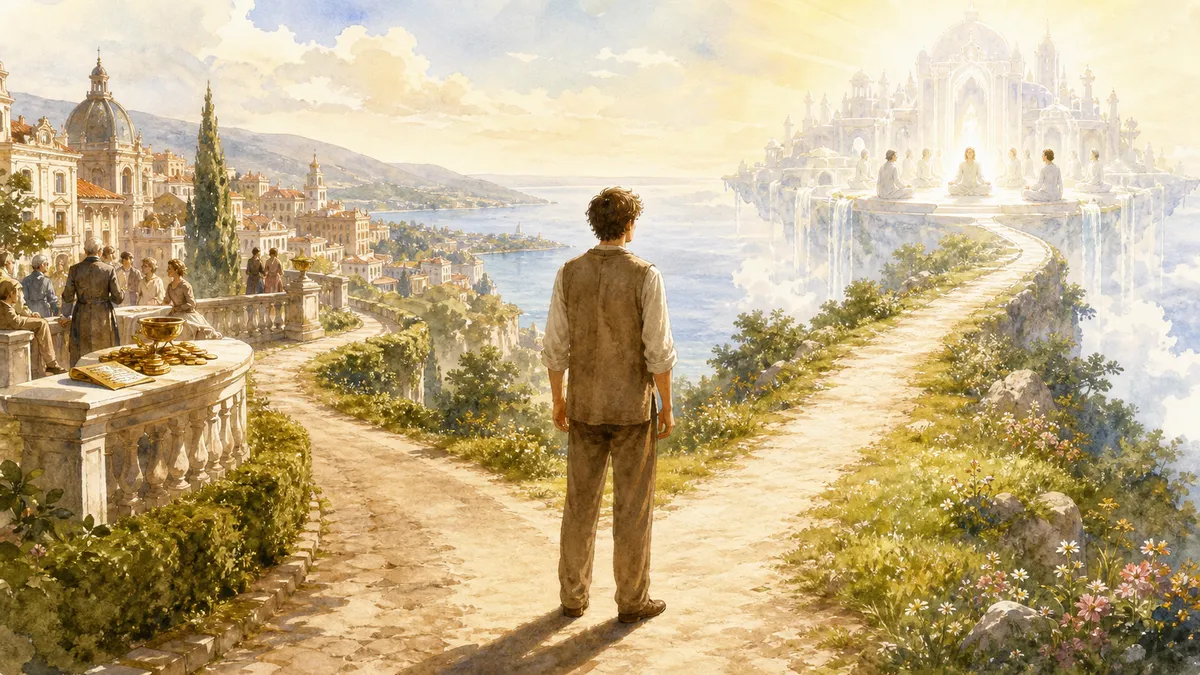
The earliest information about this is found in the text “Narayaniya,” which is a component part of the epic “Mahabharata.” This is a very important text for us, which describes the ability to be reborn in the pure lands. Rebirth in such pure lands is a very great attainment, granted only to outstanding saints, rishis, and sages.
Once, certain rishis, through very diligent asceticism and spiritual practice, were able to reach Shvetadvipa. There they saw living beings who did not greet them because they were absorbed in contemplation of a divine being whose golden aura was so enormous that it filled the entire world on that island. The living beings on that island were themselves like gods and had an aura like sunlight. They were so immersed in contemplation that they did not even notice the ancient rishis. And when the rishis arrived at Shvetadvipa, they greeted Nara Narayana — the central deity of this world, one of the incarnations of Vishnu (the primordial creator of the universe). And Nara Narayana said:
“Through your practice and merits, you have been granted the honor of coming here, although this is very difficult. Only very holy souls who have completely purified themselves can reach this world.”
And when these rishis beheld the darshan of Nara Narayana and received a profound experience of awareness, they were then told:
“And now return back. The time has not yet come for you to remain here for long; the power of your spiritual consciousness is not yet sufficient for you to stay here. In five hundred years you will be able to come here again.”
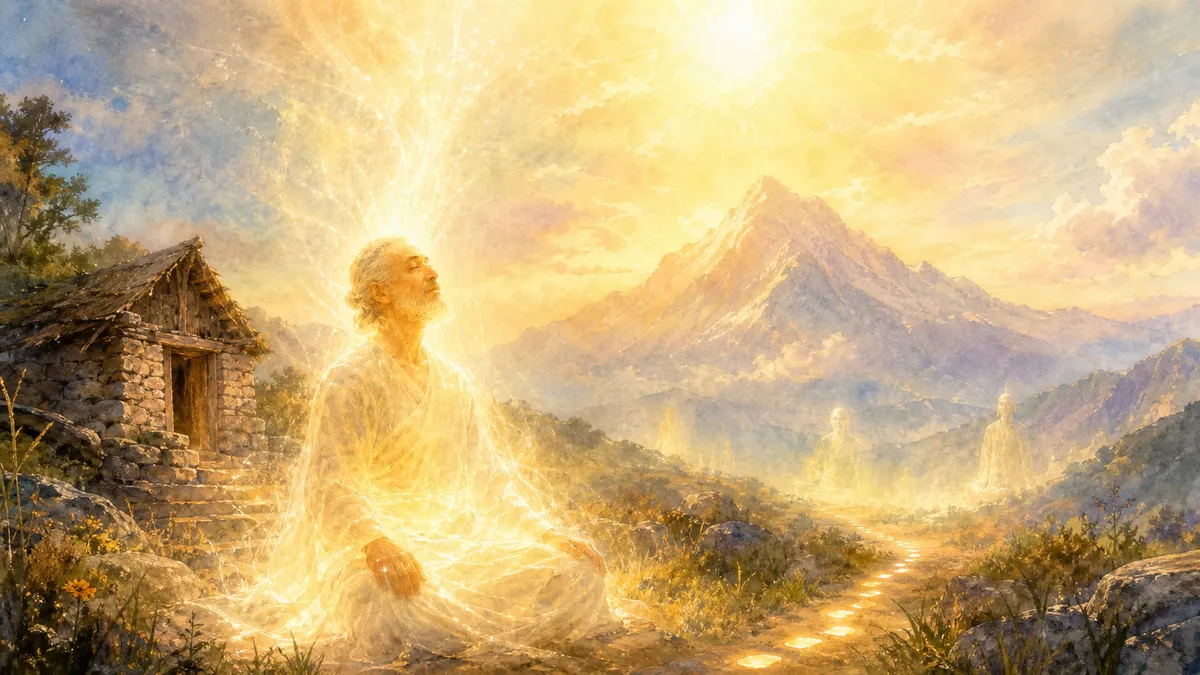
Finally, the very best way of spiritual practice is to practice in such a way as to receive the highest benefit. What is the highest benefit? It is the attainment of complete awakening, when, while still alive, the body is transformed into light. It is the attainment of complete merging with the Absolute, becoming a deity like Brahma the Creator. In other words, to attain the highest benefit is to repeat the path of Janaka, Shuka, Milarepa, and other enlightened sages.
Four Statuses of Yoga Practice
In order to carry out these five ways of spiritual practice, there are four statuses in which one can practice yoga: householder, monk, hermit, and avadhuta.
A householder practices in his own circumstances, exercising awareness and practice in the way that is convenient for him, seeing the world as a field for the awakened play of awareness.
A monk lives by practicing according to certain principles, devoting a great deal of time to spiritual practice, humbling his own “I,” and dedicating a great deal of time to the teaching.
A hermit completely abstracts himself from any communication, from the entire world, living in a secluded cell, and devotes his time only to the practice of personal meditation and contemplation.
Finally, an avadhuta observes no principles whatsoever. For him there are no laws, no statuses. He is like a cloud that flies wherever it wishes, or a bird that is in one place today and another tomorrow, or a holy fool who is beyond human norms.
For example, Dattatreya was the greatest of the avadhutas. Sometimes he was the embodiment of orthodoxy itself, observing Vedic rites and rituals. Sometimes he was a very inappropriate person. Sometimes he appeared to be a worldly scholar, sometimes a king, and sometimes both at the same time. No one could understand him.
And when one young brahmin, outraged by Dattatreya’s incomprehensible behavior, asked:
“So who are you? To which caste do you belong? To which status do you assign yourself: brahmin, kshatriya, vaishya, or shudra? At what stage are you: grihastha, brahmacharya, vanaprastha, or sannyasi?”
Dattatreya said:
“I am at the fifth stage, which is mentioned nowhere, yet permeates them all. This stage is called ‘complete freedom.’ I fulfill the Vedas, but not as people fulfill them; I fulfill them on a higher level. Today I become like an ordinary person, and tomorrow I travel through the Sun and the Moon. Today I may eat meat or drink wine, and tomorrow I drink molten metal. I am beyond human limitations, therefore my stage is the fifth.”
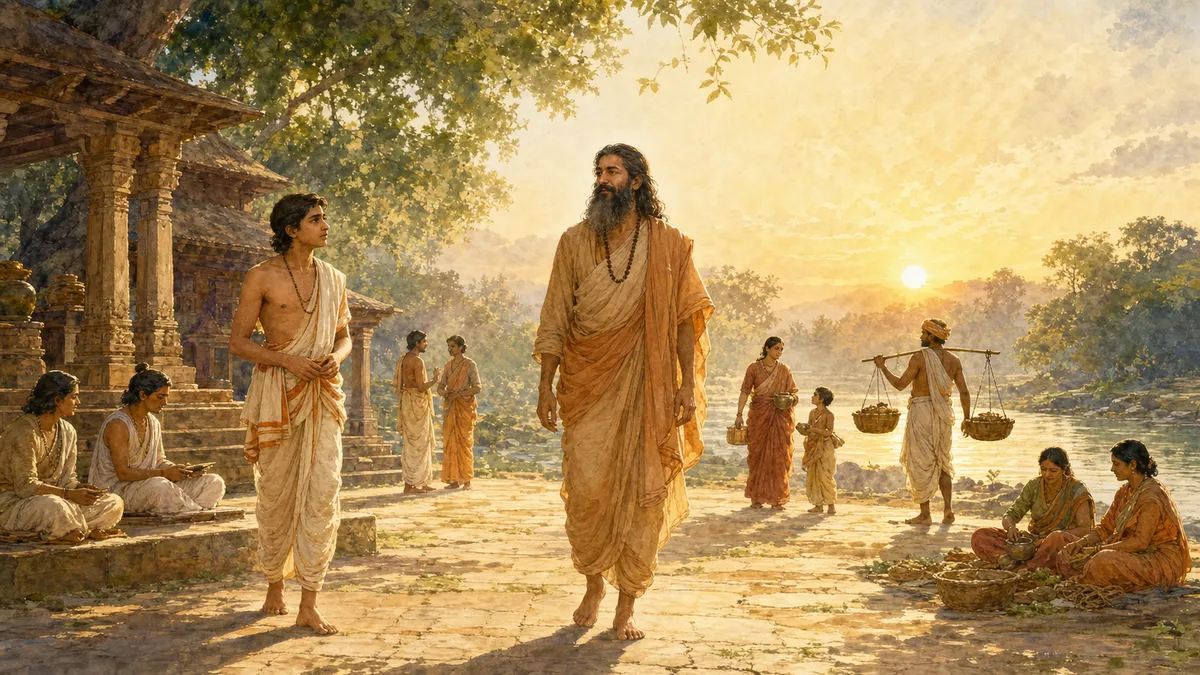
Regardless of what choice we make (whether to be a householder, a monk, a hermit, or whether we have the ambition to become an avadhuta), spiritual practice is essentially similar.
The Descent of Anugraha-shakti
Thus, after penetrating into the Atman, we realize the state of non-duality, and the next stage, logically, consists in not making this non-duality static, but in bringing it down into the lower layers of mind and matter. This is called the descent of Anugraha-shakti, that is, the descent of the light of the Atman into intuitive consciousness (buddhi), into the conceptual mind (manas), and into the elements.
If up to this point the process of spiritual practice was an ascent, a rise into non-duality and dissolution in non-duality, now everything is the opposite. Now the task consists in descent, when the primordial clear light of the Absolute begins to manifest its grace (Anugraha-shakti, shaktipatha), when it now begins to descend into the yogin’s stream of consciousness.
Saint Kabir said this about it: “At first I sought God. But it turns out that God was seeking me.” He also said: “At first the drop fell into the ocean, and now the ocean descends into the drop.”
At the stage of shaktipath, or Anugraha Shakti, spiritual practice ceases to be an effort and becomes an effortless play. Absolute awareness now unfolds and begins to descend.
After the descent of light into intuitive consciousness, into the conceptual mind, at the next stage it descends into the tattvas, that is, into the elements of the body, and dissolves them.
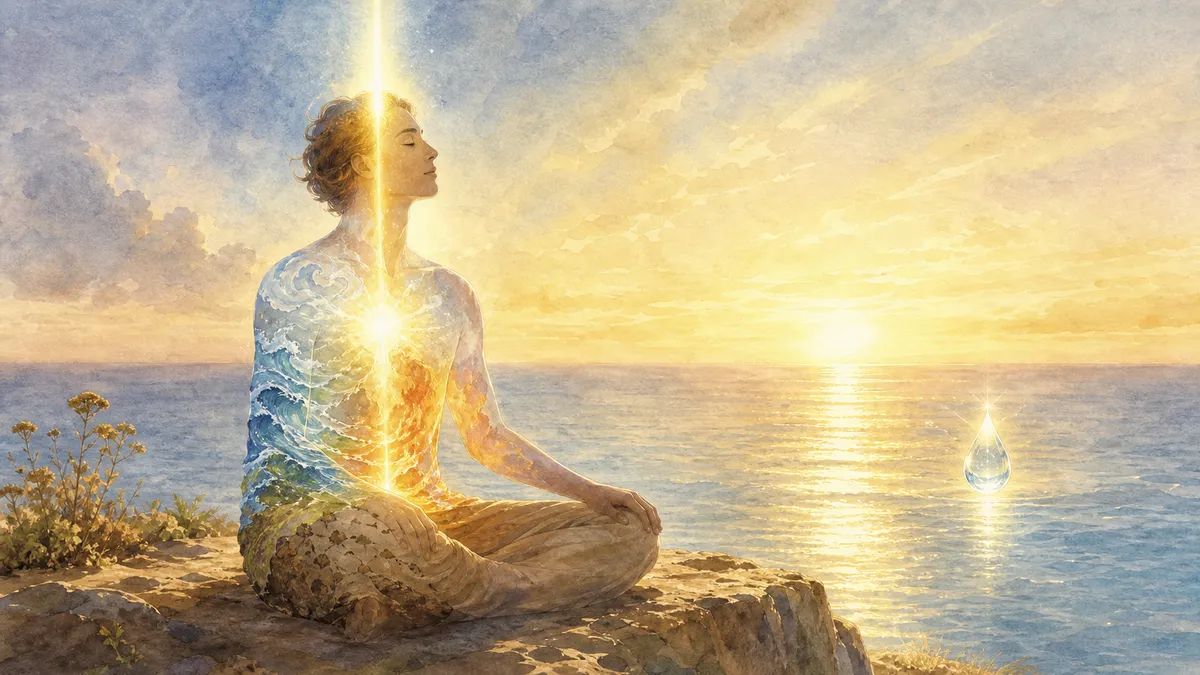
When such a descent of light reaches its culmination or power, the creation of a new body and a radical transformation take place, a transition into another dimension, into pure vision.
Such a logic of spiritual practice was demonstrated by all the outstanding saints of the tradition of the nine Naths, the eighteen Tamil Siddhas, and the eighty-four Mahasiddhas.
Efforts on the Path
Commentary on the Text “Tripura Rahasya”
In the process of practice, we apply our will (iccha shakti). Whether we are able to go through this process, or whether we fail to do so, depends precisely on how correctly we make efforts and apply our will.
In the “Tripura Rahasya,” Dattatreya, conversing with his disciple Parashurama, describes how to apply the will correctly in spiritual practice. In general, the “Tripura Rahasya” as a text is one of the root texts in the teaching of Laya Yoga. We have also now received new translations of important texts of the teaching, such as the “Yoga Vasistha” of the holy rishi Vasistha.
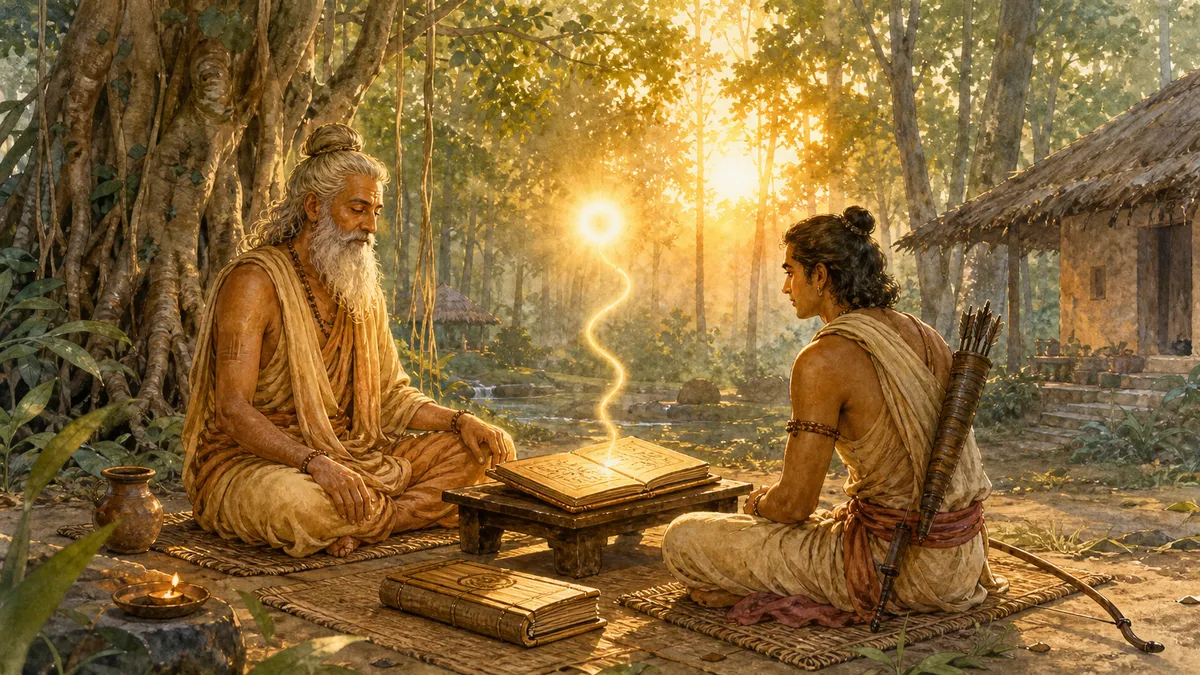
The “Tripura Rahasya” is a text that appeared as the result of the instructions of the holy Dattatreya to his disciple Parashurama, who is considered an incarnation of the god Vishnu. Parashurama came to Dattatreya in a very depressed state of mind and a broken state of spirit. The fact is that before this, Parashurama had launched a grand war against the kshatriya caste and destroyed their class twenty-one times. He would find kshatriyas, enter into battle, and destroy them, and then go into the forest, fast, and repent. But then he would be told: “There are still kshatriyas over there.” And he would again come out of the forest and begin to kill them. Then he would again repent, go into the jungle, and take a vow to become a renunciant sannyasi. Again he would be told: “Over there, descendants of the kshatriyas still remain. They are once again plotting intrigues against you.” And he would again gather an army and destroy them with terrifying force. Thus this happened twenty-one times throughout the entire territory of the ancient land of Bharata, until the lineage of the kshatriyas ceased to exist. It is believed that the present-day descendants of the kshatriyas in India are not true kshatriyas, but descendants of brahmins by kshatriya wives; that is, they were all conceived by a brahmin, since all the male kshatriyas had been destroyed by Parashurama.
Parashurama was a brahmin by origin, but by his own qualities he was a mighty warrior-mage possessing enormous magical powers. And he launched the religious battle against the kshatriyas, the warrior clan of Vedic civilization, because a king of the kshatriya caste had insulted and destroyed his father, a sage named Jamadagni.
It all began when one of the kings of the kshatriya clan, while hunting in the jungle, found the sage, Parashurama’s father. Subsequently, a quarrel arose between them because of the king’s arrogance, and in the end Parashurama’s father was killed. Parashurama could do nothing to prevent this, since at that time he was far from home. Returning home and seeing his father’s beheaded body, he swore an oath to eradicate the entire arrogant lineage of the kshatriyas, using all his brahminical might for this.
Thus, after all these long battles, Parashurama came to Dattatreya in a completely broken state, pleading with him to guide him onto the path of truth and free him from the heavy karmic burden he had incurred.
The entire “Tripura Rahasya” is a mystery beyond duality. It is an unfolding dialogue between Dattatreya and Parashurama, in the course of which Dattatreya gives him various instructions, using stories and parables, gradually leading him to the practice of contemplation. And in the seventh chapter he says that the highest goal is attainable only through the acquisition of faith, through effort, and through the tested logic of the spiritual path.
Dattatreya says:
“Parashurama, you must show great zeal on the spiritual path. If you merely philosophize and spend time in fruitless discussions, you will not be able to realize the highest goal of your life, about which you are asking. You need to set about attaining this highest goal of life. If you show your aspiration through diligent efforts, you will not fail. Through personal effort alone people earn their food, the gods obtain their nectar, devout hermits attain the highest bliss, and others fulfill their desires. If you do not undertake something, if you do not make certain efforts, you will fail.”
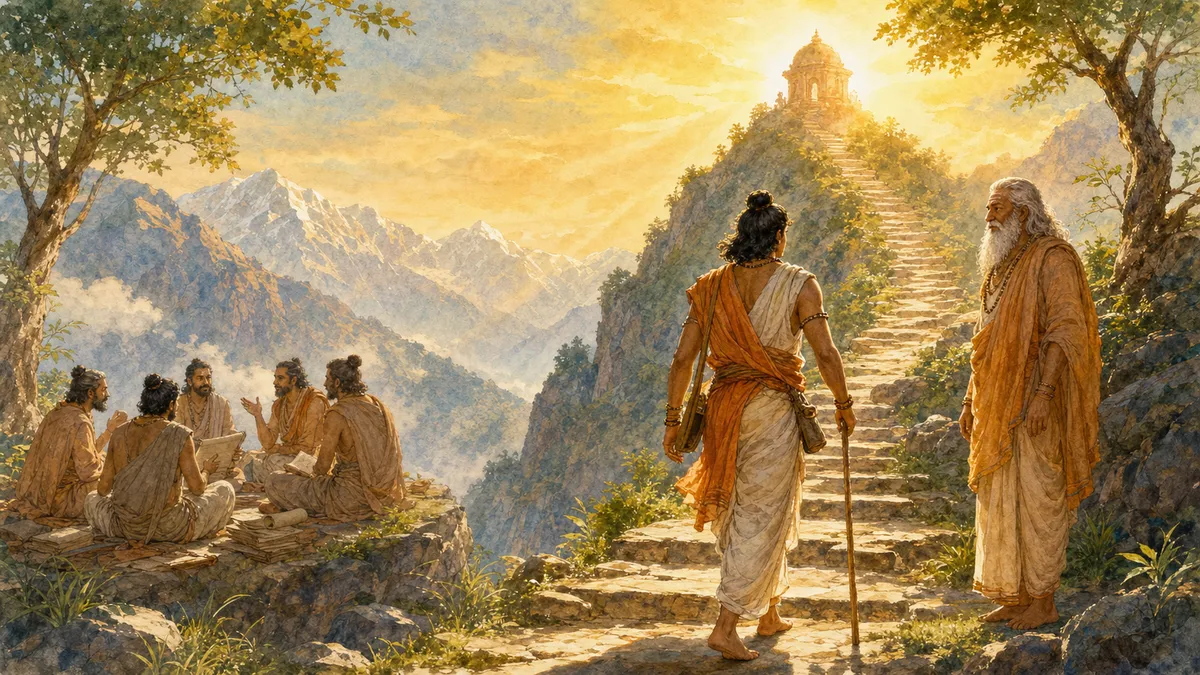
It happens that isolated unsuccessful cases lead a person to lose faith in individual effort. But if he loses faith in his “Self” and in his efforts, then this is undoubtedly a curse, a failure in destiny.
And Dattatreya says to Parashurama:
“By making personal efforts and showing diligence, you must find your path to freedom. Choose the path that is suitable for you, and make the necessary efforts.”
Spiritual practice begins with our making efforts.
Effort is connected with will. In the teaching, will is called “iccha-shakti.” This is a certain force that we can manifest or not manifest. It is precisely with the help of iccha-shakti, with the help of effort, that we conquer the space of our freedom. With the help of iccha-shakti we change the picture of the world, we change our universe in which we find ourselves into a higher dimension; that is, we move into the higher dimension of the gods, into the mandala.
A great many of those who have heard about the teaching of Laya Yoga consider it a path of non-application of effort and, having such a superficial understanding, think: “This is wonderful! This is exactly what I was looking for.”
Bhagavan Shree Rajneesh, once speaking about his teaching, called it “exalted laziness.” And I heard one person, after reading these words, say: “This is what suits me! All my life I have been thinking precisely about such a teaching.”
But when we speak of the path of non-effort and the path of non-action, there is a great deal behind this; it is not all so simple. The fact is that will (intention) can indeed manifest from two states: from an effortless state and from a state of effort.
Nevertheless, it always manifests, because energy (shakti) is an inseparable part of our life. And if we do not manifest it, then, accordingly, we will change nothing in this world. And to manifest it is not bad. To manifest it does not mean to leave non-action, to lose effortlessness in presence.
The cornerstone in the practice of contemplation is indeed relaxation, effortlessness, and letting go. This is so. Even beginners are told that the natural state cannot be attained by straining, by crumpling up one’s mind, by narrowing its concentration, by conditioning it with methods of practice; that wisdom is beyond any constructions, concepts, efforts, and concentrations. It is something natural that cannot be created, cannot be made a second time. Enlightenment arises as recognition and is not something fabricated. There is even such an expression: “One cannot become a Buddha a second time.” One can only recognize that one is already a Buddha. And this refers to wisdom. Nevertheless, the manifestation of energy, which is always connected with method, is always the manifestation of a certain creative effort, of creative forces (shakti).
If, while abiding in effortless presence, we can manifest such effort, it means that we are manifesting it correctly. Its difference from ordinary conditioned effort is that this effort is a kind of play; it no longer limits us.
In the ordinary state, any effort is tense and always limits us. But efforts manifested from contemplation are a creative act of integrating the natural state and universal energy. If we have contemplative presence, then I can unite it with anything, and if I skillfully unite it with some energy, I can derive benefit from it.
This is precisely why saints and awakened beings attain the rainbow body, the transition to pure lands. They can unfold their potential in such a way as to apply universal forces and transform all their energies into a pure dimension, unlike people and animals who do not know how to manifest their potential and use universal forces.
Thus, Dattatreya says that one must learn to apply the right effort.
The Parable of Hemachuda and Hemalekha
Next, Dattatreya tells Parashurama about the supreme Truth, the Absolute, using the parable of Hemachuda and Hemalekha.
He says:
“Now you must reflect on what the supreme Source is, the single center from which everything arises. Just as a person has the heart as a center, just as the Solar System has the Sun, and the Galaxy has its own center, so too the universe has a single center—the supreme Source. And whether you attain freedom or not depends on how much you establish a connection with this supreme Source.”
In dualistic religions, this Source is called God. The concept of “God” is not entirely appropriate to use in Laya Yoga. Because when we speak of God in the Judeo-Christian tradition, the anthropomorphic concept of “God the Father” immediately arises, sternly gazing at us through the heavens, along with certain personal dualistic relations: “I am a soul, and this is God.”
In Laya Yoga we handle the concept of “God” carefully. We say the Absolute, the supreme Source, primordial awareness, implying that we invest a somewhat different meaning in this term—the concept beyond subject and object.
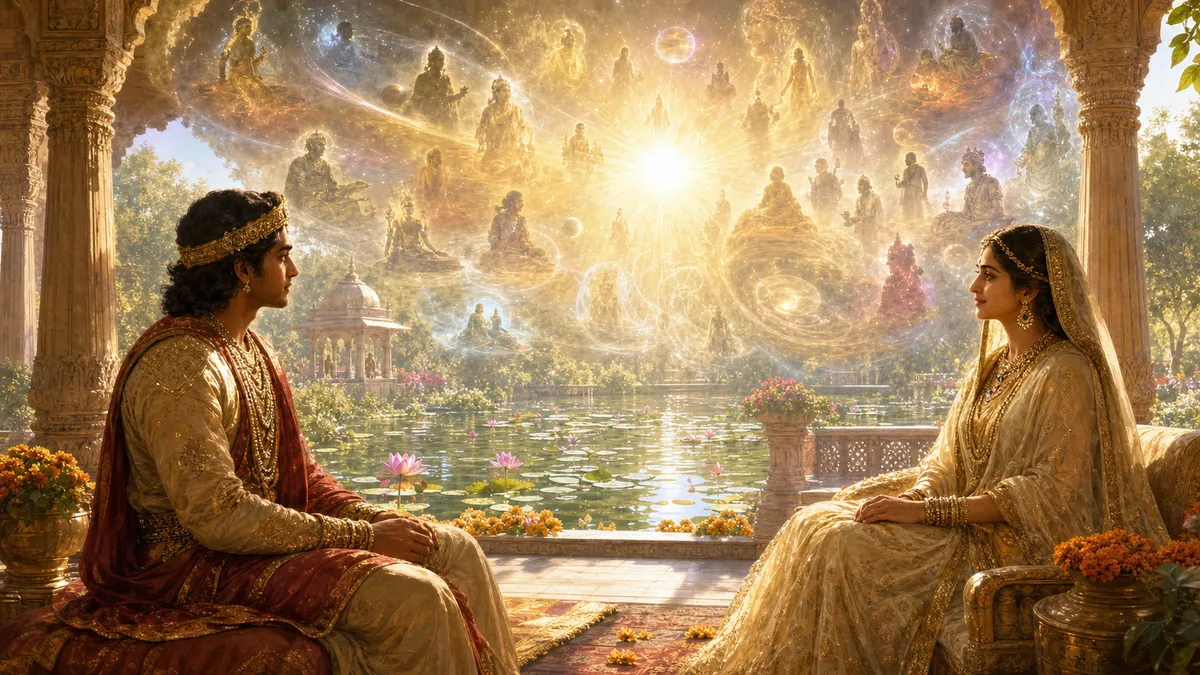
Thus, Dattatreya says:
“Hemachuda asked his wife: ‘Tell me, dear one, who is this creator god, single and self-sufficient, who directs the paths of the universe, to whom I must dedicate myself? Some say he is Vishnu, others—Shiva, Ganesha, Surya, Narasimha, or other such avatars. Still others say he is the Buddha or an Arhat. Some claim that it is Vasudeva (the principle of life), Chandra (the moon), Agni (fire), the primordial nature, and so on. All philosophical schools offer different versions of the origin of the universe; tell me which of them is the truth.’”
Dattatreya tells Parashurama the story of King Hemachuda, who asks a question of his enlightened wife, Queen Hemalekha.
Hemalekha answers him:
“Listen, God is the all-seeing one who generates, pervades, sustains, and dissolves the universe. He is Shiva, he is Vishnu, he is Brahma, he is the Sun, he is the Moon, he is the One whom the representatives of various Vedas call in their own ways. He is not exclusively Shiva, nor Vishnu, nor Brahma, nor exclusively anyone else and the negation of everything else.”
When we engage in the purification of the mind, in self-inquiry, we ultimately come to what is called God. When our sense organs (indriyas) are subdued, the mind (manas) is purified, intuitive consciousness (buddhi) is opened and turned toward the higher “I,” we begin to discover that our higher “I” is one with the supreme Source, that in the depths of ourselves there is God, that this God is we ourselves, that nothing exists except God. The task of spiritual practice is precisely to engage continuously in such contemplation, to fall in love with it, trust it, be absorbed by it, and surrender to it completely.
Hemalekha then explains that the supreme Source cannot be defined by any name, designation, or form. If you imagine it as Shiva with five faces and three eyes, or as some other deity, you will inevitably limit it with some cultural, subjective, anthropomorphic impressions. And Hemalekha says that the best way to discover the Absolute, the supreme Source, within oneself is to analyze one’s consciousness, discover the subtlest layer of this consciousness, and become established in it.
Thus, she says:
“Be that as it may, it must be acknowledged that he is pure intelligence; his consciousness is absolute and transcendent.”
In the Vedic tradition, the Absolute is called Parabrahman, from the word “brihan.” The Sanskrit root “brihan” indicates a tendency toward penetration, toward constant expansion.
In the Tantric tradition, God is a feminine personification; she is called Adishakti (primordial energy) or the Great Mother.
In the “Tripura Rahasya,” the teaching is presented more from the point of view of the Tantric tradition.
And so, Hemalekha says:
“Consciousness, intelligence in all its purity, is the absolute Being, the one queen—the goddess Parameshvari, who transcends the three states and is therefore called Tripura. Although she is one indivisible whole, the universe appears within her in all its diversity, reflected in the form in which it presents itself to us in the self-luminous mirror.”
The three states are the waking state, the dream state, and the dreamless sleep state.
Hemalekha further says:
“If a person is not capable of contemplation or of comprehending the supreme state, he should begin with purifying the mind and worshiping the chosen form of the deity, the form that appeals to him. In this way his mind will gradually be purified, and he will reveal intuitive awareness.”
After King Hemachuda heard from his wife the instructions that the supreme Source is pure intelligence contained within himself, and understood the spiritual practice, he began to engage in it diligently and subsequently attained a very high state of samadhi.
In the same way, I recommend that everyone study the “Tripura Rahasya” as a fundamental textbook on spiritual life in order to clarify their original state.
Of course, the “Tripura Rahasya” is not the only text. But it is one of the magnificent texts that can dispel delusions.
Blessing
It is believed that when we engage in spiritual practice, we receive several kinds of blessings. These blessings are called “kripa.” Kripa is also translated as grace.
Among them, the first kind of blessing is shastra-kripa. That is, we receive the blessing of the sacred text. When we come into contact with any literature of this kind, this is already a sort of magical act of the descent of higher dimensions and their penetration into our vision. And the first level is shastra-kripa, that is, the grace of the sacred text.
The second level is atma-kripa, that is, the blessing of our understanding, of our own “I.”
For example, if, as a result of studying a sacred text, clarity appears within us and some wisdom and awareness begin to arise, this can be called a certain blessing. If you meditated and your meditative experience gave you great inspiration and radically freed you from limitations, then all of this belongs to the category of atma-kripa.
Finally, the third level of blessing is guru-kripa. This is the blessing or grace of the spiritual teacher. It arises after our own mind has already been clarified through the study of the sacred text (shastra-kripa) and through our own reflections and meditation (atma-kripa). Guru-kripa means that the master with whom we have a spiritual connection helps us reveal a much higher level of awareness than we had before. In order to be receptive to guru-kripa, it is necessary to sufficiently purify one’s mind and consciousness, since this is connected with very subtle nuances, with transmission. It is something like telepathic contact. One must be quite sensitive and open in order to perceive what the spiritual master generates. The slightest closedness, the slightest unreadiness or doubt nullifies guru-kripa, breaking the line of spiritual inspiration and spiritual transmission. Since this is not so simple, it is generally believed that guru-kripa occurs after many years of establishing a relationship with a spiritual master. These relationships are called the principle of samaya.
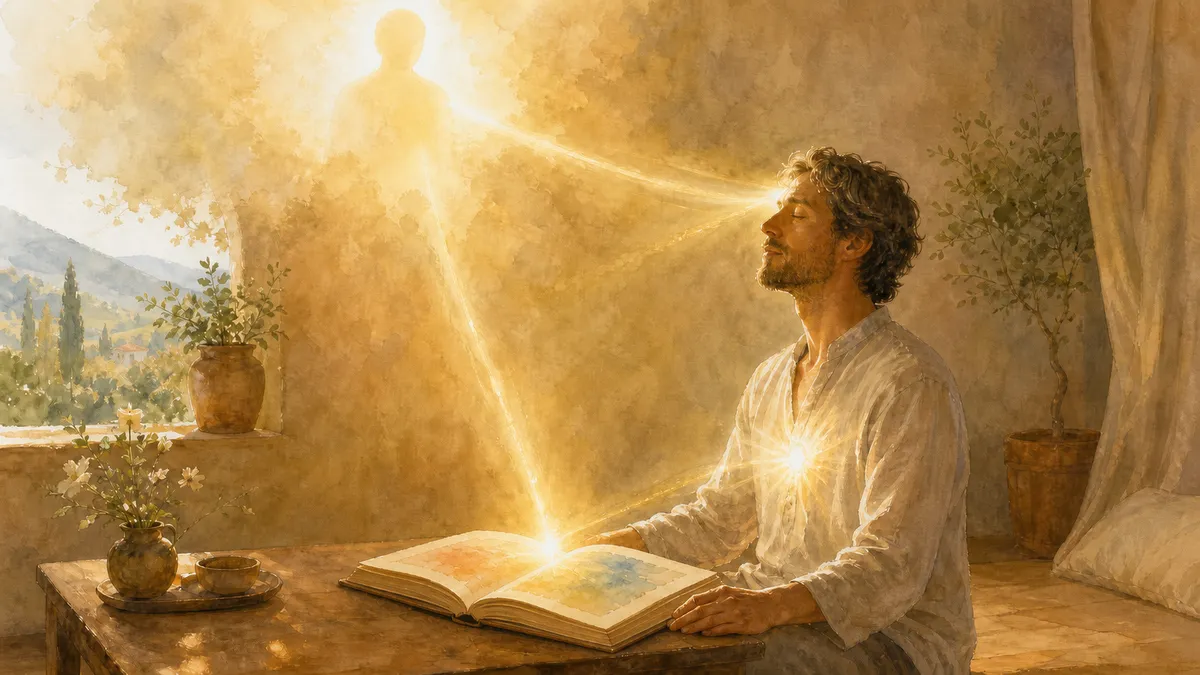
Finally, after receiving the blessing of the spiritual master, the next kind of blessing comes — Ishvara-kripa. This is a blessing that comes from the Creator Himself, the Supreme Intelligence, the Mahapurusha. This is when your own “I” begins to bless you from within, and at this point spiritual practice in the conditioned state comes to an end.
Thus, to practice means to receive these four kinds of grace, these four kinds of blessings.
What prevents one from receiving these four kinds of blessings? Skepticism, a lack of faith. That is, in general we are positively inclined, but somewhere inside us some little “worm” is gnawing away, and we feel that we are not really all that sure. Skepticism is overcome through quality training. It is similar to the fact that it is impossible to become a professor of quantum physics immediately. When Everett’s theory or Schrödinger’s cat paradox is explained to you for the first time, it will not fit into your head; you will think: “How can that be? A cat is either alive or dead! It cannot be that the cat is both alive and dead at the same time.”
In the twentieth century, physics entered a crisis after Einstein’s theory of relativity was first discovered and Newtonian physics was superseded, and then Einstein’s theory of relativity itself also began to be pressed aside by quantum physics. The fundamental concept of quantum physics is quantum uncertainty. That is, quantum physics says that the world is not as Newton described it in his laws, and not even as Einstein described it. It is even more complex; it is absolutely uncertain. Uncertainty always exists. For example, an electron is both a particle and a wave at the same time. And if a single electron is uncertain, then all objects made up of electrons are also in a state of uncertainty. In this quantum uncertainty, the consciousness of the subject as the observer influences it very strongly.
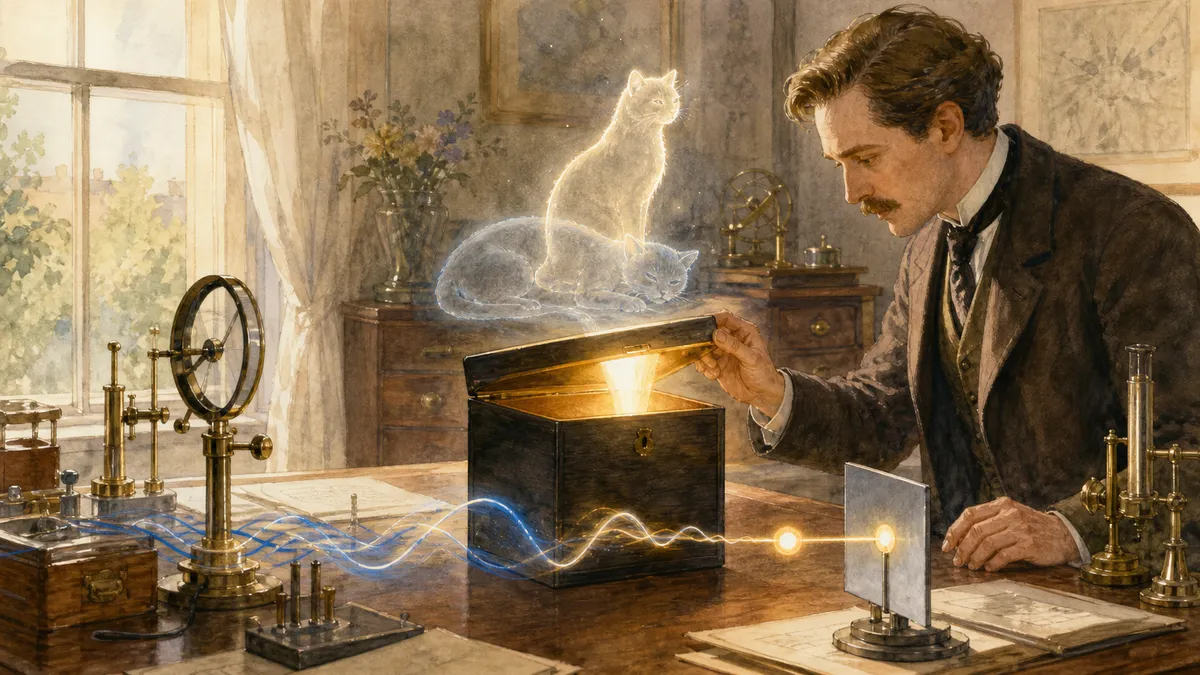
Schrödinger, one of the famous scientists, created the following thought experiment. An electron sometimes behaves like a particle and sometimes like a wave, and it is impossible to predict how it will manifest at a given period of time, but it is possible to record it with some kind of camera. There is a recording plate. Depending on how this plate records it (whether it is a wave or a particle), it will send a signal to an ampoule with poisonous gas that is placed in a black box. A cat is sitting in this black box. If the electron behaves like a particle, the tip of the ampoule reacts to the recording plate, and the ampoule breaks — the cat dies. If the electron behaves like a wave, the ampoule remains intact — the cat remains alive.
And then Schrödinger asked the question: “What will happen to the cat if we place it in such a black box with such a hypothetical ampoule?” The electron is simultaneously in the state of both a wave and a particle; it cannot be said unambiguously that it is only a wave or only a particle. It manifests itself as a particle at the moment of measurement, of registration, but behaves as a wave — this is the position postulated by quantum physics. That is, uncertainty always exists, and therefore when the cat is in the box, you can never say whether it is alive or dead at any given moment.
Physicists say that this is a paradox: the cat is both alive and dead at the same time. And then they say that, in fact, since the electron behaves like a particle only at the moment of registration, this means that we can influence whether the cat is alive or not. As long as we do not measure, as long as we do not open the box, the cat is simultaneously in two states, but as soon as we remove the lid, quantum uncertainty disappears, and the cat will be fixed in only one unambiguous state. Until we have removed the lid, the cat is simultaneously in two states — this is the paradox; it is impossible for the ordinary mind to understand. Skepticism arises: “How can the cat be in two states at once: both alive and dead?” But that is reality! Reality is paradoxical.
Religious truth is the same quantum physics, only on an even deeper level. And naturally skepticism arises in us because there are certain things we are not yet ready to perceive with our consciousness. Skepticism is overcome through quality teaching.
Another main obstacle is karmic dirt, karmic impurities, obscurations; that is, we may wish to practice, but in the stream of our consciousness there are many imprints, obscurations, that throw us off course, and we constantly lose to them. These are called kleshas.
Finally, the third obstacle is a false sense of duty, when we create certain limitations within ourselves through our own notions, when we think that we have certain karmic debts and consider ourselves obliged to repay them.
When we overcome these three main obstacles, we can realize what the holy teachings speak of and receive these four kinds of grace.
