

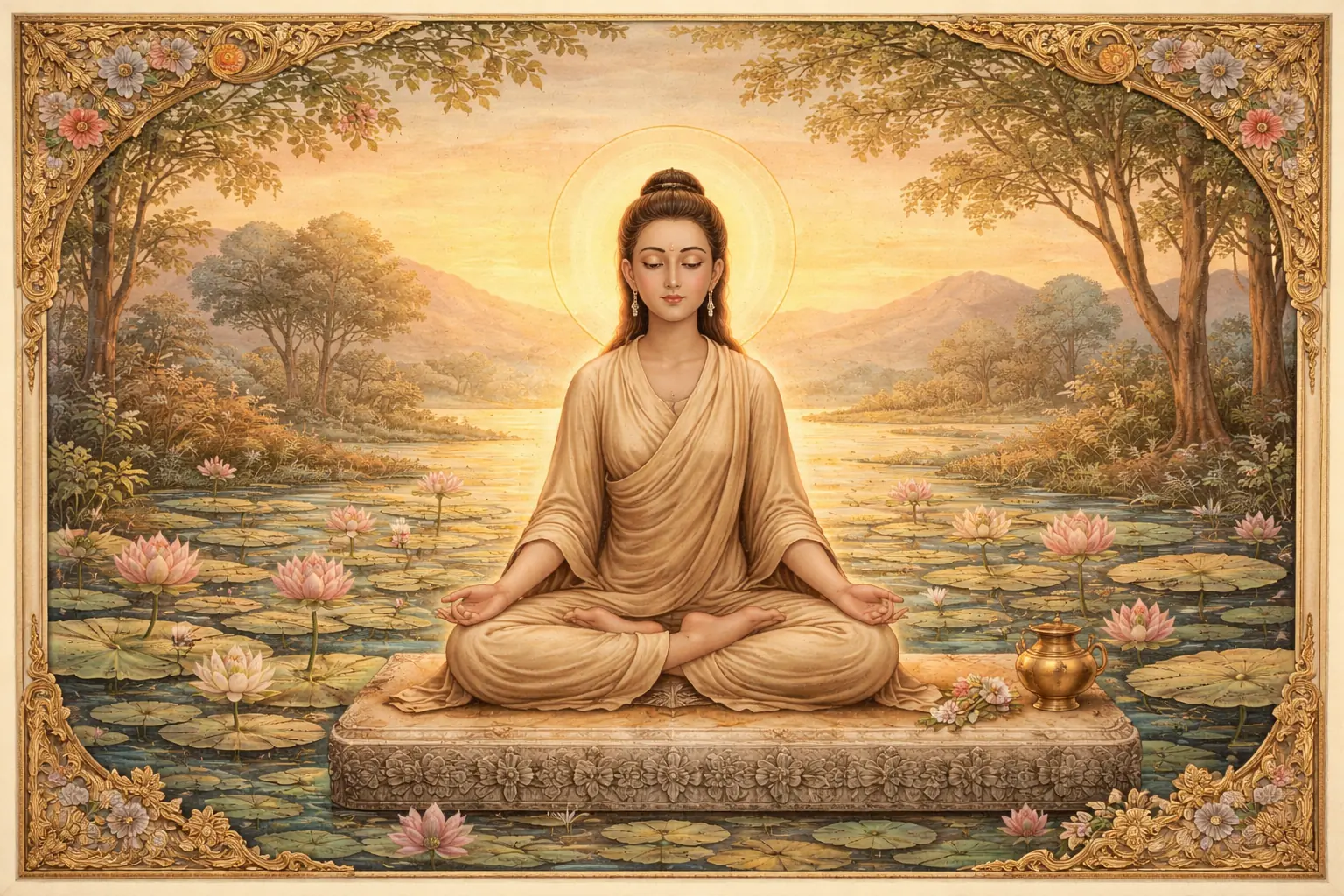
For us, Lakshmi primarily embodies willpower, the power of intention, energy manifesting through the individual—personhood, yogic success, yogic good fortune, and spiritual prosperity. To attain realization, a yogi needs many qualities, and these qualities must mature in the course of practice.
Realization is nothing other than the unfolding of one’s own potential, and this potential necessarily manifests as certain qualities. Only when a person is in samadhi, meditating on the unmanifest, does their potential remain, as it were, unmanifested. At all other times, if this potential is truly realized, it necessarily manifests. Thus, on the personal level, a yogi is not someone who displays no qualities whatsoever. Rather, they do not identify with these qualities, perceiving them as the play of the natural state. But the qualities they manifest are necessarily pure, sublime, profound, and noble. It cannot be that a yogi who aspires to liberation and rebirth in the worlds of celestial beings manifests qualities inferior to those of people who do not aspire to liberation at all, harbor worldly desires, and live ordinary lives. This cannot happen in principle; it is impossible, because realization of the nature of Mind presupposes the manifestation of more sublime qualities.
And invoking Lakshmi is precisely the invocation of such sublime yogic qualities.
The Importance of Qualities for Success in Practice
A yogi may often apply methods without achieving success. Why does this happen? Obviously, they simply lack the qualities needed to benefit from these methods. But as soon as they cultivate the proper qualities, all methods immediately begin to yield benefits. It is like a child sitting at the controls of a magnificent aircraft—a vimana or super-starship—and then, no matter what the child does or how magnificent the aircraft may be, they will be unable to get it airborne and bring it to its destination. The controls must be taken by a highly experienced, top-class pilot possessing outstanding qualities, speed, responsiveness, quick thinking, the ability to assess the situation, and strategic and tactical thinking. Once such a pilot takes the controls, the starship will certainly take off and reach its destination.

In the same way, by applying the methods of yoga and cultivating the proper qualities within ourselves, we inevitably reach our goal. This means that, alongside practicing yoga, we should always reflect on cultivating the proper personal qualities. If we lack patience, perseverance, and the aspiration to reach the goal, we may receive the most sublime teachings and transmissions; as the sutras say, our heads may even become flat from the touch of the ritual vessel used in initiations, yet we will still be unable to make use of all these transmissions and methods.
And the principle of Lakshmi is the embodied flowering of qualities; it is spiritual wealth, spiritual success and prosperity, the wealth of wisdom and signs of realization. It is a creative power that manifests in diverse ways.
Creative Consciousness as the Foundation of Sadhana
When we engage in spiritual practice, it is very important to possess such creative power, because sadhana is, above all, an inner creative process. Creativity can be understood as a very subtle process of manifesting playful consciousness. That is, when we reach the level at which consciousness ceases to be linear, unambiguous, and algorithmic. When consciousness becomes playful, flowering, multilevel, non-algorithmic, and non-linear. When consciousness has a multitude of subtle choices and many kinds of reality. When it is in a state of constant bifurcation and branching, at various turning points. When consciousness can operate with different visions of reality and freely enter various reality tunnels; when consciousness becomes multidimensional and stochastic—that is, not ordered but probabilistic. It is precisely this kind of creative consciousness that is the consciousness of the contemplative. It is the same as non-conceptual awareness; it is simply that we do not usually elucidate the principle of non-conceptual awareness.

Logical, conceptual awareness is linear thinking rigidly conditioned by sequences of events, subject-object relations, cause-and-effect connections, dogmas, and established doctrines. And it can never transcend itself, which is precisely why it is limited. That is, regarding oneself as oneself, the world as the world, and dualistic relations as dualistic relations—this is linear thinking. Non-conceptual awareness, on the other hand, is non-linear thinking. And as soon as we reach the level of non-conceptual awareness, we immediately discover its incredible creative potential, its non-algorithmic nature, and its paradoxicality. Such awareness is not linear but probabilistic; it possesses multidimensionality. And when we are deeply aware, we can choose from a multitude of possibilities within this multidimensionality, manifesting creative power. This primarily concerns sadhana.
And it is precisely this kind of creative consciousness, when applied in spiritual practice, that brings success in spiritual life.
Multidimensionality of Consciousness as a Sign of Realization
This means that you possess such wisdom, clarity, and sensitivity of awareness that you can perceive the highest contours of consciousness. You are sensitive enough to understand the principle of multidimensionality inherent in any situation.
One-dimensional consciousness is characteristic of beings in the lower worlds. For example, one description of the world of pretas says that pretas scrape at the ground in an attempt to feed themselves, but no matter what they do, even if food reaches their stomachs, it burns up, and they gain no satisfaction. It is also said that beings in hell simply “scream” in terror and pain, while animals mindlessly pursue food and pleasure. This is the principle of blind, one-dimensional consciousness, which accepts reality as it appears to be.
Multidimensional consciousness does not accept reality as it appears to be. It can always look at the same reality from many perspectives. Multidimensional consciousness has no unequivocal judgment or definitive assessment of anything whatsoever. An experienced practitioner can indeed speak this way. If you ask an experienced practitioner, “What do you think about this? How do you assess this situation?”, they will say, “It depends on how you look at it. From the absolute point of view, it is like this; from the relative point of view, like that; from a monastic perspective, one way; from a worldly perspective, another. From the point of view of sutra, it is like this; from that of tantra, like that; from that of anuttara tantra, another way; and from the point of view of a non-conceptual approach, it is entirely different. Through the eyes of a rishi, it is one thing; through the eyes of a deity, another; through the eyes of a human being, a third. There are many possibilities here, so let us find a single vantage point from which to look.”

And if you try to become acquainted with the viewpoint of multidimensional consciousness, you will see that a situation can be ambiguous, the world can be ambiguous, a person can be ambiguous, connections and relationships can be ambiguous, and a teaching can be ambiguous. And this ambiguity introduces a certain probabilistic quality, fluidity, and a degree of free will. Why? Because there is no longer a blind acceptance of reality; instead, your consciousness becomes involved as an element of psychohistory, as an authoritative operator. You understand that reality is not defined unequivocally but depends on how you look at it. It depends specifically on you. When you realize that it depends on you, you understand that this is where your free will lies. And this means that you can choose here, that your creative power can manifest itself here.
Often, when someone tells me about something, “This is how it is,” I say, “That is only from one point of view; from other points of view, it can be seen differently. Things are not so unequivocal when viewed from different perspectives.”
The Principle of Blossoming and the Consciousness of Deities
Such polysemy is precisely the principle of blossoming. Polysemy is the province of deities. When we see deities, they usually possess an element of abundance, of blossoming. They are always adorned with blooming lotuses, or they have many heads, arms, and so on. This does not necessarily mean that they actually have many heads or arms. They are free in their manifestations and can assume any form. Canonical forms are merely specific patterns or matrices in which a particular saint communicated with the deities. But the deities themselves can assume countless forms. Many heads or many arms simply indicate the polysemy and multidimensionality of the deities. Their consciousness is playful, blossoming, multidimensional, probabilistic, and non-algorithmic. They live not at the level of logic, but at the level of paradox, at the level of parasattarka logic—transcendent, intuitive logic of mystical realization.

Such probabilistic, multidimensional consciousness is in itself a sign of a certain level of realization. If you are rigidly conditioned by concepts, you will not even be able to grasp such consciousness. But when you contemplate well and abide at the non-conceptual level, such consciousness gradually endows you with inner understanding. And then the meaning of sacred texts or methods becomes clear to you.
Multidimensionality does not mean that we literally use it as our guide in relative reality. Relative reality has its own laws. Many of them are indeed quite straightforward. But here we are talking about inner reality. If, for example, you are paying for a train ticket, you actually have to do so; you cannot say, “It depends on how you look at it: whether to pay or not, whether it is a ticket or a piece of paper.” You will not get away with such things, because the material world has its own laws. Here, however, we are speaking about inner spiritual reality, about your personal sadhana.
The Multidimensionality of Samadhi and Practical Application
Such multidimensional consciousness expresses the success and blossoming of spiritual life.
This is precisely what the principle of Lakshmi represents—the embodied power of personal qualities and a blossoming, multidimensional consciousness. When you experience samadhi, it is not a single state in which you enter the light and abide in that light. Samadhi is a whole spectrum, a palette of experiences, a polyphony, an entire orchestra. The states of prana, mind, light, non-conceptual awareness, clarity, spiritual insight, bliss in the chakras, foreknowledge of the future, perception of subtle samskaras, darshans of divine beings—all these are different aspects of the palette of samadhi.

Conversely, someone who finds it difficult to penetrate such a multidimensional structure of consciousness often encounters difficulties in practicing a method or in the practice of contemplation. When I analyze the reason for this, I see that such a person approaches the practice too one-sidedly and does not see alternative possibilities. For example, a person has no success in service: they do something, but it does not work out. They try again—and once more, it fails. So they conclude, “This is impossible to do.” But then another person—a mandaleshwar—comes along, slightly shifts the perspective, and says, “Do it this way, and then everything will work out. Moreover, there are eight other ways it can be done.” Why does this happen? Because the first person tried to solve the problem in an overly one-dimensional way. But if they had entered contemplation, applied this creative power of multidimensionality, and looked at the situation from a different perspective, everything would have worked out.
The same applies to yoga and to technical practices. We try to perform some method—for example, anuloma-viloma pranayama or tribandha mudra. There is one approach in which prana accumulates and enters the central channel, and there is a slightly different approach in which we do everything and expend time and effort, but for some reason prana does not accumulate. We experience fatigue and irritation because we practiced for a long time but did not accumulate prana. Our success in practice depends precisely on our ability to look subtly at sadhana or service from a particular perspective.
This also applies to such practices as Chandali meditation, Mahashanti meditation, and so on. This does not mean that we become overly carried away by creativity and invent methods of our own. Naturally, the methods are authoritative and exist within the lineage of transmission; we simply understand these methods exactly as they are experienced by the siddhas and rishis themselves—that is, deeply and multidimensionally. And it is precisely such multidimensionality that leads to awakening and realization.
In essence, multidimensionality itself is already almost realization, because it is the consciousness of a deity or siddha.
