Lakshmi: The Principle of Stable Awareness and Pure Vision
24.08.2026
0 мин. чтения
0
Share
copy
search
add
share
Commentary on the text “Vishnu Smriti,” Chapter 99. Praise of the goddess Lakshmi, goddess of the Earth.
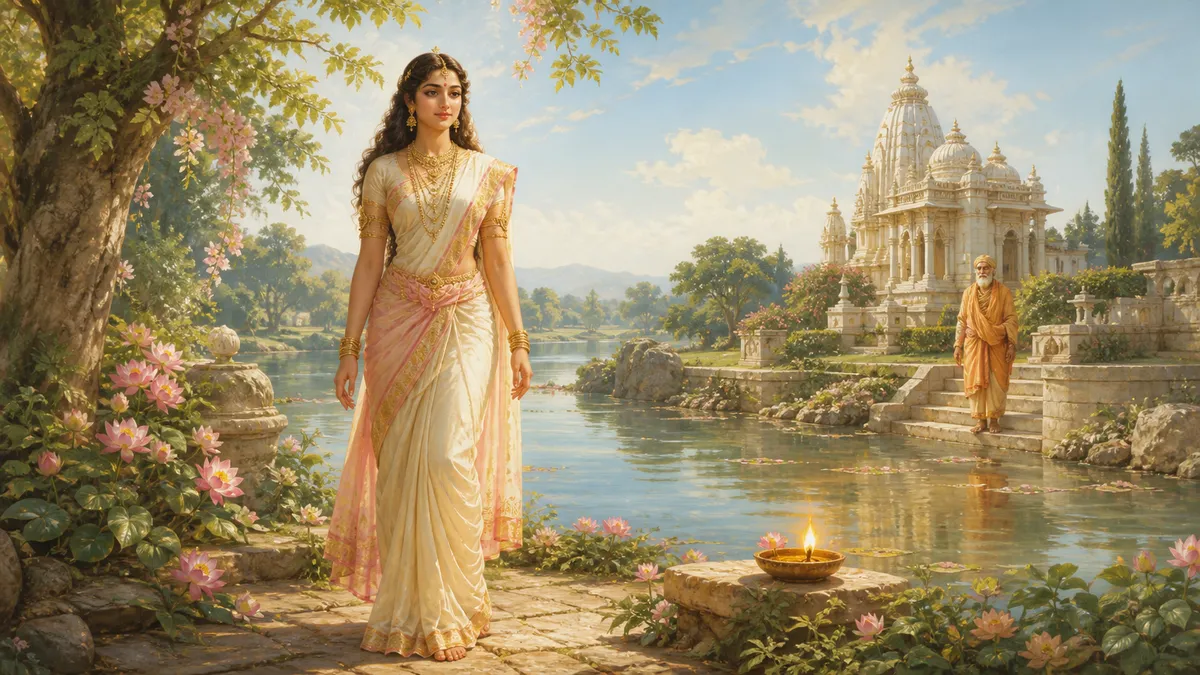
“Seeing Shri, radiant with tapas, embracing the feet of Vishnu, the God of gods, the delighted Earth asked the goddess, who shone with the beautiful color of pure gold: ‘O beautiful one, whose arms are like lovely blossoming red lotuses, who embraces the feet of him whose navel is like a blossoming red lotus, who always abides in a dwelling resembling a blossoming red lotus, whose waist is the color of a blossoming red lotus. O you whose eyes are like blue lotuses, whose skin is the color of pure gold, who are clad in white garments and adorned with precious stones, whose countenance resembles the Moon. Shining like the sun, possessed of great power, O sovereign of the world, you are sleep. You are Lakshmi, sovereign of the world, sustainer of all. You are Shri, serene. You are victory, beautiful, radiant, renowned, mighty. You are Sarasvati, you are speech, O purifier. You are Svadha, you are patience, you are the bearer, you are support, you are awareness, you are the supreme sacrificial consecration, you are righteous conduct, you are the foundation, you are illustrious, you are uncomplaining. You are Svaha, you are wisdom, you are reason. Just as the dark-eyed chosen one among the gods pervades everything while dwelling in the three worlds, so too do you abide everywhere, O bestower of boons; I ask you to tell me of the dwelling place of your majesty.’
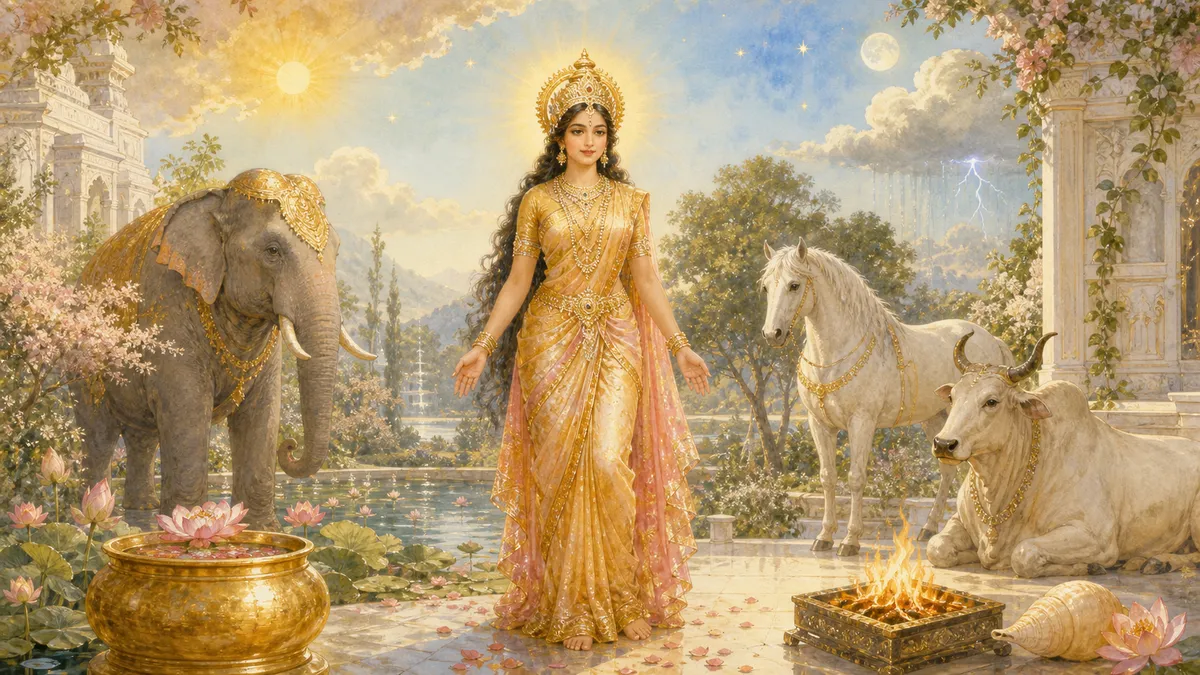
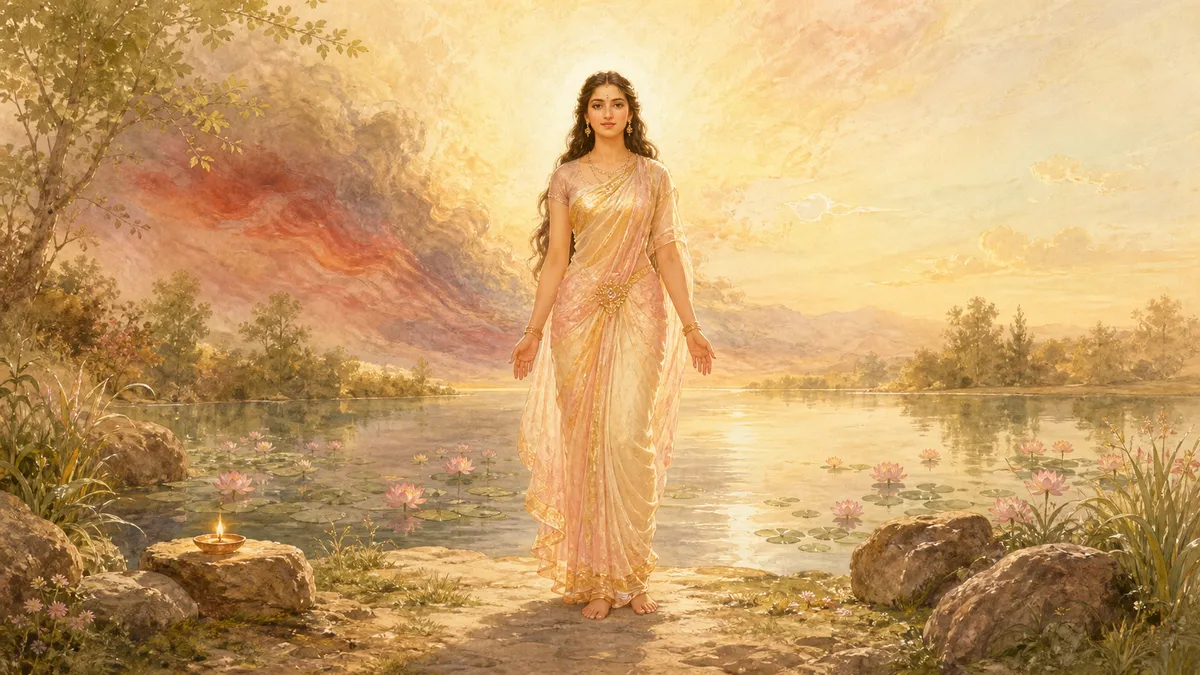
Having heard this, Lakshmi, who was beside the chosen one among the gods, said to the Earth: ‘I always abide beside the god Madhusudana, in his golden radiance. Listen, O sustainer of the world, to where I always dwell in accordance with the command of him whom I remember in my heart and whom the wise call the consort of Shri. I abide in the Sun and in the Moon, in the host of stars, in the cloudless sky, in the rain-bearing cloud, and in Shakra’s many flashes of lightning during a thunderstorm. I abide in pure gold and silver, in brilliant precious stones and garments, O Earth, in rows of white palatial buildings and in temples adorned with flags. I abide in fresh cow dung, in a majestic elephant in rut, in an exultant horse, in a proud bull, and in a brahmin absorbed in the daily recitation of the Vedas. I abide in the lion throne, in the amalaki and bilva trees, in the parasol, conch, and lotus, in the blazing sacrificial fire, in a polished sword, and in a mirror’s reflection. I abide in jars filled with water, in yak-tail fly-whisks, in ornamented fans made of palm leaves, in beautiful golden vessels, and in freshly dug earth. I abide in milk, clarified butter, turf, honey, sour milk, and female forms. I also abide in the body of a maiden, in the gods, in ascetics, in priests, in arrows loosed on battlefields, and in one who has perished forever after attaining heaven; in the word of the Veda and the sound of the conch; in the exclamations “Svaha” and “Svadha,” and in music; in the anointing of kings, in marriage, in sacrifice, in the bridegroom, in the snataka, in white flowers, in mountains, in fruits, in pleasant places and beautiful rivers, in full lakes, in waters, on green meadows, in clusters of lotuses, in groves, in a calf and in a joyful infant; in a righteous man who follows dharma, in one who follows righteous conduct and the injunctions of the shastras, in one who dresses modestly and wears elegant garments, in one who is pure and humble, free from sin, who eats what is proper and honors guests. I abide in one who is content with his wives, devoted to dharma, and places dharma above all else. In one who refrains from overeating, who is always adorned with ornaments and flower garlands, anointed with fragrances, and pleasantly scented. I abide in the righteous man and in the householder who is benevolent toward all beings; in one who is patient and free from anger; in one skilled in his worldly affairs and in the deeds that ensure existence after death; in one who thinks of good deeds and always follows the rules of conduct. I abide in women who always wear beautiful ornaments, are devoted to their husbands, and whose speech is pleasant; in frugal women who have sons, handle household utensils with care, and joyfully offer bali. I abide in women who keep their homes clean, who are restrained, not dull, not greedy, who follow dharma and are compassionate; and I always accompany Madhusudana. Not even for a moment do I abide apart from Purushottama.’
Purushottama is one of the names of Narayana (Vishnu).
Lakshmi as the Principle of Nididhyasana
Why is Lakshmi especially important to us, and why do we perform practices to invoke her? Because, from the perspective of Anuttara Tantra and the teaching of contemplation, Lakshmi embodies the stability of awareness, the stable maintenance of presence, or the principle of nididhyasana.
If Kali embodies the principle of self-liberation, the cutting off of the ego, hopes, and fears, and the sublimation of the kleshas, and Saraswati embodies the principle of clarification, understanding, and the elimination of doubts through knowledge (manana), then Lakshmi is the principle of nididhyasana brought to the level of pure vision: stability, equilibrium in presence, and constancy of mind. It is the purification of reality through mental equilibrium and pure vision, mastery over this reality, the materialization of sankalpa, the embodiment of intention, and the purification of the two preceding gunas, rajas and tamas, to the level of sattva.
In other words, no one can proceed further in self-transcendence until they have realized this principle. When tamas and rajas are present, it is through the principle of Lakshmi—stability of mind and maintaining natural presence—that rajas and tamas are subdued; and once subdued, they are purified to the level of sattva.
Lakshmi’s energy is also the progressive energy of awareness, sahaja-spanda, which is very important in the practice of visualization, the construction of the mandala of pure vision, and everything that requires subtle work with forms.
Description of the Goddess Kamala
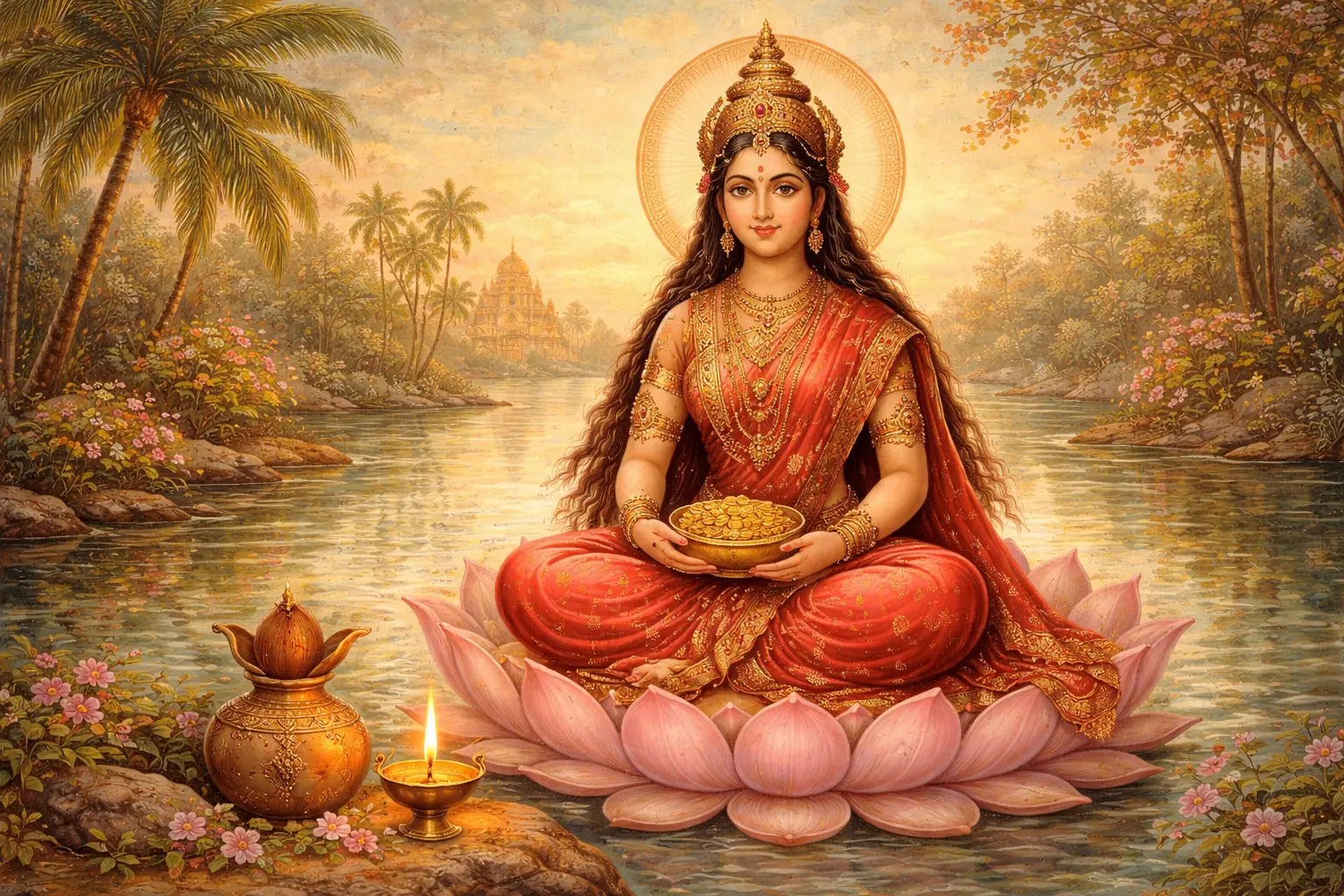
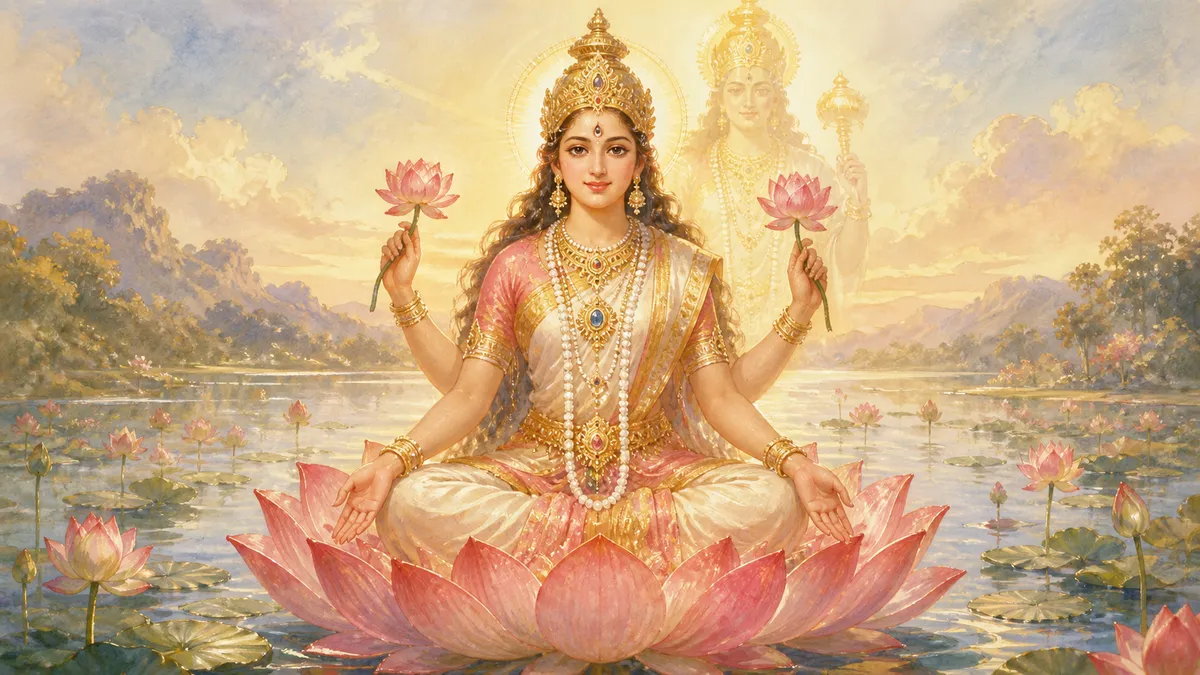
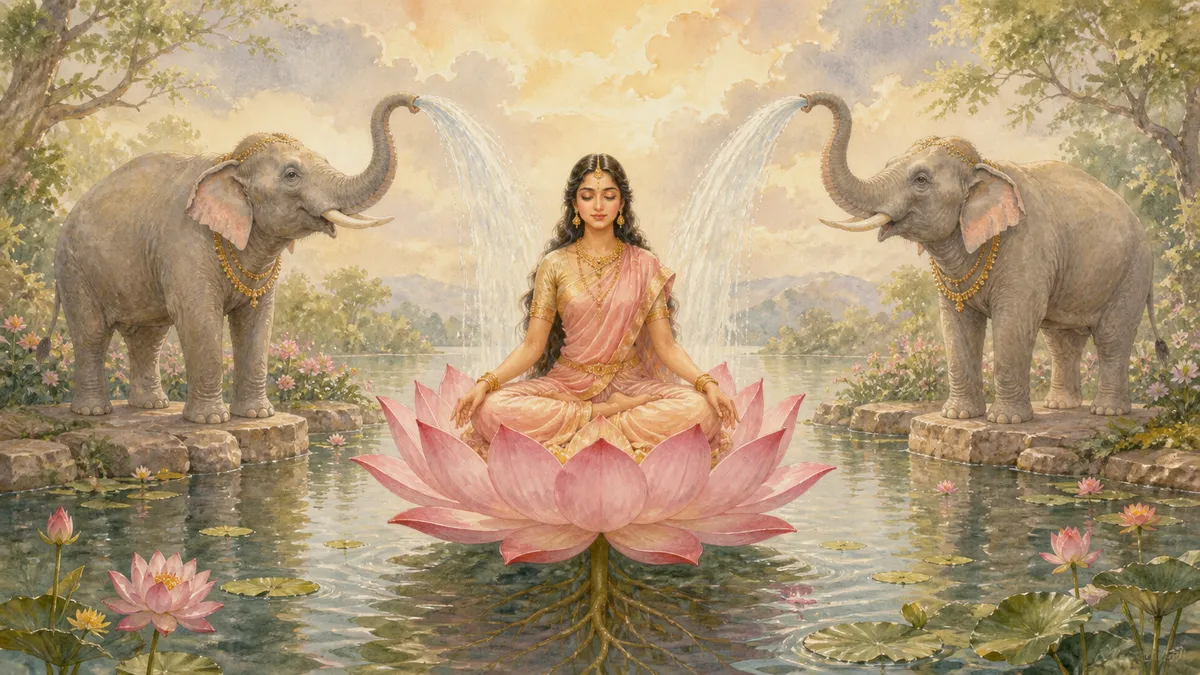
She is described as having a beautiful golden face. Her other name in the canon of the ten Mahavidya goddesses is Kamala, meaning the lotus goddess. Four enormous elephants bathe her, pouring nectar over her from pitchers. In one pair of hands she holds two lotuses, while with the other pair she makes gestures of bestowal, grace, and fearlessness (abhaya mudra). She wears a magnificent crown and silken garments. She is depicted seated on a lotus flower in the lotus posture.
The “Dhyana Mantra of Kamala” says:
“May Kamala protect us with her delightful glances, which furtively bring joy to Vishnu’s heart. Smiling, she sits upon a lotus, has four arms, holds two lotuses in two of her hands, and makes gestures of bestowal, grace, and fearlessness. Her color resembles a flash of lightning; her breasts are firm, heavy, and adorned with garlands of pearls. She is delightful like the rising sun. On her brow is the clear disc of the moon. She is adorned with a crown and a precious necklace. She bends slightly beneath the weight of her ample bosom, and in her hands she holds two lotuses and two sheaves of rice shoots. She has three lotus-like eyes. She wears the Kaustubha jewel and smiles.”
Since Dattatreya embodies the principle of Vishnu, Lakshmi embodies its active feminine aspect. Kamala means “lotus-born,” and this is another name for Lakshmi. Another of her names is Shri. It is said that she adores lotuses and is always surrounded by them, and that her eyes, too, are like lotuses.
Lakshmi’s Place Among the Mahavidyas
She is usually the tenth and last of the Mahavidyas. In the Mahavidya canon, Kali always comes first, Tara second, and Lakshmi tenth. Why? Not because her position is somehow secondary, but because she is, as it were, at the opposite pole. That is, Kali is at one pole, while Kamala is at the other.
Kali embodies the primordial principle of entropy, chaos, and destructive dark energy; Kamala embodies the principle of pure, sublimated, already subdued and purified energy that manifests in pure vision. Worship of Kali usually helps in crises, disasters, battles, and wars, when the destructive forces of chaos need to be sublimated. But chaos, destruction, and dark energies constitute a certain karmic vision or a certain layer close to the muladhara chakra. When these energies are subdued, however, self-organization, purification, and the presence of awareness arise, and this is the level of Kamala. Although Lakshmi herself also has many wrathful forms.
Kamala is a goddess possessing exceptionally auspicious, benevolent, and pleasing qualities. Many identify her with the worldly benefits that concern all laypeople: success, prosperity, power, wealth, good fortune, and security. But these qualities are merely crumbs when compared with the full spectrum of her energies. For us as practitioners, she embodies the principle of Vishnu—the principle of preservation, equilibrium, balance, and sustaining the five elements and the natural mind, which is essential for a yogi.
There is a swami named Kamal; he is described as a well-dressed, respectable swami because he bears that name. And if there is a swami who worships Shiva, he is somewhat destructive, chaotic, detached, and incisive. Thus, certain characteristics manifest depending on the energies with which a person unites.
The Principle of Pure Vision
The name Shri means “auspicious,” “bringing good fortune.” The goddess Shri (Lakshmi) is identified with food, royal power, splendor, good fortune, and beauty. For us, she always symbolizes the principles of pure vision associated with the illusory body, the mandala, and the final stages of awareness. In other words, when we work with awareness, sooner or later it sublimates energy, and sublimated energy must always manifest in pure vision. It is impossible to bypass this stage.
That is, it is impossible for a person to work with awareness while harboring demons within and think, “Well, it is nothing serious; these are simply my energies.” No. All energies—rajas and tamas—must always, upon uniting with awareness, pass through this stage and be transmuted into sattva, and then transcend the state of sattva altogether, manifesting truly only from the state of transcendence as tamas, rajas, and sattva—that is, as peaceful, neutral, wrathful, and joyful deities without any limitations.
The Symbolism of the Lotus and the Elephant
The text “Shri Sukta” discusses her positive and auspicious qualities and states that she is always associated with the lotus and the elephant. The lotus symbolizes the element of water, burgeoning life, and spiritual life. The elephant embodies stability, solidity, royal power, and steadfastness. Thus, nididhyasana is steady, stable, and natural presence; a stable mind that maintains equilibrium, balance in the universe, or the balance of the five elements in the body.
Lakshmi’s connection with the lotus indicates that she symbolizes a certain perfection, a state of purity that transcends the material world. Nevertheless, she is rooted in material energy, just as a lotus growing from mud always remains pure itself, even though it draws nourishment from the mud.
She is constantly depicted with two elephants flanking her and pouring water over her from their trunks. Elephants are usually associated with clouds and rain. This is the element of water embodied by Lakshmi; it is the flexibility of consciousness, or the flexibility of the natural state, capable of uniting with any manifestations of energy and carrying out sublimation. Elephants have also always represented royal power. In other words, the king is natural contemplation, natural awareness; maintaining awareness in stability and constant balance makes it possible to exercise such royal power over all energies.
Connection with Royal Power and Indra
Many texts also state that the god Indra maintains his prosperity by worshiping Lakshmi in various forms, and when she lives with him, he prospers both politically and economically. But when she leaves him or takes the side of his opponent, he loses his royal power and wealth and is defeated in his confrontation with the asuras.
Royal might, power, and prosperity are believed to be associated with Shri, and without her a king cannot prosper. In spiritual life, in the language of esoteric terms, the king is the principle of mind, while his power means power over the pranas and indriyas: the five karma-indriyas, the five jnana-indriyas, the five tanmatras, as well as manas, buddhi, chitta, and ahamkara. Without Lakshmi, the king cannot prosper; his power and prosperity cannot be realized. In other words, such control is impossible without the principle of stability and natural awareness. The principle of prosperity embodies the sublimation of various energies into pure vision. Without profound stability and absorption in the natural state, the sublimation of energies, their blossoming and transformation into a mandala, and the appearance of signs of realization are impossible.
Connection with Kubera and Spiritual Treasures
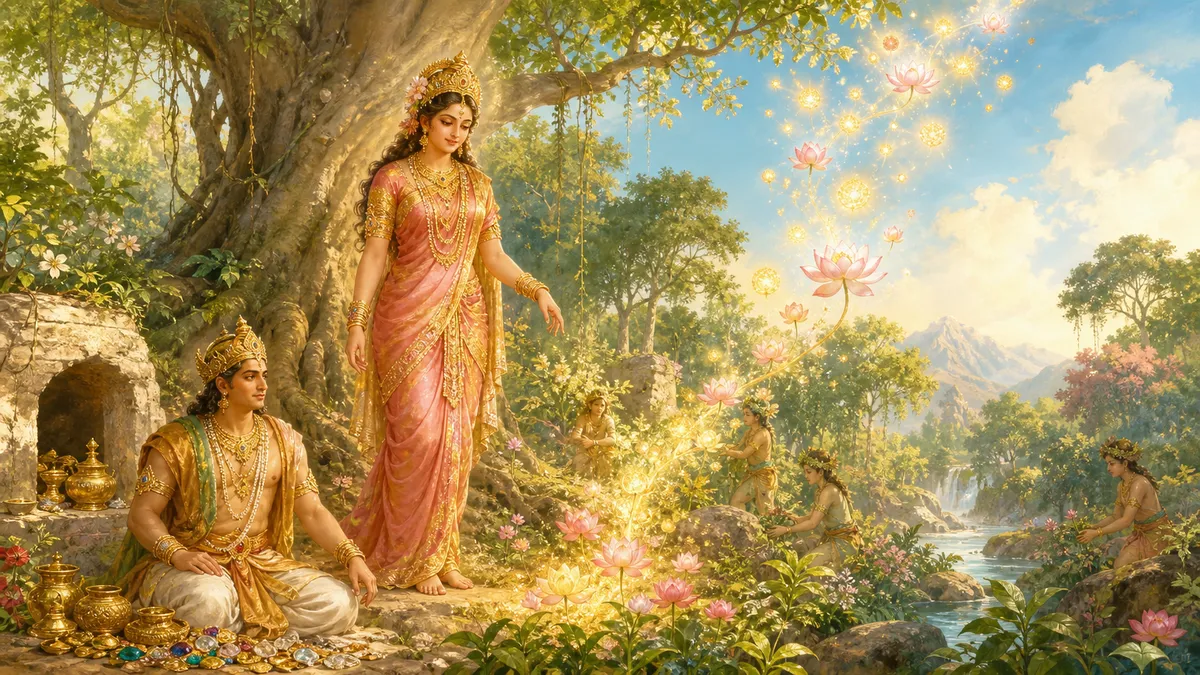
Lakshmi-Kamala is also associated with Kubera. Kubera is the deity of wealth; he is regarded as the possessor and distributor of wealth, the lord and guardian of the treasures of the Earth. He is also described as the leader of the yakshas—beings who dwell in forests and support the growth of plants. In the spiritual sense, Kubera is associated with spiritual treasures, siddhis, and the spiritual wealth that blossoms as the nature of the Mind is deepened, with spiritual treasures that reveal themselves as manifold siddhis.
Unity with Vishnu
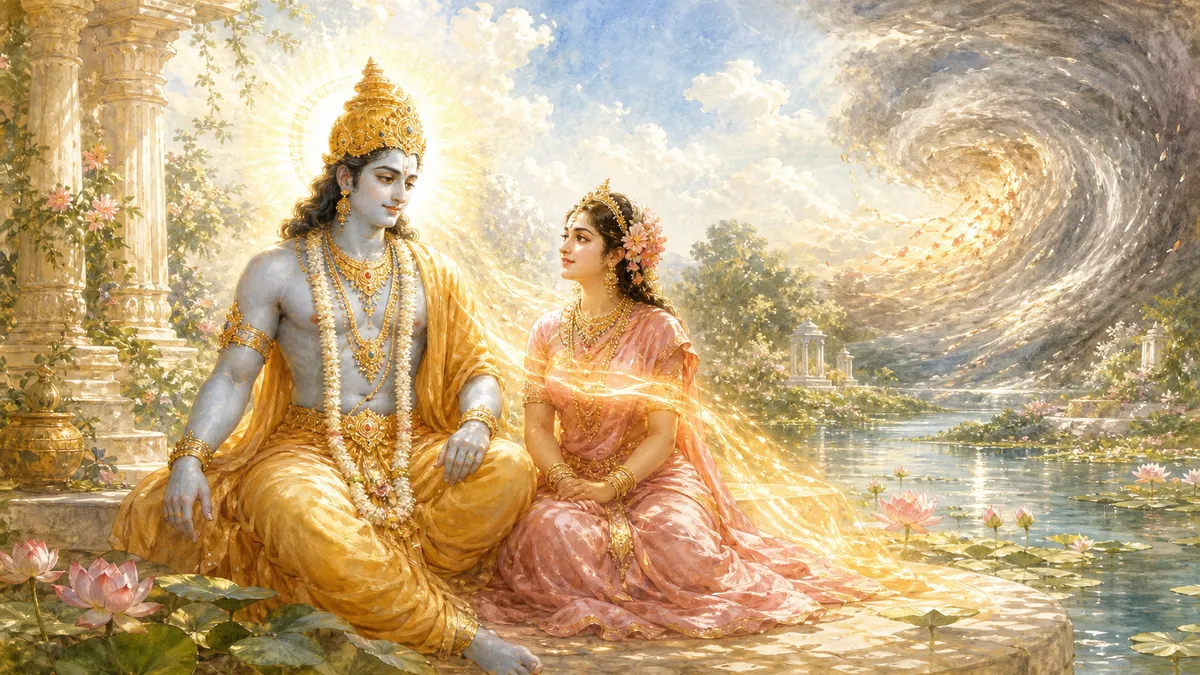
The most important deity with whom Lakshmi is associated is the god Vishnu. Vishnu embodies the principle of preserving the world. If Lakshmi is the active aspect—that is, sahaja-spanda, the natural state that vibrates, the progressive sankalpa that sublimates everything—then Vishnu, as her more passive aspect, embodies the View and awareness itself, that is, the unwavering mind that leaves everything as it is and rests in its own nature.
Vishnu is also closely associated with kingship, since the natural mind embodies the triumph of the natural state over all the elements. This is why he is often called a king. Vishnu is called a king and associated with kingship precisely because he maintains the balance, equilibrium, and stability of the elements in the universe. In the same way, the king (the natural mind) embodies the balance and equilibrium of the elements in the physical body.
In the Puranas, Lakshmi is often described as a modest, devoted wife. Wherever she is present, royal power flourishes, and wherever she is absent, it weakens and disappears; therefore, she is the embodiment of such royal power.
Sahaja-Spanda as Devoted Energy
Why is she described as a devoted, modest wife? Because she embodies not merely the energy of the dark world—chaos, a wild, uncontrollable energy that transgresses all boundaries, as Kali does, for example—but rather sahaja-spanda. In other words, sahaja-spanda means that she is devoted, modest, and loving; she has not strayed far from her lord.
Kali is an energy that has strayed very far from her lord and wanders on her own. It is a destructive force of chaos, devoid of awareness and the natural state, moving uncontrollably. Lakshmi, however, is the energy that remains very close, always nearby. Sattva is always close to sahaja, to the natural state. That is, she is always subordinate to her lord and never does anything without him; all her actions are service to him. In other words, she embodies within us the energy (spanda) that arises only from the pure mind abiding in presence and never moves anywhere on its own. She is often depicted as shorter in stature or massaging Vishnu’s feet. Thus, she embodies the principle of energy serving the natural Mind.
Lakshmi is also associated with good fortune. Special recommendations are sometimes given to those who are addicted to gambling: if a person cannot refrain from gambling, they are permitted to do so only during the festival when she is worshipped. This is the only time when they are lawfully allowed to gamble without violating the injunctions of the shastras.
Pure vision
Nididhyasana
Vishnu
Sattva
Lakshmi
Sahaja-spanda
Kali
Vishnu Smriti
Kamala
Author Гуру
Read 14 times
Articles
Vidya AI
Search
Lectures
November 2, 2026
Mantra of the day
ОМ САХАДЖАЙА НАМАХ ОМ Естественному – поклонение!
Auspicious Times(Rome)
Brahma Muhurta:
04:53 - 05:48
Abhijit Muhurta:
11:33 - 12:14
Sayam Sandhya:
16:44 - 17:25
Mokshada Ekadashi (6 November)
Ekadashi of liberation. Helps to achieve spiritual enlightenment.