Commentary on the text “Yoga Vasishtha”
How, then, can one realize the state of a divine being and accomplish this evolutionary leap? How can such a future be created? And is it actually possible to create it at all?
If we analyze the sacred texts, the answer will be unequivocal—yes, it is possible. If it were not possible, then there would be no point in our engaging in spiritual practice. But we ourselves must create this reality; we ourselves bear responsibility for our future. Even if we receive transmission from a teacher, a teaching, an explanation, all responsibility rests with us. The choice is always ours alone, because no one except us can create divine reality; we ourselves create it by the power of our consciousness.
So, how can such a reality be created, how can all 16 stages be accomplished? This is possible through spiritual practice, tapas, and personal effort.
Vasishtha’s Instructions on Personal Effort
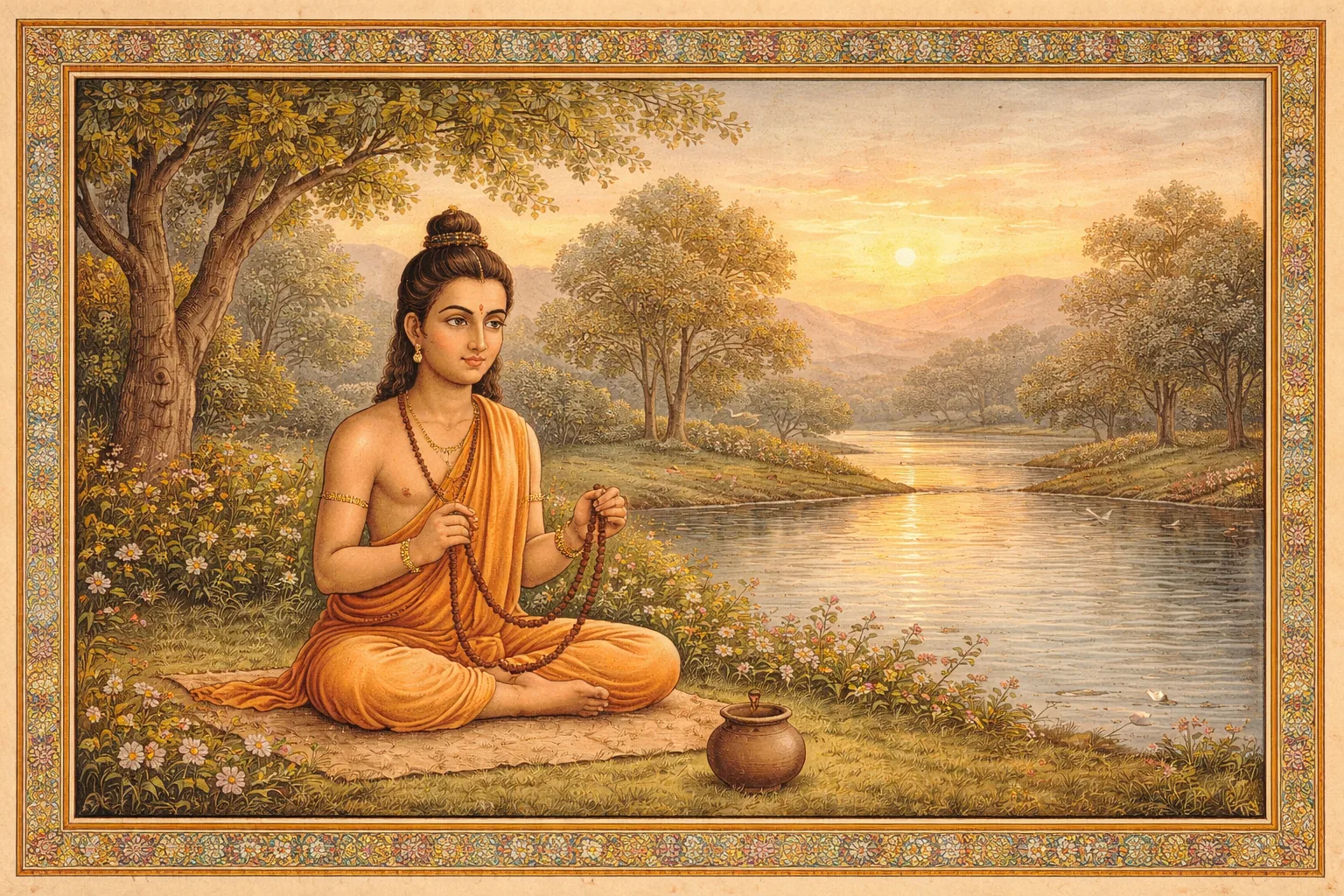
In the text “Yoga Vasishtha” there is a second chapter called “Aspiration.” In it, Vasishtha explains to Rama the principle of spiritual practice. Rama, as a disciple, as a beginner, asks Vasishtha how to become free from the cycle of birth and death, how to become a divine being, and what must be done for this.
And Vasishtha says:
“Therefore listen, O Rama, to what I am going to tell you. These instructions will surely dispel the darkness of misunderstanding.
In this world, anything can be achieved only through one’s own efforts, and when something does not succeed, the reasons must be sought in insufficient effort. This is obvious, and what is called fate is an invention, and there is no insurmountable fate.”
In the teaching there are various theories that speak about the relationship between willpower and predestination, the law of karma and personal will, the universal law (rita) and fate (daiva). But at the initial stage our own personal aspiration, our personal will, is very important. If we think, “Such is my fate” or “Such is the will of the gods; I am not destined to achieve this,” then in fact we are overestimating fate, we are overestimating the law of karma. There are no limitations if we can apply our will.
Vasishtha says:
“One’s own efforts, Rama, are those mental, verbal, and physical actions that are performed in accordance with the instructions of a wise person who knows the scriptures well. Only through such efforts did Indra become the king of heaven, Brahma became the creator, and all the other gods and demigods found themselves in their places.
Efforts can be of two categories: the efforts of past births and the efforts of this birth. The latter can overcome the former.”

The Interaction of the Karma of Past Lives and the Efforts of the Present
It is said: “If you want to know what you were doing in a past life, look at your present life.” Our life reflects our past efforts. In past lives we made certain efforts, applied will, and these efforts created certain imprints in the stream of our consciousness, which are called samskaras. In this life, we also make certain efforts. And it often happens that the imprints, the samskaras, created by the efforts of past lives come into contradiction with the efforts of our present life—this is called the collision of prarabdha karma (the karma of past incarnations) and purusha-kara (personal effort). Just as two rams collide on a narrow path, in the same way there occurs a collision between our past karmas and our present effort. If our present effort is quite strong, it can overcome our samskaras; everything depends on how purposefully we apply this effort.
Vasishtha says:
“Fate is nothing other than the effort of past lives. Between these categories there is constant conflict in this incarnation, and the stronger ones prevail.”
If your will and your efforts in this life are not strong, then the efforts of past lives prevail, your samskaras prevail, and you are forced to follow them. But if in this life you apply sufficient willpower, effort (this is called yogic tapas), then you can cancel the actions of past samskaras and change your destiny.
The Importance of the Proper Direction of Effort
Further, Vasishtha says:
“Efforts that do not accord with the scriptures are motivated by misunderstanding.”

This is a very important phrase.
Vasishtha says that if you make efforts that are not connected with spiritual practice, with evolutionary spiritual growth, and that run counter to the sacred texts and the instructions of the sages, then you are doing this out of misunderstanding. These efforts are fruitless; they will not bring a positive result. And sooner or later, even if you are convinced of the opposite, you will still have to become convinced of this.
This is indeed a very important phrase, since we all know what it means to make efforts, but we do not know what the direction of these efforts should be. Even if we make some kind of effort, we often lack an understanding of the direction in which we should apply them.
Vasishtha says:
“When there are no results from one’s efforts, one should carefully review one’s actions for what arises from misunderstanding and, upon finding such things, ruthlessly eradicate them. There is no force greater than right actions in the present. Therefore, one must, gritting one’s teeth, make efforts to overcome evil with good, and fate—with efforts in the present.”
The Nature of Kleshas and the Need to Overcome Them
Vasishtha says that at the initial stage of spiritual practice we truly need to make certain efforts. And what victory of good over evil is he speaking about? Of course, we do not need to look for some external evil. By evil here are meant our kleshas, limitations, and obscurations. What are kleshas? Kleshas are a kind of karmic dirt that clogs our subtle energy bodies, chakras, and consciousness. This karmic dirt arises as a result of past mental imprints.
It is usually said that there are three main knots in the heart. One knot is connected with ignorance (avidya), the second with desire (kama), and the third with action (karma). These three knots correspond to the three channels (ida, pingala, and sushumna) and the three gunas, that is, the states of material nature (tamas, sattva, and rajas). These three knots then grow into kleshas—obscured, limited states. What can the main kleshas be? For example:
- desires (kama)
- attachments (moha)
- anger (krodha)
- greed (lobha)
- pride (mada)
- envy and jealousy (matsarya)
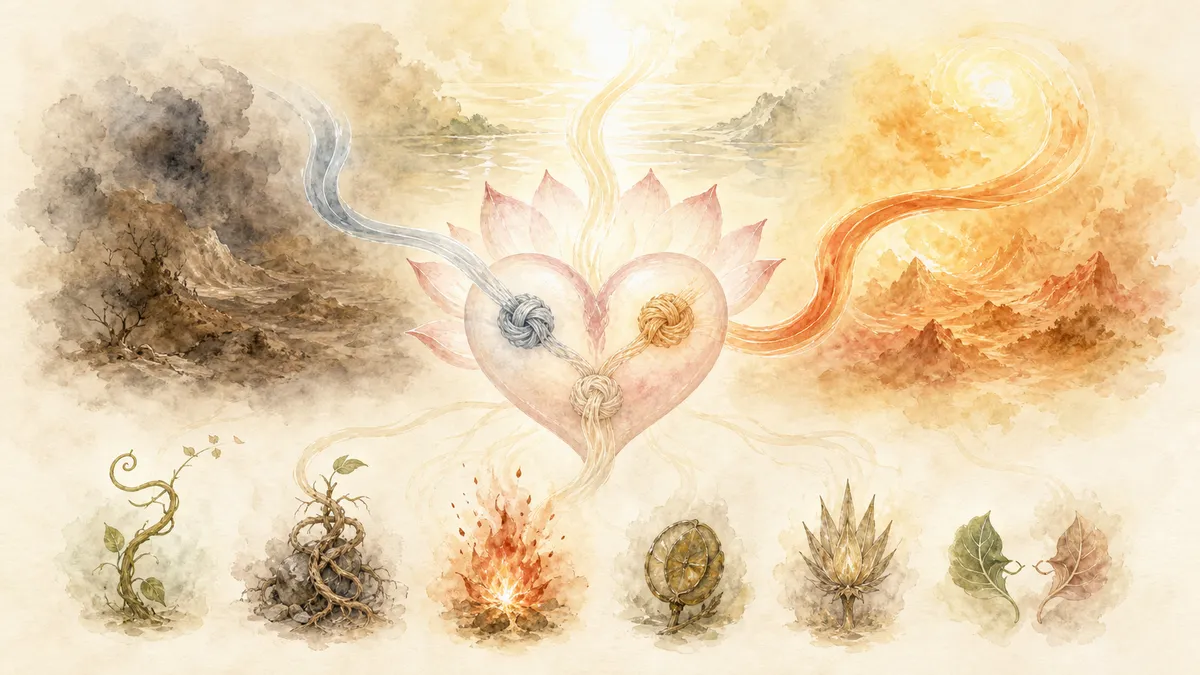
Everyone knows that we have fears, complexes, and stereotyped thinking, and we are strongly subject to them until we have completely purified ourselves. There are also energetic blockages in the chakras and channels. And all this greatly troubles us in the process of spiritual practice. This is precisely what prevents us from quickly becoming divine beings. Therefore, our task is to make continuous efforts to purify these kleshas. The application of effort is called yogic tapas.
The Essence of Tapas and Its Types
What is tapas? Tapas means (literally) “to become hot, to burn, to accumulate inner heat.” In the process of tapas, dependence on the senses, desires, and karma is burned away. Tapas is self-renunciation, self-sacrifice in the name of higher goals, for example in the name of liberation. There are various types of tapas that are performed in the process of spiritual practice. And without tapas it is impossible to achieve anything not only in spiritual life, but also in worldly life.
The simplest type of tapas is brahmacharya—chastity, abstinence from sex. Perhaps someone may say, “This is very difficult.” But no one says that the transition to a divine human being is something simple. And we have to choose: whether we want sensory pleasures or to move toward liberation. Another type of tapas is upavasa—an ascetic diet and vegetarianism.
Extreme Types of Tapas
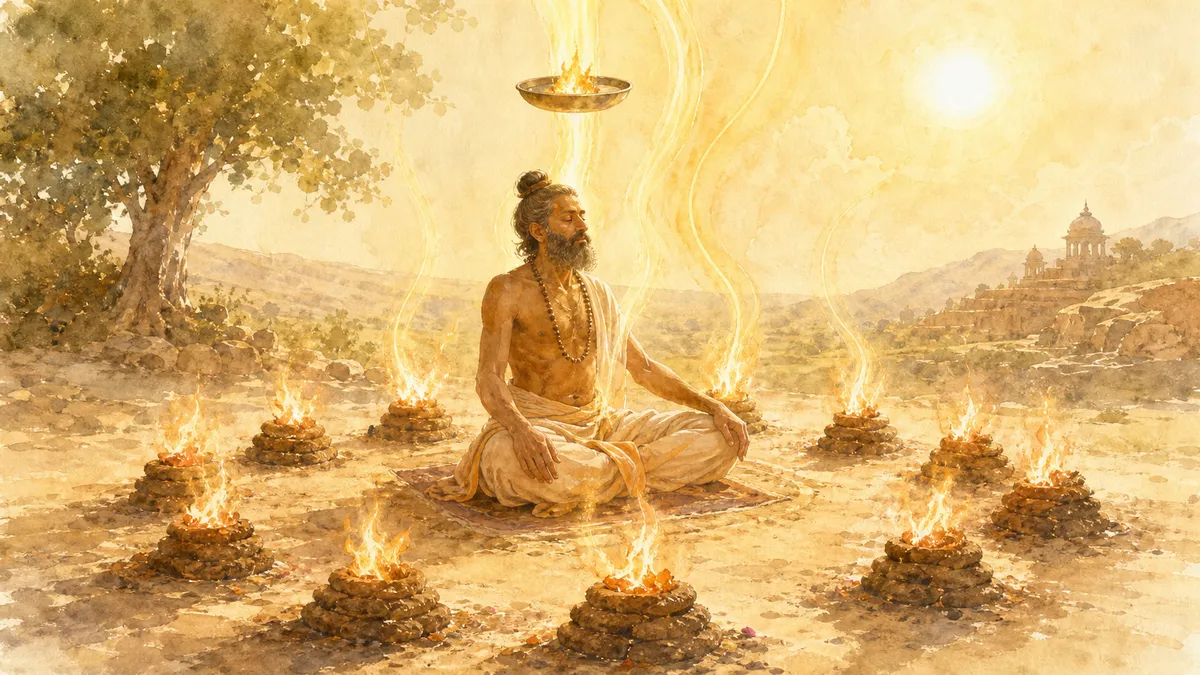
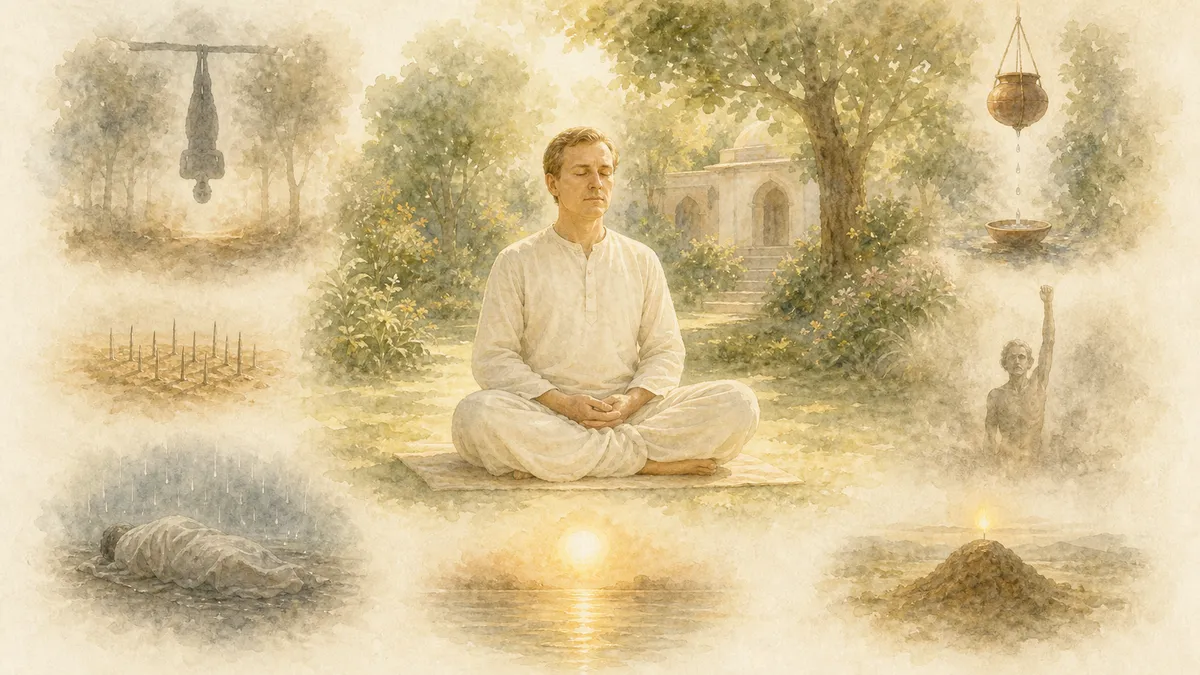
There are also extreme forms of tapas that are traditionally performed in India by practitioners, for example seasonal ones. One such form of tapas is “dhuni tapas,” when a yogin arranges from 5 to 12 stacks of cow-dung cakes around himself, lights them, and then also lights cakes on a special tray and places it on his head. This tapas is performed at the hottest time of the year (in summer) and at the hottest time of day (from 12 to 2 p.m.). The yogin lights these fires and sits in the center; then he recites the guru mantra or a specific mantra of a deity. Thanks to this, his kundalini energy awakens, and the energy channels are very powerfully purified. This is a very powerful practice that grants the yogin siddhis, but beginners are not allowed to do it, because the element of fire activated in the process of such tapas can very easily get out of control and cause harm. Of course, I do not recommend that you try to perform it, since you must already possess a high level of control over your own elements in order to do it.
There is another type of tapas called “maidan tapas” — this is a prolonged stay in the open air, in the rain, wind, and so on. It is performed in the autumn period, when a sadhu simply sits and, without covering his body with anything, remains in one place for two or three months. Even if rain pours down or a strong wind blows, he still remains in that place, practicing meditation. “Maidan” means “ground, open space.”
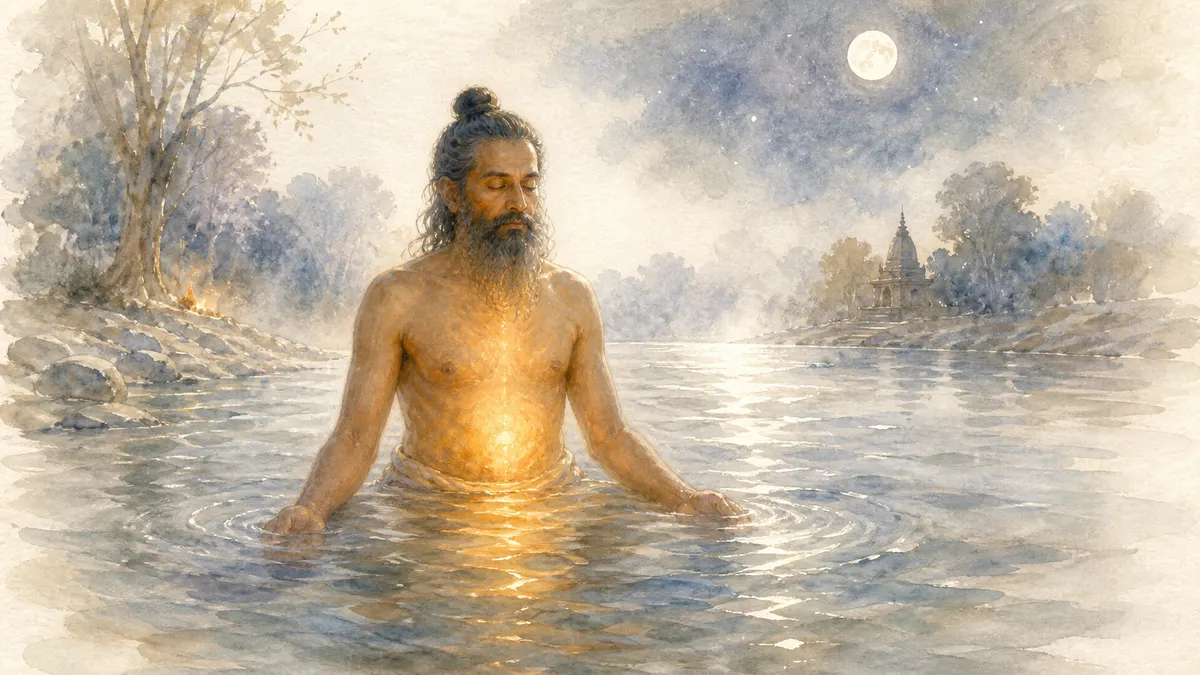
Another type of tapas is called “jala tapas.” It is performed in the cold period of the year (of course, by Indian standards, not Russian ones). A person stays in cold river water at the coldest time of night (from twelve to two at night) and meditates, kindling the inner fire, trying to sublimate the cold that enters his body by means of the active inner fire (the element of fire). For some time I practiced this type of tapas in Russia. But if you cannot control your elements and integrate contemplative presence with the lower chakras, with the element of fire, then, of course, it is better not to engage in this type of tapas, because you can overcool your body.
The next type of tapas, a more extreme one, is called “dharishwari tapas” — standing on one or two legs for a very long time. Some ascetic tapasvins perform this tapas for up to twelve years. Of course, this is a very severe type of tapas that outstanding yogis and rishis could perform in ancient times.
The Example of Arjuna
For example, Arjuna performed such tapas, and this is described in the Mahabharata. Thanks to his tapas, he received Shiva’s blessing, was able to ascend to the heavens of the god Indra, and undergo training directly under his guidance. While performing such tapas, Arjuna fed only on air or leaves, that is, he followed a strict fasting practice, stood on one leg for several months, and continuously recited a mantra while in a deep state of contemplation. After Shiva blessed him, a heavenly chariot, a vimana (something like a UFO), descended, and the pilot of this vimana invited him to board and proceed with him to Indra’s heavens in order to undergo further training in the use of magical divine weapons. This is an example of transition into a divine dimension, into the mandala of a pure dimension. If you read the book “The Highlander” from the Mahabharata epic, where Arjuna’s ascension to the world of Indra is described, you will be able to understand roughly the logic of the 16 stages of the development of awareness that exist in Laya Yoga. It is indeed very similar to the teaching on the 16 stages.
Other Types of Tapas
There is also “mauna tapas,” or “mauna vrata” — the observance of silence. This is what monks perform in the monastery. Such silence may be observed from several days during a retreat to several years (up to 12 years). It is one of the most accessible types of tapas.
There are also extreme types of tapas that can simply be mentioned; they are not to be imitated:
Kantakasaya tapas — lying on sharp nails
Urdhvamukhi tapas — hanging upside down over a smoking fire of cow dung
Jalandhari tapas — sitting under a suspended vessel from a small hole in which water drips
Urdhva-tapas – the continuous holding of an arm raised upward until its muscles atrophy and the grown nails wrap around the arm
Samadhi-tapas – being buried alive underground for several hours or days. Of course, this is possible only if the yogin can, while in samadhi, stop breathing and live underground; otherwise, it makes no sense at all
Trataka-tapas – prolonged gazing at the sun without blinking
Ajagara-sadhana – lying in one place, when the yogin (we mean Indian yogins) takes a vow to remain constantly in one place. He may perform this tapas for three years, five years, or even twenty years – it depends on his vow. Rain or snow falls, years pass, and he remains all the time in one and the same place. Sometimes he is given donations, food, prasada, and sometimes not; nevertheless, he tries, as far as possible, not to leave his place and to carry out the practice of tapas
Of course, apart from vegetarianism, brahmacharya, and mauna-tapas, I do not recommend that you perform such practices. These practices should be carried out in a particular cultural environment, in a particular context, and in appropriate surroundings. If you try in winter to be somewhere in a square naked, others are unlikely to understand you, and you yourself, most likely, will not be able to do it. Nevertheless, in India these are traditional, legitimate, and very authoritative types of ascetic spiritual practice – tapas.
I have given these examples to show you how important the principle of personal effort, the principle of asceticism, is for achieving a certain success in spiritual practice.
Next, Vasishtha says:
“A lazy person is worse than a donkey. One must never succumb to laziness; one must strive for liberation, seeing that life is passing away with every moment. One should not bathe in sensual pleasures.
He who says, ‘Such is my fate; I cannot oppose it’ is brainless and is abandoned by good fortune. By your own efforts acquire wisdom and then understand it. One’s own efforts culminate in understanding the essence.
If this terrible source of evil called laziness did not exist on earth, would anyone remain illiterate and poor? Because of laziness, people on earth lead an animal life, full of suffering and misfortune.”
Inner Tapas in Laya Yoga
Next, Vasishtha explains to Rama the subtle points of personal effort and speaks about how one can apply effort in the practice of yoga. I will touch on this at the seminar, considering the matter in more detail, but for now it can be said what is meant in our teaching of laya yoga by tapas and effort. In laya yoga, great attention is given to inner tapas (antar-tapasya). Inner tapas is connected with the ability to be in contemplative presence, with your ability to maintain sankalpa, a certain status of consciousness, and to engage continuously in contemplative practice. Perhaps this is not as spectacular as standing on one leg or sitting amid fires; nevertheless, this tapas is very profound, and it requires of the yogin complete concentration and involvement in contemplative practice virtually twenty-four hours a day.