

If we examine the practice of developing contemplation, it unfolds according to a certain logic that must always be observed, since it is very important and consists of steps and stages.
For example, some student begins practicing martial arts, watches a couple of training sessions, and then comes to the master and says:
— I am probably already a very good master, because I can hit the punching bag like Bruce Lee. I also watched a video and read a couple of techniques in a book. I am probably already a good master.
The teacher asks:
— All right, but do you do stretching exercises?
— No, I don’t.
— Do you have a training hall, a punching bag, padded gloves?
— I didn’t even know that was necessary.
— Then what do you do?
— I walk around imagining myself as a great hero.
This is an approach that reveals someone who is mistaken about practice, dwelling in fantasy.
The Teaching, however, when we comprehend it correctly, removes all fantasies, giving a crystal-clear understanding, when your mind becomes so clear that it is like a flawless surgical scalpel that can, by the power of its understanding, cut through any illusions and delusions, and therefore will always lead you onto the right path. This is precisely why we study the logic of proper practice.
Stages of Contemplative Practice
The logic of contemplative practice begins with concentration. And in concentration one must achieve serious success. When it is said that this is a preliminary or basic practice, it does not mean that it is not very important. It is very important and is the foundation.
When we practice concentration for at least six months and have results in concentration—whether it is a dot, a candle flame, or a circle—then you have a foundation. By looking at how a person achieves the realization of his intention, one can say whether he practices concentration or not, because if you practice concentration, your intentions are quickly fulfilled and realized.
If you decide to create a Dharma center or a retreat hall in your city and practice concentration, then your inner deities will offer you this Dharma center; it will certainly manifest, because your consciousness is capable of changing reality. A person who practices concentration can always solve his life and everyday problems, because his intention is impeccable; he changes karmic vision, attracting new probabilities in accordance with his sankalpa.
But if a person does not practice concentration, has not had such an experience of the power of consciousness, he is powerless; he wants something, but remains at the level of noble-minded dreams. His intention does not come true, the world does not submit to him at all, is not obedient to him, and everything goes differently from how he planned.
When we have mastered concentration, the time comes for the next practice—observing the breath. This means that we must extend concentration to movement. For example, we unite with the sky, with the vibration of the sound Om, meditate on the sound of flowing water, and in this way understand the diversity of experiences during presence.
Next we move on to the contemplation of space. That is, we have already passed through the line of contemplation, the line of divine pride, and move on to space, practicing for a long time with contemplative presence united with space.
After we have become convinced of union with space, we unite presence with the single “taste.” It can be said that this is already a deeper training. We completely eliminate our own preference for like or dislike, bad or good, good or evil, and so on.
Realization of the Single “Taste”
In fact, it is not so easy to realize the single “taste,” because it has different levels: initial, middle, and highest. Those who have realized the highest level of “taste” are, in fact, no longer human beings but celestial beings, because to realize the single “taste” means to go beyond the limits of alterations, the modification of time (for example, past and future), when the modification of time is seen as a single consciousness, or to free oneself from the concepts of inner and outer, to free oneself from the perception of “I” and “others.”
The initial single “taste” is when you attain such equilibrium of the soul that you cannot be shaken, because you are established in deep presence and act from there; therefore emotions and divisive judgments do not seize you.

Contemplation and Universal Forces
At the next stage, which we begin when our contemplative presence has developed tremendous power, we start to reach truly deep levels of the single “taste.” This is contemplation plus universal forces. This is already the stage of a siddha who has realized presence deeply enough and abides in the true single “taste” of continuous consciousness, and now he needs universal energy (shakti).
This is not simply energy in his body; it is energy beyond his body, it is universal, and therefore here the yogin trains and practices in uniting presence with universal forces. For example, with the power of knowledge (jnana-shakti), the power of will (iccha-shakti), and the five powers of action (kriya-shakti). He, as it were, mixes contemplation, abiding in nonduality, with the forces of creation, maintenance, dissolution, concealment, and enlightenment. Thanks to this, he gains a very deep experience of understanding the View and maintaining nonduality.
After some understanding of the interaction of universal forces is acquired—and this is a very important aspect—the yogin ceases to be a human being; he becomes something like a deity in a physical body. If he wishes, he can summon the power of creation and create something by entering deep presence. By summoning the power of concealment, he can change karmic vision; by summoning the power of enlightenment, he can bring down Anugraha-shakti upon all humanity, upon the entire Earth.
He is a kind of perfect resonator, a channel conducting universal energies. Thanks to inner emptiness, by changing his sankalpa, he can accumulate these universal energies and, passing them through himself, transmit them as necessary.
Mastery of Time
Finally, the next thing the yogin masters is the blending of contemplative presence with time, the elimination of the concept of time as past, present, and future. And time is the most difficult category to deal with, since even the gods are subject to the modifications of time.
At this stage, the yogin can change the past by moving through samskaras from one state to another, when the modification of the past and future is a continuously flowing sequence of events, since it is an energy inseparable from the mind. Then the universe appears as something like emptiness in which bindus (spheres) float, and each sphere contains a variable universe. Such a yogin, by changing his consciousness, flies from one bindu into another, in which an alternative event unfolds. He is completely free to leave these events or enter them.
Creation of the Mandala
Finally, when all this has been passed through, the final stage, as it were, arrives—the creation of the mandala. The creation of the mandala means the yogin’s ability to fully accomplish the “great transition” and incarnate as a divine being. Using his clarity of contemplative presence, his ability to transmit energies (shakti) and manifest them in pure vision, the yogin creates another reality by the power of his mind.
This is a subtle-material spiritual reality that manifests as a mandala; it can be likened to the radiating creative energies that emanate from saints. The environment that emanates from saints is an example of such subtle, creative, self-liberated energy manifesting in its pure form. That is, there is nothing impure in it, nothing limiting, because it manifests from the subtlest levels of light and is inseparably connected with the consciousness of the saint.
Pure and Impure Vision
For example, if we analyze our environment, we will see that our environment does not consist of such energies. External energies do not obey our consciousness and manifest as ordinary impure karmic vision. This happens because these energies are not our mandala, but Brahma’s mandala. Moreover, this is not a simple mandala of Brahma; it is also called the “wrathful mandala of the five elements,” that is, it possesses much of that shakti which, in our state, we cannot self-liberate.
For example, even if you try to self-liberate a stone or something solid while you are contemplating, it is unlikely to be self-liberated in that way; it will still remain, because inert matter embodies mula-prakriti—the fundamental cosmic energy of a very rigid level. We are located precisely within such rigid energy, and therefore it is called the “wrathful mandala of the five elements.” It is also called “impure vision.”
But in fact it is impure only for us; for Brahma it is completely pure and perfect, because its capacity for self-liberation is astounding. By the power of his clarity he can self-liberate tattvas, elements, atoms; for him the wrathful elements are entirely divine.
When we enter pure vision, we create our environment, which flows from our own contemplative presence. At this point the spiritual practice described in the teaching comes to an end. This is roughly how the logic of the teaching develops, and when we examine it, we invariably obtain the necessary results.
Now imagine that a person places the wrong emphases: at this stage he considers one thing the main thing, and at another he considers something else the main thing. In the end he begins to ask, “When will there be yogurt?” So what should the emphases be placed on at the beginning? On acquiring faith, commitment, samaya, an initial level of self-liberation, concentration, the practice of meditation on emptiness, and atma-vichara in motion. When you have all of this, you perceive the very essence of the teaching.

Levels of Transmission of the Teaching
As you know, the teaching is transmitted on several levels: the ordinary, the intellectual, the symbolic, and the nonconceptual, which is also called “direct introduction,” “signless transmission.”
- Signless transmission addresses our deep “I,” the state of dreamless sleep, the mind beyond all limitations
- Symbolic transmission addresses our subconscious, the world of images
- Intellectual transmission, connected with meaning, logic, and words, addresses our surface consciousness, the conceptual mind
And when stories are told, this is a kind of clarification, on the symbolic level, of the principles of spiritual practice.
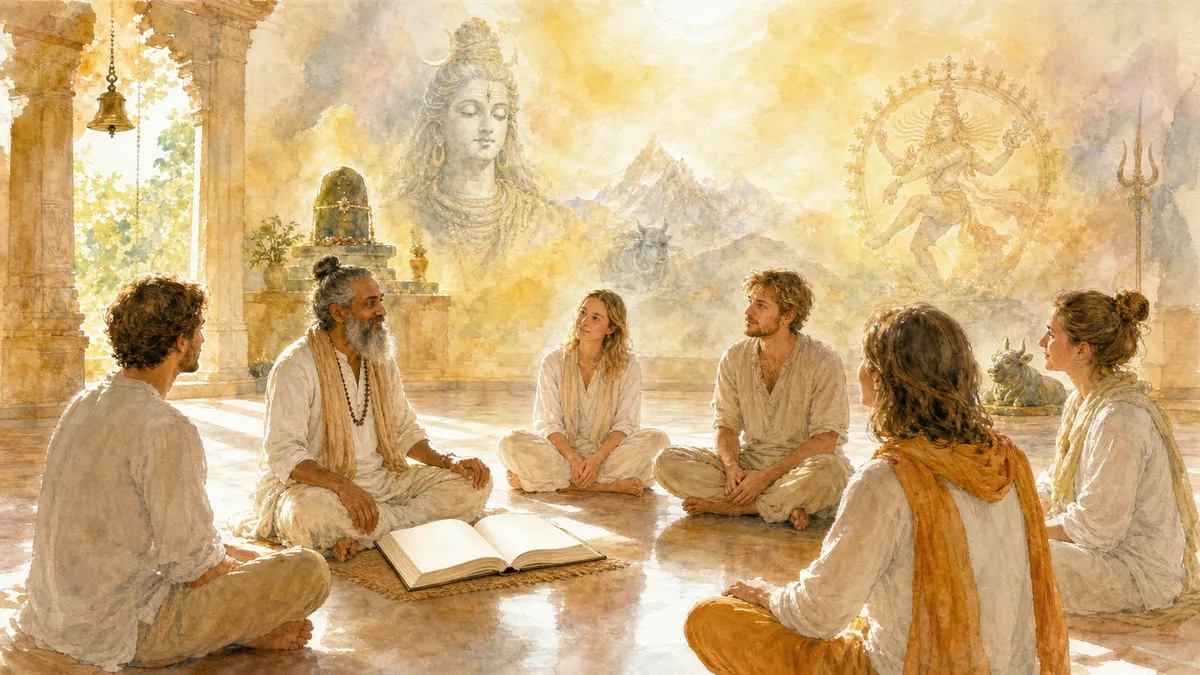
The Story of the Girl Umalekha and the Young Man Nirguna
Nirguna once decided to get married and chose a girl for himself whose name was Umalekha. He thought that first, of course, he needed to get acquainted and meet a few times, and only then would it be possible to introduce the girl to his parents. Through this girl’s friend he arranged a date with her. She thought, “A date is a date,” and so she said she would come.
But the young man was late for the date. Since he was often very busy and could not concentrate in any way, through the girl’s acquaintance he kept sending one new date after another, saying that he would definitely come to the date. He kept apologizing all the time, because he had various affairs and concerns: once he fell ill, another time he had to go trading with his father, and a third time he liked another girl, so he tried to get acquainted with her, but she rejected him.
In the end, he finally grew tired of all this and decided to go to her house and speak with her directly, frankly. When he arrived, he saw a large celebration that was almost over. And an old servant said to him:
“Oh, come in, come in, there is still a little salad left. The guests have already eaten and drunk everything, but there will still be some for you; I can bring it from the kitchen.”
And this young man Nirguna said:
“I would like to see Umalekha.”
The gatekeeper answered:
“Everyone has already dispersed, for the wedding is over. It was all so interesting! You were just a little late. But there is a little salad left for you, so don’t worry.”
That is, his girl had gotten married.
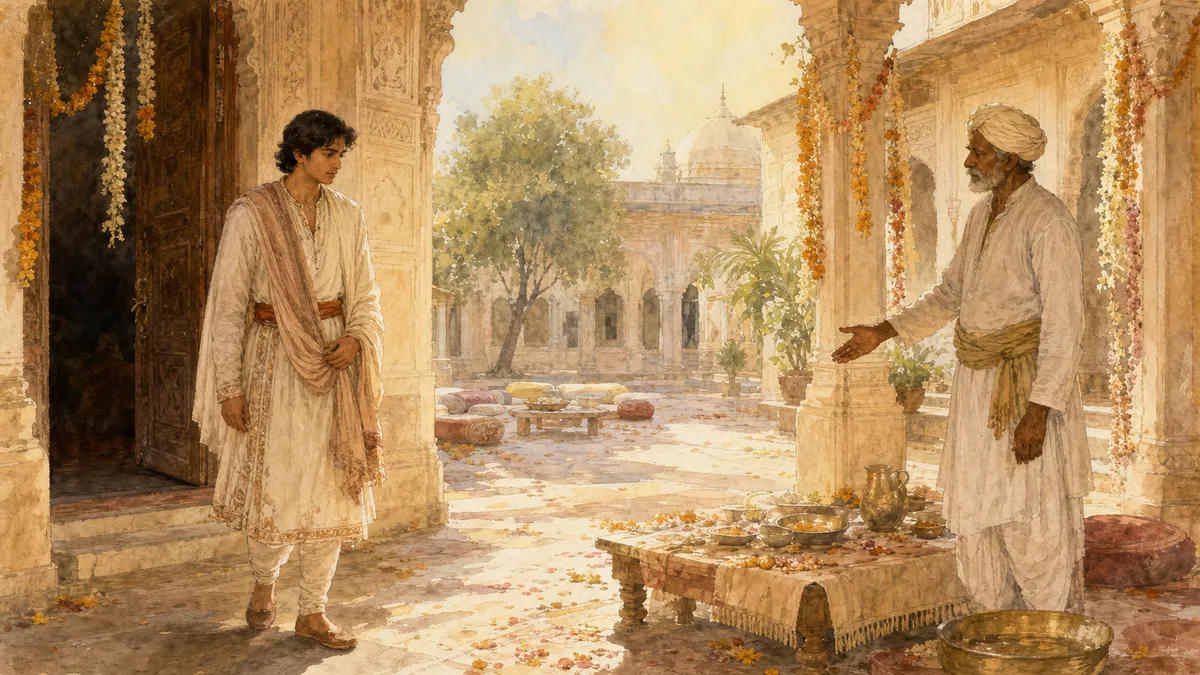
This parable is called “On Missed Opportunities.” In the same way, when a practitioner partakes of the Dharma, it is merely like an opportunity. It is no guarantee at all, but simply an opportunity. And this opportunity is stochastic, probabilistic: it may be yes, it may be no, it may be half and half. Anything can happen, because everything already depends on you; it is you who are the active actualizer of this opportunity.
Nirguna was a “dim-witted” fellow. One does not behave this way with girls, and so he missed his opportunity. A practitioner should not become like such an unlucky fellow who arrives, only to be told: “All that is left is a little salad.” He catches this opportunity, seizing it on the fly, because who knows what will happen tomorrow if he does not catch it now?
The Story of King Gunaka and His Assistant Tamatapa
There was a king named Gunaka (from the word “guna”), who was a very conditioned soul; he did not concern himself with the kingdom, spending his free time playing dice, amusing himself with girls, and hunting. Gunaka did not gather his ministers, did not review his army, and paid no attention to the brahmanas either. Seeing that the kingdom was falling into decline, his advisers gradually left him, and his ministers betrayed him, taking half the treasury and going over to the king of a neighboring state.
But the king continued to live in this way, thinking that the main things were hunting, playing dice, entertainment, and feasts. After some time, the remaining adviser reported to him that the neighboring king was already approaching with his army and intended to take away his lands, the entire state. Gunaka became seriously frightened. He wanted to summon his military commander, but the latter, hearing about the approaching army, simply fled.
Gunaka had a loyal but rather foolish servant who, however, was very diligent and determined. His name was Tamatapa. The king thought: “Since the military commander has fled, we need at least someone to lead the army.” And he said:
“Tamatapa, then I appoint you minister of defense, commander-in-chief. Gather the army urgently; we are going into battle because we are being attacked.”
Tamatapa, being an obedient servant, said:
“Of course, as you say, I will gather the army right now!”
After some time, Gunaka called Tamatapa and said:
“Quickly show me the war chariots, the elephants, the archers, the arrangement of the ranks.”
Tamatapa said:
“We have had no elephants for a long time; of the war chariots there is only one, and as for archers... I do not even know what they are.”
Gunaka asked:
“And how many warriors do we have? Did you send messengers to all the principalities so that they would send their armies?”
Tamatapa replied:
“I did not even know that we had other principalities; after all, I have always only served you. I called my friends from the village, so a few people will come out.”
King Gunaka realized that he had made a terrible mistake by appointing Tamatapa as military commander. And since it was already necessary to run for his life, he fled his state in disgrace to his brother, and there he lived simply as a relative of the neighboring king.
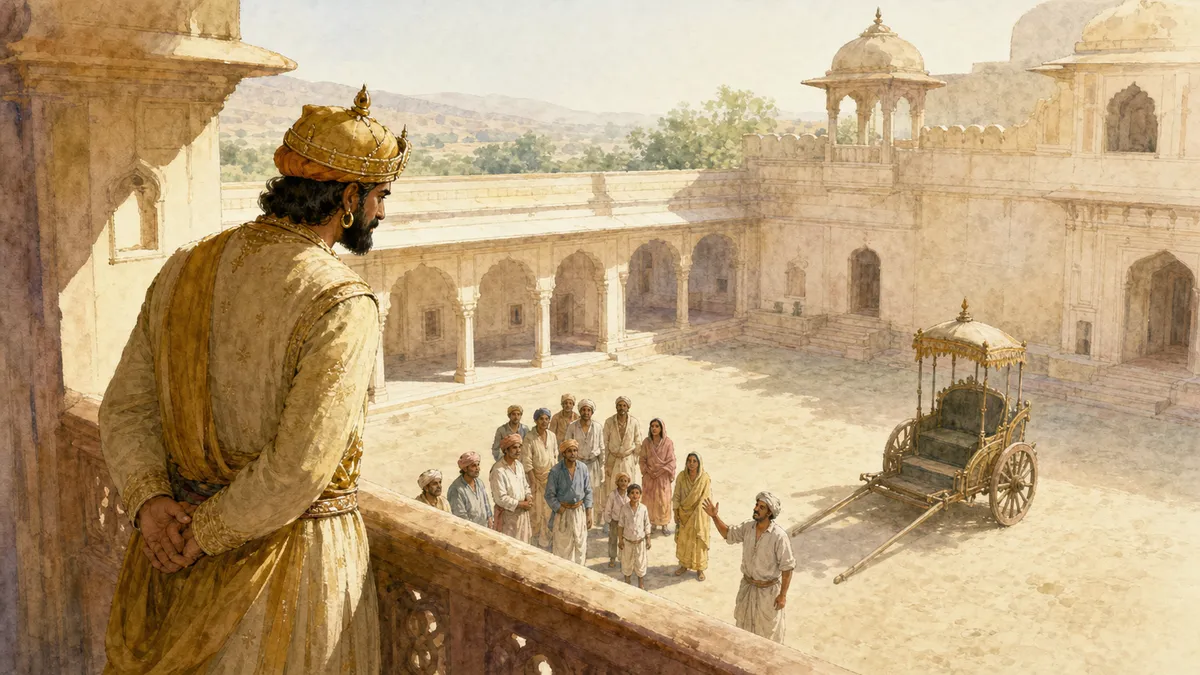
This parable is called “The Wrong Goal,” or “Backing the Wrong One.” When we choose the wrong goal and back the wrong one, we are like such a king whose state is falling apart while he himself flees, giving everything away to another.
Gunaka here personifies buddhi, that state of awareness which develops and sets goals. Tamatapa (if translated literally, it means “foolish effort”) personifies the deluded mind, which, although it can do something diligently, is nevertheless fundamentally limited. It often happens that we set the wrong goals and then act on the basis of those wrong goals, relying on limited understanding. As a result, we may fail in spiritual practice by setting the wrong goals, just like this king.
The Story of Drona and Draupada
The next story is called “The Story of Drona and Draupada.” It is described in the Mahabharata.
Drona and Draupada grew up together from childhood and became friends, although Drona was the son of an ordinary brahmana, while Draupada was the son of a king. Once in childhood they swore that Draupada, when he became king of Panchala, would give Drona half the kingdom, because there was such a strong friendship between them that they were inseparable.
Time passed, and Draupada did indeed become king of Panchala, inheriting the kingdom from his father. Drona, however, was a poor brahmana. By that time he had a son, Ashvatthaman. But when he learned that Draupada had become king, he remembered this promise, came to him, and said: “Do you remember that we are friends? Are you faithful to your promise?”
Draupada was outraged that this insolent brahmana had dared to recall some foolish childhood promises and, on that basis, demand half the kingdom from him, and so he simply drove him away.
This hurt Drona very deeply. Then he began to study the martial arts in order to surpass everyone and take revenge on Draupada, since he considered it a deadly insult. He attained such mastery in the martial arts that there was no one equal to him in all of Bharata. In time he became renowned as the martial arts teacher Dronacharya—the greatest master of the martial arts. But despite the fact that he became a master, revenge still burned within him.
He chose two students, Arjuna and his companion, and began to teach them. From Arjuna he raised the greatest master, who surpassed even him. In competitions, Arjuna shot while the chariot was moving, sometimes simply standing, sometimes standing on the pole, sometimes from beneath the cart. And when he fought with a sword, it seemed that he was growing larger or smaller, or moving as if he were appearing in different places at the same time during the battle. Or he could hit the eye of a small iron fish with an arrow while standing with his back turned and aiming at the image reflected in water poured into a basin.
When Arjuna and his companion completed their training, they asked Drona:
“What payment should we give you for the training?”
And then Drona said:
“Bring me Drupada, the king of Panchala.”
Since Arjuna and his companion were princes, they summoned their armies, conquered Drupada, the king of Panchala, and brought him to Drona. And then Drona, smiling sarcastically, said:
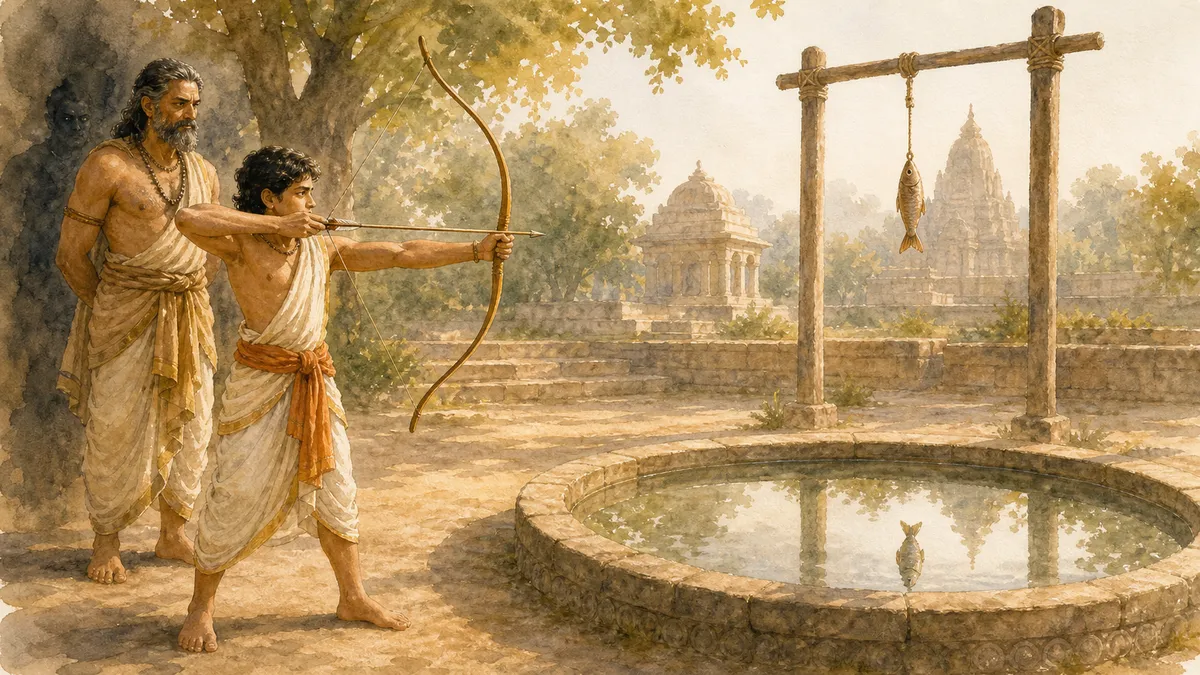
“You do remember that we are friends, don’t you? Therefore, I do not intend to take away your entire kingdom, but will take only half. Since I consider you a friend, I will leave the other half to you.”
This was the greatest humiliation for King Drupada.
This parable is called “Unfulfilled Promises.” Drupada neglected promises and vows, but they came back to him as great losses and problems.
Samaya Commitments in Anuttara Tantra
In spiritual life, when we enter the path of anuttara tantra, we choose a particular path of practice and make certain samaya commitments, which are very important for us not only throughout this life, but even for future lives, up to enlightenment. Although these commitments are not very numerous and are not so difficult, it is very important to follow them and treat them with respect, without neglecting them.
The path of tantra is often compared to a pipe into which a snake has crawled, and it is said that the snake has only the path upward or downward; that is, it can either advance and crawl out, or it can fall down. In the same way, a practitioner on the path of anuttara tantra can either advance forward toward enlightenment or fall seriously if deviating from the samaya commitments.
All these parables point to different states that a practitioner experiences.
The Parable of Misplaced Emphases
There is another interesting parable. There was a certain narrow-minded and rather foolish man named Bhumaka. All his interests came down to where he might eat something tasty, sit in company, and amuse himself. One day he heard people leaving a certain house praising the reception and the refreshments they had received there; they said that the dessert made of mango and yogurt there was simply wonderful. Since he was hungry, he became eager to get to the gathering in that house, where everyone was fed, in order to try what kind of dessert this was—mango yogurt. And he wanted so much to try all this that the thought greatly obsessed him.
One day, when all the people were entering that house, he also got inside. He saw that strange people had gathered there, mixing various ingredients (mercury and other things) and examining them, while their teacher was explaining something to them. He sat impatiently for several hours, but never received any refreshments. In the end he began to fidget and ask, “So when will there be yogurt with mango?!” Everyone looked at him as a complete fool.
The people whose circle he had entered were alchemists practicing according to the rasa-shastras; they mixed various ingredients in mercury and tested some preparations on themselves. Sometimes they invited brahmins, performed Vedic rites, and offered them food for the favorable outcome of the alchemical result, and Bhumaka had accidentally overheard one of the conversations of such invited brahmins and thought that such things were actually given there all the time. In the end, he was disgracefully expelled from the company of alchemists.
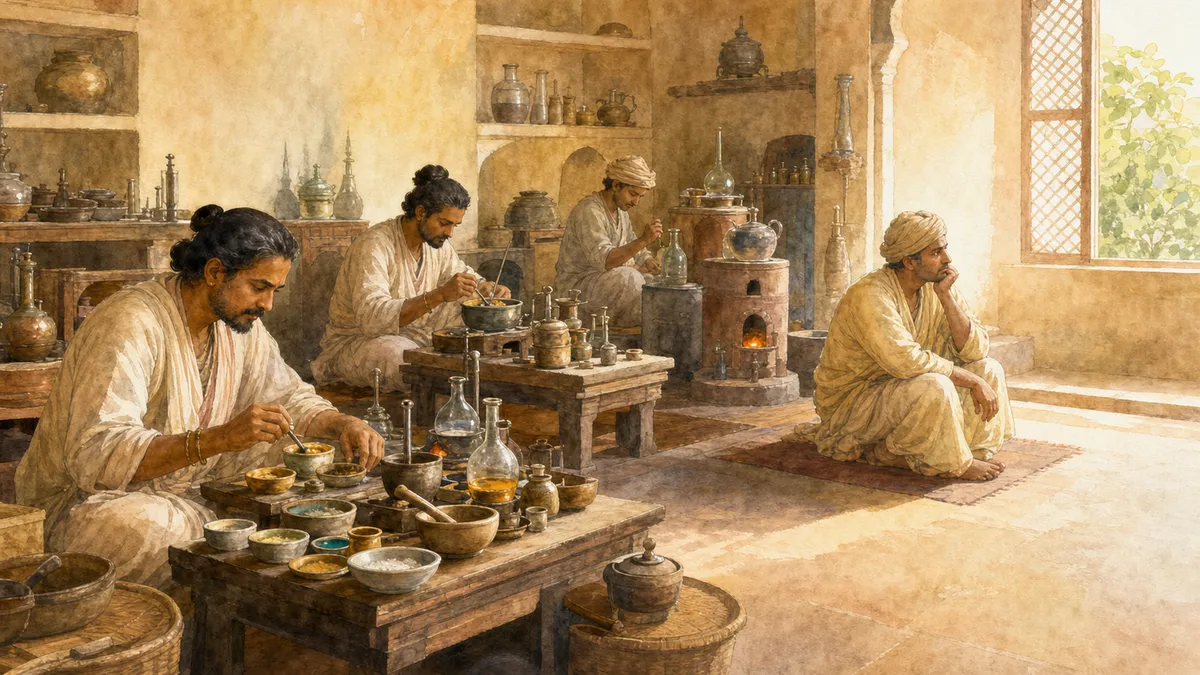
This parable is called “Misplaced Emphases.” When we place the wrong emphases in the Dharma, we can find ourselves in the role of such a Bhumaka, without even understanding what is going on. When everyone is expecting alchemical mercury, we will impatiently fidget and ask, “When will there be yogurt?!”
It is very important, when we set out on the path of spiritual practice, to place the emphasis correctly. Such an incorrect emphasis can be anything at all. For example, a person thinks that the true experience is some kind of flash of light and something else, and places emphasis on that. I ask him: “How is your work with sankalpa progressing?” He answers: “With sankalpa? What is that, anyway?” This is an example of an incorrect emphasis.
Professionalism in Spiritual Practice
Spiritual practice requires tremendous skill and professionalism from us, and, of course, it cannot bring success to an amateur. That is why I always appeal to students to acquire such professionalism and not to become like such characters.
For example, at least at the intellectual level or at the level of practice, one must know the teaching so well that even if you are given an exam at night and asked: “What are the four attitudes in shambhavi mudra?”, you immediately answer without any difficulty. Or you are asked: “What does the fivefold formula consist of? How does self-liberation differ from self-transcendence, and self-transcendence from self-recognition? What are the three tantric actions when uniting contemplative presence with the elements?” And so on.
It is necessary that you know all this even better than the date of your own birth, that is, on a subconscious level. This is true knowledge of the teaching. That is why we should always pay attention to clarifying all the subtleties of the teaching.
A master differs from an amateur precisely in that he knows the subtleties, the secrets. The amateur does not know these secrets, and therefore the master seems to him to obtain results out of nowhere; he seems to him an incomprehensible being who appears to do the same thing but gets different results. All this is because the master knows the secrets, which he observes very carefully, placing the right emphasis. The amateur, however, does not know the secrets; he does not even know that they must be observed, and therefore neglects them.
For example, some student has started practicing martial arts, watched a couple of training sessions, and then comes to the master and says:
“I’m probably already a very good master, because I can hit a punching bag like Bruce Lee. I also watched a video and read a couple of techniques in a book. I’m probably already a good master.”
The teacher asks:
“All right, but do you do stretching exercises?”
“No, I don’t.”
“Do you have a training hall, a punching bag, padded gloves?”
“I didn’t even know those were needed.”
“Well, then what do you do?”
“I walk around and imagine myself as a great hero.”
This is an approach that shows someone who is mistaken about practice, remaining in fantasy.
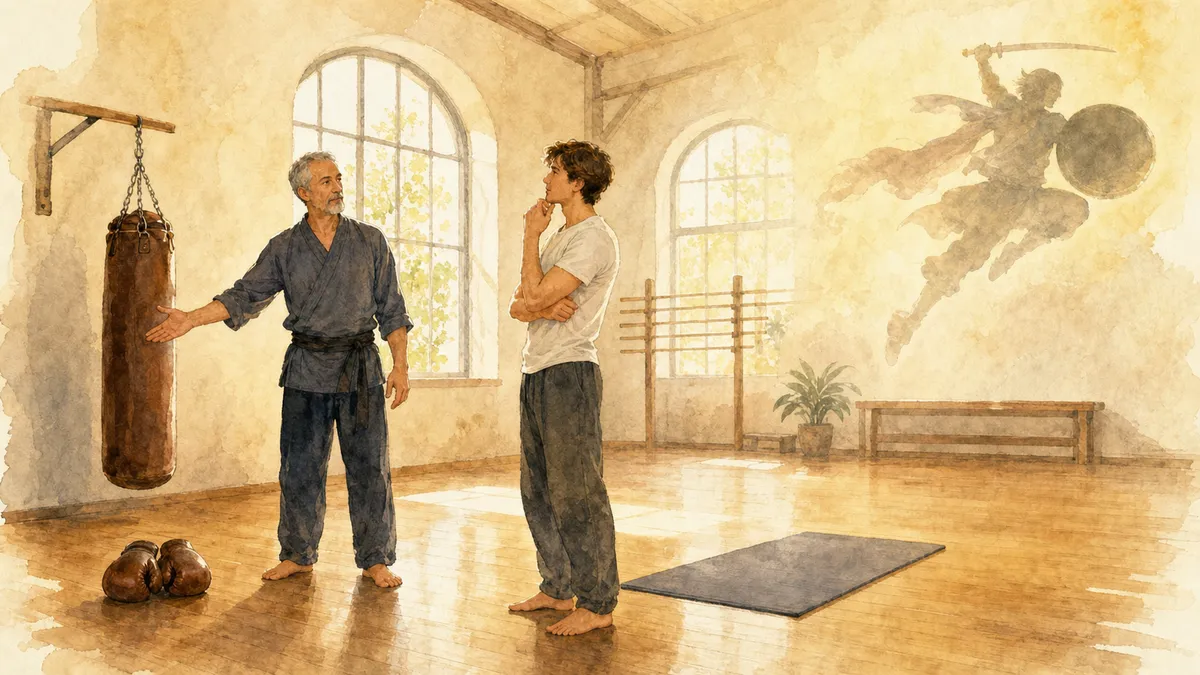
The teaching, when we comprehend it correctly, removes all fantasies, giving crystal-clear understanding, when your mind becomes so clear that it is like an impeccable surgical scalpel, capable of cutting through any illusions and delusions by the power of its understanding, and therefore it will always lead you onto the right path. It is precisely for this that we study the logic of proper practice.
The Right Emphasis at the Beginning of the Path
What, then, should emphasis be placed on at the beginning? On acquiring:
- faith
- commitment
- samaya
- the initial level of self-liberation
- concentration
- the practice of meditation on emptiness and atma-vichara in movement
When you have all this, you perceive the very essence of the teaching.
