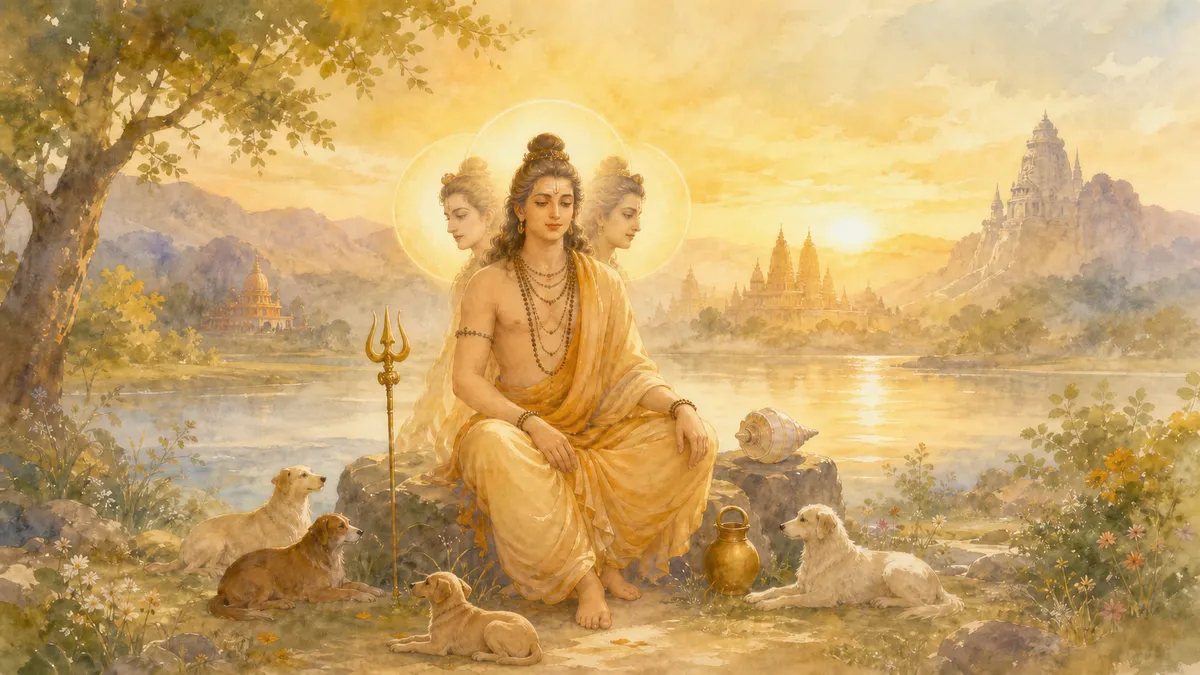
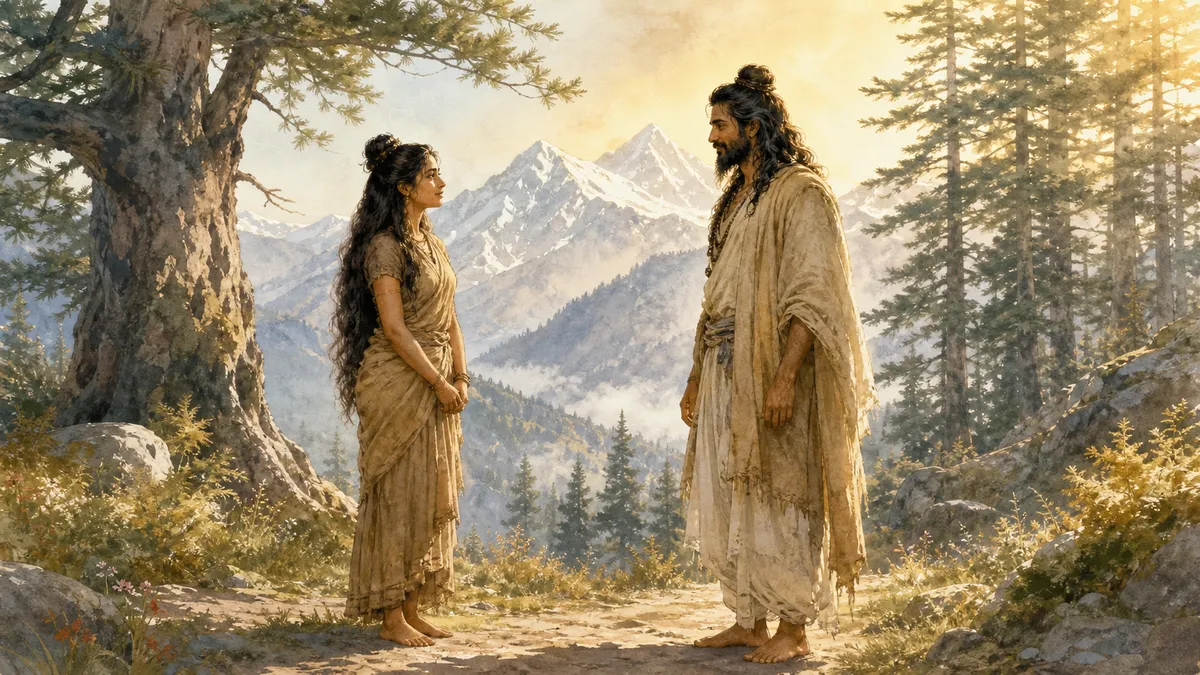
The Myth of Shiva and Parvati as the Path of a Yogi
07.07.2026
0 мин. чтения
0
Share
copy
search
add
share
Dharma means following the path of becoming a divine being, and this means transitioning into another race, even into another species, another class of beings. We must always think that when we follow the path of Dharma, we are following the path of evolution. To follow the path of Sanatana Dharma means gradually discovering within ourselves and cultivating the qualities of divine beings.
Why do we strive to cultivate the qualities of divine beings, and not merely human ones? Because we have become disillusioned with samsara, and a human being is also a samsaric being. We have become disillusioned with the worldview of a human being, a limited mortal, limited by samsara, with his way of thinking, his values, the meanings of life, the ways of achieving goals, and the tasks he sets for himself in life. We have become disillusioned with this entire worldview, this scale of values. This is what is called disillusionment with samsara.
But this does not mean that we have given up on the entire human race, on all human civilization, or on ourselves — not at all. We have a path of evolution, we have instructions, sacred scriptures, we have a teaching, and we know where we need to move; we have simply changed the vector of our movement, changed it radically.
If an ordinary person dwelling in the samsaric dimension strives to remain fixed for as long as possible, to remain a human being, to remain a samsaric being, with an ego, attachments, and illusions, then we strive to develop, we strive to purify this samsaric vision, and we believe that this samsaric vision can be purified already in this life, without departing to some heavens, and that a godlike consciousness can be realized. When we have faith in this, our spiritual path on the path of Sanatana Dharma begins, and the pratyaksha advaita of the siddhas begins, the teaching of laya yoga in the tradition of the siddhas. But we must have such faith, we must believe.
The Study of Sacred Texts and Entry into the World of the Gods
We will begin reading a text about Shiva and Parvati. Why do we study texts at all? Texts purify consciousness; they show a different way of thinking, not inherent in people, but inherent in the gods, a different state, a different vision. Therefore, it is very important to study them. We study Advaita, traditional Sanatana Dharma, its esoteric part — laya yoga, the five yantras of laya yoga. And these are the main principles: shravana, manana, nididhyasana, the teaching of the 16 kalas, and we also create the conditions in which all of this works: samaya, guru yoga, pure vision, Refuge, ethics, the single samaya of contemplation.
However, this is not enough, because Dharma is not simply following certain methods, logical schemes, or discipline and ethics; it is, in general, immersion in another world, in another atmosphere, and we need to enter it, this other world. With the help of the teaching, we need to completely rethink all our worldviews and assessments, and this other world is the wisdom of the gods, the powers of the gods, the ethics of the gods, the culture of the gods, the greatness of the gods, the knowledge of the gods, the games of the gods, and the manifestation of the gods in the material world.
Gradually, thanks to the teaching, we enter such a dimension of divine beings, and we begin to understand them. This also means that within us certain divine aspects gradually begin to open, and it is precisely because of this that we gradually become liberated, because liberation means precisely liberation from our human limitations, liberation from everything that shackled us and binds us as a human being. This does not mean that in this life we will grow six arms or five heads; in this body we will certainly remain human beings. But it means that a divine dimension is growing within us, and in this divine dimension we possess wisdom, the power of omniscience, all-pervasiveness, omnipotence, the power of the illusory body, the power of understanding, clarity, and many other things. Because the qualities of a divine being are the blossoming of various powers and energies.
Divine Energies and Their Manifestation
In a human being, these powers and energies are suppressed, and even if he tries to develop them, they often do not even benefit him, because he tries to develop them egoistically. For example, if you have low intelligence and little wisdom, it means that your jnana-shakti is suppressed; the mind thinks poorly, like a bad computer that freezes and slows down, and you cannot make decisions quickly or perform complex calculations in your mind. But if divine qualities developed within you, then the mind would be like a high-speed computer, a powerful processor capable of performing enormous calculations.
Or if your concentration is weak, you are not purposeful, you are easily thrown off course — this means that your will, your ichchha-shakti, is not developed; you do not know how to use it as an instrument. And in the case of deities, ichchha is a universal force that moves the deities along the path.
Or, for example, your mind easily falls under conditionings, concepts, connections, attachments, relationships, kleshas, and you do not know how to self-liberate through the power of natural awareness, looking into yourself, looking into the divine essence of the Absolute; this means you lack svatantrya-shakti. That is, this type of shakti is suppressed in you; everything impresses you, everything influences you, everything limits you. There is such a type of person: touchy, suspicious, lacking svatantrya-shakti, which means this power is not developed, does not blossom. Conversely, deities are endowed with svatantrya-shakti, the power of complete inner freedom.
In the same way, deities are endowed with many other energies, for example:
vichara (the power of the ability to investigate absolute Consciousness)
viveka — the ability to distinguish one thing from another in detail, to understand nuances and details thoroughly without getting confused
vairagya — the power to be detached from everything, even while immersed in some work or activity of mind, body, or speech — to remain detached against the background of all this, like Shiva
The Lila of the Gods and Pure Vision
Lila, play, is an ability of deities; it is not an ability of people. People are constantly getting entangled, and all their actions are their karma, cause and effect, and from one cause the consequences rigidly follow. They are compelled to perform certain actions by samskaras, vasanas, past karmas, planetary influences, and the course of society’s development; therefore, in a certain sense, people move rigidly along a well-worn track. But the gods play; they depend neither on causes nor on consequences, do not accumulate karma, do not depend on vasanas, do not depend on parental karma or genetics — all of this is lila.
Pure vision is also inherent in deities. It is not inherent in people. The Guru gives lectures on pure vision for decades, and with great difficulty it penetrates people’s consciousness. But pure vision is inherent in deities from the very beginning. When a deity sees a person, it sees the same deity in him; it understands that this is simply a deity now in this form. But when a person sees a deity, he may project something even onto the deity. It is said that when the Buddha sees a person, he sees in him the same Buddha, only with limitations; and when a person sees the Buddha, he sees in him the same kind of person.
Pure vision is an enormous value in the world of people, and it is not inherent in people; it must be cultivated. In essence, in order to free ourselves from samsara, we must give rise to deep pure vision so that it purifies all our connections, our tattvas, pranas, mind, samskaras, and vasanas.
There is an expanded practice of samskara-shuddhi; in this practice we examine our entire life from the beginning of birth, step by step remembering everything we have done. This practice also exists in the teachings of Tibetan Buddhism. Step by step we purify and purify, remember and remember everything we thought, everything we said in kindergarten, in nursery school, at school, in youth, all the connections we formed, all the thoughts we thought, all the actions we committed, and we purify until we reach the present life and a feeling of purification arises in us.
The Path Through God, Not Through the Ego
We have accumulated a great many different imprints, and listening to such stories is the opening of pure vision within ourselves, an entry into the understanding of lila, the world of deities. Because, in essence, to practice Sanatana Dharma, to worship Dattatreya, to make Dattatreya one’s ishta-devata means to penetrate into the wisdom of the three main gods: Brahma, Vishnu, and Shiva. That is, through the ishta-devata, through Dattatreya, God manifests for us through the three main gods of the Vedic tradition. We need to understand — this is a very great mystery, a very great secret, a very great play.
What is Brahma? What is Vishnu? What is Shiva? How do these aspects manifest in us? Divine beings also signify a single “taste,” divine majesty, abiding in the space of open consciousness. They also signify abiding in happiness (sukha), in ananda, abiding in constant deep svarupa samadhi, sahaja samadhi, omniscience, omnipotence, omnipresence, all-powerfulness, and absolute sovereignty. All of this is the vector of our evolution on the path of Dharma.
We acquire them not through egoistic efforts, not through anava-marga (the path of ego development); we acquire them through God. As soon as we want to acquire them through the ego, solely through personal efforts on the path of anava-marga, we can immediately rightly be called Tantric sorcerers; that is, we have already begun to depart somewhat from the original, greater path, the divine path of Sanatana Dharma, Advaita, and the teaching of Laya Yoga, because this path is somewhat different; it is somewhat the path of asura tapasya.
The asuras are considered ancient gods; they arose even before the present modern gods, and they relied very heavily on the ego. This path is considered difficult, dangerous, and leading to delusion. Therefore, when we say that we are following the path of divine qualities, we are going through surrender to God, through self-giving, through the revelation of God, not through the egoistic accumulation of siddhis. This means that we need to comprehend jnana, the path of devotion, and the path of tapasya.
Brahma’s Plan: The Incarnation of Parvati
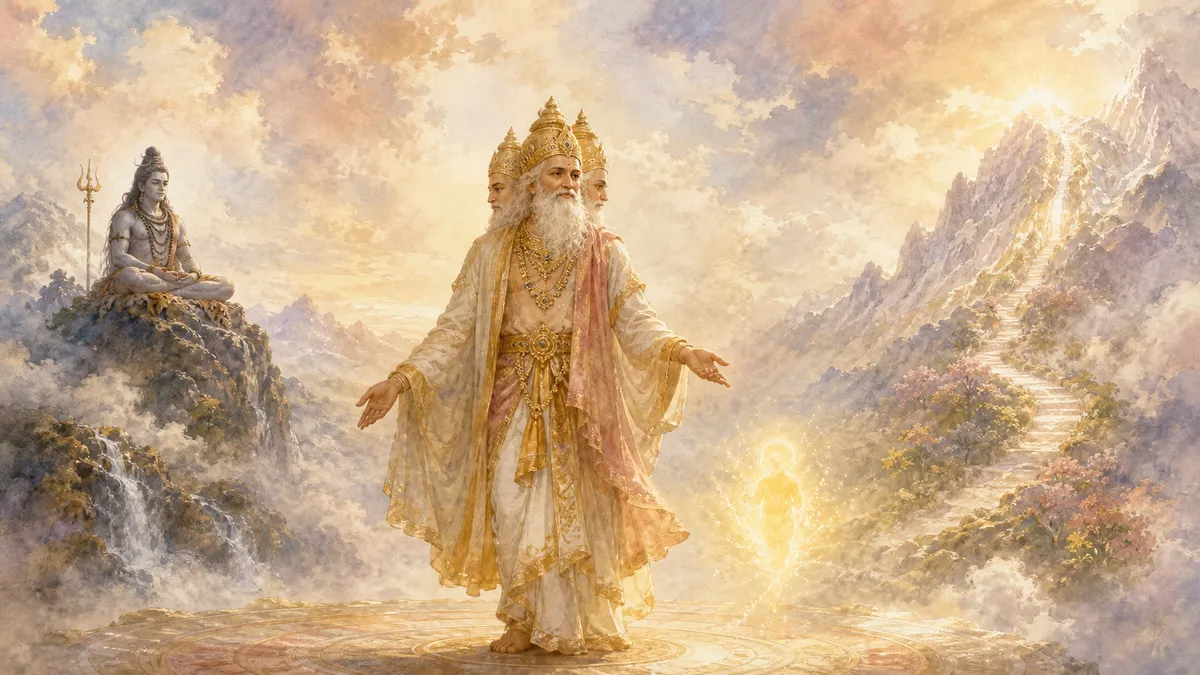
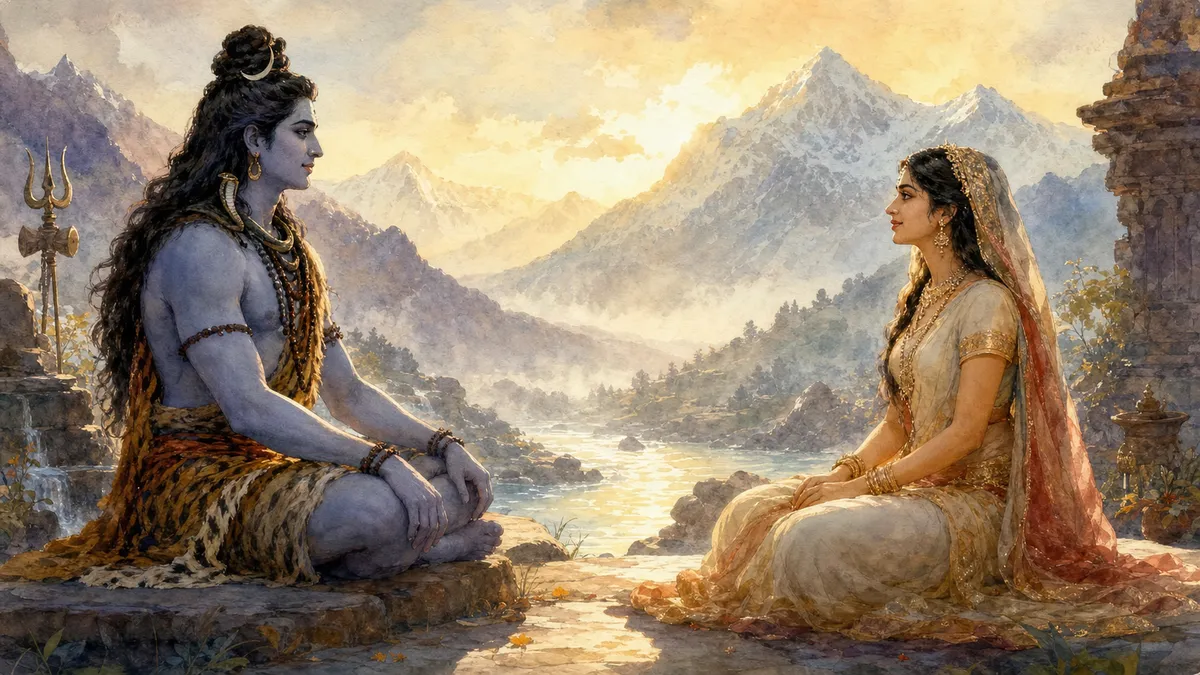
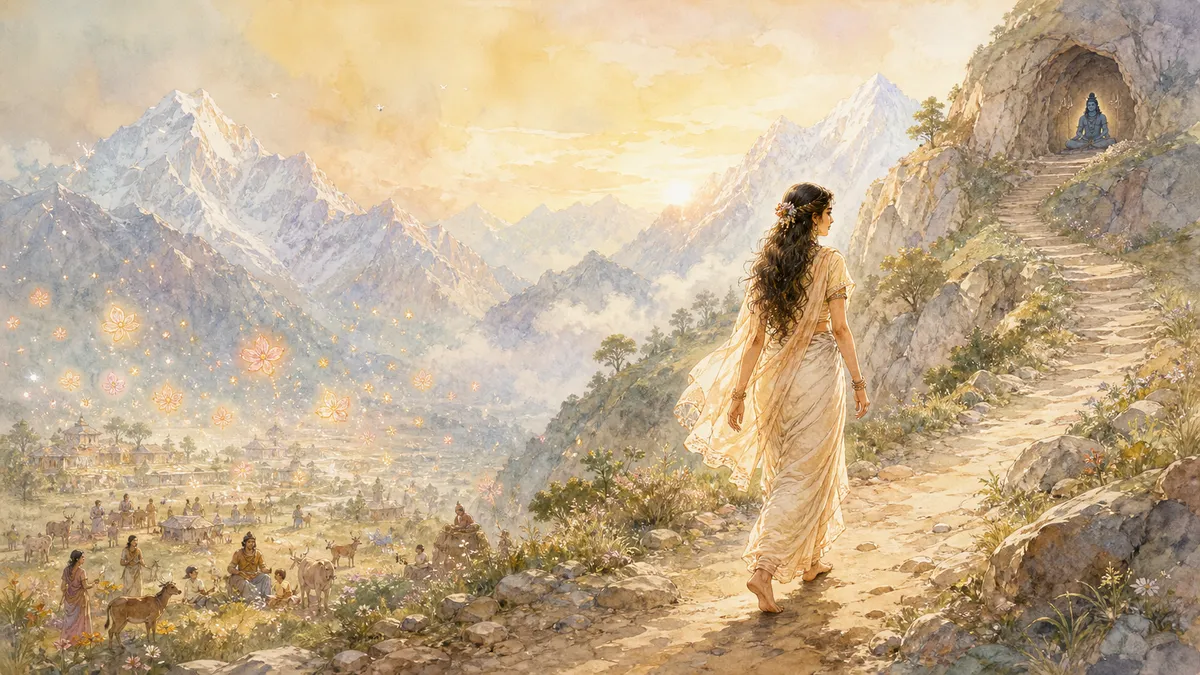
Brahma prepared the birth of Parvati so that the Lord would help achieve his goal. The Great Goddess, joining forces with Brahma, incarnated a second time as the daughter of the Mountain.
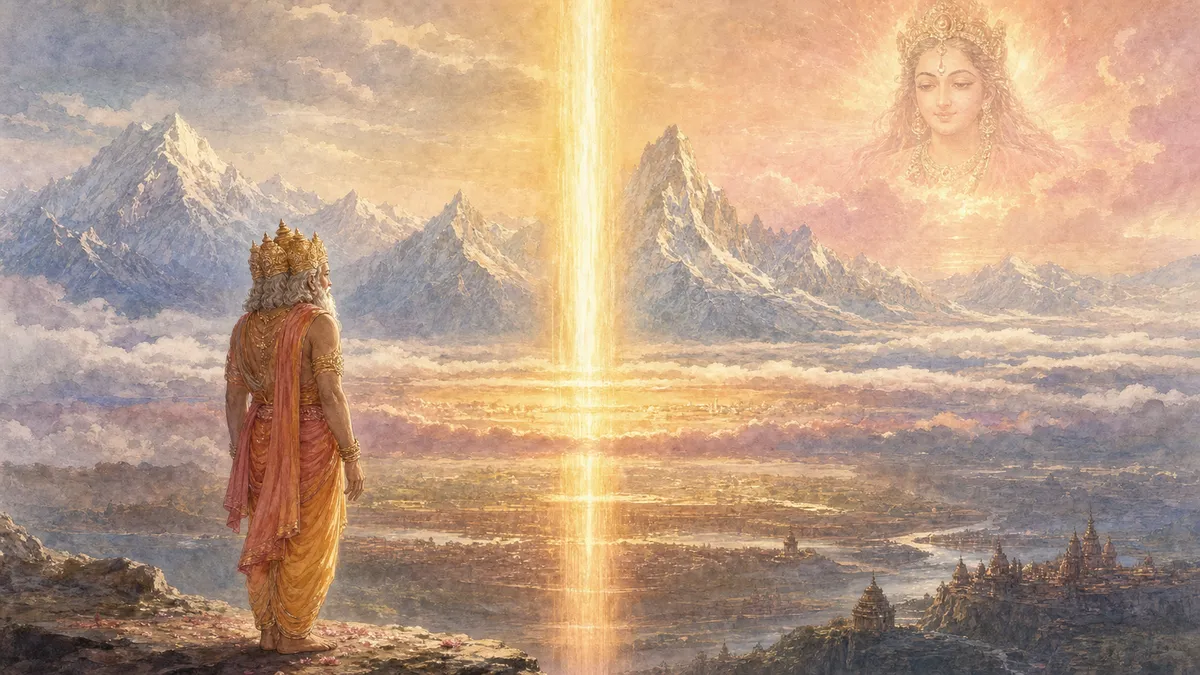
So, Brahma had his own plans for Shiva. He wanted Shiva to support the material creations. And Shiva, being an ascetic, being a completely unattached and detached being, spent all his time in samadhi. And once, in response to Brahma’s proposal, he expressed his unwillingness to support the material creations. He manifested in the form of an endless pillar (sthanu) extending into the higher and lower worlds. But Brahma, wishing to create and wishing to develop this Universe, since this is his way of service, did not give up hope of drawing Shiva into material creation, and he sought a way to awaken Shiva from this immersion in samadhi. He needed energy, and Parvati played the role of this energy. And he asked the great Mother to incarnate first as Sati and then as Parvati, in order to awaken Shiva from what seemed to Brahma to be the sleep of samadhi. So that material energy would begin to move.
She became established in the mind of the god of the Mountain when he was making love with Mena, and Mena became pregnant.
The god of the Mountain is Parvata, the lord of the Himalayas, Himavan. Brahma placed this sankalpa into the mind of the god of the Mountain, Parvata. And because of this, when he and Mena were making love, a powerful sankalpa arose that attracted Parvati. And this was Brahma’s plan. This Parvati was to become the wife of Shiva.
Brahma’s long-unsatisfied desire to create mortal offspring with Shiva’s help was now displaced by a new need. Only a super-deity born of Shiva could destroy the demon Taraka.
Brahma’s task of creation was further complicated by the appearance of the demon Taraka, who disrupted the entire course of the Universe’s construction, began to oppress the gods, and began to seize vast regions of the Universe. Brahma planned to create a civilization of mortal beings, to develop this civilization, to send Manus and Prajapatis, and here the entire plan of creation was threatened because some egoistic, asuric energy began to manifest its shakti powerfully, so much so that even the gods could do nothing about it. And therefore, in addition to wanting to impel Shiva toward material creation, he decided to summon a super-deity capable of subduing this demon. This demon Taraka, through the power of his tapas, had even begged from Brahma such a blessing that he could be destroyed only by a child seven days old, a divine child. And it was necessary to create such a super-deity with the help of Shiva and Parvati, and this was Brahma’s plan.
The Incarnation of the Great Goddess and the Reasons for the Destruction of the First Marriage
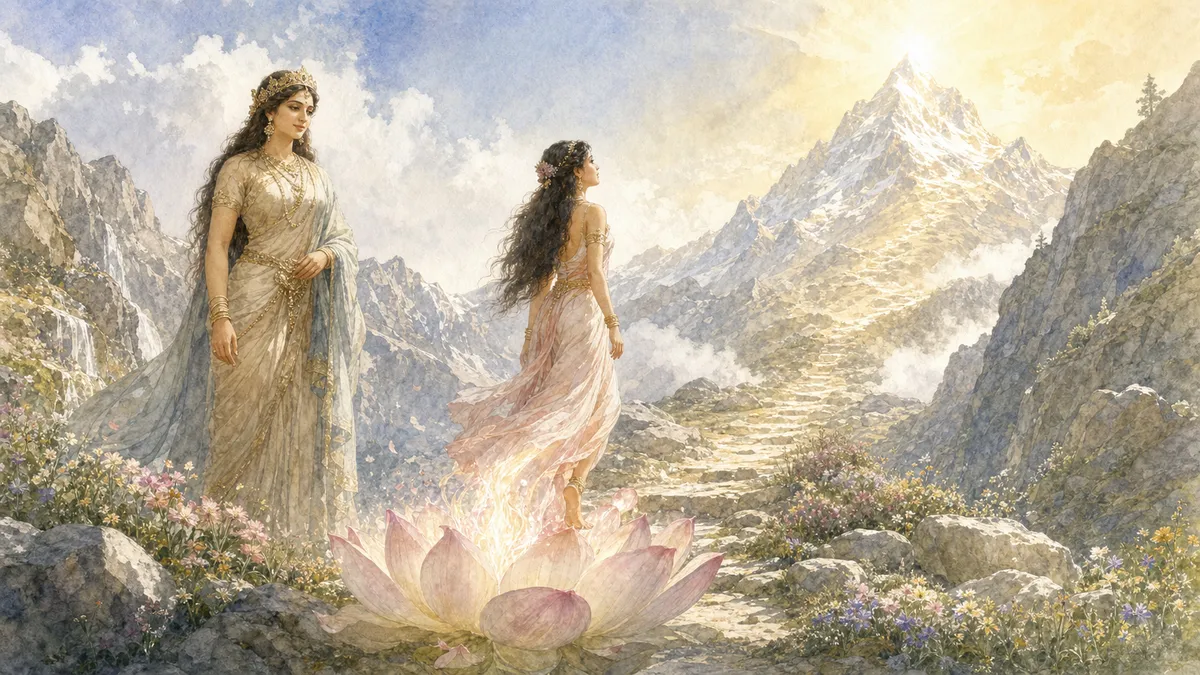
Parvati was the complete embodiment of the great Goddess. Previously, the great Goddess had incarnated as Sati in order to win Shiva’s love. Now she decided to be born as the daughter of the Mountain and Mena, taking this form at the request of the gods. The great Goddess, eternal Prakriti, remembered herself casting off her body as Sati.
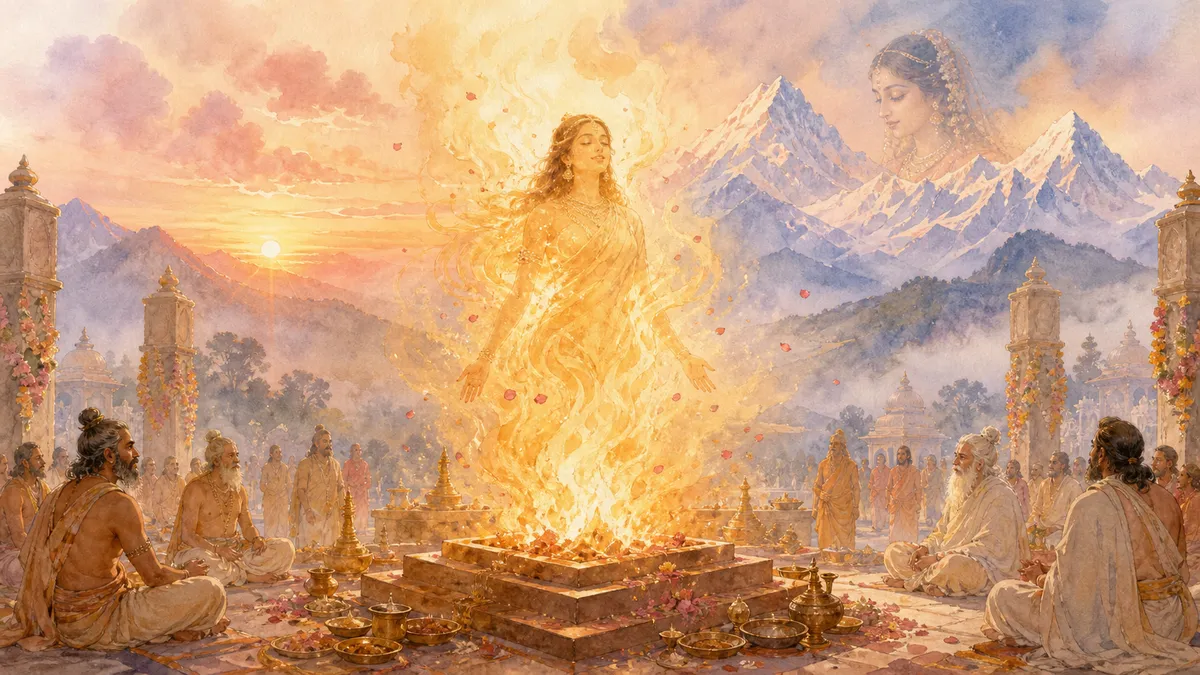
The first time, as we know, the great Goddess incarnated in the form of Sati. She burned her body after she had been insulted and Shiva had been insulted at Daksha’s sacrifice. As a sign of protest, she did this by the power of her mystical tapas. Thus, the first time, Sati’s mission as the great Goddess, impelling Shiva toward creation, was not fulfilled. But why did this happen at all? There are reasons for it.
When the great Goddess, the universal Mother, great Prakriti, material energy, had only just begun to incarnate, she took a promise from Daksha: “I will incarnate as your daughter in the form of Sati, but I will be with you only as long as I am respected. If I am not respected, I will leave you.” In the same way, Shiva promised Brahma that he would, after all, take up the work of material creation for the benefit of all living beings; he even agreed to marry. He made concessions to Brahma against his own inclination. But he set this condition: “I will marry Sati, I will live with her as her husband, an ascetic, and when I am in samadhi, when I am engaged in yoga, she must be like a yogini; but when I emerge, let her manifest as my wife, as an ordinary woman. But if she does not believe me, then I reserve the right to leave her, because the Atman always leaves material energy and separates when material energy does not follow it.” This was the condition Shiva set before Brahma. Thus these two vows worked in such a way that Sati left her body by the power of her tapas.
The Story with Rama and Sati’s First Doubt
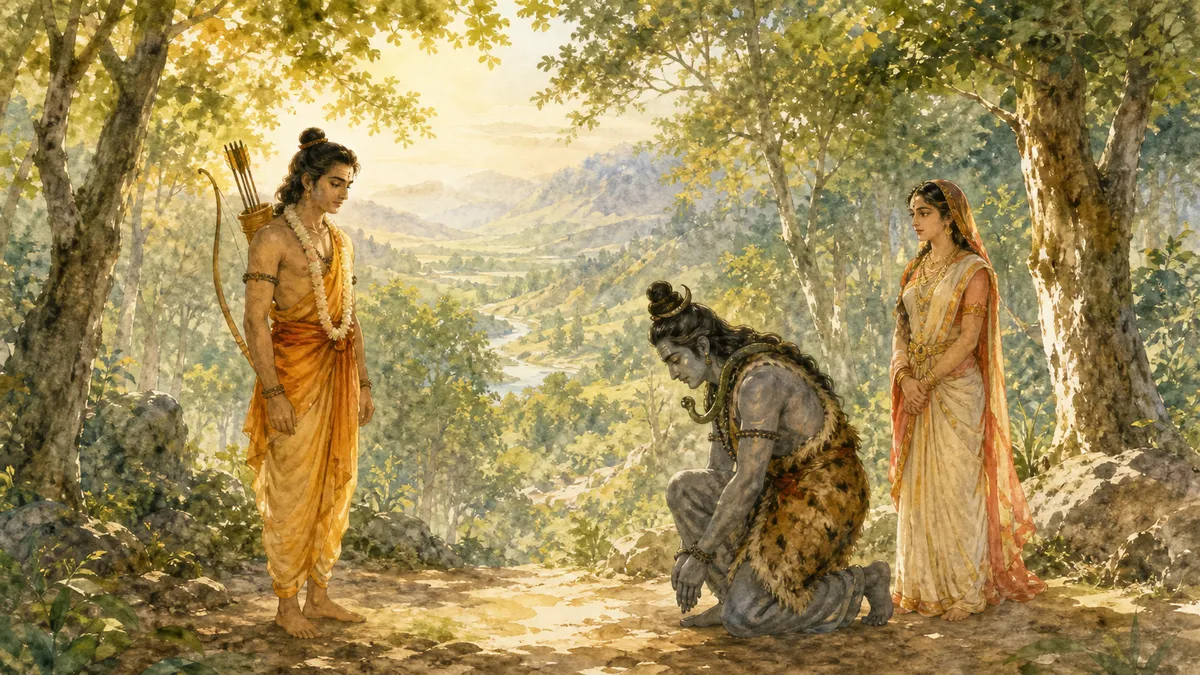
There was also the story of when Shiva and Sati descended into the valley where Rama was living in exile. They met Prince Rama; he was grieving for his Sita. Shiva knew that this was an incarnation of the god Vishnu and that Shiva himself had set Vishnu to reign over the entire Universe, to perform the duties of the Lord of the Universe. He knew that Rama was simply performing a lila, a play, and that in reality he was the god Vishnu himself. When he approached Rama, he bowed to him as to the Lord of the Universe. He could not fail to bow to him and show respect; such is divine culture, divine etiquette. Sati was perplexed and asked Shiva: “Some man is suffering over his woman because his wife has been abducted by Ravana; he is weak, powerless, he understands nothing, and you bow to him? How can that be?” Shiva was a little upset by this; he said that in truth she did not understand his great position: this is Vishnu himself, this is the Lord of the entire Universe, and everything that is happening is simply a play, a lila for the benefit of all living beings. And here Sati doubted Shiva’s words. She decided to test Rama somehow herself.
One day she appeared before him, taking the form of Sita. She came to Rama and said: “Here I am, your Sita; I have escaped from Ravana’s captivity.” And then Rama looked at her, smirked, and said: “I know who you are. You are ShivA (Shiva’s consort), you are Sati, you are not Sita at all.” He saw through her at once, although the power of her enchantment was great. Then she understood who Rama really was: it was his lila, and he understood everything perfectly; he was not attached to Sita, he was carrying out this great lila for the benefit of other living beings. Thus for the first time she doubted Shiva’s words.
The Second Doubt and the Fulfillment of the Vows
Gradually, Shiva’s sankalpa to separate from her began to take effect. And the second time, when they were living in the mountains, thunder, lightning, winds, and hurricanes began there; she doubted that Shiva, living as an ascetic, wearing the skins of a tiger and an elephant, could protect her from thunder and unfavorable factors. And she began to complain, since she had lived in a palace, in such beautiful conditions. Shiva then smiled and raised her onto a cloud above the thunder and lightning, lifted her into the sky for a while, to where the lightning could not reach.
And so, because of these two occasions when she doubted Shiva’s words, Shiva began to distance himself from her somewhat. Thus the mutual vows of Sati and Shiva worked in such a way that they could no longer remain in this incarnation, because when divine beings make any vows or sankalpas, they are inevitably fulfilled.
Daksha’s Repentance and the New Incarnation of the Goddess
It so happened that Daksha did not honor Shiva at the sacrifice, and Sati was insulted, and therefore she left her body. And when Daksha realized what mistake he had made, that what the goddess had said had come to pass: “If you do not respect me, I will leave you,” he repented greatly. He began to ask: “How then am I to find you? I know that you are the great Goddess; it is simply maya that has led me into illusion.” She said this: “You will find me everywhere and in any place.” That is, the great Goddess is Prakriti herself, material nature; she does not disappear anywhere. And she decided to incarnate a second time in the form of Parvati.
Sati was insulted by the disrespect shown by her father Daksha toward Shiva. Before the yogic fire engulfed her, Sati told Daksha that she could be found at any time, in any place, in every being; there is nothing in the universe in which she cannot be found.
And yet Shiva could not find her and attain peace. He made a necklace from her bones; he wailed loudly, mourning her, as if he were not God. The pain of separation made his speech incoherent. By the power of illusion, the Supreme Lord imposed pain and madness upon himself; in reality he is unchanging, unwavering, and invincible. Although he changes his forms, maya does not touch him. What are love and illusion to him?
Someone may think: how could Shiva experience such attachments, suffer because of them, because of his wife? For a householder, a worldly person, these are indeed sufferings, but for God, who is free, liberated, an ascetic... even many monks successfully rid themselves of attachments and do not suffer precisely from attachments. In reality these were not sufferings; it was a game. There are different energies; the deity amuses himself with these energies, he does not reject them, he freely manifests them and, at the same time, benefits other living beings. These energies are safe for him; they are like the snakes on Shiva’s chest, they cannot bite him. And the deity is in a state of Brahma-ananda (absolute bliss); he is capable of amusing himself and enjoying even such energies. In a paradoxical way, he enjoys even sufferings.
If we avoid suffering and enjoy only the energy of subtle pleasures, then divine beings can play, enjoy, and manifest any energies that seem to us somehow incomprehensible or wrong. Therefore this was a form of lila, a form of play, a form of Shiva’s enjoyment for the benefit of living beings.
The Demon Taraka and the Need for the Birth of a Superdeity
Meanwhile, the demon Taraka oppressed the gods, devastated the heavenly world, having seized the heavenly mountain. No one, not a single god, could withstand Taraka, since he was a great ascetic and had won a boon from Brahma through his asceticism. Taraka could be defeated only by a child seven days old. The slayer of Taraka had to be born as the son of Shiva.
In due time, the great Goddess was born as the daughter of Parvata. She cried like any newborn child, although the girl soon began to play with dolls and balls, and her memory of her previous incarnation did not fade. Parvati had the same advantages of birth as Sati. In addition, she possessed full knowledge of the world of the gods, who acted like human beings. The lineage in which she incarnated, however, was different. Daksha was the son of Brahma the creator, whereas Parvata is far more ancient.
There are different lineages of gods. Parvati belonged to an ancient lineage, to the lineage that is fully enlightened and conditioned by nothing. Because there are lineages of gods that are not fully enlightened, that have some conditioning, are bound by certain energies; they can be called such divine siddhas. Each lineage of gods has its own genealogy, its own type of blessing energy, its own great divine beings. Moreover, each deity also lives, as it were, in its own personal universe. Each of the lineages of gods has its own mysteries, and Parvati was born with full knowledge of the mysteries of wisdom of her ancient lineage, even as a little girl. But all the same, like an ordinary girl, she played with dolls and balls.
The Role of the Goddess of Night in Parvati’s Birth
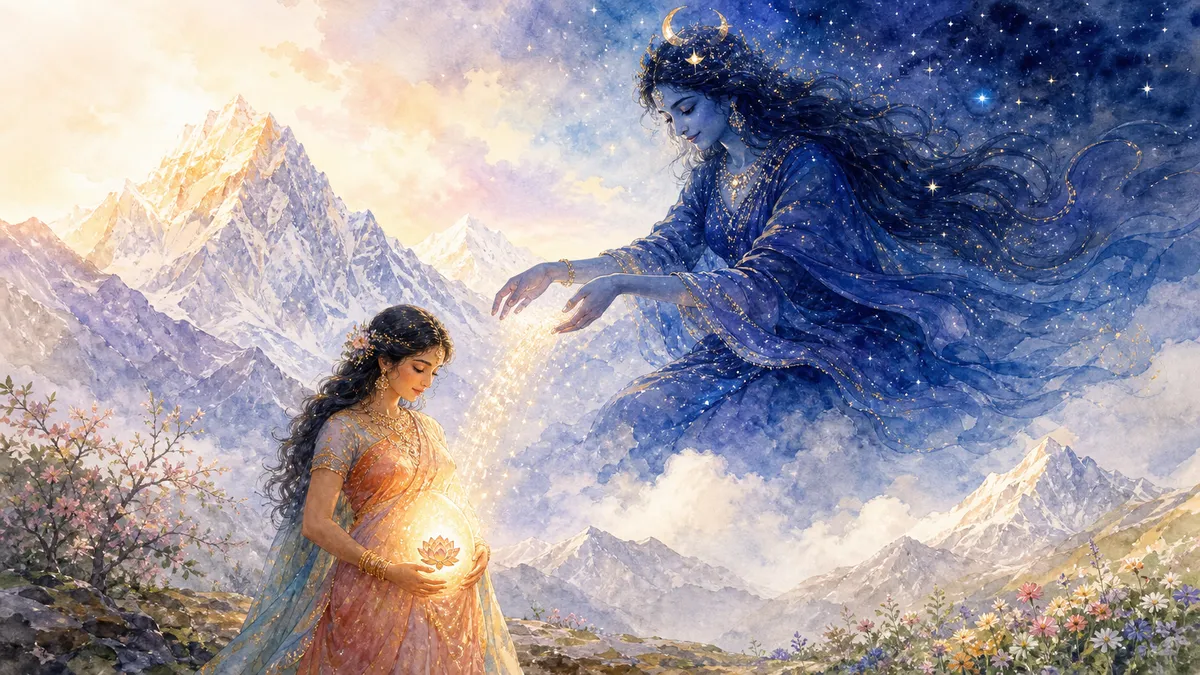
Parvata existed before the beginning of the rule of the gods and before the transformation of the asuras, the titans, into demons. The two incarnations of the great Goddess were distinguished by one common feature—the dark color of their faces, which they owed to the goddess of Night, who entered Mena’s womb. From her father, Parvati inherited the firmness of a mountain.
Sati and Parvati both had dark complexions, and it is said that Brahma specifically summoned the goddess of Night, and night is the unmanifest, chaos, the inner, deep forces of chaos, an immense unmanifest shakti, the power of darkness, the power of the dark. And Brahma summoned this goddess so that she would enter at the moment of the union of Parvata and Mena, so that Parvati would acquire a little of this power and so that she could inflame Shiva for the birth of a super-deity, such as the future Karttikeya. The dark complexion personifies the primordial power of gloom, the chaos of the ancient gods, a tremendous power—shakti.
The Goddess Night, who enveloped Parvati in her darkness before her birth, was to play an important role in Parvati’s relationship with Shiva. According to Brahma’s plan, Parvati was to devote herself to asceticism in order to reunite with Shiva. And when she united with him in marriage, their combined energy would be colossal. But even in that case, the crushing of the demon Taraka seemed unlikely.
The Goddess Night was also to further strengthen the combined tapas of Shiva and Parvati by interrupting the act of love with a quarrel. Shiva would jokingly reproach Parvati for her dark skin color; the vexed Parvati would leave Shiva and take up austerity in order to rid herself of her darkness. Shiva would also practice tapas. After such an interruption, which multiplied their energy, the son born of their union would be capable of destroying Taraka.
Here Brahma took precautions: he arranged it so that their union had to be interrupted for additional tapas, because a great super-deity had to be born. He thought that even the combined powers of Shiva and Parvati might not be enough to defeat the demon Taraka if they did not perform this tapas. Therefore he created such a chain of cause and effect, such a samskara, which was to lead to these events. From the point of view of human thinking, this seems incomprehensible. How is it possible to take such subtle causes and effects into account, to influence so subtly, to play so subtly? But for deities this is normal; divine beings see the past, the future, and the present. At the right time, through the right imprint, they can unfold any situation that can lead even to the birth of new causes and effects, even of a new connection. This is the art of iccha-siddhi.
Brahma instructed the goddess of Night to use two means to intensify the sexual power of Shiva and Parvati: tapas and a quarrel. If the pleasure of love were interrupted, their unsatisfied desire would become irresistible. The quarrel itself, by increasing their emotional tension, would require tapas for calming. Then the heightened desire would lead the god and goddess to an unparalleled union, from which the conqueror of Taraka would be born.
Brahma’s plan implied that the very asceticism of the gods should contribute to the birth among them of the savior of the world. To compel Shiva to beget a super-deity, it was not enough for Brahma simply to command Shiva, as he had once commanded him to create mortals. Now the object of Brahma’s concern was the very survival of the gods and their creative activity.
The story of Shiva’s wedding, of his meeting with Sati and Parvati, is not merely a story of the gods’ love or of some connection between them as Shiva-Shakti; it is, at the very least, a story about the salvation of the world, the salvation of the Universe, behind which in fact stands its chief director—the Creator Brahma. It is a story of aligning the balance of forces in the universe between the gods and the asuras, in which everyone plays their role. This is the story of divine play.
Both were under threat; a new deity was needed, one surpassing Taraka and any of the gods in power. It could be born only from the union of Shiva and Parvati. Brahma’s goal was now different: Shiva had to beget not mortals, but a super-god to crush the invincible demon. In devising his plan, Brahma played his role in Shiva’s lila, in which the gods seemingly behave like mortals. He took into account that tapas, or asceticism, can be practiced with different aims.
Both Parvati and Shiva devoted themselves to ascetic practice. The tapas of Shiva, the lord of yoga, led to samadhi, to the realization of his supreme transcendental nature. The asceticism practiced by Parvati, however, led neither to the renunciation of all outward-directed activity nor to samadhi. Yoga is not exhausted by strict discipline of the will, although it is part of asceticism. For Parvati, ascetic practice is a means of cultivating energy in order to win Shiva as her husband. Everything can be gained through tapas: beauty, fame, and prosperity in the human world and in the world of the gods. And Parvati was certain that what is desired is attained through asceticism, and that nothing is impossible for an ascetic. She would not have spared even her own body for the sake of austerity, since she had no doubt that by practicing tapas she would draw Shiva to herself, win the love of the great yogi, and become his wife.
Parvati was born specifically in order to fulfill the mission given to her by Brahma. And her austerity was not for the sake of attaining liberation, enlightenment, and siddhi; she was already a great Goddess, the universal mother, and she had no need of this. That is, Parvati was, as it were, the embodied sankalpa of the great Goddess in a specific body, in specific circumstances.
There is such a story (if we run a little ahead) about Shiva’s wedding. When Shiva, after the negotiations, was already riding to the wedding, Parvata and Mena, his father-in-law and mother-in-law, were awaiting Shiva. And Mena went out onto the terrace to look from afar at this beautiful procession. A very beautiful procession was approaching: Manigriva was coming in splendid garments, in shining armor, the lord of the yakshas, and Mena thought that it was Shiva himself riding there, and she became very inspired. But she was told that this was not Shiva; it was a person from his retinue. She thought: “If someone from his retinue is so great, then what must Shiva himself be like?” And she awaited Shiva with even greater inspiration. She was mistaken in this way thirteen times. Because various parts of Shiva’s retinue were coming—ganas, bhutas, pretas, spirits, yakshas, rakshasas, gandharvas. She saw such great leaders and was mistaken thirteen times; she expected Shiva to come in the same magnificent form. But when she saw that Shiva was coming in a terrible appearance, covered with ash, wearing the skin of a tiger and an elephant, with matted hair, five-faced, three-eyed, with ten arms, and in his hands a skull, a bow, and a trident, and that he was surrounded only by pretas, spirits, and ganas—she fainted. She had not expected such an appearance from her son-in-law. She wanted to run away and began to shout that she did not need such a life at all, that she did not need such a wedding. Her husband Parvata tried to explain to her that Shiva actually has many names, many forms, that he can assume any appearance, but she did not want to listen to this. She said that she would sooner take her own life than permit this marriage, that she would sooner give up the heart from her own breast than give her daughter, her Parvati, to this incomprehensible god.
Then, at that moment, Parvati came out and said that in fact she had performed serious tapas in order to become Shiva’s wife, and that she had put into this tapas all her heart, all her spirit, all her life, all her awareness, all her faith. She told her mother that she could do whatever she wanted, but she would become Shiva’s wife, because this was the purpose for which she had been born. At that moment she surpassed herself as a daughter and manifested as the great Goddess who remembers why she was born. And then Mena, her mother, completely lost control; beside herself with rage, she grabbed her and began to beat her. And only Parvata, her husband, calmed her down, saying that Shiva would become Parvati’s bridegroom by assuming his normal, decent, beautiful appearance. And only when Shiva assumed a wonderful, beautiful appearance did she calm down.
The Manifestation of the Energies of Kama, the God of Love
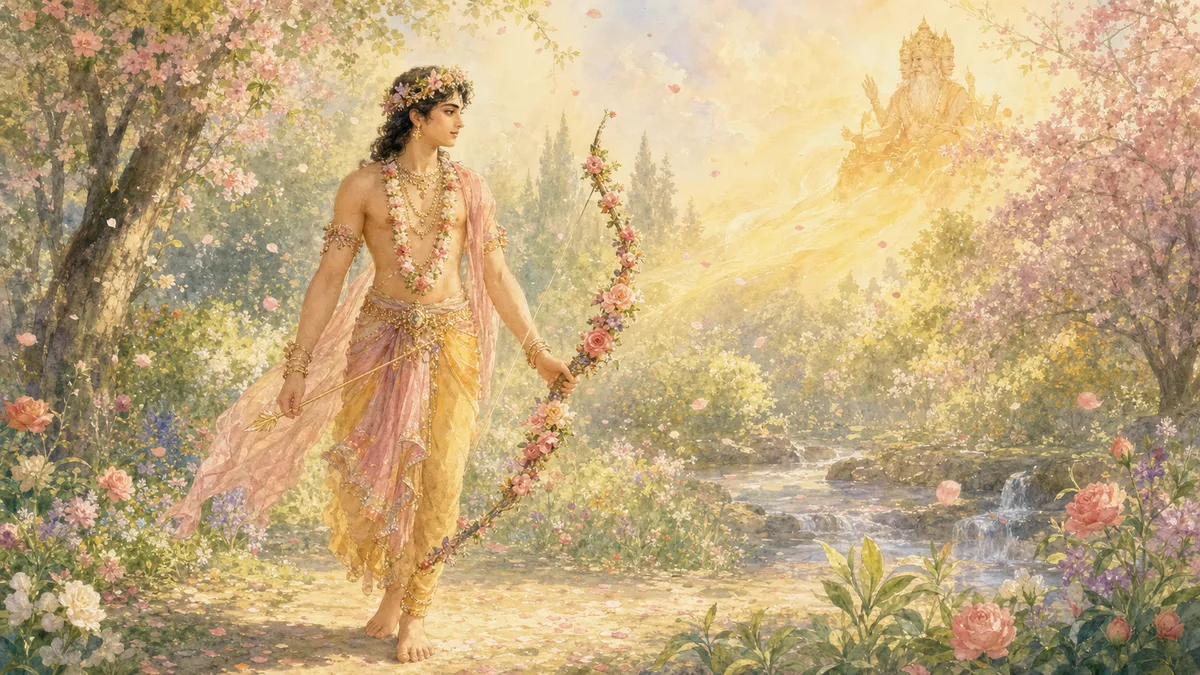
When Parvati grew up, she conquered the whole world with her beauty and intelligence. The rishi Narada read from her palm that a naked yogi, free from desires, having neither father nor mother, would become her husband. The description undoubtedly refers to Shiva. No one except Kama, the god of love, can bring about this union. Kama, who could wound beautiful women and gods, sages, demons, and others with a sly glance, must accomplish the incredible and make Shiva his victim.
Kama—in Greek mythology, Cupid—is a deity associated with the energy of kama, with the energy of lust, attachment, flirtation, sexual love, and infatuation, capable of provoking the emergence of these energies in any being in the universe. Brahma himself gave him such a blessing, and Brahma very much wanted to create, very much wanted beings to reproduce; this is his function, his service and design. And then he specifically created Kama for this purpose. That is, Kama personifies the energy of attraction, the awakening of such attraction (prabhava-siddhi), the energy of lust.
This is a rather coarse red energy, a related energy, kandarpa-vayu, coming from the area of the kanda, which very strongly arouses attachment and lust in living beings. Brahma said this: “Spare no one, not even myself.” That is, shoot at everyone, awaken this energy in everyone, because I need to create, I need to fill the earth, the entire universe, with living beings. Therefore, this energy must work through their bodies. Living beings must produce offspring, experience lust, copulate, and so on. And Kama was simply doing his work. And this time Brahma also summoned Kama to strike Shiva, to awaken this energy in him in order to save the world and beget Skanda.
At the moment when Indra thought of Kama, he, together with his wife Rati (the goddess of lust), appeared before Indra. Accepting the almost impossible mission entrusted to him by Indra, Kama, accompanied by Rati and Vasanta, set off for Shiva’s abode in order to interrupt his ascetic practice.
This was a special group sent by Brahma: three divine beings—Kama (the embodiment of the energy of being in love), Rati (the embodiment of the energy of lust), and Vasanta (the embodiment of spring, who awakens curiosity, flirtation, interest, and various desires). All three of these divine beings approached Shiva in order to bring him out of samadhi. This is the energy of Venus.
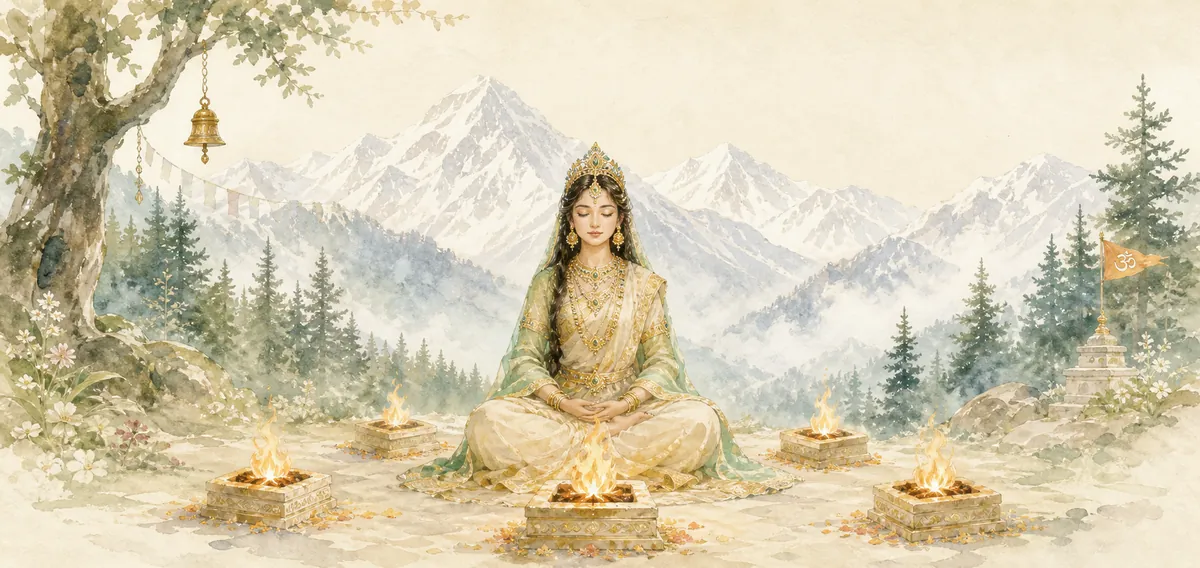
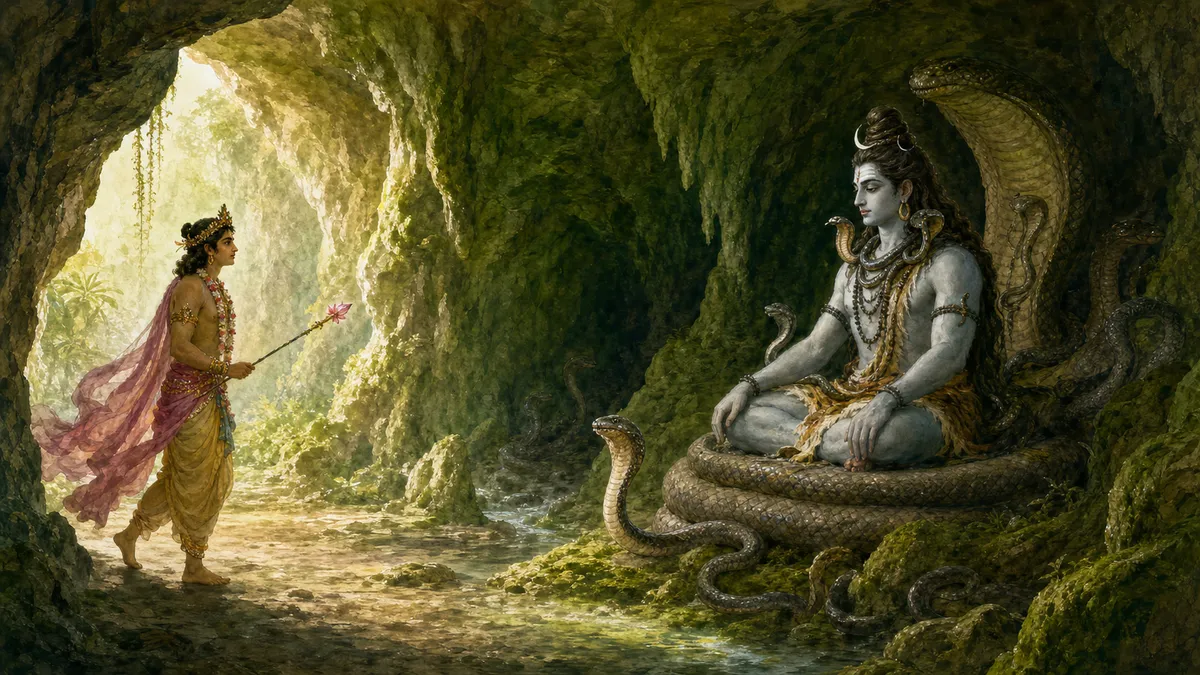
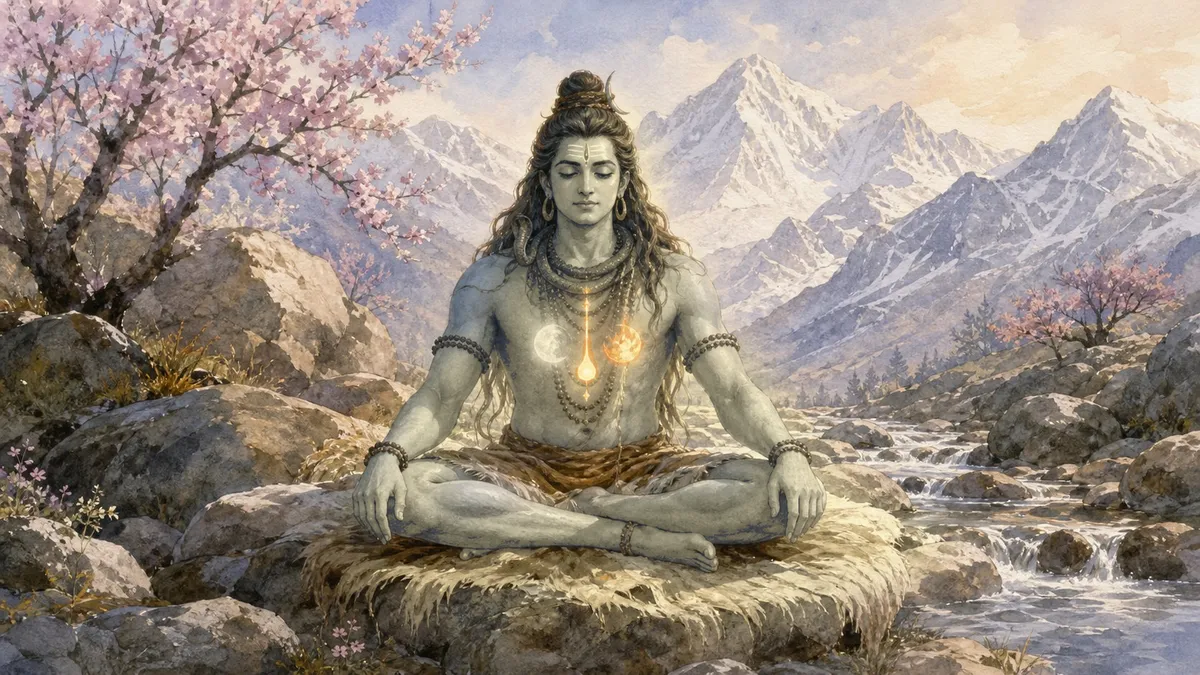
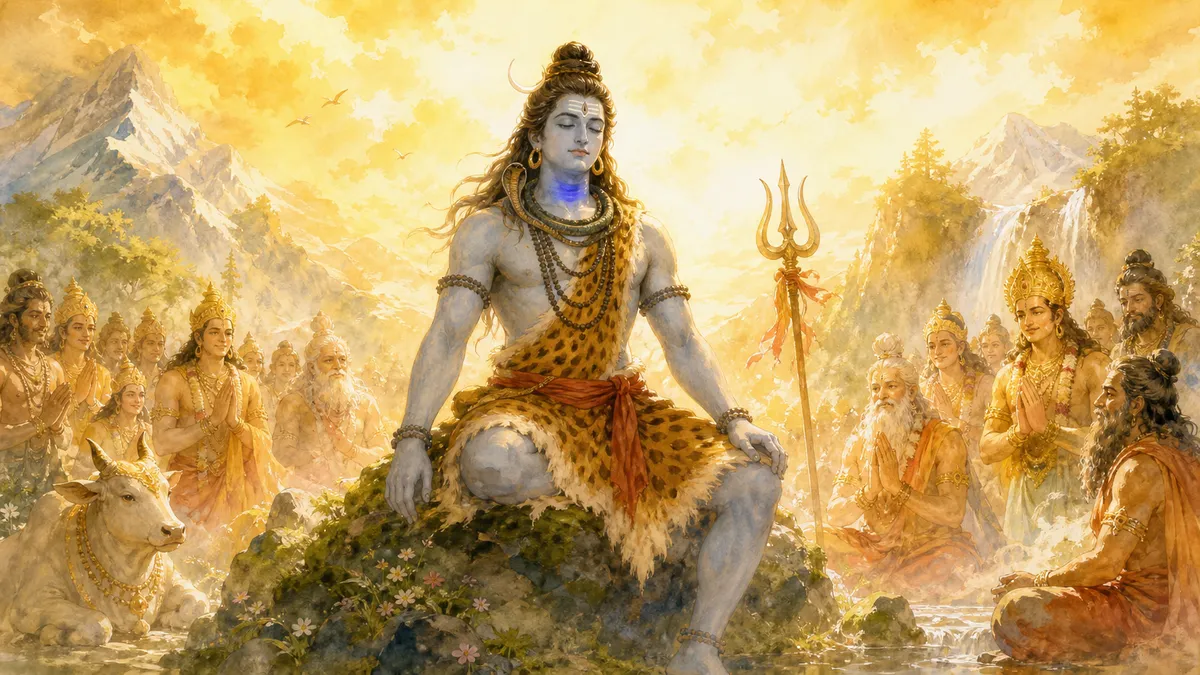
Kama, the god of love, entering the green cave on the mountaintop, found Shiva seated in deep meditation, in the hero’s pose, upon the coiled Vasuki. Shiva’s long, matted hair reached the ground. Before him lay a skull and a vessel of water. Fearsome snakes, coiled in rings, with raised hoods, adorned his hair, twined around his ears, and also around his entire body like ornaments. A lion skin hung from his shoulders, his eyes were half-closed, his face shone with inexpressible beauty. The snakes, always present on Shiva’s body, looked especially frightening when Kama prepared to attack Shiva.
It is believed that these snakes are, as it were, at the same time ornaments, weapons, and powers; this is a certain power of the nagas. These snakes sometimes transform for him into his bow and arrows. For example, Shiva struck the triple city of the asuras with a single shot. And these snakes are capable of taking the form of his weapons; that is, this is a certain shakti of Shiva, a shakti coming from the worlds of the nagas, from the lower dimensions.
Excitedly raising their hoods, coiling around his ears, they breathed fire. The king of snakes, Vasuki, served as Shiva’s seat. The snake—a symbol with many meanings, deadly and threatening—protected Shiva’s solitude. Shiva held the serpent king by the tail, and used the rest of the brood of snakes as ornaments. They surrounded and guarded him, like their ancestor Vritra, who before creation lay coiled around the cosmos, like the snakes in countless modern images spreading their hoods over the lingam.
Shiva was protected by energy, and this energy manifested as snakes. Every self-respecting sadhu knows how to protect himself on the energetic and subtle level. If a sadhu is inexperienced, he does not know how to protect himself. But when an experienced sadhu sits down in retreat, he performs protective rituals, does achamana, sprinkles water around his cell, or at least performs kavacha, or visualizes a vajra canopy in the subtle body. And thus he is certain that the subtle space around him is sealed, protected, and he feels safe and secure.
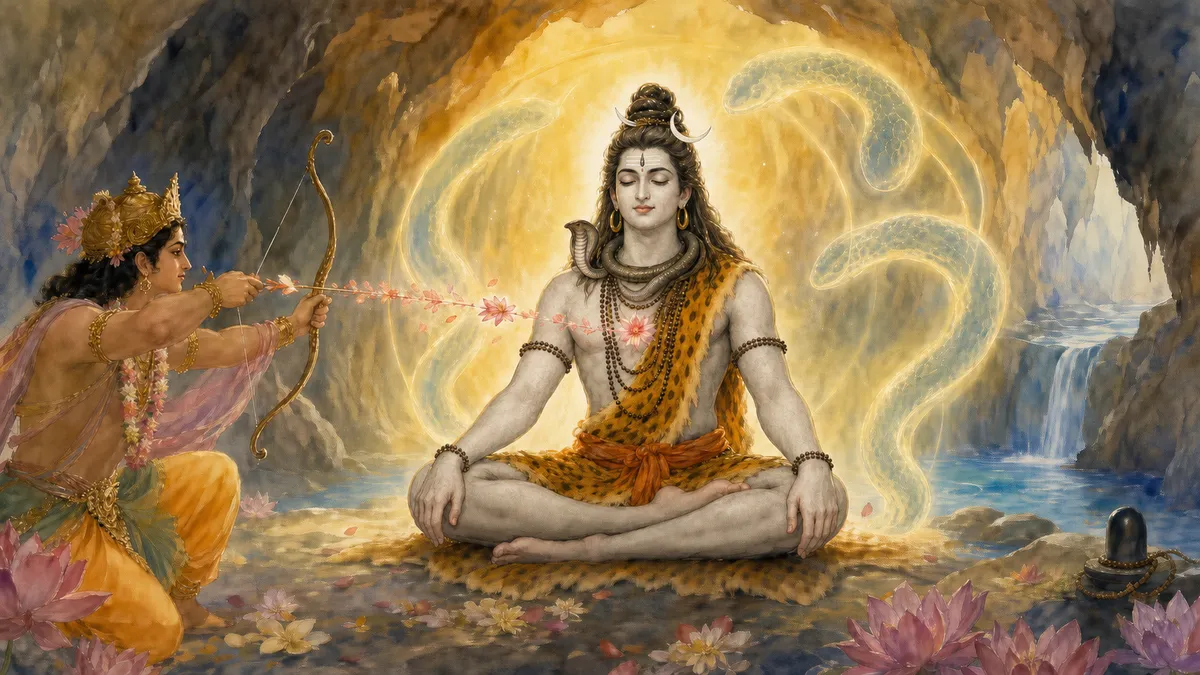
Kama invaded Shiva through his ears and his samadhi was disturbed, but Shiva, with the help of his yogic power, entered samadhi again, and Kama, pushed out of Shiva’s body by this force, released his flower arrow into his heart!
The Nature of Kama’s Divine Energy
Here it should be remembered that Kama is also a deity, and moreover one possessing power blessed by Brahma himself. Therefore he could attempt to bring even Shiva out of samadhi. That is, this is a universal, all-pervading energy whose task is to impel living beings toward creation, the manifestation of desire, falling in love, relationships, the conception of offspring, and all romance. All the romance that exists in the world is the energy of Kama; it is the energy of being in love, love, attachment, flirtation, desire, and all human culture is also strongly influenced by this energy. And as soon as you look at someone in that way—that is it, it means Kama has already shot his arrow into you.
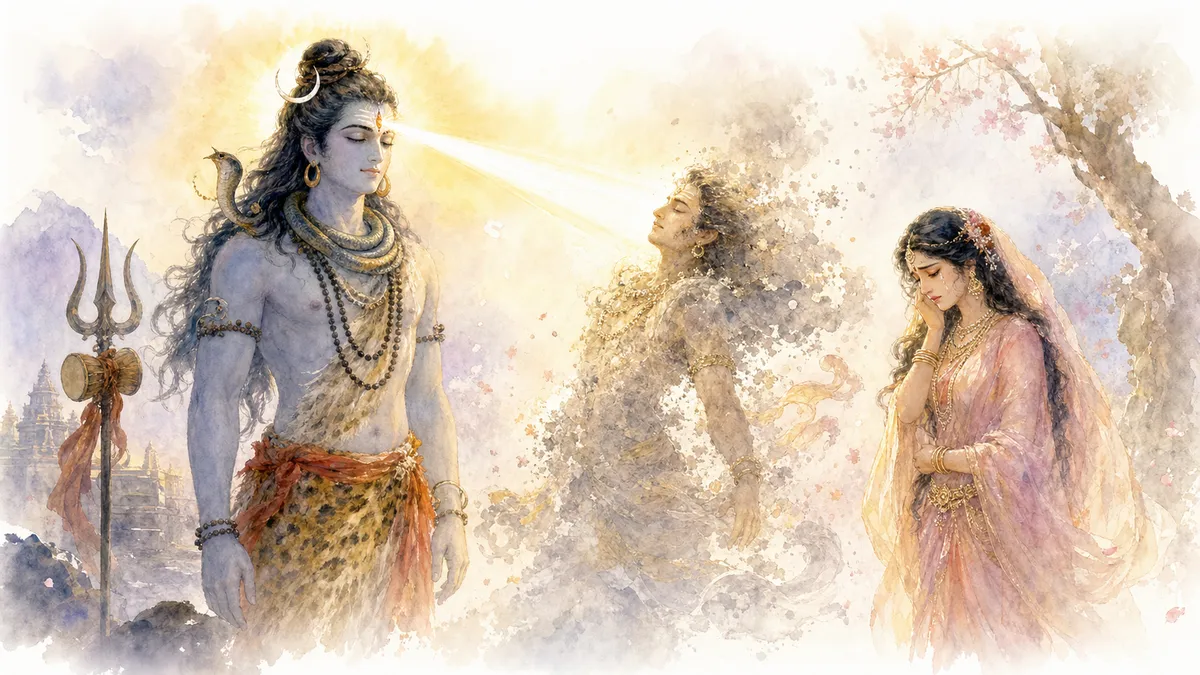
A mighty column of flame burst from the third eye of the enraged Shiva and reduced Kama to ashes. The flame took the form of a mare, plunged into the ocean, and began to absorb the water. Grief-stricken Rati smeared Kama’s ashes over her body. She wanted to die. Shiva consoled her, saying that Kama would be born again, but he was pleased by Kama’s transformation into ashes.
When Brahma sent Kama, he in fact knew that Shiva was not to be trifled with; he was, as it were, sending him to his death, although for divine beings there is no death, but still it is unpleasant for anyone to have a body destroyed, even a divine one. Then Brahma promised him that he would rise again, that he would be reborn in a new body, in that same body, but after some time. And since Shiva was very strongly devoted to the idea of asceticism, the idea of meditation, he flew into a rage, released yogic flame and simply burned him, emitting an immensely powerful light. This flame was his tejas, accumulated as a result of samadhi. Ashes mean the purest primordial substance, which cannot be transformed into anything else. This is the first tattva. That is, it is a kind of analogue of Prakriti in its most primordial form. You cannot do anything more with ashes—burn them, break them; they have already been ground down to the tiniest microparticles, which can no longer be transformed. And Shiva, by the power of his yogic tejas, transformed Kama’s energy into such a pure proto-tattva. His consort Rati suffered greatly because of this.
Dialogue Between Shiva and Parvati on the Place of Prakriti in the Supreme Reality
Shiva was pleased by Kama’s transformation into ashes, for desire leads to hell. From lust arises anger, from anger—delusion, and because of the latter asceticism is disturbed. Shiva remained in his seclusion on the mountain for many years, devoting himself to ascetic practice. When he came to the city of Oshadhiprastha, located in Parvata’s kingdom, the latter, upon hearing of Shiva’s arrival, visited him to pay his respects. The mountain king took with him his beautiful daughter, exquisitely dressed. Passing through the forest, they met the inconsolable Rati, who told them what had happened. Parvata shuddered. And Parvati, listening to Rati’s lamentations, realized that even death is preferable to a life of dissatisfaction and suffering. The latter, however, can be overcome through the practice of asceticism. And she decided to attain Shiva by the path of austerity.
Shiva was absorbed in meditation when Parvata-raja arrived, offering flowers, fruits, and his daughter for service to the lord. Shiva saw Parvati in all the splendor of her beauty. Having gained control over the passion that was beginning to arise and closing his eyes, he began to meditate on the supreme Reality, on himself. Parvata, though uncertainly, asked Shiva’s permission to come daily and serve him. Shiva interrupted his meditation. Opening his eyes, he asked Parvata not to bring his daughter with him. What need had he, an ascetic and yogi, of a woman? Parvati fearlessly addressed the great yogi: “Shiva, you practice zealous asceticism because you have the energy for it. This energy is Prakriti, the cause of all activity. How can the great lord of the Lingam exist without Prakriti?” Shiva, delighted by Parvati’s words, replied: “I destroy Prakriti through great asceticism; in my supreme Reality I abide without Prakriti.” Parvati smiled inwardly and said: “At all times everything is held together by the energy of Prakriti; everything you hear, what you eat, what you see, what you are—everything is the activity of Prakriti. O lord, if you are greater than Prakriti, why do you devote yourself to asceticism on this mountain?
This dialogue between Shiva and Parvati is an eternal dialogue from the realm of which Brahman is more important: the manifested or the unmanifested, with energy or without energy. When the Universe is manifested as the manifestation of Shakti, or when it is not manifested, which level of realization is higher? And in our body, in our consciousness, it is also always being played out. It is like a dispute between relative and absolute truth, between view and behavior. How, in what state of awareness, in what state of mind should one be—when the mind is empty and there are no thoughts, and we feel good in meditation, in light and in samadhi, or when we move, act, when energy manifests and we have to maintain contemplative presence, meditation, or sahaja samadhi under a double load. And everyone has their own preferences; both theories have their supporters. There are those who say: “You must keep away, because all of this interferes, all of this throws you off, you will never break free from the bonds of maya.” Others say that it is necessary to flexibly unite with and tame this energy, because if you do not learn to tame it, to manifest contemplation in energy, to maintain meditation in movement against the background of speech, mind, thinking, and action, then you will never comprehend sahaja samadhi, you will never be liberated from samsara, because any energy will throw you off. That is, you need to temper your meditative consciousness.
At the same time, neither the first nor the second group is talking about following material energy; those who follow material energy are materialists, worldly people. Rather, the point is to interact with it in a state of awareness or to abandon interaction altogether. And Shiva was initially the embodiment of such a complete refusal of any interaction, a supporter of pure consciousness in samadhi. But when Parvati came, he had to defend his position. Parvati also had strong positions. Because Prakriti (material energy) is also absolute consciousness both from the point of view of Samkhya and from the point of view of tantra, only manifested in this way.
Parvati, not wishing to argue with the lord of ascetics, categorically declared: “I am Prakriti, you are Purusha.” She added that only through Prakriti does Shiva have form and quality. Without her, Shiva would be without attributes and incapable of any activity. And if Shiva truly surpasses Prakriti, he should not feel fear at her closeness. Moreover, her closeness would only stimulate and strengthen his yogic power of detachment. Both Shiva and Parvati were adepts of the art of yoga. Upon meeting, they demonstrated the actions of solitary practice. Moreover, their closeness, her beauty, were desirable obstacles that strengthened their tapas as well as their tejas. Brahma’s intention was to make Shiva desire Parvati and to ensure that Parvati conceived a son.
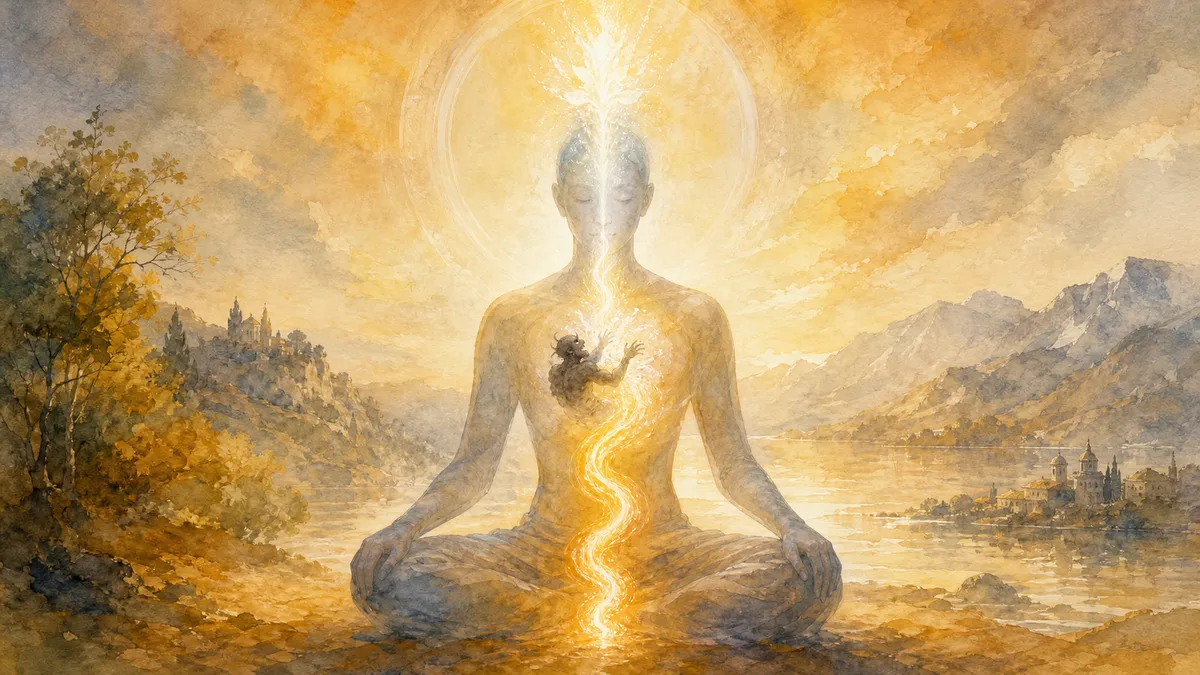
Of course, this should not be regarded as human relationships, as aspirations to build a family and have a child in marriage. These are universal forces that are conveyed through anthropomorphic images, but they are not anthropomorphic relationships and energies at all. And as applied to our reality, Shiva is our principle of awareness, our naked awareness, our view of nonduality. And Shakti (Parvati) is our kundalini energy. And at the moment of union, when they converge in the central channel, at the moment of the manifestation of the principle of sukha-shunya (bliss-emptiness, Shiva-Shakti), a superb deity is conceived; that is, they must unite in order to conceive the superb deity Karttikeya. Karttikeya in this case means a deity who has united within himself the traits of pure consciousness and powerful energy. And only Karttikeya is capable of striking down the demon Taraka.
Taraka is the enormous ego that oppresses our divine qualities. Within us, ahamkara (the ego) can assume this role of Taraka, the role of an asura, the role of one who oppresses our divine qualities, who disrupts the entire balance of our inner universe. And no one can defeat him except such a unified deity, because he has a powerful blessing from Brahma. That is, the ego is the same blessing to living beings from Brahma, so that they may use it as an instrument. And only a powerful superb deity, uniting within itself both the energy of nondual awareness and the principle of shakti, that is, kundalini, prana—only it, having been born as a result of such a union, can push back the demon—the ego, Taraka. Our inner ego can be pushed back when our consciousness comes into contact with our energy, in the processes of Mahashakti Yoga, Kundalini Yoga, Shambhavi Mudra, in all practices. Then we will acquire the proper strength to subdue this demon Taraka.
The Necessity of the Union of Consciousness and Energy
This would not have been difficult if Shiva had been a man or a demigod, but to make the lord of yogis behave like a man would have meant making him cease to be himself. Parvati’s words expressed the viewpoint of Samkhya, whereas Shiva upheld the view of Vedanta. While Shiva and Parvati were immersed in their universe of reasoning, Brahma assured the besieged gods that Taraka would be destroyed. Brahma himself, having given Taraka the blessing of absolute invulnerability, could not destroy him.
Thus, time was running out, because Taraka had besieged the gods, while Shiva and Parvati were still only coming to an agreement, and Brahma was forced to give assurances to the gods that Taraka would be destroyed. In the same way, within us our consciousness and our energy are only finding each other; they are still only coming to an agreement. The pranas are only beginning to enter the central channel, we are only learning to unite contemplation and bring prana under control, while the demon Taraka (our ego) causes us a great deal of trouble, oppressing our divinity. And the gods appeal to Brahma for protection, and Brahma says: “I guarantee you that you will be protected,” but in fact Shiva and Parvati have not even agreed on the wedding yet; the birth of this superb deity is still far away.
In the same way, in the life of a sadhu, his energy and his consciousness have not even yet agreed upon the inner alchemical wedding that would give rise to such a powerful superb deity. And the embodiment of this Skanda, Karttikeya, such a powerful superb deity, is our divine illusory body, and also our body in the form of space (these are the jnana-deha and the pranava-deha). When these bodies appear in us, it means that within us Skanda, Karttikeya, has been born: this powerful superb deity that unites luminosity, nonduality, and powerful shakti (energy) within itself, this pure shakti, which is capable of striking down the ego and freeing us from the influence of the ego, has not yet been born. But it can be born.
Shiva’s assistance was necessary. Only Shiva’s son could kill Taraka. Brahma was certain that Shiva would marry Parvati. Then the gods had to ensure that Shiva’s seed entered Parvati. Parvati was the only one who could make Shiva, who raised his seed upward, spill it.
“The seed of Shiva entering Parvati” means that transcendental awareness must touch energy. When we perform methods of uniting presence with the red bindu, Mahashakti Yoga, Vishvarupa Yoga, concentration on the chakras, and recognition of the unity of bliss and emptiness (sukha-shunya), these are esoteric methods of yoga. Like Brahma, we try to direct this process so that the seed of Shiva—that is, the seed of nondual emptiness and divine light—enters the principle of energy in our body, so that this energy is fertilized by it, giving us an impulse in spiritual life, and so that with its help we create an illusory body in the form of a deity or the divine causal body (jnana-deha). This process takes place in the body of every sadhu during his sadhana. And for some, this wedding takes place, and the inner Karttikeya, the super-deity, comes into being, and the demon Taraka is subdued, the ego dissolves. For others, Shiva and Parvati cannot come to an agreement; everyone has their own grievances and whims.
No other woman is capable of this. There was no time to lose. The gods needed to make Shiva desire Parvati as his wife.
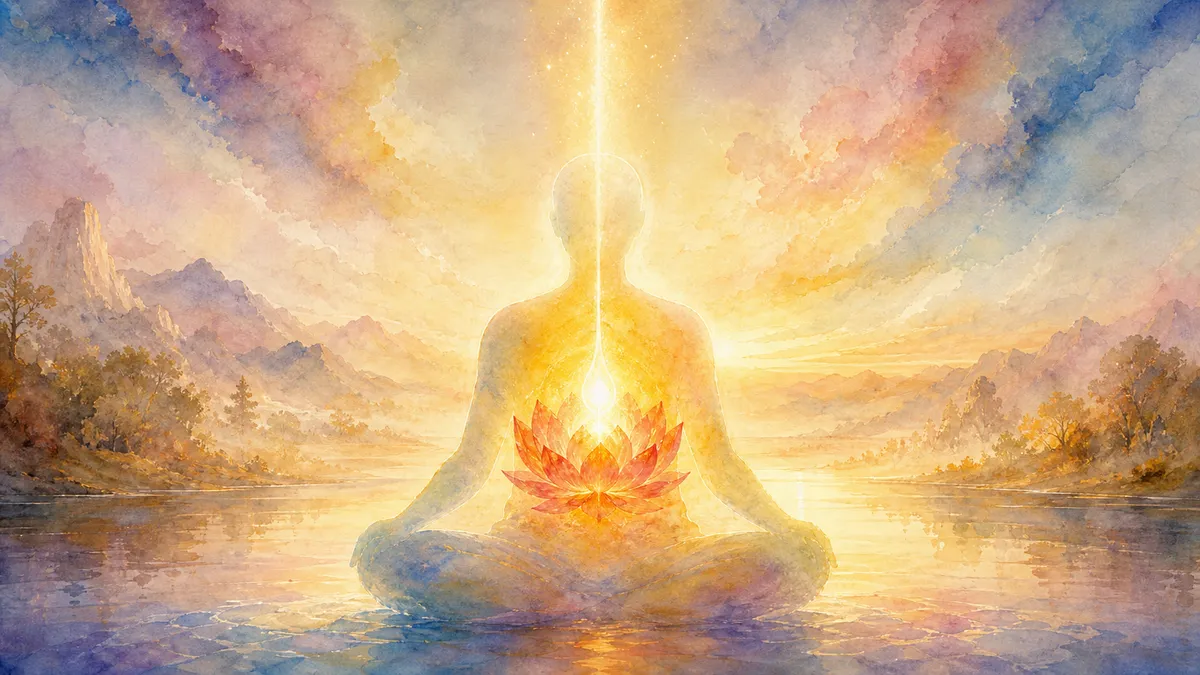
What does it mean for “Shiva to desire Parvati as his wife”? It means that the principle of nondual awareness, of nondual emptiness, must turn toward energy, and it must make energy its ally on the spiritual path. It must be able to enter this energy and draw it after itself. Here Shiva is known as Urdhvareta, “the one who raises the seed upward.” The seed is potential, the ability to create, generate, and fertilize. And when the seed goes upward, it means that Shiva himself, as consciousness, was directed only upward, toward the upper chakras, toward the Absolute. But in this case he needed to implant this seed in Parvati. Parvati is the principle of primordial energy within us. That is, if we speak of the body of a sadhu as a microcosm, then the principle of this nondual consciousness must be turned and united with energy. Consciousness and energy must act together. What happens when they act together? The winds enter the sushumna nadi, our pranas are balanced, our energy begins to flow differently, we receive a new impulse in spiritual practice, and this energy is not lust, not worldly desires, not attachments, not anger, not coarse energy; it is divine pure energy. And we obtain this necessary union for the alchemical conjunction. From this pure energy, from the subtle wind, from the subtle mind, a divine illusory body is created in the form of the illusory body of the deity Dattatreya. A divine body is created, called the jnana-deha. And it is precisely these bodies that free us from karma and disperse all our limitations. This is the mysticism of this parable.
The Inner Struggle of Opposites
The struggle between Kama and Shiva, the ascetic whom Kama entered for only a moment, taking place in spring in the Himalayas, continued within Shiva himself. In the heart of the great yogi, a pendulum swung between self-control and desire; opposing impulses struggled and interacted. But Shiva’s transcendental reality was not affected. The fierce God who abided from the beginning had to be born in order to master the cosmos. His cosmos became the stage for the divine play of the great God who protects the world. Assuming, for the sake of his devotees, the role of an anthropomorphic deity, the bearer of the seed and the yogi remained one and identical with himself, acting in a way that was logically contradictory yet conceptually consistent.
The main task of yogis is the restraint of lust. One cannot, however, conquer desire without desire, without the intention to do so. Desire is the substance absorbed by yoga; hence its power. Shiva is the lord of yoga and the eliminator of Kama. Shiva the yogi contains within himself Shiva as Kama. The latter is controlled while at the same time sustaining the former. The dialogue between Shiva and Parvati was caused by Kama, Indra’s messenger; he was sent from Brahma’s universe to prepare Shiva’s play. Kama appears twice in the play, whose theme is the seduction of Shiva: once within Shiva himself, whom he entered for a moment through the ears, and again when attacking Shiva from outside.
In fact, Kama, burned and deprived of his body, became omnipresent, dwelling in the minds of all embodied beings. The deliberations of Shiva and Parvati, on the other hand, allowed Consciousness and Shiva’s devotees to observe the divine play as if the great gods were human beings. Shiva enacted his play out of compassion for the devotees, allowing them to contemplate, in a living drama, the interaction of the masculine and feminine principles, which in reality are Purusha and Prakriti. Parvati herself spoke of this to Shiva, who at that moment was not in the mood to listen. Parvati knew herself; her resolve was firm as a mountain (her father). In addition, she possessed the attractiveness of a woman (her mother). The beautiful princess Parvati became a yogini in order to win Shiva as her husband through her austerity. The son born to them must crush the hitherto invincible demon Taraka.
Parvati was free from the weaknesses of Sati, who displayed indecision as well as stubbornness. Sati also showed faint-heartedness, doubting Shiva’s ability to protect her from the gathering clouds. Worse still, in the episode with Rama, she doubted Shiva’s words. Nothing could make Parvati turn away from her ascetic path; her mind was unshakable. Shiva dwelt in her heart. In this case, austerity was more effective than mind and beauty. Her asceticism could divert Shiva from his asceticism. He would marry her and beget a son. In her determination to attain this paradoxical goal, she was firm.
For us, as sadhus, Parvati’s asceticism means that we follow the rules of discipline, tapas, with regard to energy. When we follow the principles of sannyasis, perform the practices of kundalini yoga, shat-chakra yoga, control energy, control desires, control the mind, speech, and behavior connected with energy — all of this is Parvati’s asceticism.
What is Shiva’s asceticism? It is when we practice vairagya (detachment from all desires), meditation on nonduality, on emptiness. When we do not allow the mind and thoughts to move. Then we follow the path of renunciation, the path of mahashanti (nondual consciousness). And these two forms of asceticism — Parvati’s asceticism and Shiva’s asceticism — were meant to lead to their union. That is, when we combine the practices of the prajna-yantra and the practices of the shakti-yantra, in the end consciousness and energy ignite, and yogic processes of transformation begin: the processes of kundalini yoga, jnana yoga, and others.
In vain did Mena try to dissuade her daughter from leaving the palace for the wilderness to undertake severe ascetic practice.
The Symbolism of Mena and Parvati
Mena is Shiva’s mother-in-law, the wife of Parvata (the Mountain), the mother of Parvati. Mena is the personification of worldly, coarse energy, of worldly desires. If Parvati is the pure energy of kundalini-shakti, ready to perform tapas, who controls desires and has only one goal — to merge with her lord, with Shiva, to ascend through the central channel to the sahasrara chakra, to enter nonduality, emptiness, and unite; for this she performs tapas. That is, the yogin practices pranayama, kumbhaka, shat-chakra yoga, and other methods for only one purpose — to unite his energy with nondual awareness. But this is Parvati. Parvati performs tapasya; she was born for this. And Mena is worldly energy, the mother of Parvati. That is, this pure energy of kundalini-shakti emerges from worldly energy, from worldly Prakriti, whose abode is the muladhara chakra and the region of the kanda.
Every person has such a division into an inner Mena and an inner Parvati. And Parvati desires austerity; she performs tapasya; she wants to unite with her bridegroom, with Shiva, with nondual consciousness, while Mena does not want this: she wants worldly happiness, she wants a family, children, a well-fed, beautiful, secure life. This coarse desire is what Mena personifies — all the desires within us, within a sadhu, coarse desires. And therefore there was a small conflict between Parvati and Mena, because Parvati is pure energy that did not want to follow her mother’s path, the path of the coarse maternal energy of Prakriti; she had only one lord — Shiva, and she did everything for his sake.
Parvati’s Austerity as an Example of Yogic Austerity
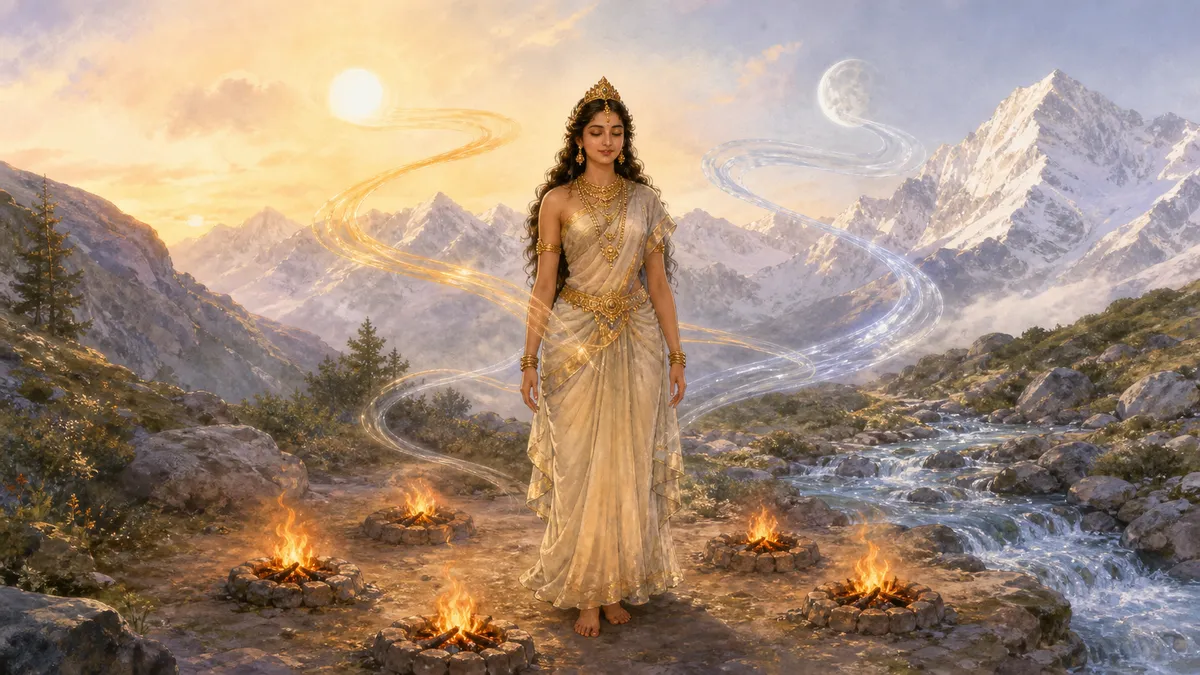
While fasting, Parvati sat in the summer heat near blazing fires. In winter she immersed herself in icy water, meditating on Shiva. The universe and the gods were scorched by her asceticism. Vishnu and the deities came to Shiva, begging him to marry Parvati and free the gods from the oppression caused by Taraka.
Fasting means that when we do not allow the energy of our worldly desires to be satisfied, it passes through purification, tapas, and sublimation. Both the five fires and, conversely, the energy of cold when she was in icy water point to the ida and pingala channels, to the two fundamental energies: solar and lunar, through which this energy flows and is purified in order to go to meet its lord, Shiva.
Lord Shiva must ask for Parvati’s hand. Shiva, emerging from his trance, replied: “If I must accept the goddess Parvati, the most beautiful of women, she will be able to resurrect Kama on the occasion of the wedding, and then all the gods, sages, and ascetics will be seized by lust.
Kama is the energy of lust, love, infatuation. A yogin must first suppress it; he must incinerate it. The yogin’s awareness, just as Shiva incinerates Kama from his third eye, likewise turns this energy into ash, because it is unnecessary, dangerous, harmful energy for the yogin. And then, when the question arose that Shiva should ask for Parvati’s hand, Shiva began to worry that this energy, which he had already once subdued and incinerated, might awaken again; that is, Kama might be resurrected once more. Because in any case, when we touch the inner energy and when we awaken the inner energy with our awareness, this energy awakens again, even if we have subdued, suppressed, or blocked it for a time. But the yogin’s task is for this inner energy no longer to cause harm, for it to be not the energy of lust, but pure energy. All the processes that unfold on the macrocosmic level take place in the yogin’s body, in the mind, in the pranas.
Parvati’s Trial by the Seven Sages
Then all the gods, sages, and ascetics will be seized by lust, and the great path of yoga will be inaccessible to them. Although Shiva considered marriage to be heavy shackles, for the sake of conceiving a son he decided to marry Parvati. Once, for the sake of the gods, he drank poison, and now he is not going to disappoint them. Shiva played the role of the future bridegroom perfectly, dispelling any doubts about his love for Parvati. He himself was caught in the nets of his maya, taking refuge behind his promise to serve his devotees and act for the benefit of the gods. Parvati shook his imperturbability. Shiva was drawn by her asceticism and stirred by her femininity.
Shiva intended to test Parvati’s resolve, the strength of her asceticism, the clarity of her mind, the purity of her devotion, and the depth of her self-knowledge. The fire of her austerities made all living beings tremble. And Indra sent the seven rishis to her. The seven sages tried to dissuade her from conquering Shiva through extreme asceticism. If she seeks to obtain Shiva as her husband, this is an attempt to attain the unattainable. Shiva is a dispassionate ascetic, by whose flame Kama has been consumed. The sages hoped to discourage her by describing the great yogi as a naked and fierce dweller of cremation grounds, a bearer of skulls, a hermit, a beggar, a madman.
The sages came to shake Parvati’s opinion. They had to test her resolve and faith; they began to say that Shiva was naked. What does naked mean? Naked means without attributes: the Absolute, Brahman, pure consciousness, has no ornaments; he is bare. That he lives in cremation grounds, that is, where there is nothing human; he is mad, that is, beyond the mind. The bearer of a skull. The skull symbolizes the remnants of the ego. This infinite divine consciousness contains nothing human; there is nothing in common with the energy, because it is pure, beautiful, flourishing energy, while he is terrifying. For the ego, the energy of nonduality is also terrifying.
The rishis symbolize the sense organs: the five sense organs plus manas and ahamkara, which try to persuade the energy not to follow this path. But in fact they are acting on Brahma’s instructions; they are simply testing her. How determined are we on our spiritual path? How much strength of spirit and faith do we have? And when they tried to convince Parvati that Shiva was unworthy of her as a bridegroom, and that this was a very difficult, complicated path, their words only increased her determination; they confirmed the strength of her faith. And they were pleased with the result. They came to Shiva, told him about it, and Shiva was glad to hear that Parvati had passed the test. And the seven sages went at once to the king of the mountains and to Mena, and after the test Shiva asked for their daughter’s hand.
The Meeting of Shiva and Parvati
The king of the mountains had to give his daughter to Shiva in order to save the world, and he was seized with joyful excitement. However, Mena was in doubt; she was not sure that it was wise to give her daughter in marriage to such a god. She doubted and said: “It is unclear whether he has any virtues besides asceticism. Does he have any normal qualities?” Having fulfilled this mission, the rishis returned to their Rishi Loka, and Shiva finally wanted to meet Parvati. He wanted to test her once more. He approached in the form of an ascetic enveloped in radiance, and this ascetic came up and expressed admiration for such a beautiful girl practicing tapasya. And Parvati told this ascetic about her goal, opened her heart to him. She said that apparently it was a hopeless goal, that despite her ascetic practice, she still had not achieved what she desired. She told this brahmin that all her hopes had already gone, that even the light was no longer dear to her, because she saw no meaning in her ascetic practice, and Shiva did not reciprocate her feelings.
And when, at the sight of this brahmin, she was already about to throw herself into the fire, that fire turned into sandalwood paste. And the brahmin was then already astonished, and Parvati told him that she had tried to reach Shiva through consciousness, speech, and action—in every possible way. And she understood that her goal was difficult to attain, and then the brahmin said: “Parvati, put Shiva out of your mind.” He had known him for a long time, and he was such a naked ascetic covered with ash, entwined with snakes, carrying a skull; he had been married to Sati, nothing good would come of this marriage, and there was no point in wasting herself, her youth, on this austerity. And he too tried in every way to dissuade her. Because he was a homeless wanderer surrounded by spirits and vampires, and it was unknown what to expect from him. Thus he tested her. And he said that this was absolutely unsuitable for her. But then Parvati asked whether he had any intention of slandering Shiva. And she saw this and became greatly indignant. And she wanted to leave this brahmin or drive him away. After that, this brahmin assumed the form of Shiva. And at last they met.