

Commentary on the text “Purusha Sukta”
“From his mind arose the moon, from his eye—the sun, from his mouth—Indra and Agni, from his breath—the wind. From him also came the four castes. His mouth became the Brahmin, his arms the Rajanya, his thighs the Vaishya, his feet the Shudra.
Seeing no one beside himself, he first said: ‘This is I’; thus the name I arose. Therefore, now, when a person is called, he first of all identifies himself as ‘I,’ and only then names the proper name that belongs to him. And since he, as the foremost of all, consigned all sins to the fire, he is called Purusha.
He was afraid; that is why a person is afraid when he is alone. Then he looked around and said: ‘If nothing exists besides me, then whom should I fear?’ Then his terror receded, because there was no one for him to fear, for terror comes from another.
He felt no joy; therefore no one feels joy when alone. He needed another. He was in the same state in which husband and wife abide. He divided himself in two. Thus man and woman were produced; therefore each of them was only half of himself, like half of a pea split in two, which is only part of the whole.”
This text is about the creation of the world. It is not philosophical or concrete, but mythological; that is, it should be understood at the level of images of the subconscious.
When, in the teaching of anava yoga, we speak of methods of direct introduction, we say that one of the methods is to reflect on the primordial source of Being, on the principles of the world order or the principles of the creation of the universe. Thanks to such reflection, acting as a powerful secondary cause, primordial awareness opens flawlessly.
Profane and Sacred Vision of Reality
When you study mythology, it differs from the way you study philosophy or technical descriptions. It requires the activation of another consciousness, another level of Being—precisely sacred Being.
It is usually said that there are two levels of vision or Being: the profane and the sacred. The profane is the ordinary, the worldly. The sacred, the holy, is that which is connected with the other side of life, emanating from saints and gods.

Spiritual practice is nothing other than leaving profane being and entering the sacred. For example, when you practice divine pride, try to practice pure vision, enter into a samaya connection, you try to generate sacred vision; you gradually, as it were, leave the profane state and enter the sacred one. When you reflect on texts such as this, contemplating them, it is a very profound way of leaving the profane and entering into the sacred vision of reality.
Siddhis and gods continuously abide in the sacred vision of reality; people, on the contrary, continuously abide in the profane vision of reality.
It can be said that the profane vision of reality is precisely the distracted state of awareness. The sacred is presence brought to the very depths, to perfection.
Cosmogonic Myths of the Rigveda
“Before the appearance of Nothing, even before something appeared, in what was everything hidden or where did it rest? In water?
Death and immortality did not replace one another like nights and days. Only the One, who was his own source of life, breathed evenly, and nothing lay outside him. Darkness was buried, like in the sea, in primordial darkness. Like emptiness absorbed by chaos, there he grew by diligent inner power.
First was born the seed, more primordial than thought, which, with something that exists, not knowing the connection of desire, the sages eternally seek and eternally find.
In the dark abyss a flaming ray suddenly flashed; whether all this was created above or below, who knows. Mighty creative forces were found, and these forces labored. Below stretched the mass of matter; above, energy in eternal motion. Who will say whence this whole boundless world arose? The gods had not yet appeared in the world at that time. So who will reveal the truth, whence the world came and whether it was created by the hand of the gods or not? Only the king in the heavens could tell us this, if this matter is possible for him.”
This is one of the later texts of the Rigveda. The cosmogonic myths of Vedic civilization are very profound, multi-layered, and complex.
It is believed that the world originally arose from Narayana. Narayana, as the primordial deity or proto-deity that existed before Brahma, Vishnu, and Shiva, is the undifferentiated Absolute, in which the creative tattva has not yet arisen and spanda (vibration) is still in a very weak state.

It is said that speech arose from his mouth, the Vedas from the vital juices of his body, nectar from his tongue, the firmament from his nose, the heavens and the sun from the pupils of his eyes, places of pilgrimage from his ears, clouds and rain from his hair, flashes of lightning from his beard, stones from his nails, and mountains from his bones.
Of course, these texts should not be understood literally. You hear stories about gods arranging various lilas, but in reality such accounts are similar to explaining quantum physics or Hegel’s philosophy to ordinary people with the help of characters familiar to them (the wolf, Kolobok, Baba Yaga, and others). This is roughly how one may perceive stories about gods in which they are described as quarreling, abducting other men’s wives, or waging war for nectar. In reality, all of this is much more complex. These myths express a depth beyond human comprehension.
It is said of Narayana, the primordial God, that he reclines in the form of an infant on a leaf of the banyan tree, which floats upon the primordial waters, and sucks the toe of his foot, symbolizing eternity.
The World Egg and the Birth of Brahma
The Bhagavata Purana speaks of the World Egg, which was produced by divine power together with the tanmatras. The tanmatras united with the divine force, proceeding from the principle of mahatattva—the primordial element. The principle of mahatattva was generated by the supreme subject, presiding over the material energy of prakriti, when it united with kala (time).
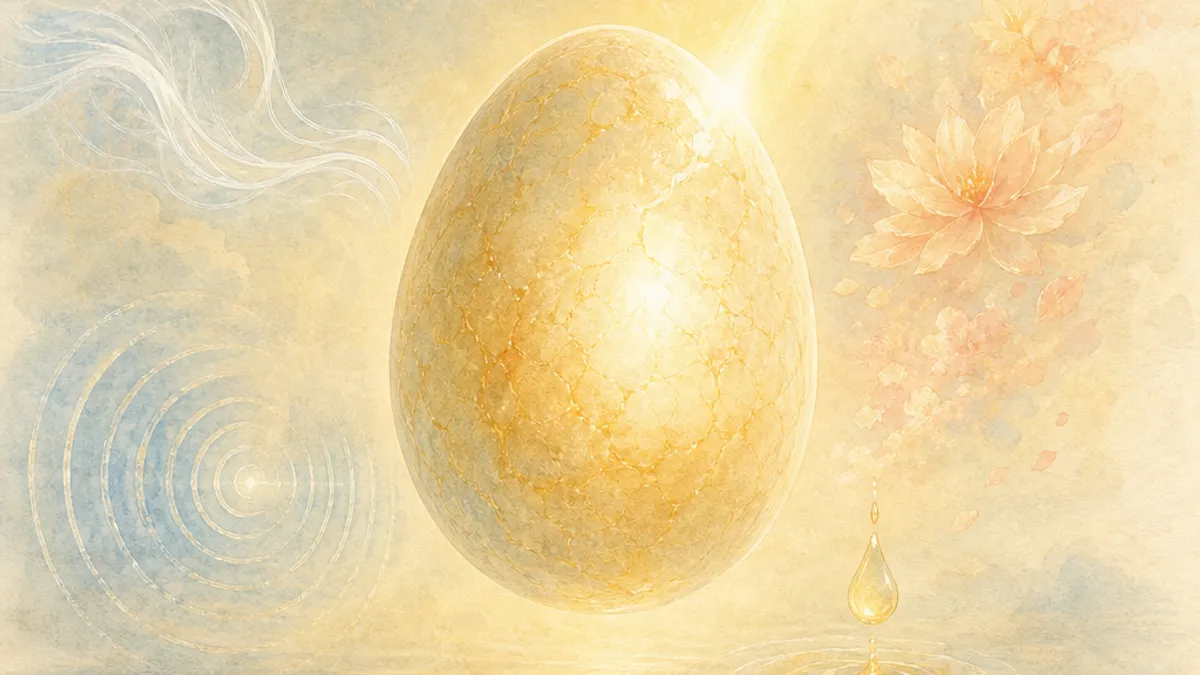
Prakriti was at first in a passive state, but it was stirred into activity by the supreme subject, the irresistible fate of all that exists. Thus appeared the Golden Egg—Brahmanda, or the cosmic Primordial Sphere.
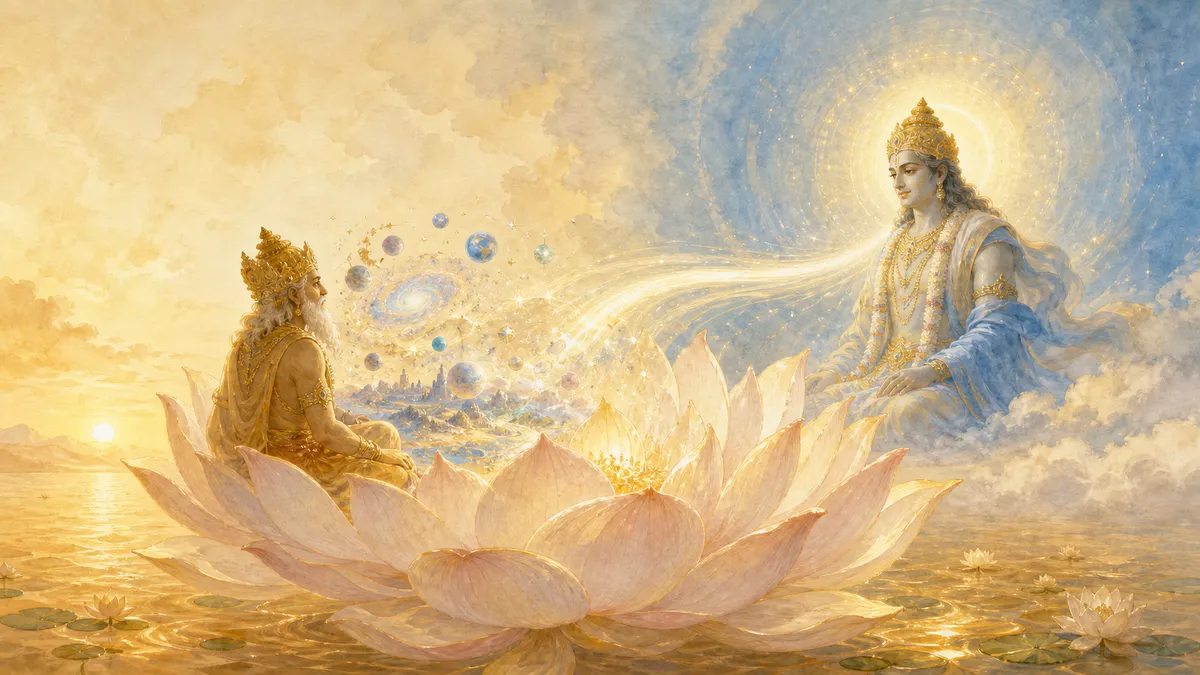
It is further said that the God of the primordial universe rested upon this Egg for more than a thousand years, free from any living beings, lying on the surface of the Ocean. Resting in such an Egg, he engaged in self-contemplation, turning consciousness upon himself. Immersed for thousands of years in such self-contemplation, the Supreme God of the universe produced from his navel a lotus whose bright radiance was equal to a thousand suns taken together.
The navel is a symbol of the manipura chakra; it is precisely manipura that is associated with creation and destruction. One can say that here the navel is a symbol of the creative state; the lotus is a symbol of the pure creative state or the primordial shuddha-tattva, that is, the primary element in a state of undifferentiation, yet ready to create.
The lotus was so vast that it could contain all living beings. From this lotus emerged Brahma, self-born.
From this initial pure state emerged the creator of the universe. It is said that he was born of himself. That is, by virtue of its own self-awareness, such a great individual consciousness came into being. After this, Brahma, endowed with the power of Narayana, created all beings and gave each of them a name and a form.
The Process of Creation and Differentiation
Thus, in the beginning, the self-existent Lord felt a desire and formed the intention to differentiate himself, to create various living beings from his body, and then, having separated his pure consciousness, prakriti, primordial matter, was differentiated, providing the basis for the three gunas. Into this primordial matter, prakriti, the creative seed was cast—the creative tattva or adi-bindu, the original creative potential, which began to create something like ripples on water, causing space to vibrate. Space in that state did not yet have dimensionality as it does in our human world. It was undifferentiated; nevertheless, such ripples on the water began to set space in vibration, the creative tattva fertilized the primordial undifferentiated Being, and its various parts began to separate within it. Subsequently, this seed became the Golden Egg (Brahmanda), whose brilliance surpassed that of the sun. It was from here, as we have said, that the primordial creative consciousness of Brahma—the progenitor of the universe—was born. The waters are also called nara because they were produced from Nara. Narayana bears this name because he was the first cause of all deeds.
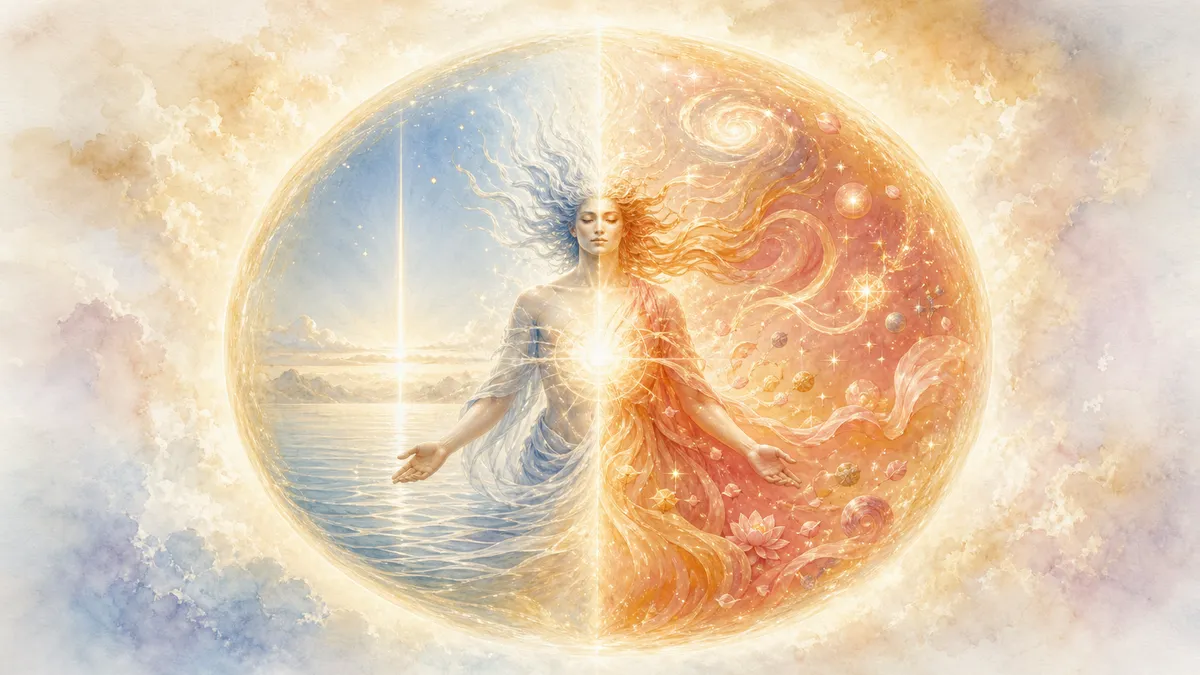
And this great consciousness, Purusha, which was produced from the imperceptible, eternal, undifferentiated state, is known as Brahma. Having lived for a long time in the Egg, this majestic being, through the power of self-contemplation, divided itself in two; that is, Brahma, as the primordial creative consciousness, also divided himself, as it were, into two parts. It is said that he became half woman, half man. Of course, he did not simply become a woman or a man. In this case, the man is the embodiment of the principle of non-differentiation, purity, emptiness, the principle of staticness, rest, immobility, and contemplation. The woman is the embodiment of the principle of dynamics, rajas, energy, movement, expression, manifestation. These two principles separated within this primordial consciousness.
“O spirit of spirits! By the strain of mighty powers
Of creative thought, you unfolded the expanses,
Set in motion the spiral of time,
Drew the order of harmonies out of dissonance,
You are older than heaven; you existed before heaven.
Before the rotation of the spheres had yet begun,
Before the earth floated in the ether,
You were then. By your love was born
That which had never been, for life in this world—
And song spread throughout the universe!
What revealed your might? Perfection!
What held power over it and supremacy?
The light of wisdom. But in what was it revealed?
My soul in ecstasy rushed
Toward you. Almighty one, guide its flight yourself,
Give it the strength to rise above transience,
On fiery wings let it glide without fear,
To receive knowledge and be inspired.
Lead, then, the poet’s imagination!”
When you hear “poet,” what is meant here is kavi, a sage, a rishi (in traditional texts). The rishis were indeed poets, because they expressed their vision in poetic, figurative language, not through logic.
“Hidden in dark, impenetrable darkness,
In a shadow brighter than sunlight,
Brahman contemplated his mind in those ages
When spirits were not yet clothed in bodies.
Thus the gaze of mortals looks into a mirror’s smooth surface.
(Thus have we compared the eternal with the finite.)
Obedient to his gaze, the first of forms arose
Before him, shining with an infinite brilliance
That would have laid a hundred suns prostrate.
This goddess was named Eternal Maya,
She was kindled with an unearthly love for her father,
And rewarded him with the casket of IDEAS—
From them the universe was later created.
When desire seized him
To create innumerable luminaries,
In complete Unity he became manifold.
Creation rejoiced, and nature
Itself laughed; a new harmonious tone
Now called the waters into being.
And the waters rushed forth, filling their home,
Rejoicing, reaching the firmament.
The murmur, the splash, and the roar of the first waves...
Over the breadth of the sea the primordial breeze breathed,
Caressing. Suddenly the surface was disturbed,
The Egg appeared, the ideal of perfection,
A wondrous radiance streamed around it.
The earth itself bowed before the miracle.
Above the battle of the waves it danced, astounding the world,
Until from the shell of the beautiful structure
Azure appeared. Pouring forth brilliance,
The greatest apparition came into view.
A stranger to the infirmities of earthly existence,
For which deep sleep is a relief,
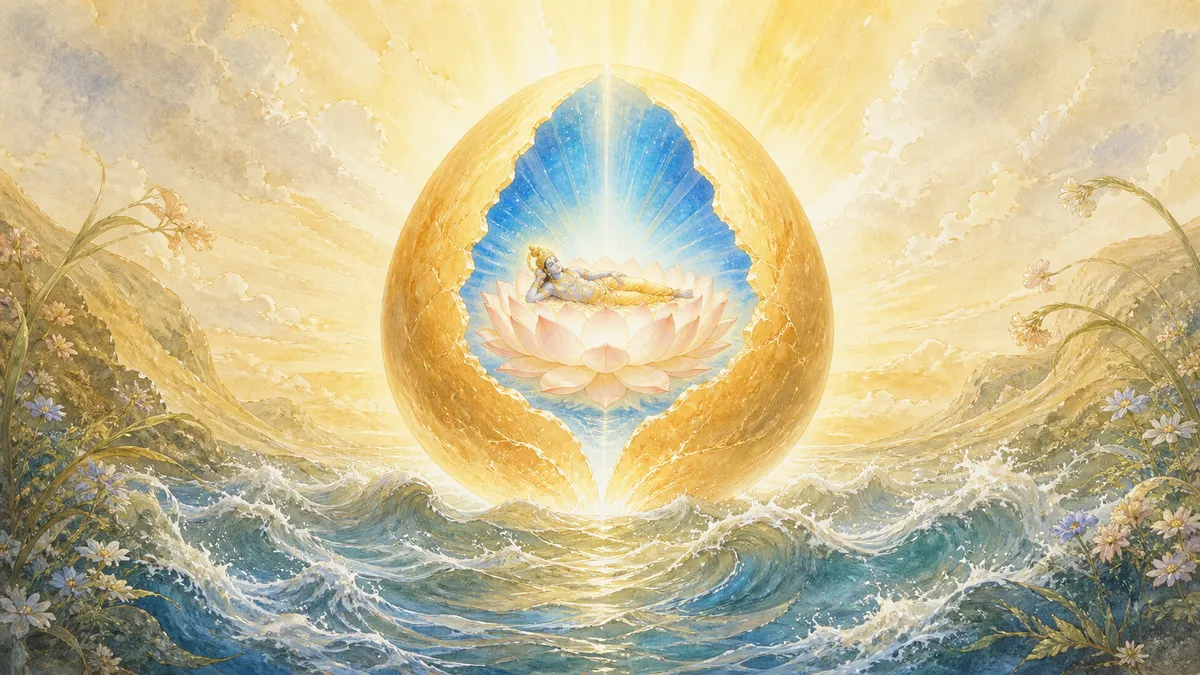
The Most High, immersed in thought, reclines
Upon the lotus that blossomed from the touch
Of His hand and pours forth the light of golden rays.”
Brahma and the Knowledge of the First Cause
Thus, it is believed that when Brahma appeared, he did not know the first cause of his creation, at least as stated in the “Bhagavata Purana.” And Brahma, addressing the gods and rishis, told them how he came to know of this first cause.
“During the night of Brahma, when all beings and all worlds dissolved into one indivisible silence, I contemplated Narayana, the Spirit of the Universe, the thousand-eyed, all-knowing one, for whom Being and non-Being have no distinction, resting upon the formless waters, supported by the thousand-headed serpent of infinity.”
The night of Brahma signifies the period of pralaya, when everything is in a state of non-differentiation or primordial chaos. At this time Brahma retains his individual existence, but is as if asleep; that is, his creative potential is not functioning, but sleeping, in a passive state, while Brahma himself contemplates the primordial chaos.
Brahma goes on to say:
“Misled by his enchantments, I touched the eternal one with my hand and asked:
‘Who are you? Tell me.’
Then he bestowed upon me the drowsy gaze of his lotus-like eyes, rose, smiled, and said:
‘Welcome, my child, your radiant majesty.’
But I became indignant at this and said:
‘Do you, O perfect God, call me—cause of creation and destruction, creator of myriad worlds, source and soul of all—“my child,” as a teacher would call a pupil? Tell me why you speak such unreasonable words?’”
Narayana appeared before Brahma in the form of Vishnu and called him his child. In other words, primordial consciousness manifested a separate energy, as if arranging such a play with Brahma. Brahma, however, had previously believed that there was no one else besides him and considered himself the sole creator of the entire universe; therefore, he was greatly indignant upon seeing some other consciousness, which moreover called him “child,” thereby expressing its seniority. Then Narayana, in the form of Vishnu, said to him:
“Do you not know that I am Narayana, the creator, preserver, and destroyer of the worlds, the infinite masculine principle, the eternal Source and Center of the universe. For you were born from my own immortal body.”
The Appearance of Shiva and the Blazing Pillar
It is said that between these two deities there began a clarification of seniority, of supremacy. When we speak of clarification, this is not a quarrel as in the world of humans; rather, it is two dynamic, interacting, incredibly powerful consciousnesses that were trying to determine the depth of themselves through such interaction.
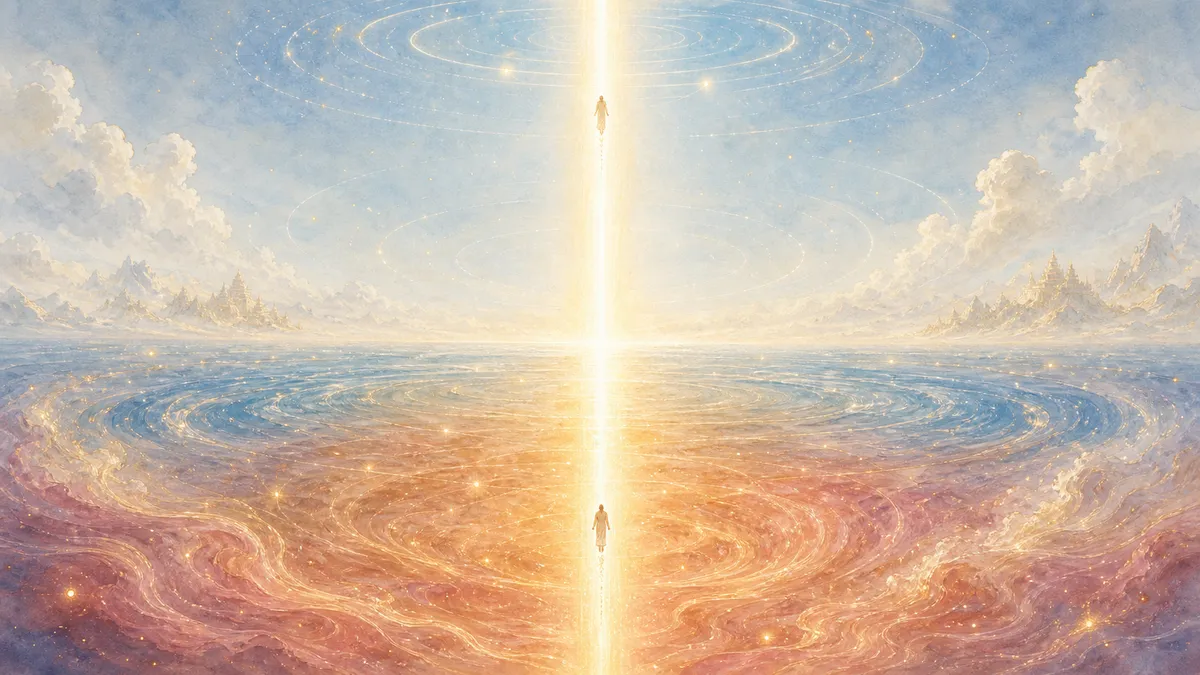
And when this transcendental dispute broke out over the primordial Chaos, this same original consciousness decided to stop this play. And then there appeared a radiant, majestic Lingam, or blazing pillar, like a hundred fires, devouring universes, having no beginning, middle, or end, incomparable, indescribable.
It is said that both Vishnu and Brahma were amazed by the appearance of such a pillar of light and decided to investigate it. Assuming their illusory forms, Brahma descended downward, Vishnu ascended upward. Ascended upward means that one deity moved toward the masculine aspect (toward emptiness, non-differentiation). Descended downward means that the other deity moved toward the feminine aspect (energy, differentiation), in order to investigate the boundaries of this pillar of light. And when they tried to investigate this pillar of light, even after a thousand years they could not find its beginning or its end.
Then Shiva appeared before these deities. Shiva here is an aspect of the unmanifest, an aspect of deep, undifferentiated primordial chaos. And they both bowed to him, acknowledging his depth, summit, and perfection. But in fact, this was a manifestation of the one primordial consciousness in its three different states.
Depending on the situation, a deity may manifest itself as a complete deity or as a partial incarnation of some guna.
It is further said:
“From his own flawless, pure state, Brahma created a woman who is glorified under the names Savitri, Sarasvati, Gayatri, and Brahmani.”
Created a woman means that he divided the primordial energy once again into an undifferentiated state and a creative state of energy.
The Five Heads of Brahma and the Loss of the Fifth Dimension
Brahma is usually depicted as a four-headed deity of red color. Many associate the four-headed form with the four dimensions of our Universe: three spatial dimensions and one dimension of time. However, in the beginning he had five heads, but then Shiva deprived him of one head. It is said that Shiva once pried off his head with his fingernail when it once began to discourse on Brahma’s superiority over Shiva. This means, evidently, that originally the universe had not four dimensions but five dimensions. Nevertheless, the fifth dimension disappeared over time as a result of certain, one might say, very subtle spatial cataclysms.
Another myth says that Brahma was punished by Shiva by being deprived of one of his heads because, being exceedingly drunk, he committed incest with his daughter. Of course, this should not be understood literally. What does it mean? The phrase “Brahma is exceedingly drunk” means that the primordial, empty awareness, which was self-liberated and undifferentiated, became intoxicated with its own rajas, its own creation, and went far in its own manifestation. One could say that this is the loss of view in action, or the loss of awareness in action. “Committed incest with his daughter” means that there was an impermissibly strong immersion of empty awareness into matter, as a result of which balance, or harmony, was lost in the creation of the universe. And then higher hypostases intervened in the process of creation and changed the dimensionality of space from five-dimensional to four-dimensional. Shiva cut off Brahma’s head for “incest with his daughter,” that is, for an unlawful contact with differentiation, with matter.
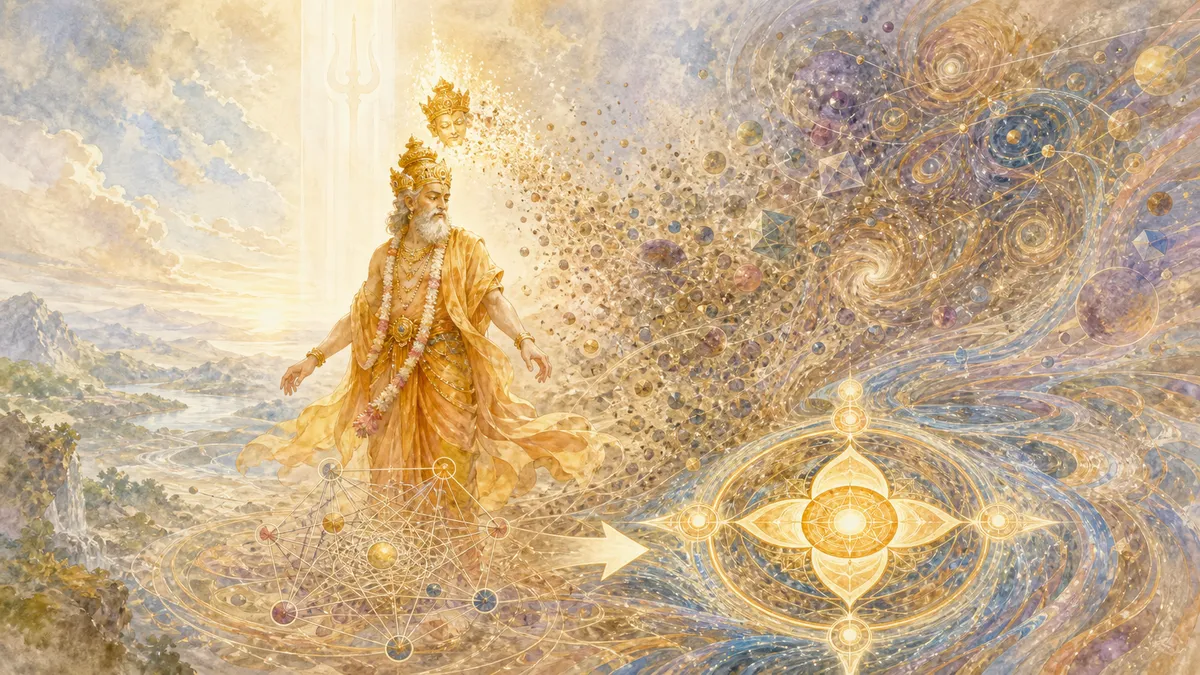
According to another version, it is said that Brahma insolently asked Shiva to be born from him as a son. For this, Shiva cursed Brahma, and the power of his curse deprived Brahma of his fifth head. It is said that when this head was severed, it fell in Maha China (the Sanskrit name for China). In the tantras, Maha China is considered a highly revered land of Chinese sages, where the fifth Veda fell.
The Fifth Veda and Taoist Philosophy
As you know, there are four main Vedas: the Rigveda, the Samaveda, the Yajurveda, and the Atharvaveda. However, it is believed that originally there were five Vedas, and the fifth was the most ancient, and it disappeared precisely at the moment when Brahma’s fifth head was severed. It is believed that the Taoist philosophy of China is precisely the bearer of this fifth Veda, that is, of profound practices connected with energy, immortality, and so on. Subsequently, these teachings were embodied in various tantric teachings and returned again from Maha China to Bharatavarsha, passing into the teaching of Tantra and Anuttara Tantra.
Brahma’s Iconography and Symbolism
In iconography, Brahma is depicted as a four-headed deity of red color. The red color symbolizes the principle of rajas, the principle of creation. He is clothed in white garments, which signifies his energy emanating from an originally pure, undifferentiated, self-liberated state.
It is said that the four Vedas originated from his heads. He is called the deity of wisdom. It is believed that learned people mainly turn to him.
The Heavens of Brahma
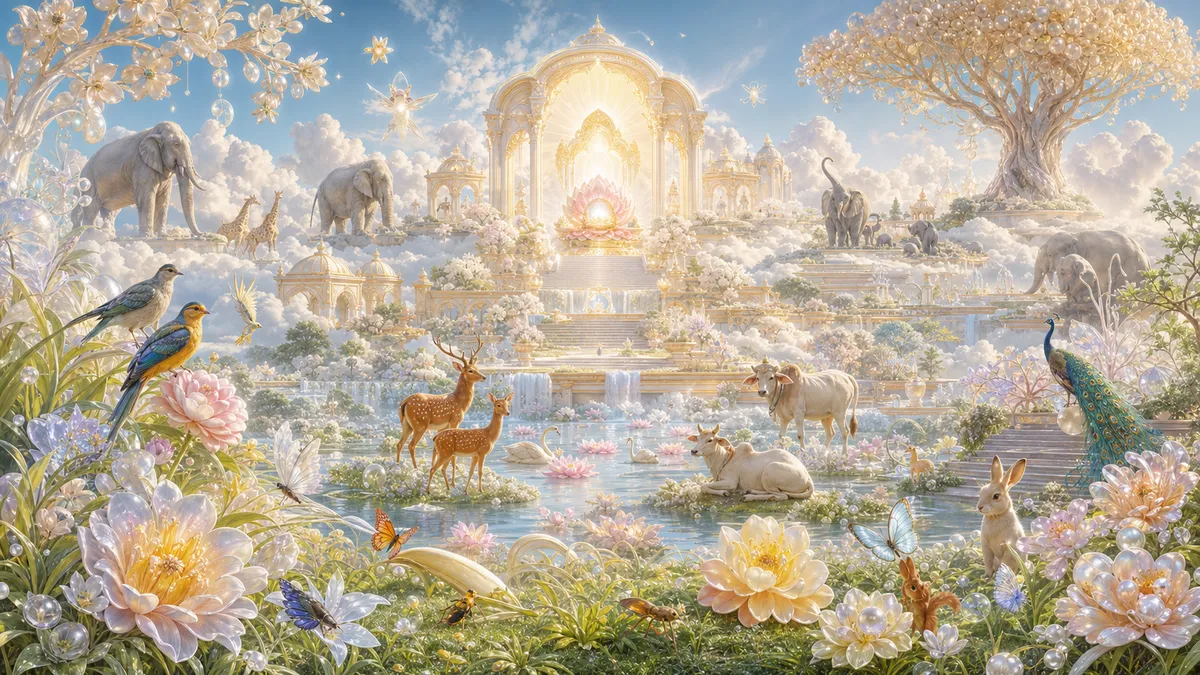
The “Mahabharata” describes the heavens of Brahma. It is said that Brahma’s heaven abounds in all the perfections of other heavens to the most excellent degree. There one can see everything that does not exist in the universe, from the tiniest insects to large animals.
Other names of Brahma are as follows: Prajapati (Lord of all living beings), Pitamaha (the great progenitor), Kamalasana (seated on the lotus), Parameshthi (the supreme priest), Hiranyagarbha (born from the Golden Egg), Savitripati (husband of Savitri).
The Principle of Brahma in Anava Yoga
From the point of view of Anava Yoga, when you contemplate the principle of the creation of the universe, the principle of Brahma, you discover within yourself the ability to deeply trace subtle creative processes and thereby more deeply reveal the primordial nature of the Mind. When you do not contemplate the higher forces governing the universe or divine beings, even if you try to contemplate, the mind easily enters a profane dimension. But a yogin always strives to unite his natural state with forces that are as high, deep, or global as possible, with exalted states, in order to remain constantly in the dimension of the sacred.
