

Satsang on the Night of Shivaratri
There is a story about the asura demon Vrikasura. Vrikasura wanted to gain great power so that he could defeat all his enemies. One day, he met Narada and asked him for advice:
“Whom should I invoke and to whom should I make offerings: Brahma, Vishnu, or Shiva?”
Narada said, “Make offerings to Shiva; he will respond the fastest, and he is the easiest to please.”
Vrikasura then went to Kedarnath, where he began performing tapasya for six days. He lit a fire and began performing a tamasic yajna: he cut pieces of flesh from his body and, reciting mantras, offered them into the fire. For six days he made these offerings, invoking Shiva, but no one appeared. Then he was already about to cut off his own head. At that moment, Shiva appeared and said, “You do not need to torment yourself like this; it would be enough for you to take water from the Ganges and offer it to me.”
So he went, took water from the Ganges, and made such an offering. Shiva, pleased with his offering, asked, “What would you like? What desire would you like to fulfill?”
Vrikasura, being an asura by nature, asked for a blessing that would cause the head of anyone he touched to split apart. Shiva granted him this blessing.
Vrikasura became very excited and immediately decided to try it on Shiva. He had a secret ulterior motive: if he tried it on Shiva and Shiva’s head split apart, he would then be able to take possession of Parvati. He chased after Shiva, and since Shiva’s blessing was effective, Shiva could not resist his own blessing—or perhaps he did not want to—but this was the lila: Shiva began to flee.

From the perspective of energy, they were great souls and possessed siddhis. Shiva was not fleeing only on foot; he was fleeing as a superbeing, like the superheroes shown in American films who can fly everywhere. He flew to other worlds and other planets, but Vrikasura, who began to pursue him, was also a superhero—thanks to Shiva, he had become even more powerful.
Then Shiva turned to Brahma and Vishnu, first to Brahma, but Brahma was unable to help him, so he turned to Vishnu. Vishnu said, “I will try to help you,” and decided to stop Vrikasura. He transformed into a very small, beautiful boy, met Vrikasura, and said, “Stop for a moment. I can see that you are a very respectable person,” and offered a namaste. Then he said to him, “You must be tired and out of breath after chasing Shiva. Shiva is not going anywhere; rest for a while and accept some prasada.” Flattered by such treatment, Vrikasura became interested in this unusual boy who was showing him such hospitality.
He began telling him proudly that Shiva had granted him such a blessing, but the boy began saying to him, “Think for yourself: I have some doubts that this is a genuine blessing. Shiva has such a strange reputation. Sometimes he associates with spirits, sometimes he wears skulls, sometimes he is surrounded by strange personalities, and sometimes he lives in such a strange place and sits on a tiger—and you believe all this? He has a strange reputation, so I would not really trust him.”
In this way, Vishnu began to display a little of his moha-siddhi, the siddhi of enchantment and magical influence. He said, “Most likely, this is not a blessing at all; it is a fake. But you can check for yourself. If you want, touch your own head—nothing will happen.” Vrikasura was so captivated by this that, in a state of mental confusion, he touched his head, and his head exploded into pieces.
The Story of the Descent of the Ganges
Everyone knows that Shiva wears the Ganges on his head, but what does this mean? Of course, it is a metaphor, but what lies behind it? There is a particular story behind it, connected with Bali Maharaja and Vishnu’s avatar in the form of the dwarf Vamana.
Many thousands of years ago, in another age, King Bali possessed great spiritual powers, and through the power of his siddhis he conquered not only the earth but also began conquering the heavenly realms. The gods began complaining that Bali was making their lives unbearable, oppressing them, and ruling through despotic methods—in modern terms, he was violating the rights of the gods and governing in an undemocratic manner.

This reached Vishnu, and Vishnu, since his task is to maintain the balance and order of the world in the Universe, decided to intervene. He assumed the form of a brahmachari wearing yellow garments and carrying an umbrella and a water pot; his name was Vamana. At that time, Bali Maharaj was performing an ashvamedha-yajna—a horse sacrifice intended to expand the territories of his kingdom and increase his power, since in another yuga yajnas were more powerful and produced results more quickly; most likely, this is how he attained such a position.
When he arrived, all the brahmins who were present saw his radiance, and because they saw his radiance, they paid their respects to him; the king also paid his respects to him. He asked: “How can I help you? How can I serve you?”
Vamana said: “Give me just a piece of land, three steps wide”—this is a well-known story. Bali Maharaj said: “I could give you much more; you are asking for so little, while I am a king and have vast territories.” But Vamana said: “This is enough for me, because if a spiritual person asks for more than necessary, he may be unable to cope with the karma that comes along with the donation. Therefore, one should not ask for more; I will take only three steps.”
Bali Maharaj agreed, and then Vamana took one step, traversing the entire earth; with his second step he traversed the entire Universe and said: “Where should I place my third foot?” Guru Shukracharya, who was Bali Maharaj’s guru, was watching this entire scene. From the very beginning, he had disliked the dwarf brahmachari for some reason; he realized that something was amiss. Through his spiritual vision, he understood that Vishnu Himself had come to take everything away from Bali Maharaj, and he said to him: “Do not give him anything; promise him nothing, or you will lose everything.” But Bali Maharaj was very noble at heart despite his asuric nature, and he also suspected that this was an unusual form, that it was somehow a form of Vishnu, and he was prepared for it.
Shukracharya tried to interfere, but Bali Maharaj stopped listening to him, and Shukracharya became angry and cursed him—at that very moment, Bali Maharaj’s strength weakened. Vamana waited until Bali disobeyed his guru; as soon as he disobeyed his guru, his spiritual strength weakened, he became vulnerable, and Shukracharya’s curse made him twice as vulnerable. He could then be taken with bare hands, and it was precisely at that moment that Vamana enacted this lila, saying: “Where should I place my foot?” Then Bali Maharaj said: “Here is my head; you may place it on my head. I revere and respect you greatly.”
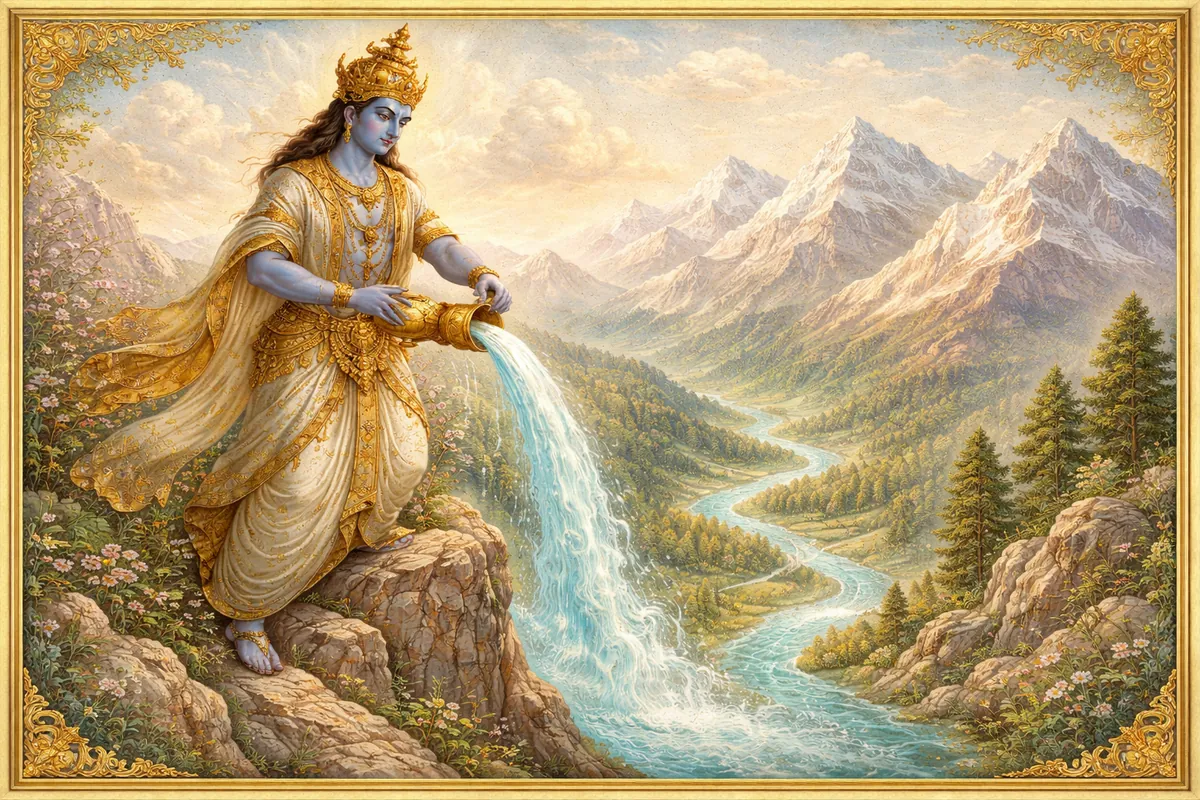
When Vishnu placed His foot, when He traversed all these three worlds, He pierced the Universe all the way to the causal world, and it was at that very moment that the Ganga began to pour forth. When He placed His foot on Bali Maharaj’s head, He simply, as it were, pushed him down into a lower dimension, saying: “There you will be happy; you will cause problems for no one; you will have a strong, healthy, immortal body, and all the inhabitants will be the same. There will be a heavenly abode there, but you will not be in this world, so as not to disturb the gods.” He entrusted Sutala-loka to Bali Maharaj, allowing him to rule it freely, and said: “Vishvakarma created this loka; now you will be its ruler.” It is believed that Bali Maharaj is still the ruler of Sutala-loka, and that this loka, despite being part of the lower heavens, is very beautiful, even though it consists of subterranean lower worlds. In his next life, Bali Maharaj will become the new Indra of this Universe.

The Spiritual Power of the Ganga
Thus, at the moment when Vamana was traversing the entire Universe, He pierced, as it were, a breach in the causal dimension with His big toe, creating an opening in the worlds through which an immense spiritual energy began to descend. This immense spiritual energy, speaking in semi-scientific terms, began to fold time and space, alter the metric and space, change the molecular bonds in the Universe, as well as the gunas and tattvas. It seemed to surge forth from the causal world and rush downward to Earth; in other words, the immense shakti of Vishnu’s avatar created this breach in the fabric of existence.
This causal energy of the primordial quantum chaos, so to speak, is very pure; this is Ganga herself. It was so powerful that if, in its pure form, it had descended upon Earth, space and time on Earth would have collapsed, and the earth tattva would have begun to split apart. King Bhagiratha, seeing this problem, began to pray to Shiva. He asked Shiva to transform this energy and take its power upon himself, and therefore it is said that Shiva, as it were, took part of this energy upon himself and reduced its force so that it could descend upon Earth without harming it. This is Shiva’s merit, which is why she is depicted in his hair, since he received part of her into his locks. Ganga possesses such purifying power because she, as it were, descended from the very pure state of maha-tattva.
A saint was once meditating in the forest on the bank of the Ganga, and he went to gather firewood for a fire. While he was gathering it, a merchant was travelling along the path, and as he rode, he saw a bull standing on the path. The bull was blocking his way and that of his cart. He got out and began trying to get past the bull, but the bull did not understand. He then took a stick and began beating it, and the bull gored him. When it gored him, it caught him on its horns and killed him. At that moment, the saint was passing by. He saw the bull standing there, the cart, and the mortally wounded man lying on the ground. The saint was carrying water from the Ganga; he sprinkled it on him and continued on his way.
Then he suddenly saw two terrifying creatures running past and saying, “What have you done? You are to blame for everything,” and they seemed to be weeping. He asked, “Who are you, and where are you running? Why are you blaming me?” They replied, “We are messengers of the god of death—the yamadutas—and we have come to take this man’s soul, but you have ruined everything; you sprinkled him with water from the Ganga.” Through the water from the Ganga, messengers of the god Vishnu appeared, and they said, “You cannot take him.” He was a sinner; they were preparing not merely to take his soul but to take it to hell. However, when the saint sprinkled Ganga water on him, the messengers of the god Vishnu came and said to the yamadutas, “You cannot take this man’s soul, because he has water from the Ganga upon him. He has been purified and has become almost a saint, so we have come to take him to the heavenly realms.”

The yamadutas began to argue and resist: “What is this water from the Ganga? What is the Ganga? Just some water—what significance could it possibly have?” Then the vishnudutas became angry: “How can you not know the power and glory of the Ganga?!”
They became angry and severely beat the yamadutas. The yamadutas were deeply offended, ran away, and blamed this man, and then the saint came to believe in the healing, sacred water of the Ganga.
Practice on the Night of Shivaratri
So, tonight, those who wish to do so will perform prostrations around the temple—36 prostrations, which is not very many. One may also recite a mantra, meditate, and express a sankalpa. Everything we wish for will be auspicious at this time, because Shiva promised: “Whoever worships me at this time, I will bless.” This is connected with the fact that the positions of the Moon and the other planets at this time are favourable for tapasya and the worship of Shiva.
