

Commentary on the text “The Hundred Thousand Songs of Milarepa”
Milarepa asked the boy to find the one who takes Refuge. When the shepherd concentrated on this, he could not find anything substantial, and so he was confused.
“But I remember nothing from my past life and do not know what will happen in the future. The minds of last year and yesterday have passed, tomorrow’s has not yet come, and the present, current one does not stop. O my teacher, have compassion, please give me an explanation. I submit everything to your judgment. You know everything; you know what I need.”
In response to the request, Milarepa began to sing:
“I sincerely turn to my Guru, who has realized the truth of non-ego. I turn to him with body, speech, and mind. I ask him with great faith and openness. Please bless me and my disciples. Give us the strength to understand the truth of non-ego. Have compassion for us and free us from the paths of clinging to the ego. Listen carefully, dear shepherd. Holding to the concept of ego is a characteristic of our consciousness. But if one looks inside this very consciousness, one will not see an ego there. There is nothing of that kind there.”
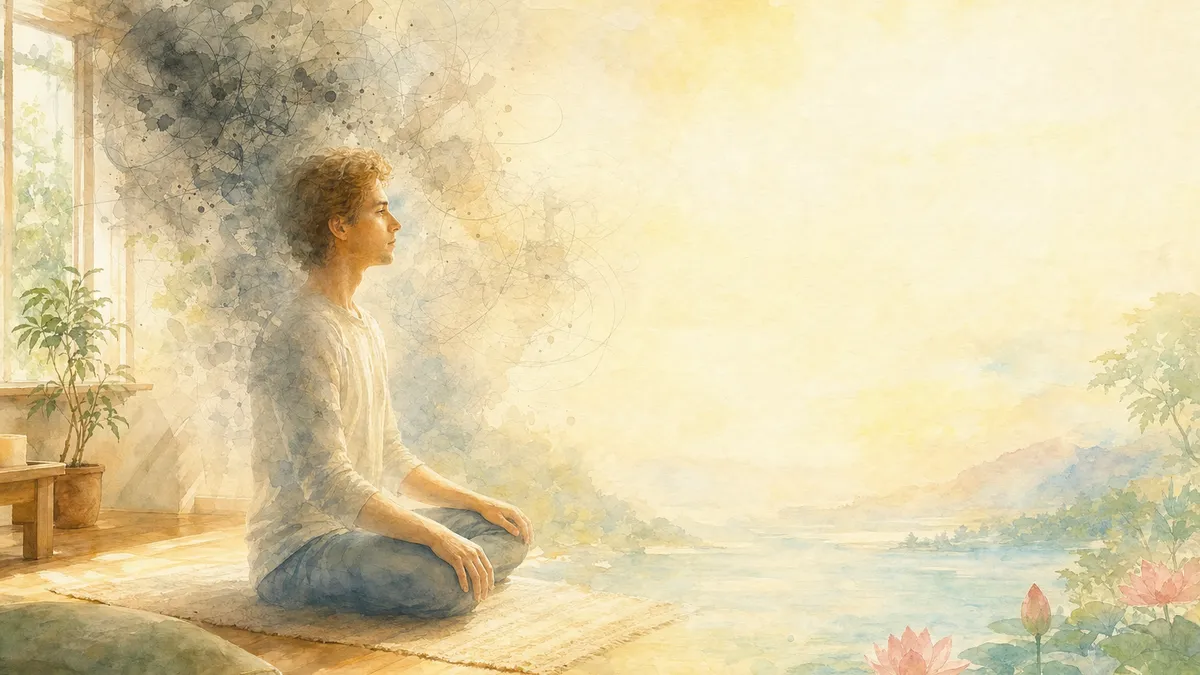
Holding to the concept of ego is part of the samsaric state. For example, when we naively suppose “I think,” “I do,” “I want,” we mean some conglomerate that we conventionally call “I.”
When we look deeper into this very “I,” we discover some confusion, chaotic fragments, and darkness. However, trusting the instructions of the saints, we do not yield to this confusion and go even deeper. Having broken through this confusion of thoughts and fragmentary impressions, we suddenly realize the pure empty space, which is in no way differentiated and which cannot be defined in any way. Moreover, in the process of realizing this space, the one who realizes it—that is, we ourselves as the subject—also disappears. Realization is present, but there is no one who realizes, no subject, no object.
Then suddenly all our views on life are overturned, our self-assessment is overturned. We discover a different attitude toward ourselves and toward everything perceived. We realize: “So this, it turns out, is what it is all about! Everything visible was the space of light and nothing else. Majestic, boundless, and freely manifesting, yet in no way definable. I too am a drop that sprang out of this space. In essence, I am inseparable from it. But this drop entered a body, and its awareness became clouded.”
When we establish a connection with this space of Clear Light, there is no longer any separateness from the world or from others, but rather a sense of unity. In the world of humans or in the world of gods, all living beings are divided into two categories: those who have restored this unity, and those who have lost it and have not yet restored it. Those who have lost it and have not yet restored it suffer and abide in ignorance, or are emerging from it. Such are the beings of the six worlds. They may even enjoy themselves, but their enjoyment is impermanent. Those who have restored it do not even have the feeling of a separate “I.”
Requirements for a Disciple on the Spiritual Path
If one is able to practice the teaching on the natural state and knows how to see nothing, then one can see something. To practice the teaching on the natural state, great trust, non-attachment, and inspiration as awareness are needed. One should understand the truth of karma, of cause-and-effect connection, as the path. In order to attain perfection, one should rely on the Guru and have the aspiration to receive empowerments, instructions, and inner teachings. Here a disciple possessing merit is needed. To receive the teaching, a person is needed who does not shrink from inconveniences and suffering. Courage, fearlessness, and disobedience to death are required here. Dear shepherd, are you capable of all this?
Here Milarepa tells the shepherd, who wanted to receive teaching from him, that many qualities are required of him, and asks whether he possesses them.
As our spiritual practice progresses, we will discover that it requires ever deeper and more elevated qualities from us. At the beginning, practice does not make very serious demands on us, but as we rise higher, we see that without developing such qualities we will not be able to ascend to the next level. Therefore, we have no other choice but to cultivate them.
“Dear shepherd, are you capable of all this? If so, you are fortunate. If not, then it is better not to speak of it. Ask yourself this question and think it over carefully. When you searched for your Self last night, you could not find it. This is the practice of the non-ego of the person. If you want to practice the non-ego of being, follow my example and meditate for 12 years, and then you will understand the nature of the mind. Think carefully about this.”
The shepherd said:
“I offer you my body and my head. Please help me understand my own mind clearly and precisely.”
Milarepa thought:
“Now I will see whether this child can truly engage in practice.”
Then he said:
“First, turn your mind to the Three Jewels, then visualize the image of the Buddha in front of your nose.”
Thus Milarepa gave the shepherd instruction in concentration, after which he sent him away.
Milarepa gave him a basic concentration practice, sukshma-dhyana (concentration on the image of the Buddha in the area between the eyebrows), in order to test his capacity for concentration.
A Yogi of High Ability
The youth did not appear for seven days. On the seventh day his father came to Milarepa and said:
“Dear teacher, my son has not come home for a week now. This is very strange. I do not know where he could have gone. I questioned the other shepherds who had been with him. They all said that he had come to you for the Dharma, and then was supposed to go home. But where is he?”
“He was here,” Milarepa replied, “but he has not appeared for seven days now.”
The father was deeply distressed and, weeping bitterly, left Milarepa. Then many people went to look for the youth. At last they found him. In a pit for clay mortar he was sitting upright, gazing straight ahead with eyes wide open. They asked:
“What are you doing here?”
He answered:
“I am practicing the meditation my Teacher taught me.”
“Why, then, do you not return home?”
“I have been meditating for only a short while; you must be joking.”
Saying this, he looked at the sky and discovered that the sun was a little higher above the horizon than it had been when he sat down to meditate. Confused, he asked:
“What has happened?”
From that day on, the youth’s parents found it very difficult with him, since he had almost completely lost his sense of time. What seemed to him to be only one day was four or five for others. Often his parents sent people to search for him. Both the household and he himself were at a loss. One day he was asked whether he wanted to stay with Milarepa for good. He said that he dreamed of nothing else. Then they gave him food to take with him and sent him to the Teacher. First Milarepa told him about the five virtues and explained the foundations of the Dharma. Then he bestowed upon him the teaching on innate wisdom. Through practice, the youth gradually gained good experience in meditation, and Milarepa was very pleased. However, in order to warn him against a mistaken understanding of the nature of true realization, Milarepa sang him the following song.
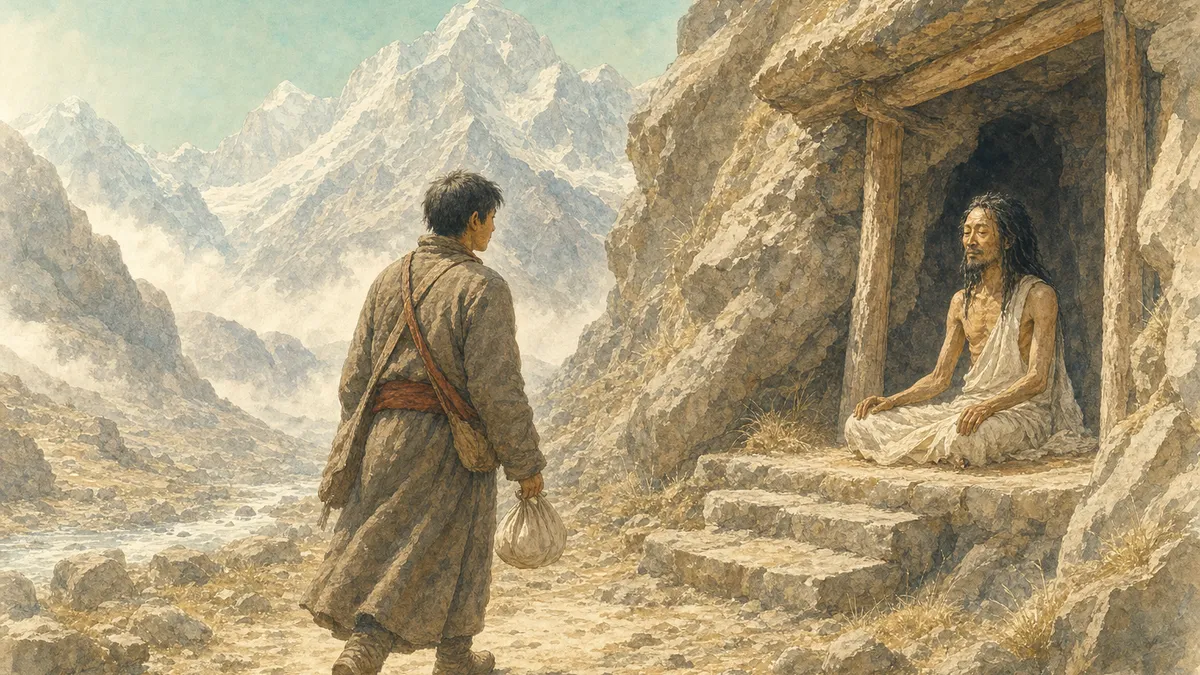
This boy turned out to be a yogi of high ability at the divya level. He was able to enter samadhi as soon as he began practicing concentration.
Warnings Against False Understanding
I bow at the feet of Marpa, the one who was blessed by Naropa. Those who practice the Dharma more with their tongues speak a great deal and, it would seem, know a great deal. But when the time comes for that which perceives to leave the body that has become dead, this preacher, servant of his own mouth, is cast out into space.
Although very many treatises have been written about spiritual life and countless words have been spoken, the principle of the spiritual state lies in the ability to be aware. Just as a person who knows many books about swimming but cannot swim cannot be called a swimmer, so too a person who knows a great deal about spiritual practice and the Clear Light but does not know how to contemplate cannot be called a yogi.
Spiritual contemplation is a matter of skill, not a matter of philosophy or intellectual knowledge; although one cannot do without them either, it is like dexterity in sports.
When the Clear Light shines forth, the clever man will be seized by blindness. The chance to see the dharmakaya at the moment of death will be missed because of fear and confusion.
Here Milarepa warns that intellectual understanding alone will not give the yogi the ability to realize the Clear Light in the bardo; therefore, such a clever man too will be seized by ignorance. When we study various texts, they are not read for the purpose of intellectual comprehension. The point is that at the moment of listening to these texts, one should simply contemplate and enter the natural state. It may seem that intellectual information is being transmitted, but this is not so. When you listen, you meditate; you enter the natural state, uniting with the listening. And it is assumed that when you spend many hours in such a state, meditative presence opens within you.
Even if one spends an entire life studying the teaching, it will not help at the moment when the mind separates from the body. Alas, even sophisticated yogis who have practiced meditation for a long time mistakenly take the psychic experience of luminosity for innate wisdom...

Here Milarepa cautions the disciple against mistakes in practice. He says that even yogis who have spent a long time in retreats can be mistaken and take some kind of cave luminosity for the Clear Light, making it the support of their practice.
...and are happy with this form of self-deception. Therefore, at the moment of death, when the innate wisdom of the dharmakaya shines, these yogis are unable to unite the light of mother and son.
Suppose a yogi experiences the first dhyana and sees light. He feels very good in this state; bliss and attachment arise in him. He thinks: “This is wonderful! This is nirvana!” His breathing stops, his heartbeat stops, he experiences a state of bliss and thinks: “I am definitely entering samadhi; I am experiencing the light of nirvana.” And his practice now consists of sitting in such a state for as long as possible. Can such a yogi unite with the primordial Clear Light at the moment of the bardo? Never. To his surprise, he will find himself reborn in the lower heavens of the world of form instead of nirvana. At best, the attainment of the first dhyana leads to rebirth as a god in the higher world of forms. If such a practitioner meets a yogi who has realized complete understanding, that yogi will laugh at his understanding of nirvana, which he experienced in the first dhyana.
It would seem that the light in the first dhyana and the light in the deep state of the Clear Light bear the same name — light. But the light of the first type is called “cave luminosity,” that is, it is nirvana perceived by the astral body. The true light of nirvana is much deeper: it is the light perceived by the formless world, perceived by the essential layer of the mind beyond the causal body.
And since meditation cannot help them at the moment of dying, they are still in danger of being reborn in the lower worlds.
When you practice, you need to learn to acquire strong concentration, to develop the ability to do work for a long time that brings no pleasure, the ability to withstand discomfort when the senses are not satisfied, the ability to sit motionless for a long time even if your legs go numb. When you have such potential, when you have developed such abilities, you will be able to experience deep meditative states.
Accumulation of Merit and Wisdom
It is said that a solid foundation is needed to attain liberation. And it is built from two important kinds of accumulation: the accumulation of merit and the accumulation of wisdom. The accumulation of merit means that you have created a karmic potential that allows you to practice all the teachings. The accumulation of wisdom means that you already have a certain intellectual and non-conceptual clarity; therefore, on the basis of lectures, from what you have read, or from your personal experience of awareness, you roughly understand what the essence is. When these two accumulations are present, you are already a fully prepared, mature yogi.
It is usually considered that there is not enough such merit, and therefore, in the status of a novice, we accumulate it. For example, we gave laypeople instructions on how to accumulate merit, how to perform good deeds for the benefit of the Dharma. When you have accumulated a fairly large karmic potential, your spiritual practice advances easily, without obstacles. It is considered that a yogi of the divya level must perform at least three hundred good deeds in order to become awakened or immortal on earth. For a yogi of the vira level — one thousand two hundred, and of the pashu level — one thousand five hundred.
Many tantric texts describe sadhanas during which one must distribute food to the poor, save fish or animals in order to obtain healing and increase one’s lifespan, that is, to attain longevity and robust health. This practice is also used in Taoism, where it is said that one must perform at least one thousand two hundred good deeds in order to become immortal. And even if you perform one thousand one hundred ninety-nine, but at the same time do something bad, the entire result is annulled, so you will have to accumulate good deeds anew. This is a kind of offering to all living beings in order to accumulate this positive potential.
Someone may say that awareness is what matters most, while actions are of secondary importance. This is true for ordinary people, but it is not true for buddhas, because only among saints is every action accompanied by awareness, while among ordinary people it is accompanied by bhavana, an emotional attitude, a worldview. And naturally, when positive actions are performed, the positive potential of bhavana is accumulated, and when a negative action is performed, a great deal of negative potential is accumulated, which in turn shortens life, leads to illnesses, and creates troubles around a person.
For example, thieves in prisons often complain that the joints in their hands hurt—this is how the karma of stealing returns. Murderers in prisons often experience unmotivated fear, and many of them end their lives very early. Conversely, when positive good deeds generally accepted in society are performed, such as distributing food to the poor, making donations, building wells, saving caught fish, or redeeming animals that were to be killed at a slaughterhouse, a person accumulates positive potential, and therefore the length of his life increases. Such a person purifies himself through a different bhavana, and therefore his perception of the world, his karmic vision, also changes. As a result, he attains longevity and a better destiny. From the practitioner’s point of view, this is the accumulation of merit. And when he purifies his karma, this is called the potential of merit.

Of course, when performing any action, the right motivation is important. When you always have a positive or pure motivation for this action in your mind, you make such an accumulation of merit. When these two accumulations have been gathered, the yogin fully takes shape as a practitioner.
The fact that the boy was able to enter samadhi so quickly means that these two accumulations were already present in him; they had been gathered in previous lives. That is, at that age he already had such a solid store of wisdom and merit that he could converse with Milarepa as an equal.
Distinguishing Superficial and Deep Experience
When your back is straight and your mind is deeply immersed in meditation, you may feel both thoughts and mind disappear. But this is only a superficial experience of dhyana. Further, through continuous practice and attentiveness, you can experience radiant self-awareness, shining like a bright lamp. It is pure and luminous, like a flower; it is like the feeling when your gaze is fixed unwaveringly into the spacious empty sky.
How can one determine whether the practice is superficial or deep, whether the meditative experience is genuine or still initial? This can be determined by whether it penetrates sleep with dreams and sleep without dreams, or does not penetrate them. For example, if a yogin has become established in deep presence or in the meditation of the fifth dhyana, then at night, in a dream, his mind is wide open, he perceives an immense luminous space, and his mind at that time is aware, awake. This is a sign indicating that the practice has already acquired real depth, that the yogin is approaching the realization of his essence. Or the yogin experiences dreams, but in the dreams he has presence. He may not fully remember that it is a dream, nevertheless he behaves in dreams not like an ordinary person, but is constantly in contemplative presence. In essence, for him, the world of phenomena and the world of dreams are one and the same. Even without knowing that it is a dream, transferring into a subtler body, he still contemplates the Clear Light without distraction. Then for him both the world of phenomena and the world of dreams are phenomena of the same order.
Awareness of emptiness is translucent and transparent, yet it is vividly experienced. This non-thought, this radiant and transparent experience, is nothing other than the feeling of dhyana. With this foundation, one must continue to turn one’s mind to the Three Jewels and penetrate reality through deep reflection and contemplation.
Testing Realization and the Maturity of Practice
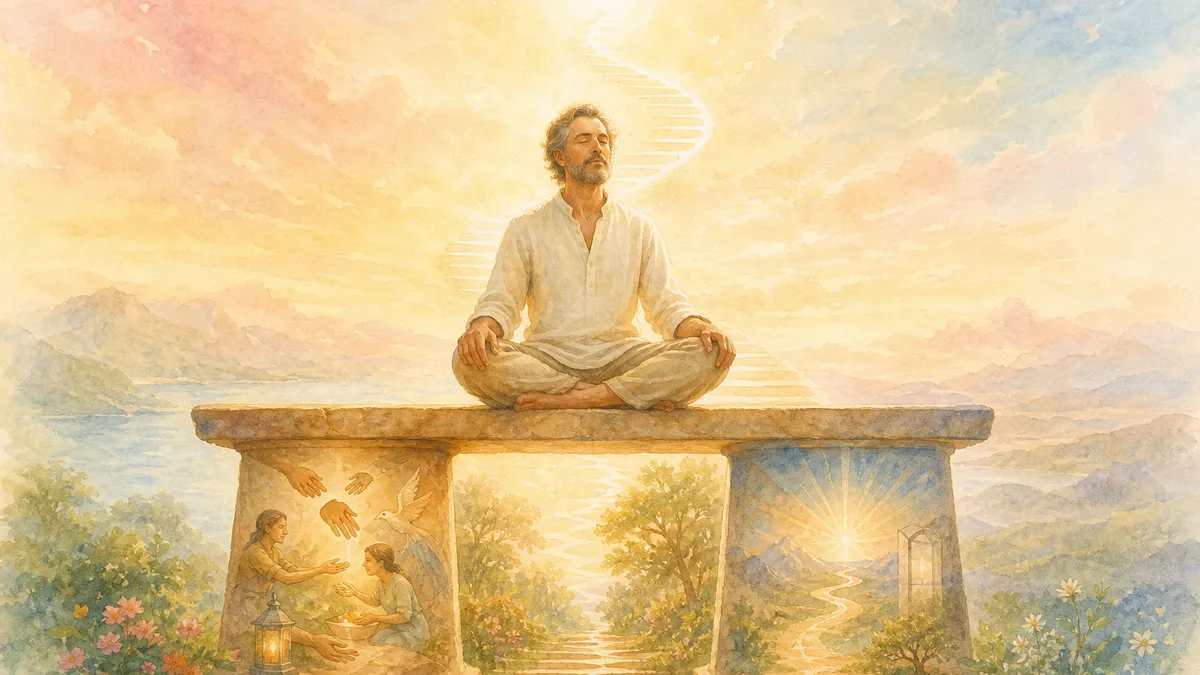
Even when a yogin discovers this empty, transparent luminosity, even when it is not interrupted in his sleep—that is, he has attained the state of the “hot eye”—this still does not mean that he has become a buddha. He may think many things about himself, but this is not so. He would do well to look into the instructions of the saints.
The point is that he may not be able to maintain this state in ordinary life. But even if a yogin can maintain this state, it may be inflexible, frozen; it may respond inadequately to what is perceived. For example, if the outer world throws the yogin off so that he cannot express this state, cannot manifest it, then this means that he must continue to practice in order to maintain this consciousness in everyday life and learn to bring it to the foreground.
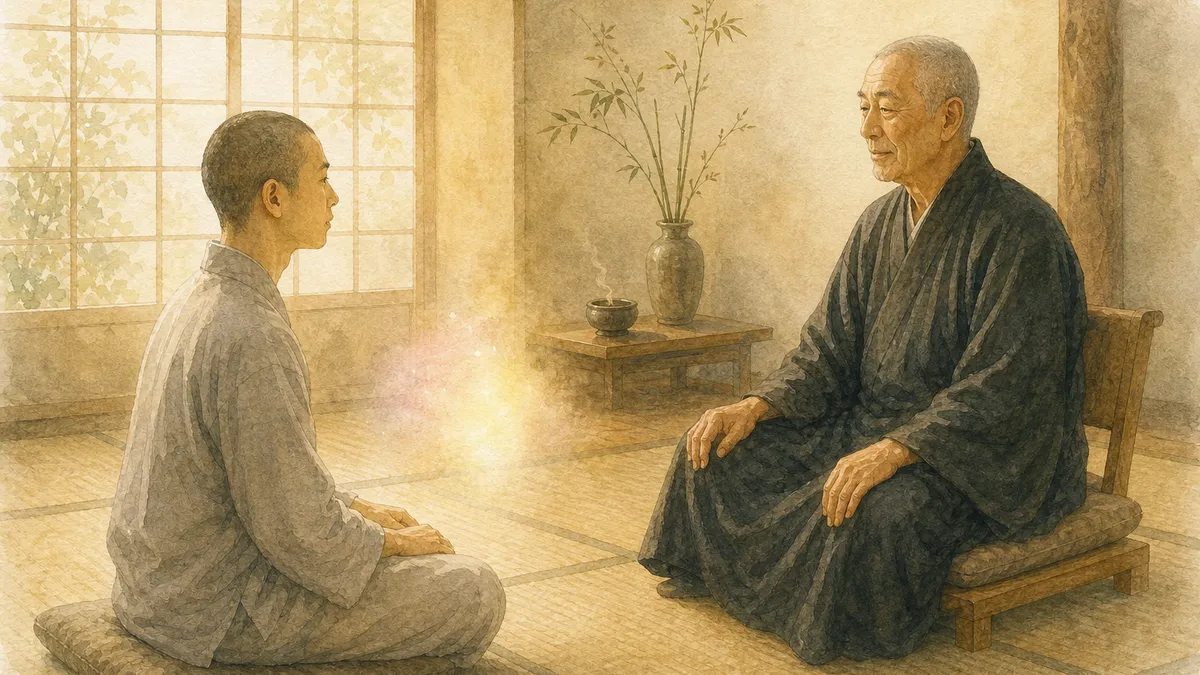
One Zen teacher decided to test a student’s experiences when the student told him about them. The teacher asked the student a question, but he could not answer it. And then the Teacher said: “Your nirvana has no tongue. Go away. Your nirvana does not yet know how to speak; keep learning.”
Milarepa’s Final Instructions
Then one will be able to grasp the wisdom of the sky with the precious life-rope of deep dhyana. By the power of kindness and sympathy, and by the compassionate vow of the Bodhi heart, one will be able to see directly and clearly the truth of the enlightened path, when nothing can be seen and yet everything is seen clearly, and to notice how mistaken the fears and hopes of your mind were. Without arriving, you reach the abode of the Buddha. Without seeing, you perceive the dharmakaya. Without effort, you do everything naturally. Dear son, seeker of the good, keep this teaching in your mind.
Then Milarepa gave the young man the full initiation and oral instructions. By practicing them, he attained the highest experience and realization.
This is the story of Milarepa’s second stay in Ragma and of his meeting with the young shepherd.
