

The Cosmic Dance and the Primordial Order
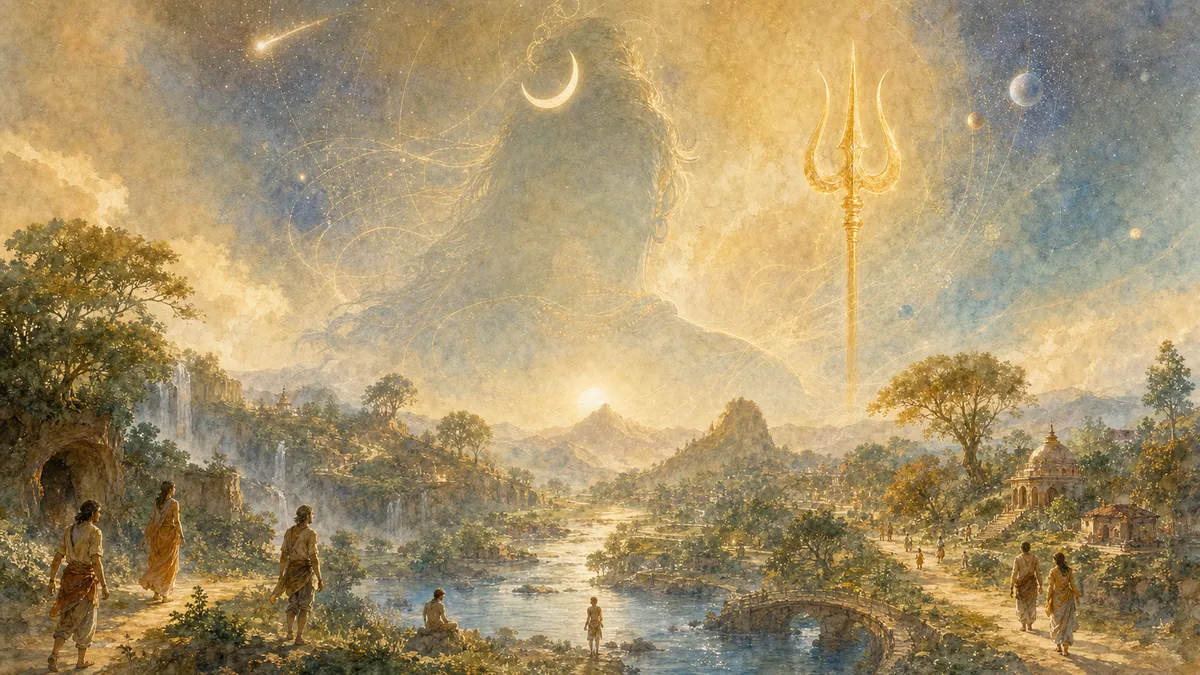
“All this creation is like a stage where these potencies of consciousness dance to the melody of time. The primordial order of things and sequences is considered the most important. It is also known by the names action, desire or will, time, and so on. The presence of certain characteristics in every object—from a blade of grass to the creator Brahma—depends on this potency. This order is free from agitation, but not free from limitations: order is that which dances the dance-drama called the ‘apparent world.’ It displays different moods, it brings in and escorts away the seasons, it is accompanied by celestial music and the roar of the oceans, its stage is illuminated by the sun, the moon, and the stars, its actors and actresses are living beings in all worlds—such is the dance of the primordial order. God, who is infinite consciousness, is the silent but attentive observer of this cosmic dance. He is not different from the dancer (the cosmic natural order) and the dance (events).”
Here Shiva describes rita—the primordial course of all things. He describes it using the analogy of dance. As is known, Shiva is called the king of dance. Dance is the unfolding of lila, the play of cosmic energies (chit-shakti-vilasa). We think that galaxies and planets are born, that people are born and die, but all of this is the dance of the play of the energy of awareness (vilasa), and the dancer here is Shiva, if by Shiva we mean Brahman, the Absolute. The course of these things is also called rita (the universal order embedded in the universe).
Recently, scientists discovered a certain world in the universe in which there is no radiation at all; there are not even black holes there. Usually, even in the emptiest places in the universe there is something (neutrinos, black holes, some remaining relic radiation), but an enormous region of the universe was discovered where there is absolutely nothing, that is, a vast space of emptiness. This was a shocking discovery for scientists.
And the great dancer Shiva is precisely emptiness, observing the unfolding of the dance itself. All living beings are like actors and actresses on the great stage of the universe. Shiva is the observer of this dance. He is simultaneously different from the play of the energies of this dance and not different from it; he is it itself. It is like some brilliant programmer creating a three-dimensional virtual game with many characters, houses, and trees, setting the course of events, the hierarchy, the plot, the lives of the characters, endowing each of them with rights and merits, and then observing all of it from the outside.
Life as a Virtual Game
All of us, living beings, are players, virtual characters. Some of them realize and understand this, because their higher subtle bodies are open. Others do not realize it at all, identifying their “I” with the body. But both are playing. What can there be besides play in a virtual game world? No one can avoid playing. As soon as you find yourself in it, you become part of this great game. Even if you fight against the rules of the game, you are also playing—only by slightly different rules than everyone else.
Thus, all living beings are game characters. Some play kings, others—householders, rich people, still others—the poor, fourth—soldiers, fifth—criminals. Everyone plays according to their inclination. It is the same as in a virtual world, when a person takes on some role: a dwarf, an elf, an orc, and so on. A storyline appears for him, he completes various quests until he reaches a high rating. The same thing happens in life: each person chooses the character, the personality and physical body to which he is subconsciously drawn, attracted. This choice occurs even at rebirth.
Of course, it seems as though we are engaged in many activities, but in reality we are precisely such playing virtual characters. Those people who do not realize this principle do not even know what they are doing here or where they are going. They forget all of it, completely identifying with this character and this body. But monks and sadhus are those who understand well why they are here, why this character and this virtual body have been given to them. And it has been given to them in order to reveal the higher contours of consciousness by turning inward, and to see the one who is doing all of this. Some say: “Yes, life is like a virtual game. The plot is lousy, but the graphics are excellent.” But when you enter the spiritual path, you yourself become the builders of the storyline of your life.
True Worship Through Meditation
Shiva continued:
“Such is the God whom alone the wise should worship. It is he whom the wise worship in various ways and in various forms—as Shiva, Vishnu, and so on. Now listen to how he should be worshipped.”
To realize the Absolute is the foremost task of any soul. In whatever manner, by whatever means, the soul comes to realization, it is victorious if it comes to it. Just as the main task of a monk is to meditate on God, to realize him.
Shiva says:
“Now listen to how he should be worshipped. First of all, one should abandon the idea of the body—the notion that ‘I am my body.’ Meditation alone is true worship. Therefore, one must constantly worship the God of all three worlds through meditation.”
The idea “I am this body” takes root from the very moment of birth. When we begin to seek the observer of the space of awareness, discover the inner deities, we change the idea “I am this body” to the idea “I am limitless Consciousness” and become accustomed to this idea. At first we rely on sankalpa or on effort, then it becomes effortless presence, and then it is sahaja—natural faith flowing from knowledge.
The Search for the Source of Action
Each of you is a spiritual soul enclosed in a body, much like a person enclosed in a spacesuit. And this soul drives the body, giving it instructions, subtle impulses. Before raising your hand and lowering it, something within you, at a very subtle level, gives commands. These commands are sent through a neuron, axon, and synapse in the brain to the muscle fibers. The chemical composition of the cells changes, the muscles contract—striated and skeletal—and as a result you move your hand. That is, even your slightest movement is a very complex process. But before the subtlest electrical impulse is given along the neuron–axon–synapse circuit, some vibration must arise in the brain cells that would issue precisely this command. This vibration is based on subtle prana. But prana received the command from consciousness, that is, from something even subtler.
It turns out that when your gross physical body performs a gross action, something very, very subtle is acting within you, sending impulses to the brain, muscles, and so on. This subtle body is you. Therefore, if you want to quickly disperse the darkness of distraction and remove the idea “I am this body,” you must trace the source of action and find the one within you who issues these commands. When you begin to trace the path to this source, you will see that it is something very, very subtle, that it is much subtler than thoughts and guides the physical body like a virtual character. This very subtle something, without thoughts, gives such pulsating impulses, which are called spanda. It is they that govern you.
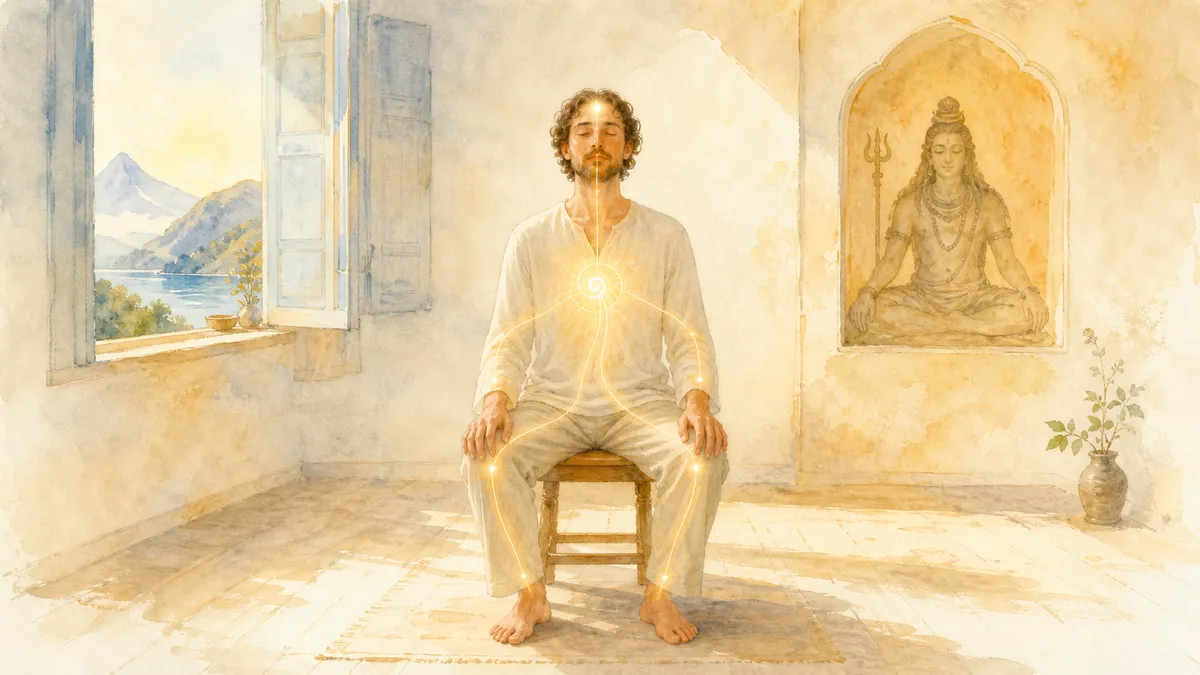
That is, you are the authoritative volitional operator of this body, which is like a robot receiving remote commands. One who distinguishes this body from the one who sends commands is knowledgeable. One who does not distinguish is identified, abiding in the illusory concept of aham dehasmi (“I am the body”). Such knowledge arises as the result of discrimination, when we constantly observe the one who sends these commands and single him out as a certain subtle component of our consciousness.
Meditation on the Universal Form
Shiva says:
“How should one concentrate on him? He is pure intelligence, brighter than hundreds of thousands of suns risen simultaneously. He is the light shining in everything that shines. He is the inner light. Infinite space is his throat, the earthly foundation is his feet, the directions of light are his arms, the worlds are the weapons he holds in his hands, the entire universe is hidden in his heart, the gods are the hairs on his body, cosmic potencies are the energies in his body, time is the guard at his gate, and he has thousands of heads, eyes, ears, and arms. He reaches everything, he tastes everything, he hears everything, he thinks with the thoughts of all, although he himself is beyond thinking. He does everything always, he gives everyone what they think about or desire, he dwells in everything, he is everything, he alone is worthy of being attained. Therefore you must meditate on him.”
When you meditate, aspiring toward the supreme light, you feel it not only in your own body, but also in the bodies of others. You eat with billions of mouths. You experience pleasure and suffering with billions of bodies. You flow like sap inside plants, trees, and grasses. You buzz, flutter, and fly together with butterflies. You glide like grass snakes. You flow like water; you shine like the stars and like the sun. You are all of this simultaneously, because that subtle layer of consciousness that you have found permeates all bodies at once.
The mind, memory, the astral body—all of this is coarse and not so important if you feel this. Then naturally you cannot be selfish; you also think of others. Why not think of others? After all, it is all you. How can you not think of yourself in another body? And these are not formal words, but real ones. Therefore saints think not only of a small body; they are more concerned, for example, with the destinies of humanity, the destiny of the universe; they are servants of the entire universe, because they regard the whole universe as their body.
Service as a Great Goal
If you are a small selfish being in the small body of a human, then you have no concern for others, because you do not consider them to be yourself. You can cause others suffering and think: “Let it be bad for them, but good for me, so there is no problem.” But if you have a body the size of the universe, and you feel yourself abiding in all beings, then your level of thinking is completely different: you care for all beings in the universe, you serve the idea of the welfare of all beings, and you are a servant of the whole world.
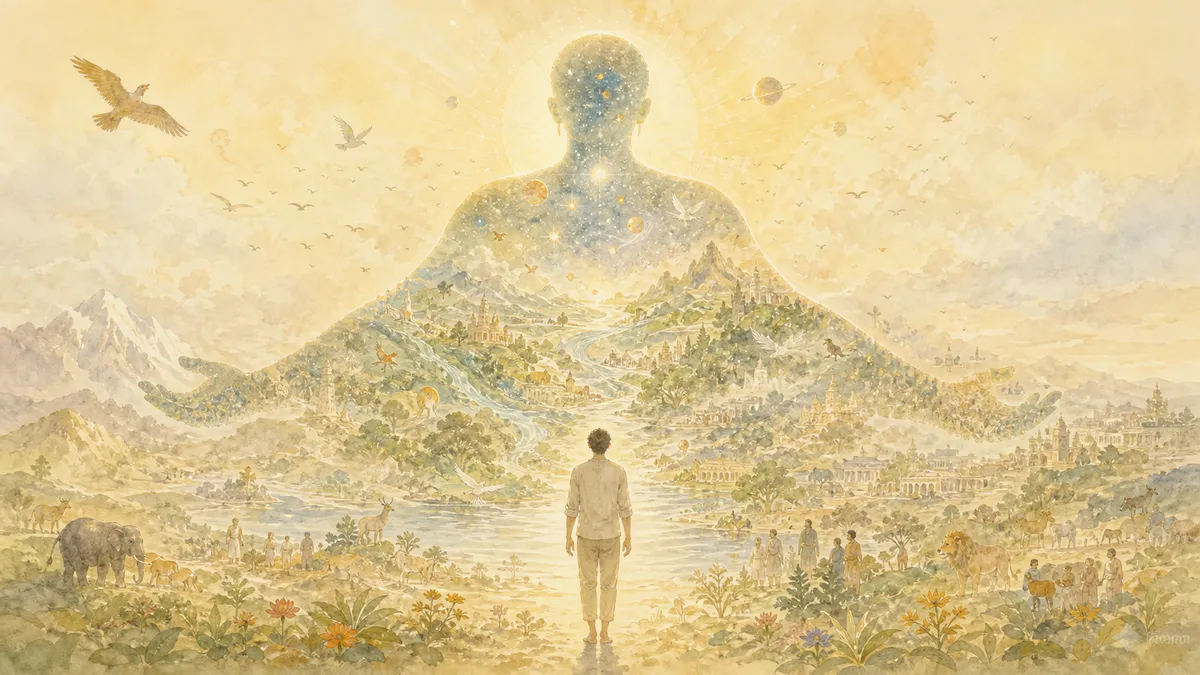
By becoming monks, you are precisely becoming servants of the whole world. Even if you have not realized this, you need to become accustomed to the idea of the welfare of all living beings in the universe, and not only to the idea of your own welfare. This is the great principle of service to the enlightening power of Anugraha. Sooner or later, having gone through training in the monastery, you will engage in some activity in service. Some in this life, some perhaps after this life or in the next, but in the end it will be activity on the scale of the entire universe—the manifestation of Anugraha-shakti. And right now you are learning to become accustomed to this. This is precisely why you study, train, and practice.
If you think: “I practice for myself, so that things will be good for me first of all,” then in reality you are limiting yourself. This is your mistake, because what you consider to be yourself is not, in principle, you. It is as if it were you, but only a very small part of you. And for things to truly be good for you, you need to understand that you are present in all bodies. That is, you need to make a revolution in consciousness, fundamentally change your vision, the scale of your thinking, and the vector of your intention. Then you will truly help yourself as well. You will not shut yourself inside the narrow cocoon of your selfish notions.
A person who confines himself to the idea “I am this body” is like a cell of a large organism. But if the entire organism is not healthy, then the cell cannot be well either. On the contrary, when you think on a large scale, broadly, regarding all living beings as your illusory bodies, you are doing yourself a very great service as well.
And here Shiva explains how to meditate on the universal form (vishva-rupa), worshiping God.
Often, while practicing, we have many personal goals. And these personal goals prevent us from following larger, truly great goals. Service is precisely such a great goal. If service becomes the meaning of life for you, something very important, then these goals lead you to the darshan of the enlightening power, to liberation.
For example, when I am asked, “And what would you personally like for yourself?” I go through it in my mind and think, “What would I really like?” And then I say, “Personally, for myself, I would like temples all over the world, or immortality for all humanity. That is the very least.” They ask me again, “But what would you like personally for yourself?” Then I do not even know what to answer, because I have completely unlearned thinking in such categories. If by myself one means this body, then I have everything.
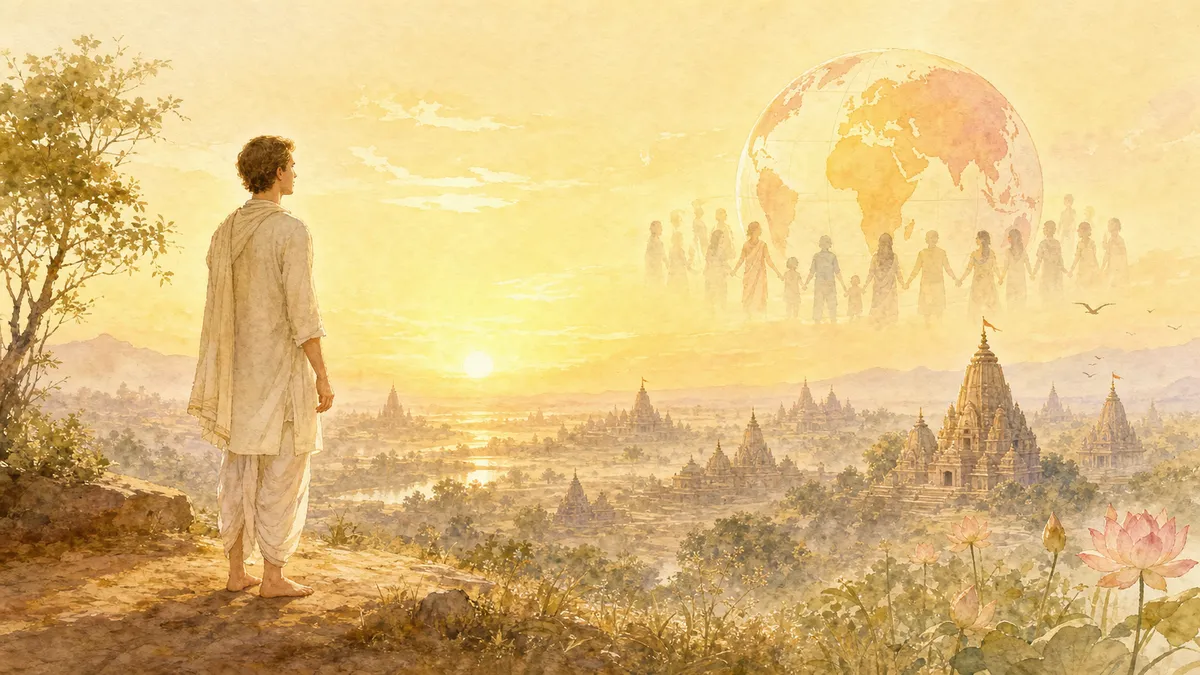
In the same way, by becoming monks, you gradually unlearn thinking in selfish categories and accustom yourselves to thinking in categories on the scale of at least all humanity, and at most—the entire great universe. And only then will you yourselves quickly transcend all your limitations.
Worship Through Self-Awareness
Shiva says:
“This God cannot be worshiped with material offerings, but only through one’s own awareness. Not by waving lamps or lighting fragrant candles, not by offering flowers, and not even by offering food. He is attained without the slightest effort; He is worshiped only through self-awareness. This is the highest meditation and the highest worship — the constant, uninterrupted sense of the inner presence, the inner light or awareness. While doing whatever you do (seeing, hearing, touching, smelling, while eating, moving, sleeping, breathing, or speaking), you must know your true nature as the nature of pure consciousness. Thus liberation is attained.”
Vasishtha apparently received his first instructions in Laya Yoga from Shiva, since these words set forth the very essence of Dharma. It could not be said better. Everything else is a decoding of these four lines and commentaries on them. Shiva says: “Whatever you do, you must know your true nature as the nature of pure consciousness.” But how can it be known? This is possible only if the knowing subject within us is turned toward this true nature, if he is continuously seeking it.
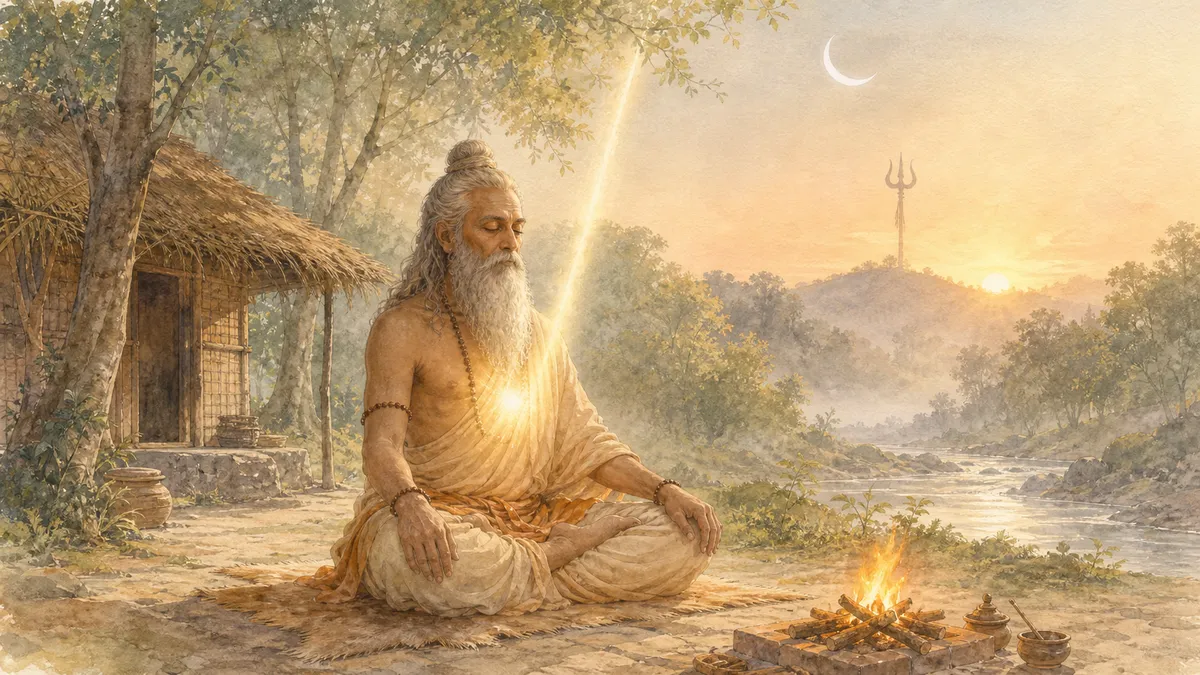
It is as if there is a certain video camera within you which, rotating, constantly follows the inner light, or a light-sensitive element that peers into the inner space, follows it, feels its way toward it. There are those who have felt out this light with the camera of their consciousness, and there are those who creep cautiously and look, because their light-sensitive element is not yet sensitive enough. The one who has felt it out is nourished by this inspiring light, and therefore his spiritual power grows day by day.
At first it seems as if there is nothing at all, as if the inner light is some philosophical concept and abstract talk. But after many years of independent practice we begin to feel something, and then we become accustomed to the fact that this subtle sensation becomes increasingly distinct and strong, that it can be experienced while awake, not only in meditation.
Those who abide in ignorance have few doubts, since they do not see this light. Those who abide in liberation also have no doubts, since they live in this light. But those who are in the middle, whose realization has not yet taken place but who are seeking this light, have a great deal of uncertainty and doubt, and therefore they tend to fall under various illusions. That is, the one who does not seek does not make mistakes. The one who has found cannot make a mistake. But the one who seeks can always be mistaken. It is like walking through a dark underground labyrinth with a flashlight and thinking: “Maybe the way is here, or here... Or perhaps here... No, definitely not here.” You shine the light somewhere else and find it, but then it is lost again. And by such an intuitive path you nevertheless find some road and come out into the light.
Shiva says: “You must know your true nature as the nature of pure consciousness.” And in the end, when you find this light, you recognize your true nature, you believe in it. And Shiva says: “Thus liberation is attained.”
Meditation as an Offering
“Meditation is an offering; meditation is the pure water offered to the deity to wash His hands and feet; self-awareness obtained through meditation is a beautiful flower. Truly all of this is directed toward true meditation.”
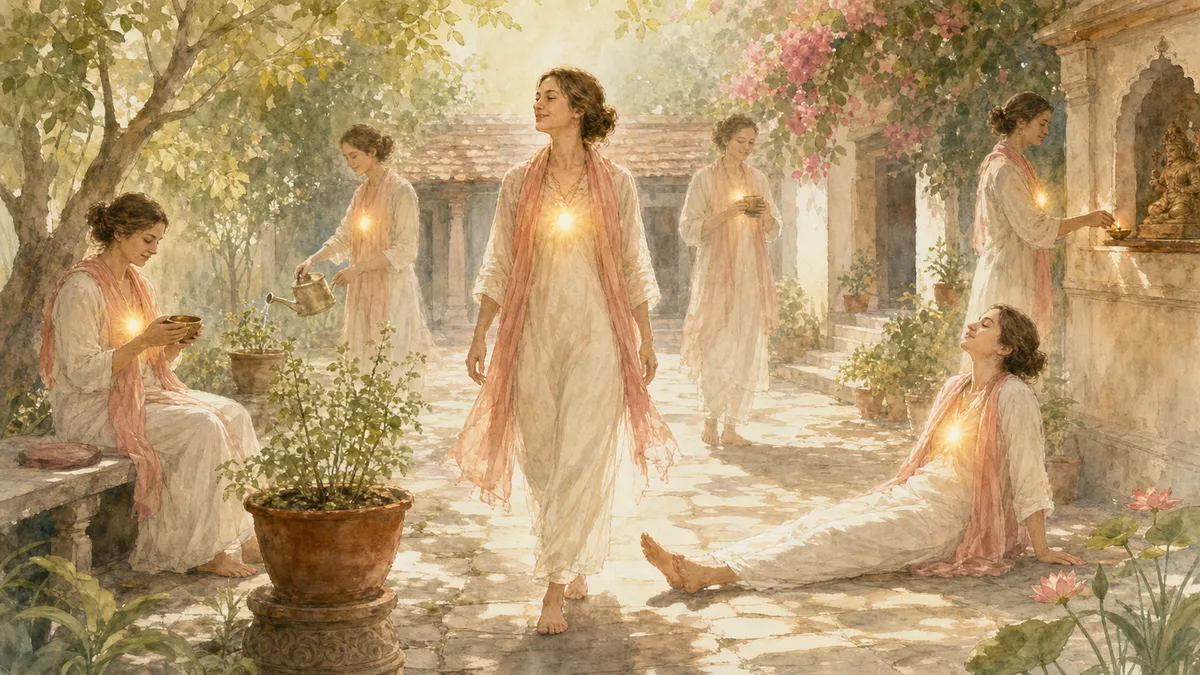
When you meditate correctly, elevated states — bhavas — arise in you. This is roughly similar to what in Christianity is called the “acquisition of the Holy Spirit.” And your task is to accumulate such flashes of spirit, such elevated, pure, bright, expanded, radiant spiritual states. The more you gather them, the purer you become, the more your thinking changes.
A good practitioner is constantly in such flashes. At first they appear rarely, then more and more often, and then they become very frequent, that is, he already lives in a transformed world. If you have ever seen a stroboscope, you know that even such a small thing can greatly change the surroundings. A stroboscope constantly emits pulsating light, so the world around you seems unreal, unusual. In the same way, your true “I” gives such pulsations of flashes in consciousness, and then the world begins to be seen in a completely different way.
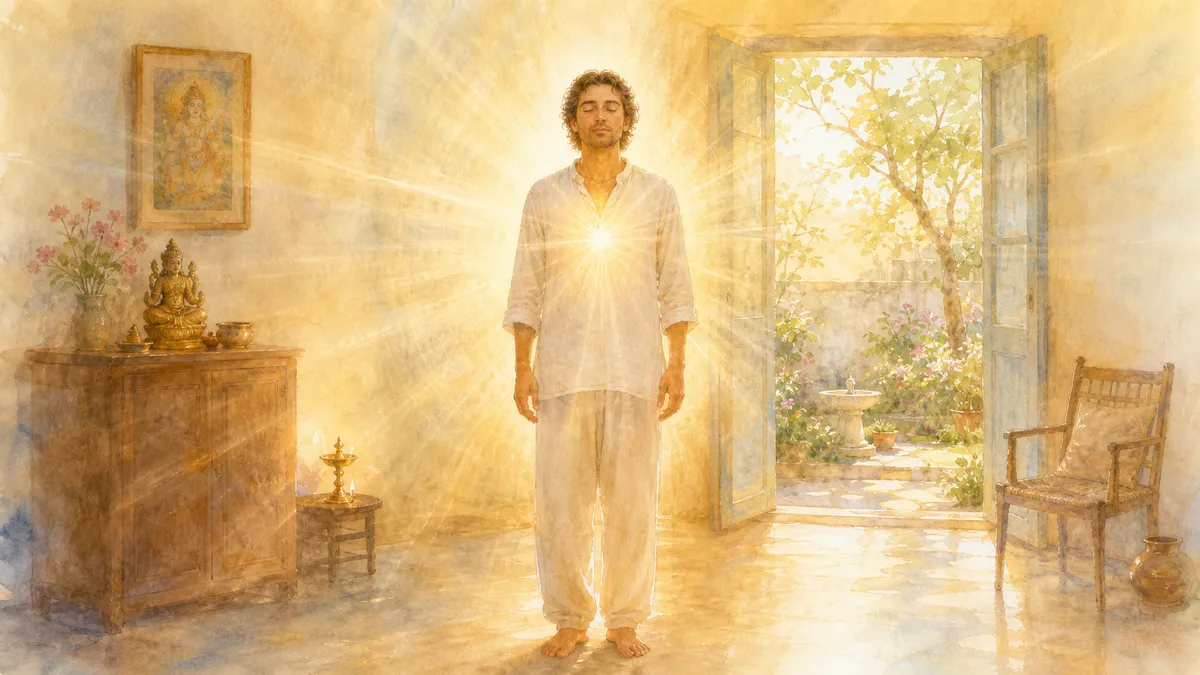
One who is deeply rooted in presence is nourished by these flashes and pulsations of light in consciousness. They constantly inspire and spiritualize him, and this is never interrupted. If a person is inexperienced, he becomes distracted, and therefore these pulsations gradually weaken; then they appear once an hour, then once a day, then once a month, and then half a year has passed, while the higher circuits of his consciousness are asleep. Only after half a year does he remember: “Oh, indeed! I experienced this half a year ago.” Such fading of flashes of light in consciousness occurs because there was distraction. And such a person thinks in patterns, lives at the level of the mind, identifies himself with the body, considers the world real, and remains in a certain karmic vision. But when there are flashes of consciousness, the yogin constantly lives in brahma-bhava, and this is not interrupted. A fountain of creativity, active spiritual power, energy, joy, and bliss simply bursts forth from him. He continuously experiences the highest state. He is very happy, and he has no attachments or identifications, unlike one whose higher circuits of consciousness are switched off. He is like someone riding a motorcycle at a very high speed, and this speed does not drop but, on the contrary, increases. He rides—just hold on! And such flashes do not cease.
Gradations of Meditation and Inner Worship
“The Supreme Self cannot be attained by methods other than meditation. Even if you are the greatest fool, but can meditate for eleven seconds, the benefit will be the same as if you donated a cow to charity. If you can meditate for one hundred and one seconds, the benefit is the same as from a sacred ritual. If the duration of meditation is twelve minutes, the benefit increases a thousandfold. If the duration of meditation equals an entire day, you dwell in the supreme space. This is the highest yoga, the highest service, and the highest action. The one who practices such worship is worshiped by the gods themselves, demons, and all other beings. However, this is still external worship.”
Here Shiva describes to Vasishtha the art of attaining dhyana, but says that “this is still external worship.”
Further he says:
“I shall now tell you about the inner worship of the Supreme Self, which is the best enlightener and liberator. It belongs to the concept of constant meditation—whether you are standing or walking, sleeping or awake, in all your actions. You must feel this supreme consciousness located in the heart, which is the cause of all modifications within oneself. You must worship the manifested consciousness or self-awareness that sleeps and awakens, walks or stands, touches what must be touched, leaves what must be left, enjoys and renounces pleasures, is involved in various external actions, gives meaning to all actions, and remains calm in the body.”
The Proper Attitude of the Mind Toward the Supreme Self
Notice that Shiva says, “you must worship.” He does not immediately say: “You need do nothing; you are absolute.” He says to Rama: “You must worship,” because Rama has not yet realized himself and abides in the position of the body and mind, while the mind, establishing a relationship with the Supreme Self, can only worship. The mind is not equal to the Supreme Self; it is not its brother or friend, but its creation, and therefore is completely dependent on it. This means that the mind can only surrender to the Supreme Self, worship it, humble itself before it, and capitulate; that is, always regard this supreme consciousness as an object of devotion and in no case regard it as an equal or as a competitor.
Often, having superficially assimilated the truths of Advaita, practitioners do not quite understand this. They confuse the servant and the master, the king and the soldier—this is a great mistake. Sometimes, looking into their minds, one can see how the servant, having put on the king’s garments, begins to repeat the truths of Advaita. But the point is that the mind must be in absolute obedience, in humility, in devotion and worship of the higher “Self.” This can be called self-surrender (atma-nivedana), prapatti (surrendering oneself to the higher “Self”), cutting off clinging, hopes and fears, but the essence does not change because of this. Our mortal, small part must surrender itself without remainder, submit to the higher part, the higher “Self.” This happens when we renounce personal gain as a result of practice, when we renounce our own small goals, any clinging and attachments, when we are ready to give everything for the sake of the higher “Self.” By and large, the higher “Self” demands nothing; it needs nothing from the mind except that the mind should know its Source, its nature. However, the mind often clings so much to its notions that it is difficult for it to know its Source until it truly sacrifices something. But one must sacrifice only one thing: one’s own ignorance, lack of understanding, or unknowing.
By its own mistake, the mind always wishes to appropriate something for itself. It appropriates a personality or a body for itself, and then says: “I must cast this off, I must renounce it, perform self-surrender.” But the essence is that it did not belong to it from the very beginning. The mind simply imagined it so. It is like some peasant who, having gone out into the center of New York, might declare: “I renounce the American National Bank and the Empire State Building.” But people will only laugh at him and say: “Dear fellow, actually, you never owned them in the first place!”
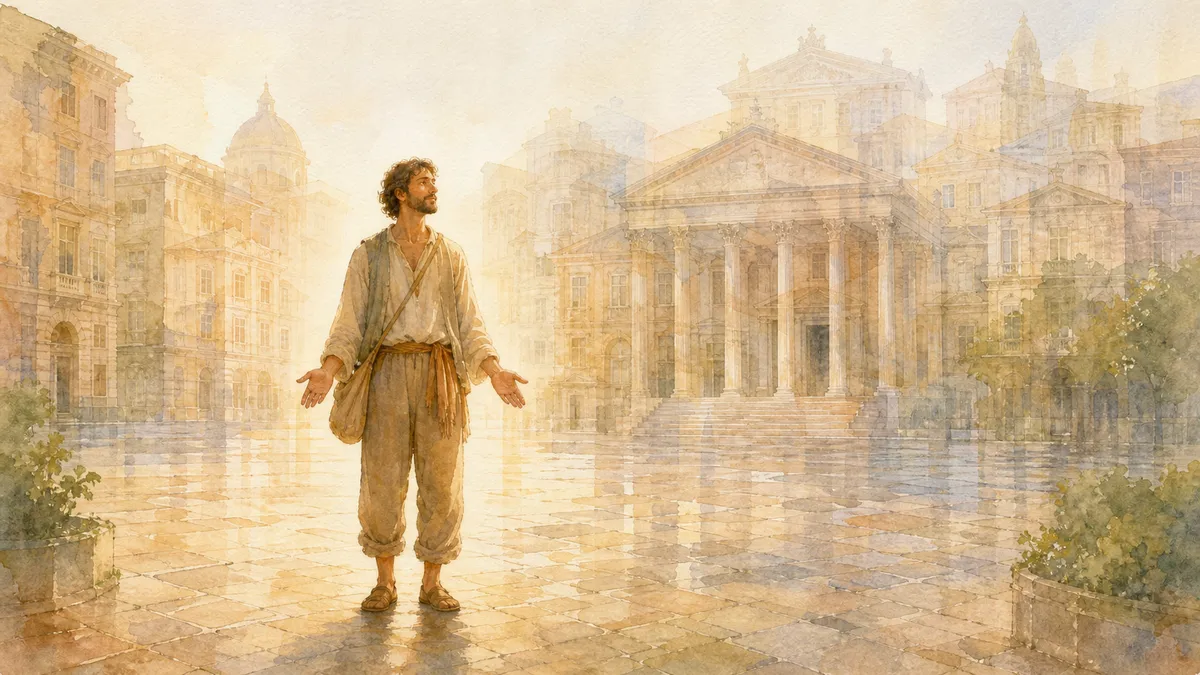
Many think that self-renunciation, self-surrender, is a feat, an act of heroism. But in fact there is no heroism in it. It is simply the elimination of a global error, a fundamental delusion that the mind possesses something. But for the mind, this is a thought that throws it into very great confusion.
