

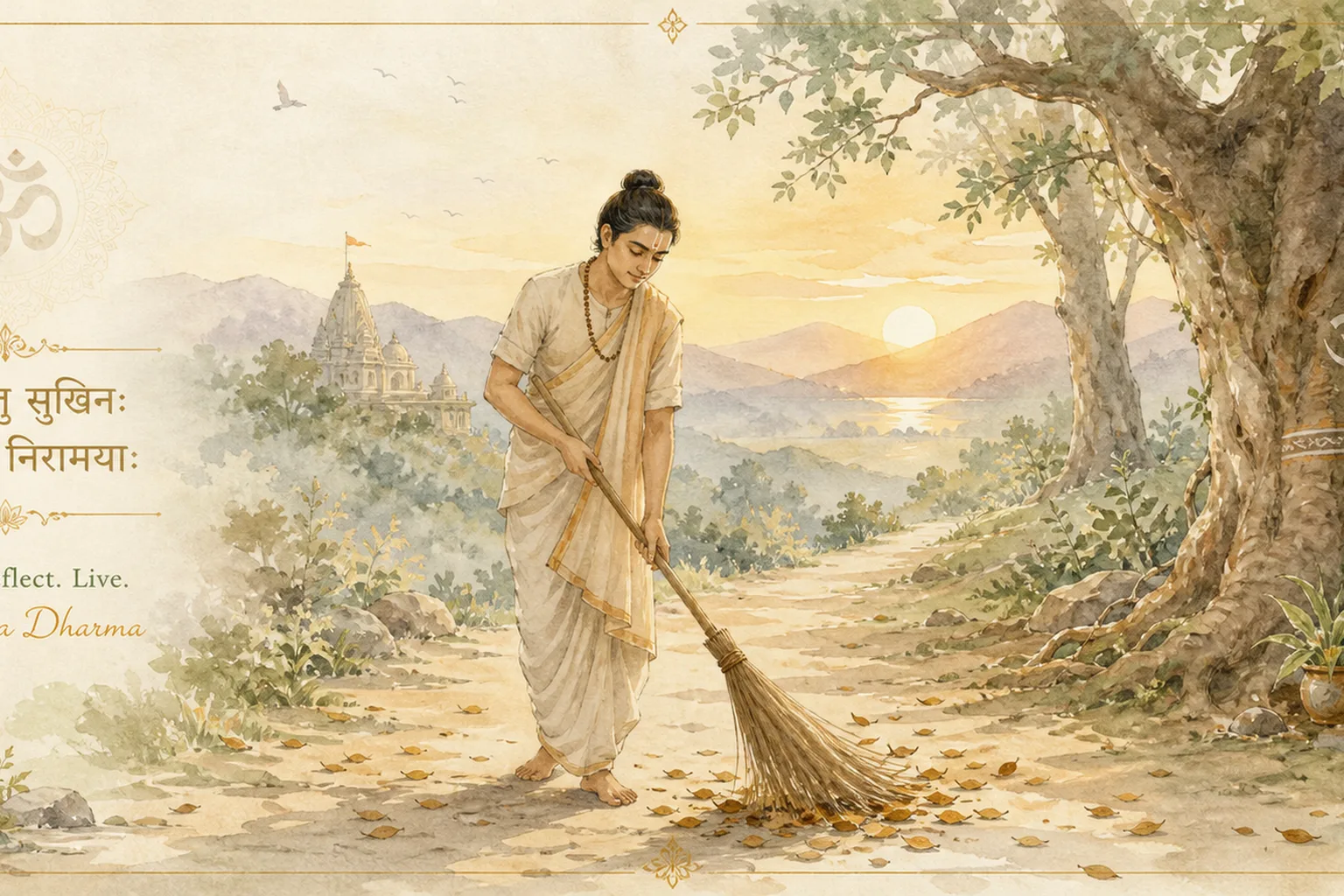
The Importance of Proper Motivation in Sadhana
First, we cultivate the right motivation; without it, sadhana will not succeed. Sadhana and tapas must always be preceded by sankalpa, the right motivation. Sometimes we cultivate a little motivation and begin to practice, but then forget to sustain that motivation, and the practice slowly slips through our fingers.
For example, a person decides to practice pranayama or recite a mantra and cultivates motivation, but this motivation is not strong. He performs the practice, then begins to care more about the method than the motivation; the sankalpa fades away, and eventually he abandons the method. But this is a mistake, because the right motivation must be cultivated every day, practically every moment; everything begins with motivation. The action, the method, the sadhana are already consequences, but every consequence must be preceded by a cause.
If, before Mahashanti meditation, we cultivate the right motivation—that is, if we construct our successful meditation on the subtle astral, immaterial level and create the causes—then it, too, will be successful.
A formal approach to practice is when we act without motivation: I must bow, so I bow; I must meditate, so I sit down and meditate. This continues day after day, and when a formal approach to practice accumulates within us, the practice, as they say, becomes tedious. It is the same thing over and over, a monotonous and repetitive way of life; we act mechanically. Of course, this is wrong; it is a serious mistake.
We must eradicate such mechanical behavior within ourselves by constantly cultivating and developing the right motivation, asking first and foremost: “Why do I need this? Where am I going? What do I want? What is the meaning of this? In what state of mind am I contemplating it?” Then an intention (sankalpa) forms within you, each of your actions becomes magical, you influence reality, create a new reality, and recreate yourself within that reality. This is what successful practice means.
Through motivation, you determine your place in the world and what you want; you express an intention, and it is important to reaffirm such an intention constantly. If the motivation is genuine, then all our actions are genuine as well. But if the motivation is weak, even great deeds bring no benefit.
For example, during a battle, soldiers whose motivation is weak and whom their commanders have failed to motivate properly become cowardly; at the first opportunity, they desert, flee the battlefield, surrender, or are simply killed. Their motivation is weak, and they have no faith in victory: there is fear and uncertainty, and no one is prepared to display heroism. Then the enemy, even if it does not possess superior technology or tactics but has strong motivation, simply sweeps them away. This has always been the case throughout history.

Purifying the Mind of Lust and Greed
When a person completely frees himself from lust and greed, which are products of falsely identifying oneself with the body (“I” and “my body”), his mind becomes purified. Having established himself in a pure state of consciousness, he rises above material happiness and sorrow.
Through purification of the mind, we must rise above worldly notions of happiness, sorrow, and suffering. These are precisely the causes that led us to be reborn and become limited. Even when we practice, our mind is not free from many things. Sometimes other people irritate us, sometimes we take offense, sometimes we cling to things, and sometimes we fail to be at our best; of course, this is disheartening. “But why are we not at our best?” we must ask ourselves. Unless we are at our best, we cannot reach spiritual heights or aspire to them, because saints are the best of the best.
Suppose we were to take the national teams of Russia, America, England, and the European Union, hold a tournament, select the very best players from among them, and form a world team in sports. They would be the very best of the best. Sainthood is much the same. Those who are not impeccable, who are not at their best, do not qualify for sainthood. They are eliminated in the initial qualifying rounds: “You take offense—that’s it, you are not suitable. Pride—that’s it, goodbye. You are attached—that’s it, come back next time. Too much egoism, and you do not understand the meaning of life? No matter, you still have many lifetimes ahead of you; that’s it, you are dismissed.”
The Inexorability of the Laws of Karma
The law of karma is harsh and inexorable. A teacher may treat you with compassion, senior monks may show gentleness, and the overall atmosphere may be mild, but you must not be deceived by this. The overall mild atmosphere must not mislead you, because the laws of karma are not mild; the laws of the Universe are harsh.
There are qualifying rounds everywhere: “Unable to understand the text? That’s all right, there will be many more bodies; you’ll understand eventually. You’ll study and even graduate from a university of philosophy. Lazy? That’s all right, you’ll receive many more bodies. You have desires? Fine, you’ll receive many new forms.” This is how the law of karma works—there are no concessions. You must understand this. “No willpower? You’ll develop it; everything still lies ahead of you, with a hundred lives ahead: in your next life, you’ll go to war, become an athlete, and develop willpower; you’ll receive a body suited to cultivating it. Fear, self-doubt? That’s all right, in your next life you’ll become a soldier, a leader, or a pop star, and you’ll lose your fear.” That is roughly the approach. Whatever necessary qualities you lack and do not wish to cultivate in this life, in the next life you will be placed in circumstances and karmic conditions will be created in which you will have to cultivate them.

Nature and the laws of the Universe reckon in thousands of lives; to them, none of this means anything. Indeed, that is how it is. We cling too tightly to this life, thinking, “Oh, to attain Liberation in this life!” because we are too attached to this body, and our perception of life is very narrow. But for the Universe, it is endless; it says, “There is nothing terrible about it—what is the big deal? One life, two, thousands, millions—there will be so many more. Why are you so worried?” But that does not suit us, because we do not possess such a broad vision.
Suppose Krishna, on the battlefield of Kurukshetra, says to Arjuna, “Just fight—why are you worried? They have already been slain by the decree of the gods anyway; it is merely a game.” But for Arjuna, that is, for the living soul, this is no joke at all, no joke whatsoever; he is frightened and confused, just as it is no joke at all for us.
The Necessity of Constant Self-Improvement
The laws of the Universe are harsh, not gentle; they impose demanding conditions for Liberation. To transcend them, we must become the best of the best and remain consistent. This does not mean that we should become despondent, lapse into self-abasement, and think, “How could I ever do it? I am so incapable; that’s it, nothing will ever come of me.” Such thinking is wrong. On the contrary, this should encourage effort, diligence, constant self-improvement, and the desire to rise to the occasion: if I am not at my best, I will strive to be at my best.
When we wish to be at our best, we notice all the moments when we fall short: “Here I fell short, and here as well. Why? I was unconscious and did not understand certain things. I thought in mercenary terms, from a narrow perspective, guided by immediate interests rather than by future lives or sadhana.” Suppose you became angry with someone over trivial matters—but what is the point? They will leave their body in a few decades; will it matter then? What will matter is the state of awareness you were in, while this will not matter at all; on the contrary, it is a drawback, dead weight.
To pass all these qualifying rounds of samsara, one must always consistently demonstrate stable, excellent results—a stable, very high standard. It is not as though we passed the exam for the second level once and then thought, “What an advanced person I am”; or performed a service with a sense of satisfaction and then decided that was enough and we could relax and stop. No, not quite. It is like being an athlete: you must keep proving your results. If you fail to do so for a while, people say, “He has lost his form, he is no longer in condition; there is no point putting him in the ring anymore.” Something like that.
If someone is a champion, they must continually defend their championship title. They cannot say, “I am the champion for all time; I have conquered all nations.” Nothing of the sort. It must be continually reaffirmed. This means that we must prove ourselves worthy every day. This is not easy; it is tapas. We can be worthy every day only if we look deeply into our souls, analyze them, compare them with the teachings and sacred scriptures, and constantly work on ourselves.

There are people who, aware of their limitations, are prone to hysterics and exaltation: “I am unworthy; I cannot do this, I cannot do that,” but that does not help either. What is important here is a sober, rational approach and constant, steady, systematic progress. Consistency is far more important than sudden bursts of effort, beating one’s chest, and so on, because a drastic approach does not work here; tears do not work, emotions do not work, and self-abasement does not work either. A sober approach and regular, attentive daily practice—that is what truly works. A consistently balanced, sober, critical approach to oneself based on knowledge of the sacred texts, together with periodic analysis, is the optimal strategy.
The Nature of Material Existence and the Purification of Consciousness
Kama and lobha are synonymous with material existence. Everyone in this world strives to possess something. It is stated here that lust and greed arise because the living entity mistakenly identifies itself with its body. When a person is cleansed of this contamination, their mind and consciousness are also purified and return to their original state. The living entity, its mind, and its consciousness are inseparable from one another. When we speak of the living entity, we also mean its mind and consciousness. When we purify our mind and consciousness, the difference between conditioned and liberated life becomes apparent. Having purified the mind and consciousness, the living entity rises above material happiness and distress.
At the very beginning of His teachings, Lord Kapila said that the perfect system of yoga enables a person to rise above material happiness and distress. This verse explains how to achieve this: “One must purify one’s mind and consciousness. As stated in the Narada Pancharatra: ‘A person must first purify the mind and senses.’ The mind can be either our friend or our enemy. A pure mind helps us, while an impure one becomes the cause of illness.”
Purification of the mind means that there are no obsessive, fixed notions at the conceptual level, but there is awareness. There are no mental attachments at the level of images, but rather an even, pure consciousness that prefers nothing and is purified by divine images containing divine beings, such as one’s Ishta-devata; nor are there any persistent vasanas stemming from past memories and caused by old emotional wounds.
For example, you are meditating and memories arise: of how your mother hurt you in childhood, or painful memories associated with a loved one in worldly life. A pure mind has no such psychological traumas. If there are psychological traumas, painful memories, emotional anguish, states of dissatisfaction, or long-standing resentment toward a relative in worldly life or anyone else, all of this is an impure, unpurified mind. You must work with this: perform samskara-shuddhi and repentance until no notches, no scars, nothing at all remains in the soul. Everything must be even, calm, and pure.
You remember it, but it does not trouble you in any way; you think: “There were some lilas. I was simply unconscious and outward-oriented. But that no longer matters; it was like a dream.” In dreams we experience many things, but when we awaken, we simply laugh. A yogin who has purified their mind looks back at the past and at their former self with laughter; they simply laugh. They have neither grievances nor regrets nor lingering attachments; they merely chuckle and think: “What a fool I was. Such things happened, and I took them seriously. It is all ridiculous.” Their mind is pure, light, clear, and impartial.

One sannyasin had been meditating in the mountains for seventeen years. One day, his wife, from whom he had separated many years earlier, came to the mountains with a group of pilgrims. He ran away, hid, and trembled all over with fear and agitation: if he had to meet his wife, an attachment might suddenly arise, and all his emotional pain, grievances, separation, and attachments would resurface. Then he thought: “I have meditated for seventeen years, become a sannyasin, and renounced the world, yet all of this is still in my mind. It is hidden within; on the surface it is no longer there, but inwardly it all remains.” This means that the mind has not yet been purified, and if you find yourself in a similar situation again, you will relive it all anew. You have shielded yourself by external means, but within you, all of it may still resonate. Yet when the mind is completely purified, all of it seems like utter nonsense, as though you were dreaming.
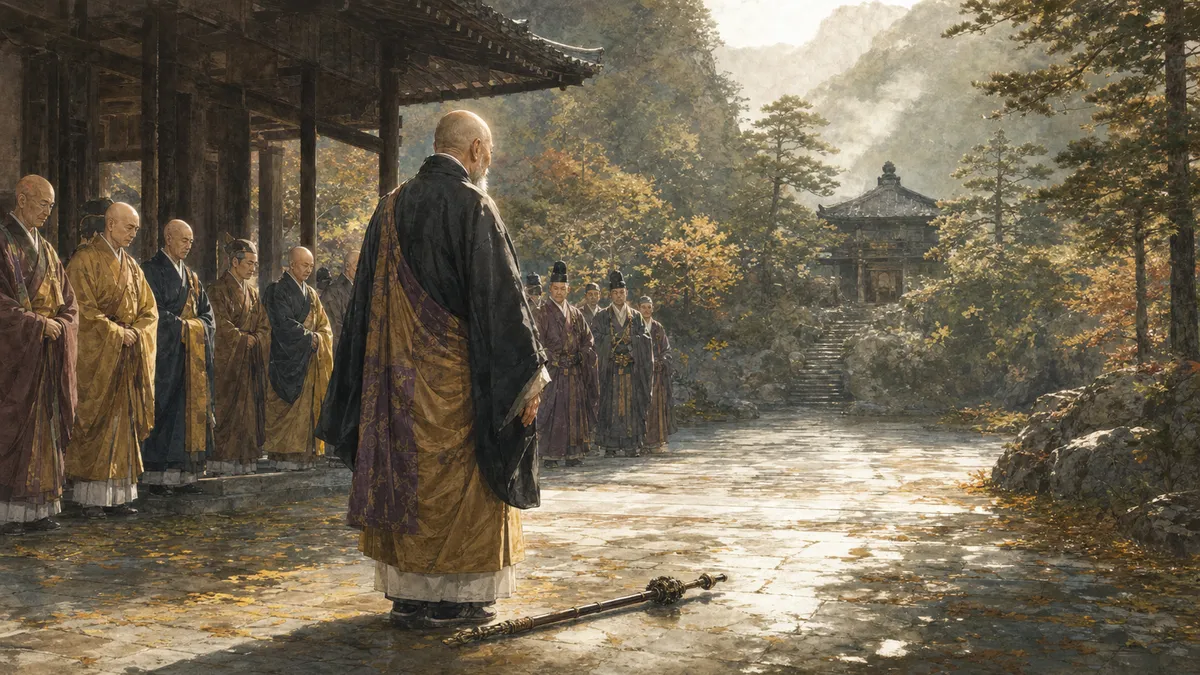
One Zen master felt his hands tremble and became agitated when distinguished people from the region—high-ranking officials—came to a ceremony. He then bowed to his disciples and monks and said: “I am unworthy to be a teacher. My mind was shaken. As soon as important people came to the monastery ceremony, I became agitated and lost my vigilance. I must continue meditating.” He relinquished his position as teacher and once again withdrew into a long retreat to continue purifying his mind, because, to his shame, he discovered that it was not pure. After ten years of meditation, he returned and once again assumed the position of teacher. Only then was his mind unshakable. This is how important it is to purify the mind.
Methods of Purifying the Mind
Day after day, purifying the mind is our task. How, then, should we purify it? When you come for darshan of Dattatreya in the temple or darshan of Vasishtha, and behold the beautiful form with a feeling of reverence, faith, and devotion, the mind is purified. Spending time near saints, sacred objects, and statues, making prostrations, and performing service—this is the process of purifying the mind. All of this imperceptibly purifies the mind.
But it is far more important to do this consciously; when we do it unconsciously, in an ordinary state of consciousness, without contemplation, it is Kriya Tantra. Anuttara Yoga Tantra implies that we perform all these actions consciously, while contemplating and remaining present. Only then does the purification of the mind become very rapid. We not only outwardly express reverence for saints, bow, and contemplate the murti in the temple, but also unite with it, enter the nondual view, and contemplate. We cultivate subtle sahaja-spanda, that is, subtle conscious activity that releases and self-liberates our samskaras. The main thing is for this to happen constantly.
It is very important not to indulge the mind or compromise with it. The mind is a mechanism that cannot be trusted, and this is especially evident during long retreats. Sometimes a person may spend three or six days experiencing intense thoughts about someone, arguing with someone. No one is there anymore, nothing remains, the situation is over, yet the person recalls some incident and tries to prove something mentally, walking around and thinking about it for an entire week, sometimes trying to settle unresolved relations—all of it taking place in the imagination. Instead of being relaxed, calm, and aware.
Sometimes the mind fixates on some theory and tries to get to the bottom of it intellectually, building entire castles in the air. It is good if it concerns philosophy, but sometimes it is something completely unrelated. The person abandons meditation and the schedule and becomes completely absorbed in this theory. Every hermit knows this; everyone who has undergone long retreats understands very well what I am talking about.
In this case, the mind cannot be trusted; one must not follow its lead or compromise with it. One must be deeper than the mind and older than the mind, always stepping aside and simply observing it. Do not attach great importance to it, thinking: “Mind, you are on your own, and I am on my own. These are your problems”—deprive it of its power through awareness.
Sometimes the mind leads us into confusion, rajas, self-abasement, or, conversely, pride, anger, suffering that simply comes out of nowhere, and fabricated imaginary grievances. All these states of mind are false, utterly false. When the mind is pure, it is serene, empty, and rests in awareness itself. You can always recognize a person with a pure mind: they are light, unattached to anything, natural, flexible, and always joyful. They have no heartrending, oppressive experiences or fixations. Their mind is fluid, elusive, and transparent.
The Gayatri Mantra as a Means of Purifying the Mind
A pure mind helps us, while an impure one becomes a cause of illness, just as unhygienic people are the first to fall victim to infections, whereas diseases do not afflict those who observe the rules of hygiene. Therefore, the mind must always be kept pure. The Vedas prescribe reciting the Gayatri mantra, which purifies the mind, three times a day: early in the morning, at noon, and in the evening. Those who follow the principles of Brahminical culture strictly observe this injunction.
When you hear or recite the Gayatri mantra, combining it with awareness, you meditate on the very essence of the Absolute. Reciting the Gayatri mantra during sandhya is one of the most important ways to purify the mind. But the most important thing is to abide in the essence of Gayatri. The essence of Gayatri is Sahajya; therefore, reciting Gayatri means returning to one's true nature: returning to Brahma-vichara and Atma-vichara, and directing one's mind toward contemplation of Brahman.

The Proper Practice of Atma-vichara
Sometimes the practice of Atma-vichara becomes, in a sense, selfish and individual: we think that Atma-vichara is connected with us, with the “I,” and that it is enough to ask ourselves, “Who am I?”, answer, “I am,” and simply abide in that state. This is how many people practice Atma-vichara. But the task is to go beyond the “I” during Atma-vichara, to move from Atma-vichara to the state of Brahman, and through Atma-vichara to immerse oneself in contemplation of the Absolute.
The Three Gunas and Purification of the Mind
It is not without reason that cleanliness is called the companion of piety. In the conditioned state, the mind of a living being is covered with a thick layer of dirt. This dirt is especially evident when the living being is under the influence of the lower gunas of nature: the gunas of passion and ignorance (rajo-guna and tamo-guna). Therefore, the first priority is to rise to the level of the guna of goodness (sattva-guna).
The mind is purified when we become established in sattva. Sattva is the only guna in which a practitioner can live and practice without any problems. The practitioner’s task is to become established in sattva as much as possible by overcoming rajas and eradicating tamas.
When does tamas arise? When principles and commandments are not observed, when sadhana is not practiced, when there is little energy, the chakras are blocked, there are energy leaks, and various substances, meat, and heavy foods are consumed—all this is tamas. It is impossible to practice the Dharma in such a state.
When is rajas present? Rajas is present when there is an excess of fire (tejas), an excess of untamed wind, when there are many concepts but these concepts do not self-liberate, no place is found for them, and they agitate the mind instead of dissipating like ripples on water; when we indulge various desires instead of allowing them to self-liberate. It is also present when we adopt a rigid, egotistical position and try to assert it, thinking of ourselves first and foremost. All these are forms of rajas.
When we overcome tamas and rajas, sattva reigns within us. Sattva is a state of consciousness in which you think more about others than about yourself, ethical principles are observed easily and naturally, you cling to nothing and do not suffer, and the mind is serene, benevolent, loving, pure, clear, and open. At the same time, you do not feel sleepy; your thinking is clear, vivid, precise, and logical, and your speech is coherent. You easily grasp a complex concept and can work with it.

Ignorance as the Cause of Suffering
Unfortunately, the conditioned soul is attached to material pleasures, which cause it to be forced to undergo birth, old age, disease, and death again and again. People are so foolish that they do not even wonder why these sufferings come to them repeatedly.
A very profound truth is expressed here. Living beings abide in fundamental ignorance (ajnana), and this ignorance is caused by the dominance of tamas and rajas. It is precisely the excess of tamas and rajas and the lack of sattva that prevent one from contemplating profound truths and the future, analyzing the mind, and engaging in self-inquiry. It would seem so simple. But if you start talking to an ordinary person on the street about meditation or renunciation of the world, it will be an insurmountable barrier. Indeed, even for practitioners, Mahashanti is sometimes a difficult barrier to overcome. Nevertheless, day after day, a practitioner gradually eradicates their ignorance.
If your Mahashanti meditation is performed properly, clarity arises. This clarity burns away certain samskaras and vasanas, and thanks to it you can move forward. Clarity does not come immediately. It accumulates in very small increments, but one must always strive for it. By accumulating clarity and increasing sattva, we can move forward. Clarity, of course, is not an attainment or any kind of fundamental support. It is merely a stepping stone from which we can leap further. But if there is no clarity, there is nothing at all to rely on. By clarity, I mean viveka, discriminating wisdom (viveka-vidya). With the help of clarity, as if using a fine scalpel, we can separate ourselves from the sense organs, external objects, and emotions, and isolate the subtle, nonconceptual layer of awareness in which we must abide and upon which we must rely.
They are like pack donkeys that washermen use to carry laundry. It never occurs to the donkey to ask itself why it spends the whole day carrying extremely heavy bundles of laundry when not a single piece of cloth belongs to it.
This is an illustration. A donkey carries a heavy load, working for its master in exchange for a bundle of grass. It does not occur to the donkey that if it were to walk a little farther, it could take that bundle of grass and eat it. It has no motivation other than obtaining that bundle of grass, yet the bundle of grass is nearby. It does not itself know why it carries this load. Such is the state of ignorance of living beings.
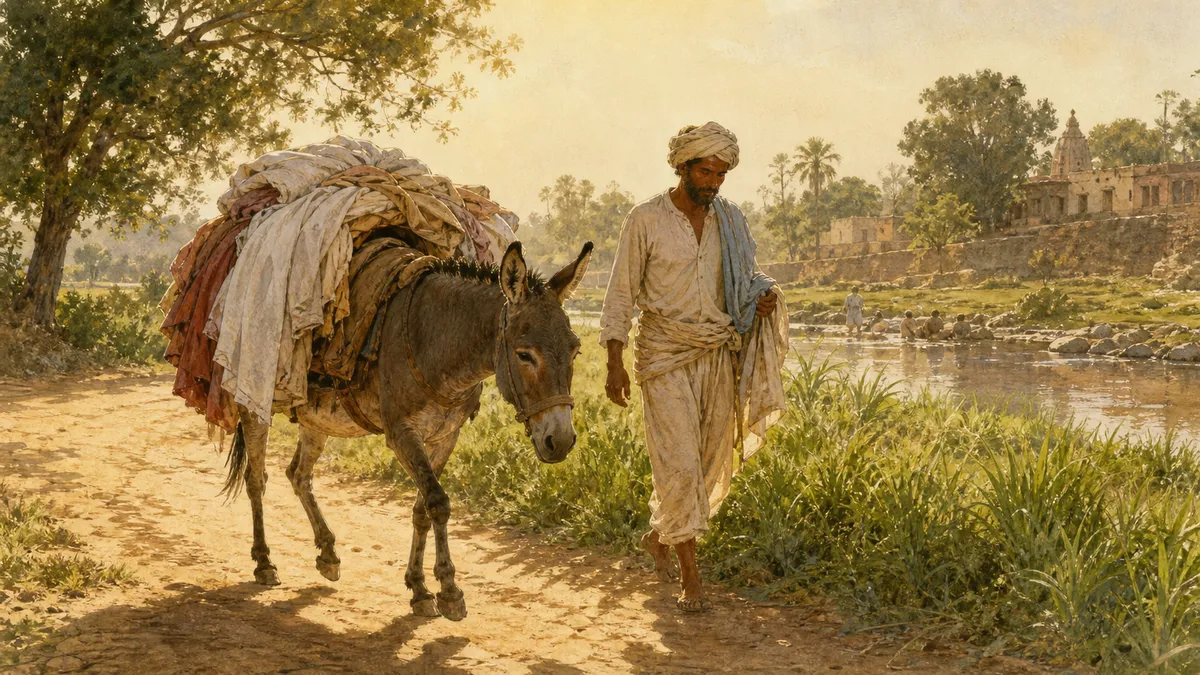
At the end of the day, he is given a few bundles of grass that grows everywhere. And the grateful donkey thinks, “My master feeds me, so I must carry these loads.” Those caught up in karma reason in exactly the same way. Even if a person is a multimillionaire, karma does not care—he remains a donkey and works without straightening his back. No matter how much money he has, he cannot eat more than his stomach can hold, and yet he works day and night because he thinks, “I must support my large family.” Similarly, a political leader thinks, “Without me, the nation will perish, so I must work day and night until I die.” All these are different manifestations of material illusion, which contaminates a person’s mind and makes him identify himself with his family, community, nation, and so on. In Sanskrit, this is called aham-mameti. People mired in ignorance say, “I am a servant of my family, my nation, my community. I have certain obligations to them.”
This does not refer to spiritual relationships within a spiritual community; it specifically refers to worldly relationships.
Taming the Pashu Nature
Attachment to the gunas of material nature is the cause of our bondage. To rid ourselves of this attachment, we first rise to the level of sattva-guna. Sattva-guna consists in following the rules of spiritual discipline, observing the precepts, performing regular sadhana, and doing so not for a month or a year, but throughout one’s entire life; it must become natural. Observing the precepts and performing regular sadhana is difficult for those who possess the pashu nature, the lower nature. Nevertheless, if this pashu nature is present—and everyone has it—a practitioner gradually overcomes it.
When the mind is impure, it becomes the cause of material bondage, but the very same mind can become the cause of our liberation. A contaminated mind forces us to be born in this world again and again, to be born and to suffer. As long as the mind is unclear, the soul has not developed the habit of a pure mind, and accumulated karma draws it toward impurity.
For example, if you begin reading the “Yoga Vasishtha” to a dog and then say, “It is very auspicious to meditate, recite a mantra, and practice contemplation,” the dog may listen to you attentively and then run off to find something to eat, and if it sees some animal, it may kill and eat it. It is simply driven by its prarabdha karma; such is canine nature.

In the same way, the pashu nature is constantly drawn toward something coarse. It simply cannot be otherwise. Nevertheless, a yogin learns to tame his pashu nature skillfully. If we try to tame the pashu nature roughly and harshly—what is called “hitting a pig on the snout”—this may lead to stress, depression, and blocked energy, which is also wrong. The pashu nature must be tamed, but skillfully and subtly; that is, it must be sublimated and redirected. Then it will be right. On the other hand, the pashu nature must not be indulged, and there is another saying: “Hit the pig across the muzzle with a club.” That is, you may hit a pig across the muzzle with a club, but its snout is its most vulnerable spot, so you must not hit it there, whereas you may hit it across the muzzle with a club. When the pashu nature shows its pig-like muzzle, you must take a club, strike it, and put it in its place—but not on the snout. Because if you hit the snout, it will suffer; that is its most painful spot. The lower nature must be handled skillfully; then it will gradually be tamed and sooner or later become a play of energy, something that causes no problems, and one day the kleshas will become wisdom.
Very often, practitioners who have not tamed their nature make such grand declarations: “My kleshas have become wisdom; they are like ornaments.” But one should not overestimate the view. The view is precisely that—the view; it is not conduct, it is not yet reality, it is like the future. It is only a possibility, tales of future power, but not the power itself. If, without taming the pashu nature, you try to pass your kleshas off as ornaments, it is like taking a piece of glass and saying, “This is a diamond.” Nothing of the sort. A good jeweler will say, “You can throw that away.” It is important to understand this and not confuse such things, because the texts are written from the level of mahasiddhas and saints.
It is as if a great weightlifter wrote, “Every day I lift two hundred and fifty kilograms twenty times. That is my training,” and someone read it, loaded two hundred and fifty kilograms of plates onto a barbell, and tried to lift it as well. He would not manage to do it even once; it would even be life-threatening.
Likewise, when reading sacred texts, we must understand that this is the view of the mahasiddhas, the future we will eventually reach, but this does not negate the work we must do now to subdue our pashu nature.
Reflections on Rebirth
In fact, there can be no question of any enjoyment in the material world. Material life is a succession of sufferings. Having suffered our share, we die only to be born again. After death, we enter the womb of a new mother and, having remained there for the allotted time, are born once more.
Who will be in which mother's womb? That is the question. What kind of mother would you like: one in America, India, or Russia, an educated one? Or perhaps you would prefer to be born from a lotus in Indra's world, without entering a womb at all? But many living beings will not even have a human mother; to be born human is itself a precious gift. There are the wombs of cows, bears, wolves, dogs, and cats. It is not difficult for an obscured consciousness to fly into such wombs. A practitioner should always reflect on this—on the future wombs into which consciousness may fly. When anger arises, one should think: “So, this consciousness is preparing to fly into the womb of a she-wolf or a she-bear.” When dullness, unconsciousness, or a compromising mindset arises, one should think: “This consciousness is preparing to fly into the womb of a cow.” When human, worldly attachment arises, one should think: “This consciousness is preparing to fly into the womb of some young mother somewhere in Ust-Kamenogorsk.”

The Purpose of Human Life
Thus begins another chapter of our conditioned life. By receiving a human body, a living being also receives the opportunity to realize the senselessness of the suffering caused by birth, old age, disease, and death. Cats and dogs are incapable of this. The Vedic scriptures were given to people to help them understand this simple truth. The shastras describe many different forms of activity that help people become pious: tapas—the performance of austerities, brahmacharya—sexual abstinence, control of the mind and senses, giving charity, truthfulness, and following the principles of the sacred scriptures. However, in Kali Yuga, people have little willpower to follow these recommendations.
Human life is meant for purification. But unfortunately, people do not want to hear about Dharma, and are therefore doomed to drag out a miserable existence in the material world, life after life. If they manage to become wealthy in this life, they do not think about what awaits them after death. “Eat, drink, and be merry”—that is their motto. This is how the overwhelming majority of people live. But the shastras call upon us to come to our senses.
Karma, Vikarma, and Akarma
Vikarma is an unlawful, prohibited action, as opposed to karma, activity recommended by the shastras. Akarma is activity that has no karmic consequences.
The term “karma” is interpreted as ordinary activity prescribed by the sacred texts, such as service, prostrations, bows, sadhana, eating, and so forth. All of this is called karma.
Vikarma is something improper and sinful, such as killing living beings, sowing discord, and using drugs or alcohol. All of this is vikarma, that which casts the soul into the lower worlds.
Akarma is something neutral that does not create any serious consequences. What exactly akarma is must be properly understood. If karma consists of ordinary prescribed actions, and vikarma results in the accumulation of sins, then akarma is the activity that liberates us.

All activity should be performed as a sacrifice to God; otherwise, it will become a cause of material bondage.
Only akarma is suitable for a yogi—that is, the kind of activity that does not condition us or create new causes for rebirth. Akarma occurs when we act selflessly, not as a doer but as a servant, in the state of a contemplator, when we transcend the small, selfish personality. Even yoga and sadhana can become karma. But when we act without attachment, without action or an actor, doing everything as service and an offering, this is akarma. When we abide in self-liberation while contemplating, this is akarma—no traces or imprints remain.
The State of Modern Humanity
As a rule, people act under the influence of the modes of passion and ignorance. Few consider what consequences their actions will have or what will happen to them in their next life. No one wants to give up the habit of eating indiscriminately. No one cares about the injunctions of the shastras. In short, people lead thoughtless lives, just like street urchins who know nothing and have no desire to learn. Under the influence of passion and ignorance, they live only for the present day. Such people thoughtlessly commit various sinful acts. To satisfy their senses, people are prepared to commit vile and abhorrent crimes. But the shastras warn: “Do not do this; you will have to pay dearly for momentary pleasures. You will suffer again and again in the material world.” Yet people lack the wisdom to understand that the material body is a source of unending suffering when one becomes attached to it (klesha-ada). Under the influence of ignorance, modern people descend to the level of animals.
One can approach a herd of animals, take one of them aside, and slit its throat, while the others stand nearby, calmly chewing grass as they watch what is happening. They do not realize that sooner or later their turn will come. In Kali-yuga, people behave in exactly the same way.
Purification of the Heart Through Sacred Texts

The Vedanta, Puranas, Upanishads, Ramayana, Mahabharata, and other works were given to humanity so that people could remember their spiritual nature, escape the contaminating influence of rajo-guna and tamo-guna, and attain perfection.
The impurities that have accumulated in our hearts (abhadrani) disappear when we listen to sacred texts and reflect on their meaning. Today, the world is driven by kama and lobha. Kama means lust, and lobha means greed. But human life is meant for ridding the heart of impurities.
