

Commentary on the text “Yoga Vasishtha,” Chapter Five
The story of King Janaka. Vasishtha continues to instruct Prince Rama.
Vasishtha continued:
“No matter how insurmountable suffering may seem, it is easy to cross it with the boat of wisdom (inner light). One who has no wisdom is troubled even by minor problems. But the wise person easily crosses the sea of suffering, even if he is alone and helpless in this world, and even if he has not studied the scriptures. Even without the help of another, the wise person performs his work perfectly. But it is not so with the fool – he will squander even the wealth he already possesses.”
Many accumulate wealth, others – property, still others – friends, and others – something else. But the only thing truly worthy of accumulation is wisdom, since with its help one can accumulate everything else. But if wisdom is lacking, then nothing will help here. In the same way, the sufferings by which we are limited can be overcome with the help of wisdom. It is said that one who does not have this wisdom is troubled even by minor problems.
Not having wisdom means being seized by momentary problems, not feeling the global nature of the life in which one dwells, the mystery that is unfolding, losing the mystical quality of life, its secret, the sense of God, and perceiving it with ordinary eyes. This is called the “killing of Brahman,” that is, betraying God within oneself. Such a person may be alive, but in spirit he is dead. From the very beginning, awareness, life as such, barely glimmers in him. If you are a practitioner of the path of negation and you have neither pure vision nor the ability to integrate, then it is said that you become infected by such a person and it is painful for you to be near him. If you have no experience, you may feel tremendous pity and pain; you may even feel suffocated when you communicate with such a person. Of course, if you have the principle of pure vision, you look in a completely different way; it is not painful for you. You simply perceive him without identifying, and think: “Well, such is his level, no problem.” But, of course, you yourself would not want to be “in his skin.”
And it all comes down to whether this wisdom is present or not.
Wisdom as the Basis of Spiritual Self-Sufficiency
“But the wise person easily crosses the sea of suffering, even if he is alone and helpless in this world, and even if he has not studied any scriptures. Even without the help of another, the wise person performs his work perfectly.”
By virtue of service, communicating with many people, I sometimes say: “You need to do this service, and you need to do that.” And if a person has wisdom, then nothing more needs to be said to him; he needs only a subtle hint. It is enough to hint, and he will do everything himself, apply clarity, find the means and methods, and everything will unfold and blossom like a mandala. It is evident that this person has his own light, clarity, wisdom, vision, and that he is capable of unfolding it.
But if there is no wisdom, he will stumble at the very first step, that is, he will not be able to manifest himself in service or in anything else. He will declare his incapacity, he will try to convince others that it is impossible, and he will say: “Right now, this or that is missing. And the time has not yet come for this. This is a limitation.” In such a case I say: “With you or without you, I will achieve this anyway. For me it is possible, because in my karmic vision all of this is possible. You simply lack vision.”
This is the difference in wisdom. When your wisdom is small, you are too limited by the laws of samsara in which you live. You accept these laws as something given.
Suppose there is mortality. Samsara is mortality. All people understand: “Yes, mortality exists, we are human beings, we must submit to these laws.” Or there are the laws of gravity and so on. But in fact, mortality exists only as long as there is no wisdom. Otherwise, the gods would also be mortal, but the gods do not die; the gods are immortal because they have more wisdom.
And it turns out that the laws of karmic vision in which people abide are not laws for the gods. For the gods, the laws are lila, sankalpa-shakti, creative play, pure vision, immortality, divine pride, majesty, one’s own will, and the ability to control time and space. Human laws do not apply to them. When they are told, “Look, such are the laws of people!” the gods will say, “What are you talking about? These are not laws at all; we are not even going to listen to this. We have our own laws!” And they will unfold an entire universe of their laws, where all human logic, values, worldview, and habitual way of thinking do not work; all of it is self-liberated. That is, the laws of a limited human view are like prison laws for a normal person—they are savagery to him. This is also like the laws of the criminal world for a law-abiding citizen—absolute savagery. And they are not even going to take part in them.
So what is the difference? The difference is that the level of wisdom of the gods is an order of magnitude higher than that of humans, and they can freely use it.
The meaning of spiritual practice is to receive a result from it. It is not only philosophy and not some artificial techniques or manipulations of consciousness. The teaching of the tantras is concrete in the sense that it gives a living result in the form of the growth of wisdom. And the growth of wisdom inevitably affects the growth of your freedom, your inner clarity, your self-sufficiency, and your gradual independence from karmic limitations and the laws of samsara. It inevitably grows if you develop this clarity.

Vasishtha says:
“But not so with the fool—he will lose even the wealth he already has.”
Even if a person has some potential, without wisdom he quickly loses it. It often happens that children show great promise, their parents admire them and say, “Such a capable child! Surely, a genius will grow out of him.” All children are somewhat geniuses. But gradually some really do become geniuses, while others squander their potential. They lose it because they encounter the crude laws of this world, and their potential gradually fades.
In the same way, when there is no light of wisdom, we lose even the potential we have. Someone in his youth has ambitious plans. He is very proud, independent, and self-confident, but gradually he acquires a family and children, has a lot of sex, loses energy, and then works very hard. He has no time to engage in self-awareness. He absorbs a lot of information, and his mind begins to think in stereotypes, in informational clichés. And when he reaches mature age, his youthful fervor and ambitions disappear somewhere. He simply understands that he has already entered some kind of rut from which he cannot get out. He is like some small railcar moving along rails and unable to leave those rails. He thinks, “Well, that is life; everyone lives like that.”

But that is not all. Then aging sets in. His hearing, vision, and intellectual clarity deteriorate. His vision continues to worsen, and he forgets about the ambitions and plans he made in his youth. A different period of life begins for him, whose main task is simply everyday survival. All the lofty ideas he cherished in his youth (creativity, art, and so on) move completely into the background. In the end, such a person finds himself face to face with death. His life passes in vain because he did not use his chance properly. All this speaks of a lack of wisdom.
Continuous Practice as the Path to Wisdom
And Vasishtha warns Rama:
“A person must always strive to attain this inner light or wisdom, just as one who wishes to obtain a harvest works without rest in his garden.”
Without rest! Very many people believe that spiritual practice is something that comes from time to time, a retreat or a seminar. In fact, such an amateur approach to spiritual practice does not liberate. It gives some clarity and merit. A professional approach to spiritual practice, however, says that you cannot have breaks, you cannot be separate from life. Your entire life must be subordinated to spiritual practice.
You become, as it were, a professional athlete who subordinates his whole life to a single goal, taking into account even the subtleties and small details. Only then will success be guaranteed to you.
Imagine that a person wants to become a ninth-dan black belt master in karate. He attends training twice a week, and one month a year he spends at a training camp with a coach, training a little more intensively. When he steps onto the tatami, even beginners from the neighboring yard, who wear only the yellow belt of a novice but train diligently six times a week, will beat him.
Question: The point is that we must totally devote our time to practice in a variety of situations; that is, we must simply shift the vector of the meaning of our life toward spiritual practice, as the saints did.
Otherwise, we will feel that we do not have enough time... And we never will. Life will pass, and it will turn out that there was no use at all in our practicing so superficially.
But that is not the goal at all. The goal is to overcome all our limitations and not only to have time, but also to make our possibilities boundless, like the life of a deity.
Vasistha says that one must labor without rest, like a person who wants to harvest a crop in his own garden. By such labor without rest, we mean the ability to bring contemplativeness into all aspects of our life.
You may not sit in retreat your whole life; nevertheless, if you want to achieve a result, you should continuously, again and again, practice bringing in awareness. This is your continuous “labor in the garden”: whatever the body, hands, and so on are occupied with, your consciousness is always occupied with this awareness. Only then can it be said that you are plowing your garden.
“Wisdom is the root which, with good care, bears the sweet fruits of self-awareness.”
The effort and energy that people expend in worldly affairs should first and foremost be directed toward attaining this wisdom. I often also tell students: “Look, in the world people have created so many remarkable things: the Baikonur Cosmodrome, an orbital station, the metro, automobiles, parliament, the theory of relativity. People have many achievements in the material dimension, and we, as practitioners, should learn from them.”

In the same way, we too must expend on spiritual practice the same effort and energy that worldly people expend. We must show the same enthusiasm, the same power of self-dedication in spiritual practice and service, regarding service as spiritual practice. Worldly people have the opportunity to learn concentration when conducting business, when serving certain ideals of the state.
Sometimes I tell students: “If you tried to perform service in a business firm the way you do service, you would have gone bankrupt long ago.” They answer: “Yes, yes!” Then I say: “Then think about how it should be done.” This is truly so, because worldly life is a harsh world where no one will give way to your weaknesses, no one will compromise with your laziness, egoism, ambitions, and everything else. That is, life among practitioners is a gentle life. You are treated with tolerance, with respect for your inner qualities, freedom of choice, and so on, with compassion toward you. Worldly life, however, is a wrathful mandala.
And there no one is going to treat you with tolerance, respecting your inner qualities. They will say to you: “What are you talking about? Go and work. If you don’t want to, write a resignation letter.” There your subtle qualities are not taken into account; no one wants to think about you, no one wants to develop your subtle qualities. There no one thinks about giving you something, because everyone looks at you with the aim of getting something from you. For these purposes, rather rigid systems operate.
If we apply the same forces of intention in spiritual life, we will obtain far more valuable things than people obtain in the world. Such is the attainment of wisdom.
Wisdom as the Path to Liberation
“First one must overcome the dullness of the mind—the cause of all suffering and misunderstandings, the seed of this huge tree of the seeming world. Whatever has been attained in heaven or in the underworld, or in this world, the same is attained through wisdom here and now. With the help of wisdom this ocean of the seeming world is crossed—not by alms, not by visits to holy places, and not by exhausting the body in practices. People of great merit acquired their merits through wisdom. Even kings attained their position through wisdom. Undoubtedly, wisdom is the road to heaven, as well as to supreme bliss and liberation.”
By wisdom we mean not some kind of sophistication gained through life experience, not intellectual or informational richness, but precisely the ability to remain in the understanding of one’s own state as it is. Understanding one’s own state arises at the moment when our subtle cognizing clarity turns toward itself. Usually, cognizing clarity (buddhi) is not recognized because the conceptual mind is too strongly turned outward toward external objects.

But when the mind begins to comprehend itself, this cognizing clarity begins to be revealed, and it is from this that the opening of the path of wisdom begins. It is as if a certain sun rises within you—a golden sphere whose touch transmutes any metal, any impurity or klesha.
As long as we do not have wisdom, we consider ourselves to be the body. When the body does something, we think: “I am doing this.” But when there is wisdom, we do not consider ourselves to be the body; the body is only a fragment of what we are. Ramalinga called this wisdom the “Light of Supreme Grace.”
A saint is identified not so much with the body as with this inner sun. That is, he feels himself to be a gigantic golden space of light or a gigantic sphere that is connected with the body and simply manifests through the body as through a vehicle. The body is simply a vehicle, an expresser of the energy and bhava of this gigantic sphere of light. And if a saint abides more in contemplation, he may completely forget the body altogether, immersing himself in this gigantic sphere of light, abstracting himself from external life. And when he connects more with the body, feels himself more as the body, he still never loses the sense of this clear luminous spatiality. And this spatiality, joining with different situations or experiences, spontaneously responding to them, manifests in the form of various clarities, or skills, or wisdoms. This is what is meant by the wisdom of which Vasistha spoke.
In the case of an ordinary person, however, this subtle spatiality is not recognized.
Wisdom as the Magic Wish-Fulfilling Stone
“Wisdom or inner light is like the magic stone of legend, O Rama, which fulfills all the wishes of its owner. One who possesses wisdom easily reaches the other shore of this illusion of the world; one who lacks wisdom drowns in the apparent world. When the intellect and understanding are rightly guided by the inner light, a person reaches the other shore; if not, insurmountable obstacles arise before him.
Defects, desires, and other misfortunes cannot even approach such a wise one, whose mind cannot be deceived. Through wisdom, in the light of the inner light, the entire world is seen as it is; neither fortune nor misfortune comes near one whose vision is so pure. Just as a dense dark cloud covering the sun is dispersed by the wind, so the darkness of the sense of ego, covering the higher Self, is dispersed by wisdom (inner light).”
Why does a person who lacks wisdom drown in the apparent world? Because with dualistic subject-object perception, new karma accumulates, new chains of causes and effects are created instead of self-liberating. That is why it is said: “The thoughts of a non-practicing karmic person are like carving in stone—what is carved will remain for ages. The thoughts of one established in wisdom are like circles on water—whatever manifests, everything self-liberates.”
Actions create new karma, but deeper than actions are intention and motivation. Even if an action seems bad, but the motivation is correct, bad karma is not created, or is not created to the same extent. But even deeper than intention and motivation lies awareness. It is the key point and makes it possible to self-liberate the karma that arises as a result of intentions, motivation, and actions.
How is the darkness of the sense of ego, covering the higher Self, dispersed by wisdom?
The ego has various functions. Affection-aversion, attachment, anger, delusions, being blinded by passions. But when the wisdom of the inner light arises, this wisdom reunites with delusions and passions, and thanks to this they instantly self-liberate; being purified, they appear as the play and manifestation of those same wisdoms. But if the union of this inner light with passions and delusions does not occur, then, of course, their pure nature is not recognized. They remain what they are—conditioning, as if binding a person’s consciousness.
One teacher once gathered his students and asked what they had achieved during their training. One said:
“I possess great love for all beings.”
Another said:
“I have developed compassion.”
A third said:
“And I have developed kindness and the desire to help everyone.”
But the teacher objected:
“It seems to me that everything you have developed is false.”
The students were upset and indignant. One of them, who was a king, said:
“How can that be? I have a great desire to constantly help others.”
Then the teacher said to him:
“You know, your minister has great potential, so give him the kingdom, and you yourself go to the forest for twelve years. If you do this, your kingdom will prosper. If you truly want to help others, help them in this way.”
The king became confused and thought, “No, I am not ready for that.”
The teacher led the man who said he had developed love for other beings into a crowd of people. These people were uneducated and ill-mannered. They began to insult him, some spat at him, and some even tried to beat him. At first the student endured it, but then he became filled with great aversion and even anger toward these people, and so he ran away from them.
The teacher asked him:
“Now do you understand how strong your love and compassion for these people are?”
To the third student the teacher brought the corpse of a dead dog and said:
“Are you capable of loving this?”
The student recoiled in disgust. The teacher said:
“You see, I told you that your love is false.”
Then the students reflected and understood that what they had been thinking and what the teacher was talking about were different things. They realized that they had not yet understood the level the teacher was speaking of. They decided to practice again very seriously and diligently.

In the same way, until we reunite with the inner light, even our positive qualities are not deep; they can easily be lost. But when reunion with this inner awareness takes place, then the purification of all our obscurations truly occurs.
Genuine and Artificial Bodhichitta
Only awareness alone is capable of granting us the very best qualities. For example, a person develops bodhichitta by following some tradition, especially a Buddhist tradition in which bodhichitta is developed. And he may say that it is precisely in his tradition that bodhichitta is emphasized; he may perform certain meditations, believing that he is developing compassion. But if compassion itself is not based on the principle of awareness and does not come from this space of the golden sphere, then such bodhichitta is nothing more than an artificially created accomplishment that has no deep foundation. And at best it can function in the same way as the compassion of that man who felt compassion only until people began to scold him or were about to beat him. After that it no longer works.
Genuine bodhichitta, however, presupposes that we connect directly with the Source, and this Source unites its light with all the kleshas and obscurations. And then there is no dualistic process (one who has compassion and one for whom compassion is felt), but rather a continuous unity and identity. Such bodhichitta is the most genuine.
Vasistha continues further:
“O Rama, investigate your own essence, as Janaka did. Then, without the slightest difficulty, you will attain the state of those who know what is worthy of knowing. Again and again one should conquer the enemies called the senses, and then your true Self will attain satisfaction through its own efforts. When the infinite Self is realized in this way, suffering comes to an end — even the seeds of ignorance are destroyed, misfortune ends, and the perception of evil and suffering ends. Therefore, O Rama, be like Janaka and realize yourself in the light of your inner light. Be a beautiful person.”
The Senses as Enemies and Servants
Vasishtha calls the senses enemies. The state of the unawakened mind is such that the senses are indeed enemies to it. Everything such a person does is a loss of prana through perceptions. Since he handles the senses carelessly, these senses, like thieves, draw life force out of him. He loses prana through the eyes. He eats—his fire element decreases. He engages in some activity—he loses physical prana. He has sex—he loses both subtle ojas and prana, and everything else. Of course, this is not immediately visible; over the years it accumulates little by little. Nevertheless, all the senses are thieves for him, since they “carry off” his life force. This happens because he has no single foundation that would accumulate life force instead of spending it. If we are in perception, we lose life force to the thieves called “sense organs.”
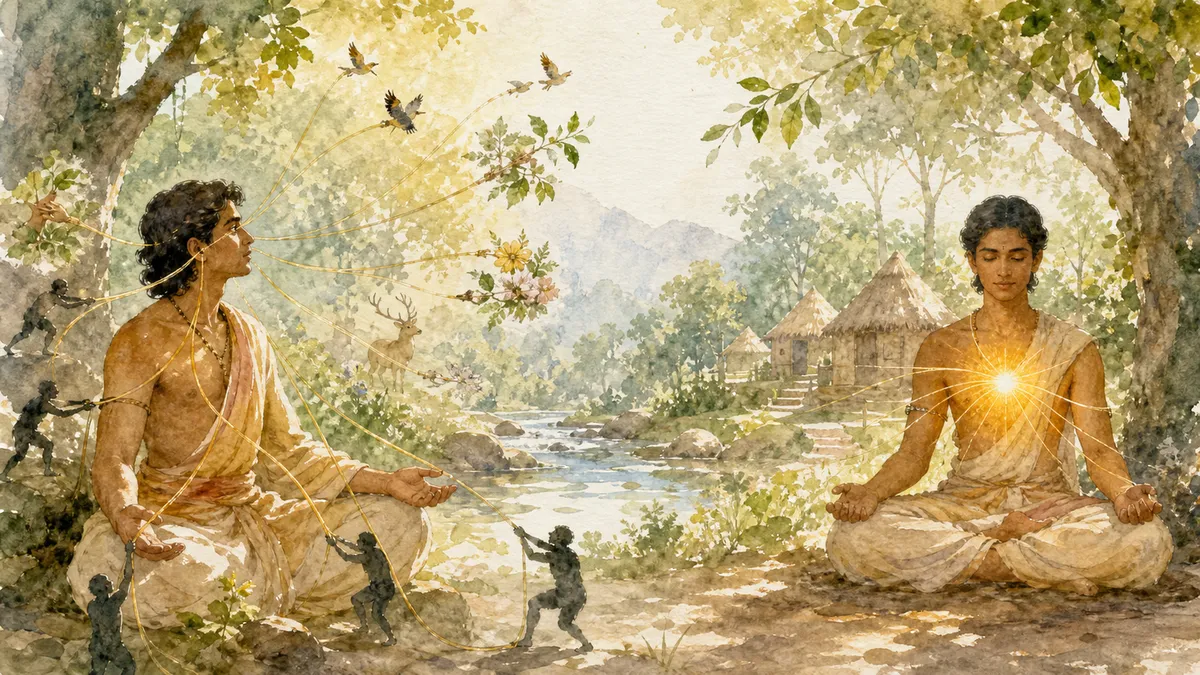
And, conversely, when we have attained the inner sphere of self-awareness, like boundless golden light, we do not lose prana but, on the contrary, accumulate it. This is like metal filings being attracted to a large magnet. We accumulate prana even when our sense organs are functioning. That is, we can accumulate it through the eyes, contemplating beautiful objects that we like. We can accumulate it by recognizing the taste of prasada, listening to sound, experiencing various sensations of bliss, pleasure, and even undergoing unpleasant sensations. Why does this become possible? Because the senses cease to be thieves and become servants, and begin to deliver portions of prana to the practitioner. And this happens thanks to the union of contemplation with the senses.
The Skillful Life of a Practitioner
Gorakshanath has these words: “In one night, one can squander twelve years of life.” That is, if you do not live carefully, not exquisitely, not skillfully, if you spend your prana in some sensory perception, if you handle the sense organs and the mind carelessly, then even in a short time you can spend a very large portion of your life force.
A practitioner who trains in contemplation, regardless of the vows he follows—vinaya or tantric samaya for laypeople, or the single samaya of contemplation—lives very carefully. This means that he knows the measure of self-liberation, the measure of transformation; he will not allow his sense organs to be overloaded, he will not allow the loss of prana. He takes from perception exactly as much as is necessary for him to abide in contemplative presence. He never allows his pranas to go “out of control”; he does not allow himself to be led by his mind, his sense organs, or his thoughts. He is very careful. He measures every step, calculates every intake of prasada. Not literally calculates, like Devananda. Let us say, he approaches the taking of prasada carefully and eats very carefully. He walks carefully, he communicates carefully, contemplating in communication; he performs any service carefully, looks carefully at any landscapes and images, without losing awareness, doing everything skillfully, not allowing the loss of prana but instead constantly accumulating it.
There are these words: “A true master, rejecting nothing, will never do anything excessive.”
Once I was riding in a car with a student. He asked:
“Don’t you ever feel like driving a car? After all, there is such an opportunity.”
I said:
“It has never even occurred to me. There are those who know how to drive; let them drive. I do not know how, but there is no need for it either. I do not know what benefit this could bring to students, to living beings. And since there is no benefit in it, there is no point in all these things.”
A yogin does nothing excessive. He will not lift a finger to do what he does not need or what contradicts the Dharma. Behind any of his actions there is an enormous motivation, which is very deep, but it may not be recognized immediately.

“Ceaselessly seeking the answer to the question of one’s own essence and constantly seeing the changing essence of the world, a person will, in due time, attain self-realization like Janaka.”
