

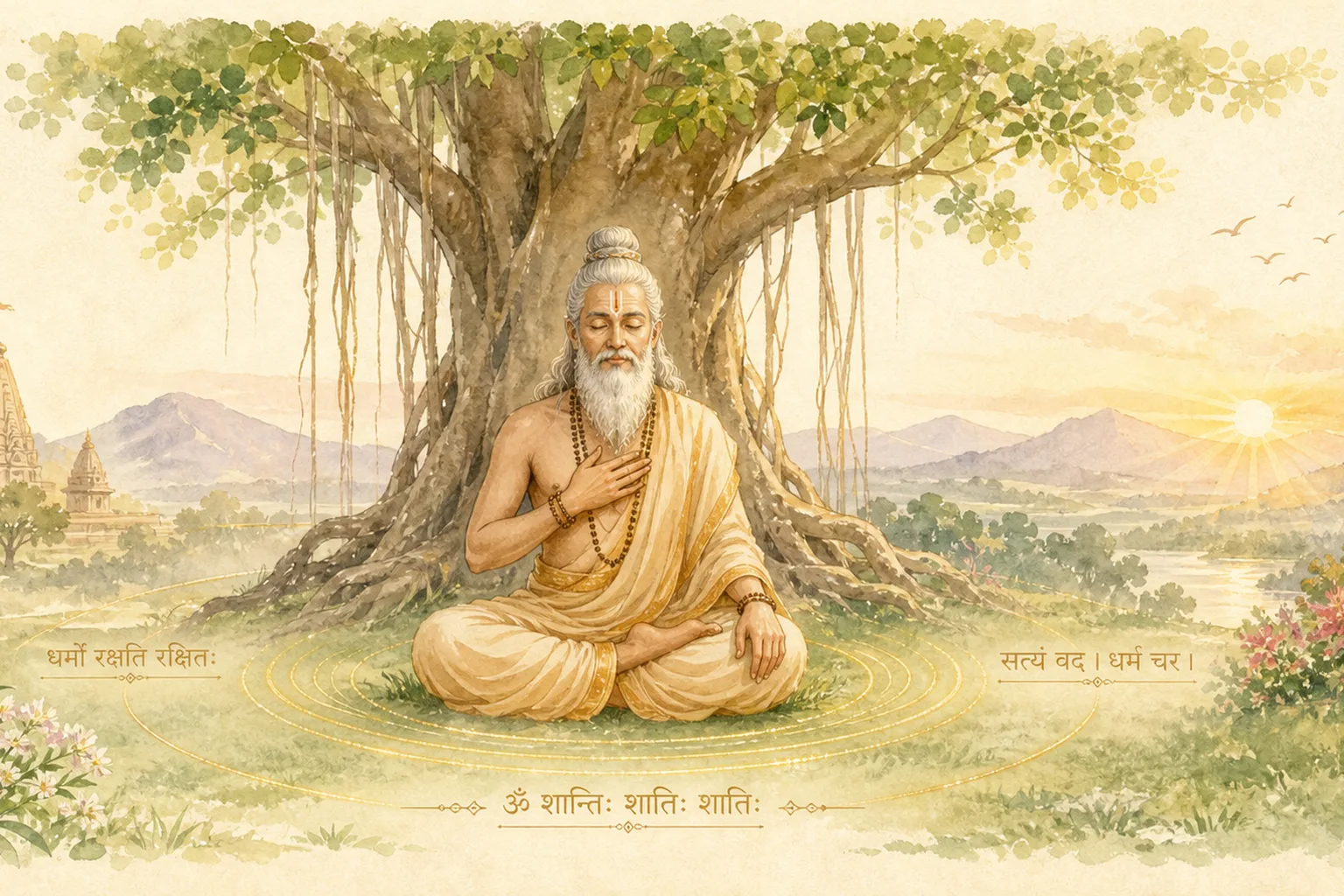
Commentary on the text “Swami Sivananda. The Power of Thought”
Thought is a real action. It manifests as a dynamic force. A joyful thought evokes a kindred joyful thought in other people. The arising of a noble thought is a powerful antidote and counterforce to an evil thought.
Thoughts can be transmitted. Thoughts are a force. On the physical level, we do not understand this until we enter the subtle body. On the subtle level, we begin to understand the nature of thought. For example, if you practice Dream Yoga well, you can see how, as soon as you imagine something, it materializes.
If you practice visualization of the illusory body and have developed the siddhis of the illusory body, then if you imagine fire or lightning emanating from a staff, it will emanate from it in the subtle body. And if you imagine a celestial warrior surrounding you, he will appear and protect you. And if you imagine a protective circle of fire forming around you, all of this will manifest in the astral world. Visualization in ritual practices is based on this.
Or if you imagine a fiery trident flying toward another person and piercing them, that person’s subtle body will be struck by the element of fire, and they may even fall ill. All magic is based on this. But if that person is stronger than you and abides in deep presence or visualizes protection, such as a rainbow shield, then the trident will not penetrate the shield; it will rebound and fly back at you. This is the direct return brought about by the law of karma.
Therefore, in magic there is a principle called “backlash.” For example, if a witch or sorcerer wants to curse someone or launch an astral attack, they take precautions, knowing that if something goes wrong, the attack will return. What do they do? They cast a spell on a neighbor’s dog or a neighbor’s cow so that if the attack rebounds, it will return to the animal rather than to them. This is common knowledge.
Such people have a very clear understanding of the power of thought. This is no joke—thought can kill. Thought can also heal from a distance, protect someone, bestow blessings upon them, change their destiny for the better, and grant them wealth. In India, many Swamis often do nothing but this, because when people come to them, they do not ask about the Dharma or how to attain Liberation; instead, they ask how to find a wife, how to ensure that their daughter gets married, how to acquire wealth, how to find a better job, or how to be healed. And the Swamis give various blessings or perform rituals. It is said that very few people ask for the Dharma; they ask for such things instead.
Thought is quite real, and you must understand that while living in a monastery and practicing, you should take samaya very seriously, because your thought can either save another person or harm them.

The Influence of Thoughts on Others
It is important to understand that you should maintain pure and joyful thoughts. If a person who radiates impure, joyless thoughts is nearby, you should keep your distance from such people. They are like sick people—thought is like a kind of virus, and it can be transmitted. If a person is in a despondent, depressed, impure state, then simply by being near them, you will begin to feel their mental aggression. You will begin to experience thoughts and images that are not characteristic of you.
If you are an experienced practitioner, then, of course, you will self-liberate all of this; you will notice that these are not your thoughts, and they will begin to disappear. But if you are a weak practitioner, you will succumb to this influence and, after some time, will also find yourself in such a state. In this case, it is very important, at the very least, not to allow yourself to be infected by such thoughts, to have your own personal bhava, and to become established in a pure and luminous bhava.
People who are inclined toward a particular way of thinking tend to believe that everyone else thinks the same way; they enter an entire universe shaped by that perspective. When I speak with people, they often say to me, “But everyone thinks this way.” I reply, “Not at all. I think completely differently. That is simply your perspective.”
A hungry ghost may say, “Everyone is like that.” If a hungry ghost is given water, it will drink it, but the water will turn into fire in its stomach, and it will derive no benefit from it. All hungry ghosts tend to see the world through the eyes of pretas, hungry ghosts; to them, the entire universe looks dilapidated, shabby, flawed, deficient, and unfulfilled. This is the universe of a hungry ghost. Even if you want to make an offering to a hungry ghost, it will spoil it. If you give it money, the money will be lost; if you give it food, the food will turn sour; if you give it water, the water will become murky and unfit to drink; it will want to drink, but its throat is narrow. Until these karmas are purified, it is difficult to help such beings. It is simply a vision.
The same applies to the vision of the gods of the desire realm. If you give water to a god of the desire realm, he will take it in his hands and it will turn into nectar. If you give him a thorny bush, it will become a lily of the valley or a lotus. If you give him a copper coin, it will become a basket of gold. If you give him a stone, that stone will become a precious gem. If you give him a hat, the hat will become a crown. If you give him a cloak, the cloak will become a robe embroidered with gold. Whatever you give a god, everything will become divine.

All living beings have a certain pattern of thought. This pattern of thought is conditioned by their karma and imprints. Each being, while abiding in this pattern of thought, creates an entire universe and shares it with other beings. It is important always to remember this and to choose the right pattern of thought. If we think impurely, we are already placing ourselves among the lower beings: animals, hungry ghosts, devils, servants of hell, and so on. It is as though they already have a claim on you: “You thought that way, so you are one of us.” This is indeed so. But if we think purely, loftily, and correctly, we place ourselves among the gods, and they see that we are kindred spirits. If we think in a holy manner, we place ourselves among the saints. And the more we think in a certain way, the more we align ourselves with that class of beings.
Developing Independence of Thought
With the help of developed positive thinking, we acquire creative power. Develop your individuality; resist suggestion. Do not readily yield to the influence and suggestion of others. Have a sense of individuality. A strong suggestion, although it may not affect the subject immediately, begins to work over time. It never passes unnoticed.
As you practice contemplation, you should increasingly acquire inner integrity, inner independence, and the ability to self-liberate from any external influences. Sometimes our own karmas suggest to us that we have desires; we succumb to this suggestion and lose awareness. Sometimes visions or certain spirits appear in meditation and try to instill an incorrect pattern of thought in us. Sometimes the external samsara manifests in such a way that it tries to disrupt our awareness.
The highest method is to self-liberate everything while abiding in awareness, to open yourself as fully as possible to the Light of Grace, to the presence of the Higher Self, and to allow this Light to dispel everything. If this Light is insufficient, then you must engage the mind, logic, thought, analysis, analytical reasoning, the analytical aspect of the mind, and your knowledge of philosophy and theory, and examine everything uncompromisingly from the standpoint of the Teaching.
Independence of thought does not mean some kind of selfish permissiveness. On the contrary, the more independent you are in your thinking, the emptier and humbler you are. People who are dependent always try to prove something to someone and assert themselves, because inwardly they feel that they are of little significance and are always trying to affirm themselves. This indicates a low level of self-sufficiency. But a person who possesses great integrity and self-sufficiency is very humble and very calm. Such a person has no need to prove to others who they truly are; they already know it.
Once, a Tibetan teacher was imprisoned when the Chinese conquered Tibet, and the Chinese guards tried to get on his nerves. At first they said, “You are a scoundrel, a supporter of reactionary teachings, and so on.” Seeing that he merely smiled, they began saying to him, “You are such an exalted teacher, a saint, a wise man,” and again he smiled. Seeing that he did not react, they asked, “We have both insulted and praised you, yet you keep smiling. Do you really not care?” He replied, “In fact, nothing you say matters. Why? Because I know who I am. No matter what you say, I know who I am.” And that was all.
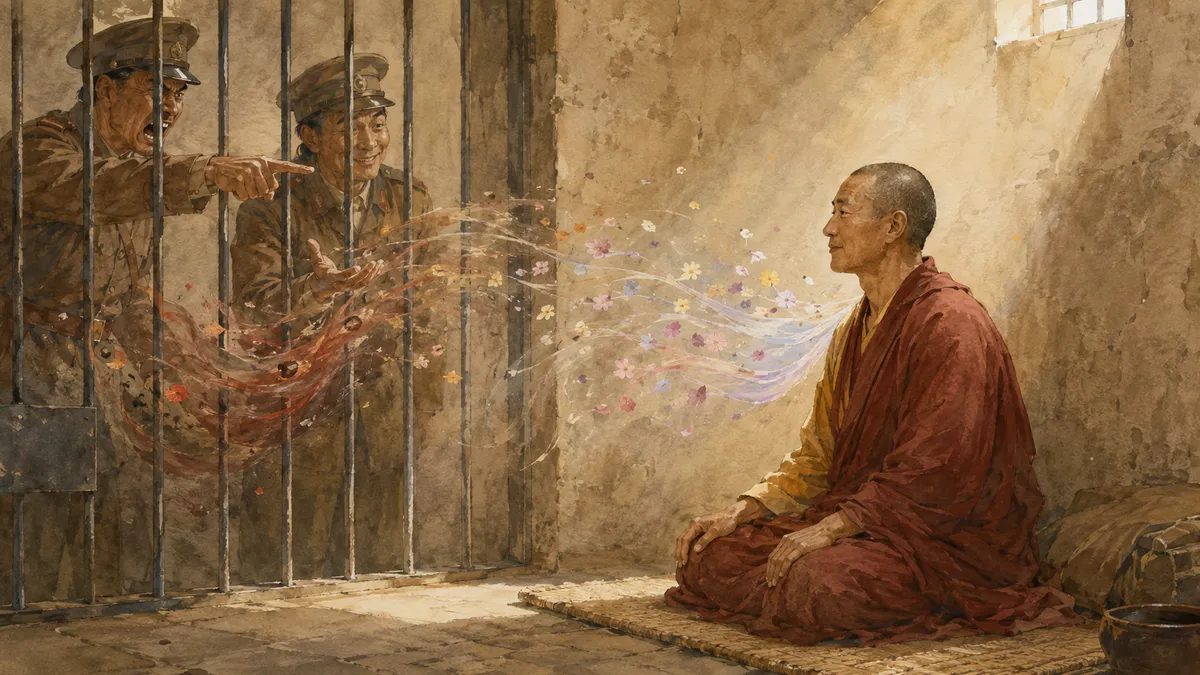
In the same way, if you are established in the true natural state, you know who you are, and you do not need to hear the opinions of others to confirm it. From this arise wholeness and self-sufficiency. The teacher’s task is always to help the student attain such wholeness and self-sufficiency.
There are pseudo-wholeness and pseudo-self-sufficiency based on egoism. Egoistic pseudo-wholeness and pseudo-self-sufficiency are forms of self-expression and self-assertion, but they are not the truth. Deep down, the person is actually unsure and understands that inwardly they do not know themselves. They are merely trying to impress others, attempting to appear important, knowledgeable, wise, or even enlightened. True self-sufficiency is internal; it does not require external self-expression or self-assertion. You simply know who you are; what is happening outside does not matter.
Suggestion and Integration
We all live in a world of suggestions. Every day, our character unconsciously changes under the influence of our interactions with people. We unconsciously imitate the actions of people we admire. Every day, we are subject to suggestions from those with whom we are in constant contact.
Suggestion is when you act unconsciously and an imprint is created in the mind. But if you act consciously, there is such a thing as integration. You simply open yourself to a certain energy and consciously work with that energy. This has nothing to do with suggestion, because you have the principle of awareness. You abide in self-liberated nonduality, yet at the same time you are not closed off; you are positive.
Many people, lacking true self-sufficiency and being highly suggestible, close themselves off. They think, “I will gain at least some self-sufficiency, at least some wholeness; I will crawl into my shell, retreat into my own enclosure, and hold my fortress so that no one can suggest anything to me.” Such people appear very critical. This critical attitude is actually a fear of losing their own small measure of wholeness, which in fact is almost nonexistent. They are not open, do not know how to integrate, and adopt a very rigid, uncompromising position, as though hiding in some fortress and occasionally poking their noses out.
This cannot be called positive or right either. Such a person will never find a spiritual Teacher, will never attain devotion to the Dharma, and will never open deeply to enlightening grace, the Ishta-devata, the saints, or the Lineage of Transmission. They will always remain in their armor and fortress, thinking that at least in this way they will preserve some degree of independence and wholeness. This is the other extreme, and it is also wrong.

Integration means that you are simultaneously self-liberated, completely whole and self-sufficient, yet at the same time completely open; you are receptive and can work with any energy.
The Universal Principle of Suggestion
We act in accordance with these suggestions. A person who does not think independently submits to one who thinks deeply. A servant is always under the influence of the master, a wife absorbs her husband’s attitudes, a patient is influenced by the doctor, and a student is under the influence of the teacher. Custom is nothing other than a product of suggestion. The clothes you wear, your manners, behavior, and even the food you eat—all these are merely the result of suggestions.
There are various suggestions coming from nature. Flowing rivers, the shining sun, fragrant flowers, growing trees—all of them tirelessly send you their suggestions.
Here Swami Sivananda views the principle of suggestion as a universal principle. It is the principle of spanda, the principle of the activity of Maha-maya (shakti). It is not merely one person exerting a certain influence on another; it is the global transmission of the energy of Maha-maya. The entire Universe transmits its meanings to us, and because we are not self-liberated, we fall under the influence of those meanings.
If practitioners are capable of recognizing certain gross meanings and, having some understanding of values, are able to distinguish false values from true ones and follow the latter, they still cannot discern the subtler meanings transmitted by Maha Maya. For example, there is the constant transmission of time (parinama). It has never happened that you woke up and the next day turned out to be yesterday, with the calendar rewinding. Time flows strictly linearly, from the past into the future. There is also the transmission of cause and effect. A cause is followed by an effect, not the other way around. It has never happened that you first tasted something and then bit into an apple. It is the other way around.
There is also the transmission of the three dimensions, the five elements, the gross mahabhutas, and the tattvas—all these are different transmissions of Brahma's energy. The universe is the result of Brahma's thought-creation, and there is a continuous transmission, an instilling of the laws of samsara into our “I.” And until we become as subtle as Lord Brahma himself, we will not be freed from the laws of samsara created by Brahma.
For Brahma, the entire universe is like a dream to us. What is a dream for us is the universe for Lord Brahma. Just as in a dream our mind creates various thought-forms of acquaintances, friends, or relatives, yet they have no independent existence and are illusory, so the universal cosmic Mind of Lord Brahma creates the universe and living beings. In Lord Brahma's universe, we are virtual characters endowed with artificial intelligence.
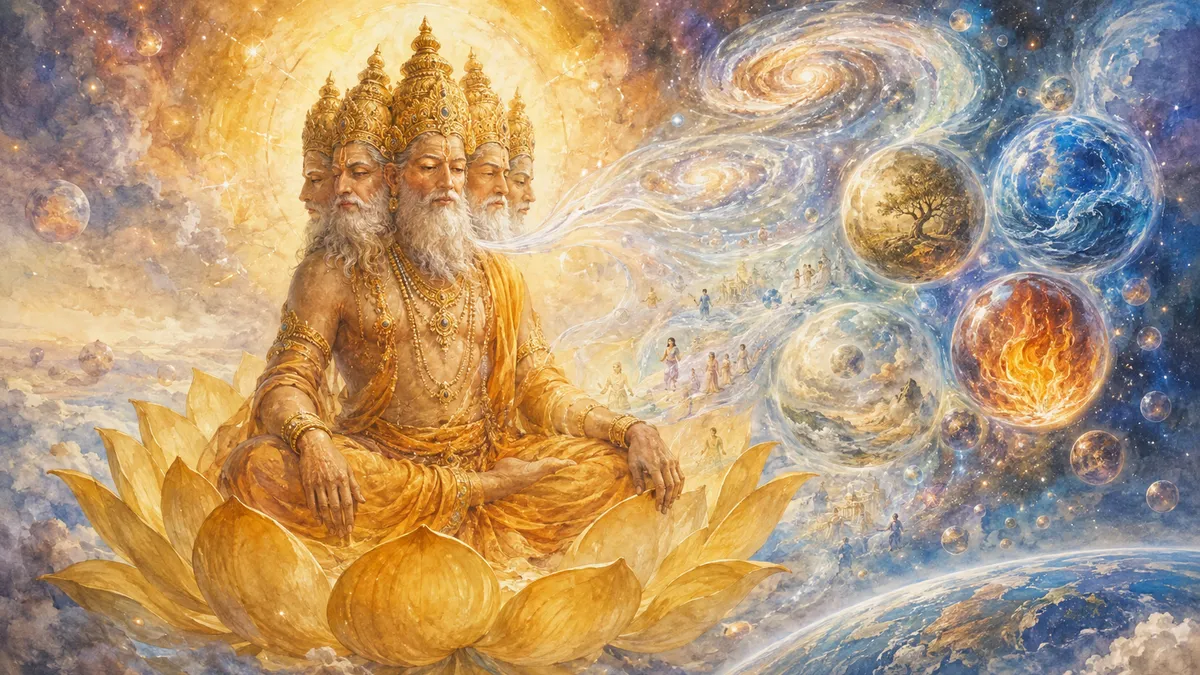
But of course, we do not acknowledge the very fact of our illusory nature; our illusoriness seems real to us.
Supernatural Powers of Thought
Supernatural powers are the result of mental discipline. The power of concentration and will enables a mighty occultist to hypnotize an entire audience and perform the rope trick. He throws a red rope into the air, suggests to the spectators that he is about to climb into the air along this rope, and disappears from the stage in the blink of an eye. But a photograph captures nothing of the kind.
Recognize and realize the power of thought. Uncover your latent powers or occult abilities. Close your eyes, concentrate, and explore the higher realms of consciousness. You will be able to see distant objects, hear faraway voices, send messages to distant lands, heal people over great distances, and travel to faraway places in the blink of an eye.
In the 1930s, in Buryatia, they once decided to arrest a certain Buryat shaman and sent several NKVD officers after him. When they attempted to arrest him, the shaman multiplied himself into several forms, and the officers did not know which form to seize. As a result, they were unable to catch him. A large NKVD detachment of about forty men was sent. The shaman multiplied himself into an equal number of illusory doubles and engaged the NKVD detachment in combat. Again, they were unable to catch him. Ultimately, they abandoned the attempt. The shaman's power of mental visualization was such that he could create numerous illusory doubles. The ancient Aryans—Kartavirya Arjuna and Ravana—demonstrated the same thing.

The ability to project visions, illusory images, and siddhis of enchantment is called moha siddhi or sammohana siddhi. When your thought-form is highly concentrated and very vivid, another person, by concentrating, can see it as though it were real.
Overcoming Gloomy Thoughts
Thoughts, their diversity, and victory over them.
Overcome gloomy thoughts. Watch your thoughts very carefully. Suppose gloomy thoughts have taken hold of you and you feel depressed: drink a small cup of milk or tea, sit quietly, close your eyes, determine the cause of the depression, and try to eliminate it.
A Christian term describes gloomy thoughts more accurately—they are called tribulations. It is said that when a person moves toward God, God sends them tribulations as trials until they are purified. Such tribulations may arise during the process of purification.
What does this mean? It means there are imprints from past incarnations that you need to experience; you need to go through this. It means that in past incarnations you did something wrong, thought badly of someone, practiced black magic, or committed acts of violence. If you were a layperson, you would fall ill or have conflicts, but in monastic life, having taken vows, you experience all of this on the mental level, on the level of the subtle body, the mental or astral plane, yet you still need to go through it and experience it.
You should not be afraid of this or make it into a problem. It is normal. Whatever you are destined to experience according to your karma, you will experience, and there is no escaping it. You will experience it either in Russia, America, or Africa, but you will experience it all the same; it is written on your palms, recorded in the book of destiny—where can you escape from it? There is no need to be upset about it; you simply need to accept it as a given.
A practitioner does not make a problem out of it, and if sorrows arise, they learn to live with them, to accept them, and even to love them. They make this part of the path and part of contemplation; they are like Shiva, who can wear snakes upon himself, and those snakes do not bite him. Or like Shiva, who drank poison, yet that poison did not harm him. This is because a practitioner does not set themselves the goal of being ecstatic or extremely happy; that is not their goal. Their goal is, first and foremost, to be aware, seeing the highest happiness in awareness.
Different bhavas, sorrows, and so on will come and go, and no importance should be attached to them; simply observe them. And if they are intense, you should perform certain practices that support the mind. The main thing is not to allow basic, fundamental awareness to become obscured, remembering that karma is not endless and that, sooner or later, manifestations of merit will replace negative karma. Yesterday you experienced certain sorrowful states, while tomorrow you may experience ecstasy, admiration, exhilaration, and joy, and all of these manifest as well. It is like the alternation of day and night.

Methods for Overcoming Negative States
Reflecting on lofty ideas and noble deeds is the best method for overcoming gloomy thoughts and the depression they cause. Remember again that the positive overcomes the negative. This is a great operative law of nature. Now attune yourself deeply to thoughts opposite to those that are sullen and gloomy; think about things that uplift your spirit. Think about being in a good mood.
When going through such experiences, it is very important to know how to work with them. By going through such experiences, you grow spiritually. Without this kind of experience of self-liberating coarse or negative thoughts and states, you will always remain immature; you will always be a “plush” yogi. A “plush” yogi is someone who, while practicing in favorable surroundings, is joyful, cheerful, and happy. But as soon as they step on a thorn or encounter some obstacle, their “heart sinks into their boots,” and all awareness is lost. A true yogi must be a fire-breathing dragon who can open their jaws and swallow anything, yet whose fire never goes out.
Imagine all the benefits of being in excellent spirits. Feel that you truly possess this quality. Mentally repeat the formula again and again: “Om, good mood.” Feel: “I am in an excellent mood,” and begin to smile and laugh. Sing; sometimes this quickly lifts your spirits. Singing wonderfully dispels despondency and gloom. Chant “Om” loudly several times, go for a run in the fresh air, and the depression will soon pass.
Working with the Sahasrara Chakra and Astral Obstacles
Sometimes, in the case of a worldly person, one can see that such states arise because the sahasrara chakra is closed; as psychics say, the connection with the cosmos has been lost. This is so because the sahasrara chakra is Brahma-dvara—the connection with the Absolute. The deva-vahini communication channel provides a connection between the physical, astral, mental, and causal bodies. And if the sahasrara is closed, then this channel, of course, does not function. It may not function because, according to astrology, the time has come for it to close; the lower chakras are active, and the lower chakras are not chakras of inspiration. Sometimes it happens because other people’s thoughts have closed the person’s sahasrara chakra. Sometimes this channel does not function because obstacles are being created by creditor spirits. For example, a small spirit may be squatting on top of a person’s head, but the person cannot see it. That can happen as well.
In this case, it is important to open the Sahasrara chakra—for example, to visualize above your head the Ishta Devata, Dattatreya, shining in all his beauty, in pure vision, with all his attributes, and to practice Guru Yoga, regarding the Guru and the Ishta Devata as one, imagining him as a dazzling form directly above your head, at a height of approximately five centimeters.

Karmic Creditor Spirits
Sometimes karmic creditor spirits, having entered the astral dimension, can be very resentful. If through carelessness you have harmed or offended someone, they will try to collect from you, to recover that karmic debt.
One teacher, after leaving his body, was making his way through the Bardo. Since he was an experienced practitioner and possessed certain powers, he was heading to the city of the dakinis, accompanied by two dakinis. He did not undergo the processes of the intermediate state that ordinary people do, but when he approached the city of the dakinis, another dakini appeared, waved her hand, the light disappeared, and he could not pass through the gates. His two dakini assistants created a radiance and restored the light in the astral dimension. But that strange dakini appeared, waved her hand, and the light disappeared again. Then the teacher said, “Why are you obstructing me and not allowing me to enter this city?” The dakini replied, “Do you remember when you were a lama and gave lectures? An old woman used to come to listen to them, but you hindered her, and then you even ordered that I be driven away. Remember, that old woman was me. I resented you, and now I want to punish you for your excessive self-importance.” The teacher then repented and apologized to her, and the dakini ceased obstructing him.
In the same way, the souls of slain animals often come before Yama’s court to testify against hunters and demand repayment for their suffering. If many of them were killed, they say, “Look how many of us were slain, and you want to send this person back to the human world? No, he deserves hell.” They try to attack him while testifying against him. Spirits are sometimes very jealous and seek to collect what they are owed, which is why they are called karmic creditors.
But sometimes we are not yet in the Bardo and remain in the human world, while the spirits are in the Bardo, yet they remember, because spirits can live for one or even two thousand years. They may seek to collect their debts while we are still alive. This is why obstacles arise.
Methods for Removing Obstacles
One way to remove obstacles is to perform manasika puja, a mental offering. You visualize an altar and abundant offerings, and even if you cannot see any obstructing beings, you invite them: “Accept my offerings. I repent if I have offended you, and I offer my apologies,” and you make abundant offerings, imagining jewels, drinks, food, clothing, incense, and so forth. After making such offerings, you will feel the astral situation become harmonized.
A good practitioner who abides in presence does not need manasika puja. Through their brahma-bhava alone, by immersing themselves in the depths of divine pride, they transform the space so profoundly that all beings receive the transmission of this brahma-bhava, become naturally nourished, and are completely satisfied. It is said that when a saint abides in samadhi, all living beings within a five-mile radius also enter samadhi in the astral world.
The Practice of Pratipaksha Bhavana
This is the pratipaksha bhavana method of Raja Yogis; it is the simplest method. The method of forcibly controlling a gloomy mood through willful effort, mental resolve, and emotional control places great strain on the will, although it is the most effective. It requires tremendous willpower. Ordinary people are not capable of it. The method of displacing or replacing a negative feeling by substituting its positive opposite is very simple. Within a very short time, the unwanted feeling will disappear. Practice this method and experience it for yourself.
Sometimes texts can be recited to remove obstructing thought forms. If a person is spiritually strong, then by reciting mantras or texts, they can radiate a powerful light and disperse entire astral veils and clouds.
There was once a saint. One day, while traveling, he met a Brahmin. This saint had studied under a very great spiritual teacher, and while they were talking, the Brahmin said, “If you wish, become my disciple.” The man replied, “I have dismounted from a horse, and you are offering me a donkey to ride.” This offended the Brahmin. He said, “Well then, let us test our knowledge.” It turned out that the Brahmin knew less than this spiritual teacher’s disciple. But the Brahmin still refused to concede and said, “The fact that you know more philosophy and scriptures means nothing. Tonight you will see which of us is more advanced.” That night, the disciple began having problems: ritual objects flew through the air, dishes fell, and he felt tremendous pressure. He turned to his Guru and said, “When I recite the scriptures, this does not happen. But as soon as I become distracted, all this begins.” The Guru said, “The Brahmin is performing some kind of rites to harm you.” The disciple asked, “What should I do?” The teacher replied, “I will give you a text. You must climb into a barrel, cover it with a lid, and recite this text.” He recited it for three days, and on the third day something utterly terrifying happened—the wind howled, trees were torn up by the roots, walls shook, and a magical dagger flew into the shed where he was practicing. It flew all around the shed but could not strike him because he was protected by the barrel. Since the dagger did not find its target, it flew back and struck the Brahmin.

Even if you fail several times, keep going. After several sessions and as you master the practice, you will succeed. Work in exactly the same way with other negative thoughts and feelings. If you feel fear, think of love. If your thoughts are filled with jealousy, think of the benefits of kindness and generosity. If you have a bout of melancholy, recall an inspiring scene you saw some time ago, or bring to mind some fascinating episode. If your heart has hardened, think of mercy; if you are overcome by lust, think of the benefits of sexual abstinence. If you want to deceive someone, think of honesty and straightforwardness; if you have a bout of stinginess, think of generosity and generous people. If you experience reckless passion, think of discernment and Atma-vichara.
The Importance of Faith and Imaginative Thinking
It is very important to be able to engage the subtle body and the imagination. If you are good at engaging imaginative thinking, everything works out much faster and better. If you perform any Kundalini Yoga sadhana, you should imagine that you are a Kundalini Yoga practitioner, that you develop dardri-siddhis, that your energy awakens, and that you enter samadhi. You must literally see this vividly. Then your pranayamas, mudras, bandhas, and asanas will be highly effective. If you practice the Yoga of the Illusory Body, you must literally feel that you possess such an illusory body and that you are succeeding. In other words, you must have strong faith in what you are doing.
For example, someone practices a certain sankalpa or sadhana and thinks, “It may work, or it may not.” This is the wrong approach. You must have strong faith in the method.
If you take monastic vows, you must believe in your vows. You must not think, “Perhaps I will be a good monk, or perhaps I will not. Will I succeed?” You should not even allow such thoughts. You must think, “I will be the most magnificent, the very best monk or novice.” If you are not certain, then your faith is weak. If you enter a retreat, do not think, “What if I fail?” You must think, “The sun and moon are more likely to change their orbits than I am to fail in retreat.” That is the kind of faith you must have. When going to collect donations, you must not think, “Will I be able to collect donations or not?” You must go forth like the horn of a rhinoceros: “Wherever I go, donations simply flow like a river; I barely have time to hold out both hands, my bag, and my donation sack, while also preaching and inspiring new monks to follow me.”

For a person of faith, the ground “burns” beneath their feet in a positive sense, and the gods bless them. A person with weak faith is always dependent on karma; they are controlled by the ego, karma, and other things. If you practice healing, you must have strong faith that you will certainly be healed. Why? Because the world is made of faith. Faith is the profound meaning underlying the creation of the entire Universe. When Brahma created the Universe, he deeply believed in its reality, which is why it seems so real to all living beings. And if we want to bring something into being or create something, we must also believe strongly.
