

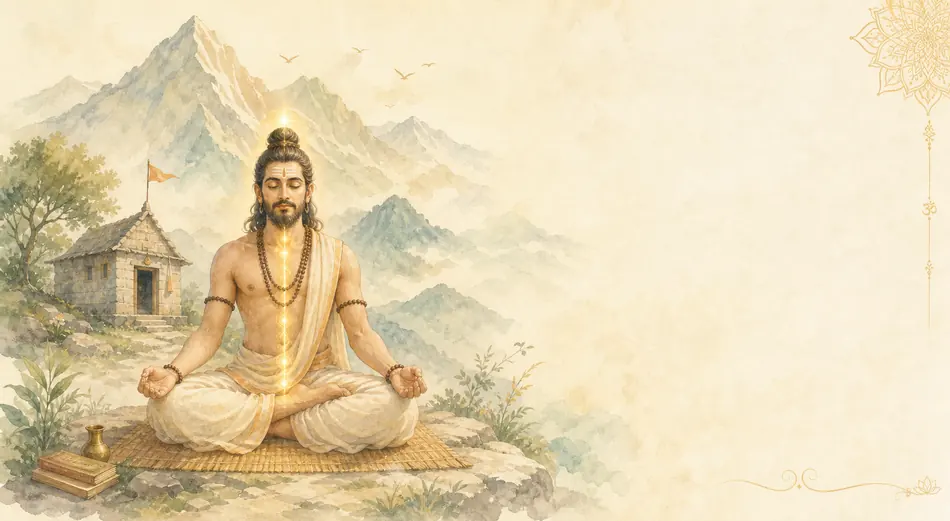
What does a yogi experience when he purifies the channels and his kundalini awakens?
Main Bodily Manifestations
1. Heat and cold
During an intense awakening of energy, strong heat rises from the muladhara region, accompanied by an increased heart rate. This is associated with the activation of the pingala channel. If a yogi awakens kundalini incorrectly without the guidance of a Guru, the energy may flow through the right channel, overheating the body. This may cause a rise in body temperature or, conversely, chills like those experienced with a cold. This is associated with the activation and imbalance of the ida and pingala channels. At this time, the yogi is severely tested by the sun and moon within his body.
2. Goosebumps and itching
The opening of the superficial channels and points (marmas) in the skin is felt as tingling, scratching, and itching, as though insects were crawling over the body. Itching and scratching may be intense in places where the channels are blocked or narrowed. As they are purified, a sensation of bliss and a feeling of transparency of the skin arise in these areas.
3. Floating and lightness in the body
This indicates the opening of the muladhara, the activation of udana-vayu, and the partial filling of the sushumna with prana.
4. Heaviness, pressure, and fullness in the limbs
Due to the uneven filling of the fingers, toes, and feet with prana, sensations of swelling, pressure, and puffiness may arise. Over time, this passes on its own as the pranas naturally become harmonized.
5. Flashes of light
They arise in the heart and between the eyebrows when enough prana reaches these areas, at which point a sensation of pressure is felt there. Sometimes the light may be as bright as lightning, and at other times it may be dim.

These are ordinary initial experiences in a yogi's body. There are also more intense experiences, such as illness, pain, nausea, vibration, trembling, fainting, or emotions. But we will consider them another time.
The First Stage of Practice—“The Time of Suffering”
What happens next? At the first stage of practice, when the pranas are not under control during pranayama, the yogi encounters difficulties. This period is called “the time of pain” or “the time of suffering.” His experiences may not develop for months, even if he practices very intensively. For nine months, I performed six- and eight-hour technical practices every day, but there was not even a hint of a result. Results appeared only when I decided that it was better to practice without expecting results, simply because one must practice. As long as you cannot let go of yourself and keep chasing results, your ego is trying to catch up with itself like a dog biting its own tail.
The yogi's mind will become distracted and sink into dullness, tamas, and prostration, craving worldly pleasures. Powerful passionate desires that never troubled him before may awaken within him. At times, he may experience intense emotions or thoughts that cause self-pity, fear, despondency, and a lack of faith in his own abilities and in his chosen method of practice. This happens because of the movement of impure karmic winds, which rise to the head and affect consciousness. During this difficult period, called “the time of suffering,” the yogi should meditate on impermanence and the sufferings of samsara, while also cultivating great resolve and renunciation. He should read the biographies of holy siddhas and great Gurus, maintain fearlessness, perseverance, and faith in the Guru, and envision himself as a fearless vira yogi.
Initial Experiences and Visions
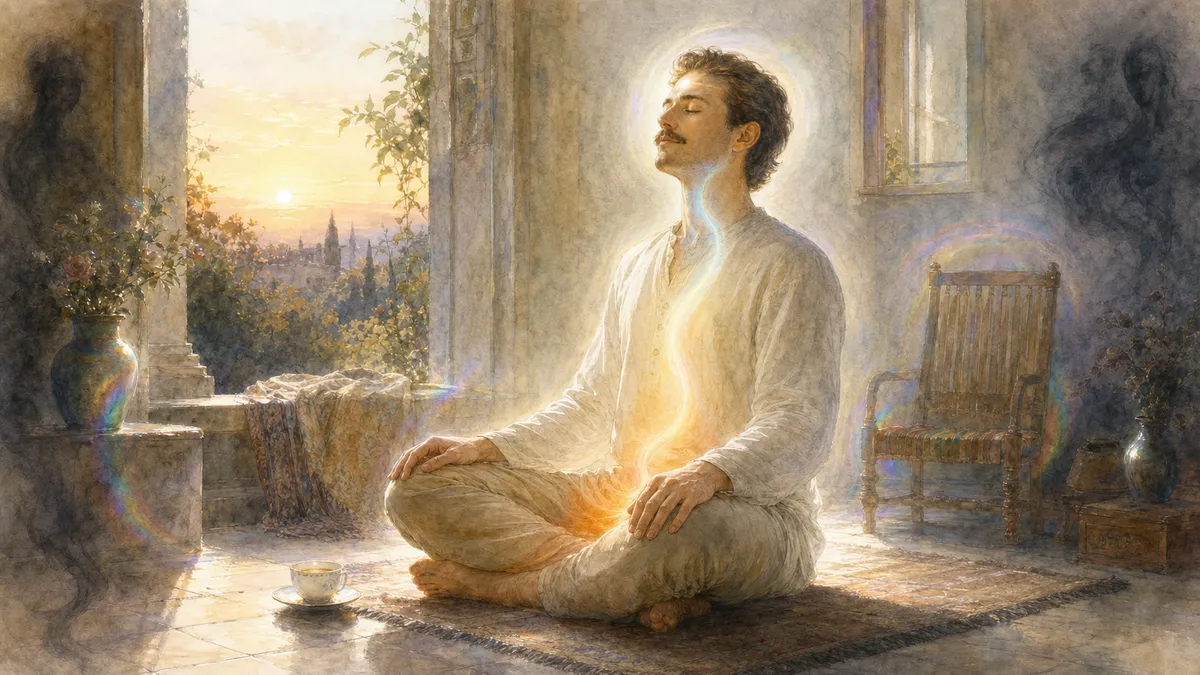
As the awakened winds rise from below, they are unable to break through the blockages in the nadis and partially escape through the genitals or anus. At this time, it is important to master the precise performance of mula bandha and continue purifying the nadis. Then, once the nadis have been somewhat purified, the winds begin to rise through the superficial channels, and the yogin may sometimes feel ringing in the ears, sometimes pulsating heat in the coccyx, sometimes pressure between the eyebrows and in the head, sometimes headaches in the back of the head or temples, sometimes bliss in the center of the chest that makes him want to sing, while at other times during pranayama his body shakes and is jolted by the ascending force.
All these varied manifestations are individual. They depend on the condition of the channels and the predominance of the elements according to each yogin’s karma.
Visions and experiences in the lower chakras
Sometimes his coccyx becomes hot, as though it were melting, and the yogin has vivid dreams resembling nightmares, as if he were killing someone, cutting or stabbing them, or as if someone were chasing him. This is caused by the movement of coarse, impure winds in the lower chakras (muladhara and svadhisthana).
At this time, he may sometimes become irritable. This is caused by the partial ascent of kundalini’s ascending pranas toward the brain. Sometimes the yogin will have dreams in which he has sex with the parent of the opposite sex—that is, a yogini with her father and a yogin with his mother. This indicates the activation of the red drop in the muladhara.
Movement of energy along the spine
Sometimes during meditation or breath retention, the yogin feels a spinning sensation and experiences a sense of flying and weightlessness; a resilient wave rises along the spine, making a meowing sound, and stops in the throat or between the eyebrows. If this wave stops in the throat, the yogin experiences a tickling sensation there; if it stops in the chest, he may cough and feel slight pain in the heart; if it stops in the stomach, his stomach may ache if his nadis are not sufficiently pure; if it stops between the eyebrows, the yogin sees images with his inner vision.

Visions of light and inner light
Sometimes his head feels so full of pressure that it seems about to burst. Then he sees a soft white light within; sometimes, at the level of the space between the eyebrows, he may see light coming from outside, like a kind of pulsation or patterns that appear when he concentrates on certain objects. These patterns may be whitish, whitish with tinges of yellow, blue, and red, resembling a rainbow. Sometimes he may see this light accompanying every luminous object. Sometimes he may see objects surrounded by a luminous halo even without any source of light.
This light is neither internal nor external. This light is the result of a vision that arises as kundalini ascends to the upper chakras. When the yogin deepens his presence, he realizes that his inner light is connected with the outer light. This is especially evident in jyoti yoga, but it also manifests in kundalini yoga. Just as the inner sounds of nada begin to be heard as inseparable from external sounds, the yogin perceives the subtle interconnection through which inner sounds are projected outward and become an external voice, laughter, or music. The yogin also begins to recognize the secret of how the inner light, emerging through the eyes and brow vision, becomes external objects. All this deepens his contemplative presence.
Activation of the upper chakras
If prana enters the soma chakra, it feels as though something warm, and sometimes hot, appears in the center of the head. Something then begins to click inside the head, after which the mouth fills with fresh, slightly sweet saliva, which the yogin should swallow rather than spit out.
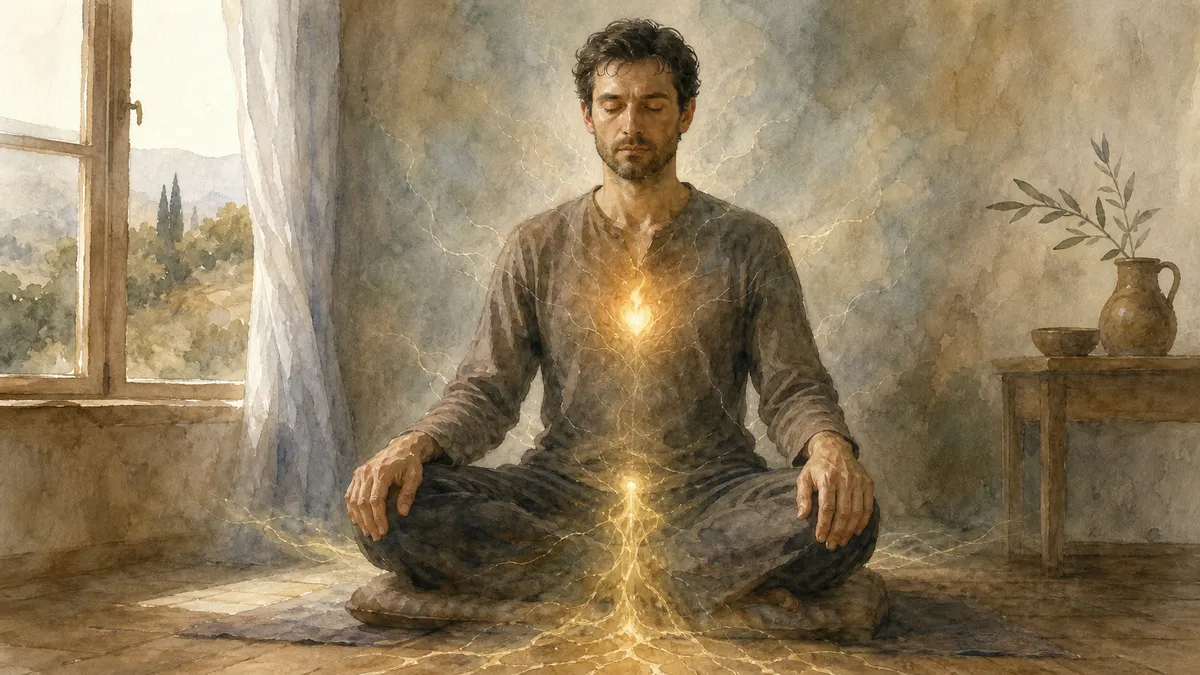
If prana rises to the crown of the head, the yogi feels the head becoming warm, while a soft golden light flares up at the center of the crown. Sometimes it appears as a golden sphere into which one can immerse oneself. Sometimes this light appears as a vortex of conscious golden light descending from above and composed of particles of golden dust. Abiding in this light gives the yogi a powerful sense of joy and confidence that his path is correct. Deep immersion in it brings detachment from all attachments and the realization: “I am consciousness, like a space of light.” At this time, his awareness remains uninterrupted throughout the night.
The diversity of energy manifestations
Sometimes the energy rises during wakefulness, and sometimes during sleep. Sometimes it is so powerful that the yogi cannot move either hand or foot as it rises along the spine. Sometimes it is soft and elastic; at other times it is coarse, unpleasant, and hot, and its ascent causes a headache. The yogi may see dark red energy rising from below, while at other times he sees a soft, silvery-white spiral winding up the spine.
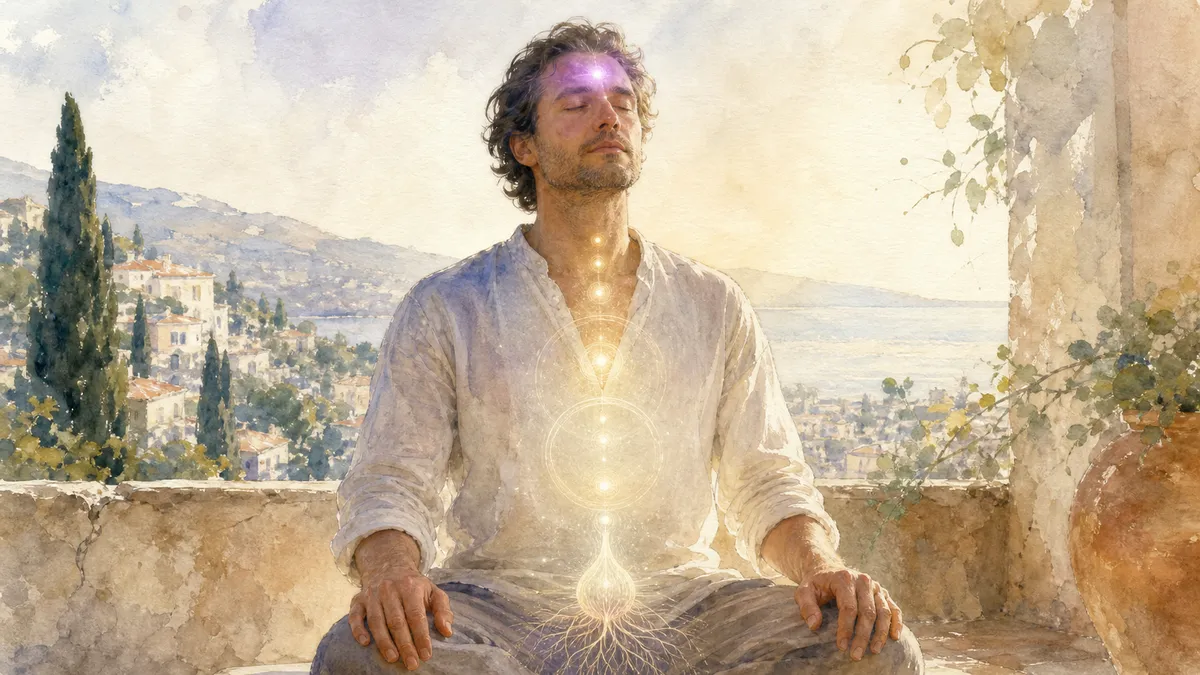
Sometimes he may see the colors of the chakras, elements, or pranas. For example, one may see sparks like those from a flame, or a violet-colored space between the eyebrows. The yogi begins to see the outlines of the chakras within his body. At first, they appear as glowing white-yellow points, then as small circles, and later their details become visible. The yogi may see the kanda as a grayish-white bulbous tuber with fibers extending outward.
Auditory manifestations
The ascent of energy is accompanied by a humming in the ears, ringing, or a subtle whistling sound, and sometimes by a drone or buzzing. A monotonous drone indicates the movement of energy through the left channel, buzzing indicates movement through the right channel, while a hum and subtle whistle indicate an ascent through the central channel.
Initial Samadhi of Kundalini Yoga
When the yogi lies down in shavasana after pranayama, this may trigger a spontaneous ascent of energy. An accidental posture, such as crossed legs or a lowered neck, may cause a spontaneous ascent of energy that stops at the point where it cannot flow freely. At this time, the anus contracts involuntarily, the abdomen draws inward as in mula bandha and uddiyana bandha, and then the energy presses against the chakras with great force as it moves upward.
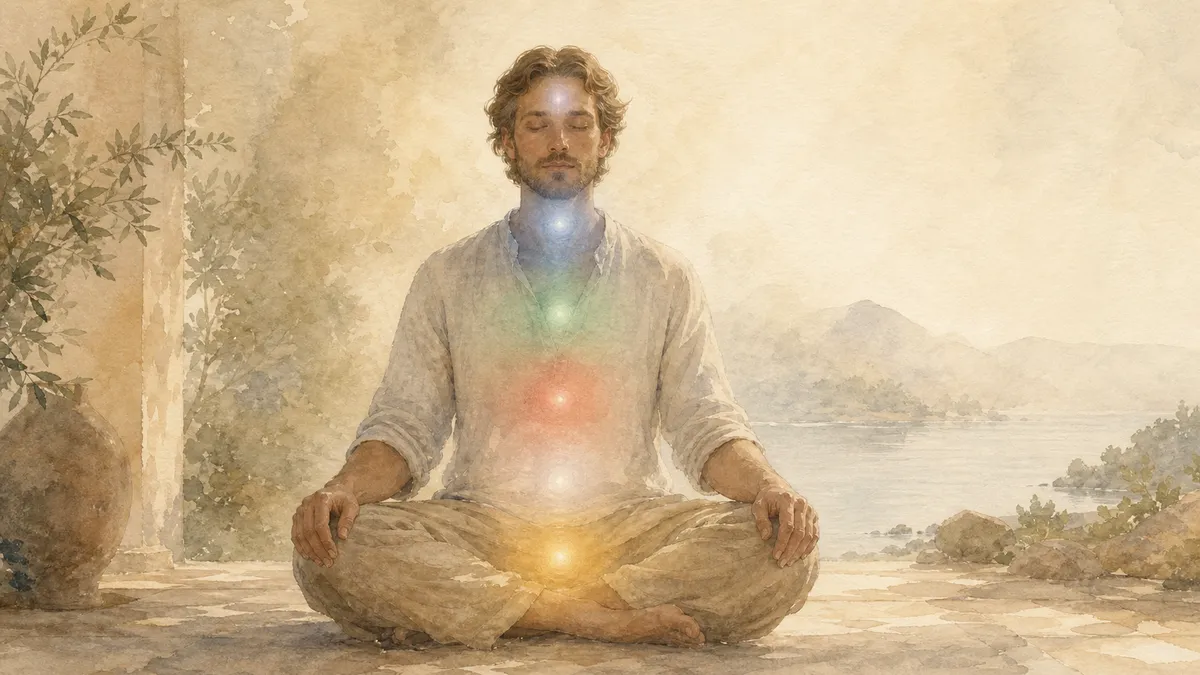
The yogi sees the circles associated with each element in the chakras:
when the energy is in the muladhara, he sees circles of yellow light or simply a yellow space
when it is in the svadhisthana, he sees white circles or a space as white as the moon
in the manipura, red
in the anahata, green or blue-green
in the throat, gray or blue
between the eyebrows, white, like a cloud-covered sky
Sometimes one may see syllables, the outlines of chakras, symbolic signs within the chakras, letters, hand mudras, and yantras. The colors may flare up one after another or almost simultaneously. Then the energy begins to press against the chakras with great force as it moves upward. Finally, it stops at the anahata chakra, in the throat, or between the eyebrows. As it accumulates, it creates intense pressure, so that a sensation of a churning whirlpool or funnel arises in the chakra. At this time, the yogi’s entire body seems to go numb, while his mind turns inward and enters the central channel. Then a sensation of spinning arises, as a result of which consciousness slips out of the physical body and finds itself in the astral body.
Leaving the Body in the Subtle Form
When this occurs, it already indicates a certain attainment in kundalini yoga and is called “initial samadhi of kundalini yoga.” Having left the physical body in the subtle body, the yogi looks at his reclining body from outside and then travels elsewhere, passing through a wall simply by thinking of where he wishes to go and concentrating on that place.
Sometimes, during this time, bands of various colors appear in the mind, indicating the colors of the yogi’s karma, the colors of his bardo, and the places of possible rebirth in the world of samsara according to the karma he currently has.
As the energy rises along the spine while he is lying in shavasana, he may see through the eyes of the subtle body bands of dull green, blue, silvery white, and red, like paths opening before him, each leading to a particular world. These colors may appear in the gaping void of black light. Then the energy will propel his subtle body out through the crown of his head. If at that moment he becomes interested in any color or vision, he will immediately find himself within it.

Visions of Pure Worlds
He may see a white light, and his mind will instinctively be drawn into it. There he will see himself standing in an illusory body in a radiant world flooded with light. In this world, he will be able to see, hear, and even touch his body and objects. If it is a pure world, he may encounter a deity, saint, or siddha and receive instructions, blessings, teachings, or transmission from them. Then consciousness will seem to waver, the yogi’s energy will also fluctuate, and his illusory body will appear to dissolve or be swept back into the physical body by some powerful current. Yet the yogi will fully retain the memory of where he was and with whom he communicated.
If at this time prana enters the central channel and the subtle body exits through the crown of the head, breathing becomes imperceptible and then disappears altogether. The heartbeat also slows down or stops completely.
These are the initial experiences that arise when the yogi’s channels have been purified and the energy awakens. To enter a deeper state of Light, the yogi must not only purify but also expand his channels in order to increase the amount of energy rising upward from the coccyx. He does this through pranayama techniques and practices such as chandali. When more energy rises to the crown of the head, the yogi’s entire worldview changes: not only does he experience a different state of awareness, but he also perceives the world differently, either energetically or through his vision. This is the next stage, which leads to the complete samadhi of the Light of kundalini yoga. We will discuss it another time.
Qualities Required of a Student Practicing Kundalini Yoga
Faith in the Teacher’s instructions and the sacred texts
The ability to undergo the trials given by the Teacher and to serve the Teacher selflessly throughout the entire period of training
Reverence for the Teacher and his senior disciples, sadhus, or monks
Following all instructions regarding sadhana, practice, and way of life
Youth, health, and vitality
A persistent desire to rid oneself of ignorance and the cycle of birth and death, and to attain liberation
Absence of arrogance and pride, the quality of an empty vessel, and sincerity
The ability to observe commandments, vows, and samayas
Humility, tolerance, the ability to live in harmony with others, and the abandonment of all worldly concerns for the sake of attaining liberation
Patience, kindness, friendliness, and compassion for all living beings, and refraining from harming anyone
Indomitable willpower, fearlessness, courage, perseverance in achieving one’s goal, a spirit of service to all living beings, the ability to master oneself and remain equanimous, fearlessness in any situation, and purity of thought

Lifestyle Requirements
The ability to preserve sexual energy and renounce sexual desire
Renunciation of sensual pleasures, coarse desires, and wasting time on entertainment
Abstaining from meat and fish, moderation in eating, and moderation in sleep
To preserve the mystical heat when practicing Kundalini Yoga, the yogin must continue to perform pranayamas or his meditations daily, without taking breaks in his sadhana. He must continue raising and lowering the fire through the central channel, avoid heat and the scorching sun, and not expose his naked body to direct sunlight, even in extreme heat. He should not wear overly warm clothing in freezing weather, blow out a fire or candle, or consume cold food or drinks. He must retain the vital substance within the body, preventing ejaculation while awake or asleep. He should not consume garlic, pepper, meat, or food that is excessively sour, salty, or fatty. He should not approach fire, sit by a fire, sit on bare ground without a mat, sleep during the day, walk barefoot, or do anything that causes sweating. He should not wash away sweat that appears during practice or work, especially during practice, but should rub it into the body. He should not insult or ridicule women.
To some, these may seem like requirements of good manners, but that is not entirely so. These requirements pertain not to morality but to energy. The point is that Kundalini energy is feminine energy. It is believed that by ridiculing or treating feminine energy outside oneself with disrespect, one thereby blocks the flow of Kundalini prana within one’s body, since the inner and the outer are interconnected.
To deepen the practice, one should practice for long periods without being distracted by worldly concerns. These are special rules.
Foods That Must Not Be Consumed
Sour, hot, pungent, salty, or bitter dishes, mustard, chili sauce, sour curd, meat, fish, garlic, onions, stale food, and overripe or unripe fruit. A yogin should always consume only sattvic food.
Preservation of Semen and Working with Desire
The next important matter is the preservation of semen, the white substance, bindu.
A yogin must strictly observe the yogic precepts and renounce sexual desire and lust. When lust arises, he must look deeply and clearly into the nature of desire and discover its source—primordial emptiness. Then the winds will enter the central channel, and desires will leave him. In other words, one must integrate with desire, bringing it into emptiness until it disappears. Such is the method of self-liberation.
If, however, the yogin is still an inexperienced practitioner, he should not attempt to liberate himself from desire by force of integration. He should renounce it by contemplating impermanence and the harmful consequences of losing energy. Many people overestimate their abilities, regard themselves as high-level practitioners trained in contemplation, and try to self-liberate desires instead of renouncing them or transforming them into something else. But genuine self-liberation of desire—leaving it exactly as it is, without evaluations or judgments, and uniting it with the space of awareness—works only when the yogin has become firmly established in contemplation and his mind can direct the pranas. At the initial stage, when the yogin is a beginner, this method is unsuitable.
If the yogin is trained in contemplation and self-liberation, his pranas and mind will never be seized by desires. A yogin who loses semen, the white bindu, will not attain signs of realization, no matter how many years he performs sadhana.
The worst kind of semen loss is loss during sexual intercourse, accompanied not only by the loss of semen but also by intense lust in the mind, when the remnants of contemplation are lost. This is the worst type because at that time both the gross and subtle parts of the semen are lost.
Types of Energy Loss and Their Consequences
The next type of energy loss during orgasm while awake is a situation in which desire is present, but due to experience, contemplation is not lost, although energy is still lost. This is a less severe type of semen loss, but it is also very harmful. At this time, the gross part of the semen is lost, while the subtle prana remains due to contemplation. Although the yogin’s awareness is preserved, his energy level declines and the channels become clogged. The yogin’s contemplation will deteriorate, and affairs around him will also begin to spiral out of control due to the loss of yogic power.
The next, less severe type of seminal loss is the loss of energy in dreams accompanied by sexual imagery. Subtle prana is not lost here, while the gross part of bindu is lost only to a small extent. And although only a small amount of energy is lost here compared with the first two types, the yogin should nevertheless learn to avoid it as much as possible.
The next type of loss is the loss of energy in a dream that is not accompanied by sexual imagery. Here the losses are even smaller. They occur because of the natural movement of energy and blockages in the channels.
The yogin should avoid all these types of loss, especially the first two, as much as possible. The requirements concerning them must be strictly observed.
Signs of Control over Energy

What happens when a yogin has brought the channels and pranas under control, purified himself to some extent, and awakened the energy through the practice of pranayama and meditation? He will feel that his body has become smooth and supple. The skin becomes smooth and lustrous, the face radiant, the eyes sparkle with joy, and the voice gains strength and melodiousness. The body becomes extraordinarily resilient, while the duration of sleep and the amount of bodily secretions decrease. Desires leave the yogin; he does not need much food or drink, and he hears the sounds of nada in his ears.
Question: “Why is it forbidden to walk barefoot?”
This is a mystery to me as well. This is precisely what I cannot explain. But that is what is written in the scriptures. I can explain why one should not lie on the ground. It is because the earth element becomes stronger, whereas kundalini yoga requires the wind element. Many pandits avoid sitting on the ground. It is believed that the higher you go, the easier it is for you to practice. That is, if you practice on a mountaintop, the elevation itself strengthens the wind element, the air, and therefore experiences arise more easily. But if you descend underground, on the contrary, the power of tamas increases. Mountains themselves are places of ascending energy. For example, if you want to increase the wind element, you need to climb a tree and live somewhere high up. Therefore, practitioners believe that it is auspicious to practice at an elevated place, while sitting on the ground, especially without a mat, is not very auspicious. But as for walking barefoot, no matter how much I searched the scriptures, I found no such explanations. It is probably also related to the strengthening of the earth element.
