The Direction of Energies and the Path of Non-Action to Divine Grace
24.10.2026
0 мин. чтения
0
Share
copy
search
add
share
In order for the teaching to be assimilated, we chant Om at the beginning and end: at the beginning so that it may be received, and at the end so that it may be sealed. Om is also a way to enter a state of awareness, cut off the restless mind, and open up the space beyond the mind. If you have any tension in your mind, you simply chant Om, relax into the vibration of Om, and remain for some time in presence beyond the mind, without evaluating reality but remaining aware; that is, it is a way to immerse yourself in your natural state, relying on the vibration of Om.
Om is the vibration of the Absolute itself. To chant Om means to attune your consciousness in unison with divine reality, with Satya-loka. We will begin with the “Songs of the Awakened One,” and then continue with a commentary on the “Tripura Rahasya.”
“Where and toward what should a yogin direct their energies?
One’s devotion should be directed toward the three treasures, encountering which is a rare good fortune for a being seized by Mara (ignorance).
One’s faith should be directed toward holy siddhas and a teacher endowed with realization, who is like a magic diamond that purifies other diamonds of impurities.
One’s love should be directed toward sinners enduring terrible torments in hells such as the forest of Shalmali and others, as well as in the worlds of pretas and animals.
One’s aversion should be directed toward samsara, the habit of remaining in ignorance, unconsciousness, distraction, and the obscuration of impure vision.
Anger should be directed toward one’s laziness, selfishness, pride, doubts, lack of faith, and dullness.
One’s prana of desire should be directed into the central channel, sushumna, skillfully working with the winds.
One’s diligence should be directed toward serving the forces of enlightenment and toward intensive practice in retreat.
One’s will should be directed toward attaining the fruits of the teaching and realizing signs of awakening, such as the sixteen phases of the moon, the three signs, the five spaces, the eight dhyanas, and others.
One’s mind should be directed toward uninterrupted contemplation of the root basis, the space of natural awareness.
One’s clarity should be directed toward attaining the realization of wisdom (jnana), which makes it possible to understand, “I am not this body,” and “My mind is like space.”
One’s irony and skepticism should be directed toward illusory dreams of worldly happiness in this dreamlike world.
One’s delight and joy should be directed toward the tree of Refuge and the precious Dharma.
One’s reverence should be directed toward the lineage of transmission and the Master.
One’s respect should be directed toward senior monks and experienced Dharma brothers and sisters.
One’s friendliness and sense of kinship should be directed toward the sangha (the holy community of samaya brothers and sisters).
One’s gifts should be directed toward making offerings to saints and deities.
One’s strength should be directed toward translating, printing, and disseminating sacred texts; creating images of great saints and gods; and building places for retreats and for yogins seeking immortality to live.
One’s wisdom should be directed toward explaining the subtleties of the Dharma teaching to beginners.
One’s pride should be directed toward the lineage of transmission and one’s school, taking pride in and admiring them.
One’s meticulousness should be directed toward observing the vows and commitments undertaken in one’s conduct, as well as toward regular sadhana.
One’s freedom and uninhibitedness should be directed toward the view, soaring in nondual vision beyond words like a free bird.
One’s fearlessness should be directed toward attaining the single “taste” by practicing in special places at the stage of tempering.
One’s playfulness, spontaneity, lightness, and flexibility should be directed toward all actions performed at the stage of letting go.
One’s humility and obedience should be directed toward honoring saints, siddhas, rishis, and deities.
One’s generosity of spirit and patronage should be directed toward those who practice the Dharma and need help.
One’s inner greatness, genius, transcendence, and mystery should be directed toward contemplating divine pride, which leads yogins to flawless realization.
O yogin, whatever you experience and undergo, direct it toward the root of the universe—the great king of natural awareness, full of grandeur, glory, and power, the one of whom even the great gods speak with reverence.”
“Songs of the Awakened One”
Instructions for a Beginner
“If vows and samaya commitments have been taken, they must be observed carefully and diligently.
If you have a Guru, you must regard him with pure vision.
If there is Dharma, it must be cherished as a magical jewel.
If there is kundalini, it must be awakened.
If there are chakras, they must be purified.
If there is an object of meditation, it must be held without distraction.
If there is a meditation posture, you should remain in it for as long as possible.
If there are winds and channels, they must be purified.
If there is bliss in the body, contemplation must be united with it.
If you have a mind, you must investigate its nature until you understand it.
If there is a sense of “I,” you must focus on it until it points to what lies beyond it.
If there is a precious human birth, it must be used for liberation.
If there are white and red essences, they must be united in the central channel.
If there is a sankalpa, it must be held one-pointedly in the mind, as though becoming it oneself.
If there are thoughts, they must be liberated in unconditional abiding in natural presence.
If there is a natural state, one must remain in it until complete awakening and the dissolution of the elements of the body.
If there are kleshas, they must be subdued like wild animals or bandits, and, having been placed on a chain, transformed into an ornament and play of the energy of the deities.
If there is a sangha, its rules must be respected and it must be regarded with pure vision.
If there are samaya brothers and sisters in the Dharma, they must be treated with love, care, and respect.
If there are other people, compassion and pure vision must be shown toward them without exception.
If there are examination tasks, they must be completed with honor and dignity.
If there are retreats, one must practice in them diligently and observe silence.
If there are sacred texts, they must be studied, rereading them again and again.
If there is egoism, it must be subdued and discarded like an unnecessary object.
If there are talents and abilities, they must be manifested only for the benefit of the Dharma.
If there is wealth, it must be used for the benefit of the spread and flourishing of the Dharma.
If there is monastic attire, it should be worn with dignity, honor, and reverence.
If there are senior monks, they must be treated respectfully.
If there is an opportunity to perform service for the Dharma, one should undertake it with joy and faith in the Three Jewels.
If there are secret methods of yoga, they must be thoroughly studied in samaya and practiced attentively and diligently.
If there are family, a home, and a spouse, harmonious relations with them should be maintained, awakening in them faith in the Dharma and reverence for the saints, so that there are no hindrances or obstacles.
If one has the status of a monk, one should behave appropriately in order to awaken the laity’s faith in the Dharma.
If there are thoughts, one should investigate their empty basis—the natural mind—and, relaxing, not worry about what has been or what will be.
If there are pranas, they must be introduced into the central channel by skillful methods.
In general, whatever there may be in your life—important or otherwise—you should do it as Dharma commands, and then you will undoubtedly attain freedom.”
“Songs of the Awakened One”
Commentary on the text “Tripura Rahasya”
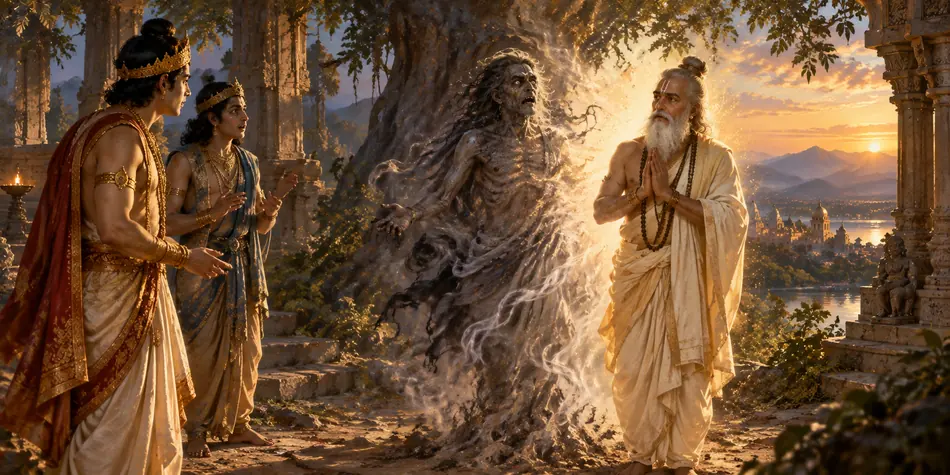
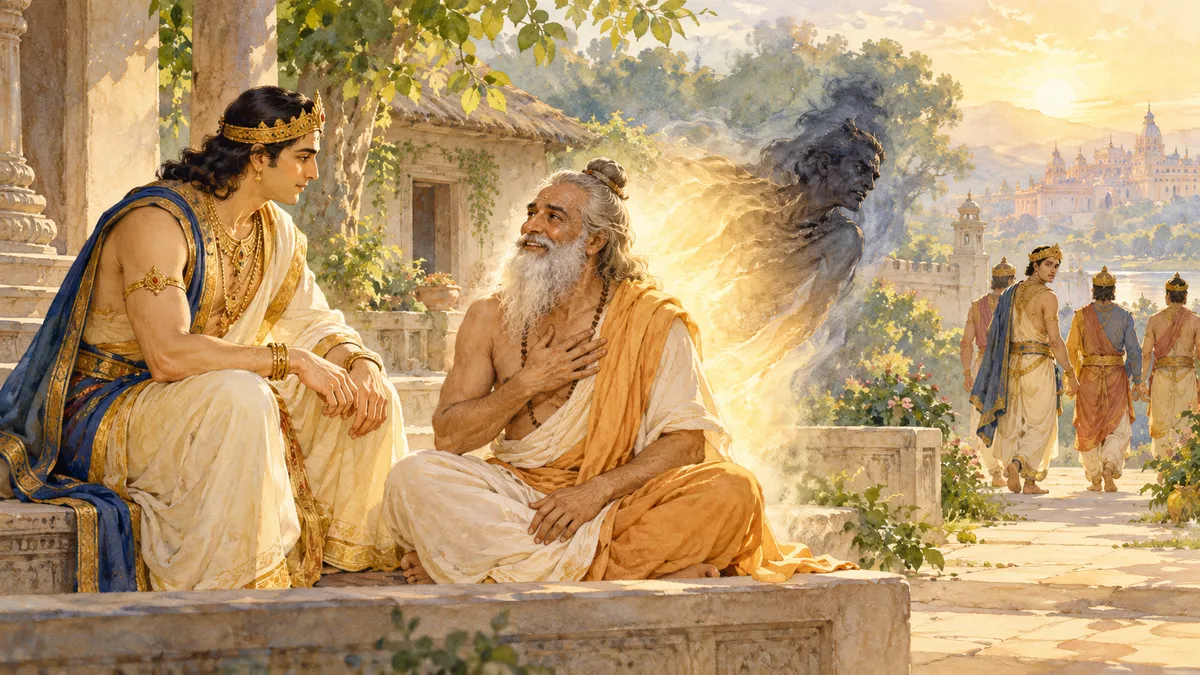
We continue with the text “Tripura Rahasya” (“The Mystery Beyond Duality”), Chapter 21, “On Attaining Wisdom, Its Nature, and the Treasure of Knowledge Contained in the Sacred Scriptures,” in which the prince converses with a brahmarakshasa, answering its questions.
The Principle of Santosha—Contentment
The Spirit asked:
— Who is this God, and what does devotion to Him mean? Who are the sages?
The prince replied:
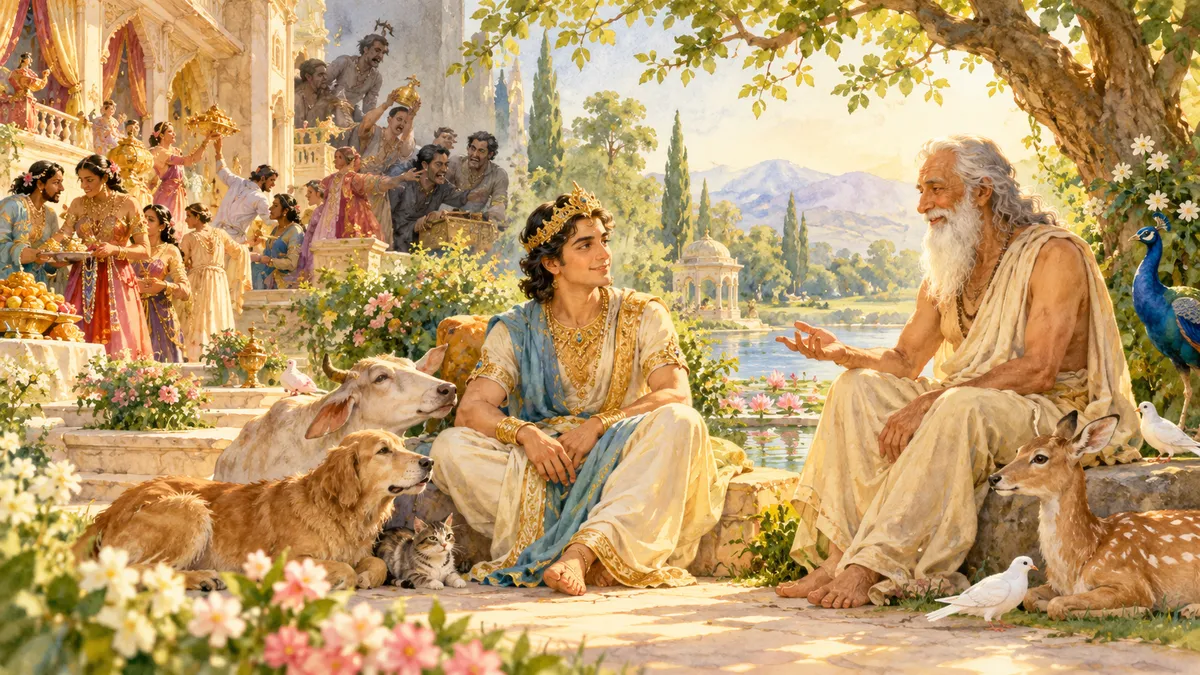
— God is the Lord of the Cosmos. Devotion is unwavering love for Him. A sage is one who abides in supreme peace and is filled with love for all.
The Spirit:
— Who is always in the grip of fear, who is in the grip of suffering and misery, who is in the grip of poverty?
The prince:
— A person possessing immense wealth is held in the embrace of fear; suffering and misery are found where there is a large family; and poverty is insatiable desires.
The Spirit:
— Who is fearless? Who is free from misery? Who never lacks anything?
Poverty is insatiable desires. There are the principles of yama and niyama, one of which is santosha (contentment). We must understand how to apply this principle in our lives, how to be content with what we have, not ask for more than necessary, how to change the direction of our desires toward the desire for liberation—from the desire for material things to the desire for liberation. The desire for material things leads to a material result; together with the desire for material things comes the desire to be reborn in the next life, to receive a body and once again have a material incarnation in material life.
All this occurs through the six transformations of the body: birth, growth, development, preservation, decay, and death. Thus, the desire for material things is always connected with suffering, because the material world itself, the samsaric world, is fundamentally disharmonious, because the material world itself is a kind of trap for the soul, a black hole into which it was sucked through carelessness. It is not intended for enjoyment; it is intended for the purification of karma, for becoming disillusioned with samsara and seeking spiritual awakening.
But in the beginning, it does not seem so, and at first a person enters life full of hopes for material things. He finishes school, and it seems to him that his whole life lies at his feet, that the whole world lies at his feet; he has enormous ambitions and enormous hopes, and society encourages this. But then some time passes, and he understands that the whole world is not at his feet at all. Many times, having become disillusioned with samsaric life, the soul begins to seek another direction for applying its desires; this other direction is Dharma, the path to liberation.
Santosha means that we must find inner contentment and get rid of dissatisfaction. Dissatisfaction does not arise from material things but from ignorance, and only knowledge can eliminate dissatisfaction; therefore, there is a principle: do not ask for more than necessary, be content with little. This principle will help turn our consciousness toward the search for God. When we ask a lot from the Universe, we should expect the Universe to ask a lot from us as well. When we want things, are dissatisfied, and ask a lot from the Universe, it means that we are spiritually poor; there is nothing inside us, and we need something from outside.
On the contrary, when we ask for nothing, we are very rich. No one has ever seen a Gazprom shareholder come and ask you for something; he needs nothing from you. Even on the material level, no one has ever seen a deity come and say, “Give me something.” The deity will say, “What do you want?”—if you invoke it through tapas.
Once, a saint was performing tapasya so intensely that Shiva and Parvati noticed him. At the same time, he was working somewhere, stitching shoes and leather goods, and they decided to bless him. When they came, they said: “You have recited mantras and prayed so diligently, and become such a righteous person. We would like to do something for you, to bless you.” He was in complete vairagya and thought that he had no desires. Shiva and Parvati said: “We cannot leave without blessing you” — the appearance of a deity is always accompanied by a blessing. Then he said: “All right, make the thread pass through the needle by itself, and I will continue sewing.”
When a sannyasin in India, during the time of Alexander’s conquest of India, was simply lying in the dust, King Alexander came to him, spoke with him, admired him, and said: “What can I do for you? What can I give you? After all, I am not an ordinary person — I am a king.” The sannyasin said: “Please move aside; you are blocking the sun — that is all you can do for me.” This is santosha (contentment).
From Dissatisfaction to Divine Joy
The cause of human suffering is that a person does not seek this contentment within and does not begin yoga with santosha. They are dissatisfied in worldly life, and even in spiritual life they go through dissatisfaction — this is the wrong path.
Dissatisfaction in worldly life drives one to seek more and more wealth, more power, more strength, more fame, more success, more and more — and there is no end to it, because its source and cause are unclear. Dissatisfaction in spiritual life prompts one to read one book after another; in principle, this is a good thing — we should begin with dissatisfaction with samsara, but we should not remain dissatisfied forever.
In order to eat, one needs a healthy feeling of hunger, but when you eat, the body must become nourished, and as spiritual practice progresses, dissatisfaction should be replaced by devotion, love, and self-surrender. If dissatisfaction with spiritual life persists for a long time, we apply one method, then another; turn to one Guru, then another; read one text, then another; practice one meditation, then another — but we still have not drunk from the source. Yet when you meet a Guru who is content, and encounter a teaching capable of liberating the mind, such contentment begins to arise within you. This is not laziness, complacency, self-admiration, or slackening — it is the feeling that you have found the right direction.
You may not be enlightened or liberated, but you have understood the right direction, and dissatisfaction is replaced by faith, devotion, and joy. From santosha we move onward, to ananda (joy), to deepening the divine presence; from ananda — to maha-ananda. A holy sage is not someone who weeps in terrible dissatisfaction: “When will I know God? When will God reveal Himself to me? When will I attain samadhi? When will kundalini untie the three knots and all the chakras, rise to the sahasrara, and the breath stop?”
A saint is one who dwells in the greatest joy, the greatest bliss, and the greatest ecstasy every second; one who drinks the nectar of God and is always completely satisfied every second, with no dissatisfied thoughts such as: “When will I be recognized as a great Master? When will I be recognized as a great yogi? When will I be recognized as an authoritative sadhu? When will I be recognized as an authoritative monk? When will I be recognized as a respected layperson? When will I receive the recognition I deserve? When will I be noticed? When will I finally begin to fly in the subtle body?” An unsatisfied mind asks these questions.
The mind abiding in ananda frees itself from “when”; it says: “Now — there is no more ‘when’; there is no more time.” Bhagavan Shri Rajneesh was once giving darshan in India when he received a note: “I have been listening to you for ten years, three hours every day, but when will this happen?” He replied: “Not when, but how.” This is not a question of time; it is a question of understanding how, in this very second, to direct the mind, remove the mind, enter a state beyond the mind, and direct it toward the Supreme Source.
But first we accustom ourselves to santosha (contentment), so as to be satisfied with little, to have no ambitions of the mind, to accept what is, and always direct our mind toward God. Dissatisfaction means that we do not have a meditative perception of life, because any meditative perception of life, in any case, gives us this contentment. But contentment is not something at which we should stop; it is only the beginning, when we have simply become normal—being dissatisfied means being abnormal.
Contentment is simply normality: a normal sadhu without ambitions, without pride, without claims, without self-admiration, benevolent, pure, harmonious, empty—this is the most normal, sattvic, most ordinary state; there is nothing complicated about it. But from here we can make a great leap toward great joy, great bliss, and great wisdom, because this is the point from which all of that becomes possible. Contemplation of the natural mind, the natural state, begins with contentment.
This contentment must not be artificial or feigned, when we engage in a kind of autogenic training: “All right, I am content, I am satisfied, everything is fine with me,” while inside we are trembling like this. “I am satisfied, I am content”—these are all games of the mind; this is not how we make ourselves content. True contentment comes when we find the source beyond the mind and understand that everything is contained in this source, and that it is so close, right here, that we can drink from it again and again. What we are seeking is contained in this source, and this source is divine; we simply need to turn toward it and accustom ourselves to drawing nourishment from its rays, its blessings.
A Christian monk or priest came to me who had lived as a hermit for eighteen years, living in a hollow tree. He said, “My mind is still not content.” He had been shot at twice in hot spots, where he preached—a man of extreme character who lived in such ascetic conditions, such a genuine sadhu, yet his mind was still not content, because there is a desire, there is one who desires, but there is no understanding of the one who desires, the source of all this—and that source is God. We must discover God and begin to rely on Him completely; this is where true contentment grows, the path toward receiving divine grace (Anugraha).
Even after embarking on the spiritual path, we often want many things, whereas the point is not to want many things but to want only God; this very one-pointedness will cut off other desires, but this desire must not be selfish.
Discovering Non-Mind and the Great Non-Action
The ghost asked:
– Who is fearless? Who is free from poverty? Who never needs anything?
The Prince:
– A person without attachments is free from fear; a person with a disciplined mind is free from suffering and poverty; a self-realized person never needs anything.
The ghost asked:
– Who is the one beyond people’s understanding, and who is visible although he has no body? What is the activity of the inactive?
The Prince:
– A person liberated while alive is beyond people’s understanding; he is visible although he does not identify himself with the body; his activity is non-action.
Contentment leads to the turning of the mind and consciousness toward non-mind. When we discover non-mind, we begin to value the awareness of non-mind as the feet of God.
A person liberated while alive is beyond people’s understanding; he is visible although he does not identify himself with the body; his activity is non-action.
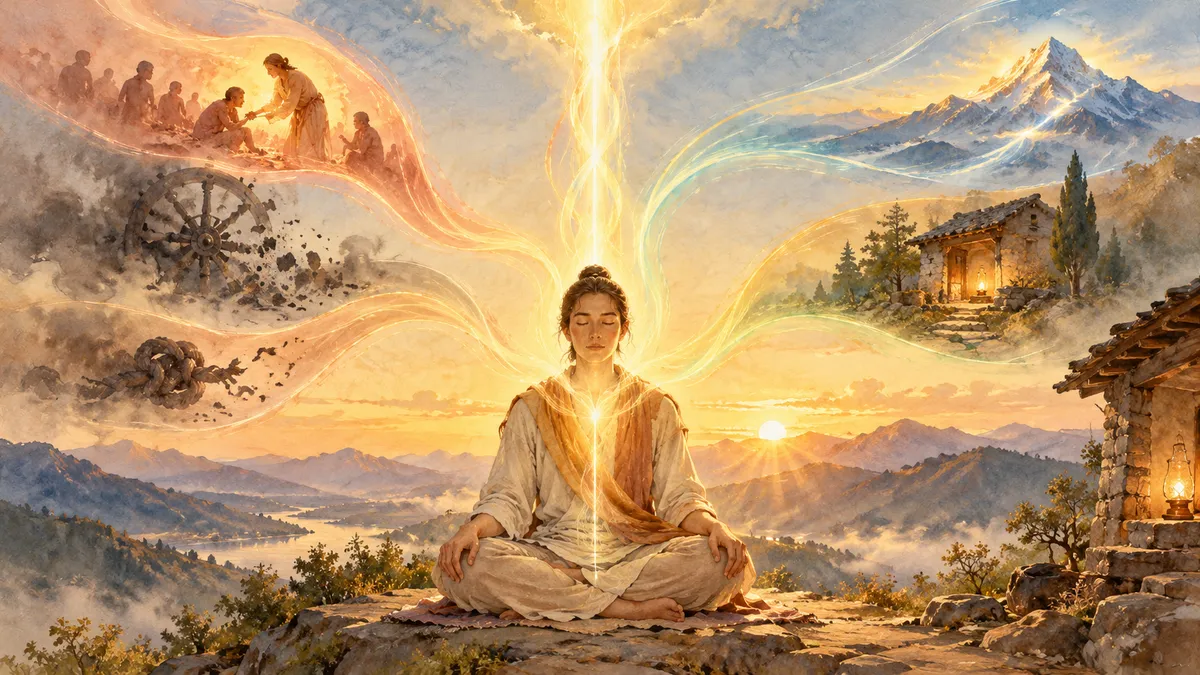
When we discover non-mind, action and non-action gradually become equal. In the life of every yogi, there comes such a moment, a point of decision, when we decide to enter the great non-action, when one day we stop and say to ourselves: “Stop, I do not need to do anything; I have already done everything. Whatever I do from now on, let it happen spontaneously, like a game, but it will not be I who do it; let it happen through me, let it be lived through me, but I myself will not participate in it. Let it happen involuntarily, as breathing, sneezing, blinking, and digestion happen.”
In such things, there is no “us” as the doer, no deliberate action; it happens by itself. But we make a decision: “I myself will not do this; I myself will be the one who is aware.” Such a point of decision is called entering into great non-doing. When we stopped, breathed in, and said: “I do not need to do anything in the external sense.” Such an entry into great non-doing must necessarily be preceded by discovering the nature of the Mind. Entering non-doing without discovering the nature of the Mind, without seeing God, is in a certain sense useless: we will simply lie down on the sofa and lazily fall asleep.
Making the decision for great non-doing is necessarily accompanied by discovering the nature of the Mind, abiding beyond the mind, abiding in a state of contemplative presence. The power of this presence is such that it is more important than any actions, and any actions against its background appear meaningless, even absurd, if they are still performed from the ego, from attachments. They may occur, yes, naturally, through the body or mind, but we can no longer act as before, from a state of unawareness, because a state of awareness does not imply the presence of an acting ego, a doer, or a passionate striving to obtain fruits and results. In a state of awareness, there is no karta (the doer) and no kartritva-buddhi (the consciousness of the doer) — this is a state beyond the mind.
Abiding in God
This is not our state; it is, so to speak, God being experienced through us. There is no doer in God, no one doing anything; God does not need to do anything, and God does not need to be purified through mantras, visualization, or rituals. God exists by Himself; we cannot do anything to Him, nor can we improve Him or somehow polish Him. God exists beyond our efforts; we cannot improve Him through meditation, pranayama, concentration, or even through samadhi lasting millions of years.
God exists beyond our knowledge of Him, beyond our knowledge of Advaita, Vishishtadvaita, or Dvaita, beyond the interpretation of sacred scriptures. We cannot do anything at all when we abide in God. God is not becoming, not action, not fruits, not results, not motivation — it is pure being beyond everything, in which, if it can be described in words, there are sat-chit-ananda, satyam, shivam, sundaram (truth, beauty, bliss).
When we renounce action and make the decision to abide in great non-doing, we coincide with the state of God; we apprehend it and understand that we simply need to remain in it. It is as if we have climbed Kailash, the highest pass at five thousand eight hundred meters — where else could we go? We cannot go anywhere else, we cannot jump any higher; we are at the highest point. Nididhyasana consists in growing into this state, deepening it, and abiding in it without a sense of doership, selfish motivation, or desire.
Transition to the Divine Path
This does not mean that this is some kind of summit or limit, or that we have attained everything — not at all. It means that the vector of our spiritual life turns toward the Divine Path (divya-marga), that manushya-marga (the human path), based on the ego and the doer, has ended, that our misguided, clouded spiritual path has ended — we can congratulate ourselves. Divya-marga (the right spiritual path) begins: great joy, great freedom, great spontaneity, great bliss, great wisdom; everything begins to unfold from this point of non-doing.
At last, we have become normal sadhus, seen the feet of God, begun to hold on to them, and begun to walk the normal spiritual path of all saints — in other words, we have somehow joined the company of saints. Perhaps we are at the very bottom of this company, but we are nevertheless already part of it. We are no longer walking in circles; even if we are at the very bottom, we are in this company, and we have seen the feet of God.
Divya-marga on the spiritual path means that we walk the path of non-doing, the path of self-surrender, liberation, divine presence, faith, and devotion; the doer has disappeared for us, dissatisfaction has disappeared, and each day we grow more and more deeply into joy, ananda, and the realization of the Divine.
Divine Grace
This is the moment when divine grace (Anugraha) begins to pour forth; it cannot pour forth earlier. Or rather, it is always pouring forth — for it there is no yesterday, tomorrow, earlier, or later. It is like an eternal heavenly stream, but we can be either open or closed.
We cannot become open to divine grace (Anugraha) before we enter contemplative non-doership, before we make this decision and stop feeling that there is doing, a doer, a sense of ego; therefore, one who has entered non-doership sees the feet of God and always bathes in divine grace. What choice does a sadhu have here? Either he bathes in divine grace and dances in ecstasy, or he does not.
Sometimes, when someone comes to me, they say something like:
– There is this problem, and this is happening with that.
I say:
– No, that is not the problem; you have one problem.
He says:
– Many problems.
I say:
– Few problems; there is only one.
– Which one?
– You are not dancing in ecstasy from divine grace—that is all. There are no other problems.
The so-called problem is not a problem. There is no divine grace—that is where all problems lie. Divine grace can come to us, but only if we are in a sufficiently empty, sufficiently pure, open state; if we have removed the ego; if we are ready for surrender, self-surrender (prapatti); if prapatti yoga is able to take place. If we trust God, the Divine, so completely that we can entrust all problems and concerns to divine grace.
Sometimes, when seemingly insoluble problems arise, I say: “Brahma created this Universe, so let him solve it—it is his Universe, not mine. He is very wise and intelligent; he will sort it out. My concern is to remember him.” The principle of contemplative non-doership means that we understand our true concern; our true concern is to remember God and be in God. Everything proceeds well from this remembrance: events occur, the mind functions, actions are undertaken without a doer, and everything happens.
Liberation
The ghost asked:
– What is real? What is unreal? What is inexpedient? Answer these questions, and you will free your brother.
The prince:
– The subject, or reality—that is, the supreme Essence—is what is real; the object, that is, non-essence, is what is unreal; worldly affairs are inexpedient. Now I have answered your questions. Please free my brother immediately.
When the prince had said this, the ghost gladly released Rukmangada and itself turned into a Brahmin. Seeing the figure of a Brahmin filled with determination and tapas, the two princes asked him who he was.
– Once I was a Brahmin from Magadha. My name is Vasuman. My learning earned me fame, and I was known as an invincible debater. I was proud of myself and sought out those learned pandits who enjoyed royal patronage. Among them was a great saint, perfect in wisdom and completely absorbed in the supreme Essence. He was known as Ashtaka. I went to him out of my love of debate; although I was merely a logician, I argued against his assertions concerning self-realization, simply overwhelming him with the force of my polemics. He supported his arguments with numerous quotations from the scriptures, but since I wanted to win the laurels of victory at any cost, I continued to refute his assertions. Realizing that I was incorrigible, he stopped speaking.
However, one of his disciples, a descendant of Kashyapa, was angered by my insolence and cursed me before the king, saying: “You sorry excuse for a Brahmin! How dare you refute my teacher’s assertions without even trying to understand them first? May you turn into a vampire ghost and remain so for a long time!” I trembled with fear at the curse and sought refuge at the feet of the sage Ashtaka.
Always immersed in the supreme Essence, he took pity on me, even though I had just been his opponent in debate; and he altered his disciple’s curse, uttering its concluding part as follows: “May you regain your former form as soon as a wise man gives appropriate answers to all the questions that were asked here by you and to which I gave answers, but which you rejected through your polemics.”
– O prince! Now you have freed me from this curse, and therefore I consider you the best among men, one who knows everything concerning this life and the next.
The princes were astonished by this story of his life. The Brahmin asked Hemangada several more questions, and after that he attained even greater enlightenment. Then, having bid farewell to the Brahmin, the princes returned to their city.
– Now I have told you everything, O Bhargava!
Thus ends the twenty-first chapter about the episode with the ghost-vampire in the “Tripura Rahasya.”
Guru
Dharma
Anugraha
Mindfulness
Non-Action
Ego
Tripura Rahasya
Santosha
Doer
Songs of the Awakened One
Author Гуру
Read 17 times
Articles
Vidya AI
Search
Lectures
November 1, 2026
Mantra of the day
ОМ НИТИМАТАМВАРАЙА НАМАХ ОМ Лучшему из нравственных – поклонение!
Auspicious Times(Rome)
Brahma Muhurta:
04:52 - 05:47
Abhijit Muhurta:
11:33 - 12:14
Sayam Sandhya:
16:45 - 17:27
Mokshada Ekadashi (6 November)
Ekadashi of liberation. Helps to achieve spiritual enlightenment.