

Commentary on the text “A Conversation Between Papaji and Chökyi Nyima Rinpoche”
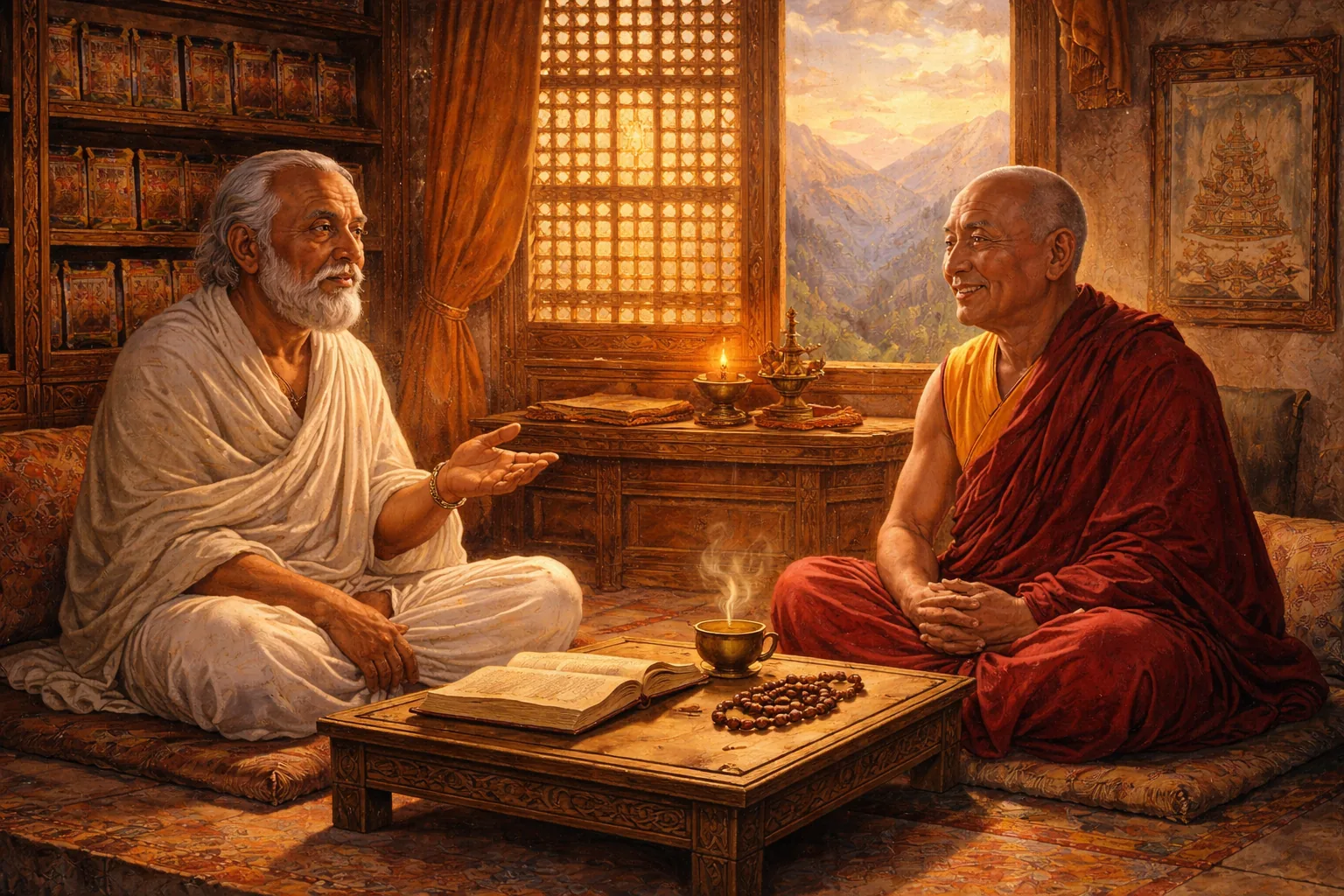
This is a recording of a conversation between Papaji and Chökyi Nyima Rinpoche, made in 1993.
Rinpoche: We all have a common goal. We are moving in the same direction. This is the direction toward which everyone is oriented.
Papaji: I don’t think so (laughs).
Rinpoche: Why, why do you disagree?
Papaji: Because directions do not exist. There are no directions. Any direction leads into the past.
This is a very rare dialogue, where representatives of Hinduism and Buddhism communicate. And here Rinpoche embodies relative wisdom, or method, while Papaji is the flawless self-liberating nondual view. And such a play unfolds between them. Rinpoche says that what we practice comes from one direction, that all religions are oriented toward this. But Papaji says that this is not so, because in the absolute sense, even speaking of directions is an illusion.
Speaking of directions makes sense in the relative dimension, where there is east and west, north and south, zenith and nadir, past and future, as well as someone who goes in a certain direction. But when we touch the essential space of the heart, the question of directions falls away. In order to have an idea of directions, one must adopt the point of view of a subject. We say that the absolute mind is beyond fixations, beyond points of view.
Rinpoche: But directionlessness is the right direction.
Papaji: Directionality is...
Rinpoche: The right direction (they laugh).
Papaji: I have eliminated all directions. Directions imply that there is a starting point, a goal, and a path along which one moves in some direction: north, south, west, or east. These are all mental concepts. I have discarded concepts. Concepts are the past, and the past is connected with the mind. Distance and directions are in the mind, so I do not give the mind any direction. If you give it some kind of directionality, it will drag you into a cycle lasting thirty-five million years. All statements arise from the mind. They consist of mind. Even the phrase “I am free from the mind” is mind.
Why are they laughing? It would seem that disagreements arose between them at the beginning. It seems as if they are arguing. But in fact they have no disagreements at all. And this dispute is merely a clarification of common positions. For example, if Papaji were communicating with some representative of the Orthodox Church or Catholicism, a very heated argument would surely flare up between them, because someone who clings to concepts and ideas cannot recognize the essencelessness, the self-liberated nature of concepts.
But when both masters are established in the nature of Mind, they understand that concepts have no significance, since they express relative truth, and relative truth is always subordinate to absolute truth. Papaji says that he has discarded concepts, since concepts are connected with the past, and the past is connected with the mind. Distance and direction are in the relative mind.
When we speak of the absolute mind, there are no directions whatsoever. Papaji says that if one enters the illusion of duality and gives it certain directions, then it will again drag on for thirty-five million years. And here Rinpoche agrees and adds: “Thirty-six million.” That is, their dispute is a kind of show for others. In fact, there is no dispute, since they hold one point of view; their realization is equal.
That is why it is said that if you dip your finger into one point of the ocean, it will be salty; if you dip it into another point, it will also be salty. Their realization is the same, but they simply adopt certain points of view and, as a practice of play, enjoy them.
Rinpoche agrees that if you accept some illusion, it will again turn into a huge cycle of samsara. And it does not matter how long it lasts: thirty-five or thirty-six million years.
Atman
Papaji: All statements arise from the mind. They consist of mind. Even the phrase “I am free from the mind” is mind.
Rinpoche: Yes, whatever a person asserts, it comes from the mind. To assert something is the nature of Mind.
Here one should understand which minds are being referred to. We must sort this out clearly.
There is the conceptual mind (manas), and there is the Supreme Mind, Atman. In Tibetan they are also called sems and semnyi. The conceptual mind is what we operate with; it is concepts. The Nature of Mind is infinite consciousness; it is that from which everything emanates. In reality, one mind and another do not exist, since it is a homogeneous substance, but in the duality of relative vision such points of view are nevertheless accepted.
From the point of view of yoga, the conceptual mind is everything that constitutes the ego; therefore, in generalizing, they say: “All this is ego.” Ego and mind are one and the same. If we examine this question in more detail, the relative small mind can be called:
- ahamkara (the false sense of “I”)
- manas (the mind that accepts and rejects)
- chitta (the storehouse of mental impressions of the past, memory)
- buddhi (subtle intuition, creative intelligence)
This small mind forms the idea of self-existence, that is, it has an idea of its own continuity, the idea of “I” as a separate being. It is like a bubble on the surface of the ocean or a wave. It is mainly based on collective memory, on past impressions. The conceptual mind usually accepts and rejects, evaluates this or that, guided by past impressions. For the conceptual mind, the superficial manas, what corresponds to its old, previously assimilated fixed ideas is good, and what does not correspond is bad for it. All of this together constitutes the ego — ahamkara, the illusory sense of “I.”
When a person’s consciousness gets bogged down in the conceptual mind, oriented toward previously absorbed ideas, he does not feel the great light of Atman that stands behind all this, because he rigidly clings to these concepts and logical schemes. In order to enter the nondual mind, we must overcome concepts. That is, we must feel our way toward a subtler consciousness that is not bound by them, and understand where all concepts come from.
Rinpoche: To assert nothing is also mind.
Papaji: Yes. The notion “I am enslaved” is formed by the mind; the idea “I am free” is also a product of the mind.
Rinpoche: Of course.
Papaji: “I am enslaved” is the same as “I am free,” because bondage and freedom are interconnected. They have common roots. These roots grow from somewhere. But from where? One must look at the roots, at their Source — at the Source of the concepts of mind, freedom, and bondage. One must behold the root. If we see where it comes from, if we reach the root, then there will be neither bondage nor freedom.
The idea “I am liberated,” the idea “I am bound” come from a more global idea — the idea of the self-existence of “I,” that is, the idea of the sense of “I” as such. At the basis of any ideas lies the main idea, based on ignorance, that is, the idea that “I” is “I.” This is the idea of Aham Vritti. All other ideas are a modification or branching of this first idea. If we had not been caught by this illusory idea, we would not have had to bother with more ramified ideas. One can say that the first ignorance arises at the moment of identification with aham-vritti.
Osho has a story about how the police were dispersing a crowd of communist demonstrators. One man was standing aside and watching this. A policeman also came up to him, shoved him roughly, and told him to get out of there. The man said: “But you are dispersing communists, and I am an anti-communist.” The policeman looked at him and said: “I don’t care what kind of communist you are. Get out of here.”
It is something like that. Regardless of whether you have the idea of bondage or the idea of liberation, this idea still proceeds from the fact that there is you as a subject, as a person who needs all these ideas. Samsara and nirvana are also ideas perceived by a certain subject. As soon as we get to the subject, all other ideas begin to fade within this idea of the subject. But when we discover the nonexistence of the subject, other ideas, such as samsara, nirvana, life, death, suffering, pleasure, and so on, are automatically liberated as well.
Papaji: That is why I say: you are already free, already free.
Rinpoche: In Tibetan we call this rootlessness and groundlessness.
Papaji: Any language is a ground. But that which is beyond language, that of which I speak, is not accessible to language.
You are already free. Of course, it would be naive to think that our bound mind is already free. It has limitations in a relative sense. And if you simply say to yourself, “I am free,” it will not make things any easier for you. Nevertheless, in the absolute sense, even this relative mind, which thinks it is bound, is still an expression of the absolute mind. And when Papaji speaks, he is speaking of the absolute mind.
He says that your absolute mind is already free, that you need only acknowledge the fact of your liberation, turn your attention to it, look at it intently, and completely reassess your position with regard to the “I.” You must stop considering yourself bound, stop considering yourself a separate person, a separate karmic being, and acknowledge the fact of your liberation simply by shifting the focus of perception into the state of that which is already free. When we acknowledge it in this way, all relative bonds are untied in an instant.
Even if we hear this, it is not easy to believe it. For example, if a peasant is told that he is actually the offspring of a noble family, it is difficult for the peasant to believe it, because the habits of the lower classes have become too deeply ingrained in him. And in doubt he thinks: “Am I really the offspring of a noble family?” But suppose he has an elder brother who knows their true lineage well, and he convinces this peasant again and again: “You must believe in your noble nature.” But the peasant scratches his head and thinks: “How on earth am I to do that?” That is, he both believes and does not believe. Perhaps he dreams of riding like a lord, but his view of everything has to change far too much, so he does not even know where to begin. Nevertheless, his brother, the noble prince, constantly reminds him of his pure noble nature, says that they have one father, and if they are brothers, then the peasant too has a right to property, power, and so on. Over time, the peasant dispels his illusions and enters into full possession.
Beyond Words and Concepts
Rinpoche: Without words it is difficult to say anything, but I agree. Words are merely labels, something superficial.
Papaji: Therefore, if words are used, everyone will cling to them.
Rinpoche: That is so.
Papaji: And since everyone clings to words, it is better not to use them.
Rinpoche: That is precisely why the masters of the past did not use words, but only gestures, for example pointing a finger at the sky. There are no words with which one could point to the absolute truth.
Papaji: Yes, a word is like a finger pointing at the moon. People seize upon the finger and do not see the moon.
Rinpoche: Yes, that is true. The finger is only meant to help shift the gaze to the moon, but the moon is not the moon either.
Papaji: Let us abandon both, because both are words. Moon is a word, finger is also a word. But where did these words come from? Any words? From where do all words arise?
Rinpoche: A word is created by thought.
Papaji: Yes. Thought and mind are one and the same.
Because saints use words, many contradictions constantly arise, because people become accustomed to clinging to words, although in reality no contradictions exist. It is like one poet looking at a sunset and saying that it is crimson, while another disagrees and says that the sunset is purple, and their admirers then begin to argue about what the sunset really was. But this is a question of aesthetic perception or an artistic view of the sunset; it is not a question of its essence.
When a person has gone beyond concepts, he understands this clearly. If he has not gone beyond concepts, they have magical power over him. He gives them independent significance; they become convictions, imprints in his consciousness. Sometimes people are even ready to fight for concepts.
Rinpoche: Thought is a function of the mind.
Papaji: Good. In that case, thought will function only in the presence of “I.” Thought, mind, “I,” space, the past — all of this is one and the same. When “I” appears, everything appears: words appear, samsara appears, bondage appears, freedom appears. The main cause of all this is “I.” I am bound, I want to be liberated, I am looking for someone from whom to learn liberation, and finally, I am free. In each of these statements, “I” is still present.
At first it seems that we are learning various methods: theories, the structure of the universe, the structure of the chakras, methods of controlling the winds, and other things. But in the end, the learning process is revealed not as a process of bringing in something new, but as a process of removing what is superfluous. We are not learning how to bring something new into ourselves, but how to remove everything unnecessary; that is, it is a negative process. In fact, we are learning how to remove our illusory “I.”
In our monastery, a more academic scheme of training is accepted. In the tradition of the individual training of the mahasiddhas, a more direct system of training is used, connected with cutting through the knot of the ego. But ultimately they lead to one and the same thing. For example, training according to Tilopa’s method assumes that the teacher does not give lectures, but simply gives such tasks that, in the course of carrying them out, the disciple has to change his understanding through concrete situations. That is, Tilopa does not explain it like this: “This is manas, this is buddhi, this is ahamkara...”; instead, he simply places one in a situation where the ego, the “I,” must be cut off, where knowledge arises spontaneously. And at the end Tilopa also chants: “Give up the idea ‘I am the body.’” In other words, whatever type of training we follow, the idea lies in removing the illusion of “I.”
This illusion of “I” presupposes that we should learn to bring in something artificial. But the essence of training lies precisely in cutting off what is illusory. Therefore, the spiritual path of the higher paths, especially anuttara tantra, differs from training on the path of science, art, or anything else. There, mastery is always the development and bringing in of something new. But training on the path of the higher levels of anuttara tantra is not the bringing in of something new, but the constant removal of the old. The disciple may sometimes not understand this at first, but such is one of the most direct methods of the old masters.
A typical situation is when the teacher deliberately does not teach the disciple. He says: “You may walk here, eat, sleep, engage in certain service. The main condition is to remain here.” The disciple has spent so much time on the journey, hoped for training, and he is simply told to do this or that, without being taught any secret techniques. And so it continues for a month, two months, half a year, a year. Everything turns upside down in the disciple’s soul. He dreamed of how he would learn and derive benefit from it, but he sees that he is still learning nothing and has derived no benefit at all. He has learned neither to shake the winds nor to levitate; he still cannot shine before others with his knowledge and abilities. Then he thinks: “What am I learning, then? What am I spending my time on?” He becomes completely confused, not understanding the essence of such training. But the teacher knows perfectly well that in this way he is learning self-renunciation. That is, he is not learning something small and particular; he is learning to cut off the idea of “I” at the root. Particular knowledge is, one might say, shamanism, while the disciple is learning the most global thing — self-renunciation, going beyond the limits of “I.”
Finally, only when the disciple has realized the emptiness of the heart and understood this principle does he become acquainted with various methods connected with lower practices. He attains mastery, but this mastery is already based on nondual vision, on going beyond the limits of “I.” It is not at all what the disciple had supposed; it is much deeper.
On one of the websites devoted to magic, I read some remarkable lines: “At first, of course, the neophyte thinks that magic is a path of acquisition. But only an experienced practitioner understands that magic is a path of loss.” That is, magic in the true sense is the path of losing the ego, losing illusions, and renouncing duality. The teacher skillfully teaches how to lose what never belonged to you in the first place. What you have borrowed (the body, mind, ego, feelings, thoughts) does not belong to you. This means that you must give all of it up. In what sense? It is not that you must reject them, but that you must cut off clinging to all of this, that is, completely reorient yourself from the position of the possessor.
Papaji: This “I” is the mind itself. So how can the “I” be removed?
Rinpoche: The knowledge by means of which one looks beyond the “I” and comprehends its absence is called prajna. This knowledge—prajna—is the medicine for the “I,” for attachment to the concept of “I.”
The Path of Acquisition and the Path of Renunciation
Our school teaches two approaches: the path of acquisition and the path of renunciation. Training in contemplation is the development of prajna. Therefore, it can be said that we acquire something—namely, the art of awareness. Nevertheless, it seems to us that we acquire it only at the very beginning. In the end, this art of awareness grows into the discovery of what has always been inherent in us.
However, at first it is impossible to understand what has always been inherent in us, because it is tightly covered by the conceptual mind, the ego, and the layer of memory. Therefore, we say that we train in the very subtle art of the practice of contemplation; that is, we do not lose anywhere. In other words, you learn the mastery of contemplation, but this mastery of contemplation in itself leads to the illusion of the ego beginning to disperse. It can be said that you are in a more advantageous position compared with students of the old schools, who did not know what was going on until contemplation arose by itself in them as a result of cutting off. You are told about contemplation and all its stages in great detail; that is, you have no need to fall into confusion.
Realization of the Absence of “I”
Rinpoche: The “I,” the ego, is the root of samsara. If a person clings to the idea of “I,” duality appears: “I” and other. It is precisely because of the “I” that there are anxiety, enjoyment, karmas, and suffering. Therefore, the realization of the unreality of the “I” makes it possible to get rid of all misfortunes. To put it briefly, liberation, enlightenment, comes as a consequence of realizing the absence of “I.” And everything is exactly as you said: this knowledge is beyond thoughts and mind. There is a nature in which subject and object are absent in meditation. The realization of the absence of “I” cannot even be called meditation, because here there is no meditation on anything. Why? Because this is the natural truth, which is called suchness. It is present in everyone.
The realization of the absence of “I” cannot be called meditation. It is abiding in a state beyond meditation. It is called precisely this—the yoga of non-meditation. Meditation is required in order to give the mind the necessary direction. When you have succeeded in meditation, you should move on to non-meditation. Non-meditation differs from meditation in that effort and the concept “I am meditating” are eliminated. It can be said that this is a highly advanced stage of meditation, when meditation grows into sahaja samadhi. This means that which lasts naturally, by itself, without effort.
Such a saint, even while awake, is in the state of dreamless sleep. It can be said that this is a very clear, concrete state. That is, it is not some lightweight self-liberation characteristic of domestic Advaitists who have read too much Ramesh Balsekar, but truly a very deep state. It is like abiding, while awake, in the state of dreamless sleep. That is, you perceive everything, but your mind functions differently. If the waves of your brain were scanned, they would correspond to the waves of a sleeping person.
Scientists measured the wave activity of one saint’s brain. They said, “This cannot be! The wave activity of your brain corresponds to the activity of a deeply sleeping or dead person.” The saint said to them, “I really am dead.” The scientists were astonished: “But that is impossible! You walk, you talk.” The saint replied: “All this happens as a result of the activity of the functions of my body and is carried out automatically in accordance with the remaining karma. But my ‘I,’ with which people usually identify themselves, disappeared long ago, and therefore I do not consider that I am doing anything.”

Nature Is Beyond Thoughts
Rinpoche: If we bring into our life this nature, which is already here, then it itself will become the method of enlightenment. It is, in itself, the nature of all things. Thus, it does not matter whether an enlightened being has come into the world or not, whether an enlightened person teaches or not. The nature of all beings is one. As you said, this nature is beyond thoughts. So what is it like? If it is beyond thoughts, we cannot find words to describe it.
Papaji: I will tell you (laughter). His Holiness speaks of knowledge. Knowledge first of all implies the presence of a knower, knowledge, and an object of knowledge. The knower, the known, and that which is knowable. So who is the knower? There must be one who knows, who receives knowledge. And since there is knowledge, it is from the past.
Rinpoche: There are two kinds of knowledge. Ordinary knowledge is knowledge connected with the knower, the known, and the act of knowing.
Papaji: Yes.
Rinpoche: But there is also transcendent knowledge — prajna paramita. It leads beyond duality.
Papaji: So there are two kinds of knowledge?
Rinpoche: Yes.
Rinpoche here embodies the relative vision, the scholarship of Tibetan Buddhism, where absolute truth and relative truth are clearly distinguished. In ordinary life we must understand that there is relative truth and absolute truth. In absolute truth there is only non-duality: there are no men and women, laypeople and monks, hermits and avadhutas, teachers and disciples, those who are higher and those who are lower, heavens and hells, enlightened and unenlightened, there are no concepts of causality, time, and space. In absolute truth everything is originally perfect. And when we speak of the natural state, the connection with the Supreme Source, we must always orient ourselves toward absolute truth, toward the view. When, however, we adopt the relative view, we say that there are elders and juniors, men and women, pure and impure, monks and laypeople. Depending on the circumstances, we can adopt one point of view or the other.
Papaji speaks here from the standpoint of non-duality.
Beyond Concepts
Papaji: Well then (he moves apart the glasses of juice standing on the table). Here is one kind of knowledge (he points to one glass), and this is another kind of knowledge (he points to another glass)? Here we have one and two. Where there are two, there is illusion. Both the concept of one and the concept of two came from the past. Are there two kinds of knowledge? Let us remove one glass (removes it). Let us remove the other (removes it). Now, nothing remains. One can say “one” only in relation to the concept of “two.” One is also a concept. If these concepts are eliminated, nothing will remain. There is no concept of either one or two.
Rinpoche: That is true. Everything is exactly so. One concept is always connected with another.
Papaji: With your permission, I will continue. What I am speaking about is emptiness. If there is neither this nor that, then emptiness remains. And in it the “I” ceases to exist. As soon as knowledge appears, the “I” arises. But in emptiness there is no “I.” One should not give names to different kinds of knowledge, because these kinds of knowledge are nothing other than ignorance.
Rinpoche: What you have said is correct. But we simply call by the word “prajna” (highest knowledge) the state in which there is no knower and known.
Papaji: Correct. This is called prajna. Prajna is transcendence. That which is beyond the mind. Prajna is super-knowledge, that which is beyond knowledge. But this super-knowledge is not a word. One should not cling even to the word “prajna.” Prajna is not a word, not a concept.
Rinpoche: Time is also just a concept.
Papaji: What?
Rinpoche: Time is also just a concept.
Papaji: I agree. Time is a concept.
The Nature of Time
It is difficult to understand that time, the past and the future are a concept. Imagine that there are samskaras of the past, samskaras of the future, and samskaras of the present. And try to see that they exist not in time, but simultaneously. This is very easy to do if we imagine a film reel. There are such huge reels that are run in movie theaters. The beginning of the film strip is the past, the plot of the film strip at which we stopped the movie is the present, and the end of the film strip is the future. The one who is in the middle of the film remembers the beginning, that is, the past, but he cannot imagine that the future is already predetermined, since he has not yet seen the end of this film strip. And now imagine a person who can take this film strip and view even individual frames. He sees that the entire set of situations is one big reel that can be wound both forward and backward, stopping the strip at any moment.
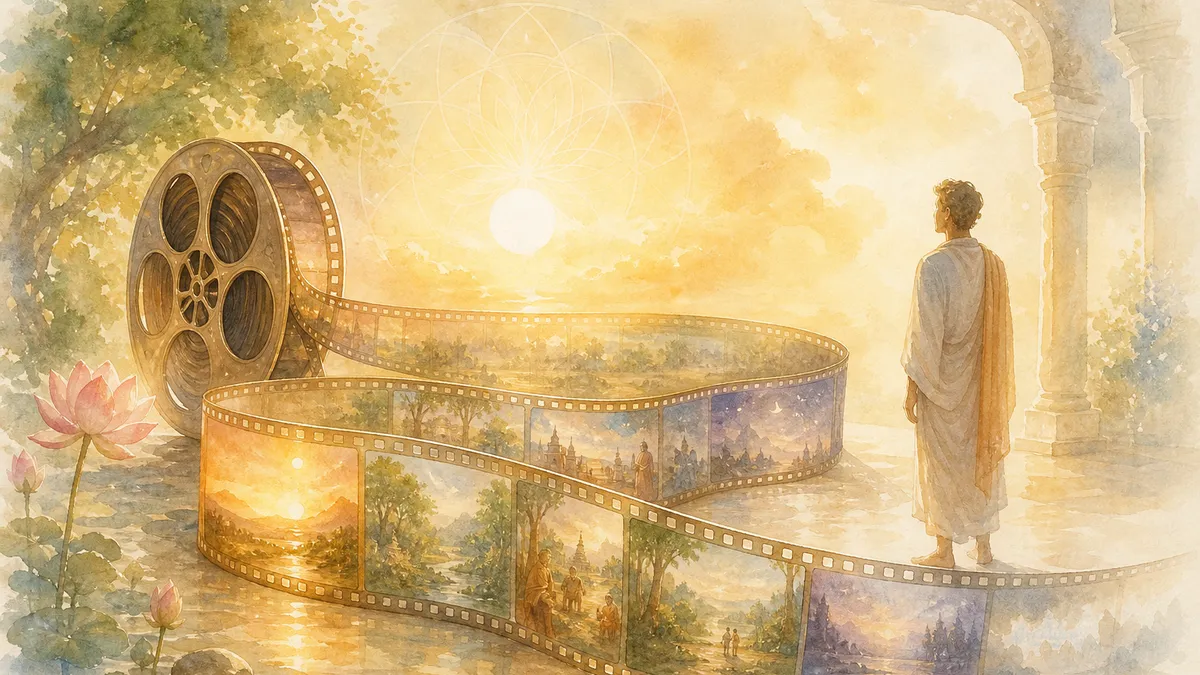
The situation with time resembles something like this. All samskaras exist simultaneously and at once. In other words, even before we were born, the movie about us had already been shot. It can be said that your monasticism, too, was programmed by this great director. And your entire life, beginning with suffering, ignorance, and the search for truth, had already been filmed according to this script. You are simply embodying it, because these samskaras existed earlier and are now being embodied.
When we realize this, we understand that through the power of our mind we can fully penetrate the past and experience old samskaras anew. That is, one can enter the past and live through everything again, for example, meet one's distant relatives. Through the power of consciousness, one can penetrate the future in order to experience all one's future samskaras. This is truly possible, because all of this is a manifestation of our mind. And imagine that the flow of time from the past through the present to the future is simply the unwinding of a film reel. But if your mind is sufficiently concentrated and free, you may not follow the logic of events in the movie theater, but move your minds into the past or into the future, since this is a set of samskaras from one and the same flow.
A curious incident occurred in the seventies. In Argentina, a man suddenly appeared in a train compartment who looked very strange: he was dressed in an old-fashioned hat and a camisole. He was in great confusion, looking around in fear and saying approximately the following: “My name is so-and-so, I am such-and-such a minister. Give me the opportunity to contact the city mayor immediately.” The passengers—a woman, her daughter, and a man—called the conductor and told him that a person had suddenly materialized in their compartment. The conductor did not come right away, and by the time he arrived, the strange man had disappeared. The conductor, naturally, did not believe this story. However, after this man disappeared, a personalized watch and some item of clothing were left behind.
An investigation was launched concerning this matter. And indeed, when the archives were examined, it was found that a person with that name had existed in the eighteenth century and had held a fairly high position in one of the cities of Argentina; he had been some kind of minister. The chronicle stated that this man had undergone a strange experience: he was transported to some realm where, as he later described, he saw a huge iron worm with some glowing openings. Then he was drawn through some tunnel inside this worm, and he saw that people were sitting there, wearing strange clothing. He told them his name, but these people looked at him in bewilderment. Then he was thrown out of this tunnel again, and in the end he found himself back in his homeland. After this incident, it was declared that he had lost his mind, so he lost his position and spent the rest of his life undergoing treatment. That is, the people of that time did not understand that he had traveled into the future.
There are records of this case in the archives, that is, a detailed investigation confirmed time travel. The man was simply carried by the power of incomprehensible karmas into the samskaras of the future, and then brought back out. This means that movement from the past to the present is a process of consciousness, a process of the mind, in which one can move by the power of the mind.
But time as such is a single state together with space. It is primordial awareness, which simply manifests in this way.
There Is Neither Coming nor Going
Rinpoche: So, there is no going...
Papaji: And coming. So, samsara...
Rinpoche: If there is no going, then, of course, there can be no coming either. Definitely, there is neither going nor coming.
Papaji: No one has ever come anywhere.
Rinpoche: But you came? (They laugh.) Did you come here?
Papaji: And I will tell you why. You brought me here. (Laughs.) I will explain. “You came, I came” — this is samsara. Immediately after enlightenment, the Buddha did not speak. He sat silently under the Bodhi tree. Having attained wisdom, he fell silent (translator: for seven weeks). Then Ananda asked him: “Lord, what do you feel?” The Buddha did not answer. He continued to remain silent. What does this mean? He attained enlightenment at the age of twenty-nine and spoke about enlightenment until he was eighty. His words came from no-mind, no-thought. They came from prajna. And what is being said today, does it come from thought? No. From no-mind.
When it is said that there is neither coming nor going, it means that when you disperse the subjective point of view, there is no place to which one could come. There is no subject who could come anywhere. It seems to us that we are going somewhere, meeting something. However, this is not quite so. It is like a person sitting at a computer, wearing a virtual reality helmet and moving through virtual reality in different adventure games. He wanders, moving from one labyrinth to another, but can an outside observer looking at him say that he has gone somewhere or come somewhere? Whatever labyrinth a person enters in a computer game, he is sitting in his room on his chair. He has not gone anywhere and has not come anywhere. One could say that he is moving within samskaras, within a program created by a programmer, within subtle impressions. All his movements are mental. All of this is an illusion.
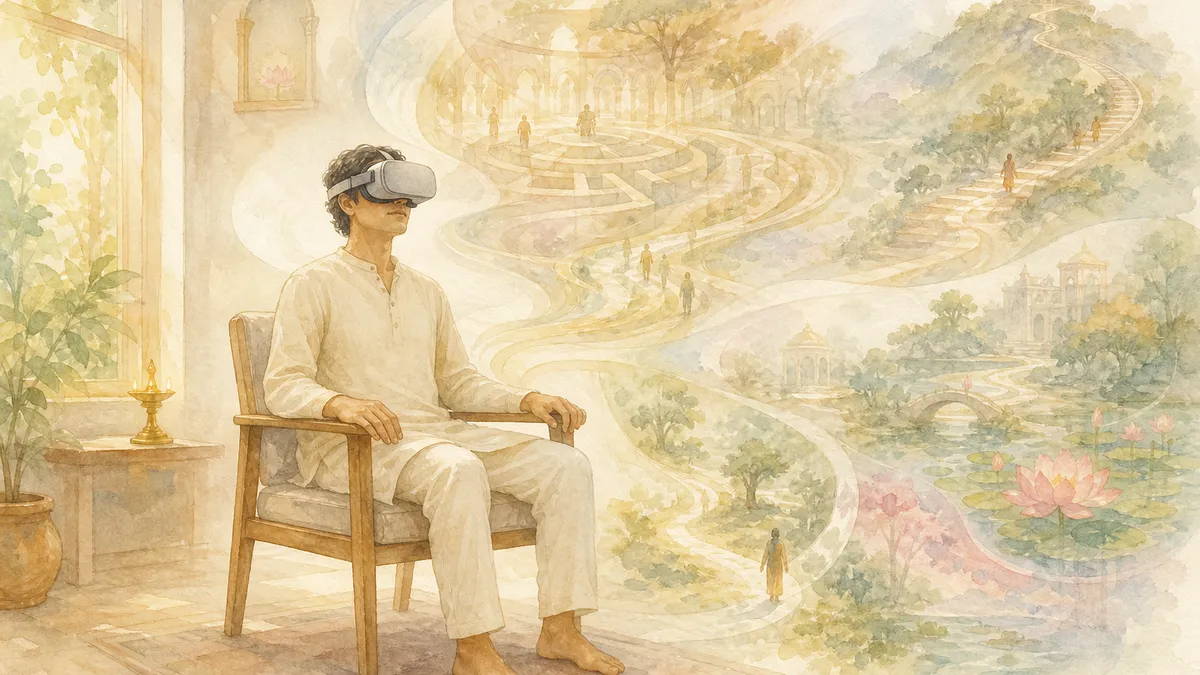
The same is true in this world. When we walk, it seems to us that we are moving from the “Serene Ocean” to the “Rainbow Light,” and from there to the “Singing Reed.” However, in reality, the samskaras in the flow of our consciousness are simply changing. Samskaras are projected from our chest and eyes. They either move toward us and are projected more strongly, or disappear and dissolve, while our body moves its legs in order to generate prana, which either dissolves these samskaras or manifests them. Thus we have the illusion that we are going somewhere as a separate person. But this is simply movement within samskaras, similar to the experiences of a person wearing a virtual reality helmet. The one who has understood this has stepped out and taken off the helmet. He has separated himself from these computer labyrinths. Wherever he goes, he sees that his mind is unchanged, that he is sitting on the same chair. Therefore he says that he has not gone anywhere and has not come anywhere.
For example, when I travel, I have never once felt that I truly left somewhere or arrived somewhere. It is indeed one state. It is seen and experienced as though the pictures on a computer screen are changing, but you are sitting in the same room.
Speaking from No-Mind
Papaji: Not everyone can speak from no-mind. Ordinary people, when speaking, use the mind. To speak from no-mind, a person needs to know that he is already enlightened. If someone feels that enlightenment is something that must be acquired, then it will later be lost, for what is acquired is always lost. If something was not here, if it is newly acquired, then one day it will be lost.
There is a saying in the tantras: “What is here is everywhere; what is not here is nowhere.” This means that awakening is not something acquired that can be found outside. Awakening is what we always have, as our inalienable quality. If it were something created, fabricated, modeled, then it would be artificial, not eternal, not primordial, not real, but human-made. It would not deserve to fall under the category of eternity, because what is modeled cannot be eternal, since if it has a beginning, then it will inevitably have an end. Consequently, there is no need to strive for what has an end. Therefore, when we speak of the natural state, we say that it is not born, not created, not modeled. We seek only that which is beyond effort.
If we create something through our own efforts, for example attain siddhis, then these siddhis may first appear and then disappear; that is, all of this is temporary. As long as there is prana in the central channel, siddhis may be present: you can perform various miracles, enchant people. But when the prana weakens, the siddhis also disappear. But if you have discovered that which is not modeled, that is, the natural state, it cannot disappear.
Absolute Truth
Papaji: If one knows that nothing can be acquired and there is nothing to acquire, then one realizes that nothing has ever existed. This is the absolute truth. There has never been anything.
Rinpoche: Is the absolute truth worth anything?
Papaji: What?
Rinpoche: What is the absolute truth good for? What use is it? Is there anything good in it?
Papaji: It is the universal truth. And now truth asks truth: what use is this? Apart from truth there is nothing, and it reveals itself to saints. Truth itself reveals itself to saints.
Rinpoche: That is true. But do you agree that the absolute truth brings wisdom, compassion, and the ability to help?
Papaji: Yes. Yes. Yes.
Rinpoche: Then can these qualities not be called properties of the absolute truth?
Papaji: Absolute truth includes compassion, but it is not compassion for someone else. For true compassion, there are no others. There are waves in the ocean. Each wave has a certain shape, length, width, height, and they move in a certain direction. But are they separate from the ocean? A wave may feel that it is separate from the ocean and may set out in search of it. But was it ever separate from it?
Question: I do not understand how one can have compassion, but not for someone else?
Papaji: I will speak about compassion. Compassion and truth are one and the same. If my hand takes food from a plate and sends it to my mouth, I will not say, “Dear hand, thank you very much, you put food into my mouth.” Who can have compassion for whom? Only samsara. Only in it is there separation.
Papaji says that true compassion can flow from non-duality. As long as compassion implies a subject who has compassion and other objects, it is not yet true compassion; it is false, modeled, artificial, since it is based on certain absorbed ideas. True compassion really does flow from non-duality; it does not even think about it, that is simply its function. It is like the Sun not thinking that it has to shine, warm people, bugs, and so on. People often say, “O Lord, thank you for being so kind! You give us bread, life, sunlight, and everything else.” It is as if ants got up in the morning and said, “Thank you, Sun, for shining especially so that we can awaken every day, carry our little bits of debris, and do other ant things.” But the Sun does not even know that ants exist; it is too far from them. Simply shining is the property of the Sun.
All living beings receive their benefit according to their karmas. Just as warmth and light are properties of the Sun, so absolute good, absolute compassion, is a property of absolute truth. The Sun does not have some idea: “Now I will send rays down to Earth. I will heat people’s homes so that they feel good.” In the same way, absolute Truth, or God, does not think: “I will give people bread and everything else they need,” because in this way one could go so far as to say that God gives people truly everything they have: both bread and nuclear weapons. The Absolute, God, does not participate in relative things; all of this is done according to the law of karma, that is, by people’s karmas. One may say that absolute Truth is refracted, but the original property of absolute Truth is absolute good. Therefore true compassion is possible only when there is no subject, no object. It is unmixed, pure, and not stained by any selfish motivation.
True Compassion and Missionary Work
There are many people who have dualistic missionary ideas. They are characterized by ideas of saving the world, of spreading the teaching among all humanity. Some missionaries, with great faith, come to distant islands and convert the aborigines to their faith. They have very strong shakti. But in reality such compassion is connected with ideas, with concepts, for example, with belief in the existence of a subject and an object. Only when you go beyond belief in subject and object will your compassion become real, natural. It is like the nature of the Sun—to shine.
Therefore, one can truly spread compassion, become a bodhisattva, a true savior, only when the idea “I am saving” has been eliminated, when the idea “I am the savior and there is someone whom I must save” has been eliminated, when you have completely gone beyond duality. Only then can you truly feel compassion and help others.
In the “Vajra-cchhedika Prajña-paramita Sutra,” the Buddha says: “Does a saint have the idea ‘I am helping other living beings’?” Subhuti answers him: “No.” Why? Because if he had such an idea, he would be clinging to the ego, to the notion of “I,” to personality. And therefore he helps others without having such an idea. Only in this case will it be true compassion.
In other words, before helping others, we must clearly understand that there are no others who need our help. The whole world is our mind, and if any help is possible, then this help consists in helping another understand this. When we understand this, compassion becomes our essence; it radiates from us.
The Story of the Diamond Merchant
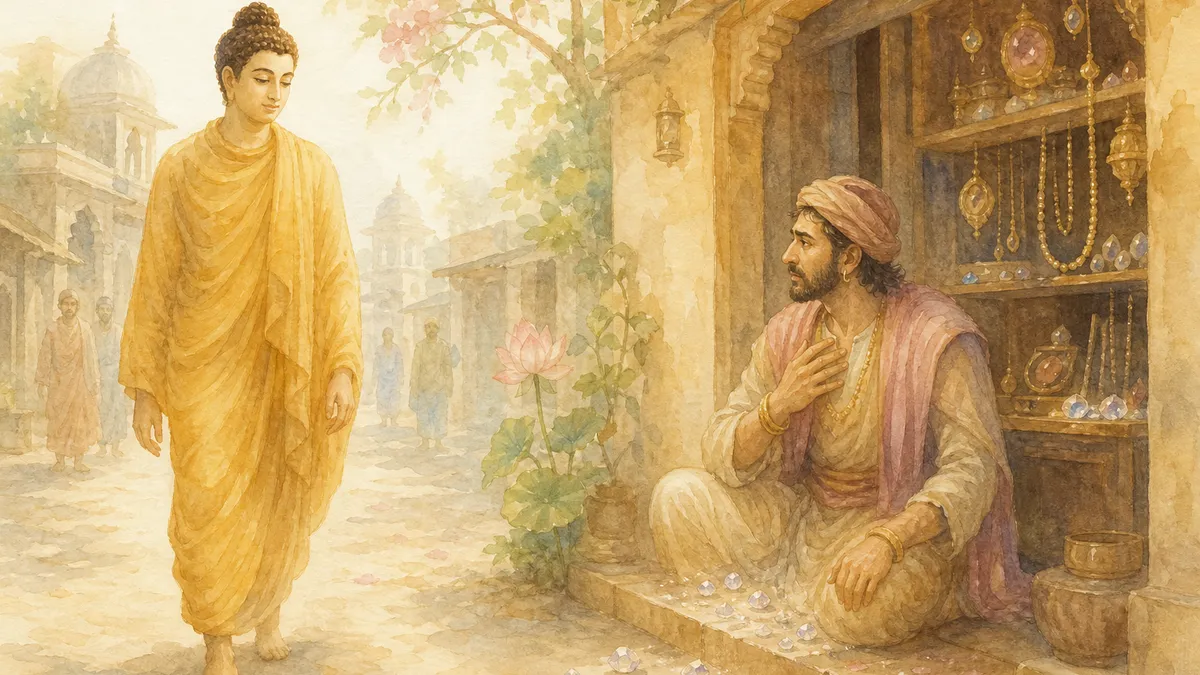
Papaji: Buddha was the embodiment of compassion, compassion itself, which had forgotten everything. It knows nothing but itself. It has forgotten everything. You must know the story of the diamond merchant whose son became a disciple of Buddha. His only son went to Buddha and became a monk. When Buddha passed through the jeweler’s town, the jeweler came out to him and began to insult him. For six hours he reviled Buddha in every possible way, while Buddha, who was compassion itself, simply smiled at the merchant the whole time. Simply smiled. When the torrent of insults finally ran dry, Buddha said, “Now it is my turn,” and smiled at the merchant. The diamond seller went home, threw all the diamonds into the street, closed the shop, set it on fire, and followed Buddha. That is compassion. True compassion burns the roots of the ego. If one responds with true compassion, suffering will disappear forever. The word “compassion” has been included in their vocabulary by Christian missionaries, but what they do is not true compassion. They try to help others.
Rinpoche: Yes, compassion based on the concept of “others” is mistaken and illusory. But there is also compassion in which there is no duality, which does not arise from mistaken concepts.
Papaji: That is exactly what I am talking about—compassion that is not connected with the mind, with the ego.
Rinpoche: Having compassion with concepts is better than feeling anger or hatred. But I agree that, compared with nondual compassion, ordinary compassion appears impure, untrue.
Of course, we must train ourselves to change our states of anger into compassion, even if we have not yet discovered the nature of Mind. At the very least, this creates problems neither for you nor for others. However, as we practice, we must deepen our compassion through the discovery of the nature of Mind, through clarifying where this compassion should come from.
Rinpoche: Nonconceptual awareness is possible only with the awareness of emptiness. Very good. We agree on everything.
Papaji: I have no room for disagreement.
Translator: Rinpoche says that he was glad to meet with you; he is very pleased with the conversation.
