

2021.07.28
OM-OM-OM!
Chitragupta and Dharmaraj: the inner record-keepers of karma
Our bodies perform actions and deeds, but it is our mind and subtle body that record and remember them. It is like an invisible built-in forehead-mounted film camera within us—a video recorder that captures everything from morning until evening. The deity governing this function is Chitragupta, the inner censor. This deity records, archives, and stores everything that happens. The inner judge is Dharmaraj, a universal deity who is also within us. Another name for him is Yamaraj when he has his representation in Yama Loka. On the basis of these two deities, our karma changes, determines our birth, the balance of merits and sins, and our destiny. Our soul is subject to the energies emanating from these two deities and follows in their wake.
Yamaraj does not throw the soul into hell or raise it to heaven—he merely certifies the fact. Our entire life in this world is the result of the accumulated balance of sins and merits. Everyone has their own karmic balance, and our task is to live in such a way as to reduce it to zero in terms of sins and, conversely, accumulate as many merits as possible. A sannyasi is one who no longer wishes to accumulate worldly merits, who strives to accumulate spiritual merits and constantly tries to cleanse their sins by behaving in such a way as not to accumulate new ones.
Faith and the law of karma
When the body grows old and the soul’s life comes to an end, a certain karmic balance—a score—remains. On this basis, it is possible to understand approximately where the next life will take place. But a sadhu, a sannyasi, is one who does not wait for old age and the next life, but begins making active efforts to purify themselves right now.
Faith manifests through studying the law of karma. Faith may arise from contact with divine grace, with a miracle, with a guru, with the teaching, with practitioners, with the sangha, or from an intellectual understanding of the teaching. There are many different channels through which faith can awaken—the ways of the soul by which it comes to God are unfathomable.
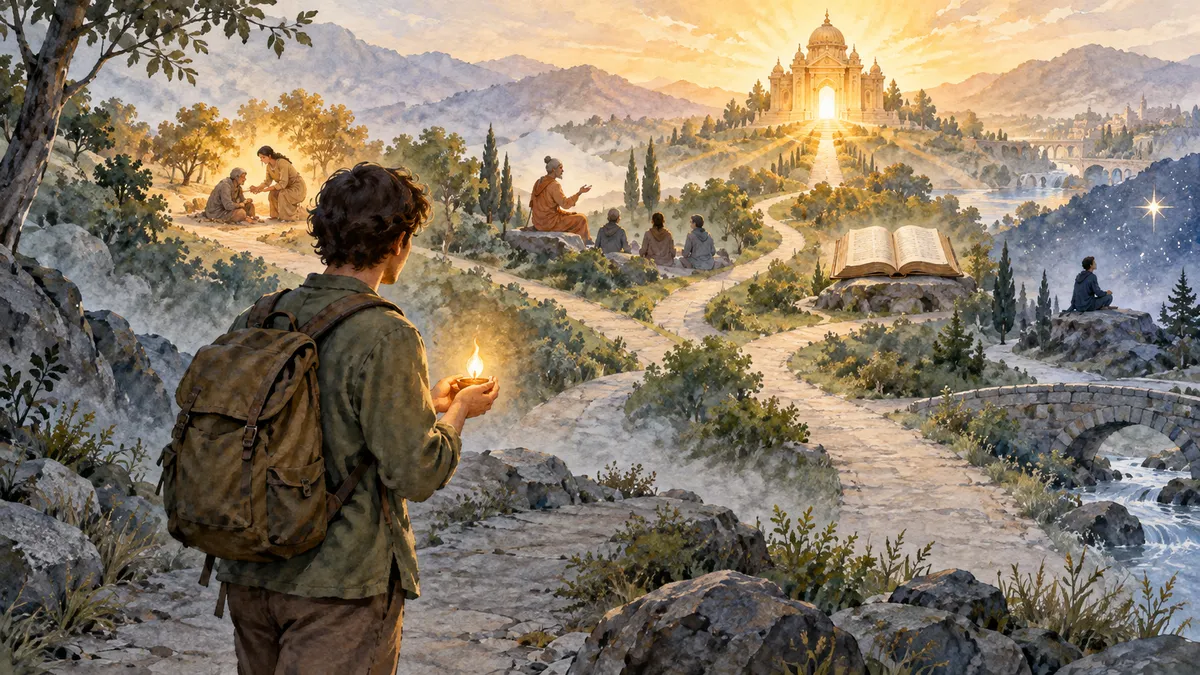
But souls often possess little, weak faith, and they need a long time to nurture that faith, change their old worldly karmic mentality, look at life through different eyes, and change their system of values. Sometimes souls come through philosophy and its study; others are attracted by miraculous phenomena. But there is a saying: “Don’t wait for miracles—perform miracles yourself.” In other words, make active efforts to cultivate faith and all the necessary qualities within yourself.
Four awarenesses: impermanence and karma
Reflecting on the law of karma grants us an understanding of where we are, who we are, and how things really are. Nothing sobers a sadhu as much as the four awarenesses—especially reflection on impermanence and the law of karma. Reflection on impermanence devalues the egoistic aspirations of samsara. Reflection on the law of karma humbles pride and the ego and prompts us to practise actively, because we see the amount of work that lies ahead. As long as we do not reflect on the law of karma, it seems that there is no such amount of work. It seems that there is only one Brahman.
The parable of karma’s train
Imagine that you have not merely one railway carriage, but an entire train full of firewood and coal. And here is the task given by the manager of this life: this train must be unloaded. If you unload it, you can freely leave samsara; you can be free in the broadest sense. If you do not manage to finish in this lifetime—say, you unload half of it or one carriage out of seventeen—you will have another opportunity. You will receive another body, and another. One way or another, you will have to unload it.
You may choose not to unload it—you have free will. You may, on the contrary, load it even more. But this train will carry you in its own direction. You can use your free will to try to unload it. And the more you unload, the less dependent you will be on it. If the train becomes empty and is completely unloaded, you will be able to go in any direction. But until at least one carriage or half a carriage remains unloaded, you will have to travel in the direction of this train.
When a person does not see the amount of work ahead of them and becomes deeply distracted—acquiring housing, a family, children, relatives, work, connections, relationships, hobbies, entertainment, ambitions, pride, and plans—then this deity says: “I see that you do not have enough of this train—I will bring up another empty carriage so that you can load your karma into it.” There were seventeen carriages—if necessary, they will bring up an eighteenth. In the universe, there are as many carriages as you like.
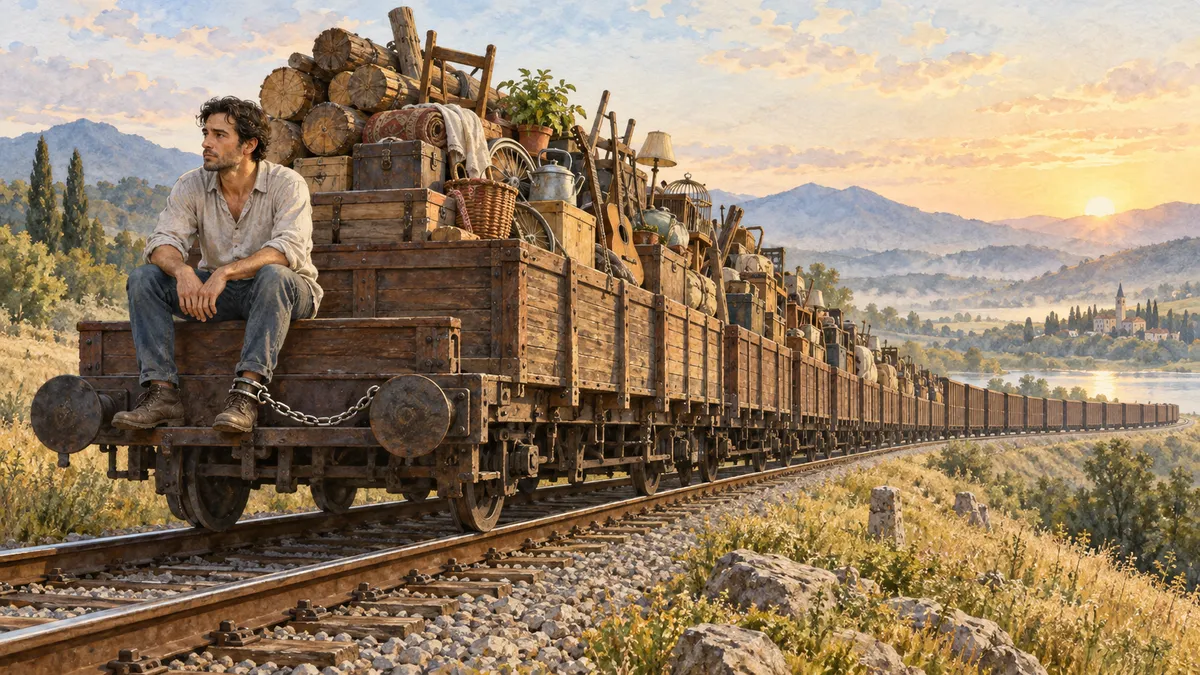
Without understanding this, a person loads yet another car with firewood—a full carload of logs from the Siberian taiga. Then another one. And he sits on this train and travels along with it. He cannot get off it, cannot go right or left, cannot transfer to another train—this is impossible. Because this railway train embodies all the karmic force that he himself has accumulated. How can you go against your own accumulated karmic force? It is simply impossible. He is as if chained to it.
And he moves, dragged along by this train; then he grows old, dies, and, accordingly, receives a new body. This train does not become any smaller. In the new body, duties, work, a home, a family, relationships, thoughts, ambitions, and desires appear once again. And if he again does not set foot on the path of sannyasa, the path of moksha-dharma or karma-sannyasa, the path of wisdom, exhaustion of karmas, and purification, another car will be attached to him, and there will be no end to it. This is avagaman—the cycle of birth and death—and all of this is bhava-sagara, the ocean of samsara. Each soul moves in accordance with the path of its karmic railway train, and each person hauls it in their own unique direction, sometimes attaching new cars, sometimes purifying them. The path of liberation is truly a unique opportunity to break free from all of this.
Question: Gurujī, so is a sadhu who has embarked on the path of moksha-dharma someone who has stopped attaching cars? If we use this analogy?
Yes. He took a shovel and began...
Question: So he stopped attaching new ones and began unloading the old ones?
...actively unloading the first car, the second. And he decided: no matter how many cars there are, I must unload them all—and manage to do so within this lifetime.
Question: And is a jñānī someone who has unloaded them? Can one put it that way, or is it not quite so?
There are different classes of jñānīs—they are described in the Tripura Rahasya. There are three types of jñānīs. There are those who have one half-empty car left. And although they are still traveling in its direction, as soon as this car is exhausted, they are free.
Question: So this is his prārabdha-karma?
Yes. They have only a few of these karmic cars. There are those who have cleared all the cars, then sawed up the cars, set them on fire, and made a bonfire out of them—burned everything completely. Such people are called jīvan-muktas or videha-muktas. And there are also those who load the cars a little—with various beautiful dharmic things: mūrtis, statues, texts—and say: “It’s all right, I’ll go over there one more time; I need to help people transmit the teaching, otherwise they understand absolutely nothing.” They load half a car with some mission, knowing that it will quickly be exhausted and they will be free again. They are like volunteers, voluntary helpers. They fill half a car with texts and mūrtis, and are born into this world in order to deliver them to their destination, to those souls that have ripened. These are the different classes.
There are also those who are bodhisattvas and say: “I will be born again and again in order to help—I will not enter nirvana.” When incarnating, they load a little karma, but this karma is pure and dharmic—it is necessary for functioning in this world. They deliver sacred scriptures, teachings, and transmissions to ripened souls. If they do not make a mistake, they will quickly exhaust their karmas and dissolve.
The Path of Sannyasa: Daily Work Unloading Karma
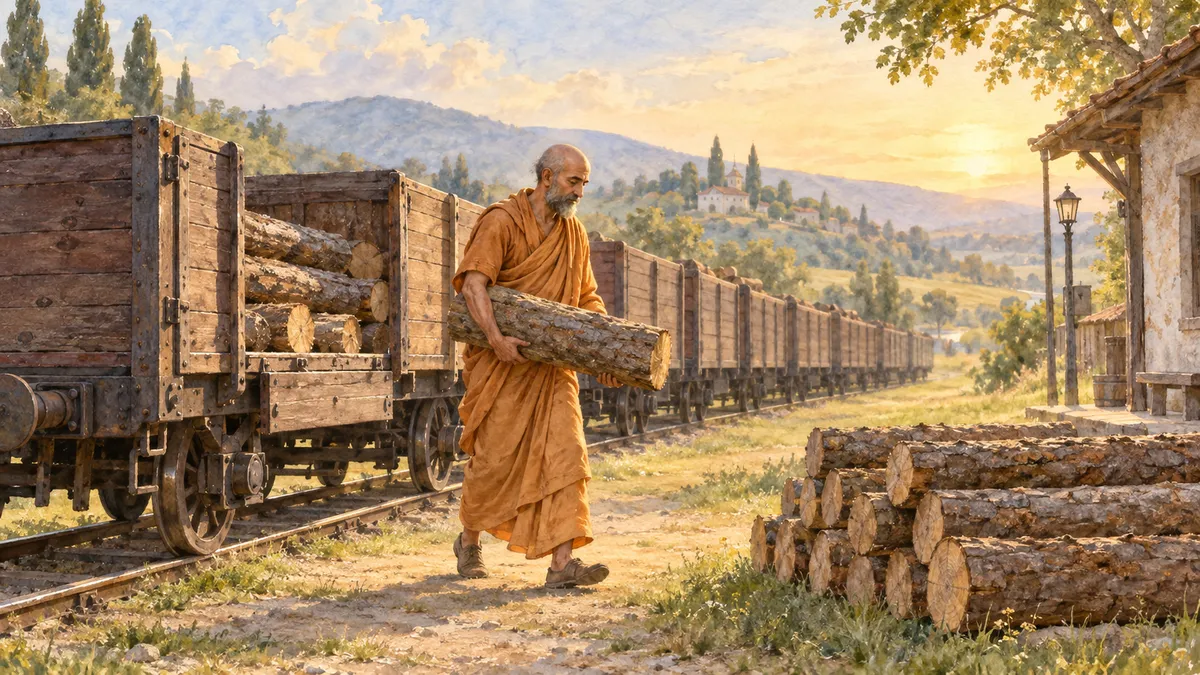
A sannyasi is someone who has begun actively unloading. The fact of accepting sannyasa does not mean that all the cars have already been emptied. It means that we begin the work of unloading. We stop this train, suspend its movement, in order to begin unloading it. This is monotonous and hard work, and it is not always enjoyable. Often, one wants inspiration, enchantment, and play—to make everything go easily and of its own accord. If you can do it that way, then you are divya, and that is the best option: with songs, enthusiastically, effortlessly. But often there are no songs and no inspiration, while the cars remain standing all the same. And a sadhu is someone who, regardless of their mood and state, takes up the work and unloads, day after day—takes up the work and unloads. Through faith, willpower, the power of aspiration and determination—śīla, through tapas, and through vows. When we can purify our karma regardless of our state, whether inspiration is present or absent, and regardless of distractions—then we become sadhus.
Mara: Temptations and the Trap of the Advaita View
During the process of unloading, various temptations come to a person. Some say: “Forget all this and take a rest.” Others say: “The unloading of karma can wait—let’s have some fun: there’s so much interesting stuff on the internet—news, humor, things about Freemasons, the flat Earth, robots and cyborgs.” Still others say: “You still have unfulfilled desires and karma.” A great many obstacles and temptations arise. What should a sadhu do? His spirit should be: “Get behind me, Satan!”—he should not indulge too much. If he gives in to all this, it will never end. This is Mara—his own mind tempts him like Mara.
But there can also be subtler Maras. Such a Mara says: “You practice the view of Advaita, after all. Just relax in the view, throw away that shovel—there are no train cars, there is no karma, nothing to unload, and who is doing the unloading anyway? Calm down.” This is a great trap of the view of Advaita, one that more than one person has fallen into. And there he sits, having thrown away the shovel—while seventeen karma cars stand nearby. He has not gone anywhere from this train, because he is chained to it. But the view of Advaita has confused him. Therefore, the view of Advaita must be upheld and remembered, but it must not confuse you. It is too great, and a great view can lead to great mistakes. This is a great mistake.
A sadhu is one who does not listen to the Maras, does not fall into the Mara of the view, into the Mara of erroneous views and temptations; one who does his work every day, expecting neither reward nor inspiration. The most foolish thing is to expect a reward. When a person has unloaded several cars, he thinks: “I’m such a great fellow, I’m such a hero.” But no one has even thanked him. Who should thank him? This is your work. Therefore, on the path of moksha, one should never seek gratitude, praise, glorification, or anything else apart from sadhana and seva themselves. We purify our karma—we receive the benefit of this purification, and no other benefit besides this is needed. The purification of karma is precisely the benefit the soul needs.
OM-OM-OM!
