

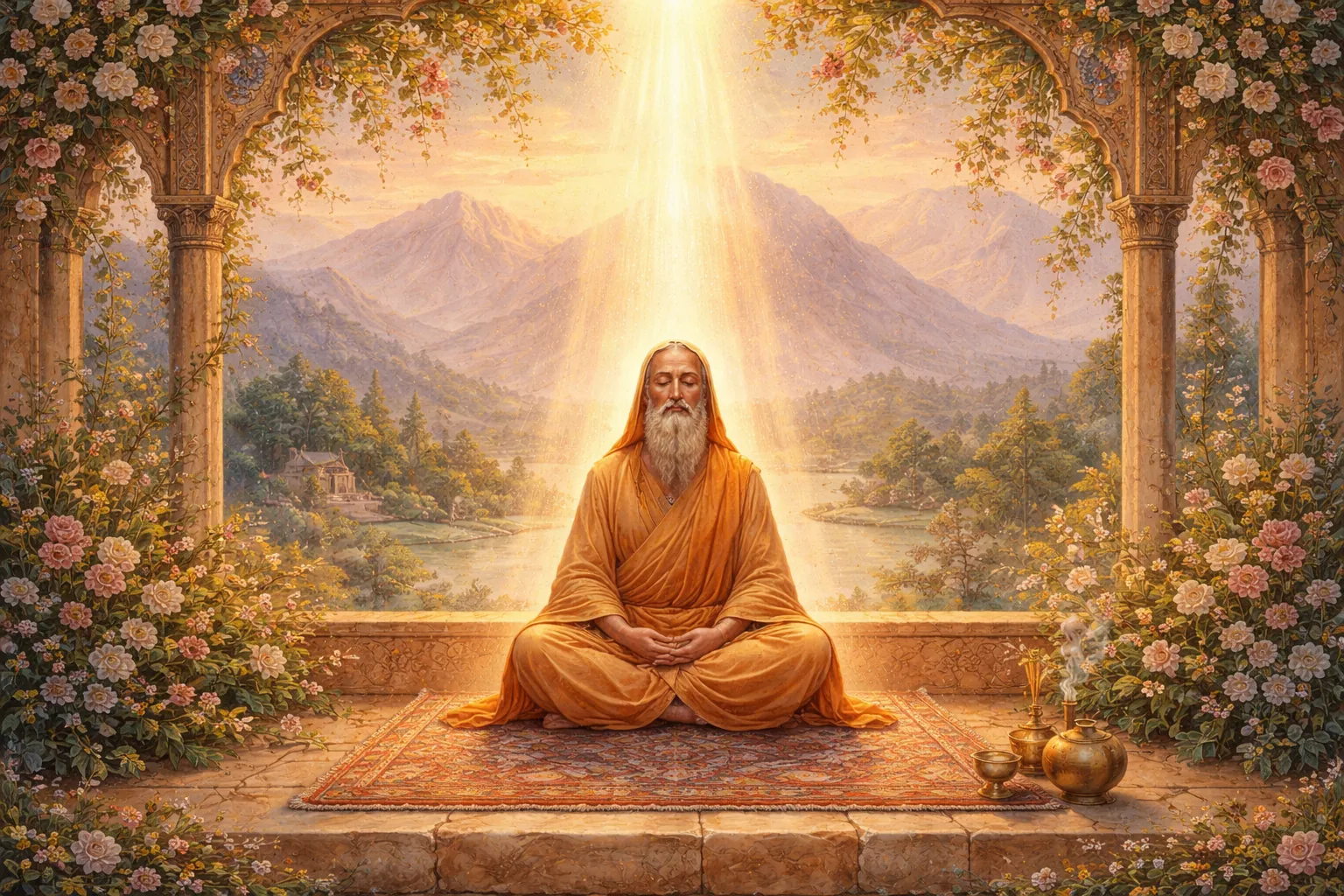
Satsang is a holy gathering and communion with truth. Communion with truth always implies that we speak only of one thing — of this very truth. We are speaking of it now, we will speak of it tomorrow, the day after tomorrow, in twenty years, and this will not change, because a sadhu speaks of nothing other than the Absolute, other than God, other than absolute truth; and if he does speak of something else, it is only in connection with absolute truth.
A sadhu is one who first becomes accustomed to holding conversations about absolute truth, conversations about God, about spiritual realization. And we must first become accustomed to such conversation, to such a way of conducting dialogues. If in the world people gather in order to talk about politics, about money, to “pick someone’s bones,” to gossip, to discuss current affairs, then sadhus gather for other purposes, and this is the distinctive feature of sadhu culture.
Sadhus gather in order to speak and listen about absolute truth, and through this their consciousness is purified. Gradually they acquire a taste for such conversations and an understanding of their importance, and they no longer want to speak about anything else. Of course, they have to speak about other things as well, but that is secondary. What they love to speak about most of all is the Absolute, God, absolute truth.
The Path from Conversations to Direct Perception
Such a taste, the awakening of such a taste, is a sign that your mind is being purified of prarabdha karma. And then, from the habit of conversations, you move toward the habit of thinking about absolute truth. Your mind turns away from prarabdha karma toward divine truth; you begin to purify the mind a little.
And then, from the habit of thinking about God, about absolute truth, there arises in you the habit, beyond the mind, without thoughts, of directly, immediately (pratyaksha) perceiving absolute truth, of investigating it. This does not mean that if you have merely stopped the mind and gone beyond thoughts, you are already one with God, one with Brahman — no, of course not. It means only one thing: that you have acquired an instrument for investigating divine reality, for establishing a connection with it — a very pure, very good, very subtle instrument — but this still cannot in any way be called realization. Otherwise, everyone who stopped the mind would possess godlikeness and God-realization. It is an instrument, and we cultivate this instrument.
And when we have mastered this instrument a little, when contemplativeness has arisen in us, awareness beyond thoughts, a certain immersion in unity with the Absolute arises in us. And this is already a success — a small one, but a success. And it is important for us not to lose this immersion, but to deepen it, deepen it, deepen it...
Thus, first there arises a taste (rasa) for conversations, for thoughts, for abiding beyond the mind, and for investigating with the subtle apparatus beyond the mind. Beyond the mind means that your subtle body begins to move, your causal body is activated, and with the subtle and causal bodies one can also investigate inner reality, conduct brahma-vichara.
Then immersion arises, bhava — immersion in infinity, immersion in absoluteness, as a finger is immersed in honey. And when this immersion endures, it erases our samskaras, attachments, identifications; it already grows into bhava-samadhi, or sahaja-samadhi. Bhava-samadhi and sahaja-samadhi are approximately one and the same, phenomena of the same order. And when bhava-samadhi, sahaja-samadhi endures, prapatti (self-surrender) comes, atma-nivedana — the offering of the soul to the Atman.
Divine Grace as a Living Reality
I would like to speak about Divine grace, because the concept of Anugraha (descending divine grace) is a central concept in the Teaching, one of the central ones. We often say that Ishvara, the Absolute, has five powers: the powers of creation, maintenance and destruction, concealment and manifestation of the Divine. This sounds rather academic: a Sanskrit term, a structure. But in fact, what is Divine grace? It is not a philosophical category; it is something we can feel, something we can live by, something we can experience, something that comes. It is that which does not fit into any Sanskrit terms or philosophical concepts, that which truly exists; it is part of the life of a sadhu.

When we walk the spiritual path, we do not renounce life, as some schools do, nor the manifested, nor movement, nor activity; rather, we seek to live in the fullness of life, transforming it into lila, into Divine play, into the fullness of life under Divine grace; we strive to be conduits of this Divine grace. To live in order to conduct it, in order to become its illusory body, its hands and feet. It is precisely this approach that is the fullness of spiritual realization.
And what is Anugraha, Divine Grace? It is the power of God’s love and blessing descending upon all souls in the Universe. It is an incomprehensible Divine Light, full of reverence, wisdom, and majesty, descending upon the soul when it is ready.
Examples of the action of Divine Grace
By the grace of God and thanks to the guidance of the sage Vasishtha, Prince Rama became a saint. Saint Shuka, by the grace of God, ascended to the gods. By the grace of God, kings became saints: Bhagiratha, Janaka, Yudhishthira, Bali, and other great souls. By the grace of the god Brahma, the Vedas and all sacred scriptures appeared, as well as wise holy teachers and rishis. By the grace of Vishnu, the Earth was saved, and the gods received the nectar of immortality. By the grace of Vishnu, in the form of Krishna, Arjuna dispelled his ignorance and attained enlightenment during the battle at Kurukshetra. By His grace in the form of Narasimha, Prahlada was also saved, and Dhruva became a deity in the starry sky, also thanks to his devotion. By the grace of Dattatreya, Parashurama reached the god Indra, and the other gods overcame the asuras. By the grace of Shiva, Shukracharya, Matsyendranath, Goraksha, and other millions of siddhas attained liberation.
The fivefold space and self-surrender
Anugraha, Divine Grace, is a special power of the Absolute, Brahman, a special power of God, like a bright space of light shining with the power of a thousand suns. In the Teaching, we speak of the fivefold space (vyoma-panchaka), and this fivefold space includes the experience of very subtle dimensions of consciousness. Guna-rahita-akasha is first—the qualityless space; maha-akasha, tattva-akasha, surya-akasha are the subtlest levels of the Supreme Consciousness. Somewhere at the level of experiencing these subtlest levels of consciousness, the soul’s self-surrender to God takes place, and self-recognition occurs. Without self-surrender, without self-recognition, it is impossible to penetrate into the dimension of these spaces. And the soul finds itself precisely in these spaces; it discovers God in these spaces, discovers new dimensions of life.
Divine Grace is when the soul comes into contact with these spaces; it understands that these spaces are no longer its own, that they are not its subjective fabrication; they are transcendent spaces, beyond its mind, its karma, its personality, its individuality. It cannot manipulate these spaces, visualize them, declare them its own creation; it cannot do anything with them—they are spaces absolutely independent of it. It understands that one can only surrender to these spaces of God.
It is like water: you cannot do anything with water if you are standing on the shore of the ocean. You can either jump into the ocean or not jump, but you cannot change the ocean, manipulate it; it is useless, it is a shakti of entirely different categories. So it is with the soul. Divine Grace arises when the soul discovers this divine space and is inspired by it. This discovery and inspiration are what impel it to surrender to God, because nothing else possesses such power of enchantment over the soul, nothing else can impel it to surrender, because the soul in itself is very egoistic, it is very attached, it is fixated on its individuality, it vigilantly guards the boundaries of its ego, and it fears the blurring of these boundaries. And only Divine Grace is capable of persuading the soul to take a step forward and surrender to the mercy of God.
The experience of Divine Grace
Thus, Divine Grace is a special power of God, like a bright space of light shining with the power of thousands of suns. When a yogin experiences maha-akasha, surya-akasha, tattva-akasha, described in the Upanishads, he is, as it were, looking upon this Divine Grace, and this grace touches him. But even if he does not experience such things, he can be blessed with such grace, because not everyone experiences it specifically through an experience of light in meditation. It can also be experienced as clarity, as joy, bhava and inspiration, and as the feeling of being a conduit of Divine consciousness; it can be experienced in different ways.
But in any case, the soul begins to be inspired by it; an uncontrived, true faith, genuine enthusiasm, and most importantly—true humility—begin to appear in it. It understands how foolish it was, how self-confident it was when it strove for liberation, enlightenment, wisdom without taking God into account; how egoistic it was, wanting, as it were, to do this by bypassing God while preserving its “I”; that this is, in principle, an impossible approach. By bypassing God, by going around God, it is impossible to attain happiness or enlightenment, because the happiness of the soul, the future of the soul, is not in itself; it is in God.
The causelessness of Divine Grace
Divine Grace is called grace because it is causeless and is like the mercy of a magnanimous king who generously bestows gifts upon a poor man without any reason. In the world, everything has a cause—from the movement of the stars to ants—but there is no cause for the grace of God, because God Himself is causeless; He is His own cause, and His grace is also founded upon itself.
Anugraha, Divine grace, the energy of blessing and liberation, is His creative power, which is based on Him alone and has no cause whatsoever. It cannot be said that Divine grace descends upon scholars, upon the advanced. It descends upon those who have acquired merit; here no rankings or spiritual accounts apply. It is causeless, it is conditioned by nothing, because if it were conditioned by something, conditioned by some cause, then it would not be Divine grace; it would be some secondary grace, someone else’s grace, because God Himself is conditioned by nothing, He is not built upon any causes, because if He were built upon some causes, He would be part of this conditioned, earthly world, part of samsara, where everything is conditioned by cause and effect, cause and effect (karana-vikara). But God is the transcendent; He is That which is beyond causal relationships, and His grace is also transcendent.
Two Types of God’s Purity
God, the Absolute, has two types of purity. And the first type is connected with shuddha-sattva. Shuddha-sattva is the purest energy of light; sattva is luminosity. Gods, angels, divine beings—all of them abide in shuddha-sattva, and this is one of the types of God’s purity. In the pure lands, they possess a special purity of tattvas, of elements.
Our tattvas, the earthly ones, the tattvas of our body—water or stones—cannot be called pure in manifestation; they are pure in their essence, but in manifestation they are not pure. Therefore our entire earthly reality, our entire samsara, is what is called impure vision, and seven billion people are gathered together precisely because impure vision predominates in them, and the Earth has been selected for them accordingly—also impure. Impure elements means that the elements manifest in a gross way: through their tamasic and rajasic parts.
But there is another type of purity of the elements: pure earth, pure water, pure fire, pure wind, pure space; the pure lands consist of them. When we do the practice of the seven nourishing breaths, we imagine not ordinary elements, but specifically pure, luminous ones, when each element consists of its own luminous part. Pure dimensions operate in paradisiacal worlds, in heavenly dimensions, in pure lands. They are all immaterial, they are all permeated with God, they do not condition, do not burn, do not moisten, do not blow; they are pure, they only bless, nothing bad comes from them. For example, impure elements can sometimes bring problems: one can freeze, get bruised, be blown by the wind, or get burned, but pure elements never do this; they only bless, inspire, and saturate with prana, with life force. And this is the first type of God’s purity. But even these elements are not the very purity of the Absolute in its primordial form.
The second type of God’s purity is transcendent purity, purity beyond the manifested, beyond the pure and the impure, beyond the tattvas, beyond the gunas, the elements; it is higher than sattva. And our task, on the one hand, is in our behavior to move toward pure elements, toward pure tattvas, and on the other, to go still higher, into that transcendent, beyond-the-beyond purity spoken of by the siddhas, which is outside time, outside cause, into the quantum, primordial chaos of the universe, into that purity where Vishnu reclines on his lotus, on the causal ocean, as he is described. This causal ocean is the primordial quantum chaos of the universe, where there are not yet elements, no gunas, no tattvas.
Therefore all gods, such as Vishnu, Shiva, Brahma, Dattatreya, are established precisely in that beyond-the-beyond, transcendent purity, and therefore the three gunas, the five elements, the twenty-four tattvas submit to them; they themselves can create them out of this transcendent purity.
Two Levels of Divine Grace
Divine grace also comes through these two types of purity. At first it comes through sattva: through purity, luminosity, refinement, sublimity. We feel subtlety; it is a very subtle experience. This subtlety, this refinement, purifies us; pure divine signs arise, pure dreams arise; in our behavior we begin to manifest purely; our impure thoughts depart, our impure emotions depart, impure connections and relationships depart, impure habits depart; we become permeated with sattva, with a sattvic approach. The spirit of samaya, faith, reverence, Refuge, pain, compassion, harmony, pure vision toward samaya brothers and sisters—all this begins to manifest in us. This means that Divine grace of the first kind of purity has touched us and begun to purify us.
And after this, after some time—how much exactly is difficult to say, as it is individual for everyone—there comes the blessing of Divine grace of the second kind. This is already transcendental purity, a purity beyond sattva, tamas, rajas, and the five elements, one that is beyond the ego, beyond causes and effects. If Divine grace of the first kind can be received while remaining an individual ego—the soul can remain itself, preserving its egoistic notions, only placing them in the service of the Divine, submitting to it, overcoming its ego, yet still preserving its subtle individuality—then the Divine grace of purity of the second kind can be received only through self-surrender, through complete dedication of oneself to God, and in no other way.

The Action of Divine Grace on the Soul
Thus, this grace proceeds from the very heart of God, and its touch is like a flash of universal fire. Descending, it pierces the darkness of the soul’s ignorance, melts the ice of egoism, dissolves all its sins, and breaks the chains of karma, freeing it from the terrible sleep of illusions. Pouring forth, Divine grace saturates the soul with light, love, and unearthly, heavenly glory, awakening it to a new life, just as the fire of a campfire warms a freezing traveler.
Often our soul, until this Divine grace has touched it, either suffers, or freezes in samsara, or struggles desperately, or becomes entrenched in its egoism and self-satisfaction. It depends on the tattva. But in any case, without Divine grace it dwells amid various kinds of limitations. Yet Divine grace turns the soul in a completely different direction; it shows: your goal is not in yourself, your future is not in yourself, you do not belong to yourself, you are not your own, you are God’s, you are part of the Absolute. That is who the true you is. That is what your true face is.
And having felt its touch, the soul then trembles and seems to awaken, rising from a long, gloomy sleep, rejoicing and marveling.
If the soul does not tremble, rejoice, and marvel, then it means that it is either already realized, or Divine grace has not yet touched it, because when Anugraha touches you, it always changes you; it always opens you into a new dimension of life. You can no longer ignore God after having experienced this; you cannot forget it.
Souls That Have Not Known Divine Grace
Divine wisdom and grace are unknown to sleeping souls, wholly mired in worldly bustle, in concerns for the body and the earthly, and entangled in thoughts and feelings. Such souls are stuck in preferences and cannot acknowledge the supremacy of God; they have neither faith nor love for God. Having incarnated in a body, these souls have forgotten their purpose: to seek God, His wisdom and grace, and to serve Him in order to unite with Him completely.
Having forgotten, they immersed themselves in illusion, the special, enchanting power of God (maya), which completely seized their hearts. Illusion bewitched them, as a treacherous seductress enchants an inexperienced village simpleton. Like an imperious queen, she forced some souls to seek entertainments of the mind, others the pleasures of the body, still others the possession of wealth, a fourth group to enjoy things, a fifth to seek relationships with people, and others yet experience, power, and prestige, instilling in them the belief that this is happiness.
Souls Immersed in Illusion
And she prompted other souls to delight day and night in their thoughts, will, feelings, and sensations. Following this illusion, souls began to immerse themselves in illusory worlds created by illusion and by themselves. When they immersed themselves in them, they lost all understanding of who they are, where they are, where they should go, and what the meaning of life is.
Such souls are young souls; they are still deaf to the rays and melodies of Divine grace, they are blind to its rays, as owls and moles are blind in sunlight. Living without faith and love for God, not acknowledging His supremacy, they believe that their preferences are the only thing that should be followed. They are too immersed in themselves, immersed in sorting through their emotions, thoughts, and feelings, while other souls are immersed in this world and occupied with sorting through the behavior of others, events, news, and so on. Some souls are immersed outwardly, others inwardly, but none of them is immersed in God, because their time has not yet come; their maturity has not yet developed.
But Divine grace pours out upon all: upon the mature and the immature, upon pashu, upon maha-pashu, upon vira, upon divya; it does not choose. The sun likewise shines upon all—upon the ant, the dog, the bird, and the human being—but some souls can be open, can understand and perceive it, while others are completely closed.
Souls without Divine grace live as though they do not live; they drag out an existence and undergo their karmas, because they do not know God, do not know the Absolute, do not seek Him and do not rejoice in Him. Suffering, they yearn as they experience their karmas, like a child who has lost the way home. But even for such souls there is hope that, if they cast aside their ignorance and set out on the path of Brahma-vichara (the investigation of Divine wisdom, the search for God), of seva, of service to God, they can attain Divine grace, because Divine grace and love are poured out upon all without cause, without choosing, without making a distinction between trees, people, and stones. A sadhu who understands this strives to cast aside ignorance and set out on the path in order to seek this Divine wisdom and grace.
The Necessity of Spiritual Effort
Why are efforts needed if Divine grace is poured out upon all and is causeless? After all, we cannot by our efforts produce some cause so that Divine grace would be drawn to that cause, for then it would be causally conditioned. But in fact, efforts are not needed for this; efforts are needed for purification, so that our soul can unseal its vessel and turn toward this stream of Divine grace.
Divine grace is poured out like a waterfall upon everyone, everywhere, in all places, at all times. Brahma-jyoti (the light of the Absolute) always shines; it penetrates absolutely everything, but only the chosen can receive it, only the worthy, not everyone—the pure vessels chosen by it, those who sought it and by their seeking purified their soul. The one who has recognized Divine wisdom and surrendered to God, has decided to serve the will of God and seeks nothing else—such a one is worthy of the descent of Divine grace.

We become worthy of receiving the blessings from the descent of Divine grace only when we have certain qualities, a certain readiness. If these qualities are absent, it is poured out, but it brings us no benefit; we do not recognize it. What is this like? Suppose there is a certain computer, an access point that provides Internet services to everyone, and someone can connect, while someone else cannot. This access point provides them to everyone; it makes no difference to it who they are. But some have a connection, while others for some reason do not. Some can access the Internet, download the necessary information, and use all informational services, while others have no connection, no connect, or their computer is not charged, their battery is dead, or the operating system is not installed.
A soul that has not surrendered itself to God is like a vessel with its neck sealed: no matter how much nectar pours down from above, not a single drop will get inside. Divine grace touches only those who have purified themselves through inner asceticism, as alchemists purify gold of all impurities. It comes to those who have given themselves to God, like a faithful wife who has devoted herself to serving her husband. Such a soul is like a mighty bird: it lives alone wherever it wishes, always content with what is, attached to nothing, clings to nothing, does not grumble, does not complain, expects nothing, and hopes for nothing except God and His grace.
The Path of Purification of the Soul
A sadhu strives to become worthy of Divine grace. We may think of ourselves: I am intelligent, I am beautiful, I am the most worthy, but for Divine grace it is not important what we think; for Divine grace it is important who we are. At some stage we can perceive it, and at some stage we cannot, whatever we may think. Therefore a sadhu strives to purify himself.
How does such purification occur? The pacification of the mind, the cultivation of faith, devotion, jnana, the recognition of Divine wisdom, when we understand: Divine wisdom is not prana, not the body, not the subtle body, not the mental body, not the causal body; it is all higher than this, pancha-kosha-viveka. When pancha-kosha-viveka appears, we become worthy of Divine grace. When there is faith and devotion, when we do not even have pancha-kosha-viveka, but faith and devotion are present, we also become worthy of Divine grace. When we give all of ourselves to God and say: I am a conduit of the Divine; here are my legs, here are my hands, Dattatreya, use them, I am leasing this body to You—then we also become worthy of Divine grace.

Divine grace is like a flash of lightning in the night sky: even a brief flash of it illuminates everything around; it is like the magical gold of the alchemists: whatever it touches is purified and transformed. The saints say: do not be a fool; follow the path of the wise, carefully perform your inner alchemy in order to obtain this inner gold.
Here is such a paradox: on the one hand, it is always and everywhere poured out upon everyone, and on the other hand, one must follow the path of inner alchemy, inner transformation, and purification so that this wisdom may touch you and be recognized by you.
Labor without distraction, without sparing yourself, in the name of God, just as the plowman labors in his field from dawn to dawn in order to have a harvest. Purify yourself tirelessly, like a gardener who, wishing to lay out a beautiful garden, works to clear abandoned land of weeds, roots, and branches.
Our spiritual life is continuous labor, and only the one who works well in the garden of their soul can count on Divine grace; poor workers cannot count on it. Spiritual life is constant purification, the purification of oneself, when we uproot the stumps of our egoism: we have uprooted one little stump, we look, and another is already nearby; we have uprooted this one, taken two steps, we look, and there is a whole field there. When we pull various stones of unbelief out of our soul, when we purify, purify, and purify. And only the one who labors well in the field of their soul is worthy of being worthy of Divine grace. Such labors do not create Divine grace, but they will purify our soul; they create the ground.
Having been purified, the soul will shine like an ingot of gold without impurities and will become transparent like clear glass. Purity and transparency will endow it with a special wisdom: to see the feet of God always and everywhere.
The Vision of the Feet of God
What are these feet of God? They are the recognition of the boundless transcendent space beyond the subject, beyond the object, and beyond the five koshas (sheaths).
And then a magnificent, dazzling light, like an infinite sky, will descend straight into your heart and will make the soul first be frightened, freeze in admiration, and then dance, sing, and weep with happiness. This is the feet of God. Having seen the feet of God, your soul will rejoice day and night and marvel at how it could not see them before. Even having seen the feet of God for a moment, it will remember them again and again, weeping with happiness and marveling, and there will be no force that can make the soul forget them. Having once seen the feet of God, the soul will decide always to look at them and never to lose sight of them.

What does it mean to look at the feet of God? This is precisely to be always in contemplative presence, in a state of awareness. But this is not merely attentiveness to the breath, to the body; these are all methods, auxiliary tools for beginners. The feet of God, one might say, are the experience of sahaja samadhi, the experience of the rasa of the nondual state, when you have truly experienced closeness to the Divine.
When you have decided always to look at the feet of God and never to lose sight of them, this is undistracted presence. And then a fear arises in the soul of losing God and falling back into the ignorance of the world. It will turn to God and decide to live only in God. And certainly, if you are a true sadhu, such reflection, such contemplation, such a fear of losing God appears in you, because the soul feels that it has groped its way to something very great, very valuable, incredibly precious, a magical jewel that fulfills all desires; that it has found the key to all doors, it has found the root of the solution to all problems, it has found the source and cause of all its lives in the past, future, and present.
It feels that it has found some enormous ingot of gold and begins to cherish it, begins to cherish it very much; it understands that what it has found is so great, so valuable, so precious, that all the other problems it had, everything else is unimportant, that this jewel solves all its problems. It is the same as when a peasant, if he accidentally comes across a huge rock of gold in the forest, understands that now he need not think about selling firewood or working in the field; he must think about how to make use of this rock, how to hide it, preserve it, and put it into circulation, how to make it his own, because, having such a rock of gold, he will no longer have to plow the field or chop firewood for sale; this solves all his problems.
The Transformation of the Soul
And then the soul turns to God and decides to live only in God. But in order to live in God, one must forget everything the world has taught and surrender oneself to Him. And the soul decides to do this: to forget not on the physical level, but on the psychological level. On the physical level, we may very well make use of the secular experience we have acquired, the knowledge we have gained, but on the psychological level we must not attach any significance to this experience, because the truth of God so far surpasses all these experiences that they cannot even in any way stand near it.
And the soul will decide to do this. And then it will reject the old life like worn-out shoes, become attentive and cautious, like a bird-catching hunter tracking a wondrous bird in the forest. And then the sadhu moves carefully, walks cautiously, speaks quietly and humbly, watches over himself so as not to forget God even for a moment. This is a sign that the sadhu contemplates God, abides in awareness, that he strives at every moment not to lose this connection with Divine reality.
Then neither joy nor sorrow will strike your heart any longer, neither the pure nor the impure will disturb you, the low and the high, the great and the small will become as if one, and you yourself will become like God’s child on its mother’s lap. What was hidden will be revealed, what was closed will be opened, what seemed lost will be found, the invisible will be seen, the inaudible will be heard, the unattainable will become close, the unprecedented will happen.

The soul will always and everywhere be drawn only to God, His wisdom and mercy; it will seek those who are like it, and it will slightly avoid those who are not like it, because it will still be spiritually young and inexperienced in seeing His mercy in everyone. All these are signs of the touch of Divine mercy.
A sadhu must labor daily in the spirit in order to invoke Divine mercy, just as an alchemist dreaming of becoming rich labors while standing by the crucible in his workshop.
My blessings that you may labor in this way and that Divine mercy, Anugraha, the blessings of the saints, and Bhagavan Dattatreya may always touch you.
Om. Namaste.
