
He has no need for sleep or large amounts of food, and he has few excretions.
However, the main sign is still his ability to remain in continuous contemplation day and night. Maintaining contemplative presence at night, in sleep with dreams and especially in dreamless sleep, is, from our point of view, the main criterion of a yogi’s holiness. Such a yogi contemplates various levels of Clear Light in dreamless sleep. In our teaching, the ability to maintain such contemplation and the revelation of the four levels of Clear Light (Jyoti) is the criterion for the attainment of liberation by a monk or mentor. Of course, such a yogi possesses various mystical abilities (clairvoyance, the emanation of a subtle body, the ability to project his body before others, control of dreams), but these abilities are transient and are not a criterion of spiritual realization.
Sri Adi Shankaracharya, in the text “Vivekachudamani,” describes that the criterion of holiness can be complete impartiality, when the yogi is constantly in a state of a single “taste” (samarasya). A single “taste” means that everything is perceived equally, as a manifestation of absolute Consciousness; that is, such a saint sees joy and sorrow, blame and praise, the pure and the impure, good and evil, the sacred and the sinful, the spiritual and the mundane, pleasure and suffering, life and death in the same way. He has neither hope nor fear, nor clinging; for him there is neither high nor low, there is no “I” and no “others.” Everything is perceived as a reflection of a single awareness in which all opposites merge.
Abiding in such awareness in yoga is called sahaja samadhi. It is precisely this that is the true criterion of holiness, the culmination of mystical experiences, the highest point indicating that enlightenment has been realized. At least, such a point of view is widespread among practitioners of yoga, Hindu and Buddhist tantra. Until this state of a single “taste” has been realized, an adept of yoga or tantra is considered an ordinary spiritual seeker.”
Samarasya and the Mixing of Spaces
Samarasya is a special state which, from the point of view of Laya Yoga, is very important. The single “taste” in Laya Yoga has its own specific property: we say that one who has realized the state of contemplation at the level of a single “taste” has mixed the inner and outer space. This means that the subject has completely reunited with the object. It is usually said that there are four kinds of space: outer space (bhuta-akasha), the inner space of consciousness (chit-akasha), and the subtle spiritual space in the heart that is experienced in samadhi (hrid-akasha). In the state of a single “taste,” the outer and inner spaces are mixed.
How this happens is very difficult to understand until we experience it ourselves. The saints describe it as the ability to abide in naked awareness until the very notion of meditation and of the meditator is cut off. When the notion of meditation and the meditator is cut off, the stage of self-transcendence (prapatti) occurs, when the false, individual “I” of the person who practices is cut off. When the yogi leaves behind all clinging, hopes, fears, and the idea “I am this body,” he suddenly comes into contact with the boundless, grandiose Source of energy of the Universe. What he previously considered external objects or denied as illusion is now suddenly seen by him as a manifestation of this Source. To enter into contact with this grandiose energy of the Universe means to open oneself to this primordial great Source. At this stage, saints describe that they have the sensation as if stars, planets, and metagalaxies enter their body. They literally feel it.

The heart of the saint does not tremble in fear. All his passions are pacified. It enjoys unshakable calm. There is neither death nor pain, neither day nor night, nor the fruits of karma. This is truly the state of those who have rejected desires.”
Tirumular, “Tirumantiram”
Of course, a yogi who has attained the state of a single “taste” is free from any attachments, including attachment to himself. He has no pride, self-love, anger, or hatred. He is free from the bonds of worldly desires, and all his actions are permeated with the spirit of compassion for all living beings.
The Teacher in Anuttara Tantra
On the path of anuttara tantra, in both Hinduism and Buddhism, the Teacher is regarded as absolute Consciousness (Brahman in Vedanta, Shiva in yoga, or the Buddha in Buddhist tantra), inseparable from the disciple. It is believed that such a Teacher should belong to a chain of discipleship succession (have his own spiritual Teacher), be versed in the subtleties of esoteric teachings, be an expert in the Sacred Scriptures, and possess knowledge of the Absolute through samadhi.

But in practice it often happens that the main criterion is the depth of one’s personal experience of realizing the Teacher.
The Guru may be young, he may enjoy worldly pleasures, he may be illiterate, a servant or a householder, but none of this should be taken into account. Does anyone refuse to pick up a precious stone dropped in the mud?
Avadhuta Dattatreya, “Avadhuta Gita” (ch. 2, 1)
The concept of the Guru denotes, to a greater extent, a process rather than the person of the Teacher. This process consists in changing the disciple’s egocentric attitudes by maintaining contact with the Teacher—the process of learning. The cutting off of selfish hopes, fears, and clinging in the battle for liberation, the laying bare of our non-dual nature—this is always a dramatic process, as shown by the autobiographies of the holy mahasiddhas Naropa, Milarepa, Matsyendranath, Gorakshanath, Kanhapa, Saraha, Jalandharanath, Chauranginath, Ramalinga Swamigal, and others. And on this path the disciple must make the right choice of a spiritual Mentor to whom he can entrust the guidance of his spiritual life.
Of course, one should not let just anyone lead one by the nose. If a disciple accepts a particular Teacher, he must first have the opportunity to critically analyze his qualities or teaching. But after he has gained trust in the Teacher and become a disciple, according to the teaching of tantra, the disciple should not look for faults in the Teacher, but should regard him, in pure vision, as the unity of all saints and Teachers, as a manifestation of the divine principle.

In the practice of tantra, the level of spiritual realization, the holiness of the Teacher for the disciple, is often not as important as his faith.
The Guru can be anyone. He may be a madman or an ordinary person. Once you have accepted him, he is for you the god of gods.
Neem Karoli Baba
In other words, the principle at work here is “it is not that one is beloved because one is good, but that one is good because one is beloved”; that is, the disciple is traditionally encouraged to view the Guru as enlightened, even if this is not the case. As we can see, the success of spiritual awakening depends to a greater extent on the disciple’s own faith. This is the principle of Guru Yoga.
Guru Yoga and the Principle of Samaya
Guru Yoga is the principle of attunement between the consciousness of the disciple and the consciousness of the Guru. Through the disciple’s attunement to the Guru’s consciousness, the disciple receives a blessing—a direct introduction to the primordial Reality of naked awareness (pratyabhijna-darshan), which gives impetus to his spiritual realization. Thereafter, the disciple trains to maintain this impulse through attunement with the Teacher’s consciousness. This principle of attunement presupposes sincerity, openness, and trust, and is called “samaya.”
When we study the teaching, we understand that it is not sufficient simply to study the teaching as such. One may study it for decades, but in order to obtain results, it should be studied in a specific context. This context is very clearly set out in the tantras; it is called the “Teacher-disciple relationship” or “samaya.” Then we understand that we need to assume a certain role—the role of a disciple. If we understand this and have decided to practice the Teaching, then we need to reflect on what such a role entails.
For example, if a person wanted to study martial arts in their primordial purity, he would go to China, find a gray-bearded old master, and ask him to teach him the art of kung fu or wushu. This master would say: “Stay and live here. I will try to teach you.” And this person would chop wood for two years, carry water, simply get used to being near the Teacher. And when his ego rebelled within him, he would say: “But you are not teaching me anything!” This master would say: “You may leave; this is my method of teaching.” In reality, the training had already begun; he was teaching his disciple many things: patience, the ability to empty and let go of himself, to acquire and develop flexibility of consciousness, to cast aside the pride that prevents him from mastering martial arts. This principle in martial arts can be transferred one-to-one into spiritual practice.

Samaya is a special spiritual obligation, a promise of sincerity that a disciple gives when entering the path of spiritual training. In fact, discipleship in the true sense on the path of tantra is possible only if the disciple takes on such spiritual obligations. These obligations mainly concern the pure vision of the teaching, the Teacher, and fellow practitioners—that is, what in dualistic religions is called “faith.” And an experienced Spiritual Teacher always tests a disciple before accepting him for training, for no less than a year, and sometimes for up to twelve years (as in the case of Tilopa and Naropa). It is believed that, once having accepted a disciple’s samayas, the disciple must maintain their purity, no matter what difficulties and trials he may undergo. It is believed that violating samaya creates serious obstacles in the sadhana for both the disciple and the Teacher, and in the worst case can lead to birth in the lower worlds, for example in the “vajra hell.” If, for any reason, a disciple parts with the Teacher, or subsequently the disciple feels that this Teacher turned out to be the “wrong” Teacher, or such a conclusion arises in the opinion of other people, then despite this, the disciple must still preserve the purity of perception toward the one from whom he studied, in order not to create obstacles for himself in this and future lives.
In other words, whether the Teacher possesses high realization or not very high realization, for the disciple’s spiritual benefit the saints recommend regarding the Teacher whom he follows as absolute.
If you have sincere faith in the Guru, no other Buddha is needed.
Padmasambhava
Milarepa once told his disciples that whoever he himself might be—a great saint or even a hungry ghost (preta)—if the disciples regarded him as indistinguishable from the Buddha, they would receive the same benefit as if they themselves were direct disciples of the Buddha.
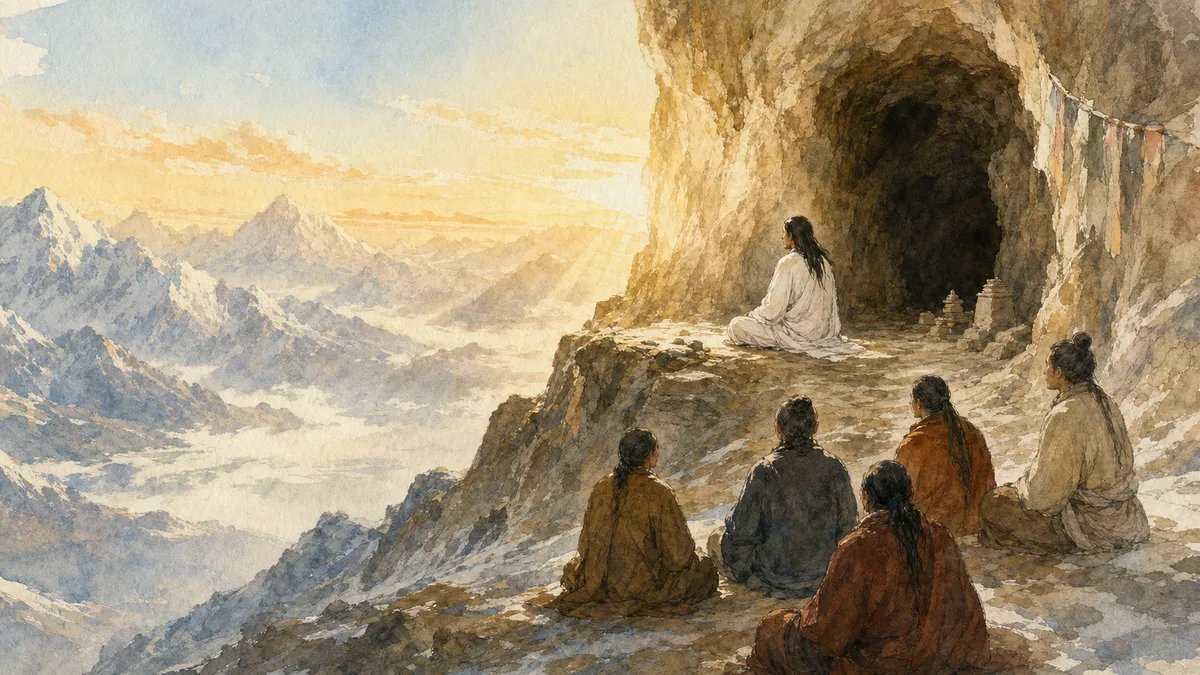
The Guru’s teachings should not be evaluated from the point of view of literary quality. In fact, intelligent and spiritually gifted people perceive the essence of the teaching, its quintessence. Is a boat, even if it is unpainted and poorly made, not nevertheless capable of carrying its passengers across the ocean?
Avadhuta Dattatreya, “Avadhuta Gita” (ch. 2, 2)
It may seem to some that we are examining this topic in excessive detail, that disciples already know it anyway. But if we look at the life of Naropa, who searched for the Guru for twelve years and underwent trials with Tilopa, the situation here is completely different. Obviously, if the saints of antiquity devoted so much attention to this question, it means that there is something in it, since the holy mahasiddhas were personalities of such realization that they would hardly have done anything frivolous, unnecessary, or useless. Their level of clarity, self-discipline, and awareness was beyond anything imaginable.
If you become a disciple by receiving the Teaching from a Teacher, this means that the Teacher becomes more important to you than your father, mother, and anything else in general, because traditionally the Teacher should be regarded as the Absolute. Someone may think: “But I want to realize myself, and this is something external; after all, it is duality, while we are talking about nonduality.” But in Laya Yoga we say that the Teacher is a manifestation of the disciple’s own consciousness. And since we must recognize Brahman or the Buddha within ourselves, in this body, naturally, when we look at the Teacher in this way, it is easier for us to recognize him within ourselves as well. If, however, we cannot acknowledge him in the Teacher, then acknowledging him within ourselves is even more difficult, since our level may differ from the Teacher’s level.
When Western seekers come into contact with this principle, they develop a false notion based on their false pride and egoism, because the Western mind is not accustomed to such relationships. It may seem to it that this is a means of inflating the Teacher’s false ego or a means of some kind of submission. However, everything is much more subtle. Since the teaching is transmitted in a very subtle context, one can say that practicing the teaching by receiving it from a Guru is more subtle than establishing a relationship with a father, mother, or spouse. These are very subtle things that enter us on a very subtle level. If we decide to enter into such relationships, this must be done properly, purely, and then the Teaching will work. When we enter into such relationships, the Teacher may set certain conditions for us and give us methods for our spiritual growth that help us realize the teaching.

In the Teaching of Tantra, a great deal depends on the disciple, on his independent, conscious choice and on his ability to bear responsibility for his choice. To see someone or something as holy or sinful, pure or impure—such an evaluation depends first and foremost on the observer himself, that is, on the subject. A saint, looking at a sinful person, sees the Buddha, although one who has not yet fully revealed his potential. A person bound by karma, even looking at the Buddha, may project his own sins onto him. Based on this, when it comes to evaluating any phenomenon, we encounter a paradox: the Teaching of Yoga Tantra turns us away from external evaluations toward the evaluation of our own consciousness.
The Qualities of a Disciple and the Transmission of the Teaching
Now we can talk about the qualities of a disciple; they are also described in the shastras. A disciple must passionately strive for liberation. That is, if you have one thought and one goal, like an arrow that flies without deviating (liberation and enlightenment), then you can be called disciples of yoga. The ideal disciple must have devotion to the Teacher, the teaching, and the sangha of practitioners, a striving for liberation, know the sacred scriptures, be ready to engage in service, carry out any instructions, preserve the purity of the samayas and the commitments given, possess faith, and then the process of learning can develop fully. If, however, such qualities are absent within the disciple, then the Teacher may refuse to teach him, or, if the Teacher doubts the presence of such qualities, he tests the disciple in various ways.
The tantras give quite specific recommendations regarding how the teaching is transmitted. The fact is that the Teacher is a challenge to the disciple’s ego with its conditionings, worldly attachments, way of life, and so on. Accepting the Teacher means that we have now acquired great trust in the Teacher and say to him: “I want to practice as you instruct me. I place no conditions on you.” If the Teacher wants to give his disciple growth, he will necessarily challenge his attachments, his false ego. Sometimes this can even be painful, since our conditioning is very strong. Nevertheless, this whole process works for the benefit of the disciple, and it is above all not the Teacher but the disciple who is interested in these relationships.

Thus, there are instructions on how to transmit the Teaching to a disciple who accepts such a challenge.
How to transmit the Teaching.
This supreme, transcendent, incomprehensible, secret teaching should be transmitted to devoted disciples through the line of unbroken succession and should be concealed from those who lack abilities, do not have faith in them, and are not ready to make great efforts to practice them.
It says here that you must make tremendous efforts to practice the teaching; small efforts are not enough. So that the disciple knows what lies ahead, the Teacher warns him: “The goal that must be realized through practicing the teaching is very great, therefore you must make not ordinary efforts, but great efforts. These efforts will require great self-transformation from you, so be prepared for your way of life, your egoism, pride, mentality, and all your stereotypes to be challenged.” The teaching implies complete self-transformation if we enter into it.
To show how great such efforts are, the Teacher may give the disciple various tests. For example, at Vyasa Puja one female disciple offered me a stick and said: “Guru, destroy my egoism with this stick.” I did not ask her to do this; it was her initiative. I said: “All right, I will think about it.” About a month later I gave her a very simple task. Since we do not beat anyone with sticks, it was a task connected with a certain service. Unfortunately, however, she did not cope with it.

When you ask the Teacher for something, be aware of the responsibility that arises as a result, because the Teacher may respond to your request, while you may turn out not to be ready for that response and for his task; you may think that it requires too much of you. Unlike the disciple, the Teacher is very well aware of how great the goal is, and understands what path of self-transformation the soul must go through before it can approach it.
Those who neglect samayas, who have no faith and devotion toward practicing Teachers and the teachings, and who are biased against the spiritual path should not even be told about these teachings. These holy, great teachings should be entrusted to the very best and most worthy, to those who have passed the tests given by the Teacher. The teachings should not be transmitted to those who disclose and blurt them out. Such teachings should not be explained to people who are not interested in Dharma; otherwise obstacles will arise, divine beings will be displeased, there will be no blessing, and therefore the effectiveness of the Teaching will be lost, since it will be spoiled. The teachings should be protected from those who violate samayas and the rules of purity and secrecy, because by treating the teachings improperly, they will inevitably introduce their own views and various admixtures into them and pass them on to those who are incapable of practicing. As a result, those who practice them will not obtain signs of realization.
It is said that the gods hate it when something is revealed and spoken of directly. Therefore we say that the teachings must be treated with proper respect, if, of course, we want them to work. If we do not intend to obtain any effect from the teaching, then, of course, this is not at issue. The teaching is something very subtle. When a true artist paints a picture, if he has not finished it, he hides it away from others’ eyes so that others’ thoughts do not prevent him from creating a masterpiece. When an alchemist prepares pills of immortality, he observes a certain process, and it is not permissible for an outsider with incorrect thinking to interfere in it, because this may hinder the process, and the pill of immortality will not be created. Anyone who has taken even a little interest in Western or Eastern alchemy can confirm that such a rule exists among alchemists. The same processes exist in the teaching as well, and therefore we say that the teaching should be carried out very carefully and reverently. This process is called samaya, and so it is said: “Guard samaya as the apple of your eye.”

These higher teachings should likewise not be passed on to people of limited views, to beginning practitioners of Dharma who follow only the practices of Kriya, Charya, or Yoga Tantra and, due to the narrowness of their thinking, are unable or do not strive to understand the exalted teachings beyond duality, concepts, and limitations. If such people even hear them but do not understand them, doubts, distrust of the teachings, or slander may arise in them, and in this way they will accumulate bad karma. If the teachings are kept improperly and are not preserved, this leads to misunderstanding of the teaching and distorted interpretations, as a result of which those who try to practice them acquire various obstacles in practice instead of signs of realization. If, however, the teachings are concealed and taught properly, then the teachings flourish for a long time, always possess living power, carry the spirit of blessing and realization of the siddhas and gods, and those who apply them will attain the highest fruits of practice.
When we speak of preserving and concealing the teaching, this has nothing to do with sectarianism or a sense of selfish self-love or superiority, with a desire to hide something very precious from others. To have such views means fundamentally not understanding the essence of the spiritual practice of Laya Yoga. The necessity of concealing the teaching is not dictated by any selfish or other motives. The teachings are hidden not because they contain something forbidden or reprehensible. They are protected because in this way we safeguard the purity of practice, preserving their spiritual power. This is like carefully maintaining the purity of an experiment in the worldly sciences.
The Teacher’s Tests
Before giving instructions to disciples, the Teacher must carefully test them to see whether they are worthy vessels. For example, the Teacher may behave strangely, pretending to be an ordinary person, put the disciples in an awkward situation, propose that they perform difficult service, or subject them to insults, criticism, or ridicule. At the same time, he carefully observes whether such disciples preserve pure vision, the purity of samaya, faith, and commitment, and how they conduct themselves in such a situation. Or he may intentionally tell the disciple some unusual information, saying that it is strictly secret and intended only for him, and then send another disciple who would “accidentally” show curiosity and try to find it out. Such a Teacher, wishing to test the disciples’ self-giving, may say: “I need such-and-such” or “Take up such-and-such a matter.” If the disciples do not possess the proper qualities, they will lose faith, become confused, their determination will disappear, and they will leave the path. This will be a sign that such disciples are not suitable as vessels for the transmission of spiritual teachings. For in the process of spiritual practice they will not be able to maintain pure vision and faith, they will not be able to observe samayas, and they will fail on the spiritual path because of a lack of determination, commitment, and capacity for awareness. And since they will not benefit from the teaching, it is better from the very beginning not to start a conversation with them about spiritual practice.

When seminars were being organized at which George Ivanovich Gurdjieff was to give lectures, sometimes, practically just before the seminar began, he would say: “Now move the entire event to another city” or “Change the time of the seminar.” His disciples objected: “But then many people will not want to come; after all, it is very far away.” He answered them: “Then those who really need it will come, and those who do not need it very much will not come.”
In the same way, when we practice the Teaching, we set a similar goal: let only those come to the teaching who really need it, who are ready to give everything for the practice of the Teaching. Since the teaching is both our present life and the next one, such self-giving will not seem great. If athletes can devote all their strength for the sake of records, and worldly people give themselves completely for the sake of money, then to give oneself for the sake of one’s goal, practicing the teaching, is not much. If we establish such a relationship with practice, then it can be said that the teaching becomes effective for us.
If the disciples’ resolve, their faith, and their aspiration for Liberation are unwavering, if they are ready to sacrifice everything they have, this indicates their spiritual merits, that they have the capacity for practice and a karmic connection with these teachings. When the teachings are properly transmitted to suitable disciples, such teachings work and are preserved for a long time, saving countless living beings.
When we have understood these principles of the teaching, we simply face a choice: either we begin to practice them, or we wait until we mature enough to practice them someday. If we do begin to practice them, we understand that they require respect and great care so that we can obtain the fruits of the teaching, so that the practice is not false but genuine and true.
The Five Yantras of Laya Yoga
Once we have clarified how the teaching should be practiced, we can now speak about the teaching itself. Since laya yoga is a tradition of saints and mahasiddhas, the level of realization it presupposes is also very high. Laya yoga as an integral teaching can be divided into five yantras; the yantras can be regarded as sections of the teaching.
The first is Prajna Yantra, the section connected with wisdom. It includes methods of meditation, contemplation, as well as philosophy and vision. If you practice Prajna Yantra, it means that you are seeking the nature of the Mind as such. Meditations such as niralambha, mahashanti, and atma-vichara are ways of discovering the empty nature of awareness. All of them belong to the section of Prajna Yantra. In this section, it is not enough simply to discover the empty nature of the Mind; after that, we train to bring contemplative presence into everyday life and to blend it with the manifestations of body, speech, and mind. When we practice in this way, it is said that we follow the path of the natural state.

The next section is Shakti Yantra. Shakti is the manifested energy of the primordial emptiness of our Mind. Although energy (shakti) is empty in its essence, it has the capacity to manifest. It is manifested in the body as kundalini energy. When we purify the channels, work with the winds and pranas, purify the elements and essential substances in the body, all of this belongs to the section of Shakti Yantra.

The next sections are Nada Yantra and Jyoti Yantra. These are sections of the teaching connected with nada yoga and jyoti yoga. The fundamental basis of our consciousness manifests as light and sound. Ordinary living beings in the intermediate state after death perceive great manifestations of sound, light, and deities. If a person is trained in contemplation, then by integrating with sound and light, after death he can attain liberation up to the radiant rainbow body; either he will attain it partially, or he will not attain it at all. These signs are experienced by the yogin during life as certain stages of sound and light. Nada yoga primarily works with inner sounds, while jyoti yoga works with inner visions. Nada yoga is based on the “Hamsa Upanishad”; jyoti yoga is based on the “Advaya Taraka Upanishad” and the “Mandala Brahmana Upanishad.” These are ancient tantric Upanishads that describe the processes of liberation when we meditate in a special way on the manifestation of light, on space, and on the sun. Or, as a result of practicing special kinds of gaze, visions appear. They arise not as a result of reciting mantras or worshiping deities, but as something originally inherent in our nature. This is a pure subtle state of energy. Such visions have four stages: arambha (beginning), ghata (vessel), parichaya (increase), and nishpatti (exhaustion). At the first stage (arambha), visions appear only at the very beginning. At the second stage (the “vessel” stage), the visions develop, and inner and outer space gradually blend. By “vessel” is meant the well-known example of Shankara or Dattatreya from the Upanishads, where it is said that in the process of liberation the space inside a pot blends with the outer space. At the third stage of increase (parichaya), these visions reach their culmination—spaces of light appear, as described in the “Advaya Taraka Upanishad.” At the fourth stage, there is a complete exhaustion of all visions up to the attainment of the final point of emptiness.

In Nada Yoga, something similar happens, but only with sound. By integrating with inner sounds, we work with the unity of contemplative presence and the sounds themselves until consciousness begins to merge with the energy of sound. When this happens, the mind begins to move the wind in the channels, untying the granthis, and the wind enters the central channel (sushumna nadi). Then the processes that are usually difficult to achieve through kundalini yoga practices occur in the yogi’s body.
The fifth yantra is the Nidra Yantra. It is connected with dream yoga and sleep yoga, when we train ourselves to fall asleep in a special way and practice awareness in dreams in order to realize contemplative presence in dreams.

When we practice these five sections of the teaching, it can be said that we are full-fledged practitioners of the teaching of Laya Yoga.
The initiations that will be transmitted at this seminar will belong to the sections of Prajna Yantra and Nada Yantra.
Direct Introduction to Primordial Awareness
Spiritual practice begins with the Teacher directly pointing out to the student the awareness naturally inherent in him. Such transmission is carried out according to three principles: shravana, manana, and nididhyasana. Shravana means that the Teacher explains the nature of consciousness directly to the student, trying to awaken his own awareness. It is believed that the more often and the more we receive a direct introduction to natural awareness, the more favorable it is, since the samskaras and attachments of our mind are so deeply rooted that even many direct introductions are not enough.
In Laya Yoga, training begins with the Teacher directly introducing the student to the state of awareness beyond concepts (sahajya), pointing out ignorance to him and as if awakening him from the sleep of unconsciousness.
If a person, after listening to Vedantic texts or to the Guru’s own words, or thanks to merits accumulated in past lives, contemplates his own heart, which proclaims itself to be the root of the “I-thought,” distinct from the body and the mind, then this is shravana.
Bhagavan Sri Ramana Maharshi
Such direct introduction is called “familiarization with the vision” in the Sahajayana of the siddhas, or “pratyabhijna-darshan” in the schools of Kashmir yoga. Pratyabhijna literally means a turning (prati) toward one’s primordial face (abhi), as a result of which knowledge (jnana) arises.
The Teacher helps the student interrupt the flow of rational thinking and then gives an explanation addressed to his spirit: “O dear student! Look within yourself right now! Understand the nature of the primordial ‘I’! It is precisely your ‘I,’ in its essence, that encompasses both samsara and nirvana.
The mind in its naturalness is the sole seed of all that exists: both samsara and nirvana grow from it.
Mahasiddha Saraha
But if you seek the ‘I,’ you find nothing, because the ‘I’ is an illusion; there is no separate ‘I.’ Although its nature is nondual, empty, and inseparable from the supreme Reality, it seems to you that there is some real ‘I’ existing by itself. Although your true Self is always present as a deep undercurrent in the consciousness of ‘I,’ you do not notice it. This is the nature of Mind; right now it is naked, wide open, and permeates the entire world.”
The essence of all religious teachings, all kinds of yoga exercises, all mantras, rituals, and tantric practices is contained in the natural state (sahajya) of the unborn Mind, where there are neither practices nor teachings, neither rituals nor bondage, neither liberation, neither Teacher nor student, neither the six philosophies, nor the Vedas, nor the Upanishads, nor Buddhism, nor Jainism, nor sects, nor past, nor future, nor life, nor death, nor varnas (castes), nor ashramas (stages of life).

Your true Self is not improved by good deeds and is not worsened by sinful acts. It can only be indicated negatively, as “not this, not this.” Your Primordial Essence is incomprehensible, indestructible, bound by nothing, unchanging, and never suffers.
“Brihadaranyaka Upanishad”
Explaining, the Teacher makes it clear that any ideas inherent in karmic vision cease to function when we directly touch the Heart of Infinity.
Here, in this state, the father is not the father, the mother is not the mother, worlds are not worlds, gods are not gods, the Vedas are not the Vedas, the thief is not the thief, the murderer is not the murderer, the untouchable is not the untouchable, the monk is not the monk, the ascetic is not the ascetic.
“Brihadaranyaka Upanishad”
Again and again the Teacher turns to the disciple, trying to awaken, through the veil of ignorance, his self-born clarity, naked awareness. It is like waking someone who is asleep.
Why do you not know yourself, the one who is the very embodiment of Consciousness, Bliss, and Being, the one who contemplates the mind and its fluctuations?”
Sri Adi Shankaracharya, “Explanation of the Saying.”
Rita and Anugraha
Now we will touch upon the terms “Rita” and “Anugraha.”
Rita in Tantra is roughly the same as the Tao in Taoism. It is the divine law, the cosmic first principle that determines the harmony of all manifestations in the Universe. One may say that in accordance with this cosmic law the planets and galaxies move, the pulsation of life, creation, birth, preservation, and destruction occur. When we are not enlightened, we are in disharmony with this universal law. Therefore, one may say that humanity follows the illusory path of ignorance, is in delusion and disharmony with the universal cosmic law. This cosmic law can be maintained in harmony only when we are in a state of unity with the Universum, with absolute Being. This means being beyond duality. But when the idea of an individualized “I” arises in us, our mind contracts, shrivels, we squeeze ourselves into the cocoon of individual perception, we are in a cage. Then our mind is seized by conceptual thinking formed by experience, sets goals, and becomes attached to objects.