

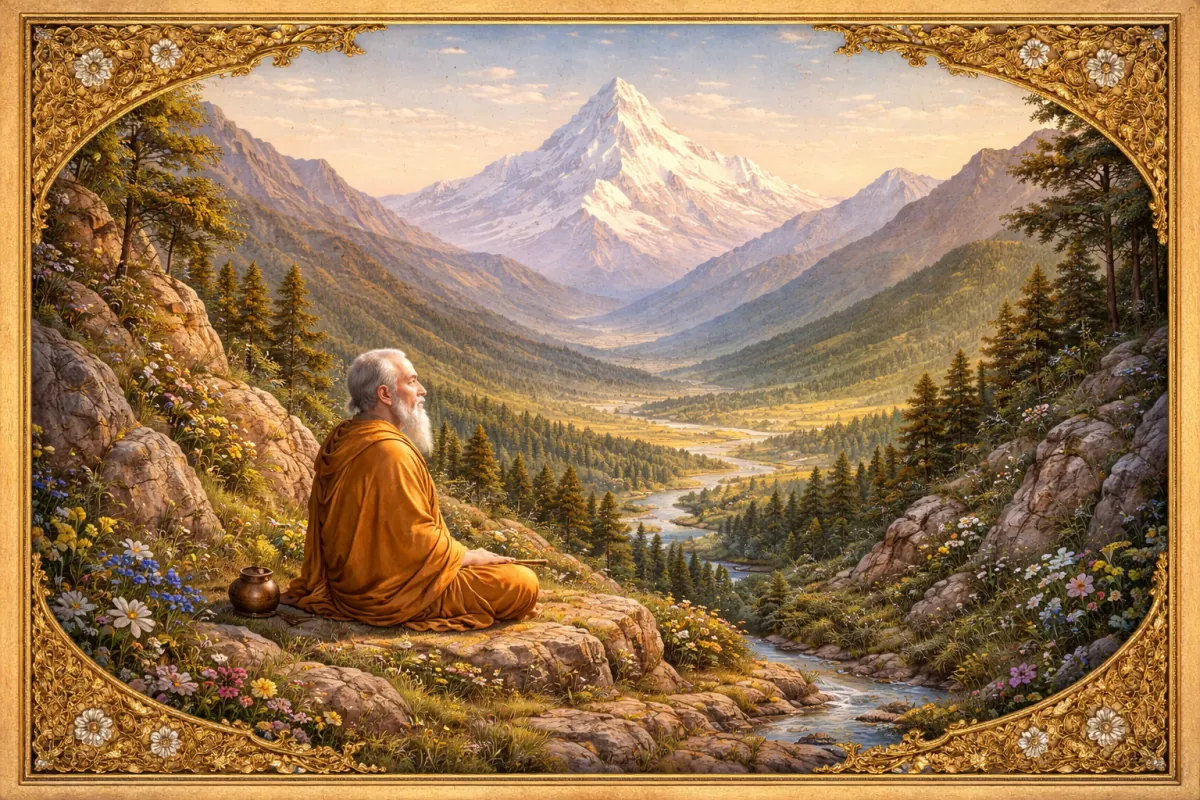
When you engage in meditation, you may have various experiences. Classically, these experiences are called bliss, clarity, and emptiness.
During meditation, you may experience joy or intense bliss. Sometimes it can last continuously and be so strong that you feel like singing or rejoicing for no reason. However, a yogi should not become captivated by this experience or become attached to it. It is believed that if one stops practicing and becomes absorbed in this joyful state, the most one can attain is rebirth in the world of samsaric gods. Of course, this cannot be called liberation.
The second experience is clarity. When your consciousness deepens, you have visions of deities or subtle meditative experiences, and a feeling arises: “Wow! Amazing!” You want to cling to this state, go toward it, look at it, contemplate it. But yogis say: “Do not hold on to it, do not cling to it. Observe it detachedly, do not keep it in your consciousness.” That is, your inner experiences should not capture you or change your behavior. Each time you must go deeper and deeper and observe them, thinking: “This is not the true state. I must go deeper; I must not stop here.” You must not become attached to anything at all, to any meditative experiences, because the state of Clear Light is a state of absolute non-attachment, absolute transcendence. If you become attached to lower meditative experiences, you turn away from the path of liberation.
It is like setting out for the summit of a mountain, for example Everest, but on the way you see a beautiful view of some valley that so delights and captivates you that you decide: “Very well! I suppose I’ll stay here; I don’t need anything else.” On the spiritual path, too, there are many different traps and dead ends, so one must study the teaching deeply and be guided by the instructions of saints and Teachers. It is unlikely that you will be able to reach the goal on your own, unless, of course, you were Shakyamuni Buddha in a past life.
The next experience is emptiness. This is the highest experience. Only a high-level yogi can attain it. Emptiness fascinates and draws one in, like a hypnotizing abyss. However, even this experience should not be clung to. Saraha said the following about this:
“One who is attached to material objects is like a cow. But one who clings to inner emptiness is even worse.”
The natural state is beyond these three experiences. Clinging to emptiness will lead to rebirth as a god of the formless world. Perhaps from the point of view of human beings this is wonderful, but from the point of view of liberation it is also a drawback. It is a static state in which such a yogi will spend many thousands of years as formless consciousness, but there is no evolution of consciousness there.
If a disciple clings to such experiences, the Teacher gives him instructions and tries in every way to awaken his awareness so that he does not cling to any states. Every meditator should know this as a basic textbook truth.
Questions and Answers
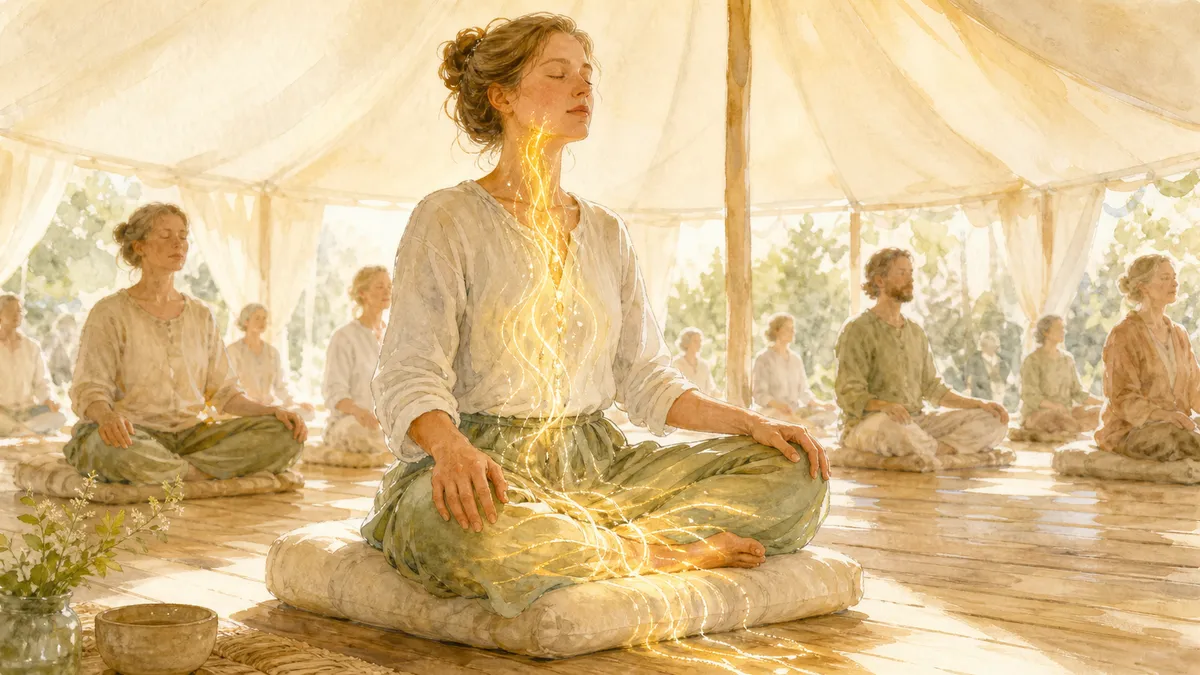
A question was asked about pain in the legs. This is normal. It is also connected with the fact that you practice shakti yantra and kundalini yoga. When you practice meditation on emptiness, there is slight (tolerable) pain. When you practice kundalini yoga, shakti yantra, several times more energy rises (especially during collective practices), the nadis are quickly purified, and this is accompanied by the movement of prana. And since the channels are still narrow, such pain arises. But this sensation is normal. One could say that your sins are hurting; they are coming out, and this is accompanied by pain. But when purification takes place, the pain will also go away, and then you will be able to sit for three to five hours, experiencing lightness in the body. A moment comes when meditation lasts continuously and is accompanied by joy.
Question: “Is it possible to enter emptiness immediately?”
Partly, yes. This happens if the upper chakras are activated and there is a predisposition from a past life. However, this is not a complete experience, but a partial one. In any case, everything will still unfold gradually. When emptiness is realized over a long period, at first it will give joy, bliss. Then this joy will grow into depth, and so the experience of clarity will arise. Only after that will the experience of genuine emptiness come. That is, bliss, clarity, and emptiness are degrees of deepening the clarity of our consciousness. But sometimes, because of innate inclinations, some of us may experience one aspect or another more quickly.
Question: “In Laya Yoga, do Guru-disciple relationships exist, or do they exist only within the framework of an ashram? In other types of yoga, training follows the Guru-disciple line, but not necessarily in ashrams. For the most part, does discipleship exist in Laya Yoga?”
In Laya Yoga, there is such a system of practice: monks are generally considered disciples, while laypeople are considered those who have taken Refuge. In rare cases, laypeople are also considered disciples if, in some way, they develop close contact with the Guru. But in general, a disciple is subject to very high requirements, which are difficult for laypeople to fulfill right away. Therefore, one can become a disciple, but not immediately—only after some time—because the status of a disciple implies very great responsibility.
A disciple is someone who comes, prostrates, and says: “I offer you my body, speech, and mind; I ask you to lead me to liberation by the path you deem necessary.” The Guru may say: “Very well, I consider it necessary for you to sit in retreat for three years. And you need to enter it in a couple of months.” You will say: “Oh, I have a family, I have children, I have an apartment, I have a job.” The Guru will reply: “Well, then think for yourself.” It is easier with monks, since they can carry out the entire practice program. Therefore, traditionally monks are considered disciples, and laypeople are considered those who have taken Refuge. Which status to choose is a personal matter for everyone. Nevertheless, practicing in any status, we progress and benefit ourselves.

Question: “But do those who have taken Refuge maintain a connection with the Guru?”
Of course, the connection certainly exists. It simply does not imply obligations. Monasticism implies obligations, while taking Refuge does not imply obligations, apart from the basic Vedic principles.
Question: “How can one master atma-vichara more quickly?”
I recommend everyone to undertake a seven-day practice of atma-vichara on their own. Three sessions of seated meditation, and the rest of the time in motion (while walking). You can make your own schedule. For example, three sessions lasting one to two hours a day (in the morning, at lunchtime, and in the evening). At other times, you can go outside and wander around, but at the same time steadily maintain the awareness of “I,” remembrance of yourself. And you need to try to maintain the sankalpa of atma-vichara without being distracted for even a second.
Question: “And what is atma-vichara?”
Atma-vichara is what you should have been practicing just now. It is self-inquiry, when you concentrate on the sense of “I.” You hold on to the sense of “I” and try not to deviate for even a moment, and if you notice deviations, you return. When you walk, you give yourself a task—for example, to walk these hundred meters to the stop (or metro station) and not lose atma-vichara. You break the distance into several segments and walk them. When you have completed one segment, you again give yourself a task: “Reach this store and maintain aham-vritti.” If you practice this way, it is extraordinarily difficult at first. You will see how the mind slips out of control. However, your intention will lead to atma-vichara, after a week of practice, if you do nothing else, being maintained at the level of peripheral remembrance. But the question is how to maintain atma-vichara even outside retreat states—that is, when you are working, communicating, and engaged in other things.
When you practice atma-vichara, it activates the sahasrara. The sahasrara gives an upward flow from below upward, which may be accompanied by a feeling of ascending currents through the body. But the principle is this: if you are practicing something (let us say, atma-vichara), you simply stay with the theme (atma-vichara), and ignore all other sensations. It is important to be able to single out the object of meditation and ignore all extraneous objects. This is similar to tuning in to a wave using a radio receiver: you need to isolate a specific signal and stay only with it, completely ignoring all other radio stations.
Question: “Will these sensations remain?”
Yes.
Question: “When you feel your body as a form filled with prana, is that presence?”
Not exactly. There are stages of the practice of the natural state when the body is included in contemplation. But these sadhanas are complex; they are connected with the ability to unite contemplative presence with the sensation of energy in all five centers of the body. Then we feel both the body and contemplation simultaneously. This principle is also called “maha-sukha” in tantra (emptiness and bliss, or great bliss). Bliss arises from the circulation of energy; emptiness arises from contemplation. And when we have opened presence, then at the stage of tantra we work with how to unite contemplative presence (the emptiness of awareness of our “I”) with energy. Then we attain a state in which energy begins to open wide inside our body, and therefore we can experience everything: the element of wind, the element of all-fire, the element of all-water, the element of all-earth, the element of all-space. Then we are no longer bound by the physical shell; we realize ourselves as the five great elements. And when contemplative presence has fully united with the elements, the yogin experiences in his body the energies of the five wisdoms, the five enlightened states of mind. But when we simply feel the body being filled with prana, this is an ordinary result of practice, expressed in an increase in the level of energy.
When the nadis are purified, you experience various kinds of bliss. There is male bliss and female bliss. Male bliss is difficult to control; female bliss is softer. There is also the bliss of the channels. In the section on shakti yantra, these kinds of experiences are described in detail. However, presence is our mind without boundaries, our openness of awareness, like the sky. It is not connected with anything, yet it can be applied to everything. This is a state beyond duality, beyond concepts, beyond subject and object, beyond the experiencer; nevertheless, it can be integrated with any experience.

Question: “A question about the ‘minuses’ from yesterday’s lecture. As I understood it, minuses are when we lose energy. We still perform the actions that lead to a minus. Is it possible to somehow become aware of them and neutralize them?”
Yes, we must be flexible. If we cannot defeat these minuses head-on, we must choose tactics and a strategy such that, at the very least, we neutralize their impact. And a true yogin always analyzes his state and thinks about how to strengthen the pluses and neutralize the minuses. Suppose that, in the specific situation you are in, you cannot avoid polluting the channels; then this is a minus. But as a yogin you cannot put up with this; at the very least, each time you pollute the channels, you can purify them, for example by doing asanas, wind training, and so on. Then for every minus we can introduce an antidote; we can set something against it. In this way, the minuses are gradually neutralized.
If you cannot avoid unnecessary communication, then at least you can try to turn it into practice: to remain aware during it, to practice sankalpa. An experienced yogin identifies the weak points in his life where there are especially many such minuses, and tries to make precisely these weak points a time of special practice, so that they do not take away time and awareness. We must accumulate energy, purify the channels, and lead an impeccable way of life, not allowing the five thieves to scatter our mind and energy. However, our conditions often do not correspond to such an impeccable way of life, so we work with what there is, trying to reduce the number of minuses to a minimum, and to neutralize those that remain.
Question: “This is about inharmonious communication. Is it possible to imagine the situations that occur during communication as a game or as a dream?”
Yes, when you practice, the only method that will allow you not to identify during communication or in the process of any activity is the practice of play. The practice of play means that you maintain inner awareness, while not identifying with what you are doing. That is, we are guided by the principle of “doing without doing.”
Question: “And specifically in the family, is this practice of play possible?”
It is precisely in the family that it is possible. Suppose you live among monks; there is less need to play there, because everything is clear there, and they also look at you differently. But in the family it is precisely necessary to learn to play, since if someone does not share your spiritual life, you need to mask it and look for some acceptable forms of expression in order to remain in a harmonious environment.
Question: “Tell me, is vegetarianism an indispensable condition? Russia is not India, after all, and the temperature conditions are completely different.”
As long as you are a practicing layperson, it is simply a desirable condition.
Question: “And if there are indications for eating meat?”
This is all individual. If there are some health problems and the intake of protein food is necessary, then meat can be used. But if your energy level rises, then you will easily be able to get by on plant-based food alone. The problem is that meat food contains coarse energies. If, for example, you were to conduct such an experiment—spend about seven years as a vegetarian and then eat meat—you would feel something strong, angry, and fierce entering you; you would be in a somewhat agitated state, since animals are constantly in such a state. In some tantric practices meat is used; that is true. But it is used only for ritual purposes, it is consecrated beforehand, and it is used by high-level practitioners who possess presence and a high level of energy capable of sublimating such rajasic energy.

In my view, the most harmful thing is unconsciousness. When you are aware, your own wisdom appears in the body and in the mind, when you know what you need and what you do not need. The body, if it is purified, is an infallible instrument; it feels what harms it and what benefits it.
At first it is advisable to perform these practices separately; afterward you will be able to combine them. The meditation “All dharmas are illusion, a dream” strengthens the feeling of the inner observer, and then roughly fifty percent of your attention goes toward awareness of the external world, which you acknowledge as a dream and an illusion, and roughly fifty percent of attention is given to the external observer. If some situation manifests very actively, then you also bring your attentiveness outward in order to somehow sublimate this activity and not lose control. When a situation manifests passively, you go more inward and concentrate on the inner observer, on atma-vichara.
Question: “What does ‘dream’ mean? How should this be perceived?”
No lengthy explanations were deliberately given regarding the sankalpa “All dharmas are illusion, a dream.” It is assumed that it works by itself if you apply it. You will feel this yourself. It means that you constantly attune yourself to seeing in this way. You recall any situations in dreams that you remember and interpret what manifests in this world in the same way. For example, when something appears that makes you angry or, on the contrary, makes you happy, you simply superimpose a certain perception on it: “All this is an illusion, it is like what happens in a dream, it is a dream. Remember and do not forget that this is only a dream!”
Question: “That is, that at any moment all of this can fall apart? In that sense?”
Not exactly fall apart. It may continue as well. But if it is a dream, then it is a dream, even if it does not fall apart; that is, it has no significance. A dream may not fall apart, but if you have awakened in the dream, then you understand that all of this is a chimera, and therefore you no longer identify with it. Suppose you practice dream yoga and have awakened in a dream: you see people and so on in the dream, and you may even be seized by a certain euphoria from understanding that all of this is unreal. You may want to joke with someone or do something to test it, and you will no longer take the objects around you seriously. In the same way, if you practice sankalpa in the waking state, after some time a clear feeling of unreality will arise in you, with the only difference being that here you do not need to test it or behave in some inadequate way. All of this is an illusion, a dream; however, if you want to eat, you will not be able to say that everything is an illusion—you will still have to eat.
The Depth of Sankalpa Practice
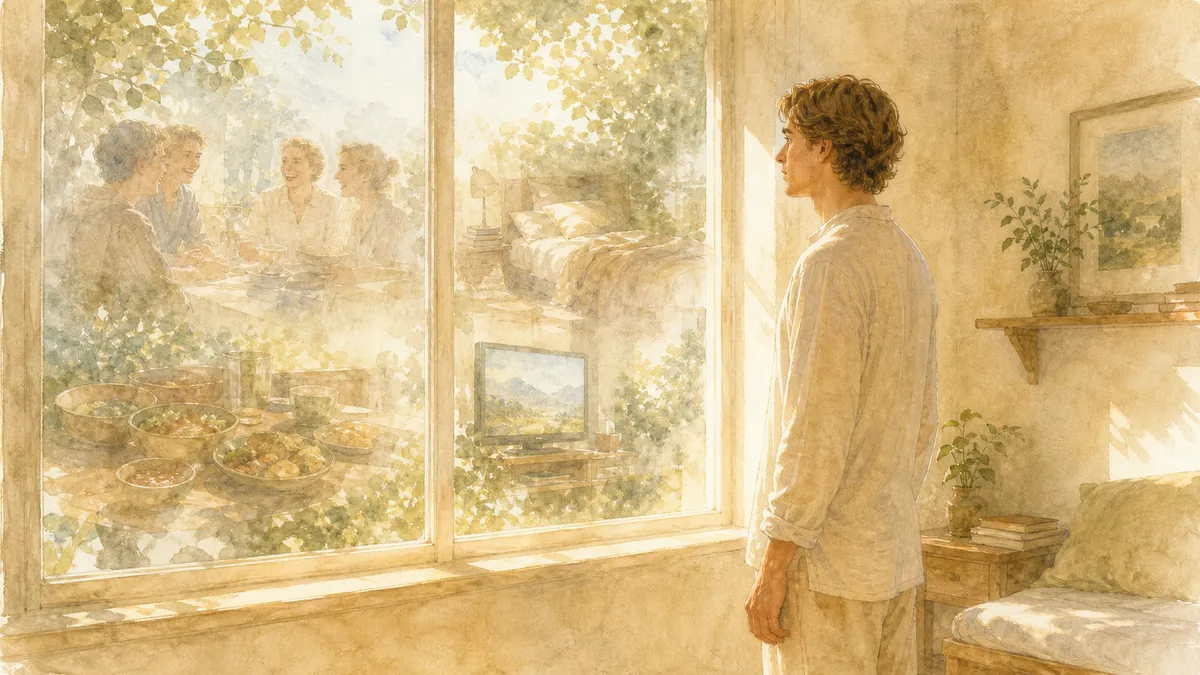
When practicing the sankalpa “All is illusion, a dream,” a very deep mystical feeling arises, your attentiveness continuously grows, and you do not identify with anything. Whether you see friends and relatives, eat or sleep, drink or watch television—you perceive everything as a dream, and this means that a subtle attentiveness is brought to the surface of consciousness, one that interprets any sensory data differently. And this subtle attentiveness does not allow you to identify with anything. You do not cling to anything. You understand: “Since this is a dream, all of this is not different from my subconscious. All of this is unreal; it must not be taken at face value. One must simply observe and not get drawn in. One must constantly remain awake, remember oneself, and not lose oneself in this dream, because if I lose myself, I will become part of this dream, which is disastrous for a practitioner.”
To be awake and continuously remember this dream means to constantly remain in a state of inner awareness, abiding in the role of the inner observer. And after some time, a very deep mystical feeling arises in you, when you do not identify with anything manifested even for a second, and the memory of the inner “I” also grows until all attachments and illusions begin to fall away. You yourselves must determine what is important for you in this dream and what you need to leave behind. Moreover, when you practice this sankalpa, you should think not that you are inventing it, but that the world is actually unreal and similar to a dream, that it is in fact a manifestation of your consciousness. This is the greatest and most astonishing discovery for a yogin. When he discovers this, nothing remains the same; he already looks at any object and smiles, thinking: “Yes, I know what you are, I know how to relate to you.” Nevertheless, in a relative sense, the yogin understands that there are dreams that must be developed and deepened, and there are dreams that must be purified. He does not lose his head. For example, this seminar is also a dream. But it is a dream toward awakening; one might say it is an auspicious dream. Therefore, in the course of our life, we improve the quality of our dreams.
Question: “Are maya and dream one and the same?”
Yes.
Question: “And is the state of wakefulness when a person no longer returns, or can he descend to a lower level?”
If it was a brief moment of nonduality, it may not be enough to melt the ego and the dualistic notion. Ramana Maharshi said this: “Manonasha must occur—the destruction of clinging to the ‘I’ and individuality.” Then a return to duality is impossible. In order not to return to duality, we constantly maintain contemplative presence.
Question: “Are there any recommendations regarding time? How long must one abide for manonasha to occur?”
It is believed that five hours of nirvikalpa samadhi in the Clear Light (samadhi with cessation of breathing) is sufficient to destroy all clinging. However, these are all general criteria, since everything depends on past karmas. One saint awakened upon hearing the “Vajracchedika Prajnaparamita Sutra” in the marketplace. There are souls for whom only a hint is enough, whose mind opens wide due to the fact that they possess enormous merit from past lives, and vice versa.
Making Decisions from the Natural State
There is such a principle: when we make a decision, we must first make a choice, having thought it over, based on the wisdom of our natural state. If we believe that work under these conditions is necessary for us, that it cannot be avoided, then we accept it as part of our practice. If we believe that it is a serious obstacle, and we have the possibility of avoiding it in order to lead another, more favorable way of life, then we reject it, based on the wisdom of the natural state. It is important to make such a decision at the level of values. Once the decision has been made, we fully accept it as practice. Suppose, if you have decided to work, then, at the very least, you should unite work with the natural state, regard it as part of practice, when any situation is suitable for contemplation. And when the power of consciousness gains more strength, then one can also change the conditions.
