

Now we will talk about very important matters concerning the teachings of Laya Yoga, and in the next lecture — about the qualities of a disciple necessary for comprehending the teachings of Laya Yoga. Since the teaching is very precious and transcendent, in order to fully enter into the practice of the teaching, we must change and prepare ourselves. In other words, when we merely hear about the teaching or practice it for the first few years, we are not practicing the teaching itself, but training in order to change ourselves, to become fully prepared for the practice.
The path of liberation and enlightenment, which is set as the goal in the teaching, is a very high summit. At the beginning, we do not even imagine how high it is. It is like when we are going to conquer Everest: we know that in order to do so we will have to prepare very well (purchase equipment, learn the technique of ascending to the summit, and so on), and that this is far from easy. And if we take this preparation lightly and do not give it proper attention, everything will end at the very foothills. Attaining liberation is a much more global goal than conquering Everest or anything else of that kind. Therefore, we must not only study the teaching, but also truly work on ourselves. Such preparation is called “preliminary practices” or “the necessary qualities of a disciple.” But now we will talk about the essence, or the very heart, of the teaching.
The Teaching of the Mahasiddhas of Sahajayana
The teaching of the Mahasiddhas of Sahajayana is the quintessence of Hindu and Buddhist Tantra. The Mahasiddhas of Sahajayana gave an entirely special path for realizing liberation. It is also called Anuttara Tantra. Anuttara means “supreme” or “transcendent.” Tantra means “a single thread” or “a liberating method.”
So, what do the saints who practice the path of Sahajayana, to which Laya Yoga belongs, say? They say that living beings live as if in a dream. Not merely as if, but literally in a dream. If you practice or study various teachings, you have probably heard many times that until a person attains enlightenment, he is like one who is asleep, and that various teachings and religions propose various methods of awakening. This is so. However, the view of the Mahasiddhas is based not so much on methods as on understanding. They say: “We only need to awaken, as one awakens from sleep, and understand that the entire surrounding world was never reality from the very beginning.”
On the gradual path, we need to purify ourselves and hope that someday, if we accumulate a sufficient amount of merit and rid ourselves of sins, we will be able to count on the Heavenly Kingdom. On the gradual path of yoga, a certain amount of time is required to change oneself and enter samadhi. And someday in the future, with the help of samadhi, we will liberate ourselves. From the point of view of Anuttara Tantra, our primordial foundation already exists, and this world that we perceive is already the heavenly kingdom. However, we do not understand this.
Two Ways of Perception
There are two ways of perceiving the surrounding world. The first way is deluded perception, and the second way is liberating perception. Of course, the way in which all living beings perceive the surrounding world is deluded perception. It is precisely because of such perception that we have to be born, suffer, die, and be born again. The wheel of samsara is nothing other than deluded perception.
So, if we perceive phenomena, including the subjective feeling of our “I,” as if they were something independent, self-sufficient, existing by their own nature, then we are deluded; we have deluded perception. When we consider our “I” to be something real, something unambiguously fixed and true, we are mistaken regarding our own nature. It is said: “If we are mistaken regarding our own nature, then we are mistaken regarding everything.” In other words, the state of an ordinary living being is a total error, a total unawakened state. And when such a total error occurs, the process of samsara exists.
There is another way of perception — liberating perception. In classical terms, this is called sahaja samadhi. The state of mind of a saint can be defined as sahaja samadhi.

Types of Samadhi in Laya Yoga
In Laya Yoga, the attainment of various types of samadhi is traditionally set as the goal:
- At a minimum, this is savikalpa samadhi, when a yogi can leave his body, departing into subtler states
- A higher level is nirvikalpa samadhi, when a yogi can enter the state of nonduality
- And, finally, sahaja-samadhi, when the yogin remains in non-duality even in everyday life; that is, he does not leave non-duality even when he eats, speaks, walks, sleeps, or works
It is precisely sahaja-samadhi that is the desired goal for a practitioner on the path of laya yoga, the path of the natural state. The perception of a saint in sahaja-samadhi is liberating perception.
At first, the aim of the spiritual Teacher is to give the disciple a pointing-out instruction so that he can cultivate this state, recognize it as his own, and work with it until he fully enters into it.
Liberating Perception
Thus, if all phenomena, including the subjective sense of one’s “I,” are recognized as an empty manifestation of space and light, then this is liberating perception. All phenomena (houses, trees, clouds, people, our own body) seem to us to have independent being, to exist in and of themselves; all this appears to us as a scattered heap of different objects. There is always an opposition: “I” and the external, “I” and the outer world. And there is always conflict between them.
In reality, all phenomena, including our body and “I,” are immersed in space; their basis is the single space of consciousness. If we imagine a vast ocean, then in the ocean there are small and large fish, and there are also boats, ships, motorboats, ocean liners, and seaweed, but all of this is within the space of the ocean and has never been separate from it. In the same way, all visible phenomena are inseparable from the space of the primordial Ground. This primordial Ground is always empty; its quality is light or luminous clarity. And when we recognize this Ground as empty luminous space, this is a liberating type of perception.
It is said that if a yogin abides in the state of the Ground, he abides in his own natural state, because this empty Ground is our natural state. Thus, to practice laya yoga means to abide in the natural state of the empty Ground of all things and of one’s own “I.”
Direct Introduction and Deepening of Understanding
At first, when the disciple does not understand what the empty Ground is, the Teacher helps him awaken to its perception. This is called “direct introduction” or “showing reality as it is.” However, even if such reality has once been shown, the disciple must deepen his understanding of it, since his understanding may be shallow rather than deep. Therefore, he is given a specific task, for example ulasa—special expressions, paradoxical tasks with which the disciple then works. And until he receives the answer, his understanding will remain shallow.
Finally, when the yogin has deepened his understanding, he needs to work with sustaining it, with abiding in this natural state, because external objects and the deluded mind constantly try to draw him out of the natural state. This is the meaning of the practice of laya yoga.

Attitude Toward Experiences in Meditation
On the path of practice there are various experiences; for example, during meditation one may see light, deities, or spirits. But if we speak about the essence of meditation, we are not interested in experiences at all, even the most wondrous ones, because experiences belong to the plane of duality. They arise in the karmic vision of the subject as a result of the play of energies in the channels, and thus are a manifestation of the subject itself. As long as there is a subject, there will be experiences. Experiences are such because of the subject, and the subject is such because of experiences. There is an interdependence between them, through which the world of duality, the world of samsara, exists.
But when we move away from attachment both to experiences and to our own “I” (the subject), we enter the world of non-duality, the world of the primordial Ground; therefore it is said: “Do not attach significance to any experiences, but seek their Ground.”
When we train in practice, we do not attach significance to experiences, but try to reveal their basis. Whether we see gods on the altar, our friends or relatives, ourselves in the mirror, or perceive wondrous experiences in meditation—all of this is neither good nor bad. It is like seeing fleeting people and trees from a tram. The yogin seeks the single basis of any experience; he knows that until it is found, all his astral projections and beautiful visions will be merely yet more illusions. But to find that in which all this rests, to find the Source—this is the most important thing for practice. Therefore we say that, while practicing, we should find the single Source of all experiences and then strengthen our mind in abiding in it.
Everything as a Manifestation of Consciousness
In essence, whatever we may encounter is a projection of our own mind. When we abide in duality and identify ourselves with the feeling of “I” (the subject), the external world, of course, appears objective, real, and actual, but this is not so. The saints say that the entire universe of phenomena is a manifestation of our own consciousness.
Suppose, when you see me as a Teacher, this is a manifestation of your own consciousness. Perhaps it is a wiser part of yourself that is telling you something. This is precisely how, from the point of view of Laya Yoga, one should become accustomed to perceiving the world. And when you see some person you dislike, you can, of course, become angry with them. However, from the point of view of Laya Yoga, you should think as follows: “This is a manifestation of some aspect of my consciousness. It is myself, and I need to work with it, because to reject it means to continue remaining in a state of duality.”
Thus, everything we perceive is a manifestation of our own mind. When we say “our own mind,” this is also conventional speech, which can be misleading, since no such thing as “our own mind” exists.

The Nature of the Mind and the Primordial Ground
Of course, we have a mind (manas) — this is the conceptual apparatus with which our “I” is most strongly identified. The false ego (ahamkara) includes ordinary things: the conceptual mind (manas), subtle intuition (buddhi), consciousness as a whole, and memory (chitta). However, all of this pertains to our little “I.” But when we speak of the nature of Mind or of the primordial Mind as such, this is something global and grandiose; it is the same as God in Christianity — the supreme Source of Being.
As soon as we analyze our own mind a little, we will see that it is not substantial, that it rests upon something more global, more fundamental, that our own mind is merely a certain part of the iceberg, a very insignificant part of ourselves. When we analyze, engage in self-inquiry, for example by performing the practice of atma-vichara, concentrating on the feeling of “I,” we may discover that as soon as we investigate the mind and try to understand its nature, color, form, and any qualitative characteristics, at the very moment of investigation this mind falls apart, and behind our ordinary mind and little “I” there is some global and incomprehensible cosmic Ground, which is empty and in which there are no specific qualities.
Nevertheless, this is not a negative emptiness; it is a fully positive state, and all qualities arise from it. The longer we engage in such self-inquiry, the more we come to the conclusion that the foundation of our “I” is completely empty, that it lies beyond ordinary concepts, and that this vast ocean of cosmic consciousness, which we had not even suspected before, always exists within us. Practicing self-inquiry, we begin to come into contact with it and understand that, compared with this vast ocean of cosmic consciousness, our superficial “I” is like a speck of dust; it is so insignificant that identification with it is like a dream, like a fundamental delusion. Yet this is precisely how our life passes — in continuous identification with this speck of dust, with the false “I” based on the feeling “I am this body.”
Knowledge of the One
There is a saying: “If you know the One, you know everything.” To know the fundamental basis of the nature of Mind means to know the One. To know the One means to know that this Ground is nondual, that apart from it there is nothing. Therefore, in Advaita Vedanta they say: “Sarvam eva Brahman” (All is Brahman). And Brahman is the very deep awareness of the subject.
Therefore, when we discover this Ground, we find that there is no dichotomy in it, no duality, no subject and object, that it is a single undifferentiated mass of consciousness. It cannot be said that anything exists in it, but neither can it be said that nothing exists. All attempts to explain this Ground conceptually fail; therefore we say that it is non-conceptual, incomprehensible (achintya) to our superficial mind. It is something paradoxical, absurd, terrifying, and beyond the mind; nevertheless, this Ground can be experienced without interpreting it.
When we know the Ground, we know everything, because from it are born galaxies, stars, universes, beings of the higher worlds, gods, hells and heavens, humans, asuras, animals, and the entire diversity of energies in the Universe. Therefore, when we enter the path of the teaching of Laya Yoga, we try to meditate constantly on this One. This is precisely the principle of nonduality.
When we discover this single state, we know the entire diversity of other states; there is no need to study magic, the life of the gods in the heavens, or anything else. Knowledge of the one Source intuitively develops any other relative knowledge, since the Source is the cause, and all other kinds of relative knowledge are the effect. If, however, we are mistaken with regard to the knowledge of this Source, then even if we possess profound knowledge of philosophical texts and certain relative things, we are mistaken with regard to everything. Conversely, even if a person does not know philosophical texts or certain relative aspects of the Dharma, but thoroughly knows the nature of his mind, he is an absolute sage.
Recognition, Not Development
There is an expression in the teaching: “Nothing needs to be developed; it only needs to be recognized.” The fruit of our practice, of our path, is already present. On the gradual paths of Kriya, Charya, and Yoga Tantra, we really do need to develop certain things, and therefore we work with the body, energy, and mind. If we do not develop the mind and do not learn concentration, we will not obtain the results of Raja Yoga. If we do not control the winds in Kundalini Yoga, of course, Kundalini will not awaken and enter the central channel. That is, on the relative levels in yoga, many things need to be developed.
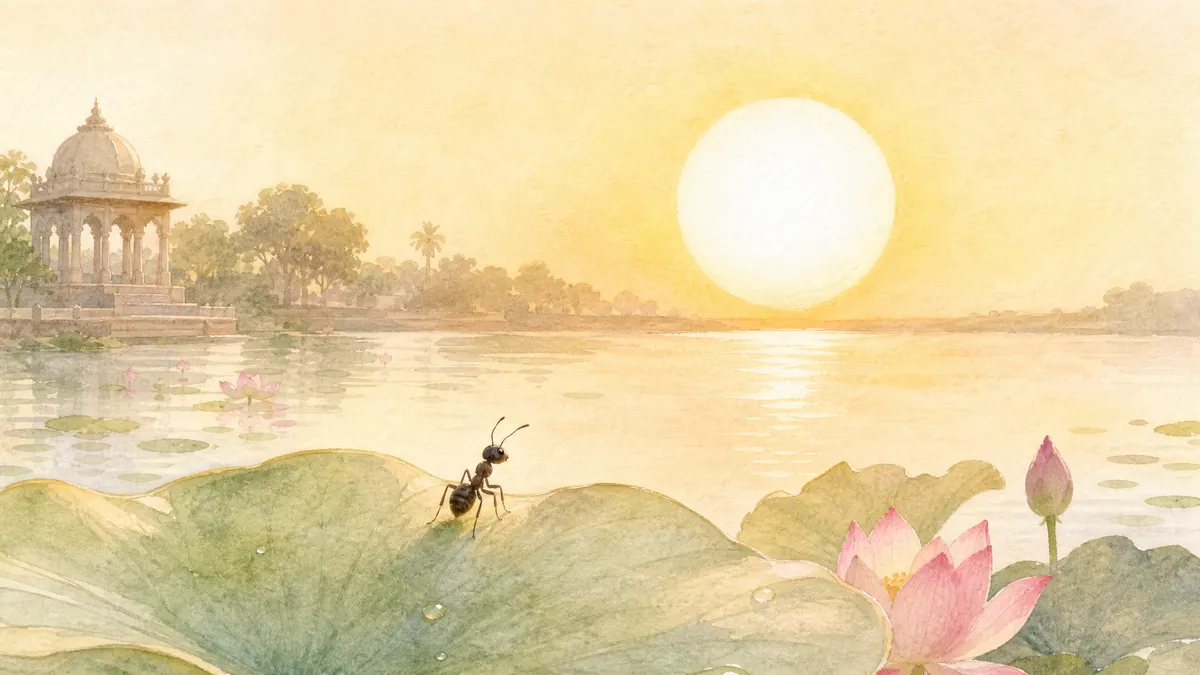
However, when it comes to Anuttara Tantra, we say that we do not need to develop anything; we only need to recognize the nature of Mind, because the nature of Mind as such is, in principle, impossible to develop, since it is already perfect. An ant cannot improve the sun; it can only look at it and see that it exists and always has existed. Therefore, enlightenment is not a process of development, but always a process of recognition, in which we recognize the fundamental Ground as such, inherent in us, which has always already existed. It should be understood that this fundamental Ground is already present, it is already absolutely perfect and inherent in us. The problem is that we do not recognize it.
Shravana, Manana, Nididhyasana
There are three main principles that we investigate when practicing the teaching. In Sanskrit they are called shravana, manana, and nididhyasana:
Shravana means that we need to recognize our primordial nature
Manana means that we need to clarify it, eliminating all uncertainties and doubts
Nididhyasana means that we need to try to constantly abide in this primordial nature
It is also said: “One must recognize, dissolve, and abide.”
What does “recognize” mean? For example, when you hear any sounds, they may seem external to you; when you see other people, they may seem to you to be something separate from you. This is called “not recognizing.” “Recognizing” means that when you see or hear anything, you are in contemplative presence, in non-duality, and you recognize all sounds, other people, everything perceived, as inseparable from empty nature; you recognize them as manifestations of your own consciousness.
If you hear angry words that disturb your consciousness, or if a situation does not unfold as you would like and you become angry, this means that you do not recognize. But if you work with this anger, try to be aware, and regard it simply as a manifestation of the fierce energy of the primordial Ground of your own consciousness, then you recognize, and your consciousness does not waver.
Dissolution and Abiding in the Primordial Nature
What does “dissolve” mean? “Dissolve” means that we oppose any external influences or any internal intentions with our primordial nature until any experiences are dissolved. In other words, we do not allow any feelings or emotions to take possession of our consciousness, but constantly dissolve them.
Here is an example. Suppose you experience great joy. If you become carried away by this external joy and rejoice in the ordinary way, then you do not dissolve it. But if you unite with the joy and remain aware, you discover that the joy has a certain basis, that it is situated in something more global, and that this basis is the empty space of your own awareness. Then you dissolve it, that is, you shift the focus of your awareness from the superficial joy to its Source and try to establish yourself precisely in it, and not in the most peripheral joy itself. This does not mean that you do not rejoice at all. Rather, it means that you rejoice and allow everything you experience, while nevertheless remaining in the presence of awareness and not losing the Source.
Finally, the third principle, “to abide,” means that the yogin strives always to remain in contemplative presence. To be in contemplative presence means to continuously be aware of oneself as an empty, aware space from which everything manifests, to always abide in the nature of Mind.
To always abide in the nature of Mind is both the goal of practice, the path, and the fruit. Even when certain techniques, visualizations, offerings, and so on are performed, these are auxiliary means on the path of Laya Yoga; that is why we say that everything must be unified. If we do asanas, then we must abide in the nature of Mind while doing asanas. If, however, we forget the nature of Mind and simply do asanas because yoga classes are beneficial for us, then we will probably receive benefit on the relative level for the physical body, but this can in no way be called Laya Yoga, Anuttara Tantra. That is, we have completely failed to understand the principle of the teaching; somewhere we have missed the mark entirely. Conversely, if we maintain contemplative presence, abide in the natural state without distraction, then it is not so important whether we do asanas or not. If our consciousness is not distracted, it means that we have deeply understood the principle of the teaching.

View, Meditation, Conduct
There are aspects of the teaching such as view, meditation, and conduct. It is very important to understand what they point to. View cannot be called philosophy, nor can it be called a Symbol of Faith; nevertheless, it is very similar to a philosophical worldview and to a Symbol of Faith. However, in Laya Yoga the view is non-conceptual. View means that we try to look at the world through the eyes of saints, through the eyes of mahasiddhas. And what kind of gaze is this? It is the gaze of nonduality, a gaze beyond concepts. And when the Teacher explains the nature of nonduality, gives instructions on Advaita, we somehow become imbued with this view. Moreover, when we develop and deepen this understanding to the point of the non-conceptual, it can be said that we have acquired such a view. If we have simply received the Teaching on nonduality or read books on Advaita, it still cannot be said that we have the view. You may be a good philosopher; nevertheless, view presupposes the realization of non-conceptual awareness. This is a quite definite state, and the Teacher can say whether a student has it or does not have it. For example, at this retreat, I give the students who have taken Refuge the task of reflecting in their free time on certain sayings. As a result of such reflection, an answer should arise in you. If you have acquired the view, you receive such an answer. If you do not have the view, then your answer will be incorrect.
Thus, view means stabilization in the state beyond concepts. The state beyond concepts and the understanding of nonduality are the basis for further practice.
The next aspect of the teaching is meditation. Meditation is a specific practice that should be performed, for example Mahashanti or Atma-vichara. Meditation allows us to truly experience the view. Even if we have some glimpse beyond concepts, this is not enough. It must be developed and nurtured. When you sit in meditation for a long time, your view becomes a personal experience.
Finally, the third aspect is conduct (kriya). Conduct is how we realize our knowledge in life. It is said that the teaching should penetrate every aspect of our life. It is not something detached. If we abide in the nature of Mind and merge with space, rather than identifying ourselves with the body or with objects, with what arises, then the results should manifest in life. Suppose a person has assimilated the view, and he seems to meditate, but years go by, and anger and attachment remain in him; in everyday life he still behaves like an ordinary samsaric being. Can it be said that the Teaching has penetrated his life? Probably not. Practice should affect our life in such a way that our fixation on our ego (selfishness) weakens, our values and plans change, our environment changes; it can be said that everything changes in general. And one of the indicators of a true teaching is that it really changes everything genuinely. Therefore, the criterion of how much we are progressing in practice is the change in our everyday life.
The Path of Complete Transformation
Of course, if you do not set transformation as your goal, then most likely it is better not to practice the teaching, since it is very profound. To practice the Teaching means to work on one’s own transformation, to go as far along this path as is possible in principle. Therefore, the fruits of the teaching always reveal themselves in our transformation. Let us say that the highest level of transformation of the mahasiddhas was the realization of the rainbow body of light. This means that transformation has gone so far that it can even transform the cells of the physical body. Therefore, many of the mahasiddhas attained the state of supreme samadhi (saruba-samadhi), when even the elements of the physical body, at the moment of death or during life, dissolve, leaving only clothing, a lock of hair, and nails, while the physical body itself shrinks and disappears, turning into the rainbow body of light. There are historically attested facts showing that this is not a myth, but a genuinely attainable state even in our time. Thus, the teaching is complete, absolute transformation. Of course, when we approach such an exalted Teaching, we need to understand how profound this path is in order to follow it to the end.
So, when we practice, the result of the teaching always manifests in our life. Joy or sorrow, anger or love may arise, but the practitioner never again loses connection with the space of the primordial Mind, from which all these experiences arise. This means that the mind becomes flexible and accepting; we cease to identify ourselves with the false “I” and constantly identify ourselves with the subtle present awareness. Over time, we discover that it is like a bottomless ocean, and we hand over to it all rights in our life. This is Brahman (the Absolute or the supreme Source). We understand that now our task is to resubordinate our little “I” and all our thoughts to this supreme Source, to this boundless light—that is, to surrender to it completely. In fact, this is not something external, dualistic, like, for example, God in Christianity. This Absolute (the supreme Source) is the subtlest and most luminous part of our own “Self.” And the question of surrender or resubordination consists in our lower “I” resubordinating itself to our absolute “Self.” When such resubordination reaches its culmination, full realization or self-recognition occurs. The yogin recognizes himself as who he has always been, but whom he did not consider himself to be. He recognizes himself as the Absolute, Brahman, transcendental consciousness. Such recognition is the sought-after enlightenment, or the fruit and goal in the teaching of laya yoga.

This is a lecture on the fundamentals, which should be clarified for oneself so that further practices are based on a solid foundation. If there are no questions, we will conclude it.
Questions and Answers
Question: “What is the source of the lower ‘I’?”
The higher “Self.” It is the source of everything, including the lower “I.”
Question: “When the lower ‘I’ tries to dissolve and goes into the common Consciousness, does that mean the game will end? Is this an attempt to leave the game, to leave maya?”
What, in fact, do we practice for? The game cannot end, because the higher “Self” always manifests. However, now it will manifest in a pure and absolute way, without harm to the lower “I.” There is a great difference between holy mahasiddhas and suffering living beings in the hells and in the world of humans. In the second case, the lower “I” is not integrated into the higher “Self,” and therefore there is a rupture with the Source, the illusion of individual self-existence, and suffering. In the first case, the lower “I” is fully integrated into the higher “Self,” and the energies also manifest, the game (lila) continues, but now it is completely free. For example, a saint can also manifest a physical body and send it to any worlds, yet this body is inseparable from the Source, it does not forget itself, it is completely subordinated to it, it has no false idea of separateness, and it never suffers. A deluded living being, of course, suffers; it has a sense of separateness. There is no contradiction here.
Question: “So the game does not end at this point?”
The game is endless. And the game (the manifestation of universal energies) is an inherent quality of our “Self.” Therefore, realization is not a return to an unmanifest void. Saraha spoke about this as follows: “Those who are seized or attached to material external objects are like a cow; those who are seized by unmanifest emptiness are even worse.” The question is that, while abiding among objects, among the diversity of universal energies, one should not allow the Source to be lost, nor be stained by all of this. This is the true game. Moreover, the true game (lila) begins only in this state; before that, it was not the game of the Absolute, but krida, that is, a controlled game according to the law of karma, when you are controlled by deities, your own mind, and other living beings. Krida is a conditioned game according to someone else’s rules, according to the law of karma, whereas lila is an unconditioned game. Neither karmic beings, nor Yama, nor the gods of passion control you, because you are inseparable from the Source. All activity in the manifested world is a manifestation of your creativity. If, however, we take an ordinary living being, is that really a manifestation of creativity? It is an oppressed state of complete bondage to karmas.
