

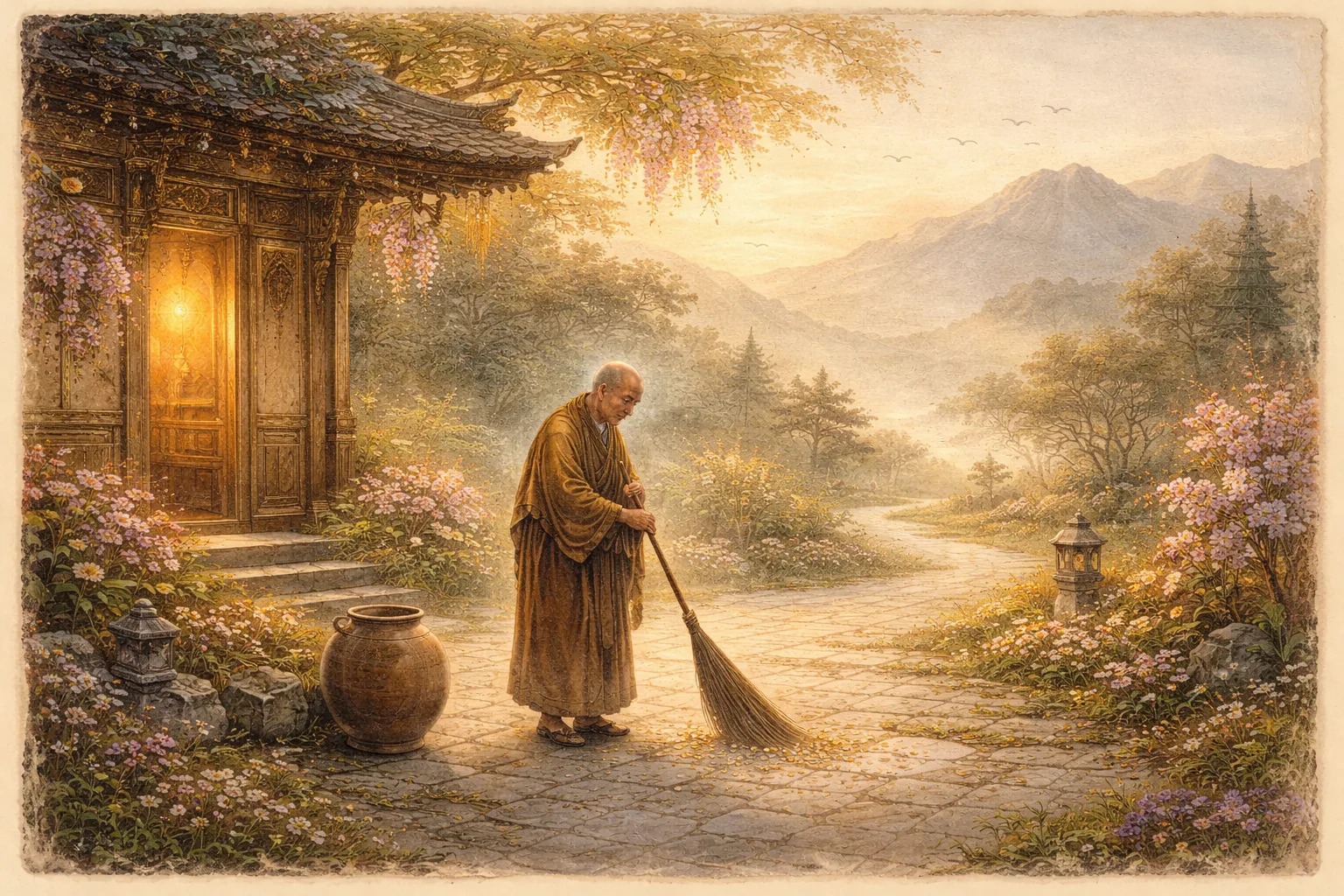
From the very first moment of entering the monastery, one should live in such a way as to ceaselessly safeguard one’s mind. The practice of monastic work consists in continuously safeguarding one’s mind. One who does not safeguard his mind, even if he wears a sanghati, is not a monk. One who is accustomed to safeguarding his mind, even if he is not a novice and does not have a monk’s vows, is a true monk.
Safeguarding one’s mind means that we constantly separate the wheat from the chaff in our consciousness. This is an unceasing battle for awareness. No matter how many kleshas, fluctuations, doubts, or difficulties may arise, we must always safeguard our mind and separate its pure nature from everything that is samsara. In fact, ceaseless purification is precisely monastic practice.
Such a safeguarded mind is purified over time, and then it can continuously contemplate the Absolute. When the mind contemplates the Absolute for a long time, it becomes saturated with its qualities, loses its corporeality, its identification with the body, with the lower layers. It becomes spiritualized, enlightened, and acquires the qualities of the Absolute itself.
From one who safeguards his mind emanates an aura of luminosity, of radiance. He himself is a bearer of such luminosity. There is not even a shadow of the worldly in him. He is entirely permeated with light. He thinks of nothing except God. Whatever he does, each of his actions is an offering to the Absolute. Conversely, one who has not accustomed himself to safeguarding his mind from his monastic youth cannot find the path to this luminosity. He performs various practices, does service, and works on himself, but his mind is like a dog that looks first in one direction, then in another. He does not have that holy ray by which one can reach the sun.
How can one not lose this sun of the primordial mind? Only through ceaseless practice and safeguarding the mind. Since the mind is very worldly and has a tendency to constantly manifest itself in a worldly way, the monk’s task is to constantly stand guard over this mind and safeguard it.
Mindfulness, naked awareness, whatever it may be called—all of this is aimed at preserving the mind.
When we do not preserve the mind, it manifests its lower nature. In order to continuously contemplate the light of the natural state, the mind must be very attentive, and this requires work. But when we do not preserve our mind, it has a tendency to manifest the lower nature.
It happens that a person practicing in retreat begins to judge others instead of focusing on the theme of meditation. This happens involuntarily; it simply comes from within. It is simply his habit. It happens that in a monastic sangha a novice or monk begins to take an interest in matajis, to “make advances” toward them with questions. I regard this as an inability to preserve one’s mind, as forgetfulness regarding one’s choice. It happens that a monk may sort things out with another monk in some disharmonious forms. All these are different forms of an unpreserved mind. Perhaps he has gained some momentary benefit, but does he think about the consequences? Behind every unpreserved act of the mind stand hot and cold hells. One must always remember reincarnation, and that every act of unconsciousness can cost very dearly. Every klesha that is not sublimated, not self-liberated, can turn into a huge demon or a hungry ghost.
I am not saying this in order to evoke a sense of guilt in you and bring you into a state of sinfulness. A true practitioner of anuttara tantra is always oriented toward purity and perfection, so the last thing I would want is to generate in your minds a sense of sinfulness and an awareness of your own guilt. This cannot be called practice at all. But this does not mean that we should lull ourselves with thoughts that our mind is always pure and perfect. Although this is so, we must still strive to preserve our mind and truly be in this purity and perfection.
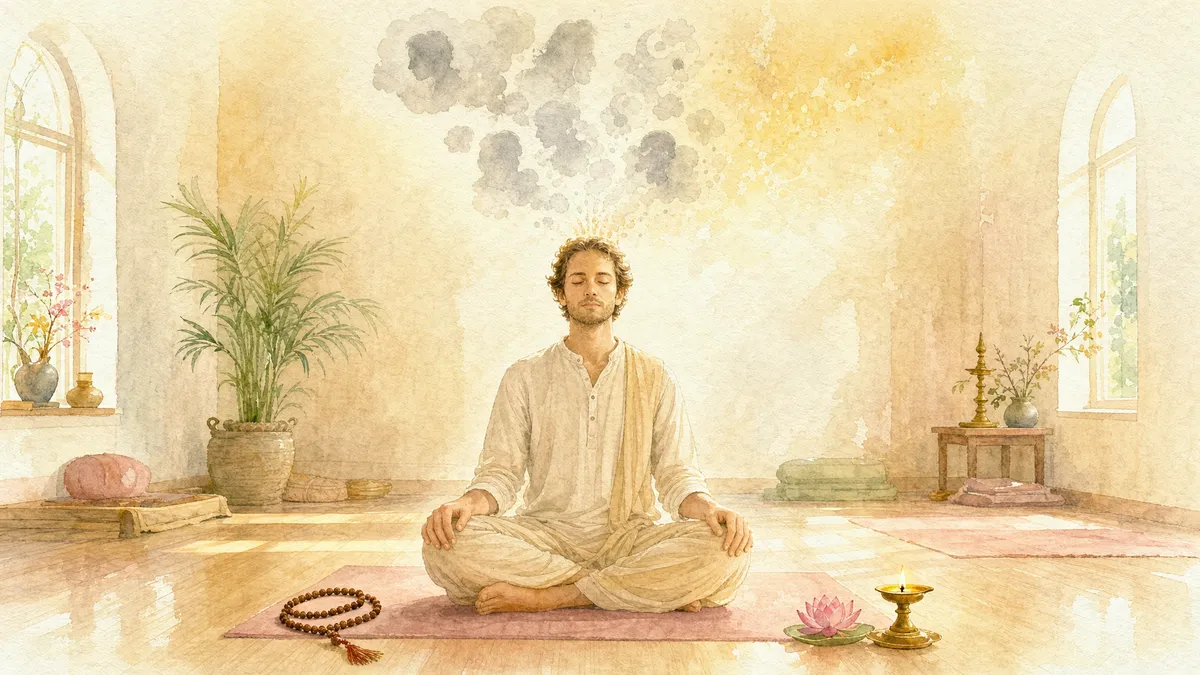
The Nature of False Concepts and Self-Liberation
Our entire problem consists in the absence of awareness of reality. Like hallucinogenic drugs or mushrooms, false concepts create illusions in our consciousness.
First one must understand what it means that “false concepts create illusions in our consciousness.” When we do not preserve our mind, we cannot self-liberate. And then we are inclined to fall into delusion, becoming enchanted by concepts. For example, we think: “This is so, and that is like this.” That is, we construct various conclusions. However, these are merely concepts. If we do not possess the secret of self-liberation, we will enter into illusion because of these concepts.
A true yogin always self-liberates any concepts, although he does not reject them. He can use them. If you have not mastered naked awareness, you can at least self-liberate concepts intellectually. This means that no concept should seize your consciousness. You must understand its conditionality and relativity and adhere to a deeper vision of awareness beyond concepts. When I said this to one mataji and gave her the practice of intellectual self-liberation, she did it and said: “Yes, you train like this and do not understand what exactly needs to be self-liberated. For example, should the Guru’s words be self-liberated or not?” I discovered that her problem was that she did not understand the difference between relative and absolute truth.
When you practice, you must clearly understand what absolute truth is and what relative truth is.
The Relationship Between Absolute and Relative Truth
I told her: “You simply need to understand how absolute and relative truth relate to each other. In absolute truth, nothing exists; everything is self-liberated. In it there are no buddhas, no saints, no Guru, no disciple, no pure, no impure, no good, no evil, no vinaya, no samaya, no subject, no object, no attainment, no bondage, no life, no death, no manifested, no unmanifested, no concepts, no absence of them, no practices, no absence of them, no liberation, no bondage. Absolute truth cannot be expressed in any way at all, and all words in this sense are absurd. They are like an echo in the mountains, like the babbling of a madman. You ask how to relate to the Guru’s words? And how do I relate to my own words? Before they come out of the mouth, they are already originally self-liberated. They are like an echo in the mountains, a rainbow in the sky, a dream, a play. This is conventional speech, vahara vachana. This is how I myself relate to them. And you should relate to them in the same way. However, they point to something.” That is, in the absolute sense, everything is originally self-liberated. There are no seniors, no juniors, no monk, no novice, no one who has attained, no one who has not attained. This is truth beyond concepts. Even to speak of it is the same as profaning it. One can only enter naked awareness, contemplation.

In relative truth, there are senior and junior, pure and impure, sins and merits, hells and heavens, life and death, novices and monks, teachers and disciples, gods and demons, kleshas and good qualities, methods of yoga, pure states and impure states, effort and effortlessness, rules of discipline, vinaya and samaya. And all of them must be applied at the proper time, without confusing them.
How do absolute truth and relative truth relate?
If we exalt absolute truth and deny relative truth, saying that everything is emptiness, that nothing exists, then we fall into an extreme called nihilism. We ignore the Absolute’s capacity for manifestation, fall into unmanifest, empty, nondual darkness, and get stuck in it. Saraha said of such people that they are worse than cows. And if we ignore absolute truth and take into account only relative truth, that is, blindly accept the laws and conventions of this world, forgetting to self-liberate them, believe that things are as they appear to us, and think that they are real, then this too is a mistake. Falling into the false acceptance of everything is a deviation called eternalism. Saraha said of such people that they are like cows.
What is the true way of practice? It is when we combine absolute and relative truth. One truth expresses vision, or view — nonduality, the Absolute, which is beyond all categories, definitions, and concepts. The second truth expresses behavior, which accords with circumstances and accepts certain rules, principles, and ways of communication. However, behavior, that is, relative truth, is subordinate to the view. That is, relative truth is subordinate, while absolute truth is primary. Therefore it is said: “The vision (or view) is boundless like the sky and fearless like a lion. And behavior is as scrupulous as finely ground flour.”
When we understand the principle of combining the two truths, all contradictions disappear. We know exactly what to self-liberate and what to adhere to, how to accept a particular circumstance, how to relate to it outwardly and in the soul. Absolute truth is in the heart, while relative truth is on the surface. That is, we do not become unbalanced in either direction.
In relative truth there exist many worlds, gods, laws, saints, and principles. If we ignore them, then in the relative world we may get a result. By violating the law of karma, one can incur the wrath of gods and demons. Whether you want to or not, you can experience this in reality. For example, by violating the Vinaya, one will later have to repent, and by eating improperly, one can worsen the state of prana. Such are the laws of the relative world. By forgetting the method of practice, one may not obtain the result. But in the absolute sense, that is, from the point of view of awareness, all this is an illusion.
Our view, our purity, perfection, and transcendence will not suffer from our taking relative truth into account, if we have fully mastered the view and our awareness is continuous and boundless, like the sky. Then in our soul we have vision and absolute truth, while outwardly we have relative truth, which helps us navigate the relative world. Since relative truth (behavior) is subordinate to absolute truth, it is like a game, because everything has been self-liberated from the very beginning. In our heart we have self-liberation and absolute truth, and this means that our consciousness and our manifestation are always flexible.
In response to the question of how to relate to my words, I told that nun the following: “From the very beginning, even before you came, I know that there is neither you nor me. But since I also manifest the relative dimension, I accept, in the relative sense, your existence and your questions, and I respond to them. And although I relate to all this while self-liberating my speech, I know that it can help, and therefore I perceive it in the relative sense as something that can bring benefit.”
When we combine absolute and relative truth, view and behavior, it means that we are not mistaken and possess the ability to unite the two parts of the Absolute.
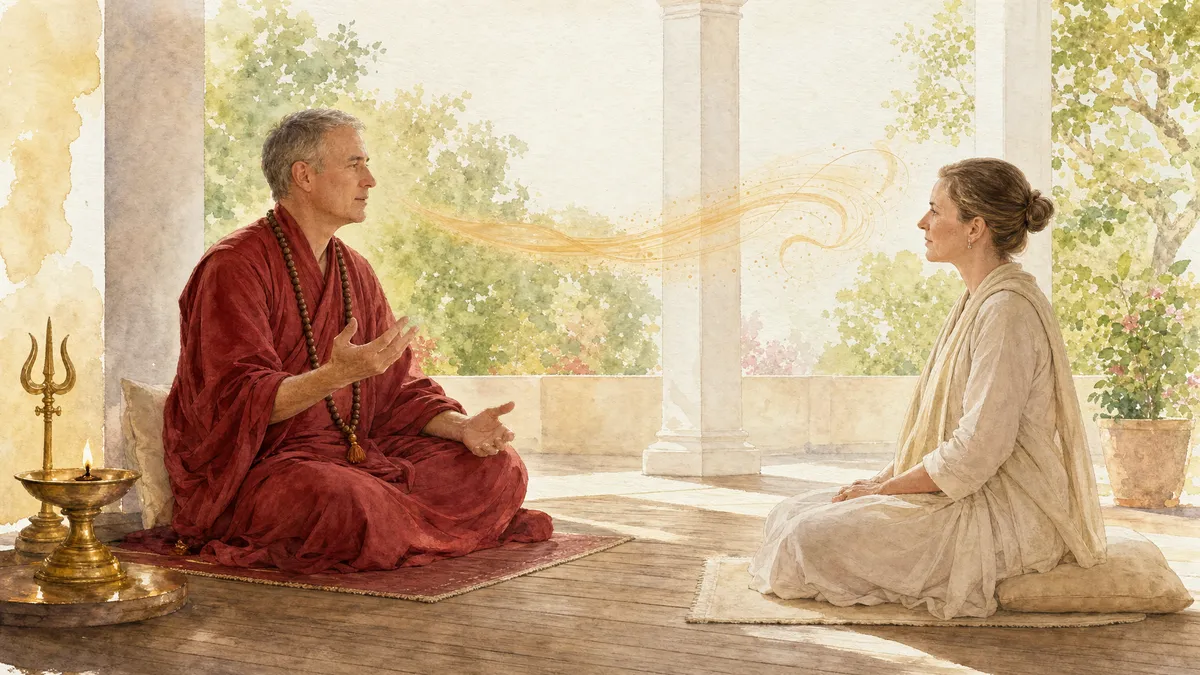
Practice in Contemplation
Another monk asked the same thing: “When I practice, it seems to me that I am performing techniques, but missing the great consciousness, as if I am betraying something. When I begin to immerse myself in the work—doing asanas, pranayamas, and so on—then instead of disidentifying from the body, I identify with it more and more.” I told him that this is a question of teaching, of doctrine, which needs to be clarified already at the stage of novitiate. After all, it is assumed that we perform the practice while being in contemplation. Even when doing coarse practices with the body, winds, or channels, we do them from the point of view of the natural state, absolute truth, without being distracted from presence. That is, our doing is beyond effort. This is called “doing without doing.” Such a yogi has no hope, does not strive for the fruits and results of his labor or sadhana, and does not become attached. How can he become conditioned by the physical body if he is constantly in contemplation of absolute truth, as if he were sitting on the summit of a huge mountain, and is completely satisfied with this contemplation? Such a combination in practice is always inherent in the sadhana of Laya Yoga. And then there should be no confusion.
The Illusory Nature of Perception
We are not capable of realizing reality, that is, of knowing that all phenomena have causes and are transient, and that everything appearing before us does not exist in the way it appears.
Everything appearing before us does not exist in the way it appears.
When we abide in duality, the world also appears to us in duality. When we contemplate correctly, the world is seen by us in nonduality, and then old notions disappear.
There is a story about how one disciple asked the Master:
“Do I possess Buddha-nature?”
The Teacher said:
“No.”
The disciple asked again:
“Do cats and dogs possess Buddha-nature?”
The Master said:
“Yes.”
Then he became indignant:
“If cats and dogs possess this nature, then why do I not possess it?!”
The Master replied:
“They do not ask.”
Our ego, our separation from true consciousness, makes us consider ourselves to be the body, and then delusions based on this arise. When we do not guard our mind, these delusions intensify, and when we guard the mind, they disperse.
What does it mean to guard the mind literally? It means correctly performing the sadhana of mindfulness. For example, when you walk, you should constantly practice some sadhana of mindfulness. It should not be the case that you spend a couple of years in a monastery, but when you walk, you do not practice any sankalpa, even the most elementary one. Your mind is not allowed to wander somewhere; otherwise, you lose the opportunity to work through your practice of mindfulness. But disciplining the mind while walking constantly provides this kind of cultivation, this nurturing of consciousness.
The Nature of True Existence
Through the ignorance of our mind, everything appears to us as truly existing. We are focused on the “I” that exists. But we perceive this “I” as truly existing, which in reality it is not.
In the same way, everything on which our ignorance focuses—the “I,” the body, the mind, others, the objects of the six senses—exists, but not in the way ignorance perceives it. This is where the illusion lies.
You must apply great diligence in the practice of nurturing the mind. Without this, there will be no result, because illusions are deeply rooted; the obscured mind constantly slips into identification with the body and so on, while this subtle consciousness is very elusive, especially at first. And even if you catch it in retreat or in meditation, it quickly slips away if you do not make daily efforts to nurture the mind and support it continuously.
When, thanks to ceaseless training, the mind becomes self-sustaining, self-liberation already comes easily, because it becomes something natural for you.
Look at all the projections of true existence. Just as a tablecloth hides the table, the truly existing “I” hides the simple “I.” In your vision, the subject “I” is concealed by true existence, as are the action and the object. They are all adorned with the appearance of true existence.
Here it is necessary to explain the following. Primordial consciousness is concealed by the supposedly real existence of material things. This means that you look at a bell and think, “This is a bell.” But the bell has a luminous, empty nature, and in reality it is not a bell, but Brahman. It only seems to you that it is a bell. Or you think that this is a book. But it is only in your karmic vision that it appears to you as a book, while in reality it is the Absolute manifested as energy. For example, if you were now to obtain the eyes of the gods, you would see it differently, for instance as an inlaid scroll, a sacred scripture; for you it would no longer be simply a book. And if you looked at it from the world of hungry spirits, you would see charred paper. That is, everything depends on karmic vision.
Of course, something exists; one cannot say that nothing exists. Energy exists. And this energy is the Absolute itself. How it is perceived depends on the karmic vision of the subject.
How does a saint see? First of all, he sees the essence of an object. Seeing objects, he does not attach labels: “This is a book, and this is a bell.” He sees that all this is the energy of absolute consciousness, and what label to assign to it already depends on the specific perception.
Of course, he has discriminating vision, that is, he is able to distinguish a bell from a book. Nevertheless, he knows that “bell,” “book” are merely conventional names inherent in a particular karmic vision, while in their essence they are energy that can take various forms. And everything depends on the power of consciousness. This can manifest especially in dreams.
But when we do not nurture the mind, external objects conceal their empty, luminous nature. To perceive this more easily, you can think as follows: “All external objects consist of molecules, molecules of atoms and electrons, and electrons of photons, that is, of light. In their essence, they are empty. In their essence, they are energy flowing from consciousness.”
Meditation on Emptiness
Look closely, realize that all this is empty. Focus on the fact that all this—the subject, the action, the object—is empty. Anything that exists is completely empty.
Focus on emptiness. In emptiness there is no “I” and no others, no subject and no object, no friend and no enemy, no attachment and no anger. In emptiness there is no emptiness.
Meditating on emptiness, observing emptiness, think as follows: “Then this makes sense.” There is not the slightest awareness in believing that anything exists in and of itself.
Intellectual analysis of the fact that everything is emptiness is merely preparation for naked awareness. This is good in terms of worldview. However, we are more interested in mindfulness as such, which leads directly to the perception of the empty nature of all things. If you directly perceive the empty nature of all things through awareness, then intellectual reasoning is not required, since you penetrate directly into the essence.
To manifest such recognition is precisely what it means to guard your mind, to perform monastic practice. Mindfulness, self-liberation, satipatthana, contemplative presence — all these are synonyms; they are one and the same.
When anger or irritation, suffering, fear, fright, joy, attachment, or strong desire arises in you — for example, the desire for food during prasad — you must penetrate into it, observe its complete emptiness, and at that time practice the nurturing and observation of the mind.
When you attain perfection in this, your mind becomes very clear and unshakable, and you gain a tremendous source of vital force. And any situation is suitable for carrying out such monastic practice.
