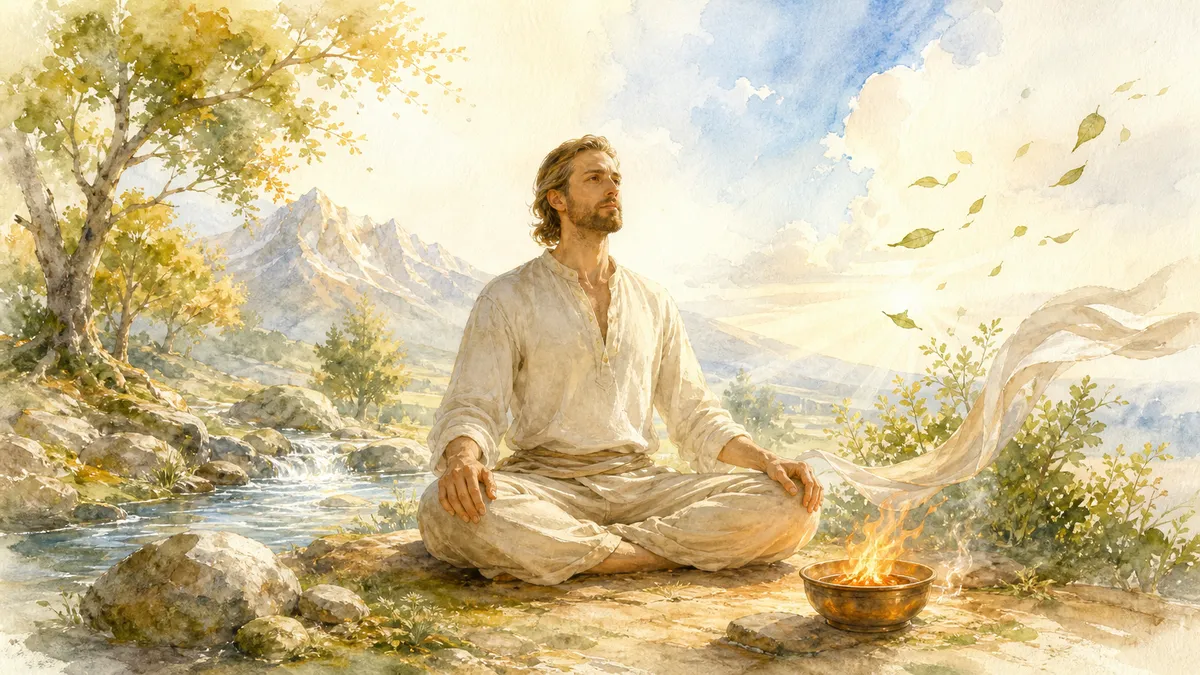
The Lord said with an encouraging smile: “Kartavirya, in order to experience bliss, one must curb this unruly mind. Is not the mind the cause of bondage and freedom? But it is not easy to control it. The elders say that the mind is as uncontrollable as the wind. In fact, it is easier to control the wind than the mind. That is why followers of yoga achieve control of the mind through control of the breath.
The mind and the breath are like a pair of horses. If one becomes unruly and behaves as it pleases, then by pulling the reins of the second, the first can also be restrained. Consequently, if we are able to control the breath, the mind also comes under control.”
This is known from the teaching on svarodaya: if your breathing is frequent, your mind is also uncontrolled; if the length of your breath is great, it is difficult for you to control desires, your thoughts are chaotic, and it is impossible for you to attain liberation. Conversely, if you are deeply immersed in contemplation, the breath does not go far out, and it is not so frequent.
It happens that our mind is agitated, and then we breathe frequently. If you want to communicate in the proper state, you should first regulate your breathing.
Some attain purity of mind through righteous deeds and, with a purified mind, achieve victory over the breath and thus control of the mind.
Only followers of yoga achieve control of the mind solely through control of the breath. The breath is the external form of the life force. One must inhale through the left nostril, following the procedure shown by the guru, and retain it. Then one must slowly exhale through the right nostril and retain it. Then slowly inhale through the right and retain it, and then slowly exhale through the left.
If your breathing is disordered, rapid, with uncontrolled inhalations and exhalations, then, of course, your mind will also be in the same agitated state. Except during physical exertion, when you are simply moving, the breath should not be very frequent. The best way to regulate the breath is anuloma-viloma pranayama. You can regulate the subtlety of the breath and evoke the sensation of subtle prana if you constantly practice anuloma-viloma pranayama.
The breath will circulate if the channels are pure. Therefore, a self-respecting yogin always takes care of the purity of the channels. It is not difficult to maintain the purity of the channels if you practice regularly, do not allow gross desires to arise, do not stay in impure places, do not associate with impure people, do not manifest gross desires, and if you are attentive to your pranas in the body.
Every yogin should have a threshold below which the purity of his channels must not fall. It is like a red line. After the red line, an emergency light comes on: “Alert! The purity of the channels is below the permissible level! Engage in practice urgently.” A good yogin does not allow his level to reach this red line. Being a good master of his body and mind, he takes preventive measures in advance.
This is similar to how a good car driver will not allow the carburetor to become clogged, the gasoline to run out, or some other indicators to fall below normal. This is already an “Alert!”; it indicates that the owner is not taking care of the car.
In the same way, the body can be likened to a car, and a good yogin tries never to let the state of the channels fall below normal.
How can this be felt? You feel it yourself. If your body is light, if apana-vayu circulates well in the area of the legs, if there is no heaviness in the chakras, if prana moves normally during kumbhaka, if there are no strong blockages anywhere, if kumbhaka is sustained, if, listening inwardly to the body during meditation, you do not discover any dense clots of energy in different parts of the body, if you simply feel comfortable in the body, this is an indicator that the winds are moving normally, that the purity of the channels is normal. When the channels are pure, you almost do not feel the body. You begin to feel the body when the channels become clogged, when there are obstructions somewhere and heaviness arises in different areas.
This technique is called pranayama. If this method of pranayama is practiced properly and sincerely, all the nadis in the body are purified. Then the strength is attained that enables one to practice yogic techniques continuously, with devotion to one’s work. This pranayama can be performed with a mantra and without a mantra.
If you want to purify the channels over a long period of time, then the best way to do this is anuloma-viloma pranayama. You can listen to lectures or sacred texts, for example the Yoga Vasistha, and practice pranayamas. And this can be done for hours when you have free time.
The Stages of Yoga: from Pratyahara to Samadhi
By practicing this method, the seeker will master the vital breath.
Then, by the power of reason, the sense organs must be withdrawn from objects and merged in the mind. This is called pratyahara.
Eventually, the mind will be concentrated on the Atman. This is dharana—the stage at which tremendous attention must be developed.
The mind wanders again and again; through consistent and persistent practice it must be brought back and established in the Atman. This is called dhyana.
Through reflection on the meaning of great statements such as “Tat Tvam Asi,” by means of the six components, namely: beginning and end, repetition, peculiarity, reward, appraisal, and reasoning, the supreme Reality—the goal of the great teaching—will be known. Then, through the destruction of lust, anger, and so on, which are alien to that Reality, the movement of an uninterrupted stream of the thought “Aham Brahmasmi” (“I am Brahman”) will begin. This state is called nididhyasana. It is also called savikalpa samadhi.
When in this way the thought “I am the one and only Parabrahman—the one and only Parabrahman is I” is maintained constantly, endlessly, and steadily, evenly, like the flow of the Ganges, then the supreme Consciousness fills that state of mind. This consciousness flashes in the mind just as a spark of fire ignites cotton. Only the seeker in whom there is not even an atom of inattentiveness, and who is in a constant state of awareness, can hold it. The state of mind that is the cause of the manifestation and reflection of the supreme Consciousness in the mind reveals the absolute Brahman, which is the basis of that reflection in accordance with sakhachandranya, and then disappears. Meanwhile, the one Atman shines. The division of “knower-known-knowledge” gradually disappears.
In our tradition, the principle of nididhyasana is connected with sahaja samadhi. Nididhyasana is a section of the teaching that is connected with holding the mind in presence. At first you have no presence at all, and you only listen to tales about it from those who have experienced it. You think: “So that is what this presence is like, or like that. Wonderful!”
It is like a poor man listening about people who have found a certain jewel. People went into the forest and found a treasure with a great jewel; each of them obtained it. You listen and think: “Yes, that is wonderful! I wish I could obtain something like that!” At first you engage in various practices and apply methods simply in order to obtain it. All of this is the stage of shravana. Like a blind kitten, you poke here and there, receive one transmission, then another, reflect analytically, concentrate, meditate, and apply sankalpa. And eventually it does happen: you experience the necessary “taste.” And then everything is illuminated, everything changes. Outwardly everything seems to remain the same, but the perception of reality changes. For some this may happen in leaps; for others it is gradual, as fears and hopes are little by little cut off, and clarity gradually arises.
Basically, this is connected with the twenty-four recognitions. A certain clarity arises that illuminates something, and then a block of karma falls away.
The stage of manana is when the twenty-four discernments increase and intensify, when you reflect and contemplate again in order to restore and retain this “taste.” The twenty-four kinds of viveka must necessarily manifest. Of course, they will not manifest all at once, but gradually, one after another, without any sequence, simply in accordance with your karmic inclinations. But when viveka grows, you become like a wise person who properly manages the power of his mind. And at the stage of manana you become convinced: “Yes, now I can remember and retain this ‘taste.’ It is deep within me.”
It is similar to how you too went into the forest and found the very same pearl that others spoke about. It is already before your eyes. But now you need to take it and constantly carry it with you. This pearl seems very heavy to carry so simply.
“Carrying within” (nididhyasana) is when we learn to constantly carry this pearl, to bear it within. There are various methods for this. When we constantly “carry it within,” viveka grows. And sooner or later the twenty-four kinds of discernment will manifest and eliminate the sixteen knots of ignorance. It is like the sun shining on ice: under the influence of the sun, sooner or later the ice melts and turns into water.
In the same way, the sun of the natural state emits rays of clarity—viveka. These rays of clarity shine upon our samskaras, vasanas, and karmas. At first it seems that however much it shines, all of this is useless. Our limitations and tendencies of mind are so great and all-encompassing that it seems to us that the sun that is shining is very small. We may feel that our mind, like a very stubborn monkey, still follows its tendencies. But here one should neither become upset nor fall into confusion. Without rushing ahead, one must simply allow this sun to shine, emitting rays of clarity. Clarity works continuously, and over time we will begin to see that, after all, samskaras, vasanas, and karmas yield and little by little recede.
Supernatural Powers and Dangers on the Path
Yogis who have attained such a state effortlessly gain mastery over supernatural powers. This is the whole essence. However, if the seeker uses supernatural powers incorrectly, he falls out of yoga.
Recall now where we began. Was it not with the inquiry into the Supreme, after establishing that both this world and the other are illusory and impermanent? Then, if the seeker does not realize that these eight supernatural powers are also transient and thus constitute a danger, and continues to use them, what can follow except a fall? Therefore, in this regard, the yogi must develop vigilance.
Many supernatural powers come after you deeply carry within the natural state, for example:
the powers of earth—authority over the spirits of earth, the ability to summon the deity of earth, invulnerability to the influence of earth, the ability to change the weight of the body;
the power of water—authority over the spirits of water, the ability to summon the deity of water, invulnerability to the influence of water;
the powers to control the five elements come when you learn to “carry within” the natural state and unite it with the five elements; the mind during shambhavi mudra, abiding in presence and in the bhava of divine pride, when well united with the corresponding element, bestows the siddhis of that element.
The State of Kashayapakva and Liberation from Karma
Moreover, there is the problem of the mind. As long as it exists, vigilance is necessary. When the mind becomes restless and rushes from side to side, it must be brought under control. On the other hand, if it relaxes and falls asleep, it must be awakened.
The state of mind free from agitation and dissolution, in which it remains unchanged, is called the state of kashayapakva. This is true equanimity. When it is attained, the yogi becomes like a fire in a windless place. Triads no longer exist, there is no movement, no satisfaction with bliss. The knot of the ego is cut. All doubts, such as incompatibility and contradiction, are shattered to pieces. With the exception of prarabdha karma, all other karmas will be destroyed.
Ordinary people have sanchita karma, prarabdha karma, and agami karma. Practitioners who have advanced have sanchita karma and prarabdha karma, while they have almost no agami karma, since their actions self-liberate. They are conscious enough not to create new imprints anymore while performing numerous actions. Why? They act without generating emotions, without becoming attached to the fruits. Their actions are bhakti yoga, an act of self-surrender, of contemplation. Their movements are united with presence; they have neither hope nor fear. Outwardly, they seem to be acting, but in their soul it is like a game. The principle of contemplative non-action is extended to all actions. When a person can act in this way, there is no attachment to action and distinctions, and agami karma is not created. But there are two kinds of karma—prarabdha karma and sanchita karma.
In yogis of an even more advanced level, sanchita karma is exhausted, and only prarabdha remains, connected with the physical body. Sanchita karma lies deeper; it is our roots and our past. It is more difficult to liberate than agami karma. Agami karma is easy to liberate; it is enough to be attentive and aware. If the mind is not colored, then any action ceases to be action. And once we have made the “great decision” to abide in “great non-action,” we free ourselves from agami karma. But sanchita karma is not easy to purify; it lies very deep. A deeper presence is needed, one that would penetrate into the past; a single “taste” that would penetrate into time and blend the past, present, and future. Such a power of presence is needed that we could penetrate into the impressions of childhood, when we were not practitioners, into all our old “fragments” of impressions of this life, and erase them. Then to penetrate into the impressions of the previous life, into all the emotional records, “fragments,” existing in the muladhara chakra, and erase them. Then, by the power of presence, to penetrate into many previous lives and also erase all tendencies and samskaras of past impressions. Then to generate such a mass of presence that it could encompass vast stretches of past time (hundreds of lives, thousands of lives), bring clarity and awareness there, allow everything to dissolve in the light, until time (past, present, and future) blends together. Only such a state is capable of destroying sanchita karma.
Siddhis have only prarabdha karma. They no longer have either sanchita karma or agami karma, but prarabdha karma remains, since this body exists. These are residual karmas, which end either with the dissolution of the body or with its physical death. The elements of the body dissolve, or its physical death occurs, or it self-liberates as a rainbow body into the pure five elements, and prarabdha karma, like a bubble on water, naturally disappears by itself.
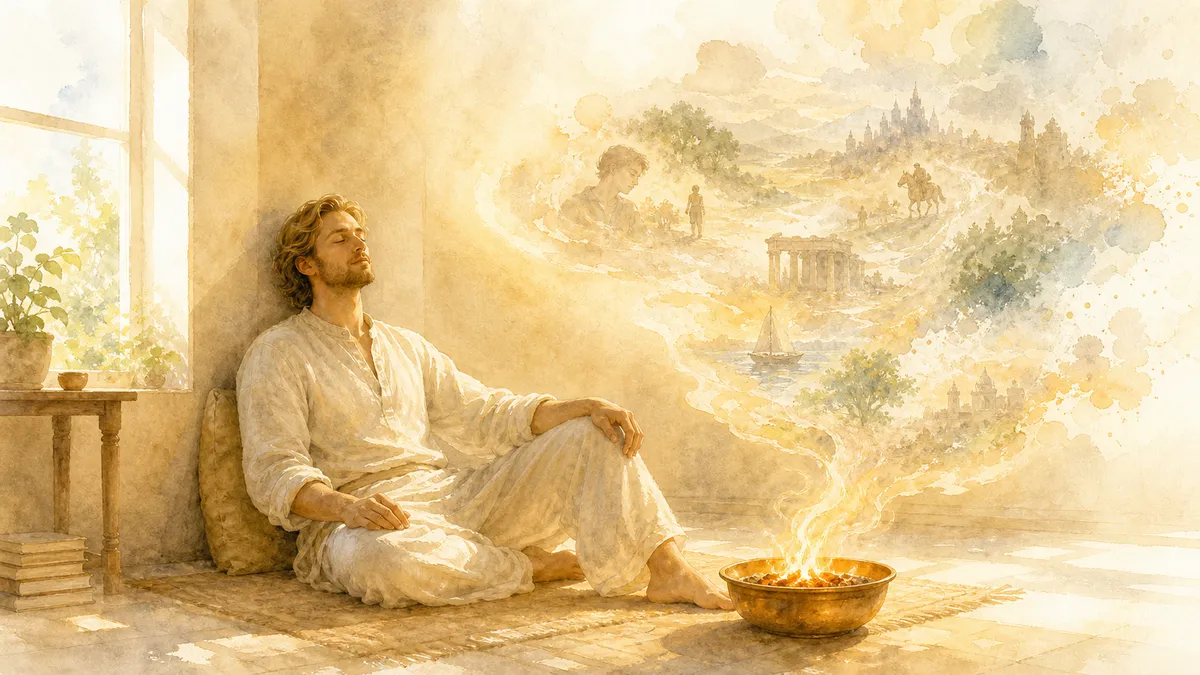
To dissolve sanchita karma, a presence like fire is necessary, one that penetrates ever deeper into you, opening new layers of past lives. During this period the yogin makes great discoveries; for him each day is like a great experience, an entire layer of life. For example, during sleep he lived through his past life, and all the samskaras of that life were burned away by the fire of the natural state. This happens constantly and spontaneously. When he realizes the unreality of past lives, then the unreality of future lives can no longer happen to him either. His mind, at any moment and independently of samskaras, can form any tunnel of reality both in the past and in the future.
The Emperor of Yoga and Instructions on Practice
He will remain in the state of Brahman, he is liberated while alive, he is the emperor of yoga.
Arjuna, out of love for you I have taught you this most secret yoga. It must not be transmitted to the unworthy. One cannot practice without having the instructions of a guru, or merely having heard about them from others, or simply by studying books. Before obtaining direct experience, it is better to receive indirect knowledge from the guru. That is why I am describing it to you in such detail.
Arjuna, I know that your heart passionately longs for direct experience. When I am here, how can I not fulfill your wish?
Look at the beautiful cave opposite. It is a suitable refuge for your practice. Go into that cave and sit, firmly keeping your spine, head, and neck straight.
Why should one maintain a straight position during meditation? In this position the winds can fill the central channel, but if one meditates with a crooked back, one can develop an imbalance of wind and ill health.
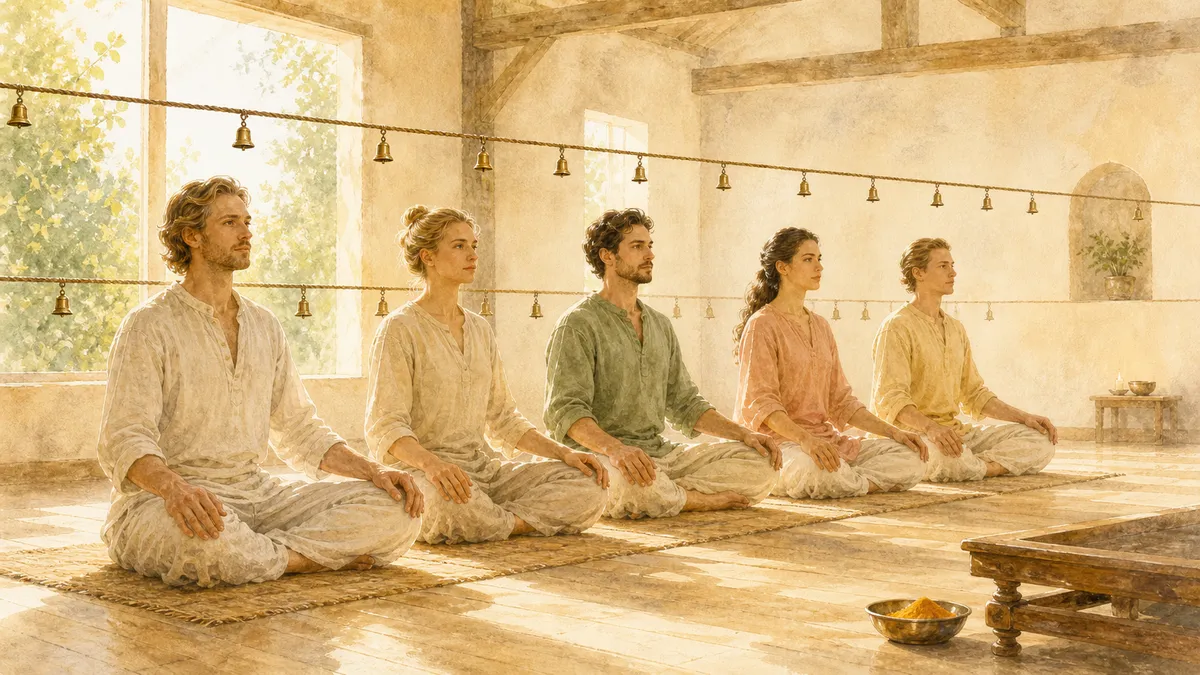
In shambhavi mudra, there are special practices in which teachers train their students to maintain stillness of the body and an upright posture. This is done as follows. A thin string is stretched so that it is next to the head, and a small bell is hung on it. Behind the head, a second string is stretched, almost touching the head. A second bell is hung on it. Five or seven students sit in a row between the two strings, and two bells hang in front and behind. And it is clear that the bell rings if one of them moves.
Moreover, they also trained students in this way: turmeric powder was applied to the eyelid. In shambhavi mudra one must sit with the eyes open, preferably without blinking. If a person did not blink, the powder did not scatter; but if he blinked, the lower eyelid also became stained, and the mentor could see it.
You should know how great the requirements are in training shambhavi mudra. But if you sit well in shambhavi mudra, without moving, with your back straight, then the winds enter the sushumna and the mind truly opens wide, and then you simply need to stand up and bring this state into everyday life—that is, to walk very carefully and smoothly, like a cat (as I explain).
Sometimes a person may walk very impulsively, his movements jerky, as if he is walking but his reality is loading poorly. It is like on a computer—if the graphics are bad, the reality there jerks. And he too walks quickly, impulsively, but a yogin should not walk like that. A yogin should walk carefully, smoothly, like a stalking hunter or like a cat stalking a bird. The back leg bends slightly when walking in contemplation, the feet touch the ground fully, as if screwing themselves in; grounding occurs. There is not a single abrupt movement in the body. If there is such smoothness, then the winds also move smoothly, and the mind is not subjected to a strong disruptive influence. Then shambhavi mudra is carried over into the processes of life.
“Reflect on the true path of yoga shown by me. In a short time you will thus attain samadhi and supreme realization.”
Having said this, the Lord placed his right hand, which pours forth the nectar of bliss, on the head of Kartavirya Arjuna. With an exclamation, Kartavirya embraced the Lord’s feet, entered the cave with His permission, and began to perform the exercises taught to him.
Read 16 times
Articles
Vidya AI
Search
Lectures
November 3, 2026
Mantra of the day
ОМ САДРЩАЙА НАМАХ ОМ Видящему равно – поклонение!
Auspicious Times(Rome)
Brahma Muhurta:
04:54 - 05:49
Abhijit Muhurta:
11:33 - 12:14
Sayam Sandhya:
16:43 - 17:24
Mokshada Ekadashi (6 November)
Ekadashi of liberation. Helps to achieve spiritual enlightenment.