

When we bow, we give something away, but we can give only what we have. Each person gives exactly what he has in his soul. If there is love, he gives love; if there is faith, he gives faith; if there is fear, he gives fear; if there is attachment, he gives attachment, because in order to give, one must have. And we have only what we have.
When we give, if we do it sincerely, an empty space forms within us, a certain empty place, a certain emptiness, as in a vessel. And something can be poured into this empty space; something else can flow in in return, for example, Brahmabhava, jnana, faith, devotion. This is what a blessing is: we give one thing and receive another.
For example, we bow before Dattatreya and give away some working state of ours. Suppose today we were in a state of pleasure: there was delicious prasad, it was a good day. In a state of pleasure we bow to Dattatreya and, as it were, give Him this state, becoming empty for half a second. But for Dattatreya this is enough: in half a second there is a flash, and something flows into us. The blessing has occurred, and we feel that the superficial satisfaction, the superficial feeling of pleasure has gone somewhere, and suddenly a certain depth has appeared, strength and wisdom. Almost like Dattatreya, but for half a second. And then we remember: “What was that? For half a second I became somehow deep, wise, eternal, absolute, and vast, incredibly wide open! Yes, I must remember this!” Then the usual state of pleasure returns again, and we are in ordinary pleasure—our basic state. But something unusual happened during that half-second of bowing, when the mind was in surrender, when it had nowhere to go. This is how a blessing can come.
The True Essence of Worship
It is important that the spirit be in a state of bowing. With the body one can do anything: one can tumble, stand on one leg, do asanas. After all, we are not the body. There is simply a tradition that says a bow should be made exactly this way. But it is just a tradition. The most important thing is not how the body bends, but how the mind bows. After all, one can make a bow with the body, yet not bow in one’s soul. That also happens. That is, outwardly the body makes a bow, while in the soul there is some kind of one-legged stance or viparita karani. There is enough religious hypocrisy in life. In churches everyone is such a believer, but why then are there so many problems in the world, why so much hatred, so much envy? It means there is enough religious hypocrisy. In the name of religion, a great deal of negativity is done by misguided people.
Outwardly, we can bow on our knees or standing, we can do namaste, we can nod our head, we can even wink, although that seems not to be customary; but the point is that the body is not the main thing—the main thing is what we do in the soul. We can quickly do namaste: “I am very busy, I am a businesslike person! Namaste, Guru Maharaj. Many things to do.” But the most important thing is how much our soul, our heart within, bows down.
Once I was in St. Petersburg, and a man who by nature was a strong kshatriya was leading a yoga group. He came to me for darshan. His forehead, as someone wishing to become a disciple, bowed down, while in the subtle world he looked as if he were in vira-bhava.
What does the process of bowing and worship mean? Everyone has some basic setting through which his subtle body exists at all, has some form, mindset, and bhava. And the process of worship means that we remove our dominant setting of being someone, being something, insisting on something, being attached to something, striving for something, fearing something, being proud of something, and so on, in a state of self-offering. For this time, we bare our pure, believing, and devoted heart in a state of complete surrender; we offer it to God. This is the meaning of any upasana, any bow, and any worship. And when we do this, we inevitably come into contact with the Source. Then the mindset of our soul changes for a certain time, its vibrations rise, and we can feel a light breeze of blessing, a feeling of joy, of expansion, because we have touched the grace of the Supreme Source.
The accumulation of such grace gradually changes the soul, changes its basic settings of holding on to something, clinging to something, being stuck to something. These are no longer concepts; this is already the subtle mind of the subtle body. And these settings of the subtle body gradually dissolve.
The Subtle Body and Its Structure
Everyone probably understands that at the level of the mind we can say, “I am Brahman!”, adopt the Advaita view “Aham Brahmasmi,” but the subtle body lives in its own way. Until the attitude “I am Brahman!” or “I am devoted to Shiva” (Shivo Ham) has reached the depths of consciousness, the subtle body, it has its own form, its own bhava, and its own tendency. This is karma. Or we may not say anything at all. We have learned contemplation, attentiveness, the self-liberation of words, and we understand that it is not about words but about deep awareness; we abide beyond concepts in some contemplative state, but if this contemplative state does not reach the subtle body, then the subtle body still has some position and attitude of its own.
People, as seen by spiritual vision, always abide in some bhava, in some position, in some attitude. That is, the subtle body, just like the physical body, always has some manifestation. And our souls, as long as they are clothed in the manomaya kosha (the subtle body), always have something. It is said that the subtle body is the true essence of a person; it cannot be hidden, it cannot be falsified. For example, outwardly one may wear a mask, for instance, smile and say, “I love you,” while in the soul holding a fist or a whip, which signifies malice toward a person, irritation, anger. This is the subtle body; it directly expresses the state of our current thoughts. And until contemplation and presence penetrate the subtle body, it will continue to abide in its bhavas, in its tendencies.
Our task is, in wakefulness, to discover sahaja, the nature of the Atman, and to make it penetrate the subtle body and begin to dissolve and absorb it. That is, we must discover sahaja in this waking state, in reality. Of course, this state can be discovered in meditation, in Mahashanti, in different ways. But in general, the field of our activity, the field of our battle, is here, this waking world, not the subtle world. The subtle world’s turn has not yet come. First we must become established in wakefulness, learn to abide in freely flowing, wide-open, non-conceptual consciousness directed toward the investigation of Brahman, absorbed by Brahman in Brahma-aham-bhava, in the view and contemplation of jnana yoga, in Guru yoga. All this is one; these are not different states, but facets of one and the same. This subtle abiding in nondual presence, in natural awareness, must be deepened and deepened until it gains the strength to begin penetrating the subtle body and changing it.
One must learn to abide in the light of self-awareness, in the radiance of Brahmabhava, in the waking state, so that it may then penetrate the subtle body. And when it penetrates the subtle body, the subtle body will begin to change its nature, its structure. In the subtle body, as you know, there are manas, buddhi, chitta (memory), and ahamkara. All of this together is called antahkarana — our inner instrument. The subtle body consists of this and also of certain pranas. It is precisely the subtle body that is reborn; it is precisely the subtle body that is the element that binds us. We have to dissolve it. And this is called antahkarana laya chintana — the dissolution of the inner instrument.
The Nature of Memory and Karmic Tendencies
There is memory in the subtle body. What is memory (chitta)? Every person is a storehouse of impressions, a storehouse of memories; within himself he carries, as it were, a hard drive with a huge number of photo albums, with a huge number of video recordings of his life. All of this, in computer language, is history, a browsing log, a history of visiting different places, different lokas, a history of the consciousness’s search queries into the Universe, a history of life, a history of registration in different corners of Creation. A person carries these memories, slides, files. He not only carries them; he acts on the basis of them.
For example, if a person is a former warrior, a former kshatriya, and in his records there are only wars, only battles with sword, bow, and arrow, attacks, the taking of fortresses, political intrigues, then what do you think he will subconsciously be guided by in this life? Even if society has educated him, even if he knows the dharma, even if some social ideology has been implanted in him (for example, consumerism), even if he has read the “Yoga Vasistha,” but his memory is like that, then what will he do with it? Do you really think that inside he will be full of love, harmony, and the desire to play the violin? No, of course not. His subconscious, his vision, will intuitively wish to continue. It will intuitively still take embodiment in these forms; it will intuitively seek opportunities for battle, confrontation, some asuric karmas, heroic pathos, and something of that kind, until it is exhausted. This is how chitta acts.
When you look at one another, you should not assume that all of you think in the same way. Yes, you were all born in this world; you all have roughly the same mindset, culture, perception of time, historical and political processes, and psychology. But your deep psychology, your deep perception, differs greatly, because memory is completely different, and the sequences of events are arranged differently for each person. Someone in a past incarnation was a temple prostitute, someone was a king, someone was a skilled diplomat, someone was a wine merchant. And all of this must be dissolved.
The Process of Dissolving Chitta
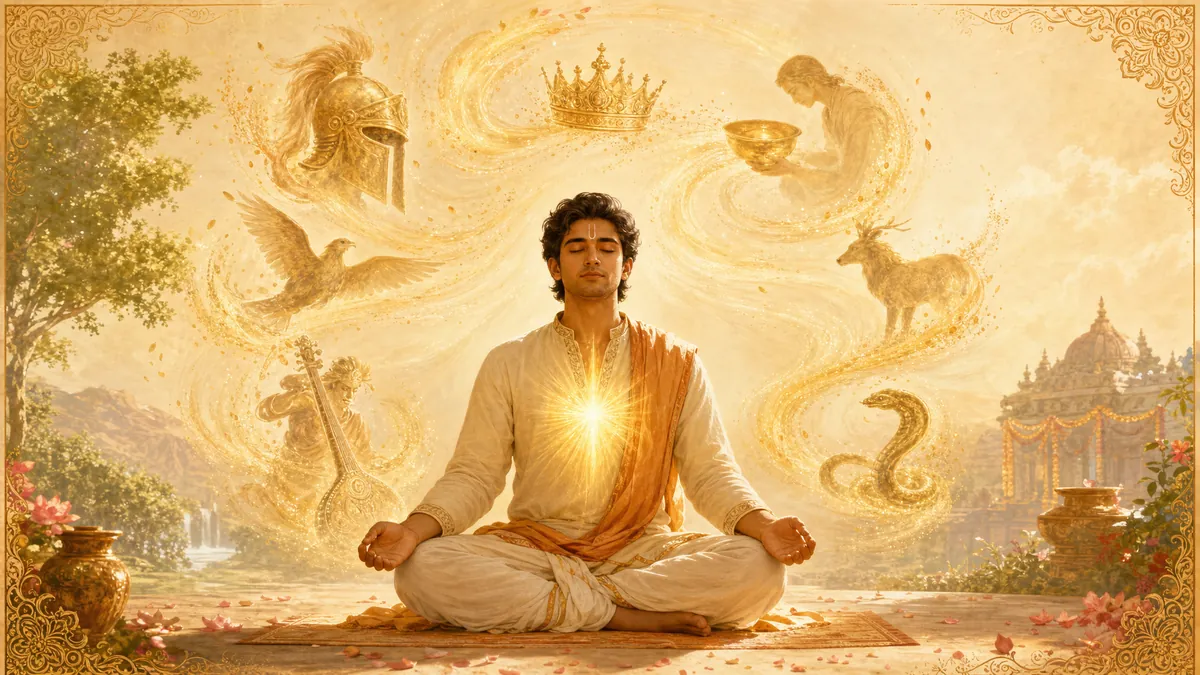
Chitta, through the introduction of presence into the subtle body, must disappear; it must be dissolved. It is like deleting all the files from a computer. The inner light of awareness joins with chitta, and all these slides, memories, pictures, and images melt, melt, and melt. There are very many of them. You have dissolved one life and its tendencies (for example, the tendencies of a warrior), and another tendency has manifested—the tendency of a king. You dissolve the tendency of a king, and the tendencies of a slave appear. You dissolve the tendencies of a slave, and the tendencies of a drunkard appear. You dissolve the tendencies of a drunkard, and you look—and there are the tendencies of a hare. You dissolve the tendencies of a hare, and some serpent tendencies appear. You dissolve the serpent tendencies, and the tendencies of a kite manifest. You dissolve the tendencies of a kite, and some asura-alien on a vimana manifests. And you think: “How much of all this has been accumulated? When will all this finally dissolve?” You dissolve the tendencies of the alien, and you see that the tendencies of a gandharva with a musical instrument have manifested, playing some pipes in a heavenly pavilion, delighting in the music.
All of this has truly been accumulated. We have truly experienced very many lives. And chitta can be dissolved only when we begin to understand that all these tendencies do not need to be lived out. All these tendencies influence our mind, our buddhi, our manas, and they say: “Let’s live some more, let’s enjoy ourselves some more. This is who we are. Let’s live this way, let’s live like a soldier.” And then: “Let’s live like a king,” “Let’s live like a drunkard,” “Let’s live like a slave,” “Let’s live like a hare,” “Let’s live like a monkey,” “Let’s live like a gandharva.” And it is difficult for the mind not to follow these tendencies, because subconscious tendencies are almost a guide to action.
All subconscious tendencies exist at the level of an unconscious inner command. That is, if a person strives for wealth and wants to earn a lot of money, he thinks this is normal, that everyone wants wealth. It does not occur to him that this is simply the inner command of his karma. And someone else does not strive for wealth; he strives for the Heavens, and it seems to him that everyone strives for the Heavens, because that is normal. It is simply his merit; his inner command allows him to set such lofty goals. And someone else strives neither for wealth nor for the Heavens, but wants to go somewhere far away to a hot spot, find a rifle, and live there. And someone else is interested neither in wealth, nor the Heavens, nor a rifle; he is interested in mathematics, and he thinks: “If only I could discover and substantiate the Poincaré conjecture! If only I could prove Fermat’s theorem!” And someone else has the tendency to be the king of chess. All of these are tendencies that exist as an inner command; they are difficult to overcome. They distort the picture of the world, color perception, and give rise to value judgments. And they must be dissolved by our basic presence.
In addition to these tendencies, there is the ego (ahamkara), which makes us identify with these tendencies, act, and constantly assert ourselves. Having discovered presence, we must direct it toward the subtle body and dissolve all these tendencies until nothing remains, until only the image of God remains, a pure state and a space of emptiness, of light. From this space, one can already manifest in different ways. Then you will feel: “There, the tendency is already gone.”
Signs of Liberation from Tendencies
What does it mean to feel that there is no tendency? Suddenly you will feel that you have no pronounced inclinations, that you can easily form any inclination, that you are truly empty inside. And what is the sign of this? For example, you begin to be attentive to other people and capable of listening to them, because you are empty enough. Those who are not empty are very interesting to themselves, so if you find people who are not empty, they find it very interesting to talk about themselves. It happens that fellow travelers on a train try to talk about themselves because they think: “I am unique, my tendencies are unique, I am a very interesting person. What is inside me is the truth!” But the one who is empty understands this secret, and his own tendencies are not interesting even to himself. He understands that they are illusory, that it is better to remove them and be nobody, nothing, to be emptiness, to be in a state of readiness to perceive the light of God, and then there is an opportunity truly to become interesting, to become an infinite divine abyss.
The first sign that you are becoming free from tendencies is that, when communicating with others, you begin to speak less and listen more; that is, you are an empty enough vessel to perceive the tendencies of others. If two overfilled vessels meet, the situation looks like this: one speaks and the other speaks. You address him, and he says: “Yes, but no, listen. You see, I have...” That is, each is filled with his own tendencies. But if you are free from tendencies, then you can listen to others attentively enough. You already become a sufficiently harmonious personality, because your tendencies no longer protrude, they do not come out. You can not only listen, but also take into account the tendencies of others, understand their character, the work of their consciousness, their needs and requirements. And if you are even more empty, you will wish not only to listen to the tendencies of others, to take into account the tendencies of others, but also to think about how to make them happy.
How often do you think about how to make others happy? For example, your neighbor, your samaya brother. Do such thoughts ever come into your head at all?
Question: “Occasionally.”
Occasionally. If they come at all, then this is a sign that consciousness is being purified, because billions of people do not even have such thoughts come into their heads. Apart from one’s own family, that is understandable, since “every cat cares for its kittens.” What is meant is care even for strangers or for those who come into your field of vision. And the more empty you are, the wider the circle of people you can understand, the wider the circle of people you can begin to think about in terms of how to bring them happiness, how to care for them. This is a sign that you are becoming free from inner tendencies, your chitta is being liberated, your ego is departing, and you assert yourself less and less as an ego. When you stop asserting yourself as an ego, you wish for other people to grow, for them to be happy; you begin truly to take responsibility for helping others, for the dharma. This means that your personal ambitions, your personal tendencies have ceased to be important. And at the same time you are able to perceive some great tasks, great goals that surpass your personality, that are transpersonal.
Providential Recognition and Transformation
Providential forces—the inner Gods and the outer divine forces—notice this. And when they notice, they somehow turn your destiny around; they think: “Yes, this person seems to have emptied himself. He can be placed in charge of caring for others. He can be entrusted with something more responsible, connected with carrying out the divine will.” And such purification occurs when we bring awareness into the subtle body. Our subtle body begins to transform; its impure bhavas, which are usually expressed as visualizations in tamas and rajas, as some kind of mood, as an image, as a picture, depart, gradually developing into pure ones.
But there are also diseases of the subtle body. What are these diseases?
Six Diseases of the Subtle Body
Kama is lust for something. Not in the sense of sexual lust, but in the broad sense as the desire to desire something, the passion to have something, to possess something, to receive something.
Krodha is anger. When we cannot obtain what we desire or someone hinders us, we become irritated, we become angry. We have had such moods, haven’t we, when we were angry at someone, when something or someone hindered our kama? We had a desire to receive pleasure, and something interfered with us; as a result, anger naturally arose.
Lobha means greed, when we have something, receive something, but we desire to hold on to it and obtain more. I heard how one billionaire, when he was giving an interview in very old age a few days before his death, was asked: “What is your philosophy of life?” He said: “More.” This is lobha. Even in the face of death, in very old age... Lobha means greed as the desire for possession. It does not matter what kind of possession is meant: material goods or siddhis, influence, power, something subtle. It is greed as such, based on the ego.
Moha is intoxication with enchantment. Moha means that something has impressed us so much, enchanted us so much, that we cannot in any way free ourselves from it; in the soul there has arisen a striving to be intoxicated by it, so that we constantly fixate on it and receive energy through it. Just as the asuras were intoxicated by Vishnu in the form of Mohini, when Mohini took the nectar from them.
Mada is pride. When we have some achievements, some powers, some wisdom, thoughts arise in us: “I am wiser than others, I am better than others, I am purer than others, I am more sattvic than others, I do seva better, or I understand the Teaching better, or I am able to practice better, sit in padmasana, or my kumbhaka is greater.” There can be various reasons for pride and arrogance.
Matsarya is envy. Matsarya means that, on the contrary, we feel that someone is better than us. Someone performs more complex seva better than us, someone manifests intelligence and clarity better than us, someone has the ability to be responsible better than us or to practice better than us. In this case matsarya may arise, when we do not wish happiness to another person, do not think: “Well done!”, but think: “Yes, who is he anyway, what does he think of himself? After all, I am the most important one here, I am the most valuable, I am the most precious to God. And here is another one, a competitor.” This is matsarya (envy).
The Root of Diseases and the Path of Purification
All these things are based on the principle of kama — the desire for something. And the very principle of kama is based on another principle — the principle of dambha. Dambha is the illusory identification of oneself with all of this. Just as in the Russian language a dam is some kind of barrier. It is like a barrier between the soul and God.
All these diseases of the subtle body are purified when we act without desire. This is called nishkama karma. That is, action without desire gradually purifies our subtle body.
When we have freed the subtle body from the kleshas, Brahmabhava, devotion, faith, love, compassion, and awareness can penetrate it, and it begins to be purified and dissolved. The beginning of Liberation is precisely the process of dissolving the subtle body (antahkarana laya chintana), because it is the subtle body, containing our subtle mind, that is reborn.
