


Commentary on the text “Ishvara Gita.” Chapter 8. The Instructions of Ishvara
The Correct Diagnosis of One’s Spiritual Condition
Ishvara said:
I shall reveal another, most secret knowledge, O best of the brahmanas, by which a person crosses the terrible ocean of samsara.
We enter the spiritual path when we soberly assess our condition, when we make a diagnosis for ourselves. If the diagnosis is wrong, we cannot enter the spiritual path, nor move steadily along the spiritual path. This is not specifically a diagnosis of me as an individual person, but in principle, of me as a human being. To be human is a certain diagnosis, a certain role, a certain karma.
When we become aware of our human condition, make the correct analysis, and establish the correct diagnosis, then we can move on. For example, if you have laryngitis, but you are diagnosed with cholecystitis, then you are being treated for entirely the wrong thing. All of it will be useless. Something else needs to be treated. Very much depends on the correct diagnosis.
Not all living beings embodied on earth immediately understand their condition. They are born and ask childish questions: Mom, why was I born, where did I come from, what is this world, why is it like this? Their parents make something up for them, say jokingly: when you grow up, you’ll find out. They do not receive an answer right away. Then they receive a school education, and science creates the illusion that they know something, that science knows something; even faith in science arises.
Science says: here we have an experiment, we can prove everything, we can confirm it. The repeated confirmability of any experiment is a criterion of scientific validity. If something cannot be proven, if statistics cannot be gathered and it cannot be confirmed repeatedly, it is said that this is not a scientific theory, that it is not confirmed. It seems to work in the physical world, but in the spiritual sense, in terms of the meaning of life, values, life goals, and awareness of one’s place in the universe, such criteria do not work.

The soul gradually begins to believe in science, in the materialistic picture of the world. This is called scientism. Science. Scientism. Blind faith in science; it can be just as blind. These questions gradually leave the soul. And then, after education, it is presented with—offered, rather—a certain model, a template of consumer culture, and these questions disappear.
Samsara as a Terrible Ocean
But from the very beginning, the correct analysis, the correct diagnosis, is needed. The analysis is that this world is samsara, and we have fallen into it. Why—that is another matter. For some reason, the saints call it “the terrible ocean of samsara.” Why is it terrible?
The saints say that we must learn to relate to the world in which we find ourselves as to a certain element. An element with which one must be vigilant. Like fire, for example, or like water, the ocean, or like mountains, or like underground mines, or like air, or like outer space. All those who deal with the elements, who work in emergency services, understand what is meant. For example, travelers, sailors, miners, rescuers, firefighters, astronauts. They understand: yes, this is a serious element; it must be treated with respect and great vigilance.
The saints say that we have found ourselves in a certain elemental environment. Poorly managed, poorly controlled. Moreover, this environment, let us say, is not always well disposed toward us. We live in it. In it, we should not indulge our senses or seek the eight worldly dharmas.
The Eight Worldly Dharmas
What are the eight worldly dharmas? They are:
- the hope of finding happiness and the fear of not finding it, the fear of suffering
- the hope of gaining fame and the fear of disgrace
- the hope of receiving praise and the fear of blame
- the hope of gaining profit and the fear of losing profit
Four hopes and four fears. Eight in total. Our purpose here is not to seek the eight worldly dharmas, but to develop our awareness, wisdom, and strength so that in this ocean of samsara we may feel ourselves at least on an island of safety. And in the best case—to become completely free from this ocean of samsara.

But when we have misdiagnosed ourselves as human beings who have fallen into the ocean of samsara, we do not understand our situation. Then other goals arise. It is like treating the wrong illness. A person wants wealth. He is ill with samsara, yet he strives for wealth. Or a person wants worldly happiness, a person strives for fame, a person strives for pleasures, for anything at all. He has given himself the wrong diagnosis.
Then such a wrong diagnosis, that incorrect attitude toward the material world as an element, disrespect for samsara as nature, a lack of understanding of the principle of time, the passage of time, and accordingly settings knocked out of alignment in terms of values, goals, and the meaning of life. Although many people seem to profess one faith or another, few have this diagnosis, apart from saints and strong sadhus. Those who truly follow dharma.
The Correct Strategy in the Ocean of Samsara
Here Ishvara says unequivocally that this samsara is a terrible ocean. This is not a reason to fall into depression, but a reason to reflect in order to develop the right strategy. If this is a terrible ocean, then what should I do? Should I engage in something temporary here, indulge the senses? Should I nourish some illusions, hopes, fears here? Should I strive to find happiness in the middle of this ocean? And what is true happiness? Should I acquire something, become famous here? Should I gain praise here or receive some kind of profit?
For example, a person is sailing in a boat on a stormy sea and thinks: it would be good for me to gain fame here. Fame may bring profit, and I might even earn something. But those who are sailing in a boat know that they must reach the shore as quickly as possible at any cost. He thinks: it would be good if someone praised me. All of these are meaningless things. We move forward, we understand our situation, and we need to get to the other shore.

The eight worldly dharmas are the result of an incorrect assessment of one’s situation as a living being. When we make the correct assessment, a burden suddenly falls away, a great burden. Suddenly we see the illusory nature, the futility of our hopes for happiness in samsara. Disillusionment with samsara arises. From this appears the sadhu, as one who strives to cultivate within himself the qualities for Liberation.
The Correct Attitude Toward the Material World
Disillusionment with samsara does not mean that we stop acting within it, that we renounce it. Energy will always exist, and we will always be within it as long as we live in a physical body. But we change our attitude toward it. This does not mean that we reject the use of material objects.
For example, today I saw a video: one Christian, some young priest, takes an iPhone and says — this is an icon of the Antichrist; I am asked how to get rid of chips, surveillance, the future number 666, identification numbers; I will now show what to do. He places it on a stump, takes out a hammer, and bang — smashes it to pieces. This is what must be done with the devices of the Antichrist. A radical approach. According to the principle: if your eye tempts you, pluck it out.
But we have a slightly different approach. We say that we do not renounce interaction with material nature or the use of material objects. We can employ them in service to God. We can use them to help other living beings in Liberation. Our task is to learn how to use them; this is what wisdom consists of. We can put them in the service of the divine will.
It may seem to be the same thing. We live in houses and have cars. But the attitude is completely different, the mindset is completely different. We know that none of this belongs to us. We do not try to enjoy it. We do not try to gratify our ego with it. We use it to carry out the divine will, spread dharma, and help other living souls realize themselves. This is our mission.
This means that we have built the right relationship with the material world. This means that we act without worldly dharmas, without hope, fear, and clinging, not having any attachment to the material world in our own soul. We use, we engage the energy of the material world for devoted service to God. This is the intelligent management of this energy, finding one’s role in this material world. Without the eight worldly dharmas. Because we have made the correct diagnosis, correctly determined our location, and defined this world as the ocean of samsara.

The Nature of Ishvara and the Creation of the Universe
I am Brahman, peaceful, imperishable, pure, eternal, the one Bhagavan, the distinct Supreme Lord. My womb is the great Brahman; into it I place the seed. That womb is called the root maya. From it this universe is born.
Root maya is mula prakriti or prakriti pradhana, the primordial energy. Shiva speaks here about his position as the Absolute. To reflect on the cause of all causes, to develop and cultivate devotion within oneself, to perform upasana, worship, and to constantly remember God — this is the path of bhakti yoga indicated by the saints. It is the path of liberation from samsara, alongside jnana yoga.
There was such a saint, Yarpakaya Nayanar. One day a holy sadhu came to him, smeared with ash and with matted hair. This saint was a devotee; he gave donations to monks, constantly brought guests, treated them, washed their feet, held bhandaras, and constantly donated to temples. He led the pure life of a devotee of Shiva. He was praised and came from a good family.
But one day a sadhu came to him. He asked: “What can I bestow upon you? I am ready to do everything for you, ready to serve you in every way.” He had a beautiful wife. This sadhu said: “Your wife is beautiful; offer your wife.” Without batting an eye, he said: “I am glad that I have something I can offer you.” He called his wife and said: “I have decided to make an offering to the sadhu; I promised any offering, and I follow my dharma. Any offering. I said that I would fulfill any wish. The sadhu asked me to offer my wife; I will offer you to him.” At first his wife was shocked, but he explained: “This is our duty, this is our dharma — to serve dharma and the sadhu by any means, to give everything. This is a very great dharma, a great merit.” Gradually his wife was convinced.
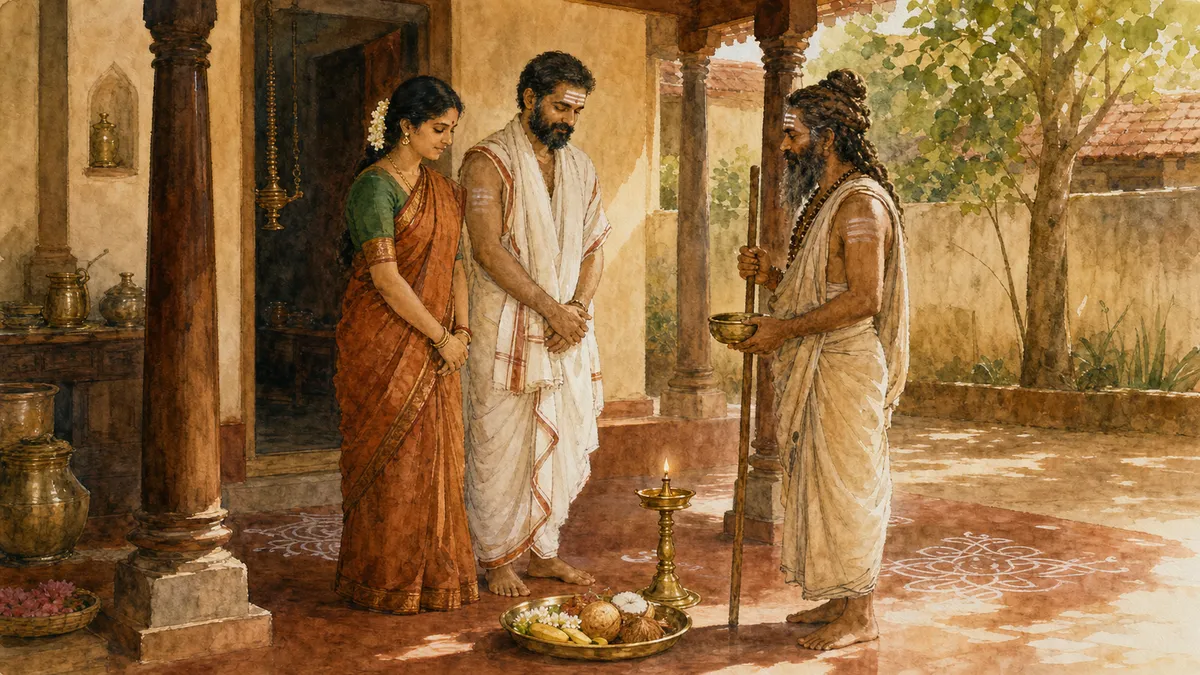
But then the matter reached the relatives, and the relatives began to say: what is this? They decided to beat him for intending to give away his wife and dishonor their lineage. After all, there had been a wedding; they had obligations. This sadhu was Shiva himself, who had come to test him. He said: “Do not fear anything, just let us go.” Yarpakaya Nayanar said: “I will accompany you so that the relatives do not attack and take back my wife. Until we reach some boundary; beyond that they will not go.”
And they set off. The relatives came with clubs and weapons, and a fight broke out before they had even reached the boundary. He said: “Sadhu, I will protect you,” and he began to fight with his own relatives. He laid low half of all the relatives, but repelled them, defended his wife, and said: I have given her to you, I promised, I have fulfilled it, take her. The sadhu went away and took her with him. Everyone was in utter, incredible shock. How could such a thing be? But he fulfilled his duty, so devoted was he. He believed in this sadhu as a manifestation of Shiva.
Then the sadhu returned and manifested in a state of light as Shiva on the bull Nandi with his consort Parvati and said: “I am satisfied with your devotion and faith, that you were able to renounce attachment in this way; take your wife back.” He healed him and his relatives and blessed him with Liberation. This is an example of perfect self-surrender, perfect devotion.
There was another example when Shiva tested a devotee. This was Ilayankudiyar Nayanar. He, too, constantly performed worship, constantly fed sadhus; sadhus constantly came to his home, and he held bhandaras, donated, performed pujas, and gave away all the wealth he had. At first he was a rich man; he arranged lavish ceremonies, golden dishes, golden altars, many garlands, many flowers, bhandaras, and great offerings. All of it was splendid and beautiful. He earned well and was a Vaishya, a businessman.
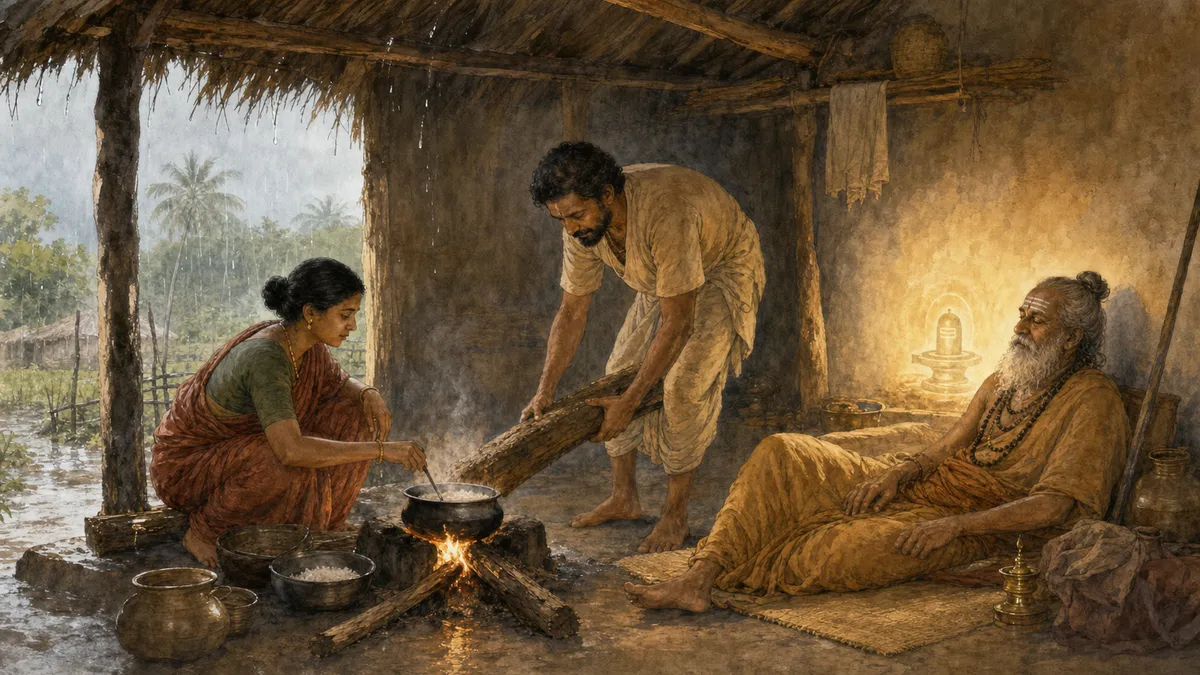
Then all the wealth gradually disappeared; as they say, the business did not succeed. But he still preserved his faith and devotion. One sadhu once came to him. He was accustomed to welcoming sadhus, arranging bhandaras, offering garlands, and feeding them the finest prasadam. But they had already become so poor that they had absolutely nothing at home. He put the sadhu to sleep, but promised that he would feed him, and began thinking with his wife about where to get food to feed the sadhu. Then he came up with an idea. They had recently sown a field with rice. He went to dig the rice out of the ground, the rice that had been planted. He dug out this rice and cooked some kind of dish. Then they began to think further: to cook this rice, they needed firewood. Firewood is not always easy to find in India. He looked and saw there was a beam in the house that supported the roof; he cut down this beam, chopped it into firewood, and cooked the rice over that fire. Then he went somewhere else, found spinach, green grass, and plucked some somewhere. He prepared everything. Then he woke this sadhu. Suddenly, when the sadhu awoke, he began to emit light and turned into a Shivalingam. From the Shivalingam Shiva emerged together with Parvati on the bull Nandi and blessed him. He blessed him with Liberation and Enlightenment for his devotion and self-surrender.
These are examples of how great devotion is capable of dispersing all karmas. To have such great devotion, such a pure devoted heart, one must think of Shiva day and night, always. One must always abide in God, one must perform upasana, one must remember God, glorify and sing the praises of God, serve God, worship God, and, most importantly, revere his devotees.
No one can receive Shiva’s grace without worshipping his devotees. To revere a sadhu is precisely the principle of pure vision. Even one who worships the lingam or murti does not attain Liberation if he treats a devotee of Shiva, his servant, with disrespect, if he does not manifest his spirit of samaya and pure vision. This is very important. By serving Shiva’s devotees, by serving sadhus, another sadhu is liberated. This is very important to understand.
Cosmogony: the Order of Creation
First was Purusha, the Atman. From him arose mahat, the elements, the tanmatras, the senses, and the great elements. Then the golden egg appeared.
Purusha, the primordial spirit, the primordial consciousness, together with Shakti. From him arose mahat, the world mind, the world consciousness, also called maha-tattva. The principle of consciousness, buddhi in a person. From it arose the tanmatras, the seeds of the five elements. From the tanmatras arose the five elements. Then Hiranyagarbha appeared, the golden egg, the foundation of the universe, the foundation of creation.
One might say: a black hole from which the prototype of the universe emerged a second before the singularity of incredible intensity; the seeds of the five elements, ready at any moment to explode and create a new universe. The golden embryo Hiranyagarbha means that the elements exist in a pure form, in a quantum-probabilistic state, at the moment of the birth of a new universe on the subtle level. Hiranyagarbha is the embryo of our universe at the level of the astral body.
There is a physical form of the universe. There is an astral form of the universe. The physical form of the universe is called “vishva.” The astral form of the universe is called “taijasa.” The causal form of the universe is called “prajna.” Ishvara is present in each of these forms. In the causal form of the universe, Ishvara is present as the lord, Ishana. In the astral form of the universe, Ishvara is present as Hiranyagarbha. In the physical form of the universe, he is present as the universal form, Vishvarupa or Vaishvanara.

The Birth of Brahma and the Nature of Living Beings
Then the golden egg appeared, shining like ten million suns. In it was born the great Brahma, endowed with my power. A multitude of other living beings are all identical to me.
From the golden embryo of the universe is born, initially, the first divine being specifically in our universe. Brahma is not Ishvara. Ishvara gives birth to Brahmas from different Hiranyagarbhas, in different aspects of his body. Ishvara is the primordial consciousness, but Brahma is directly the Creator of our universe. A great deity born from Hiranyagarbha. Ishvara himself includes Brahma, Vishnu, and Shiva. This is Dattatreya.
All are identical with Me, but they do not see Me, the Father, led astray by My maya. The forms that are born in all wombs—for them maya is the great womb. I am known as the Father. Whoever knows Me as the seed of the Father, the Lord, is steadfast in all worlds. He will not fall into delusion.
The Manifestation of Maya and the Role of Shakti in the World
Living beings find themselves led astray by illusion, by Ishvara’s maya. How does it manifest? For example, it manifests as the astral world, as time, as the dimensionality of space, as the five elements, as the laws of cause and effect, as the manifold divine beings who govern maya, the five elements, and other aspects. All of this is the great Mahamaya, the great Shakti of God.
Therefore, in this world everything is determined by Shakti. Shiva does not directly take part, unless we realize him. But Shakti governs everything. For example, it is believed that Shakti brings the disciple to the guru. Shakti brings the devotee to the deity. In accordance with his karma, of course. The play, chit-shakti-vilasa, in this universe is the main property of this world.
Shakti leads souls into the samsaric world, into birth in the samsaric world. From the heavens to the hells. Divine Shakti, attracted by blessings and tapas, on the contrary, liberates the soul. We live in a world in which Shakti decides everything. Even our desires are the play of Shakti. Everything always happens not as we want, but as Shakti decides, because she is the mistress, the ruler, and the sovereign of this world. We may desire whatever we please, but in the end it will be as Shakti desires.

But we can influence Shakti’s decisions. We can change the movement of Shakti in this world if we know how. For example, by performing rituals, making offerings, reciting a mantra, doing tapasya, we can influence the vibrations of Shakti around us. Then Shakti, uniting with our Shakti, with our intention, changes the world around us. It is that very same Shakti. Souls who perform tapasya are able to enchant Shakti with their asceticism, their wisdom, their devotion, their faith in God, their renunciation of the ego. Because they become like her spouse, to whom she is immeasurably devoted.
There was, for example, Amarnathnayanar, who honored sadhus, holy people. One day a brahmachari in white garments came to him. Amarnathnayanar placed a garland around his neck, fed him, and this sadhu, the brahmachari, said: “Now I will go to bathe in the Ganges; could you watch my clothes while I bathe and recite the mantra?” He went, bathed, and came back completely wet.
Amarnathnayanar was very devoted, very serious about fulfilling duties, about service, about serving the devotees of God, feeding them, receiving them, welcoming guests. This part of Vedic etiquette is very important. For example, when an important guest, a sadhu, comes to the ashram, when you render service to those who are above you, you must always be very attentive. This is an important part of Vedic etiquette. You can accumulate immense merit simply by serving sadhus, those who are higher, older, wiser than you. But at the same time, you can accumulate various aparadhas if you build relationships incorrectly with those who are higher and wiser than you. This is an opportunity both to accumulate great merit and to lose it. Therefore, in ancient times there were many such stories.

Knowing all these subtleties and being very faithful, very devoted, he promised to watch over the clothes. When the wet sadhu returned and asked: “Where are my clothes?” he said: “Right away, I’ll bring them.” He ran off, but the clothes were not there. He said that the clothes had disappeared somewhere, I cannot understand it, but I will compensate you. It was simple clothing. What kind of clothing could a brahmachari have? He said: “I will give you better clothes, I will gift them to you, embroidered with silk.” The other said: “No, I need my own. Where are my clothes?”
He began accusing him: “You are a thief, you stole my clothes; householders cannot even be trusted. You come hoping to be received hospitably, and then you are treacherously robbed as well.” He began to reproach him, to scold him with all his might. The other began to repent, to weep, to cry out: “How could I have stolen your clothes? I honor sadhus, I could not have committed such a sin.” The other said: “I know nothing; give me my clothes.”
Ultimately, Amarnathnayanar said: “I will pay, I will give all my wealth and jewels for this garment.” He began placing silk, cloth, and fabric on the scales. The sadhu said: “All right, however much this garment weighs, that is how much wealth you must place on the scales.” He began to put it on, but the scales did not tip. He began to put even more, but the scales did not tip. He could not balance the scales in any way. Then he began to understand that something was not right here and said to his wife: “Let the two of us stand on the scales; then we will make them tip.” The sadhu said: “You may stand on the scales, but if you have no devotion, it will not help you.” Then they prayed, stood on the scales, and the scales became balanced. The sadhu said: “Now this I accept.” He transformed into Shiva on the bull Nandi and blessed them. The scales turned into a golden chariot. They attained Liberation, salokya-mukti, solely through devotion.
The Vision of Ishvara and the Path of Spiritual Practice
The Lord of all vidyas, the supreme lord of beings, the form of the syllable Om, I am Bhagavan, Prajapati, Brahma. Equally in all beings abides the supreme Lord. The imperishable among those subject to perishing. Whoever sees Him truly sees. The one who sees Ishvara abiding equally everywhere does not harm himself; he follows the highest path.
How can one see Ishvara equally everywhere, without harming oneself, and follow the highest path? Everything begins with Guru Yoga. Guru Yoga is bhakti yoga, ishta-devata yoga, which must establish a connection with the ishta-devata, with God, grow into Ishvara Yoga, and become one stream of bhakti yoga, of devotion. Everything begins with Guru Yoga, but it does not end there. Guru Yoga must expand to the scale of the universe, because the primordial Guru, the Adiguru, is God Himself and Dattatreya.
When we have cultivated such faith within ourselves—the capacity for faith, devotion, and self-surrender—we must master contemplation, learn to abide in Shambhavi Mudra, and make Shambhavi Mudra, natural awareness without evaluations and judgments, naked awareness, our way of life, our way of perceiving the world. First faith, devotion, and then contemplation. Not the other way around.
If, while spreading the teaching, someone, without paying attention to faith and devotion, simply explains techniques, explains philosophy and meditations, this will not help. Because first come faith and devotion. According to the tantric tradition, one must not transmit the teaching or explain techniques to people without faith and devotion. But sometimes in the West this is done. Because people simply do not have faith and devotion. But the proper way is: first faith, then techniques; first faith, then the explanation of contemplative practices; first faith and devotion, then other sadhanas.

When faith and devotion have arisen, we learn meditation, the fullness of attention, until we reach the level of natural awareness through Shambhavi Mudra and other contemplative practices. Natural awareness means that you have subdued the mind, you have learned to dissolve and liberate dualistic thoughts, you have learned to be in harmony with yourself. You have removed all the obstacles of the dualistic mind, you have purified your mind, you have no conceptual attachments, fixed ideas, or thoughts impure in karma left, at least at the level of surface consciousness, and you can contemplate wherever you may be. You can abide in the nature of the mind without falling into forgetfulness. You have obtained the mirror of awareness in which God lives, in which God is always seen. When God is always seen, you no longer make gross mistakes. You do not lose faith, because the blessings are always with you. You are not distracted; your mind and your senses cannot disturb you. This is Shambhavi Mudra.
When you have learned to contemplate in this way, it is said that, as a sadhu, you have mastered the view and contemplation. To master the view and contemplation means to accomplish sixty percent of the work. The nondual view and then nondual contemplation, like the naked mirror of awareness. When you have attained this, it is a great merit, a great achievement.
Karma Yoga and Action Without Attachment
But kriya, action, still remains. There is the view, there is contemplation, and there is action. This is the path. One must also learn to act without expectation and without reward. One must learn to act in the spirit of karma yoga, in the spirit of devotion to God, in the spirit of self-surrender, in the spirit of renunciation without attachment to the fruits and results of one’s labor, in the spirit of mahayajna.
When we have learned to act without expectations, fears, hopes, clinging, without expecting rewards and praise, this means that we have mastered karma yoga, we have mastered the principle of bhakti yoga, when everything you do is not appropriated but offered. When there are no expectations, when there is no desire to receive the fruits and results. This is the spirit of self-renunciation. To act in the spirit of self-renunciation. In the spirit of self-renunciation means: I perform actions with a completely different motivation, not out of a desire to receive fruits and results, but on the contrary—not to receive, but to give.
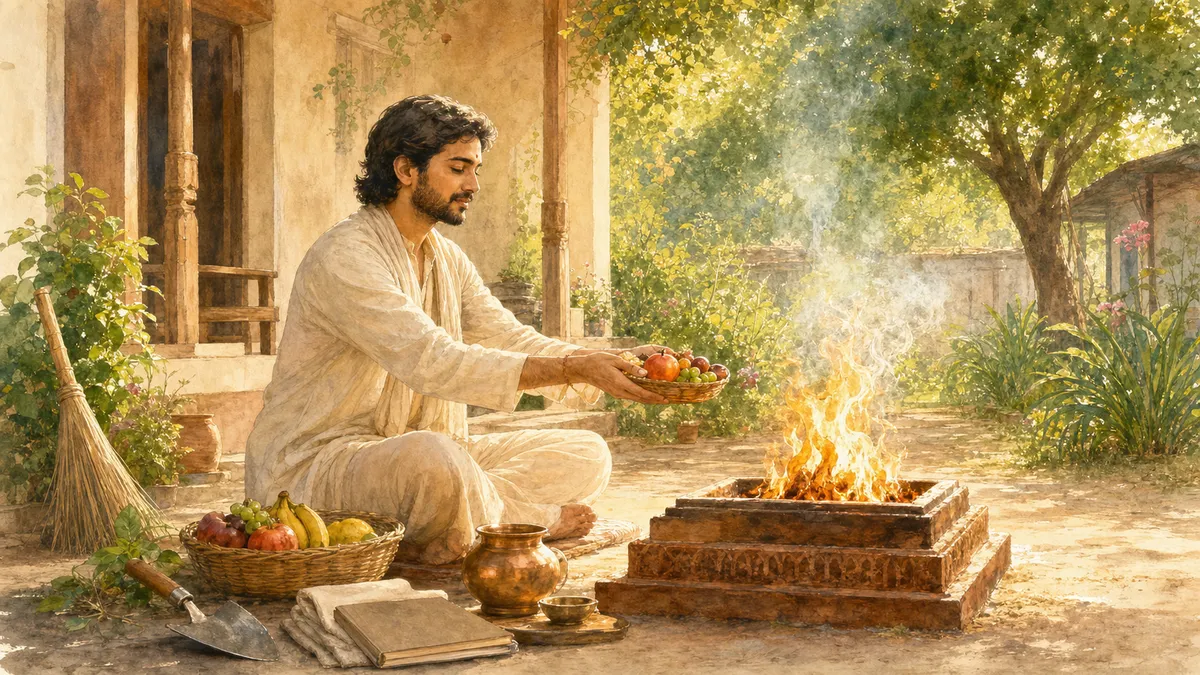
This is a very unusual motivation from the point of view of a worldly person. If one acts and then does not receive but gives, what is the point? One could simply not act at all and amuse oneself, for example. But the point is to carry out a great offering, mahayajna. Mahayajna is action in the spirit of self-renunciation. Action as a constant, continuous offering to God. Action without worldly meaning, without orientation toward a worldly result, action without hope for the enjoyment of the senses.
Then someone may ask: what is the point, then, if the senses are not being enjoyed, if there is no attachment to results—what is the point of action in renunciation? The point is that by acting without expecting a reward, a result, or praise, we gradually learn to enjoy, to delight our senses through yajna, through an offering to God. To rejoice in God Himself, and not in the fruits and results. This is the spirit of karma yoga and the spirit of bhakti yoga, when as a result of such self-giving we enjoy God Himself, contact with God, remembrance, abiding in God. This is the most valuable action.
Therefore many masters, especially in the old-school tradition, gave their disciples completely different tasks. Completely meaningless ones. For example, constantly sweeping the ashram in circles, carrying a stone from one place to another and then back again. Brahmananda in the form of Palani Swami gave his disciples such a task. Our action still has meaning: what we do benefits the sangha, brings beauty, it has some worldly meaning. We partly cherish certain hopes, partly we serve, partly we ourselves receive pleasure. But complete self-giving is when you have no attachment to the fruits and results, yet you are diligent, you do it with total self-giving. This is the point. To learn to give to God.
Christian elders in Christian monasteries would make a disciple plant carrots with the roots up. The disciple, the novice, would then ask: what is the point of planting carrots—nothing will grow anyway. The elder would say: there is a point; obedience will grow. Self-giving will grow. Or a guru would send a disciple to the market and say: buy lettuce for one hundred rupees a bunch. The disciple would return joyfully: Guru, I found the same lettuce, but for thirty rupees. “Go, give it back, buy it for one hundred.” “What is the point? I found it cheaper. That’s better.” “There is a point.” And the disciple, perplexed, would set off. He thought: what nonsense.

From the point of view of a worldly mentality, it is an absolutely foolish action. After all, our mind is so geared toward benefit. Benefit, benefit, cheaper, cheaper, how to buy cheaper, how to make it more advantageous, more convenient. We do not even notice how much our mind is geared toward benefit. But here the pattern of benefit is broken. Perhaps one must act differently. Sometimes, from the point of view of bhakti yoga and karma yoga, one must do things that are completely disadvantageous. The benefit lies elsewhere: in casting oneself aside, in giving up the ego, in cultivating within oneself the spirit of humility, self-giving, the perception of divine will, the establishment of contact with the divine will, and ultimately the receiving of blessing. This is impossible until these patterns of the mind disappear—the pattern of the doer and the pattern of action, attachment to action. If there is attachment to action, then there is attachment to the fruits and results. All this is called “kartritva-buddhi”: I am the doer.
When we can act without expecting a reward, we realize the third aspect: the aspect of behavior. We have right behavior. Unattached, fully devoted to God, united with the divine will, and capable of also conducting this divine, self-liberated will. Then a sadhu becomes a great warrior of dharma, capable of fighting on land and at sea with any weapon. No material activity will condition him.
Purification of Karma and Liberation from the Past
When a sadhu masters the view, contemplation, and action without expectation of rewards and attachment to the fruits and results, gradually his habitual mind, which holds him, begins to stop, begins to give up its positions. He can use it when necessary, but this mind no longer holds him in a death grip with its patterns, stereotypes, and fixed ideas. Contemplation gradually begins to displace these patterns, and he can remain continuously in contemplative presence.
Contemplative presence means seeing God always, seeing God everywhere and in everything. Three aspects. Always, everywhere, in everything. When a sadhu begins to see God always, everywhere, and in everything, his past karma gradually begins to be annulled, erased. This does not mean that he is already free; there is still work to be done. But his past karma, contained in the subconscious mind in the form of samskaras, in the form of vasanas — the sub-subconscious karmas are even deeper — begins to be erased.
A true sadhu is one who has freed himself from his past. The past holds a sadhu for a very long time. For a very long time we still identify ourselves. Lineage, nation, culture, biography, attachments, family ties, identifications — all the accumulated information does not let go for a very long time. It can still remind one of itself, regardless of status, karma-sannyasi, purna-sannyasi. A person thought: I am already free, I have already liberated myself; suddenly, while meditating, he receives some news, and his mind simply goes out of balance. All of this is worldly bonds, worldly attachments. They can still haunt one for a long time, even in monasticism, even after twenty years. It is not so easy to shake all this out of oneself. The worldly bonds of this life are erased, and then comes the understanding that there are still worldly bonds from past lives, and in general, as a tendency to be reborn in the human lineage.
One sannyasi went to an ashram, then to the mountains in India, put on orange robes, shaved his head, and meditated for a long time; after twenty years he had already attained steady, stable dhyana, steady meditation. He practiced yoga, upasana, served his guru in the ashram, and then spent several years in the Himalayas. His wife heard that he had already become almost like a holy man and decided to see him at darshan. She requested an audience where he lived. He became frightened. He thought: what if feelings awaken again, what if the mind becomes stirred again, what if unrest comes again. He already considered himself a renounced, enlightened person, but he became frightened. He did not meet with her. He said: I am not yet enlightened, I have not yet fully mastered my feelings; for me there is a difference between another man’s wife and my own, between a woman and an extraterrestrial. There is still a difference, it turns out, because feelings, the past, have power; memory has power.

All this is not so simple: to erase one’s personal history, to erase one’s personal karma, to accomplish samskara-shuddhi. Complete samskara-shuddhi. This is called samskara-shuddhi. For a very long time this will still weigh upon a sadhu. Everyone who has walked the path of renunciation, the path of purification, knows this. He knows how treacherous maya is, how one must not relax, how one must be vigilant, how one must act throughout life in the spirit of self-renunciation. But if he can do this, carry out the view, contemplation, and conduct, gradually his karma becomes sufficiently purified.
Indirect Methods of Teaching and Preliminary Practices
Usually teachers act in an indirect way. If one acts in a direct way, it often does not succeed. Indirect action means that for a long time, in the tradition of the old masters, the disciple did not practice pranayama or meditation. He did something else. For example, if the teacher was a musician, he sat with him and studied music first, as preliminary practices. Or if he was a teacher of Sanskrit, he studied Sanskrit. This is called “upadharma,” or the skillful methods of the awakened ones. If the teacher was a potter, then the disciple first studied pottery. He had to devote a certain part of his time, his attention, before he received the opportunity to study the dharma.
In the same way, when we enter the path, for some time we practice the path of worship, the path of devotion, the path of service, karma yoga, bhakti yoga. In order to allow these old samskaras, old karmas to be purified, to learn to act in a new way, without expectation of reward, without attachment to the fruits and results, to learn to act in the spirit of awareness and gradually begin to erase old karma, to learn to act in the spirit of faith, devotion, and self-giving.
The Qualities of Maheshvara
Having known the seven and six subtle parts of Maheshvara and the constituent parts of pradhana, one attains the supreme Brahman. Omniscience, contentment, primordial consciousness, self-sufficiency, inexhaustible power, and infinite power are known as the six parts of the great Maheshvara. Tanmatras, mind, omniscience, contentment, beginningless consciousness, self-sufficiency.
Omniscience, all-knowingness, the all-knowing Lord, sarvajnatva — one of the highest qualities, properties of Ishvara, Bhagavan. Perfection in knowledge. This means that He is the Source of all knowledge. He is the primordial divine being who produces knowledge; having known Him, we know everything.
Contentment as Divine Fullness
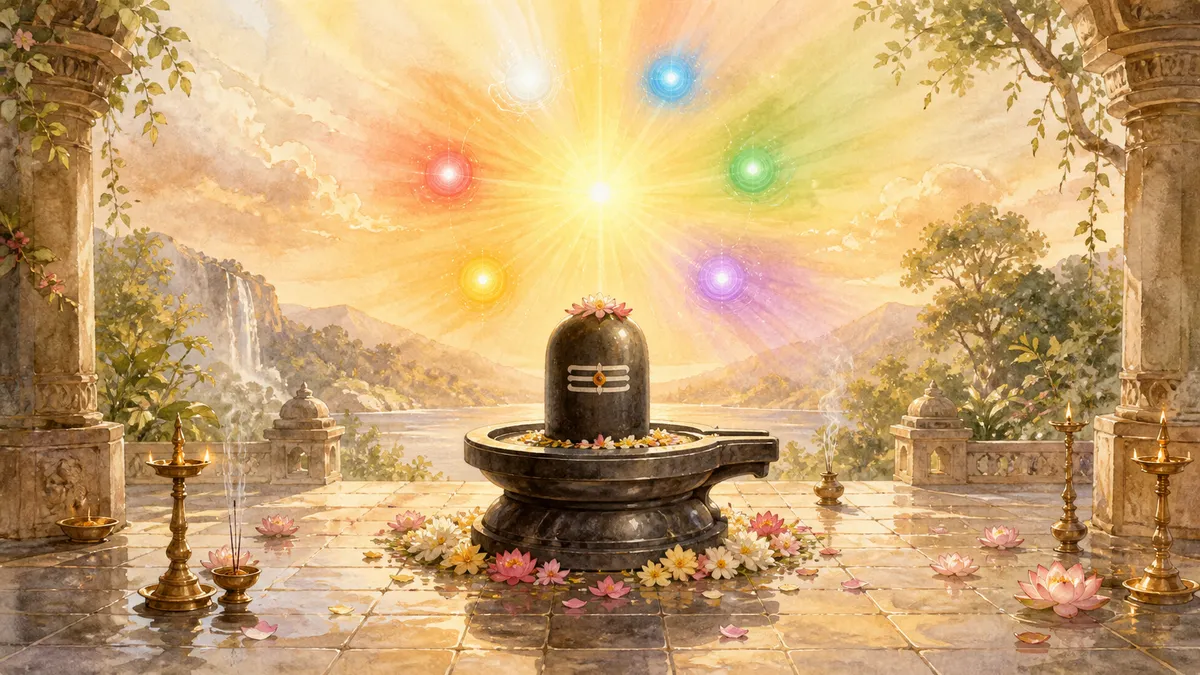
Contentment is purnatva, divine fullness, divine wholeness. That which needs nothing, which rests upon itself, acts through itself. When we come into contact with divine reality, our own wholeness and self-sufficiency also increase.
Purnatva is the feeling that you have done everything. The experience of blessing, when you experience that you have everything. When you experience that you are in your place at the center of the universe, and nothing can be added to you or taken away from you. When perfect contentment comes. This is not tamas and not the self-satisfaction inherent in a conditioned soul in the material world. It is something transcendental; it is a divine phenomenon.
Divine fullness and contentment are a paradoxical state in which you seem to abide at the center of the universe, at the center of creation. When even as a beggar, you experience yourself as a great king who possesses everything. Such a person may be completely poor, he may have nothing at all, but his bhava will be higher than the bhava of a king. Because purnatva means: “I experience unity with all divine being that exists, and I possess everything; I need nothing.”
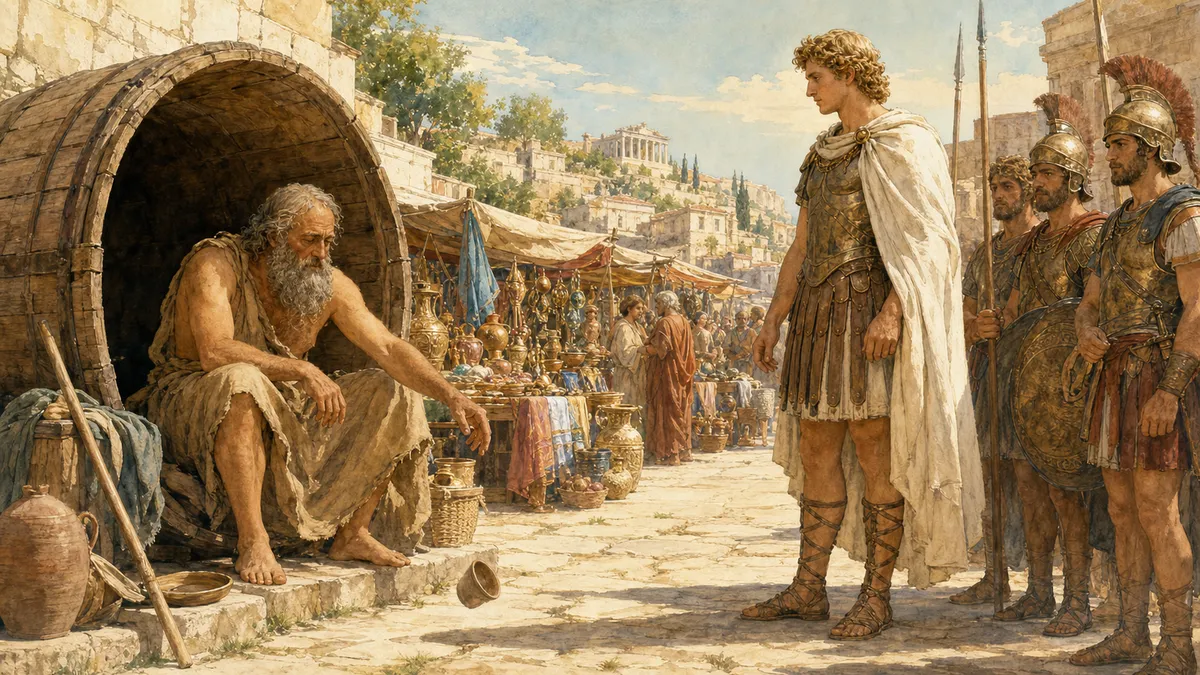
There is a well-known story of how Alexander the Great ordered Diogenes to be summoned. Soldiers came to him and said: the great Alexander is calling you. He laughed and said: who told you that he is great — did he tell you himself? If he needs me, let him come to me himself; I need nothing. Let Alexander come to me himself. Alexander had to go to him. He looked at Diogenes and said: yes, this is a great man. If I were not Alexander the Great, I too would have followed such a path, I too would have become like Diogenes. Because he felt that Diogenes, possessing nothing and living in a barrel, was great.
He had a vessel from which he drank. He thought: why do I need a vessel if I can drink from my hand, and he threw the vessel away. When he walked through the shops, through the market in Greece, he would usually say: how many things there are in the world that I do not need at all. This is purnatva, fullness, wholeness. Who was Alexander in comparison with him, yet he was eternally dissatisfied. They conquered one kingdom, then another was needed. They conquered that kingdom, then still more was needed. Half the world was needed. They conquered half the world — where could one go further? Dissatisfaction.
Contentment, purnatva, is a property of Bhagavan; when a yogin realizes the higher tattvas within himself, he radiates contentment. He can create, bring forth, but this is no longer a desire to obtain fruits and results. It is play, a creative manifestation, when something is created out of fullness. He himself is whole and abides in himself.
Dissatisfaction in Spiritual Life
Purnatva means that we give everything to God, both the fruits and the results. Because dissatisfaction can exist both in worldly life, material life, and in spiritual life. In spiritual life, if we do not have self-surrender, we too can be dissatisfied. A great many spiritual seekers are also dissatisfied with their spiritual life.
They were not satisfied with material life: he divorced his wife, the children were somehow not right either, the boss at work pays too little, the government is also unsuitable, this surrounding material culture is terrible, there is no satisfaction at all. A person thinks: I will seek happiness in spiritual life, I will go toward God. But when he comes into spiritual life, it is the same thing. Kumbhaka does not work out, the mantra is not chanted properly, kundalini has not awakened, the monks are somehow not very inspiring, seva does not correspond to my inclinations. There are plenty of ways to be dissatisfied in monastic life as well, in the spiritual life of a sadhu, or in karma-sannyasa. Some methods give no inspiration at all, meditation does not work out, only sleep, concentration does not work out. And again a person enters a state of dissatisfaction.

Very many spiritual seekers sought selfish satisfaction in spiritual life; they nourished selfish projections, projected selfishly onto spiritual life when they came to it. With these selfish projections, they entered the same absolutely dissatisfied state. Even more dissatisfied. In worldly life one can at least indulge the senses, but in spiritual life — neither a stake nor a yard. If one is a sadhu, there are neither spiritual nor material pleasures. It seems that seeking material pleasures and entertainment is already somehow awkward, improper, and there are no spiritual ones. Then the dissatisfaction is double.
This happens because of an incorrect attitude toward spiritual life, toward spiritual practice, and incorrect motivation. One wanted to satisfy oneself through spiritual life. One placed a very large bet on oneself, gave rise to very great hopes that one would satisfy oneself, that one’s ego would be happy. But in spiritual life one must satisfy God; one must be happy in satisfying God. One should think less about one’s own satisfaction. Such is the principle.
Because as soon as we begin to think about satisfying God and think less about our own satisfaction, happiness suddenly comes as well, because the soul turns out to be in its proper place. Because this is its purpose. But by satisfying the soul itself, it is never possible to make it satisfied — in principle, it is impossible.
It is like trying to feed a finger. You can dip it into porridge, dip it into delicious food, into the sweetest food, into cakes, into pastries, feed it mangoes, bananas, avocados, grapefruit, but the finger is not capable of eating, it is not capable of being satisfied. But the finger can take food, bring it to the mouth, and the food will reach the stomach; then the whole body will be satisfied, and the finger will automatically be satisfied.
God is purnatva as perfect satisfaction. When we come into contact with this satisfaction through service to God, we ourselves become satisfied. While serving, thinking, worshiping, remembering, glorifying, and chanting the praises of a perfectly satisfied being, it is impossible to be dissatisfied oneself. We ourselves inevitably become satisfied by coming into contact with this great fullness and wholeness.
The Inexhaustible Power of Ishvara
Bala is another of the attributes, aishvarya, the boundlessness of power, perfection, the possession of power. The whole world is shakti, power, and in this world it belongs to Ishvara, Shiva, Dattatreya.
Infinite power. Known as the six parts of the great Maheshvara. The tanmatras, the mind, and the Atman are called the seven subtle tattvas. Their cause is called prakriti. She is also pradhana; through her bondage is produced.
Prakriti, material energy, covers and envelops the soul, enslaving it. Our soul is enveloped in various sheaths, and it is like a diamond. Each of us is like a divine diamond. But for now this diamond is useless to itself and to others, because the potential of this diamond has not yet been extracted.

A diamond is useful when it is properly appraised and can somehow be used. In worldly life it is appraised, placed somewhere valuable, it can be valued and sold. But if a diamond lies underground, somewhere on an uninhabited island, no one can see it, appraise it, no one can use this diamond to buy food or anything else. It is simply by itself.
A sadhu is one who gradually discovers this diamond. This diamond already exists as the Atman, but we must appraise it with the help of vichara and viveka, discover it and appraise it correctly. Gradually bring it out through contemplation. Gradually learn to live in it and act. This diamond is the particle of Ishvara within us.
The One God in Various Manifestations
Shakti is Prakriti in its dissolved form. In all the Vedas she is called the womb of Brahman. Above her is the one Parameshthi, Maheshvara, Purusha, the image of Truth. Brahma, the yogin, the supreme Atman, pervading space, comprehended by the Vedas, the ancient one, the one Rudra, death, the unmanifest, the one, the seed, the universe — this is the one God. Some call him one, others not-one. Some say that this is one essence, others that it is another. Smaller than the atom, greater than Mahat, Mahadeva, so he is called by the knowers of the Vedas.
There was once a king named Meyporul Nayanar. Besides being a successful king, he was very devoted to God, devoted to Shiva, gave gifts, always received sadhus, listened, accepted various teachers, and organized great celebrations and festivals. He had a sworn enemy, Mutha Nathan, the king of a neighboring state. Meyporul Nayanar constantly defeated him in battles. Several times. In battles he always crushed him. The text says that this Mutha Nathan finally understood that a fox cannot defeat an elephant. To him, he was like an elephant.
Then he decided to act by cunning. He disguised himself as a sadhu. Knowing that the king always received sadhus, and that the guards always let them into the palace, he smeared himself with ash, grew long hair, matted his hair, put on rudraksha, took a trident, and gave himself such an appearance, like some majestic aghori from the mountains. When he arrived, the guards in the palace began to stop him, and he said: “I am going to the king to bless him; I have an important blessing for him.” The king’s bodyguard came and realized that something was wrong here. But the king himself came out to meet him and said: “Do not touch him, he is a sadhu, I must receive him.”
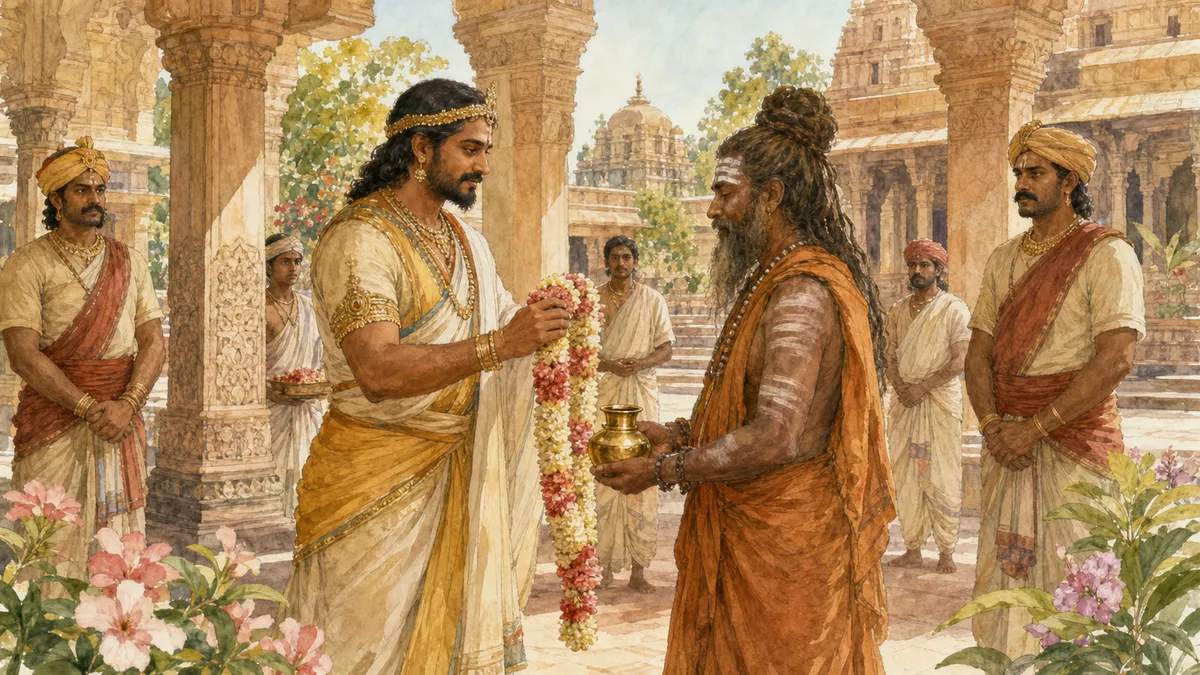
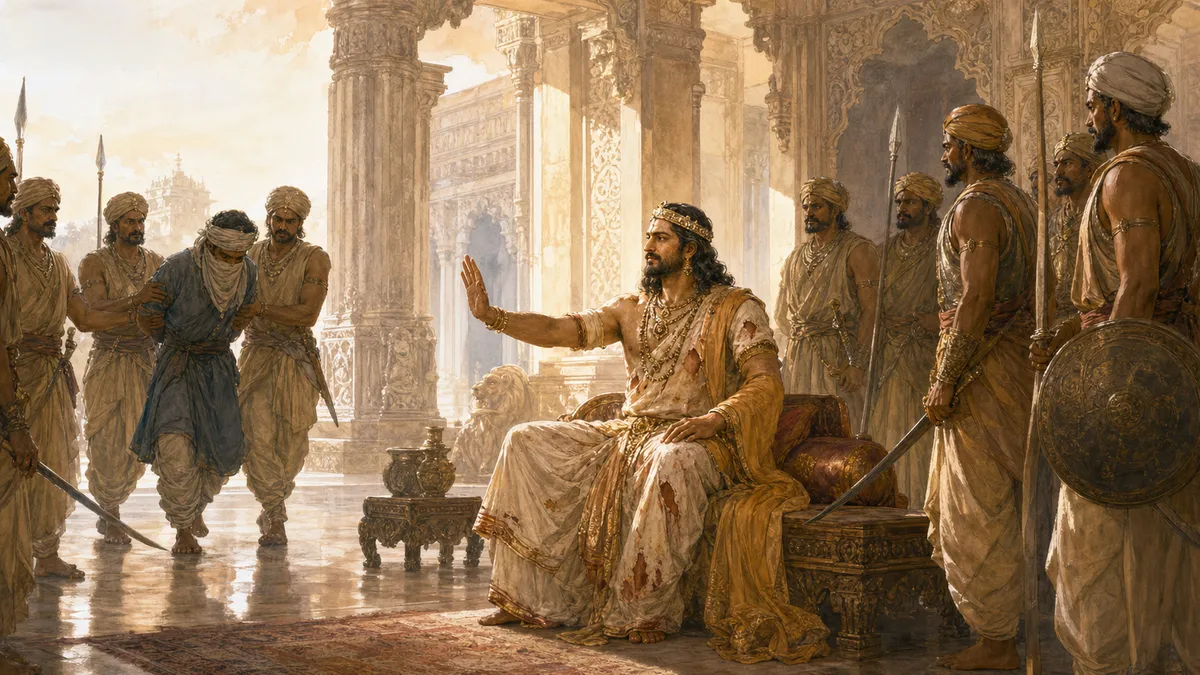
He received him, put a garland on him, washed his feet, and began to offer him treats. This king Mutha Nathan, in the guise of a sadhu, a devotee of Shiva, said: I have very important texts for you, revelations received directly from Shiva from the Himalayas, and I must pass them on to you. But only in private. His wife, the chief bodyguard, and the adviser became worried. He sent them away and remained alone with the sadhu. This Mutha Nathan took out a knife and struck the king in the heart.
When everyone came running, seized this Mutha Nathan, and understood who he was, that he was no sadhu at all, but a bandit, the king from a neighboring state, who had come in person. In their fury they were ready to tear him apart, simply to kill him. The king said: “Do not touch him. Because he too is a devotee of Shiva, he too is the one Brahman.” This king, as he was dying, told his adviser that he must not kill him, that he must protect him, take him to the border, and let him go. He had a very magnanimous, very devoted heart.
The adviser’s mind was simply paralyzed. He could not oppose the king’s order, although he wished simply to destroy him. Together with the guards, he took him to the border and released him, fulfilling this order of the king. This is the power of self-surrender and the realized jnana of the holy Nayanar.
Whoever knows thus the hidden Supreme Lord, the ancient golden Purusha, in the form of the universe, consisting of buddhi, as the supreme path, that sage becomes one who has transcended buddhi. Thus, in the sacred Kurma Purana, in the first part, consisting of six thousand shlokas, is the eighth chapter of the Ishvara Gita.
