

When you meditate, it is very important to learn to distinguish dullness and agitation. If you do not note in your consciousness when dullness and agitation appear, then, of course, you make mistakes in meditation. When dullness and agitation are noticed, you apply mindfulness and vigilance. Mindfulness is the state in which you are focused on the object; vigilance is the state in which you check your concentration on the object.
Mindfulness is like a guard who constantly stands watch at the gate; vigilance is like the guard’s supervisor, who checks whether he has fallen asleep. In the same way, you check yourself during concentration.
Next we will talk about the practice from shakti yantra, about processes connected with energy.
Purification of the Channels
For the first several years, the most important thing is to purify the channels well and to feel the flow of wind in the body. When you purify the channels, your body undergoes transformation; one could say that a transmutation of impure pranas into pure ones takes place. Sometimes this is accompanied by experiences that are not very pleasant. And the texts warn about such experiences, which one should not be frightened of, for example toothaches, headaches, itching in the body, and exacerbation of chronic illnesses. All these experiences are connected with the fact that the winds become activated in certain parts, and in those places where there were blockages, these blockages make themselves felt. This will continue until all the pranas begin to circulate freely throughout the body.
The least attainment of success in the practice of controlling the wind is the ability to experience dardri-siddhi and nectar. For monks, for example, in a three-month retreat there will be a week-long retreat for attaining dardri-siddhi and nectar. Dardri-siddhi manifests when prana and apana unite, and therefore the body begins to make jumps during pranayama. Nectar arises when enough energy rises to the crown of the head, and then a special mystical secretion oozes from the palate. This is the minimum criterion indicating the success of your practice of controlling the pranas.
The Practice of Chandali
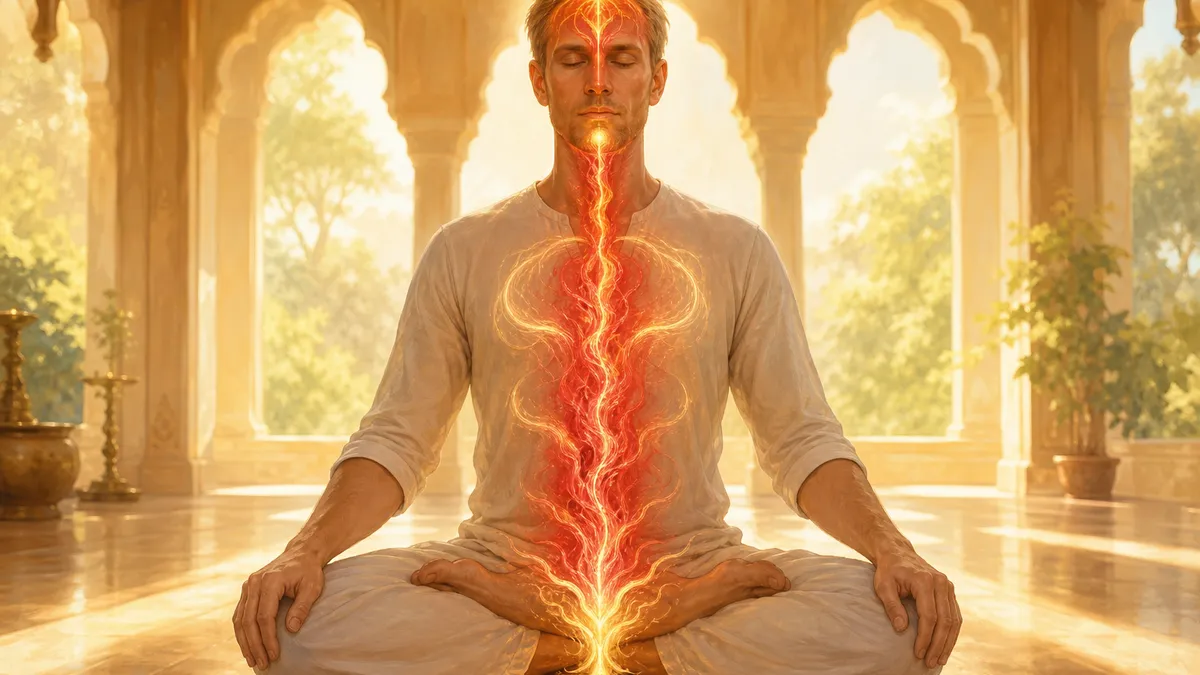
After these two criteria have been achieved, it becomes possible, through the practice of chandali, that is, by rotating the energy in a circle, to raise a great deal of energy to the crown. Then the following criteria manifest: the vision of light, the cessation of breathing, and exits of the subtle body through the crown. All these criteria necessary in the practice are experienced one after another. The next criterion is continuous consciousness.
One could say that these are the minimum criteria in the attainment of kundalini yoga in order to move toward even higher stages, which we will discuss later. For example, I explained all these stages to one mataji. She said, “But that is not my goal!” First study the teaching so as to understand what your goal actually is. When you practice, you should not do it at random; you must know precisely what steps should be taken, as well as what experiences arise in the process. In the absolute sense, our goal is the Clear Light, but in the relative sense we have a body, from which there is no escaping. And the body acts according to its own laws; it has channels and pranas. Whether you want it or not, these experiences will happen to you if you practice correctly.
That is, the experiences connected with the channels, winds, bindu, and the subtle body are simply an accompanying phenomenon that goes along with the practice of any practitioner. It is like a certain degree of holiness. When you have the minimal degree of holiness, you do not feel the nectar, but you already think that you are holy. But you are holy only at the level of consciousness. When you have a higher degree of holiness, you already feel this dripping nectar and the prana moving through the channels. And when you are a saint of an even higher level, you can enter the Light, and your subtle body can exit through any chakra. This means that you are holy not only at the level of consciousness, but also at the level of prana.
Eight Sensations in the First Stages of Practice
There are eight sensations that are considered normal in the first stages of performing the exercises.
Heat: it can be very hot and burn to the point of pain.
Cold: sometimes prolonged chills.
Numbness, goosebumps: as if insects are running or crawling over individual parts of the body, sometimes at different speeds or of different sizes.
When your side channels, Ida and Pingala, are being purified, you feel as if you are being thrown either into heat or into cold. You may have the sensation of having a cold, or a rise in temperature. At the same time, the mind will be quite clear, and there will be sufficient energy in the body. Such a painful sensation, resembling a cold, can occur during the practice of pranayama.
Itching: it can be so unbearable that you literally want to tear your skin apart.
Lightness: sometimes a complete loss of weight and the sensation of losing the body.
When udana-vayu becomes activated, you experience a sensation of lightness in the body, as if you are walking barely touching the ground. Conversely, when apana-vayu becomes activated, a feeling of heaviness arises, as if you can barely move your legs. For example, there are methods of raja yoga in which you can unite with the earth element and increase the weight of the body. And when you concentrate on udana-vayu, the body becomes light, so one can walk on thorns, marshes, and spikes. However, in the initial stages, when there is no control over the wind, this may arise spontaneously, of its own accord. If you practice pranayama for two hours a day, such experiences will be very smooth, not pronounced, and will arise only to a small extent. But if you begin practicing pranayamas and asanas for eight hours a day, and practicing chandali for six hours a day, then such experiences can be intense. In our style, we practice asanas gently, in moderation, so that the experiences are not very abrupt.

The Importance of Gradual Practice and Working with the Subconscious
Why else is it important to practice in this way? When we practice with energies, our perception also changes. The winds enter the central channel, and we find ourselves getting closer and closer to the subconscious. As you know, the subconscious is a world of images in which desires manifest themselves directly. The subconscious is not controlled by society or by surface consciousness. And if you have secret desires or emotions in the subconscious, they express themselves directly; they are difficult to restrain if you are inexperienced.
In surface consciousness, you may think: “Well, I want this only a little.” But if you are in the subconscious, then a feeling arises that you want it more than anything else in the world, that you do not want to know anything else, as if what you want represents the state of the entire universe. This is how the power of the subconscious acts upon an inexperienced person. Therefore, if you have not learned to self-liberate your thoughts and desires, it is not recommended to go even deeper, that is, from the astral body to the plane of the causal body. The causal body is the plane of the cause of the subconscious, that is, of what stands above the subconscious — witnessing awareness, which has no desires or fluctuations at all. If you have not learned to self-liberate, it will be difficult for you to cope with such manifestations of the subconscious, and therefore great fluctuations in the emotional state will arise.
The scriptures say that monks and hermits are tempted by passions more than laypeople, because laypeople have certain anchors, attachments to surface consciousness. For example, when a monk practices kundalini yoga in retreat, his level of energy increases. He has no attachments in the form of fixed ideas of the surface intellect; since he concentrates for a long time on inner data, such inner anchors no longer restrain him. In this case, the restraining anchor must become self-liberation, witnessing consciousness, which, while experiencing anything whatsoever, nevertheless clings to nothing and is able not to attach importance to anything. And then our practice of kundalini yoga will progress without difficulty.
Additional Sensations and Phenomena in Practice
Bursting, heaviness: it is impossible to lift the legs from the ground.
Slipperiness: the impression is as if the skin is slippery like ice. The intensity of the sensation depends on many factors, but above all on the condition of the organism, both physical and emotional.
In addition, there are phenomena and sensations associated with certain illnesses or simply with changes in the physical body and the evolution of the current one.
For example, a person had some illness related to the sexual organs (chronic inflammation of the prostate gland or some other condition), which proceeded in a sluggish form with a disturbance of prana, but which did not go away. If such a person begins to concentrate on the svadhisthana chakra, then after some time pain will appear in this area. But if he continues to concentrate, over time the channels will be purified; accordingly, the karma will also disappear, and therefore the pain will pass.
When a yogin’s level increases, he periodically begins to feel various painful areas in his body. He understands that these are spasmed, compressed areas in the channels where the wind cannot move freely, and therefore at times this is felt painfully. But he knows that if the channels are purified, the wind will move throughout the entire body, the stagnant pranas will begin to circulate freely and bathe all the organs, and then all painful sensations in the body will disappear.

I heard that one yogin, when he was doing pranayama in retreat, had pus constantly flowing from his ear. This is the karma of asuras in the vishuddha chakra; that is, impure pranas were being released in this way. He was doing one of the advanced pranayamas very intensively, six to eight hours a day.
Temperature Sensations and Balancing the Channels
We will briefly consider the most common of them. So, if the solar and lunar channels in the body are not balanced, the practitioner may experience cold or heat. Concentration of energy in the ordinary and middle centers usually causes the sensation of a warm or hot ball. When certain energy practices are performed correctly and energy is intensively gathered from the environment, there sometimes arises such a sensation of intense heat that it is difficult to endure; the heartbeat quickens, and profuse sweating begins. At certain stages of practice, some people experience sensations of different temperatures in the right and left palms or in the right and left halves of the body. This is connected with the fact that one half of us is more solar, and the other is lunar. There are methods and practices that make it possible to develop and consolidate such an effect. In ancient times they were used in martial systems. With one hand one could burn an opponent as if with fire, and with the other one could chill him with cold. Sometimes for several days the practitioner feels chills and begins to wrap himself up, but still cannot get warm. Then one must practice more. This indicates that a restructuring has begun in the body. Sometimes, after performing certain practices, there arises a sensation of such sharp cold that it seems as if the blood is freezing in the veins. There is no need to be frightened of such a state. There is no need to try to interrupt it artificially. This means that, despite the cessation of the exercise, changes continue to take place in the body. One must continue the practice or simply endure this state. And after this you will rise to the next stage in the development of your organism. The opening of active points is accompanied by the sensation of goosebumps running over the body or itching. If these points somewhere, especially on the head and hands, were blocked, the itching may be simply unbearable. Usually such intense sensations pass quickly, and afterward the practitioner begins to feel relief and lightness in this area. He can, as it were, breathe through it. Sometimes the sensations of goosebumps are accompanied by vibration in these zones, but not constant vibration; rather, it comes in waves. Such sensations are more interesting than uncomfortable, but sometimes they may verge on painful, which indicates a very intensive opening of the points. After this it seems as though the body has become porous and is being blown through. In such a case, until you become accustomed to these sensations, it is better to refrain from bathing in cold water and from contrast showers. Lightness, weightlessness arises if, during the exercises, you manage to forget yourself; then you pass into another state, in which the body does not hinder you and does not limit your perception, your sensations.
Transition to the Experience of Bliss
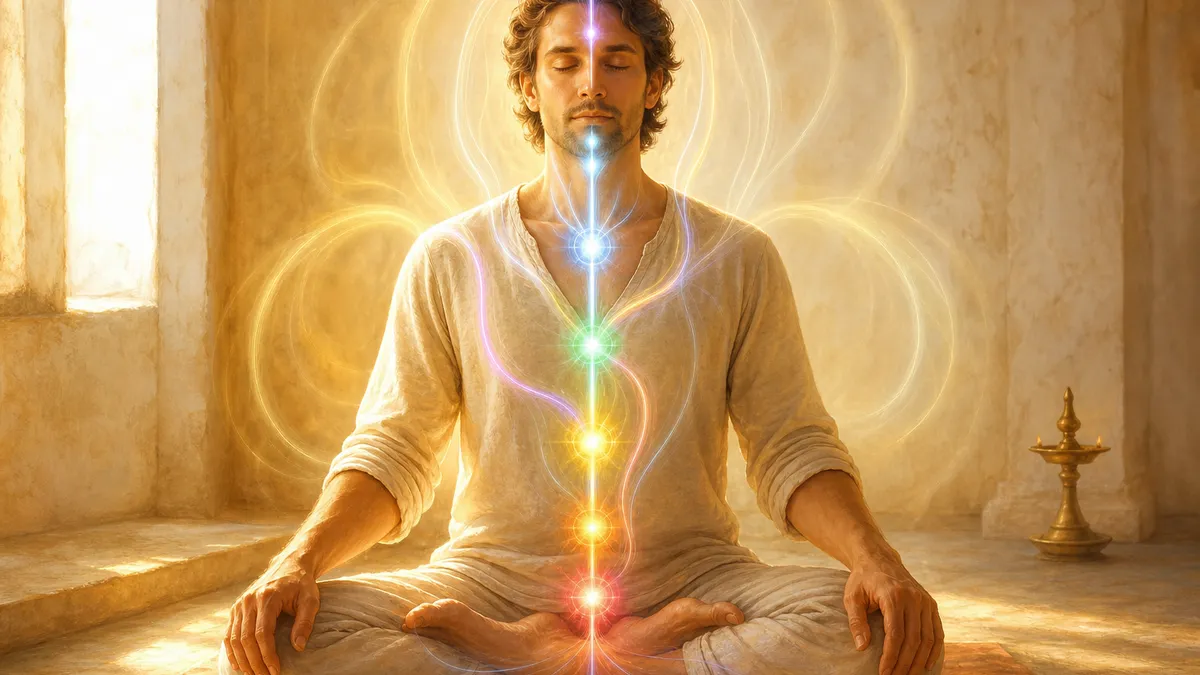
If you practice, then after some time such unusual sensations pass, and different kinds of bliss begin to arise instead. The channels are purified, the level of energy rises, and you begin to feel bliss in the body that accompanies you constantly. This bliss is described in the texts; it may be male or female, the bliss of pranas or the bliss of nadis. For example, it may arise in the svadhisthana chakra and be accompanied by mula bandha and uddiyana bandha, which occur spontaneously. This indicates that the energy is rising and entering the central channel a little. Bliss may arise in the muladhara chakra and flow upward along the back, from the kidneys to the shoulder blades. It may arise in the navel, the manipura chakra, and be experienced as bliss reminiscent of the sensation of eating food, only more refined, bringing merriment and joy. Bliss in the anahata chakra manifests as the bliss of love or joy, of meeting friends; it envelops you and gives a subtle state of inspiration, like a subtle divine ecstasy. Bliss in the vishuddha chakra manifests as a state of excitement. The bliss of the ajna chakra and the sahasrara chakra manifests as a state of causeless joy.
That is, at the stage when the channels have been purified and all the difficulties listed above have been overcome, another temptation arises—various experiences of bliss. Sometimes the practitioner feels so good that he wants to laugh, dance, or sing constantly.
Working with Heaviness and Lightness in the Body
The sensation of heaviness arises because of an inability to relax and assume the correct posture, and then the unfamiliar position of various parts causes heaviness or pain, numbness, and so on. The same is true when entering an image and filling the whole body with energy.
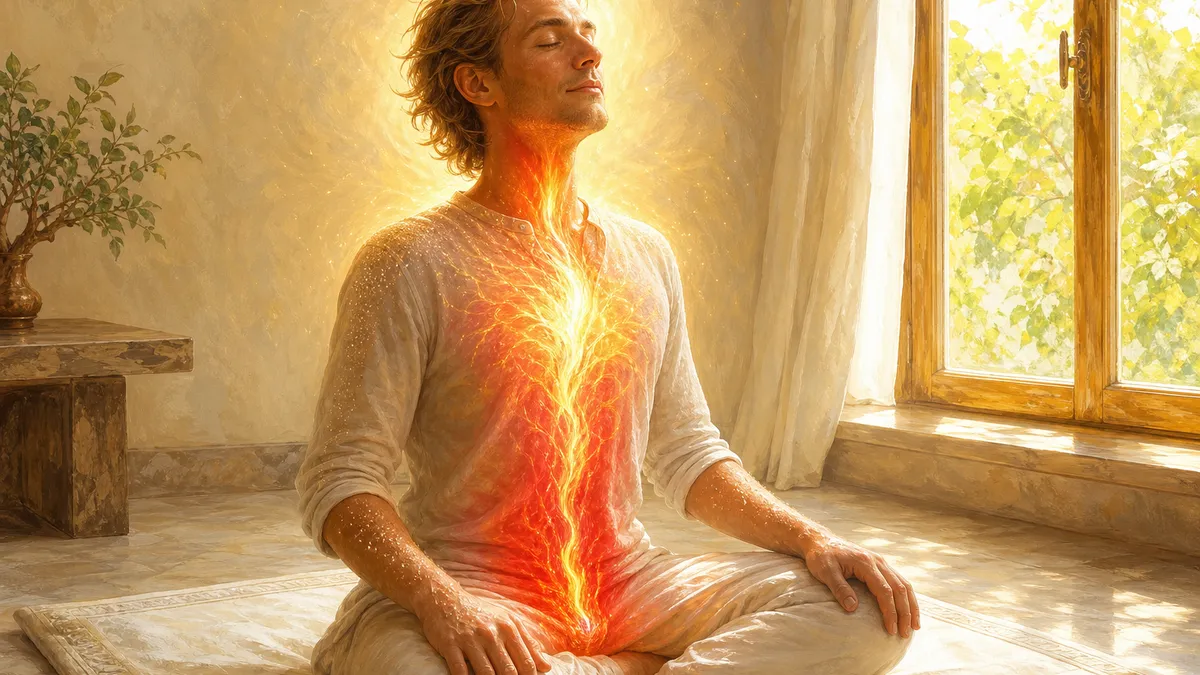
In order to feel lightness and weightlessness in the body, one should be able to let go of oneself and enter presence. Whenever you do not fixate on the physical body and can let your mind go free, allowing yourself to expand, you inevitably enter presence, and this always gives the physical body lightness. Lightness arises because the winds from all the side channels are drawn in and begin to circulate through the central channel (sushumna). Sushumna also contains ida and pingala within itself, only on a subtler level. That is, the two side channels exist on either side of the central one, but when the winds converge and enter the central channel, then within sushumna there are also its own ida and pingala. These are chitrini nadi and brahma nadi, which on the subtle level also represent solar and lunar energy. And when they circulate, the yogin experiences very deep states of clarity; his body is not felt.
Distension in the Chakras and Its Causes
Filling with energy also causes a feeling of distension: the fingers may swell, it may be difficult to bend them, and the legs may become swollen. Over time, an even distribution of energy throughout the entire body begins to occur.
Distension can sometimes be in the chakras. When you practice concentration or the circulation of the wind, and some chakra is clogged, this may be accompanied by such distension. For example, if a person’s anahata chakra is blocked, he will constantly have a tendency to cough, which is a sign of blockage in the anahata chakra. If the channels are blocked not in the etheric body but at the level of the astral body, then the energy stops in the anahata chakra. If such a person experiences love for God, devotion, and other elevated states, then at the level of the chest he will have a red spot; he will always have a sensation of burning in the chest area.
Ramakrishna, in order to check whether a person had seen God, asked him to show his chest, to check whether his anahata chakra had been activated. If the person had such a red spot, he would say: “Yes, indeed, you have seen God.” And this is truly so. For example, my chest was constantly red in this area for several years because the wind in the anahata chakra was working very intensely.
If, however, the pranas are impure and consciousness cannot sublimate them, then states of slight heaviness in the legs and even swelling may sometimes arise. For example, if a person’s muladhara chakra is working very strongly, causeless anger arises in him, but he does not manage to liberate it and unite it with contemplation. Then this anger, instead of rising through the central channel and circulating, will go downward and settle in his legs. And he will feel that his legs are swelling. This is not a very pleasant state. But if he somehow gets rid of the anger, then in an instant he will again feel lightness in his legs.
States of prana are highly dependent on consciousness.
Energetic Phenomena and Visions
The sensation of vibration is often connected with the influx of energy from outside and the movement of energy through the channels. Sometimes it seems as if there are humming wires inside the body. Blocked ears, a roaring sound like in an airplane when the flight altitude changes, are connected with receiving a large amount of energy from outside and its entry into the brain. In the future, the practitioner will gain the ability to hear sounds and conversations at a very great distance. Flashes of light before the inner gaze are connected with activation in the area of the ajna chakra, when a sufficient amount of energy enters this zone. Visions, images, or communication with deities and saints, conversations with them, scenes from various eras of earthly life, scenes of other worlds, voices, light, and so on—at the initial stages all of this consists of models of our brain, consciousness, and psyche, based on information available at conscious and subconscious levels.
At the initial stages, when we experience such visions, they are not necessarily visions of any saints or deities. And even when we see them, there is no need to become overly fascinated. Sometimes ordinary spirits can take the form of beautiful visions.
Assuming the Forms of Deities and Visions
It is written in the tantras that yogins, in order to subdue someone or bring certain enemies under control, can assume the form of the deities worshiped by those enemies. For example, once Muslims decided to conquer India, and then one yogin assumed the form of a Muslim prophet and manifested himself in the sky, thereby stopping the Muslims.
In the same way, if we see some deity, it does not mean that we are seeing the true form of that deity; it may simply be some manifestation. For example, one mataji saw Sai Baba, who came into the kitchen to help make flatbreads, while also smoking a little and behaving very freely. She was surprised that such a thing could happen. Now imagine that this had been seen by a person who sincerely worships Sai Baba but who still has his own impurities. As a result, a certain image of the saint Sai Baba would have been created in his astral body.
That is, if we worship something, revere it, enter into samaya, our subtle channels radiate subtle states of consciousness that take the form of those deities most familiar to us. And they can be seen quite often. Of course, they possess a certain state of wisdom, since these are subtle states of mind. However, a yogin tries to self-liberate everything and is not too captivated when seeing anything.
For example, one nun often contacted Babaji, but something about these contacts of hers did not seem right to me. No matter how much I tried to clarify her consciousness and raise it to a higher level, she was fascinated and believed that she was contacting the genuine Babaji. When I looked to see which Babaji exactly she was contacting, it turned out that these were several beings assuming that form. One of them was a low-level spirit who, to put it simply, was fooling her.
A yogin must always look at everything critically and think as follows: “I am interested only in emptiness, light, infinite space.” This is what one cannot be mistaken about. But everything connected with visions, name, and form can very easily lead us by the nose.
Attitude Toward Phenomena and Visions
All of this is not true; it is nothing more than phenomena, and one should not focus attention on them, however interesting they may be. Visions and sensations will keep changing all the time, since this is connected with changes in the body and consciousness. If one pays attention to such phenomena, one can easily stray from the road leading to the summit and never reach the final goal. This can be compared to a highway along which you are driving in a car and which you need to cover within a certain time. Various landscapes flash by outside the windows; you can admire them, store them somewhere in your memory, but at the same time keep your eye on the main road and remember the final goal of your journey.
Usually it is said like this: “Did you see something? It is neither bad nor good, so continue the practice. Did you experience something? It is neither bad nor good.”
If you stop at every new section and get out to look around, it may happen that you get stuck at the very beginning of the path, unaware that all this is only the beginning, the threshold, and that further on there are other landscapes, another perception. You risk getting lost, becoming hopelessly late, or not reaching the destination at all. Your life may not be enough to reach the goal of the journey. Remember, these are only illusions; pay no attention to them, do not indulge your weaknesses and desires to come into contact with the unusual.
Weaknesses of a Higher and Lower Order
There are weaknesses of the so-called higher order: the desire to come into contact with the unusual. There are also weaknesses of a lower order, arising from our own impurities. For example, when you concentrate for a long time on the anahata chakra, you may have experiences connected with relatives: attachment, love, feelings of guilt, remorse, a desire to ask your mother’s forgiveness for something or to finally sort out relations with a beloved woman left behind in the world, and so on. All these are simply channels of the anahata chakra; they should not be indulged. On the contrary, if anger and other similar emotions have been suppressed, they may now manifest.
One Buddhist practitioner sat in retreat for nine months. It so happened that, somehow, the retreat rules were violated, and from the mainland (he was practicing on an island) he was informed that eight months after he had gone into retreat (he was a layman), his wife had left him and married another man. Then, instead of the theme of the retreat, he began to seethe with anger and hatred. In the ninth month he came out of retreat and went to the teacher asking for advice on how to kill the rival with whom his wife had betrayed him. The teacher said: “You have entered an incorrect state, so the retreat is over for you.”
That is, we may experience many things, but we must not indulge anything, thinking that in this way some of our impure karmas are manifesting and that we should simply observe them. If we fail to observe them, then we should evoke opposite sensations by instantly restructuring our consciousness. The method of the opposite sensation is called pratipaksha-bhavana; that is, if hatred or anger arises, one must evoke the opposite feeling (love, compassion, and so on) and immediately imagine that you love this person. If sexual images arise, if the mind is seized by them, then one should evoke a feeling of dispassion, complete indifference. By applying such an approach, one can cope with all inner data.
Painful Sensations During Practice
Painful sensations may be caused by several reasons. If the practitioner is healthy and has sufficient energy that rises upward to the head area and the ajna chakra, then first, pain arises when the nervous system in the area of the third eye is activated and when it opens, as well as when the points of the upper part of the head around the perimeter are activated and opened. This is the preparation of the body for the possibility of the soul’s future exit.
Mild, aching pain may occur in the chest if you practice kumbhakas and pranayamas intensively, especially during the practice of bhastrika pranayama. In this case, you need to reduce the load on the anahata chakra, decrease the duration of breath retention and the number of technical practices. If, however, your energies move freely upward to the head, pain may occur in the forehead area, in the ajna chakra. This indicates narrow channels through which the wind cannot pass freely. In this case, more attention should be given to anuloma-viloma pranayama, viparita-karani, and the raising and lowering of energy. If you raise the energy too quickly, not very pleasant sensations may arise. In this case, you need to focus on making the raising and lowering occur as smoothly as possible.
If you hold the energy during raising and lowering or concentrate, then in order for the wind not to accumulate in this area, you simply need to imagine how it descends along the front channel down into the lower abdomen; that is, you need to perform the second part of chandali — the lowering and concentration of energy in the lower abdomen.
Diseases and Energetic Processes
In the second case, painful sensations arise if the practitioner has or has had any diseases, injuries, operations, and so on. In this case, painful sensations are inevitable. Let us consider this in more detail.
States associated with the practitioner’s diseases.
First. Painful sensations.
From the point of view of traditional medicine, in any area where a disease is localized, whether current or past, there is a narrowing or blockage of the channels through which energy circulates. This causes stagnation or obstruction of energy through this area, and along with it a disruption of blood circulation. Such a state of the channels can be compared to the bed of a dried-up river, when moisture remains only in the deepest places. During practice, energy begins to enter the body from the outside. As it accumulates, it automatically flows to those areas where it was lacking. A redistribution of energy takes place. And when it begins to pass through a narrowed or blocked section of the channel, a person experiences pain. This is described as: “Energy is fighting the disease.” The pain may vary in intensity and duration.
First. Sometimes acute pain arises during classes in the hall or at home and quickly passes, without recurring in the future. This means that the person has received enough energy to immediately, as if in one surge, break through a difficult-to-pass section of the channel. Then the disease begins to recede.
Second. Sometimes the pain that arises resembles an ordinary exacerbation of the disease and lasts a long time, sometimes several days or weeks, but as soon as one stops practicing, the pain goes away. This happens in cases of long-term chronic diseases. Sometimes everything begins to hurt at once. This means that you have too many disorders in the body, and most likely it is oversaturated with medicines, while the accumulation of energy is proceeding slowly. Then time is needed to overcome the disease and remove all the impurities, medicines, toxins, salts, and so on. Therefore, under no circumstances should the practice be stopped. One must allow the energy to carry the healing process through to recovery, to the end, because with any treatment the disease often worsens, and then recovery comes.
This does not mean that as soon as you begin practicing with energy, you will experience various pains and other unpleasant states. If a person has sufficient merit and his spiritual karma is pure, then he goes through such processes practically painlessly and imperceptibly. That is, there is no need here to be overly suspicious.
Harmonization of Energy and Other Experiences
There is a universal method that makes it possible to harmonize energy. This is the practice of shat-chakra yoga, connected with concentration on the lower chakras. When you become accustomed to concentrating on the chakras and at the same time sensing how easily prana circulates through the body, you feel how, with the help of each chakra, you can regulate any part of your body to an excellent state. In principle, the mechanism of self-regulation in any situation becomes clear to you.
Other experiences that a practitioner may encounter are strong swaying, intense movements, and intense vibrations. They arise when the wind rises strongly during technical practices with the superficial channels, or during the awakening of kundalini if you have a good padmasana. Nausea or the urge to vomit may occur if a person’s energy ascents are abrupt and unbalanced; however, they pass immediately.
After some time, we become skillful in experiencing various energetic states and are able to regulate them. The general principle is that in any states, if they are connected with energy rising upward, we try to bring the energy down through the front channel and accumulate it in the region of the yonisthana. We always practice in such a way as to ground ourselves and feel the connection of the lower part of the body with the earth.
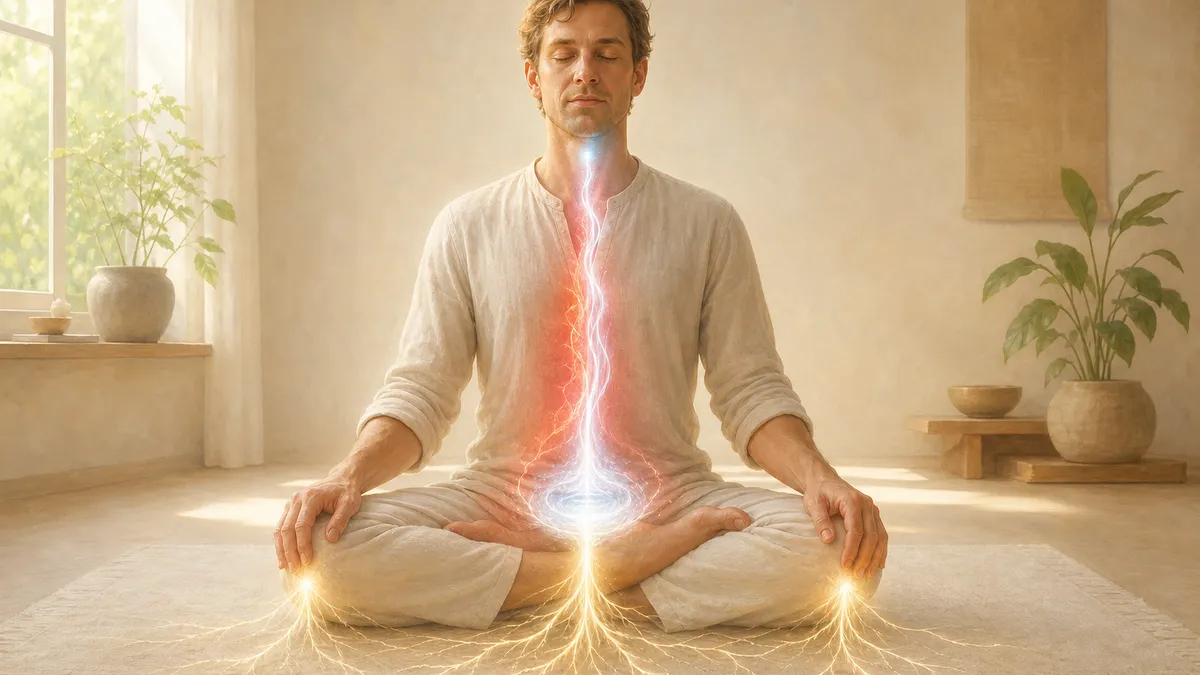
When we know all these principles, our energies reach a new level, and then various negative and unpleasant sensations are replaced by bliss, after which different kinds of mystical experience arise. In essence, mystical experiences become part of the yogin’s physiology; that is, they are no longer regarded as something mystical, but as something just as natural as sleep or food. For example, sensing prana in the chakras and condensing it there, allowing it to circulate freely through the body, making exits in the subtle body, feeling nectar—all of this, over time, will become part of your physiology in the physical body.
Maintaining the Purity of the Channels
Such a body and such a pure experience of energy are the basis for deepening the practice of contemplation and for success in samadhi. Therefore, every yogin must know how to have pure channels, how always to keep the pranas under control, and, if they have become polluted, how to purify them. A true yogin will not allow polluted channels, and therefore will not experience strong desires. He always watches over himself so that his channels are purified, kumbhaka has a decent duration, the pranas are balanced, the energetic state is good, and the body is strong. He will never allow a feeling of heaviness in the stomach due to overeating or a blockage of the svadhisthana chakra, when sexual desire overwhelms you but you do nothing to prevent it. He will not allow the feeling of unconscious falling asleep and tamasic awakening, a feeling of heaviness in the legs when apana-vayu is blocked, a feeling of loss of energy during erotic dreams at night, or kumbhaka lasting thirty-five seconds on the inhalation. A true yogin will never allow such a thing in principle. He always tries to keep himself in good shape and to purify what is within his power.
Questions and Answers
Question: Is it true that in the process of purification the aggregate of karmas that are in the body, images, and thoughts must surface in precisely this order? Is this inevitable, or can they dissolve as akarma? Or does everything depend on the method?
This is all individual, because everyone has different karmas. It also depends on the degree of intensity of the practice and on the method being practiced. Some people may practice the same methods but have different results. One will have no problems, so he will immediately enter samadhi, while another will experience being thrown now into heat, now into cold. This is all very individual, although general tendencies are roughly similar among certain groups of people. In general, everything depends on which category of yogins you belong to: divya, vira, or pashu. Here, the experiences of pashu were described. Vira will feel a slight vibration in the spine, warmth in the body, his head will ache a little, and he will enter samadhi. Divya will immediately experience bliss in the body in ecstasy. These are different types of temperament.
Question: “For example, one method is practiced, and in the process of purification pain is experienced in the knees. But if one nevertheless practices another method, one that acts more subtly, will this pain be inevitable? Can it be that this pain will not be felt, or will be felt only very weakly, that is, that the karma will be eradicated at the root?”
Each method must be considered specifically. For example, if you have decided to sit in padmasana at all costs, your knees will hurt, because by such a forceful method you are purifying apana-vayu. But if you sit not in padmasana, but in sukhasana, doing sahita-kumbhaka, your knees will not hurt. It all depends on the approaches used. If you sit in the rishi posture, your impurities in the channels may be sublimated very gently and harmoniously and enter the central channel, although this will take more time. That is, this question cannot be answered unequivocally. The result depends on the construction of the line of practice and on many other factors. Each line of practice is unique and gives certain different shades of sensation. But the principle is this: if the channels in some area are blocked, they will still cause sensations of improper or weak circulation of energy. Whether you purify them through shat-chakra yoga, sahita-kumbhaka, sitting in padmasana, contemplation in the rishi posture, or shambhavi mudra is a matter of technique.
For example, a person’s svadhisthana chakra is clogged because for fifteen years he led a sexual life without sublimating the energy, and then he became a monk. When he begins to practice, this area will be blocked, so it will be difficult for him to sit in padmasana, and he will have difficulties with sahita kumbhaka; pains will constantly arise, and when the energy rises, strong sexual desire will appear. But if he practices ashvini mudra, sahita kumbhaka, and viparita karani for thirty minutes a day, then in about two years apana vayu will be purified, and all of this will pass. And so that the energy does not plunge him into stress, it should be raised upward and lowered downward along the spine, just as we do in chandali. Then the karma of the lower worlds will be purified, and the pain will disappear. That is, it will arise only during very long sitting in padmasana or during intense technical practices, while under ordinary loads it will no longer be felt. If a person simply sits and concentrates on the svadhisthana chakra, he will have a sensation of rotation in the svadhisthana chakra, which spreads throughout the whole body and to the knees, as well as a feeling of the channels opening and prana circulating. In this way he can also purify karma. If he does wind training or viparita karani, he will feel the ascending wind opening the channels in the muscles; they become freed, and therefore the circulation of energy begins. In other words, energy can be purified by various methods. And there are very many such methods.

Question: When concentration on the chakras takes place and blockages in the channels are opened, the sensation of vibration in the channels becomes stronger than the sensation of the chakra. In this case, should attention remain on the chakra or switch to these blockages?
The sensation of vibration in the channels is stronger than the vibrations in the chakra? And what kind of vibrations are felt in the channels?
“Heaviness or pain.”
Continue concentrating on the chakra. Try to move your attention slightly inward, closer to the central channel. If it is the spine, then you concentrate on the petals, on the kshetram, that is, on the surface of the body. But you can try to shift the point of concentration slightly closer to the sushumna and listen to the sensations, and then move it back again to the kshetram. There are different schools of yoga, and some recommend concentrating on the kshetram, under the skin, on the petals of the chakra, on the outer surfaces, while there are those that recommend concentrating closer to the central channel, that is, in the depth of the body. We concentrate on the kshetram, but if what you are asking about arises, then you can move your attention deeper while continuing to hold the object of concentration.
At the higher stages of practice, when you master presence and can move it into the lower abdomen, into the coccyx, into the manipura chakra, and into the anahata chakra, you can purify the channels by the power of presence alone. This is the greatest method of managing your pranas.
Purification of Channels in Lucid Dreams
Question: And if one attains awareness in dreams, is it possible to purify the channels in a lucid dream? Will this be more effective than while awake? They say that two minutes there can be equal to weeks or months of purification here.
By purifying the subtle body, you purify only the subtle pranas in the body. Perhaps you will not immediately purify some gross channels this way, but the subtle pranas can be purified quite quickly with the help of lucid dreams.
By what means are the pranas purified by themselves, without techniques? Through the refinement of consciousness. If you evoke refined bhavas and pure vision within yourself, then the channels are purified by themselves, even if you do not do a single technique at all. True, this method is not so fast; it requires years of refining consciousness. For example, in worldly life you have all encountered refined people, such exquisite, polished worldly gods. These are very rare people — gods of passion. They are not necessarily practitioners, yet they have a sculpted body, refined manners, and very wise speech. They are certain great artists, sculptors, musicians, poets, and so on. Their pranas are subtle; they do not feel such strong desires as ordinary worldly people do. They are not thrown off by the vibrations of the lower chakras, so when drawing, their hand does not tremble, and they can create graceful lines. Their pranas obey their clarity. This means that their refined consciousness controls energy without techniques. They do not even practice yoga; they simply have, through karma, such a body structure and prana, such a state of refinement.
We also pay attention to having such refined consciousness.

Practical Questions on Pranayama
Question: If, while performing pranayama, one experiences painful sensations in the anahata chakra, but this pain is tolerable, is it still better to reduce the load or to continue practicing?
The load should be reduced until the painful sensations disappear. Painful sensations indicate that the throughput capacity of the anahata is not yet sufficient to hold kumbhaka for a long time. Comfort should be maintained during practice until the nadis have been purified, while making just a little effort beyond that comfort. When your channels are purified, you will not feel discomfort even with retentions of three minutes during three-hour and four-hour pranayama sessions. This, too, will be comfortable for you and will be perceived as a kind of entertainment. But while the channels are not fully purified, you should not force events by causing discomfort in the body.
Question: What can be the consequence of this forcing?
All those experiences we have spoken about, in greater quantity than necessary. There are, of course, vira yogins, heroes, who, by forcing events, think: “Well, it’s nothing terrible. At least I will quickly experience transmutation.” They attain the samadhi of light, continuous consciousness, within a month. The Guru belongs to this category. But in general, students are advised to practice more gently, that is, to spend more time but have greater stability in practice.
Question: Why does the anahata constantly feel expanded when concentrating on any chakra?
This indicates that the anahata chakra is dominant for you, that the channels there are the widest, but they also have blockages. In this chakra, the wind accumulates in greater quantity, so practices connected with the anahata will work better for you than others. But with the purification of the channels, this will disappear. It is also important during concentration not to concentrate with the mind, not with the head, but to feel the chakra with the body. Then the wind will gather there.
Features of Concentration on a Point
Question: There are instructions that when concentrating on a point, for example, one should not pay attention to the secretion of mucus. But what should one do if tears are secreted, a strong stinging arises, and the eyes smart as strongly as when cutting onions? Since purification occurs through tears, should one not pay attention to this? Or should concentration be stopped?
If you have strong discomfort, you may stop the concentration. However, these instructions are given in order to enter dhyana; that is, if you move, you destroy dhyana; if you do not pay attention, you enter meditation more deeply. If this does not distract you from dhyana, you may continue. But if your mind becomes agitated, if you lose concentration, then it is better to stop and wait it out.
Question: Why is it recommended to concentrate on the kshetram rather than on the root of the chakra?
This is because this area in the chakras must first be purified before penetrating to the sushumna. And one should concentrate on the roots of the chakra, that is, closer to the central channel, later, when the chakra’s throughput capacity increases. If we do this from the very beginning, then the petals in the chakras are, as it were, not yet activated, and the channels are not opened. That is, we are trying to enter immediately through the back door, but we will not have a free passage for the energy.
Question: How long should one mix prana during vase breathing, for example, with a retention of thirty seconds? At the end of the retention or constantly during the retention?
You inhale, gently push the prana downward, pull the apana upward, slightly pack the energy, and hold it below the manipura for these half a minute. And if it gets out of control, then by contracting the lower gates, lightly pushing with the diaphragm, or slightly drawing up the uddiyana, you continue to control it. That is, you mix it from the very beginning, and then you only maintain control with the three locks.
