

Commentary on the text “Moksha Dharma,” Chapter 199
Spiritual evolution includes various levels: people, sadhus, jnanis, siddhis, gods.
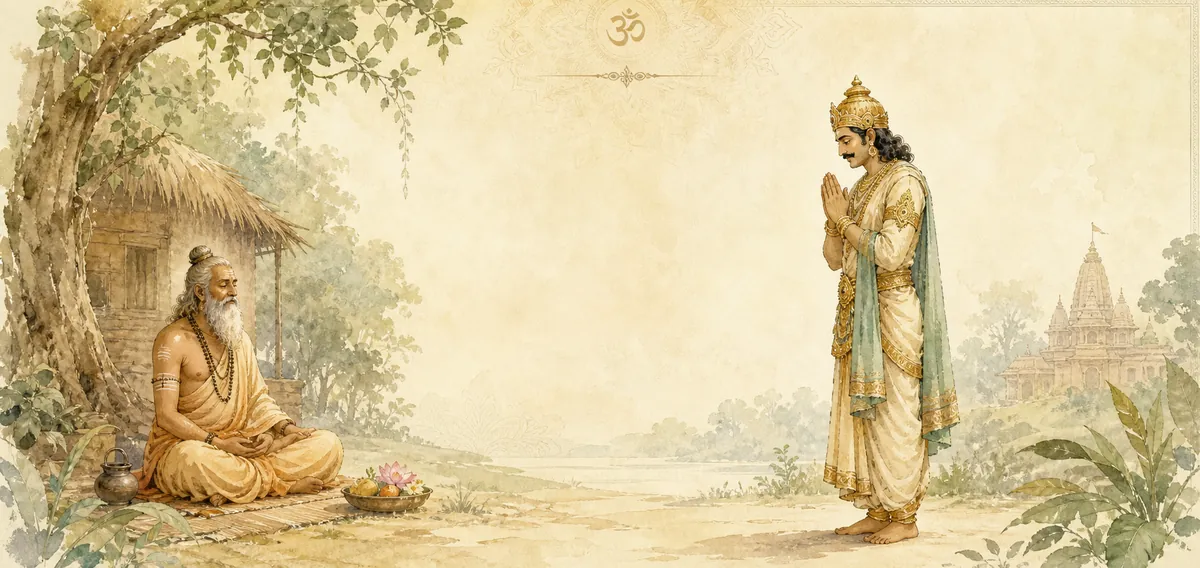
In the “Moksha Dharma,” Chapter 199, a conversation is described between Kala (time), Mrityu (death), Yama (the god of justice and rebirth), Ikshvaku (the son of the Sun), and a brahmin. A certain brahmin—a reciter of the Vedas, firm in dharma, who had accumulated many merits, the son of Pipala, a descendant of Kushika—attained jnana after studying the six parts of the scriptures with great diligence. Experienced in knowledge, he constantly remained in a state of devotion to dharma.
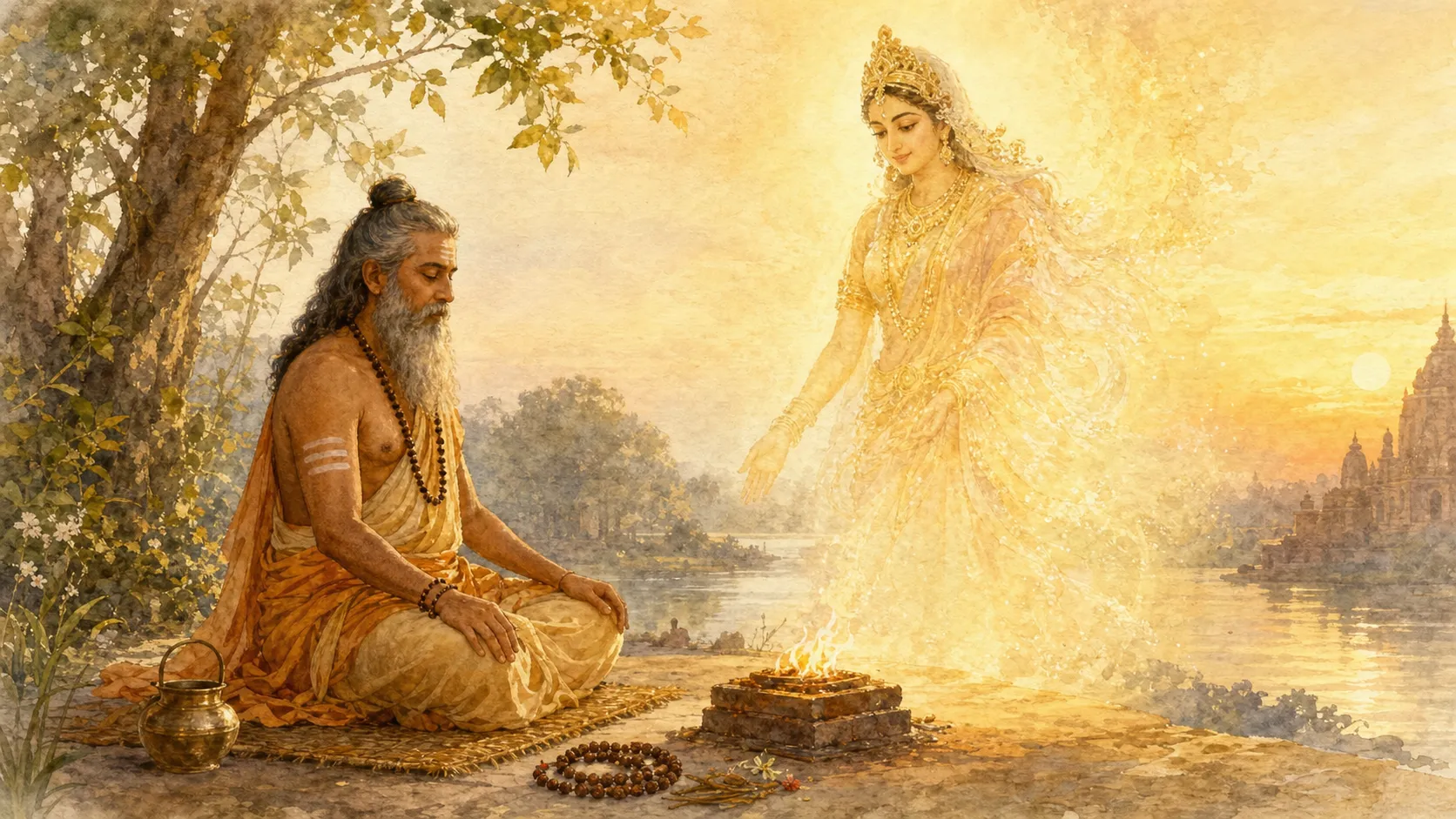
Having restrained his senses, this brahmin performed the austerity of reciting the mantra—he recited Vedic hymns and mantras. In a state of deep concentration, a thousand years passed in this way. After he had concentratedly recited mantras for a thousand years, the goddess Savitri appeared before his eyes and said: “I am fully pleased with your tapas.” But the brahmin, continuing to whisper the mantra, gave no answer. The goddess remained favorable to him for some time and approved his recitation of mantras. Having finished reciting the mantras, the brahmin sprang up, fell with his head at her feet, and said: “What happiness, O goddess, that you are gracious and have appeared before me in person. If you are pleased with the recitation of my mantras, may your heart rejoice.”
Savitri said: “What do you desire, rishi? What wish shall I fulfill for you? Tell me, best of mantra reciters. Everything shall be yours.” To these words of the goddess, the brahmin, who knew dharma, replied: “My desire is for whispering, O meditative state. May it increase more and more. May the self-absorption of the samadhi of my mind grow greater with each day.” Then the goddess said: “So be it.”
Then she said: “You will not go into the pitch-dark abysses where other brahmins go (she meant the unmanifest worlds or the worlds of the gods of passion, considering them unfavorable). You will go into the unconditional, flawless state of Brahman. That which you asked of me will be fulfilled. Controlling your senses, continue the recitation of mantras, and dharma will draw near to you; Time, the god of Death, and Yama will come to you, and a conversation will take place between them and you.”
Having said this, the goddess returned to her own state, while the rishi sat for another hundred divine years, engaged in the recitation of the mantra, controlling his senses and having conquered anger.
The Appearance of the Gods and the Dialogue with the Brahmin
When he was practicing self-restraint in this way, the god Dharma appeared before him, the twice-born one, in person and said:
“Brahmin, look at me. I am dharma; I have come to meet with you. Hear from me what fruit you have attained through the whispering of the mantra. O twice-born one, you have surpassed the heavenly and earthly worlds—all that exist. Holy one, having surpassed all the external abodes of the gods, you will go further. Therefore you may part with life, muni, and go to whatever worlds you wish. Abandon yourself and the body; then you will attain the worlds.”
The brahmin said:
“What are those worlds to me? Go yourself wherever you wish. But I will not leave the body, which brings much suffering and joy, O Lord.”
Then Yama and dharma said to him:
“Unwillingly, all the same, you will have to abandon the body, bull among ascetics. O rishi, flawless one, arise and go to whatever heaven you wish.”
The brahmin said:
“I do not like living in the heavens without a body, O Lord. Go, dharma; I have no desire to ascend to heaven after abandoning myself.”
Then Yama said to him:
“Why should you turn your thought to the body and become attached to it? Abandon it and be happy. Go to the eternal, imperishable worlds. Having arrived there, you will not grieve.”
The brahmin said:
“What are the eternal worlds to me? I like the recitation of mantras, O blessed one, abiding in samadhi. Either I will go in my own body, or I will not go at all, O mighty one.”
Then Yama said:
“Since you do not wish to abandon the body yourself, then look, twice-born one: here Time, Death, and Yama are coming to you.”
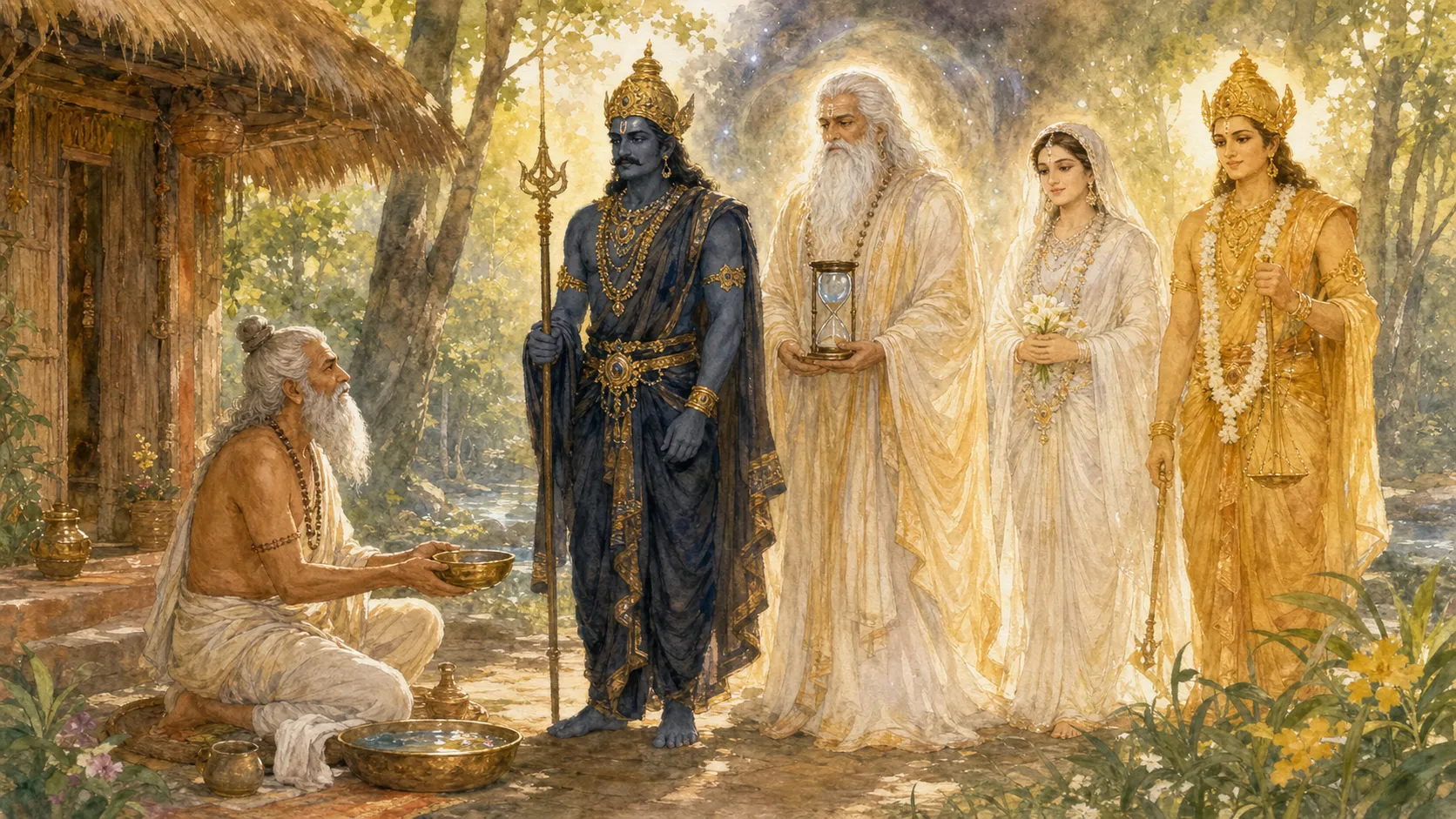
And then the three lords—Yama, Time, and Death—approached this brahmin of great merit. Yama said:
“You have received the fruit of this life filled with austerity and virtue. I address you; it is I—Yama. You have deserved the fruit of your whispering.”
Time said:
“Since the excellent fruit of reciting the mantras has been attained, it is time for you to ascend to heaven. I am Time, and I have come to you.”
And Death said:
“Know, virtuous Brahmin, that I am beautiful Death, Mrityu, and I have come to you, O singer, together with Time, Kala, in order now, as is proper, to take you away from here.”
The Brahmin said:
“Welcome to Time, and to Death, and to dharma.”
To all three who had arrived he offered honorable sacrificial food and water for washing the feet, and then asked with the greatest respect: “By my own powers, what should I do for you?”
Meeting with King Ikshvaku
At that very time, returning from wandering among the sacred springs, the king, the lord Ikshvaku, came to where the assembly was. The great king honored them all with prostrations to the ground and treated them with reverence. Seeing the king, the Brahmin also offered him a high seat, water for washing the feet, and sacrificial food. Then he inquired about his health and asked:
“Welcome to you as well, Maharaja. Tell me what you desire. What should I do for you by my own powers? Let the lord declare it to me.”
The king said:
“Know that I am a raja, and you are a Brahmin. Since you are steadfast in good deeds, I shall give you some wealth. Tell me what you desire—whatever you want, that I shall give you.”
The Brahmin answered him:
“King, Brahmins are of two kinds. There are those who are inclined to accept gifts, and those who are not. I am averse to accepting gifts, so give the desired wealth to those Brahmins who are inclined to accept gifts, while I do not accept gifts. Tell me what I can give you. What do you desire? Tell me, king, by the power of my tapas, how can I be of use to you?”
Then the king took offense and said:
“I am a kshatriya, and I have never known the word ‘give.’ I demand, O best of Brahmins. We repeat one thing—‘battle’; this is the law of the kshatriyas.”
Then the Brahmin said:
“Very well, you are content with your duty, and I with mine. There is no difference between us, therefore act as you wish.”
The king said:
“But you said: ‘I will give you what is within my power’—that is what you offered. Therefore I demand that you give me, Brahmin, the fruit of the recitation of your mantras.”
The Brahmin said:
“A kshatriya demands: ‘May war always bring me spoils.’ But I have no war with you, so how can you demand?”
That is, he said to the king: “A kshatriya demands when he is fighting someone. But are you and I at war, that you demand something?”
The king said:
“The weapon of Brahmins is called the word, and the weapon of a kshatriya is his hands. And now a heated verbal battle has begun between you and me, therefore I demand as in battle.”
Transfer of Merit and Dispute over the Fruits
The Brahmin said:
“Well, then. Since I have promised, what should I give you? Indra among kings, tell me—if I can, I shall give it to you.”
The king said:
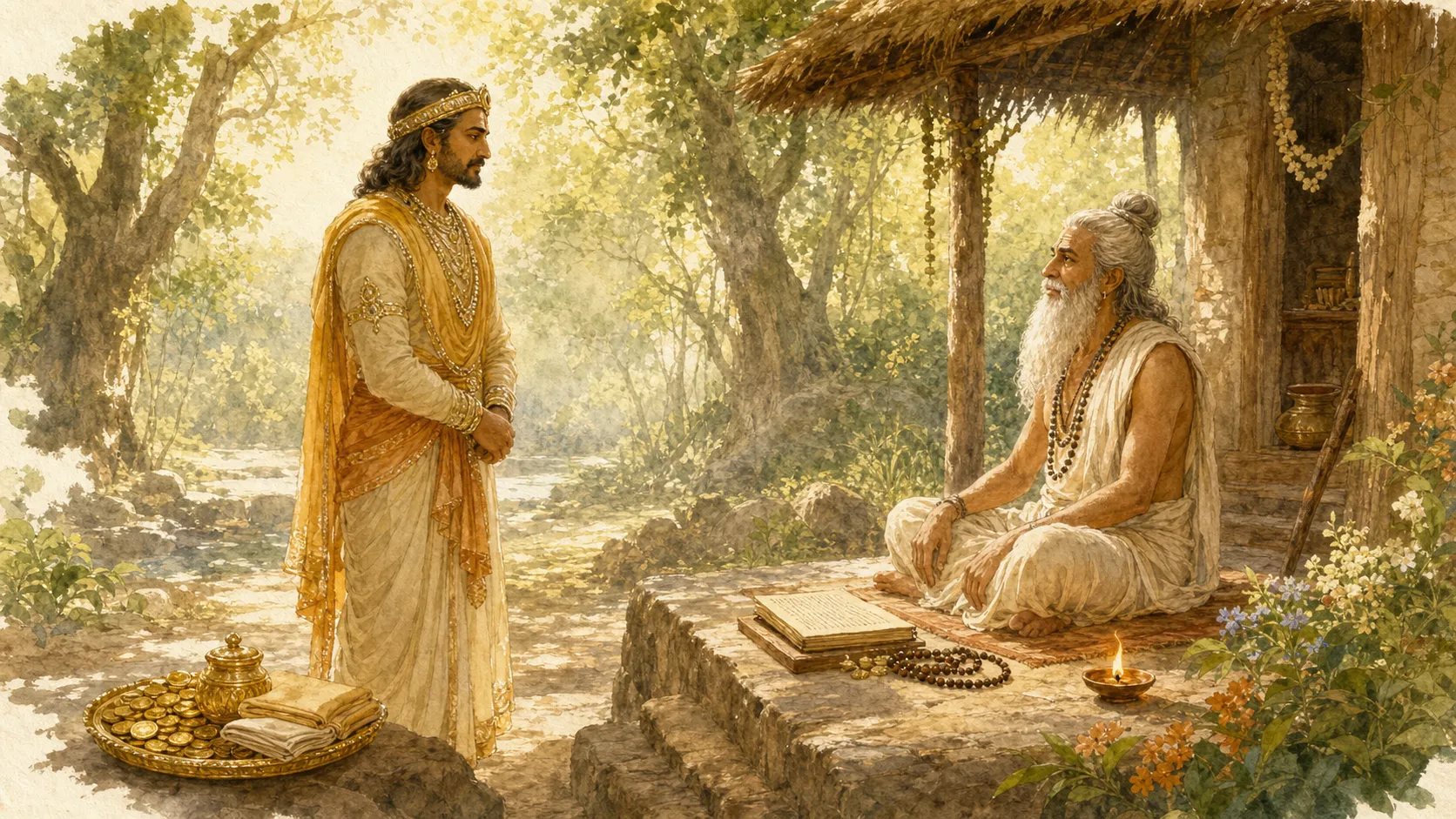
“For a hundred years you performed the tapas of reciting mantras, therefore I demand the fruit of the recitation of mantras attained by you, since you intend to give me something.”
The Brahmin said:
“Receive the excellent fruit attained by my whispering. Without hesitation, right now accept half of this fruit, or take the entire fruit. Receive it according to your wish. Even if you want the whole fruit of a hundred years of mantra recitation—you may receive all the merit from it.”
The king said:
“Good, we have agreed. Everything you have whispered for a hundred years, I will take for myself. I am leaving; be happy. But tell me, what is the fruit of your mantra recitation?”
The Brahmin said:
“I do not know the fruit that has been attained; everything I whispered, I have given away. Dharma, Time, Death, and Yama are witnesses to this.”
Then the king said:
“What is this fruit to me, since it is unknown? If you do not say what the fruit of the merit of your mantra whispering is, then this fruit is doubtful. I do not wish to receive it.”
The Brahmin said:
“I will accept no further discussion; I have given you the fruit of that whispering. And the agreement that was between you, the king, and me is dearer to us than anything else. I recited the mantras without any definite aim; how can I know the fruit of the whispering? You said, ‘Give it,’ and I answered, ‘I will give it’; therefore I will not break my word, and you too must be steadfast in observing truth. If you do not take it, how will you fulfill the word you have given and the duty of a king? I gave my consent without hesitation; you too, without hesitation, accept the fruit of the whispering. For you yourself came to me and demanded the fruit of the whispering; I have given it to you. So accept it, if you wish to fulfill the law of truth. And for one who gives himself over to false words, neither this world nor the other will be for his good, and he will not save his ancestors either. Neither the fruits of sacrifices, nor of gifts, nor vows save those who lie.”
Then the Brahmin gave these instructions:
“Truth is the one, eternal Brahman. Truth is the one, eternal tapas. Truth is the one and eternal sacrifice, the one, eternal revelation. Truth moves the gods. Truth is the Vedas and all the sacred texts. Since righteousness, dharma, and truth have now been placed on the scales, it is important that you fulfill your promise. If you do not accept my gift, you will act wrongly. If you do not accept the fruit of my whispering, you will violate your own ordinances and then wander unhappy through the worlds. He who, having first promised, does not give, and he who, having demanded, does not wish to take—both are unrighteous. One should not act so.”
Then the king said:
“To protect and to fight—this is the duty of Kshatriyas, and mine as well. Kshatriyas are considered men of action; why then do you compel me to take?”
The Brahmin said:
“But I did not beg from you, nor did I visit your dwelling, O king. You yourself came here and demanded a gift. Why then do you not accept it now?”
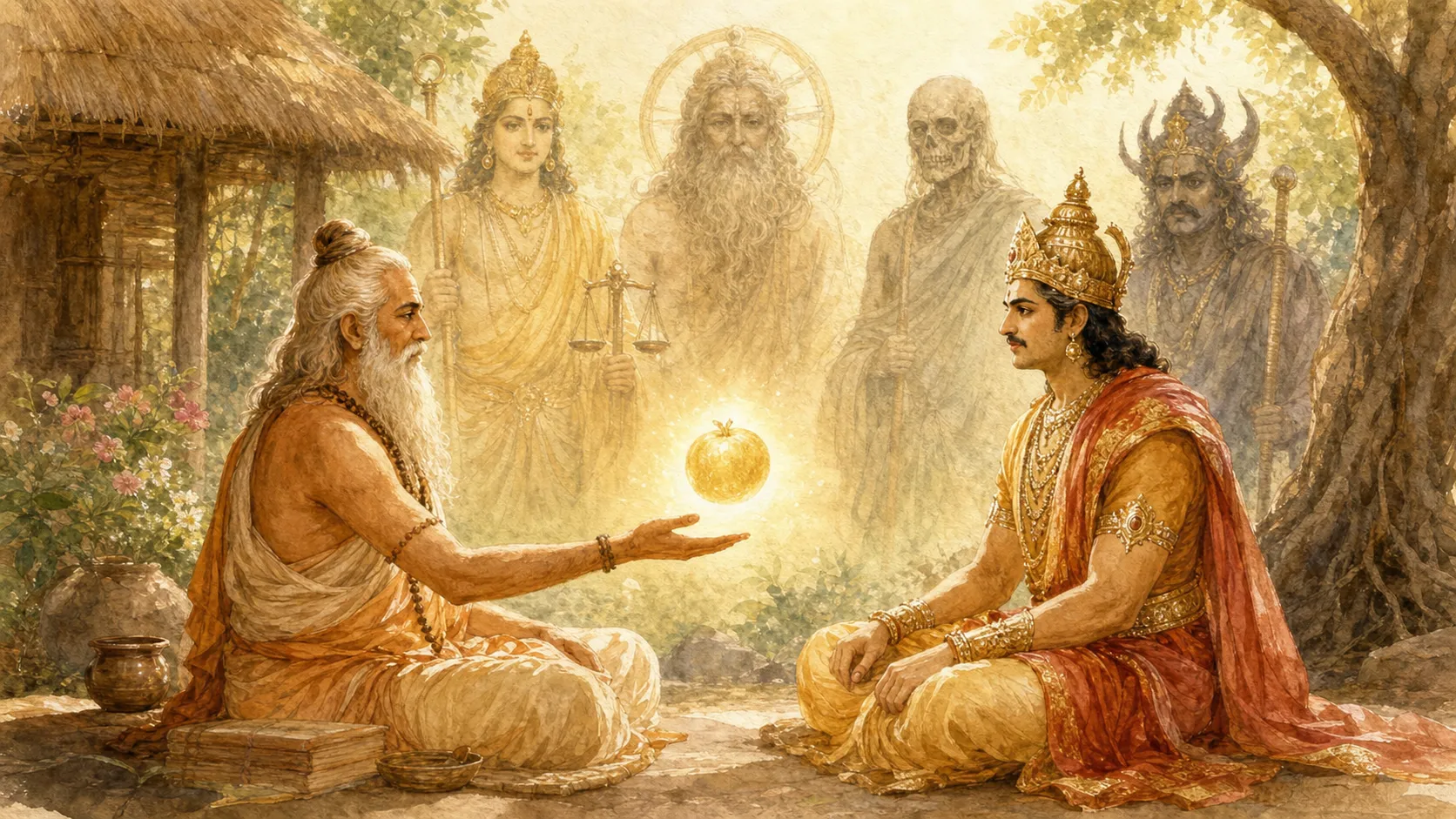
The Intervention of the Gods and the Resolution of the Dispute
Then the god Dharma said:
“So that you do not quarrel, I have come here. Therefore the merit of giving belongs to the twice-born one, and the fruit of the Brahmin’s recitation belongs to the king.”
Likewise the deity Heaven, who arrived at that time, said:
“Know, O Indra among kings, that I—beautiful Heaven—have appeared here so that there may be no discord between you. The fruits are equal for both of you; therefore divide the merit of reciting the mantra in half.”
The king said:
“I have nothing to do with Heaven; from where you came, there return, Heaven. And if the rishi wishes to go to you, let him take the fruit received by me.”
But the Brahmin said:
“If earlier, in childhood, I stretched out my hand in ignorance, asking for alms, now there is no more greed in me. Long ago I destroyed greed, so why do you stir it up in me—so that I might share with you, or so that I might ask something for myself? I am no longer attached to anything; I have ceased accepting gifts. I am diligent in tapas and study the scriptures.”
Then the king said:
“If you have given away your highest fruit of whispering the mantra, then let all the fruits of both be shared. It is proper for Brahmins to accept gifts. For Kshatriyas born in a royal lineage, it is proper to give. Therefore the fruit too should be shared. Accept this fruit from me; make use of my fulfillment of duty, if you are kindly disposed toward me.”
Thus they argued for some more time. In the end the king regretted that he had made such a decision. The Brahmin said:
“Take, if there is anything of yours here, the merits of the accomplished recitation of the mantra and the whispering of the samhita.”
The king said:
“Enough for me is what has already come into my hands. Let this be shared, if you deign to accept it.”
In the end they reached an agreement and came to accord; they honored Dharma, Yama, the god of Time, Death, the deity Heaven, and those Brahmins who had arrived there earlier and had witnessed this scene.
Then the Brahmin said to the king:
“Having this fruit, go in peace, O royal rishi. I, released by the lord, shall continue the whispering of mantras. Once a boon was granted to me by the goddess Savitri, and she said: ‘May faith in whispering be eternal.’ Therefore I shall devote myself to the recitation of the mantra, in order to fulfill her blessing.”
The king said:
“Since you have remained without the fruit you attained, but faith in the recitation of the mantra has remained, then share the fruit of the mantra recitation with me.”
Then the brahman said:
“In the presence of all, we have made great efforts. Possessing equal fruit, let each of us go his own way.”
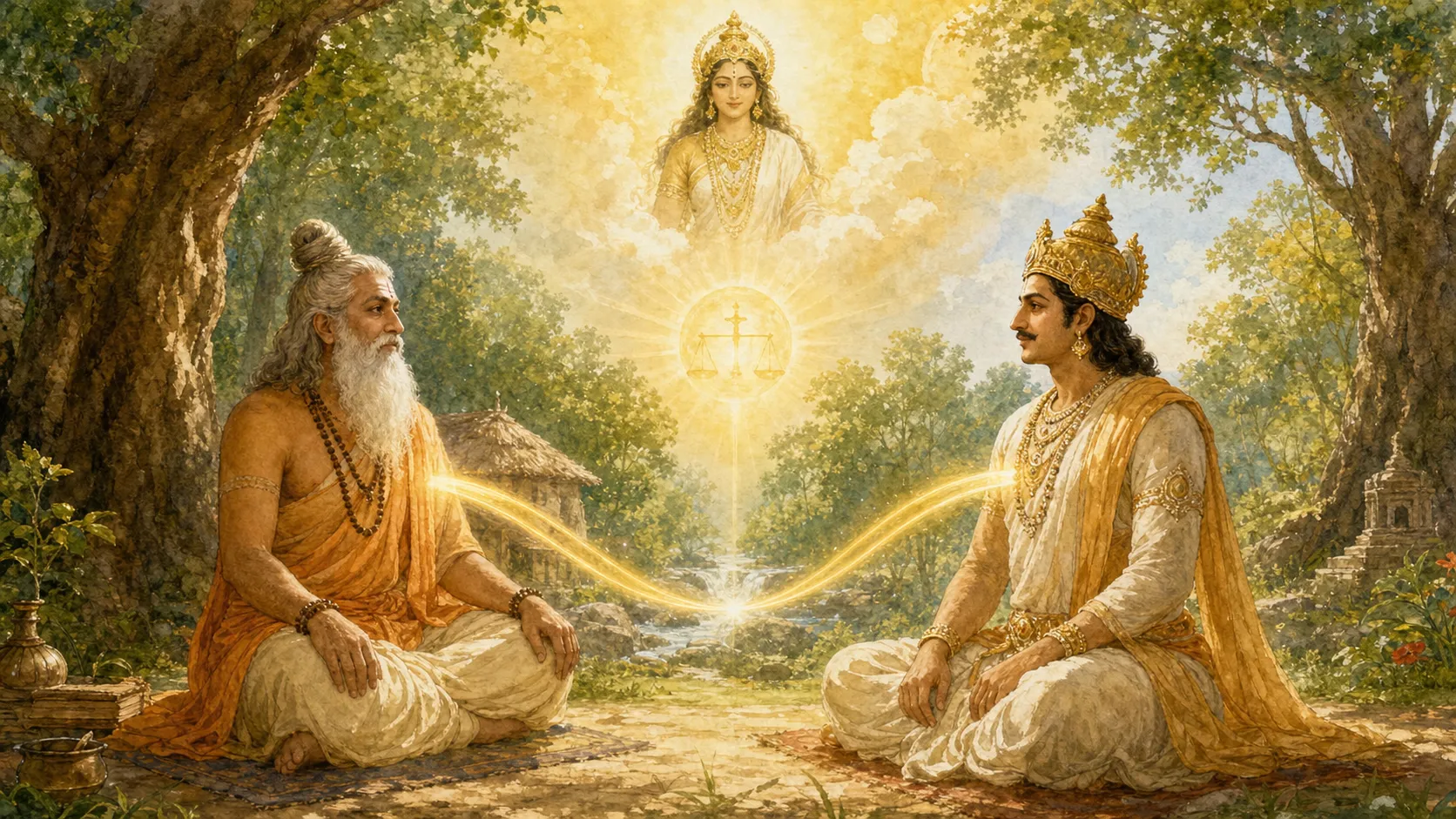
The Manifestation of the Gods and the Attainment of Liberation
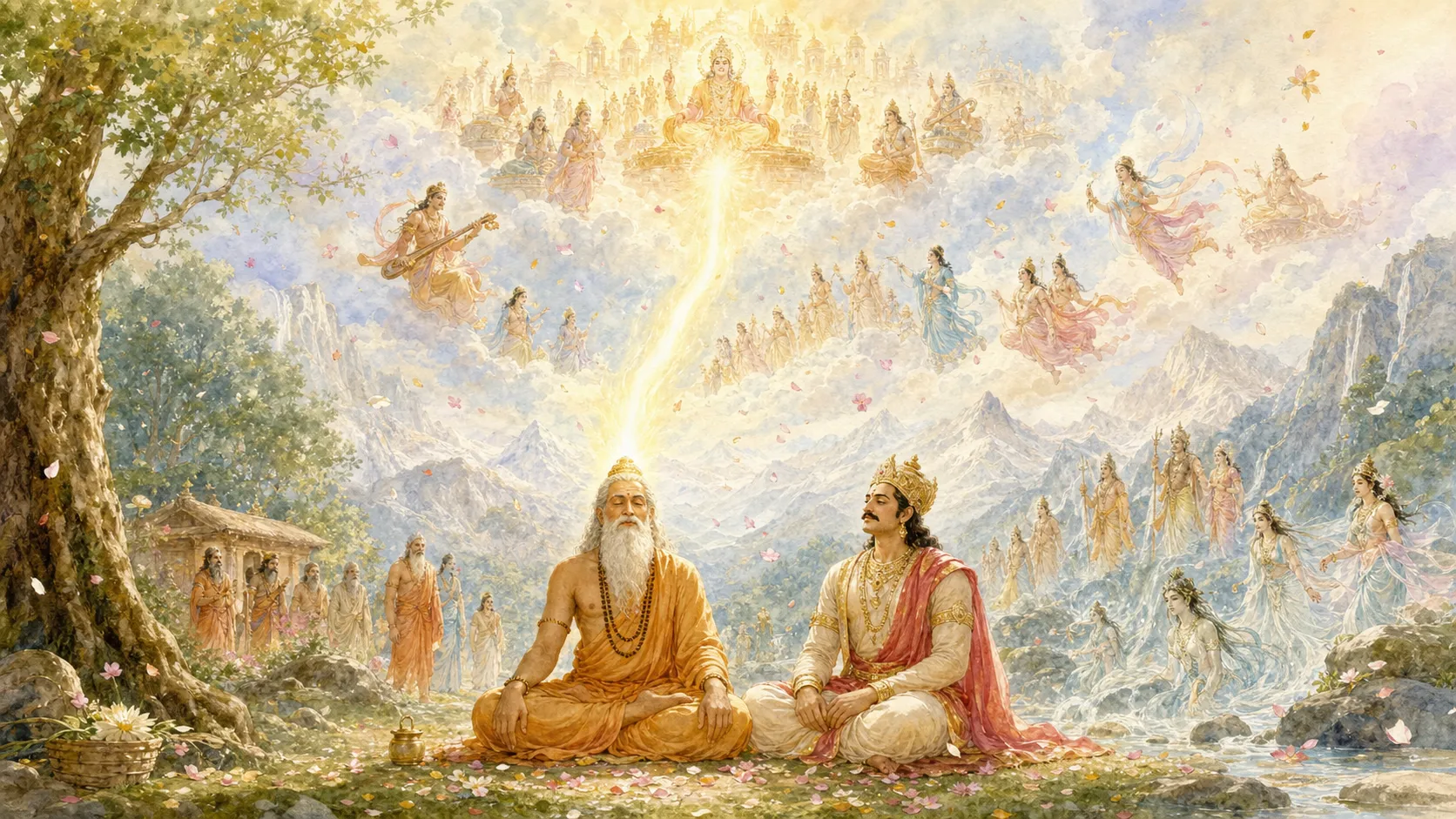
Having learned that they had divided the merit of the mantra recitation and each gone his own way, the Lord of the thirty-three gods (Indra) arrived together with the gods, the guardians of the world. Hearing of this story, the dispute, and the great merit of the brahman, the saints appeared, the Vishvas with immense trumpets, the spirits of the wind (Maruts), the spirits of rivers, mountains, the sea, various sacred springs, ascetics, knowers of yoga, the Vedas, Sarasvati, Narada with Parvata, the Maruts, the Vishvas, with the Gandharvas and Vasus, the Gandharva Chitrasena surrounded by a crowd, the Nagas (serpents), and perfected munis. The god of gods Prajapati appeared—the inconceivable, thousand-headed god—and Vishnu. Drums and kettledrums resounded in the heavens. Wondrous flowers began to fall upon those two from everywhere. Here and there the apsaras, who had come with the gods and their retinues, danced.
Then the goddess of Heaven said to the brahman:
“You have attained perfection and are worthy of a great destiny, O rishi.”
And together, though by different paths, they attained detachment from the ego. Sitting in the posture for meditation, they stilled prana, apana, udana, samana, and vyana, and immersed them in the two-petaled lotus—in the manas chakra. Establishing prana within, below the eyebrows, at the level of the root of the nose, by drawing the eyebrows together, that is, by shambhavi mudra, both brought their manas to rest. Without moving, fixing their gaze on the space between the eyebrows, both entered samadhi. Having overcome themselves, they directed self-awareness into the head. And then, splitting the palate, an exceedingly great light issued forth from the brahman, and the brahman was transported to the third heaven. From all sides the sacred exclamation “Ha-ha” rang out. And the light of the brahman, as if with a hymn of praise, penetrated even into Brahma.
Brahma met the brahman with words of greeting: “Welcome.”
At that time the soul of the brahman turned into a light the length of a thumb. At that time Brahma spoke these words:
“Equal is the fruit of the reciter of mantra and of the yogin; of this there is no doubt. It is plainly clear what the fruit of yoga is for those who devote themselves to it. For those who recite mantra, however, a special ascent is ordained; therefore abide in me.”
Having said this, Brahma instructed him again and again, and then the sorrowless brahman entered Brahma’s mouth. In the same way, the king too entered and united with Brahman.
Then the gods, bowing down, said:
“By destiny, a special ascent is prepared for reciters of mantra, and for the sake of the reciter of mantra we have taken the trouble to appear here. Behold—the brahman and the king, having performed equal worship, receive equal fruits of their sadhana.”
Then Brahma said:
“Those who recite sacred texts and receive revelations through them, and those who practice yoga by performing ascetic disciplines, after the body’s demise attain the same worlds in which I myself dwell. In the same way, yogins also attain the same worlds in which I myself dwell. Therefore strive for perfection in your own realms.”
Having said this, the god disappeared. After Brahma had disappeared, the gods likewise departed to their abodes. Then, having honored dharma, all the holy sages also followed after them with very contented hearts.
The Teaching on the Foundation, Path, and Fruit
Throughout these chapters, Yudhishthira asks Bhishma about the fruits of jnana yoga, the study of the Vedas, and tapas—that is, about what fruits are attained by particular yogins.
As you know, in the teaching there is the basis, the path, and the fruit. Just as any event has a beginning, a development, a culmination, and an ending, so too does the Dharma have a beginning, a development, a culmination, and an ending. The fruit of Dharma practice is the ultimate goal; it is what we intend to attain. And the fruit of the teaching is liberation.
We often say that in the teaching of Laya Yoga there is a special approach to the fruit, that in the teaching the basis, the path, and the fruit are one and the same:
- The basis is the natural nondual state
- The path is abiding in the natural nondual state
- The fruit is deepening and even greater immersion in the natural nondual state
In other words, from the very beginning we try to take the state of the fruit; therefore, Anuttara Tantra, to which Laya Yoga also belongs, is a teaching of the fruit. This is an extraordinarily high teaching, and perhaps only after many years of clarification can one understand what it means to adopt the position of the fruit. To adopt the position of the fruit means to immediately try to enter the state of primordial self-perfection, and then to continuously become rooted in it.
The fruit of the teaching is liberation from everything that binds us in samsara, and complete freedom. Freedom of what? Freedom of consciousness, freedom of will. Freedom of will means that the limitations imposed upon our will in the world of samsara can be transcended when this freedom blossoms.
For example, we fall asleep and cannot control consciousness in a dream; our consciousness is intermittent. Freedom of will means that our consciousness is not interrupted, that our will has blossomed, and now, with its help, our awareness no longer suffers limitations. That is, the blossoming of freedom of will means that we move from the state of a limited human being to the state of a divine being.
Signs of a Divine Being
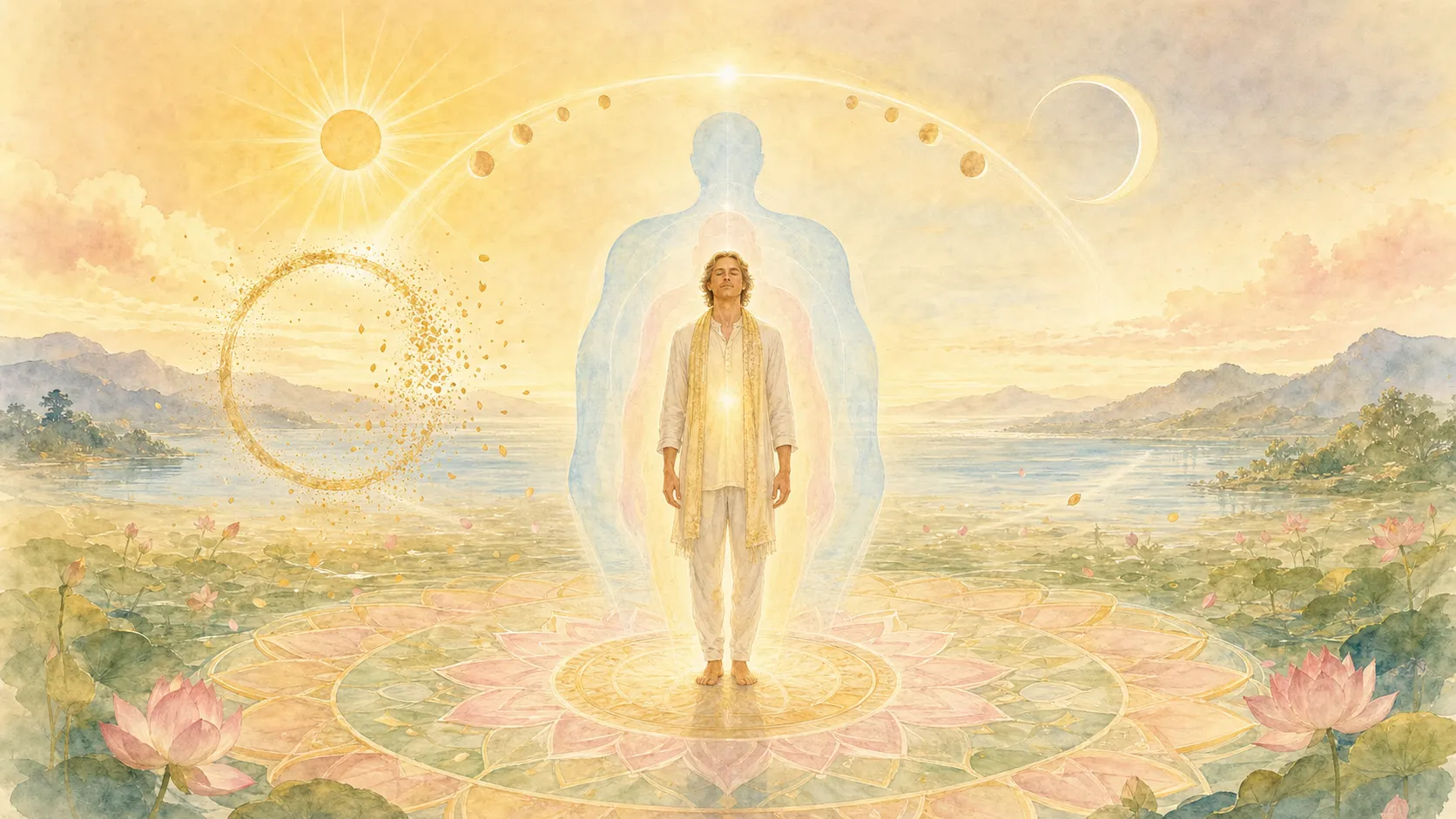
Usually we say that there are such signs of a divine being, a siddha, or a deva:
- realization of the three divine bodies — the body of wisdom (jnana-deha), the body of space (pranava-deha), and the perfect body of manifestation (siddha-deha);
- attainment of the state of an immortal deity whose consciousness is not interrupted;
- going beyond karma and transitioning into lila, that is, leaving collective history and entering personal history;
- going beyond the dualistic world, where there are subject-object relations, and transitioning into a mandala, into a personal world, into a personal universe created from one’s own mind;
- not being bound to a single body, but having the possibility of possessing many bodies (rupa-siddhis);
- going beyond causal connections, the law of karma, and the ability to govern causes and effects oneself, to shape and model them;
- going beyond the limitations of space and the ability to create any space by the power of consciousness;
- going beyond the limitations of past, present, and future and the ability to abide in a single “taste” beyond past, present, and future.
Mastery of Universal Forces
The natural state as fruit does not mean that we merely realize some status of nondual consciousness. It also means that as this state grows, we begin to master various universal forces, namely:
- jnana-shakti (the power of wisdom);
- svatantriya-shakti (the power of divine freedom);
- iccha-shakti (the power of divine will);
- aishvarya-shakti (the power of divine sovereignty);
- kriya-shakti (the power of divine action).
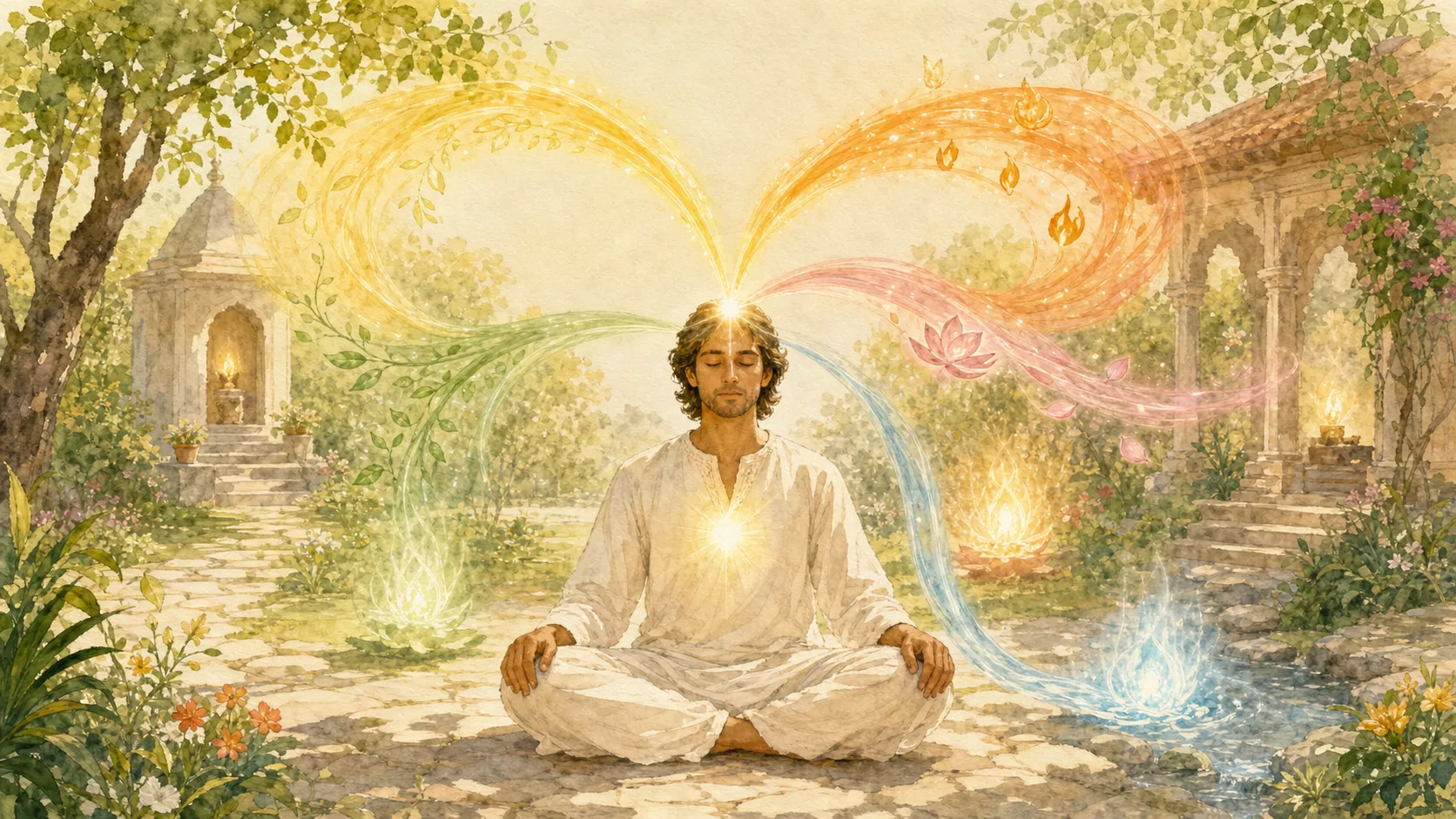
All of this occurs thanks to penetration into the space of the natural mind. When such penetration gains strength, it begins to attract these forces just as honey attracts bees, as a good musician attracts lovers of music, as a magnet attracts filings.
The text says that the gods came to a brahmin, a reciter of mantras, offering various gifts. As a result of austerity, his spirit had been purified and became strong, and therefore the gods felt a resonance with his consciousness. In the same way, when our consciousness is purified, subtle divine beings begin to enter into resonance with it — our inner deities contained in our subtle spiritual channels. As long as they are inaccessible, it is as though they do not exist for us, but if consciousness is purified, then these subtle divine beings can enter into resonance with us, opening various levels of knowledge and freedom.
Reflections on the Fruit of the Teaching
When we practice, it is also important to reflect on the fruit of the teaching: “How do I see myself in the future? What am I trying to achieve as a result of yoga practice? If liberation, then what does that mean? If enlightenment, then what are its signs and fruits? In what state of mind should I abide so that this future may be realized?”
Having clarified this state for oneself, one should express the intention (sankalpa) and wish for its realization. If, as a result of practice, day by day you are drawing closer to this future, while in fact trying to be at that point where there is neither past nor future, then you are taking the right position. Each day of practice is a small step toward the realization of this future.
A yogi constantly analyzes his sadhana, checking how close he is coming to this future. If our practice is correct, then every step brings us closer to such a future, which is the fruit of the teaching.
The Activation of Karma in the Process of Practice
It happens that in the process of practice the energy of sattva increases, and then all the karmas that were in the yogi’s subtle bodies become activated, so he begins to experience various difficulties. But this is actually normal. First, without such a trial he would not even temper his contemplation. Second, sattva has simply been activated; that is, a powerful cleansing agent has begun to wash out the karmas that are in the subtle bodies.
It has been observed that often, when a yogi begins to practice diligently, various desires intensify and obstacles become sharper. If he stops practicing, everything goes away. If he begins practicing again, painful and unpleasant states arise literally out of nowhere, especially if the yogi has little merit. He thinks: “Maybe I am doing something wrong.” He even begins to lose sight of his goal, standing on the brink of temptation and enticement. But as soon as he stops practicing, everything immediately becomes wonderful for him. He thinks: “What is this? Maybe I was cursed in past lives. Maybe some rishi, displeased with me, placed upon me a ‘crown of failure in the Dharma.’” And he begins to torment himself with such thoughts.
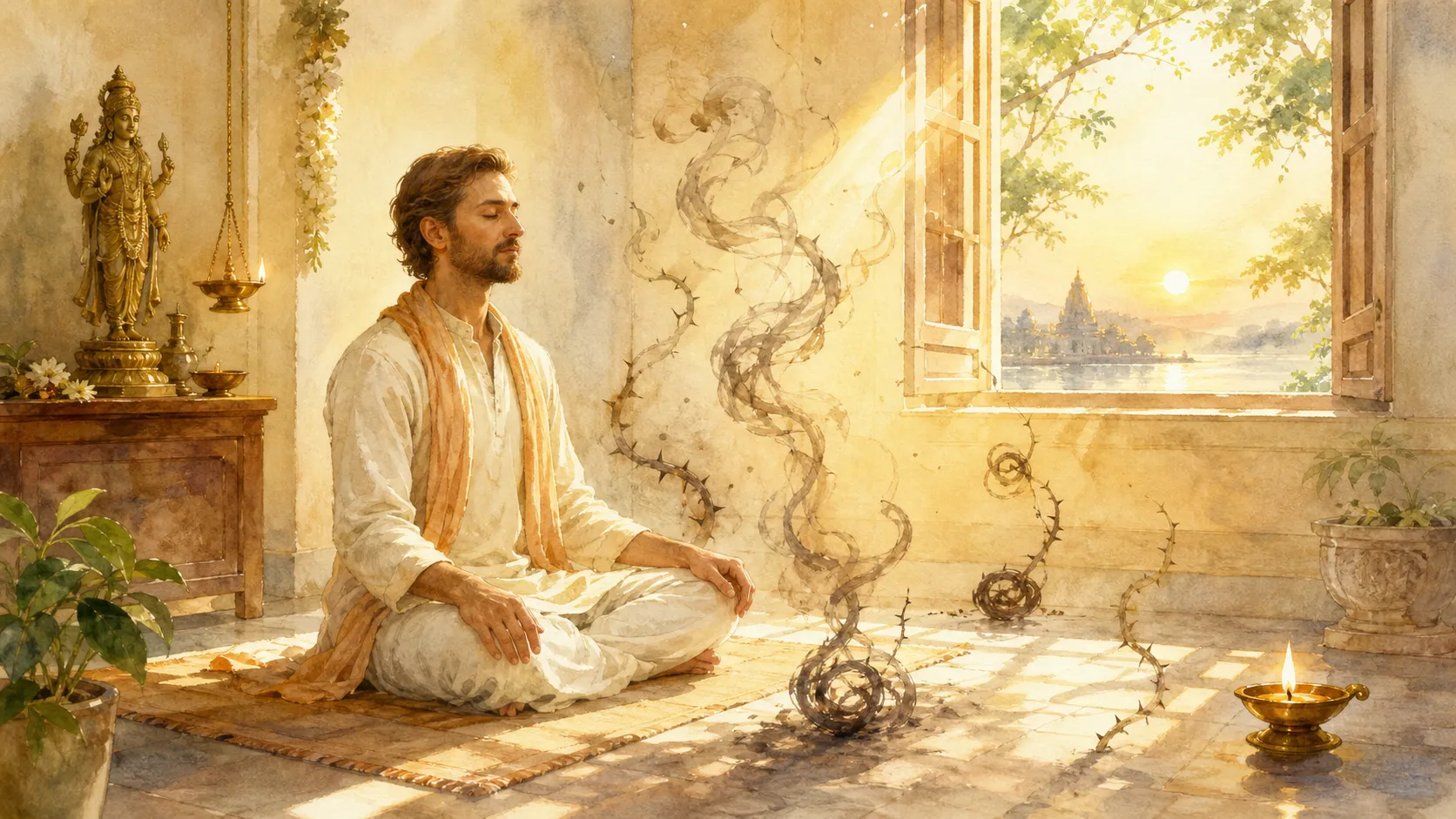
But in reality there is nothing mystical about this. His karmas are simply being activated a little faster. If karma is likened to a boulder of snow that is rolling along, then in an ordinary state, when a person does not practice, this boulder rolls slowly, for many years, and then crushes him. But if a person practices, these boulders begin to roll faster, because he himself is moving faster. And if he is a wise yogi, he begins to go around such boulders; he begins to maneuver between them, like skiing in a slalom. That is, if he has a refined consciousness, he does not allow these boulders to crush him. He acts very quickly and cunningly, choosing the right tactic, the right method, skillful means. And then, despite the fact that his karma is activated, he goes around the boulders and reaches his goal.
