

Commentary on the text “The Liberating Nectar of Precious Instructions”
The yogin said: “Such is samsara: whether you are born as a god, a human, a spirit, or an animal, as long as there is no enlightenment, suffering cannot be avoided. Leaving behind all worldly bustle, O wise one, immediately steer your boat toward the shore of enlightenment.”

The Four Awarenesses as the Basis of Motivation
Before seriously embarking on spiritual practice, we must repeatedly reflect on our motivation in practice. To develop motivation in practice, reflection on the four awarenesses is usually recommended:
- reflection on impermanence, in particular on the fact that there is an inexorable passage of time that cannot be prevented, which makes us grow old, die, and be reborn;
- reflection on the preciousness of human birth, when we have the chance in this physical body to attain awakening and leave the cycle of births and deaths; such a chance is as rare as winning the lottery;
- reflection on causes and effects, that is, on the law of karma;
- reflection on the sufferings that arise if we follow not the path of awakening, but the opposite path.
It is said that these four reflections turn life upside down, that is, they completely change one’s values. This is indeed so.
Until our life has been turned in a certain direction through these reflections, our motivation for spiritual practice will be shallow and unserious. Conversely, when through such reflections we have very deeply realized impermanence, we see that with each passing day we grow older and become one day closer to death. Whatever we do, this process continues, whether we remember it or not. All our affairs, even the most urgent and “important,” will one fine moment be interrupted, come to an end, and never be repeated again, because death exists. Nothing is resolved until we have resolved this great task—liberation from death. It is precisely this kind of motivation that gives us a healthy radicalism in spiritual life and an absence of compromise. Until such motivation has been developed, compromises always exist for us. From a worldly point of view, they may be assessed in one way or another, but in spiritual life such compromises are a fatal mistake.
There is a passage of time that inevitably changes everything, inevitably transforms us. But we do not attach importance to it because our consciousness is not very deep. Yet when the passage of time transforms us more than we can control, we suddenly discover that we have missed everything. If we did not make efforts when the time was right, we suddenly discover that it is already too late.
It often happens that a person in youth shows great promise, has great ambitions, makes plans, and so on. He thinks: “Everything is still ahead of me.” Others think the same about him: “Everything is still ahead of him.” Then he spends some part of his life in bustle, and when he tries a little to become aware of what he has come to, he suddenly sees that the years have passed, his life force is running out, his abilities are deteriorating, the situation is beginning to slip out of control, and he is simply slowly leaving the stage. Perhaps he is already glad to make efforts and engage in practice, but the inexorable passage of time is at work—Black Kala (as time is called in its destructive aspect). And nothing more can be done about it. All his outstanding plans, hopes, and ambitions are suddenly seen as a dream, because some new reality arrives that cannot be controlled. This is impermanence. And such an awareness of impermanence gives great maturity to the spiritual practitioner.
“Wealth, youth, sons—do they grant true happiness? O mind, do not chase after sensual pleasures, do not make plans; better seek God,” sang one of the great saints.
This can be paraphrased as follows: wealth, youth, sons, family happiness, money have meaning if you are immortal; but if you are not immortal, all this does not have much meaning, because soon everything will disappear. Important work, relationships, and so on—all this has meaning if you are immortal; but if you are mortal, all of it will likewise soon disappear. Therefore it is far more important to seek immortality than all these things, because having attained immortality, you will be able to preserve all these things. But if you do not attain it, all of this will be useless.
Compared to the life of the gods, human life is so short that it is like a flash of lightning. One day of the gods lasts 10 thousand human years, but, unfortunately, people do not realize this. I think we will have a separate lecture on the awareness of time and a meditation on time. It is precisely the lack of awareness of the passage of time that makes a person pay attention to insignificant, momentary things. Because we do not realize the passage of time, we are unable to make any great plans or achieve any important goals. As a rule, our plans are momentary; they are determined by perhaps ten years, thirty at most, while 70–80 years is the event horizon for us; we cannot even comprehend it. But precisely such unawareness and unconsciousness costs every person very dearly. In the end, he leaves this world without having managed to realize anything, without even having managed to understand something about himself and about the universe.
Human ideas about themselves, about the world, about the universe are still very immature, very childish. And accordingly, a person’s whole life is built from these immature notions. But in fact, it is far more important to use this precious human birth for the sake of self-knowledge and education, in order to develop higher ideas about the world, oneself, and the universe, and to work out a certain vector of action.
When we reflect on the four awarenesses, this helps to work out the necessary vector of action. This does not mean falling into depression and thinking: “Yes, everything is impermanent. What is the point of all this?” The practitioner understands all this, nevertheless preserving a joyful state of mind, because without a joyful state of mind he cannot practice, but will only remain in despondency or weep. The life of a person on the spiritual path resembles a smile through tears. He understands the boundlessness of the world, the boundlessness of time, his own mortality and impermanence; he understands that he has almost no hope at all. Nevertheless, he acts as if everything is normal, smiles and goes forward, falling neither into despondency nor into confusion, because despondency and confusion are not the best friends on the path of spiritual practice. We reflect on the four awarenesses not in order to bring the mind into despondency or confusion; we reflect in order to sober up. In such an unaware state, we are as if intoxicated by maya and samsara, whatever we may do, and the four awarenesses are like a cold shower over the head that makes one “sober up” a little and work out the right vector of life.

When we come into contact with the teaching, we suddenly discover it as the greatest treasure. When we come into contact with practice, with the method, all of this must also be valued as the greatest treasure, since the teaching and practice are what are truly able to lead us out of this tangled labyrinth—the cycle of birth and death. The teaching, practice, the three jewels, the sangha—these are what are truly able to give us immortality. And not only immortality as immortal consciousness, but even physical immortality. Even this is possible if we practice properly and manifest awareness. I think we will have time to devote one lecture specifically to the methods of attaining immortality.
The place in which we will find ourselves in 80 years, in 200 years, depends on how much awareness we manifest now, how much spiritual practice we engage in, how much we concentrate our intention. There will be new people and new generations, but in 200 years we will become history for those generations. And they will say: “Yes, here is the history of the emergence and spread of the Advaita teaching in Russia. 200 years ago, the monk Vishnu Dev brought the Advaita teaching to Russia, and that is how it spread.” Future generations will see us differently than we see ourselves now, because now we ourselves are the contemporary age, the present time, but for future generations we will become history, a line in an encyclopedia, the memories of great-grandchildren, nothing more, if we do not become immortal. If, however, we become immortal, then time too will become the present for us. We will be not only history; we will be reality.
The Preciousness of the Teaching of Laya Yoga
“The precious teaching of Laya Yoga leads astray those whose minds are immature. But the sage, upon hearing it, will dance with joy.”

The teaching is precious because, if it is understood and applied correctly, it bestows all blessings, and in a short time, even without any particular ascetic feats. The saints of ancient times, as well as those of the present day, made colossal efforts to attain enlightenment and liberation. When we read about the mind-boggling practice performed by the siddhas of antiquity, we see that we do not even come close to them. Nevertheless, the teaching makes it possible truly to obtain all the signs of realization through skillful mastery of it. Even if you are a layperson, but have skillfully mastered the teaching, you cease to be a layperson and become a master. The task of every practitioner is not simply to study the teaching, making it part of one’s spiritual search, but to study it in such a way as to benefit from it. I would like all of you to benefit from the teaching. One can benefit from the teaching only if one oneself becomes a practitioner at the level of a master, attains mastery.
There is a way to practice the teaching in which one practices and receives no benefit at all, except perhaps satisfied curiosity and socializing at “spiritual gatherings.” But in reality such an approach is, of course, not serious.
There is another way of learning—you can practice in such a way that you even harm yourself. For example, while practicing, you may violate samaya or make some serious mistakes. Then it is better not to practice at all, because in such a case one may fall into the lower dimensions and get stuck in them not only in this life, but even in the next, if these are serious obscurations.
One can practice in such a way as to receive a small benefit: to develop clarity a little, purify the intellect, and so on. But this too is insufficient, because the salvation of the soul cannot be attained in this way. In general, this is work for the next life.
One can practice in such a way as to receive real benefit, that is, to move to a pure land after spiritual practice in this world, attain the level of holiness, be reborn in the next life as a deity, and continue one’s practice in the pure lands in the status of a deity, transforming and purifying one’s body, speech, and mind.
Finally, one can receive true benefit from practice—to attain complete realization of non-duality in this very life. Of course, it is always better to practice so as to receive the greatest, maximum benefit from the teaching.
The Importance of Purification Before Spiritual Experiences
At first, when we practice, we often strive to experience spiritual experiences, believing that it is precisely through spiritual experiences that we can receive great benefit. But I often tell students: “At first, do not be too eager for spiritual experiences; strive instead to purify yourselves, develop awareness, contemplativeness, and self-liberation.” Even if you have no spiritual experience, your maturity will grow if you purify yourself and develop awareness. All spirits in the intermediate state, psychics, and sorcerers receive spiritual experiences. But the task is to develop true maturity of consciousness. And for this, at first it is far more important to purify oneself, to bring into oneself the qualities of sattva, of holiness. What does it mean to purify oneself? It means to make the guna of sattva (radiance, goodness) dominant within oneself, and to displace tamas and rajas.
If we receive spiritual experiences while our mind is in rajas, like a monkey, such spiritual experiences bring no benefit. In one spiritual school I once saw the following scene: everyone was doing pranayama (a yogic technique) and practicing tribandha mudra. They were doing this very seriously, since they placed a great deal of emphasis on pranayamas and technical practices. One mataji was doing kumbhaka in tribandha mudra, and she was being thrown upward. While she was in kumbhaka, she stood normally together with everyone, but as soon as the kumbhaka ended, in order to catch her breath, she began talking and quarreling with the practitioners standing nearby. Another, more experienced mataji said to her: “Perhaps you should not be doing pranayamas and kumbhakas in that case.” And she replied in such a heated, irritated state: “I will, and no one will forbid me to do it.” This is rajas. If rajas is not pacified, then pranayamas and techniques will only strengthen it, and our restlessness, our nervousness and irritability will only increase if we do not control the senses and do not know how to self-liberate.
Purification is, first and foremost, the accumulation of sattva, the overcoming of rajas within oneself. One must truly displace rajas within oneself, literally control it continuously, not allow it to manifest anywhere, and, of course, tamas as well.
The next thing to understand by purification is liberation from egoism and the kleshas, the so-called pancha-klesha, that is, the five obscured states: anger, pride, lust, envy, attachment. Kleshas are obscurations, that which obscures a person, binds, limits, and forces one to fall into a coarse, gloomy state. And egoism is built upon all of this. Such purification requires continuous work on oneself, and it is far more important than experiencing any kinds of experiences. Because one can successfully be reborn in some unfavorable world, even while undergoing numerous experiences, if such kleshas are present. Purification means daily control over one’s own pride, attachment, anger, and so on, when you give yourself no slack every day. Such control in the teaching of Laya Yoga is achieved mainly through self-liberation. And life sometimes places us in situations that are stronger than mystical experiences, when you encounter something that could drive you into a rage, but at the same time you self-liberate it. This is the best mystical experience.
Finally, purification is connected with freeing the mind from worldly stereotypes and notions, because entering the spiritual path means that we have made a global choice, we have become yogins, sadhakas, those who seek the absolute truth. This means that we gradually begin to come out from under the influence of all worldly and social conventions, stereotypes, and everything else. This means that one must free oneself from all of this.
The Practice of Pure Vision
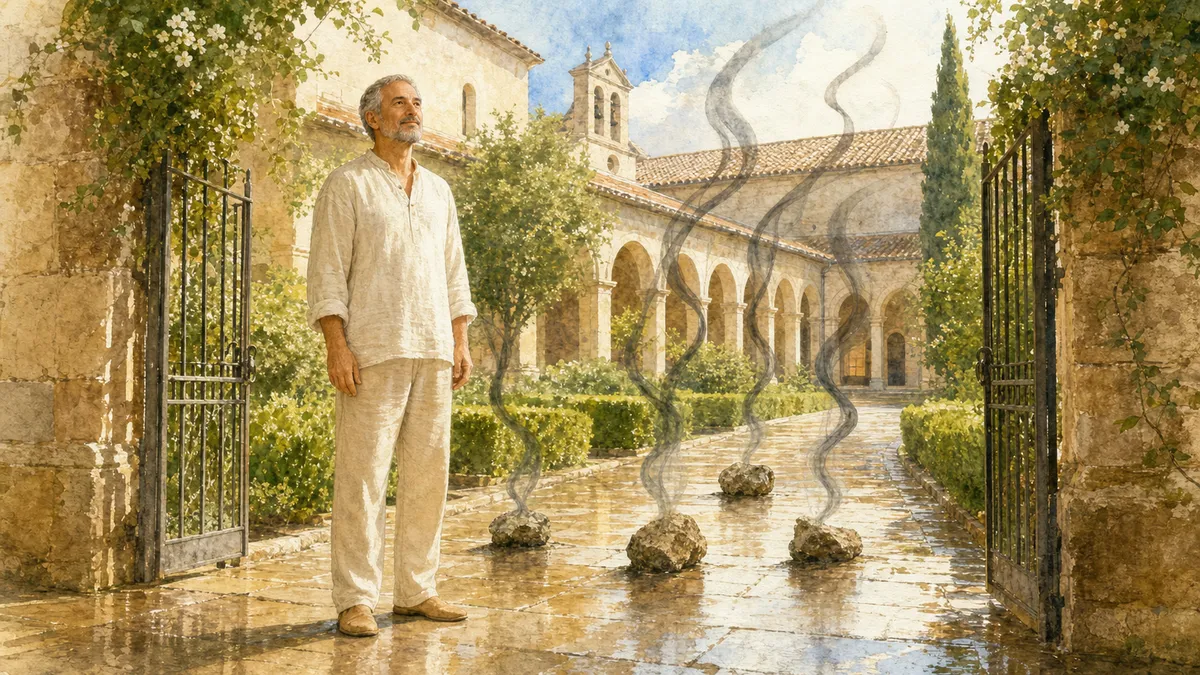
Finally, purification should be understood as pure vision. Pure vision is a special term of tantric practice, inherent in many tantras. It means that we cultivate a pure view of the world, trying to regard the world as an awakened mandala, as a pure, sacred dimension. Not as something we will attain someday in the future, but as something that already exists right now. In the teaching of contemplation there is a specific practice — the sankalpa “Pure Vision.” It is very important to understand the meaning of pure vision and to practice it as much as possible. Even if you have not chosen this sankalpa as your basic contemplation, nevertheless apply it in everyday life.
What is pure vision? For example, you go to a store to buy groceries, but if you practice pure vision, you try to regard the store as a mandala, as a divine palace, and the seller inside it as a deity, the mandaleshvara at the center of this mandala. When this seller trades in goods, he is not actually trading, but giving a blessing; the products are divine nectar, through which he gives blessing. All those who buy are not actually buying, but performing a ritual of offering; they are devotees of this deity who receive blessing from him. The process of speech during the purchase is blessing mantras, bhajans, prayers. When such a person says, “Please give me a loaf of black bread,” this is his request for blessing, his plea to this deity, and at the same time he makes a ritual offering. The deity, having received the offering, satisfies his plea and gives him the nectar of blessing that sustains the life force.
At first you may think that this is some kind of interesting game, but in fact it is not a game; it is a real way to see things as they are. And when you go a little deeper into this practice, you will discover that everything happens exactly in this way, and that our human vision does not exhaust everything, that there is a higher vision. And as soon as you practice, you can enter into this higher vision and actually see all of this. When you see everything precisely in this way, you will be seized by a tremendous feeling of wonder, delight, and awe, because it is as if you slightly open the other side of reality, in which the gods live constantly. At the same time, the practice of pure vision does not mean somehow repeating or visualizing all of this; it means having such an attitude on the inner level and trying to regard everything in this way.
Pure vision is the habit of perceiving in a person his or her very best, divine, enlightened qualities, and of perceiving even what seems negative or wrong as a manifestation of the play of the divine, the play of the Absolute. This is not something artificial, as though we had deliberately agreed to perceive things this way in order to train ourselves. In fact, precisely this vision is more correct and deeper.
Purification of Outer Life
When we strive to purify ourselves, it is also important to purify our outer life. In addition to purifying our own qualities, developing sattva, freeing ourselves from kleshas, and developing pure vision, it is also important that our external environment correspond to our state. It is very important to live in a pure place, and if there is no such place, then it is important to create one.
Sometimes I am surprised at how practitioners live in places completely unsuitable for practice. This is not entirely favorable for practice. We are not so spiritually advanced as to live like siddhas in cemeteries, in some terrifying places, in garbage dumps, to see all this in pure vision and thereby develop a single “taste.” Perhaps someday you will be fortunate enough to practice in this way, but not now. First, it is very important to create for yourself a pure place for life and practice. This place should be filled with sattva.
Dattatreya says the following: “A yogi does not remain in a place where sattvik-bhava (the feeling of the divine) does not arise.” Where there are low vibrations, where there is tamas, a yogi has nothing to do, unless it is a special practice or unless it is a mahasiddha who consciously initiates these harsh vibrations in order to sublimate them later.
It is always favorable to have a beautiful interior, good design, a spacious room for practice, for bhajans to always be playing in this place, for this music to always be sattvic, for there to be a pure and beautiful landscape, for pure harmonious relationships to be maintained there, so that nothing can disturb sattvik-bhava — the divine experience that arises through staying in such a place. Often a person does not attach importance to this, but in fact it is very important.
Sometimes I look and think: “A person lives a worldly life, and it even seems to him that he is enjoying himself. But how can one live like that? I do not even understand this. And they call this enjoyment? If a monk were placed in such conditions, he would feel that this was a harsh practice of the single ‘taste,’ that is, in fact, it would not be enjoyment at all.”
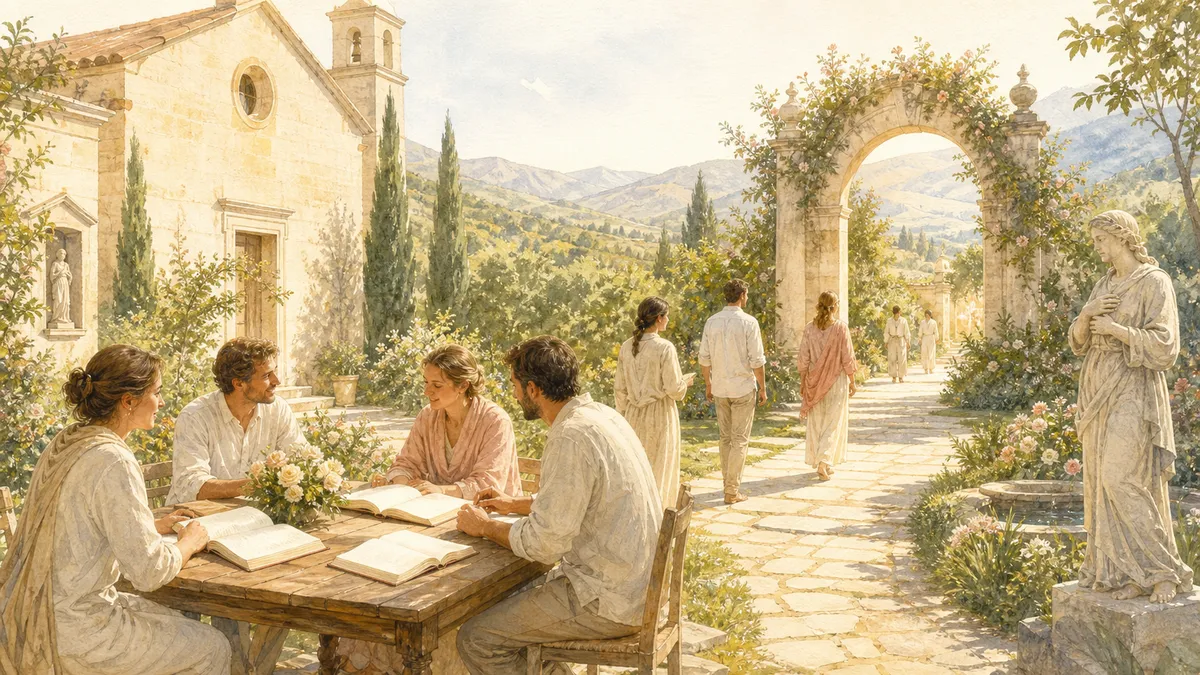
It is very important for a yogi to purify his outer life. When we purify our outer life, we are surrounded by a beautiful landscape, temples, statues of deities, sattvic music, a favorable environment of practitioners who maintain pure relationships and observe the principle of samaya; when we regularly study sacred texts, we enter another tunnel of reality, another vision. Of course, this presupposes great maturity on the part of practitioners. This is precisely the value of the Sangha as the third jewel. The Sangha is a treasure that makes it possible to concentrate such energy.
Rishi Tirumular said: “God is where there is an awakened teacher and a group of his disciples who observe samayas. This mandala of God is where there is such a sangha.” The third jewel means that we value such a field and, as far as possible, try to develop it, strengthen it, and in every way nurture and cultivate it. A Sangha, of course, cannot appear in a single day. It is something that requires great effort and spiritual labor.
Accumulation of Merits and Service
Finally, what else is necessary for purification is to change the meaning-forming vector of one’s behavior, one’s actions. Simply put, to realize the value of accumulating merits and serving. Often we do not attach importance to behavior, yet behavior greatly affects our dreams. It actually determines everything we do.
As you know, there are three aspects of the teaching — view, awareness, and behavior. These three aspects correspond to three powers — jnana-shakti, sankalpa-shakti (or ichchha-shakti), and kriya-shakti. Kriya-shakti is how we behave in the outer world, what we dedicate our actions to. When we do anything, we always come into contact with certain energies, and these energies are invoked in response to our actions.
For example, if a person distributes alcoholic products, this means that he comes into contact with the forces of concealment, with forces that veil consciousness, and these energies come into his life. If a person distributes sacred texts, he invokes a different energy — Anugraha-shakti. And this energy also enters his life. When you analyze from the point of view of spiritual practice, you see that it is right and favorable to come into contact with some energies, while coming into contact with other energies is completely unfavorable. Contact with a third kind of energy is neither favorable nor unfavorable, that is, it is of no benefit whatsoever, except for monetary compensation.
Accumulating merit means that we strive to perform such actions as to invite into our lives only an enlightening, beneficial force. The accumulation of merit refers to certain specific actions that invoke this enlightening force. For example, printing a sacred text is undoubtedly a merit that returns in the form of your always having access to the teaching, to the Dharma, in future lives as well. Building a temple is a merit that returns in the form of your living, on the material level, near spiritual practitioners and temples in your next life.
One person said the following to me:
— I have no time to practice yet; I devote all my time to accumulating merit.
I asked:
— And what merits exactly are you accumulating?
He answered:
— I’m doing business, working for the development of my company.
That is, he implied that accumulating merit means acting precisely in this way. But when you work on yourself in order to achieve success on the material, worldly plane, this can be called the accumulation of worldly merit. In your next life your intentions will be fulfilled; you will become the owner of a large corporation. However, from the point of view of spiritual merit, this is not quite it, because spiritual merit is accumulated precisely when you invoke subtle spiritual energies through your actions.
Service is when you act on an even higher level, when you do not even try too hard to accumulate merit, but regard the meaning of your life as service to certain global universal forces. There is already nothing egoistic in this. This is already the level of an enlightened being, or of one who strives toward it. The point is that one must free oneself from egoistic motivation in order to attain genuine awakening; one must cease to be a servant of one’s own “I,” of one’s own interests or the interests of some limited circle of people. One must become a servant of the whole world, of all living beings.
The XIV Dalai Lama said: “If you are selfish, then be selfish on a grand scale.” That is, regard all living beings as your “I” and give yourself to them. But in reality, there are no more than 1% of people in the world who care about the destinies of the nation, their people, civilization. These are truly people of great maturity. As a rule, people are very limited; the circle of their concerns is their own personality or their own small circle of relatives and close people, at best a circle belonging to a political party, clan, lineage, and so on. However, the principle of service to the universal forces of enlightenment means the motivation to become a servant of all humanity, to think on a much larger and more global scale, to change the semantic, value-oriented vector of one’s own life.

The Need for Purification and Awareness
Thus, when we develop all these qualities, it is said that we are purifying ourselves, since light, the power of sattva, accumulates within us; then we are truly capable of spiritual practice. Without developing these qualities, spiritual practice will confront us with our own obstacles and limitations and will not always bring joyful results.
Also, before receiving experiences, it is necessary to develop awareness, the capacity for self-liberation. It is precisely the capacity for self-liberation, the proper development of awareness, that distinguishes a student of Laya Yoga from a person engaged in Hatha Yoga or some other spiritual practices. Developing awareness means that you are able to dissolve, to self-liberate any state, any experience, and to find the right point in which consciousness should be placed. It is connected with abiding beyond concepts, with the opening of the mirror of the pure “I.” When purification and awareness are developed in us, then one can truly proceed to the practice that gives mystical experiences. Then mystical experiences will unite with your purity and awareness and lead into the world of holiness.
Contemplation of the Non-Dual Nature
“The supreme path cannot be learned without a teacher. With his help, contemplate something beyond perception, beyond understanding, beyond non-being.”
What should we contemplate? It is called “Brahman,” “the Absolute,” “prajñāna” — primordial awareness; “prathana” or “mahaprathana” — the great foundation; “tathatā” — suchness, mind as such, the nature of Mind, Atman. Some call it “sahajya” — the natural state; others in the siddha tradition call it “samarasya” — that which has a single “taste.” It is also called “mahashunyata” — the great emptiness. All these terms point to the non-dual nature of consciousness.
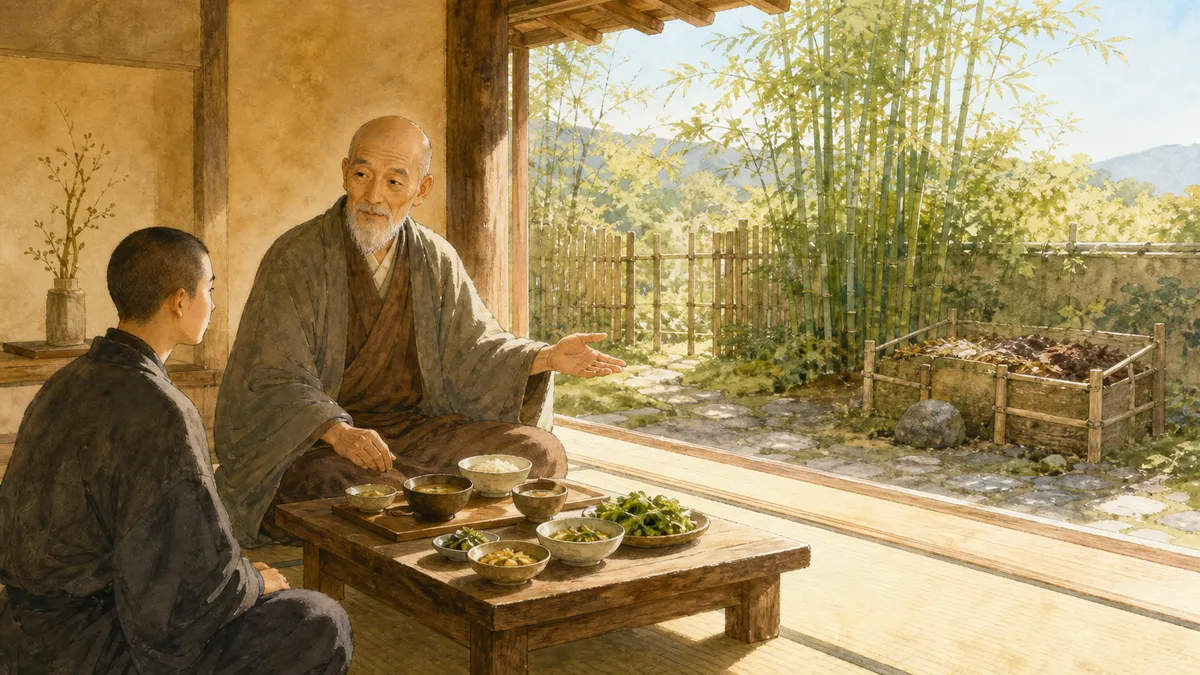
Once, a Zen spiritual master spoke to his disciples as follows: “Dog excrement and Buddha-nature are one. Everything has Buddha-nature, even dog excrement.” The next day, when the table was set, one disciple placed dog excrement on the table. The master asked:
“What are you doing?”
The disciple said:
“Everything has Buddha-nature, yet you make distinctions.”
The master then said:
“Fool! You must understand that I was speaking of the absolute vision when I gave the lecture, but truth also has a relative side, that is, a concrete one. And in the concrete sense, distinctions must be made; one thing should not be confused with another.”
Why is this so? Because the laws of the relative world and the absolute differ, and the laws of the relative world must also be respected. Even knowing that all of this has Buddha-nature, one must know what to put on the table and what to keep off it. If we confuse this, there will be nothing but problems. This is the distinction between relative truth and absolute truth.
Distinguishing Absolute and Relative Truth
Sometimes one needs to communicate in the language of relative truth, and sometimes in the language of absolute truth. Whatever language you communicate in, inwardly you always uphold absolute truth. You uphold it as a principle of awareness, like space.
Suppose you write an email to the monastery administrator: “I would like to come at such and such a time. What are the conditions?” And in reply you receive: “Who is to go where? Everything is perfect from the very beginning; in Brahman there are no conditions whatsoever, therefore you have nowhere to go.” What will you do then? Or the administrator says to the cook: “Today, prepare buckwheat for the monks,” and the cook replies: “In the Atman there is neither buckwheat nor radish. Who needs to cook, and what is the process of cooking? Everything is already perfect from the very beginning.” Such a cook would hardly remain in his position for long; the monks themselves would remove him. This is a manifestation of relative truth, and relative truth must also be respected.
To respect relative truth means to understand subtly how to build relationships in a given situation, and to build them correctly. For example, there are worldly relationships in which we must maintain harmony so that there are no obstacles. There is the principle of samaya. In samaya, we must maintain proper relationships and harmony. There is an algorithm for learning spiritual practice; we try to follow it in order to complete the entire course of training properly. There are monastic rules that must be respected. Even I respect them, knowing that if I do not respect them, they will weaken and cease to be beneficial, despite the fact that they are an illusion in the absolute sense. When we understand the difference between the absolute and the conditional, we are able to abide in this world, yet nevertheless always remain in the absolute Truth.
When people came to a certain master in the monastery and asked, “What is your teaching?” he was working in the garden at that moment and said, “My teaching is the shovel and the rake.” The people who heard these words did not understand what it meant, what kind of teaching this was. But this master expressed the very essence of contemplation. It means abiding in presence and uniting with all the actions you perform. And when you work in the garden, there is nothing but the shovel and the rake. This means that at that moment you unite with the work, the shovel, and the rake; that is, the shovel and the rake become the teaching. When you leave the garden and eat, the teaching will be the spoon and the food, because the natural state unites with the process of eating.

The very heart of the teaching lies not in reciting mantras, making prostrations, or circumambulating statues, although this is useful on the relative level; not in quoting texts and engaging in philosophical debates, but in being in presence every single moment and being able, in this presence, to unite with all manifestations of life.
The Art of Self-Liberation
“Learn to see everything that is favorable and everything that creates obstacles as a play, the blessing of the unborn ‘I,’ or the blessing of the guru. If attraction to someone or hatred toward someone arises, hold to the center of the ‘I,’ without leaving your nature.”
Self-liberation is precisely the art of holding on to the feeling of “I” without leaving one’s nature. At first, this feeling of “I” does not respond; it is very weak, but as practice progresses, this feeling of “I” is discovered as a deep, magnificent space saturated with various universal forces (shakti). When we hold on to it, even if attraction or aversion to something arises, this is the path of maintaining presence. When we do not hold on to it and act unconsciously with a restless mind, this is the path of samsara, the path of distractions.
In the course of life, we constantly try to be attentive in order to distinguish between these two paths (the path of nirvana and the path of samsara), so as not to let our mind slip onto the path of samsara, but to constantly keep to the path of nirvana, continually abiding in proper awareness.
