

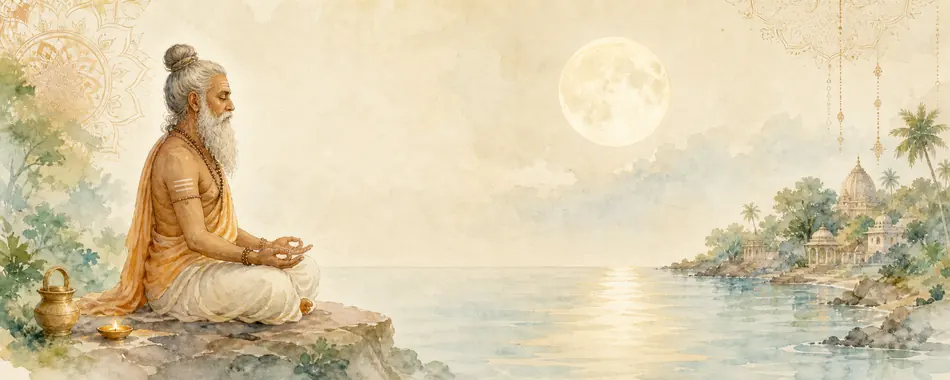
Commentary on the text “Yoga Vasishtha,” Chapter 5 “On Cessation”
As long as the inert and unintelligent mind follows the path of pleasures, this darkness of the apparent world does not disappear. But at the very moment when a person awakens and inquires into their own essence, the darkness dissolves. Therefore, one must constantly strive to awaken the mind dwelling in the body, so that one may go beyond the process of becoming someone or something, because such becoming is full of suffering.
Awakening the Intuitive Consciousness of Buddhi
The mind dwelling in the body here refers to the intuitive consciousness of buddhi, which the yogin must awaken. How can it be awakened? First, it is necessary to calm the sense organs, which are constantly drawn toward objects; they must be disciplined. One must control the senses and desires with a firm and authoritative hand.
From the perspective of the sutra path, one simply needs to renounce them and overcome them through an act of will, just as the strong overcome the weak. From the perspective of anuttara-tantra, the matter is much subtler — one must learn to be attentive and aware; instead of following desires, one must self-liberate them, that is, anticipate them with naked awareness. At the moment they arise, your naked awareness must act faster and, as it were, knock the ground out from under the desire itself, cutting it off at the root.
When the sense organs have been calmed either through renunciation or through attentiveness and naked awareness, it is time for purification. The very fact of self-discipline of the mind and senses is not so difficult; even worldly people possess it. Many people can work diligently and labor hard, subduing their desires for the sake of the future. For example, a person may undertake austerities on oil rigs in order to earn a great deal of money, or a scientist may work day and night for the benefit of their project, forgetting all sensual pleasures — these are examples of worldly austerity. In other words, disciplining the sense organs and renouncing sensual pleasures is actually not that difficult. All that is needed is willpower.

Then, once we have disciplined them, the stage of purification follows. Manas (the mind) and consciousness as such must be purified. The stage of purification concerns subtler layers. And here, again and again, we must suppress impure thoughts and impure vision. Again and again, we must analyze our subconscious, eliminating everything that obscures and everything impure. Then, with the help of philosophy, manas becomes purified, trained, flexible, subtle; it becomes, as it were, transparent, and the channel of buddhi opens. It opens through intuitive awareness.
And it is precisely this awakened mind that Vasishtha speaks about. It is very subtle. It seems that nothing has changed, yet everything has changed, because when the channel of buddhi is open, we look at the world through the eyes of another consciousness. We assess the entire situation differently.
The Nature of Pleasure and Pain
Just as the sky is not affected by the dust flying through it, the higher “Self” is not affected by the existence of the body. Pleasure and pain are mistakenly imagined as being experienced by the self, just as one may mistakenly think that “the sky is polluted by dust.” Truly, pleasure and pain belong neither to the body nor to the higher “Self,” which transcends everything; they belong only to misunderstanding.”
A very good saying. Pleasure and pain belong only to a misunderstanding of the fact that you are not the body.
There is a distance between the body and consciousness. But if sensual desires are very strong and the mind is not controlled, the channel of buddhi does not function, and it is impossible to see this distance. Then the desires of the body are your desires. And the desire for desire as such is equivalent to the desire to live; you cannot live without desires. But if the senses are purified, manas is disciplined, and the channel of buddhi is open, then there is a distance, a gap, between the body and consciousness. And you can realize that pain and pleasure are not connected with consciousness. Consciousness is not affected by them; it can accompany experiences, desires, pain, and pleasures. It can penetrate into their essence, revealing their emptiness. It can unite with them without losing itself.
Usually, we either blindly follow our desires or rigidly suppress them. But the path of anuttara tantra is different. In the absolute sense, anuttara tantra is not connected with renunciation, since renunciation is only the initial stage. Anuttara tantra is connected with self-liberation, that is, it is a fundamentally different approach. Self-liberation means that we integrate and unite. What do we unite with? With any experience. We open ourselves to it; we are not afraid of it because we have immunity. Immunity is naked awareness, which gives us the ability to feel aura-loka—the boundless consciousness. And then we can connect our awareness with any experience; it instantly loses its power, liberates itself, disappears, and does not become a klesha or an obscuration.

Being seized by desire, perception, or anything at all arises from misunderstanding. Misunderstanding of what? Not a misunderstanding of particular details, but a misunderstanding of one’s own intuitive consciousness, the consciousness of buddhi. So how can this misunderstanding be eliminated? By constantly looking into the essence of one’s own “I.” By searching for this intuitive channel of buddhi and trying to activate it. By asking yourself: “Is my intuitive channel activated, or have I lost this connection?”
The Unity of Brahman and the World
Their loss is not a loss. Neither pleasure nor pain belongs to anyone—in truth, everything is consciousness, supreme tranquility, and infinity. Realize this, O Rama.
The Supreme “I” and the world are neither one nor different from each other. All this is merely a reflection of truth. There is nothing except the one Brahman. “I am not like him”—this is a mere whim of the mind; renounce it, O Rama.
Living beings with their differences exist as long as dualistic vision persists. In reality, there are no living beings; there is only Brahman manifesting under different guises. In other words, when we see a living being, it is a kind of skillful play, a skillful illusion, in which Brahman, concealing itself beneath the guise of a person, plays with you. And it plays very sincerely and seriously; it has free will, intellect, and its own mind—it is a complete virtual copy. Nevertheless, it is not a person at all; it is Brahman. The same can be said of animals and other beings.
It is like a person being possessed by some spirit. In such a case, you do not regard him as a person; you regard him as someone possessed by a spirit. You can no longer become attached to such a person, get angry with him, or make plans for a life together with him. You know that this person is possessed by a spirit, meaning that he is no longer a person at all, but that some spirit is acting through him. A person may smile and imitate something for a while, but eventually his true nature will reveal itself.
The same is true here. In the absolute sense, every person is possessed by Brahman. They are, as it were, made of a material called Brahman, which is their essence. Their role-playing guise is their personality, their ego (ahamkara). In other words, they pretend to be a son, a daughter, a mother, a senior monk, or a dog, but, by and large, one cannot take any of this too seriously. Of course, one should not disregard it entirely either, since certain rules of the game exist. But all of this is precisely such a game, in which Brahman assumes various forms: a siddha, a deity, a saint, a spiritual teacher, a commoner, or an ordinary worldly person. By and large, all these distinctions are unimportant. Just as all pots are clay and all bracelets are gold, so all of this consists of the faces of the same Brahman.

One who recognizes this will no longer be misled and think: “This is my wife, these are my relatives, these are my enemies, these are my friends. I am attached to these, while I feel aversion toward those”—such things are laughable to them. They no longer have such connections that they would establish.
Brahman plays very skillfully through the power of its maya, which is why this game is extremely subtle. It is very difficult to recognize; everything seems real, yet it is merely such skillful acting. There is not the slightest bit of reality in it.
Brahman plays through the ego (ahamkara), through the personality, and even the personality itself need not be denied. Even the personality is a complete manifestation of the Absolute. Nevertheless, the personality itself, as such, does not exist.
There was one such case. A superhuman woman, a demoness who could assume various forms (a police officer, a man, a woman, and so on), attacked people. One day, she was imprisoned, and a police officer conducted an interrogation. Trying to impress the officer, the demoness assumed the form of the President of the United States and said, “How dare you keep me here?! Call the Secretary of State immediately!” Then she assumed the form of a little girl, began to weep pitifully, and said, “Let me go home, I want my mother.” The consciousness of the police officer who witnessed all this also changed, since it was deeply impressive. But another police officer said, “Yes, yes, go ahead, keep pretending! If you keep pulling tricks like that, I’ll give you an injection right now. I have a drug here that will knock all your mystical powers out of you.” Then she once again assumed her demonic form and said, “I could strangle you!” In other words, despite all these metamorphoses, her character did not change. It was all merely her trickery, her ability to manifest different external forms.
In the same way, on the absolute level, all living beings change their forms, but their nature is pure, perfect, and absolute.
Teachings on Abiding in Higher Consciousness
The one Supreme Self perceives itself within itself as infinite consciousness. Therefore, there is neither suffering nor delusion, neither birth nor creation—there is only what is. Be free from agitation, O Rama; be free from duality; establish yourself in higher consciousness, abandoning even concern for your own well-being. Preserve peace within yourself, calm the mind, and let it be free of sorrow. Remain in inner silence. Be alone, without self-arising thoughts. Be courageous, having conquered the mind and senses. Have no desires; be content with what comes to you of its own accord. Live without effort, neither appropriating nor renouncing anything. Be free from all distortions of the mind and the blinding veil of illusion. Be content within yourself. Be free from all agitation. Remain in an open state in higher consciousness, like the full ocean. Enjoy yourself within yourself, like the blissful rays of the full moon.
In fact, here the rishi Vasishtha gives Rama a direct transmission, explaining how to abide in this state. Once you have resolved the confusion between the body and your self, all that remains is to abide in the proper state. He says, “Abandon concern for your own well-being.” Why? Because it proceeds from the ego. The personality should be protected, but not defended. True well-being is abiding in Brahman; no other well-being exists.

Vasishtha says, “Preserve peace within yourself, calm the mind.” When the mind is calm, shanti, peace, exists in the soul. A peaceful state is precisely the background in which true contemplation is possible. But when the mind generates restless thought-forms, when it craves something, constantly spins, and is perpetually dissatisfied, it itself moves away from its nature; then there is no place and no happiness for it anywhere.
Then he says, “Let it be free of sorrow.” Sorrow proceeds from a strong, hypertrophied sense of self-importance, from intense egoism. By and large, there is no reason for sorrow if you are in the right state of mind, because the world is divine, perfect, sacred, pure, and wondrous in itself. The world is a mandala, and all the energies unfolding within it are a play. And we are part of this play. But as soon as we create a false center—the small self that begins to think highly of itself—and start clinging to it, this hypertrophied sense creates an unjustified expectation, and when it is not fulfilled, we begin to suffer.
Vasishtha says: “Remain in inner silence. Preserve peace within yourself, calm the mind.” There is a saying: “When the mind is calm, the evil spirits are calm as well, but when the mind is restless, the yogi has no peace either.” Often we worry about many things and want to eliminate these worries. The more we want to eliminate them, the more anxiety arises within us. And the more anxiety arises within us, the more preoccupied we become with it and the more difficult it is to eliminate it all. Then we enter a not very peaceful state. Instead, the saints recommend relaxing, letting go, and simply being attentive to our nature, being aware, allowing things to flow naturally, not attaching such great importance to everything that happens, but instead simply allowing ourselves to be aware in the present moment. Then everything becomes easy, spontaneous, playful. But the mind often does not want to adopt such an attitude because it is very egotistical. It feels very important and tries to fight all the time.
Vasishtha says: “Remain in inner silence.” What does inner silence mean? It is not necessary to maintain a thought-free state (unmani); it is enough to remain at the point where thoughts arise but do not disturb you—that is, in the nonconceptual. You can play with thoughts in any way you like, weave beautiful lacework out of thoughts, construct theories, grids, diagrams, and so on, but these thoughts themselves have no significance. You do not grow tired of them; for you, they are like an adornment, because you yourself remain continuously in silence, you are not seeking anything, you do not attach importance to thoughts because you have found a point that is much deeper than thoughts. And this point is your true home. This is the state of silence.
Vasishtha says: “Be alone, without self-arising thoughts.” Thoughts are very necessary for the ego to affirm itself, to confirm the fact of its existence, to say to itself: “Yes, here I am. I am like this, unique! How wonderful I am!” And it thinks on its own. Sometimes I have even noticed people walking around and talking to themselves out loud, gesturing, communicating with some imaginary interlocutor, and so on. All this is a form of self-forgetfulness, of falling asleep to oneself, a way of escaping from one’s true self. The ego is afraid of the inner emptiness that arises, so it tries to fill this emptiness with thinking.
But if we are free from self-arising thoughts and do not conduct inner dialogues, we discover that this emptiness is the source of immense peace, strength, joy, and everything beautiful that exists. It is our true essence. Only when we begin to trust it will we truly begin to live. Until then, we are not living but dreaming while awake with the help of thoughts. It is difficult to call this true life, the kind that bestows happiness.
Vasishtha says: “Be courageous, having conquered the mind and the senses.” To overcome the ego’s tendency to perpetuate itself through thoughts, one must possess courage. Often, when confronted with inner emptiness, we become frightened by it and lose heart because it is beyond all limits. And we feel that our ego is so small, while the inner abyss that opens before us is so vast.
It says here: “Be courageous.” A yogi practicing the path of anuttara tantra must be fearless. There is a saying: “Forward, into the lion’s mouth.” When we approach this mouth—meaning the boundless ocean of awareness—we must not tremble. We must understand that, on the one hand, this is our essence, that there is no alternative but to enter this state. And on the other hand, we must understand that the ego as such has never existed; we have always been this boundless ocean of awareness.
“Have no desires; be content with what comes to you of its own accord.” Neither indulging desires nor fighting them is the true position. The true position is only natural self-liberation. A yogi has few desires. These are desires that cannot be eliminated because they are connected with the karma of this body: eating, sleeping, and keeping the elements protected. In all other respects, he is free from any desires. He moves through life, accepting what naturally comes to him. By accepting it, he does not cling.

It is said: “Live effortlessly, appropriating nothing and renouncing nothing. Remain in an open state like the vast ocean.” On the surface, we may make many efforts. But these efforts themselves are based on inner effortlessness, on inner non-doing. For example, when a highly skilled musician or actor performs, one cannot say that they are experiencing any great difficulties. This is precisely what is called play. Through it, they embody their own meditation. But when a person performs not in this way, but with effort, they become very tired. These two examples show how to act with effort and without effort. Life in effortlessness is a joyful life, a life of bliss, a life of creativity, a life of play, a life of blessing, a life of ecstasy. Every action becomes a source of joy, an inexhaustible source of inspiration. Whether you are sweeping the floor, washing the dishes, or preparing food, the most ordinary things amaze you and bring tremendous inspiration, because there is no effort on your part, because it is not you who are sweeping the floor—the Absolute, God, is sweeping the floor through you. And since it is being done through you, it is a completely transcendental act.
Life as Blessing or Suffering
Everything you do, if you act in a state of effortless non-doing, is a blessing. But when you sweep the floor while your intellect is torn apart by contradictions, comparing, evaluating, expecting, and striving for gain, even such a simple thing can become hell. When you wash the dishes, but your mind itself is wandering somewhere in the clouds or indulging in pleasures, so that the external comes into conflict with the internal, this can become an inner hell.
This is because there is effort, that is, something unnatural. For example, being a monk is very simple; it is something natural. Performing practices and meditating are very simple if you act in a state of play, in a state of intuitive awareness. Everything is done as if you were undertaking nothing, while everything is being accomplished. But when you project strong hopes and expectations, introduce some powerful egocentric motivation, when clinging to ahamkara arises, great difficulties suddenly appear out of nowhere, and obstacles emerge one after another. It is as if we are facing a wall. This principle applies to any kind of activity, even worldly activity. The question is how long we can remain in this state of effortless hovering.
Saints are astonished by how people manage to turn the sacred mandala, the divine play, into the life they live. They are filled with immense wonder and compassion when they see how the beautiful world of divine lila is transformed into a world filled with suffering. It becomes a world of suffering precisely because an egotistical element is introduced, effortlessness is lost, and then the law of cause and effect comes into force.
The Obstacle Within Ourselves
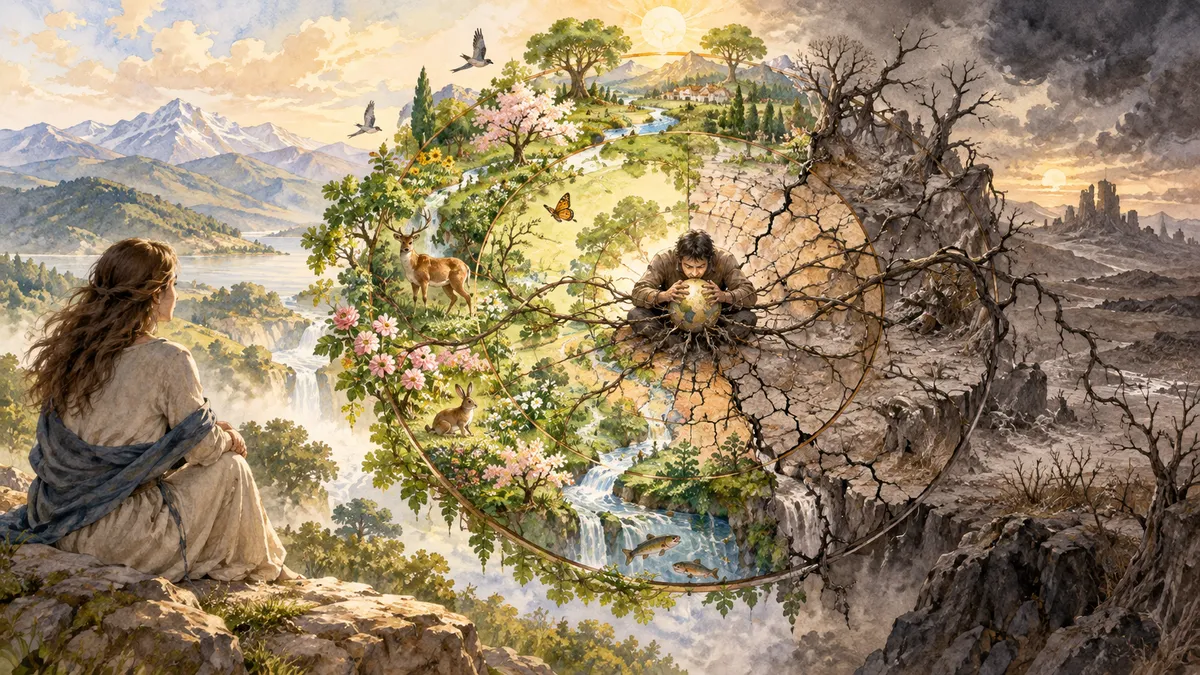
In essence, nothing prevents us from celebrating right now, from being in a state of play right now, from abiding in the highest pure vision, in divine pride. Nothing prevents us from feeling boundless, majestic, and expanded right now. The gods do not prevent you from doing this; on the contrary, they encourage you. The sacred scriptures, the teacher and senior monks, and worldly people do not prevent you from doing this either. So who is preventing you from abiding in a state of play, greatness, boundlessness, bhava, and divine pride?
If you analyze it, you will see that you yourself are the one who is preventing yourself. Then I want to ask you: “Why are you doing this? You are not your own enemy.” And I will tell you why. You do this out of habit. It has simply been this way since time immemorial. You have simply become accustomed to feeling this way. As soon as you cultivate a new habit, you will see that everything can change completely. This habit is called ahamkara. It appeared from an unknown source, from beginningless time, spontaneously, through inexplicable ignorance. But it is unreal, and it does not take many years to eliminate it; you only need to try to see this unreality immediately, and then, just as spontaneously as it appeared, it can spontaneously disappear.
It is like someone seeing a mirage in a mirror and becoming frightened by it, after which other people also began to fear it. But someone came and told them all: “It is only a mirage; there is no need to be afraid of it.” And then everyone immediately breathed a sigh of relief.
