

Commentary on the text “Ashtavakra Gita”
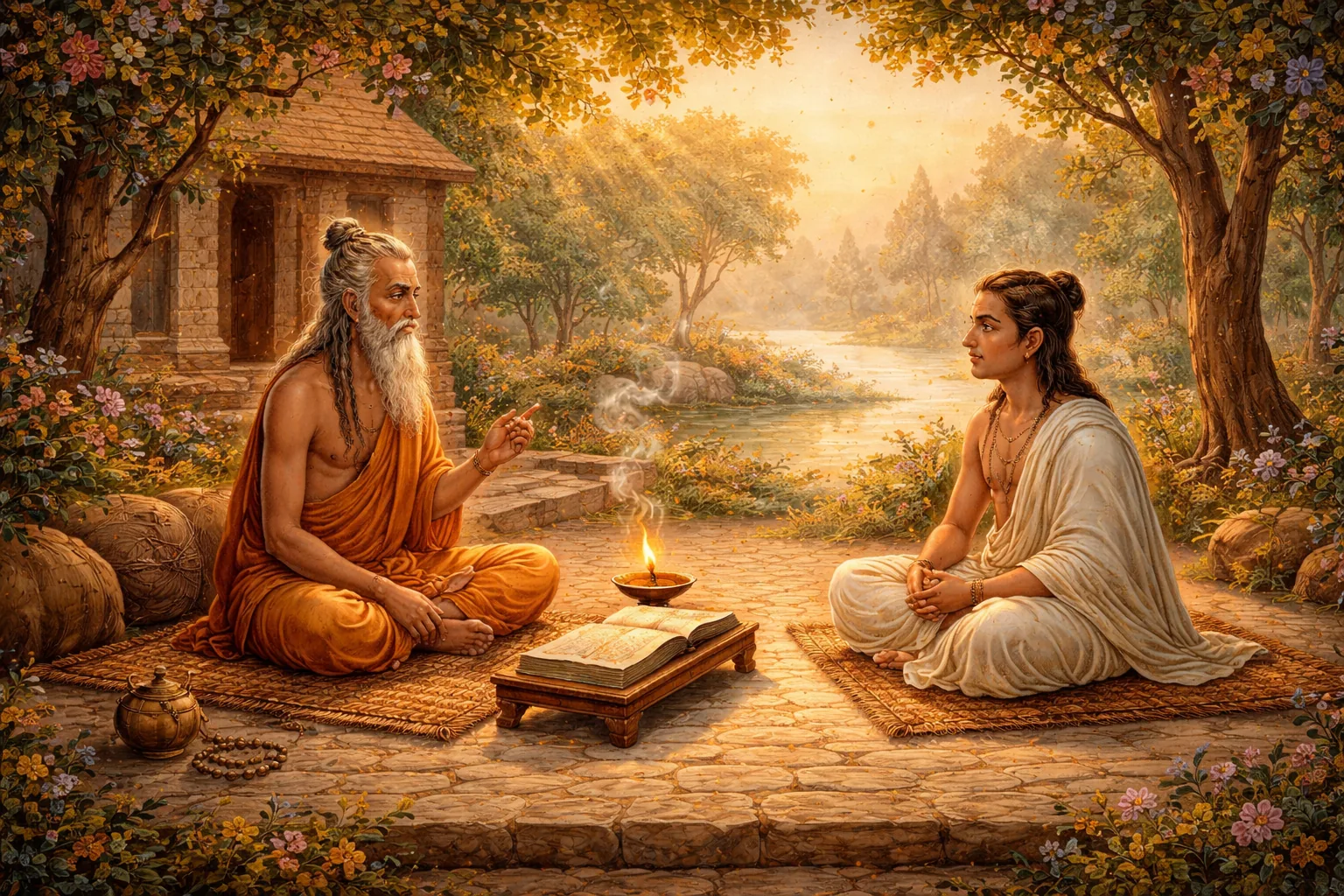
The “Ashtavakra Gita” is a text of classical Advaita Vedanta that can be equated with the “Tripura Rahasya.” In the “Tripura Rahasya,” Ashtavakra received instructions from Janaka, while here, conversely, Janaka questions the Brahmin Ashtavakra.
Janaka said: “How is knowledge attained? How is liberation achieved? And what is the impartiality that must be attained before this? Tell me this, my lord.”
Ashtavakra said: “If you seek liberation, my dear, avoid the objects of the senses as you would poison. Open yourself to the nectar of patience, sincerity, compassion, contentment, and truthfulness. You are not earth, water, fire, air, or even ether. One who desires liberation knows himself as consciousness—the witness of these five. If only you remain calm in consciousness, observing yourself as distinct from the body, then even now you will become happy, peaceful, and free from obligations.”
Thus, Ashtavakra says here that if you seek liberation, then first you must learn to avoid bondage to the objects of the senses, because such bondage is like poison. There is a direct avoidance of sense objects that we must carry out, for example, in mahashanti meditation. If you have objects, you cannot direct the mind into mahashanti. Any object—external or internal (thoughts)—is a destroyer of mahashanti. However, from the point of view of contemplation and the avoidance of objects, this is different. What is meant is avoiding not the objects themselves, but the tendency of the mind to perceive objects outside the natural state.
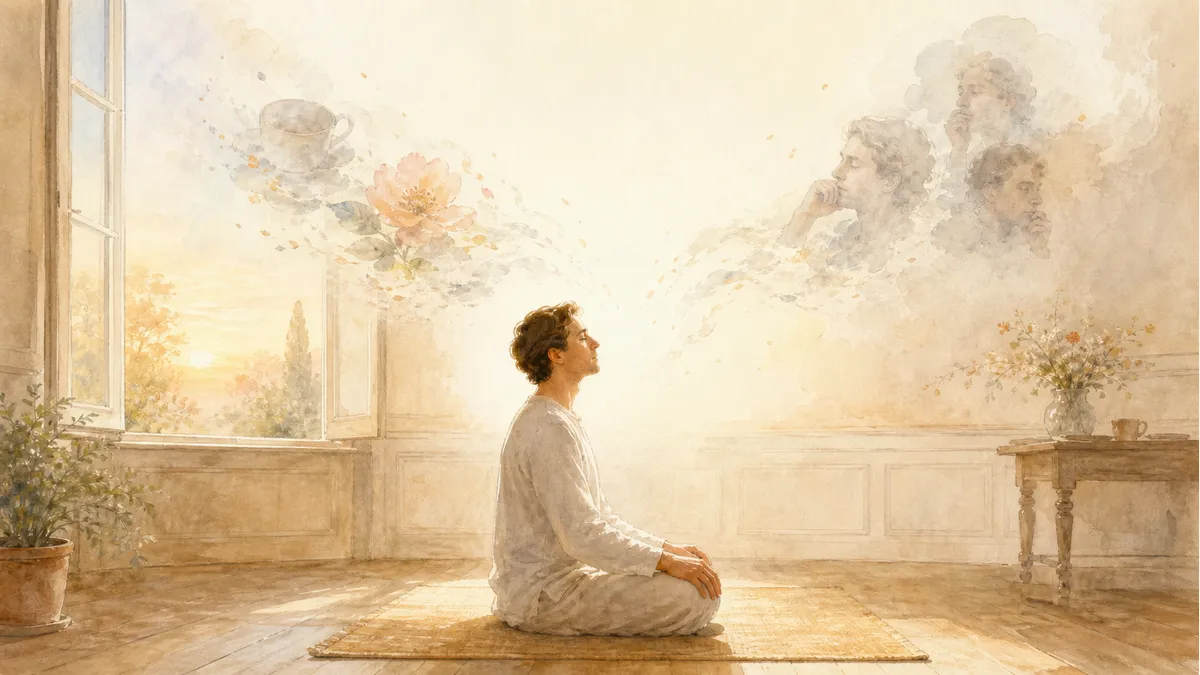
There are two kinds of vision, or perception: deluded and true. When we understand the two kinds of perception, it is always very easy for us to see whether we are avoiding bondage to the objects of the senses or not. The first kind of perception is worldly, ordinary, when we are seized by objects. That is, when we are in distraction and the object appears simply as an object, it is imprinted in our consciousness. This is the state of samsara. The second kind of perception is when we are in contemplation and perceive an object in a special contemplative way.
The first way of perception leads to new births and suffering in samsara. The second way of perception leads to liberation, to nirvana. Just a subtle nuance—whether the presence of awareness exists or not—leads into two completely different worlds.
The Principle of Consciousness Beyond Limitations
You do not belong to the Brahmins, or to the Kshatriyas, or to any other caste. You are not passing through any particular period. You are not that which the eye sees.
Here Ashtavakra says that you do not belong to the four castes, you do not belong to the four ashramas (periods of life), you are beyond any limitations: temporal, social, cultural, class, racial, national, gender-related, or any others. That is, if we feel ourselves to be within any limitations, no matter what kind, it means that we have not yet managed to discover the principle of consciousness.

When we correctly discover the principle of consciousness, the first thing we experience is abiding beyond all limitations. We see that our mind is free in all directions. We allow ourselves to discover this freedom and become rooted in it. In principle, we do not see the mind as being bound by any limitations, except only one—our own karma. The only limitation is our own lack of awareness. And when our lack of awareness is absent, our mind is constantly free.
When speaking of a yogin practicing Anuttara Tantra, it is said: “Fearless view, modest conduct.” This means that we discover the principle of the pure mind beyond all limitations and allow the mind to soar in boundless freedom. Nevertheless, understanding that we act in the relative world, we adhere to certain conduct.
The Detached Witness
You are the solitary and formless witness of everything. Now you are happy. Justice and injustice, pleasure and pain are of a mental and bodily nature and now do not trouble you in any way. You are neither the doer nor the receiver of the consequences of deeds. You are always free. You are the detached witness of everything and are always completely free. The cause of bondage is that living beings know the witness as something other. When you were bitten by the black snake of self-importance, you foolishly thought, “I am the doer.” Now you drink the nectar of the feeling “I am not the doer” and are happy.
Solitary means that one must come to know the self-sufficiency of the mind. You may communicate or not communicate with others, be in retreat or in interaction; nevertheless, you must come to know the complete self-sufficiency of your own mind.
A person communicates with many, but is born and dies alone. This is the first thing a monk must grasp when renouncing the world. He must renounce not a world of two or three people and some single house, but in principle renounce any, even the slightest, desire to find satisfaction outside his own awareness.

Gorakshanath says in his song: “A siddha knows one. A true sadhu knows two. A virtuous grihastha, a householder, knows four or five people. An ordinary worldly person knows several dozen.” This means that the siddha who knows one knows only the true “I.” He knows no one else with whom he could communicate or become acquainted. A sadhu who has not yet become a siddha knows two. What is meant here is that the disciple knows the master, the soul knows the Absolute, and besides this there is nothing. That is, a subtle duality still remains, when the whole world has already disappeared, but “I” and the Absolute remain.
One who is lower in rank knows a few more, that is, he still has a tendency of the mind, a subtle identification, an attachment. And an ordinary person is attached to an even greater number of people and objects.
But when we know the mind in non-duality, we see that we abide in a state of oneness. There are no others besides ourselves. This does not mean that we cannot communicate. We can communicate, but at the same time, deep within, we know that there is no one to communicate with. If this is communication at all, then it is simply like a play of the energy of awareness. It is similar to how a person sometimes likes to look at himself in the mirror, make some grimace, and cheer himself up. For a siddha, communication is something like that. He no longer ever communicates seriously with anyone, because he knows that he is the sole essence, and others are expressions of this sole essence. Therefore, in the true sense, there is no one and no one with whom to communicate. Nevertheless, the play of energies continues.
Therefore Ashtavakra says: “You are the detached witness of everything and always abide in freedom.”
But the cause of bondage is that the living person regards the witness as something other. Every person has a witness. The witness is consciousness that knows and observes within. But at the same time, an ordinary person considers the witness to be something contracted, small, limited, narrow, identified. Both an ordinary person and a siddha have the witness. One could say that the witness is buddhi, a very subtle creative and aware intelligence. But in an ordinary person it is undeveloped because of identification and is considered narrowed. A saint has a witness that abides in a state of space. An ordinary person does not become a saint only because he cannot recognize his witness as very deep and space-like. This is the cause of his bondage. In principle, nothing binds him except the false notion that he is narrowed.

This is similar to if an adult person were suddenly subjected to hypnosis, to suggestion. It was suggested to him that he was three years old; regressive hypnosis put him into a state of child consciousness, and then he was taken to a kindergarten, and then he begins to have various relationships with children, problems, acceptance of the authority of the kindergarten teacher, parents, and other difficulties of the childhood period. But nothing prevents this person from perceiving himself as an adult. Such a person can use neither independence nor the benefits of civilization. He rightfully possesses all of this, but why can he not make use of it? He possesses it because he is already an adult from the very beginning; he does not need to grow up. And he cannot make use of it only because of his false perception of himself as a child, because of identifying himself with some suggested program. In the case of a living soul that is bound, the living hypnosis is collective karmas caused by one’s own thoughts.
Ashtavakra says that the feeling “I am the doer,” “I am this I,” “I am that which proceeds from me as a personality” is the black serpent of self-conceit. And when you drink the nectar of non-doing, the feeling “I am not the doer,” then you are happy.
Burning the Forest of Ignorance
Burn the forest of ignorance to the ground with the fire of understanding. Know: “I am one pure consciousness.” Now, with only the ashes remaining, be happy, free from suffering. That in which everything is born, like a snake appearing in a rope; this joy, supreme knowledge and understanding — that is what you are; now be happy.
Ashtavakra gives Janaka a direct introduction. Bypassing various relative concepts of dharma, he simply says to Janaka: “You are not this, but That. That is the whole point.”
The forest of ignorance is when, for example, we consider ourselves to be the body, the sense of “I,” a person. That is, we identify ourselves with the ego.
Jnana is knowing that “I am one pure consciousness.” When this forest of ignorance burns down, ashes remain — residual karma (prarabdha). The yogin abides in happiness and in freedom from suffering.

The snake appearing in the rope is a classic example: a rope is seen, but it appears to be a snake. Upon careful examination, it turns out that there is no snake at all, but only a rope. The snake was apparent, yet the fear was real. In the same way, this samsara is apparent, like the snake, yet the fear and suffering are real.
Nevertheless, when we discover the primordial space of the “I,” the snake is truly seen as unreal. We see that what we suffered from and were confused by did not exist from the very beginning. The ego that had various goals, hopes, or fears did not exist from the very beginning. And from the very beginning we were the boundless ocean of pure consciousness. As soon as we begin to discover this fact, all the limitations of the ego begin to fall away one after another. Of course, they do not fall away in an instant, because discovering the ocean of consciousness is a sadhana that requires decades. And if you read Ramana Maharshi’s conversation with his disciples, it says there: “I have been practicing for twenty years, but there are no results.”
As the ego discovers the ocean of consciousness, it gradually turns around in its views by one hundred and eighty degrees.
Freedom and Bondage as States of Mind
Next, Ashtavakra says truly unique words:
If one thinks of oneself as free, then everyone is free. If one thinks of oneself as bound, then everyone is bound.
This expression should be remembered. If you think of yourself as the Absolute, as completely free, then over time you will see that everyone else is also the Absolute. Here, “to think” does not mean mere thinking; it is a subtle sadhana that is nurtured, grows, and has its own signs. To think in this context means to abide in correct contemplation. Simply thinking “I am free” will not be correct if only the superficial conceptual mind participates in such reflection. The thinking of which Ashtavakra speaks is a thinking that pierces the three universes, penetrates dreamless sleep, and goes even deeper. In other words, it is not thinking at all, but a subtle mental process that we call “comprehending clarity.” That is, it is awareness that comprehends its own deep Clear Light. Therefore, to think of oneself as free means to have such comprehending clarity. Such comprehending clarity may be connected with naked awareness, with space, or with bhava. All three of these nuances are equivalent; therefore it is said that in contemplation there are three lines.
If we perceive ourselves as free, then everything else is also perceived as completely free. If we consider ourselves bound, then all other things likewise appear as objects of samsara. This can also be called pure vision.
Pure and Impure Vision
Usually, when you encounter people who do not have a purified mind, you may encounter the manifestation of impure vision. Ordinary human vision is connected with fear, suspicion, arrogance, dislike, greed, the thirst to dominate, and the projection of one’s own impurity onto others. This is an example of impure vision. Why does a person have impure vision? Because these data are inside them; they are radiated outward.
For example, one person from St. Petersburg who wants to become a novice with us cannot become one. Why? Because his parents believe that their son is fascinated by the teaching of some sect, and that their Guru is a bandit. When he showed them a cassette with Sai Baba, they said that he was the devil. When he showed them a cassette with Ramana Maharshi, they said that he was a madman. A difficult case with the parents. I replied to him that we cannot accept him as a novice until his parents change and give their blessing, since parents are considered karmically important objects from the point of view of sadhana. The Guru, the parents and the true “I,” which manifests as awareness, the deities, the surrounding companions, the sangha—these are three important karmic objects on whose part everything must be pure. There must be blessings, since they influence the subconscious during spiritual practice. That is, there must be pure relationships with the spiritual Teacher, there must be at least loyal relations with one’s parents, and pure relationships must be established with companions in the Dharma, the true “I,” and the saints.
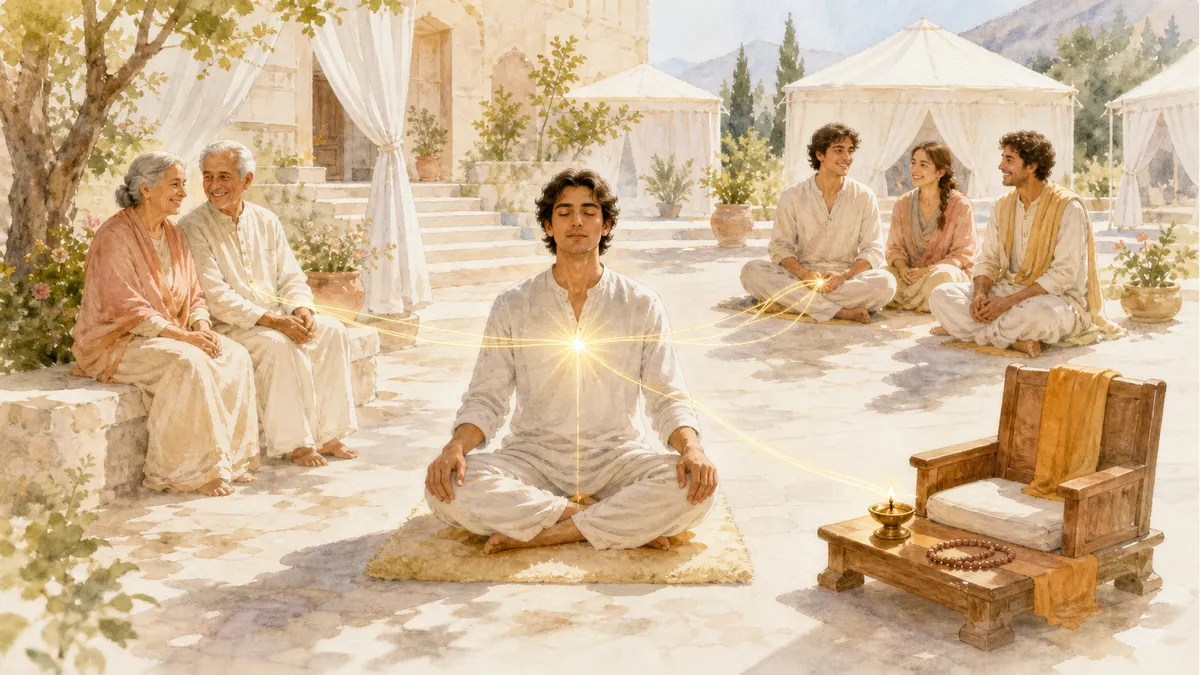
When there is an impure perception of oneself in the soul, when a person has any impure inclinations, vices, and so on, he is inclined to project them onto others as well. He sees this through a prism.
When, under certain circumstances, something arises in a person, his consciousness descends, and then in his soul he begins to think that this is something impure. When, under the same circumstances, he sees another person, he thinks that this person’s consciousness is also lowered at that moment, although in reality that person’s consciousness may even be elevated. Why does this happen? Because there is a projection of one’s own impurity onto another.
Pure vision is when you think of yourself as free. Then all others also appear as free. When you perceive yourself as a deity, then the world appears completely pure as well.
As soon as you begin to perceive yourself as free, as fully awakened, your consciousness begins to form a world of freedom and awakening; the space and environment around you begin to change. Everything depends on the strength of such a sankalpa.
Meditation as the Realization of Thoughts
Thus, the words “meditation makes thoughts a reality” are true. Your real nature is one perfect, free, and inactive consciousness, a unique witness, detached from anything, without worldly desires. It is an illusion when you seem to be involved in some affairs. Reflect on yourself as motionless consciousness, free from any dualism, having abandoned the erroneous idea that consciousness is only a derivative of you. Everything external or internal is false. You have long been caught in the trap of identification with the body. Cut apart the trap with the knife of knowledge, seeing “I am consciousness,” and be happy.
Ashtavakra says: “Meditation makes thoughts a reality.” When you meditate, the power of your consciousness begins to radiate and manifest; that is, your inner reality begins to manifest outwardly. Your inner sankalpas, your thoughts, begin to be realized. The extent to which they materialize depends on the power of your meditation. Suppose that in your soul you have the consciousness “I am fully awakened,” or “I am a fully awakened deity,” or “I am an immortal mahasiddha”; if you are convinced of this and constantly identify yourself with it, generating such an image of yourself, then over time you will begin to see how you change and become this. All deity yoga consists in this. If you begin to consider “I am Gorakshanath,” constantly meditate on this, and feel yourself to be so, then over time you acquire his qualities and traits, you become his essence. This is the meaning of the practice of divine pride, when you continuously develop divine pride until it becomes the essence of your consciousness.
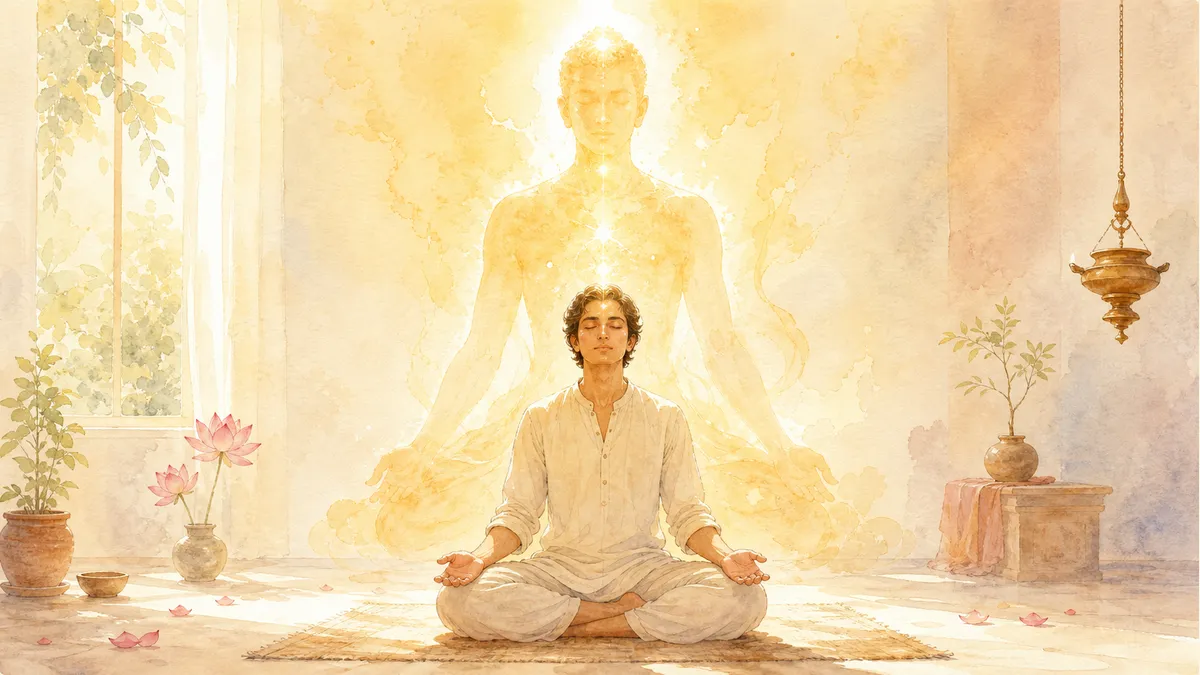
It can be said that any contemplation is the continuous making into reality of one thought: “I am the Absolute.” All spiritual practice, all three lines of contemplation and the five yantras of laya yoga, come down to one thing—to always and under any circumstances consider “I am the Absolute.” Of course, there are different levels.
In a dream, I met a student who was meditating on “I am Brahman.” He said to me, “I am God.” I asked him, “And what comes next?” All he could manage was to remember the phrase “I am God” in the dream. Then I began to explain to him that something greater lies hidden behind this phrase. I tried to show him a vast expanse and a very subtle light, an incomprehensible and powerful bhava, the radiation of the deities’ energy. That is, an abyss lies hidden behind this phrase. But this is only the very beginning.
That is, you move from the mental conviction “I am God” to the meditative state “I am God,” from the meditative state to bhava, from bhava to the boundless state of space, and from the state of space to the ability to radiate and manifest energy.
Realization of the Divine Nature Through Conviction
Nevertheless, your thoughts become real if you meditate: “I am a pure, holy, and refined deity, possessing all powers, abiding beyond karma, beyond limitations” — and constantly convince yourself of this until you learn to remember yourself as such a deity instantly upon awakening. If you have this bhava, then it grows, and therefore in time you inevitably become this.
If one explains the principle of contemplation in simple language, it is nothing other than constantly convincing oneself of this day after day, week after week, for months and years. That is, all the subtleties of contemplation are nothing other than convincing oneself that you are a completely holy awakened being, without limitations. Such conviction makes your transformation a reality. In time, you discover that you are truly becoming such a being. Just as a caterpillar becomes a butterfly, so too does the yogin become fully awakened, one with Brahman.

In order to bring about such a transformation, you must have boundless and absolute faith. One may say that faith is a constant attunement to the bhava of such conviction. If your attunement is very deep and surpasses your karmic mind, then such a transformation manifests. And then you discover your real nature — a perfect consciousness free from anything, abiding in non-action, a unique witness who is detached from everything and is beyond worldly desires.
The Principle of Non-Action and the Illusion of Involvement
Ashtavakra says: “It is an illusion when it seems that you are involved in some affairs.”
Your external mind (manas), your body, may be involved in affairs, because such is their nature. But your fundamental part can never be involved in affairs. How can this contradiction be resolved, when the body is involved in affairs, while the fundamental part is not? By mastering the principle of non-action, when in your soul you do not feel that you are doing anything, when there is no doer as such.
The question arises: “How can an action be performed if there is no motivation, if there is no doer?” The action is performed by virtue of past karmas, through integration with the situation. This is how a saint acts.
The Illusory Nature of the External and the Internal
Ashtavakra says: “Everything external or internal is false.”
Why is it false? Because in reality neither the external nor the internal exists in the true sense. The external and the internal exist when there is samsara, when there is obscured consciousness. With proper contemplation, however, the external and the internal begin to converge and blend. You see that everything is not so unambiguous, that some things that seem external actually abide as part of consciousness within you. Some internal things are easily projected outward. The boundary between them is conditional.
In the text “Shiva Samhita” (or “Gheranda Samhita”) it is said that in this body there is Mount Meru, and there are various worlds with gods and other beings. All of them exist in the channels of the body. Our inner reality is boundless. This means that each channel of your body contains billions of universes.
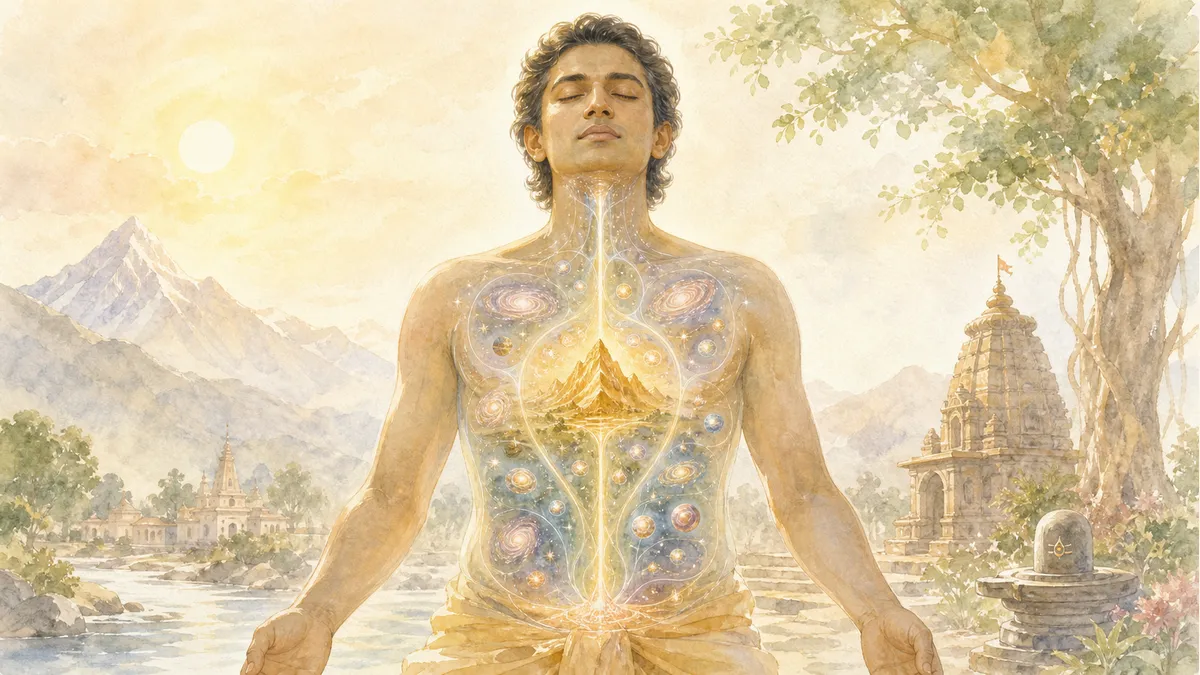
In one of the sutras it is said that a pore on the body of the Tathagata contains a countless number of worlds. At the same time, the worlds do not decrease in size, and the pore does not increase in size. How is this possible? It is possible because the body and the worlds are derivatives of consciousness, and consciousness can place billions of universes on the tip of a needle. At the same time, the universes will not become smaller, and the tip of the needle will not increase in size.
