

Commentary on the text by Namkhai Norbu Rinpoche “The Mirror. Advice on Presence and Awareness”
“A follower of the teaching shows an inadmissible weakness if he exchanges the sacred Dharma for worldly benefits and riches.
One who preaches lofty ideals but does not live according to them himself shows an inadmissible weakness. A follower of the Dharma shows weakness if he does not accept deprivation and comfort equally. One who, claiming to follow a religious path, is unable to be self-sufficient, content with his meditative consciousness, and who is unable to communicate properly with others, shows weakness.”
The book “Initiations and Initiates in Tibet”
If you have a weak spirit, then obstacles and illnesses can easily harm you. When we practice, we break away from the worldly, and there comes a stage when we have not yet become firmly established in the spiritual. Such an inexperienced practitioner may feel like a torn cloud, as if between heaven and earth. At this time he is very vulnerable and weak; he has, as it were, broken away from his roots but has not yet acquired wings.
As soon as you have understood this principle and moved into such presence, you become a different being. Until this principle is realized, you are studying the external Dharma. When the principle of awareness is realized, you become a practitioner of the inner Dharma.
“Self-liberation in terms of behavior absolutely cannot arise unless it is based on the presence of awareness. Therefore, if you fail to bring about the self-liberation of your behavior, then in this life you will not be able to overcome the separation between sessions of sitting meditation and your everyday life.”
What does the self-liberation of behavior mean in the absolute sense? It is the flexibility of consciousness manifesting outwardly. The ability to manifest such flexibility indicates your qualities as a monk.
The Story of Milarepa and the Teaching on the Natural State
Once Milarepa, after having killed twenty-eight people by magic, came to a Teacher who taught the natural state and spontaneous perfection. This Teacher said:
— My method is such that if you meditate in the morning, you become a buddha in the morning, and if you meditate in the evening, you become a buddha in the evening, because my teaching on the natural Mind is the pinnacle of all teachings. The path is equal to the fruit. If you are a fortunate person of the highest capacities, then you will realize the highest stages of the rainbow body already in this life and become awakened. What need have you for the lower paths?
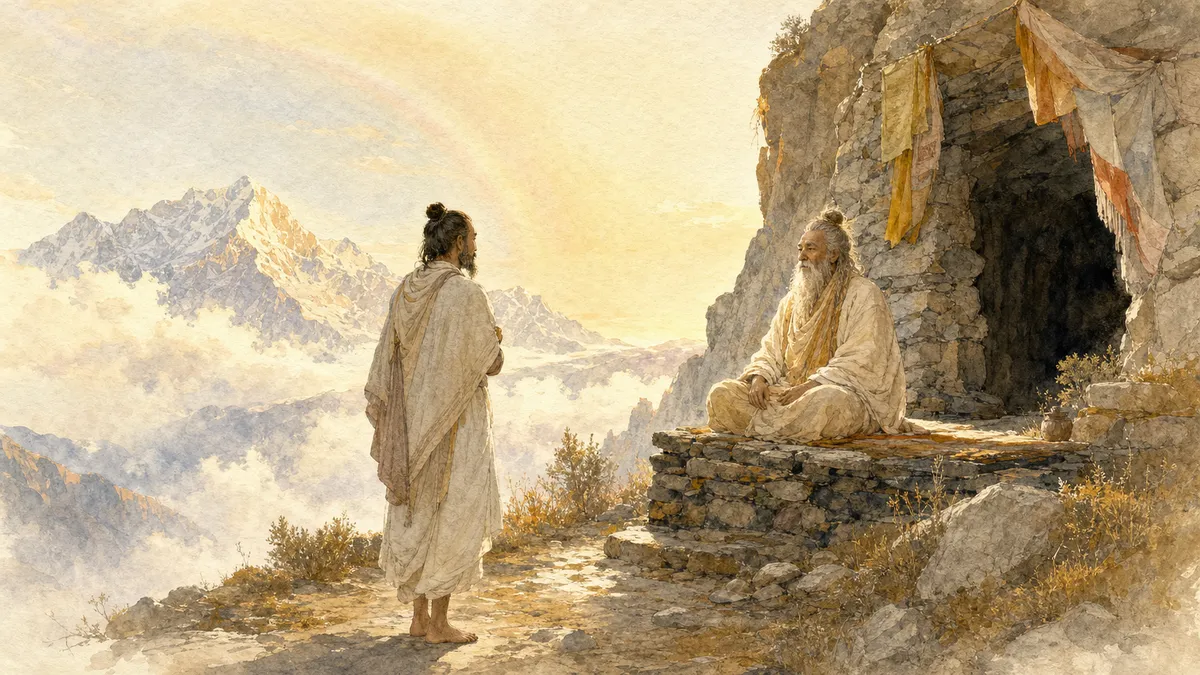
Milarepa was very pleased and thought: “A person of the highest capacities — that must be me. It took me only seven days to master magic, and my magic worked. It took me only ten days to bring a storm and hurricane down upon the village. Surely, I am exactly such a person of the highest capacities. That means this suits me.”
The Teacher then said to him:
— My method of the natural Mind is beyond meditations. Whether you meditate or not is unimportant, because here there is no need even to meditate. You only need to relax.
Milarepa listened to his instructions and went to meditate in a cave. He thought: “Since there is no need even to meditate, I will relax,” and during that time he slept. Some time passed, but no signs appeared.
The Teacher said:
— Strange; evidently you really are a great sinner. You have many obstacles, so the method of the highest teaching is not suitable for you. Better go to Marpa.
Marpa taught him the yoga of tummo, the yoga of light, and the yoga of dreams.
The paradox is that the realization of self-liberation can be achieved in a single instant and stabilized at that level, but if karmas and obstacles arise, this may stretch over several lifetimes.
The Importance of Applying Knowledge in Practice
“When self-liberation of behavior is spoken of, this may delight modern young people. But some of them do not know that the real basis of self-liberation is the presence of awareness. Many of them, even if they theoretically understand it a little and know how to speak about it, nevertheless still do not apply it. If a sick person knows perfectly the properties and effects of some medicine and can give any explanations about it knowledgeably, but still does not take the medicine itself, then he will never recover. In exactly the same way, since beginningless time we have suffered from a serious illness — susceptibility to the dualistic state.”
In India there was a school called “Kapalika.” It is one of the ancient schools. It was founded by a sage named Lakulisha, which means “the bearer of the club.” He constantly carried a club and a skull with him. This school developed two lines of conduct: one internal and the other external. In the internal line, they behaved according to their own rules. In their external behavior, practitioners of Kapalika tried in every possible way to provoke society; many of them behaved very defiantly: they bandaged their arms and legs, pretending to be cripples, behaved like madmen, snorted, babbled, made obscene gestures, uttered insane words, and dressed like madmen. By provoking people in society, they brought various anger upon themselves. Their goal was to call down as many misunderstandings and curses upon their heads as possible in order to test their principle of awareness and the extent to which they were attached to public opinion, to their own personality. Within their own community, however, they behaved quite decently.

The Principle of Harmonious Conduct
“For those who begin the practice, there is no other way of entering into practice except by alternating sessions of seated meditation with everyday life.”
However, when we speak of the principle of conduct, we mean that a yogin must be attentive in his behavior, like a newlywed bride entering the home of her husband’s family. This means that we try to maintain harmony in our behavior so as not to create obstacles in practice, and not to create difficulties for others or for ourselves.
Analytical Meditation on the Absence of “I”
“We have a very strong attachment based on logical thinking and the perception of the objects of our senses as truly existing, and even more so—to our material body of flesh and blood. When we mentally meditate on the ‘absence of self-nature,’ mentally examining our head and limbs and removing them one by one as not having a ‘self,’ we can finally state affirmatively that there is no ‘self’ or individual ‘I’ whatsoever.
In one of the analytical meditations, we examine our body in order to discover the absence of self-nature. We begin to reason: “What am I? If I am the body, then which part of it exactly? Perhaps the arm or the leg, the head, the blood vessels? Where does this very ‘I’ reside? With which part would I identify myself?” After some time, we see that there is an observer who is outside the body, and that we cannot identify ourselves with any part. That is, with the body it is more or less clear, since after examining it we understand that we cannot be located in a specific finger, in the chest, or somewhere else.
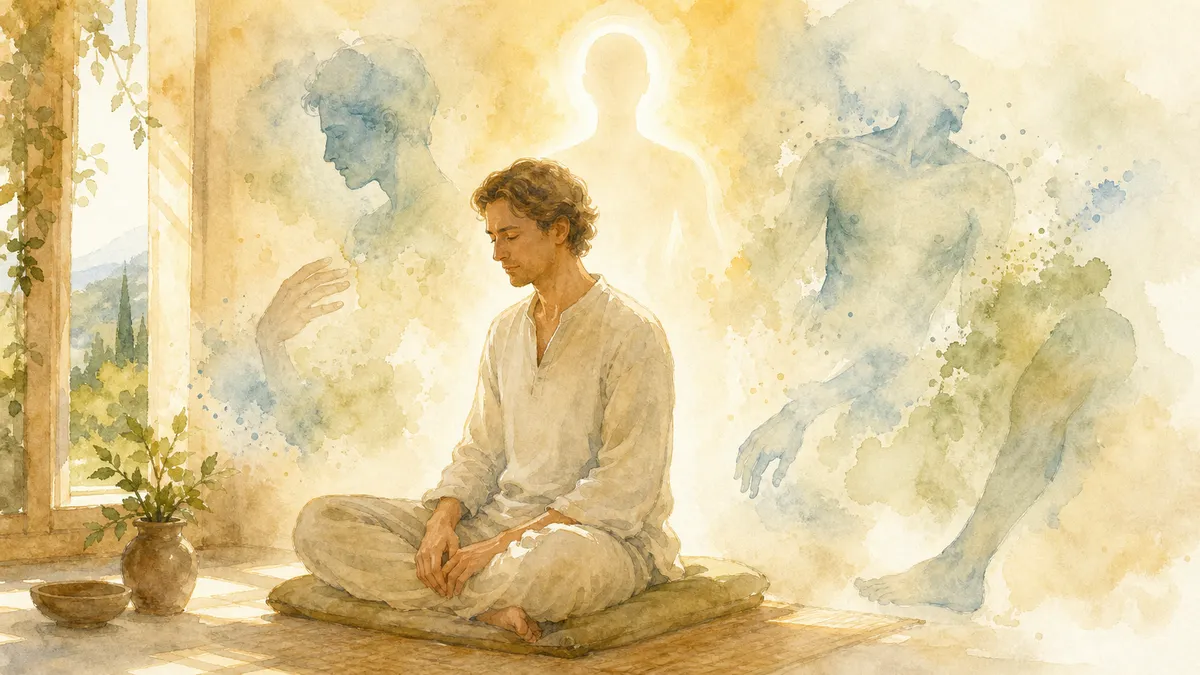
Then we begin to analyze feelings and emotions. Analyzing feelings, emotions, and sensations, we see that they are all transient, none of them lasts continuously, and we cannot say that this particular feeling or emotion is me.
After that, we analyze perception. If we try to find ourselves in vision, then our “I” disappears when there is no sight. If we try to find ourselves in auditory consciousness, then the “I” disappears when there is no hearing. Nevertheless, we remain as the witness (sakshi) when these consciousnesses are absent.
In the seventies, John Lilly invented the underwater samadhi tank. Water saturated with a saline solution is poured into an absolutely dark, airtight chamber, and a breathing tube is lowered into it. A person descends under the water and breathes through this tube. Thanks to the saline solution, the illusion of weightlessness is created. A person in this chamber, literally after four hours, begins to receive many diverse visions; he loses himself as a personality, even without knowing how to meditate. His body receives no tactile sensations, even the sensation of the body’s weight is lost. He sees nothing, hears nothing, smells nothing, and only breathes; he is like an embryo in the mother’s womb. Then subtle visions begin to appear to him. Thanks to this, if he is aware, he can enter the samadhi of the subtle body.
When you gain such experience, you understand that you are not bound to any of the perceptions. Then a clear understanding arises: “I am not this body; I was mistaken in identifying myself with the body.” Until such experience has been obtained, the absence of the nature of the “I” is merely intellectual knowledge. A person, of course, may proclaim: “I am not this body,” but when he steps on a thorn, he will cry out: “Ouch, ouch!”, forgetting that he is not this body. But when a sage abides in true realization, he is in the state of a child who does not know whether his mother fed him at night or not. Something was happening, but his consciousness is in a very deep state of presence, so he does not remember it clearly. If the principle “I am not this body” is realized, then this is called the state of “one taste” (ekarasa), when pain and pleasure are phenomena of the same order.
Self-Surrender as the Highest Method
“And although we good-naturedly discuss this very ‘absence of the nature of one’s own “I,”’ we may still be subject to a dualistic state, and the absence of the nature of one’s own “I,” so loudly proclaimed by our lips, has not yet become a state that is truly experienced by us.”
Why is it said that self-surrender and non-egocentric practice are the highest method? Because self-surrender erases our identification. You may not even have experiences of yoga techniques and so on, but if your “I” has been erased, then it has already been erased forever. It then has no need of experiences or of yoga. In order to need experiences, yoga, there must be an “I,” do you understand? And if it is not there, then there is no one to apply them. If you are not there, there is only the one Being and Consciousness. Therefore I always tell students that cutting off egoism is the very highest practice. From prapatti to self-recognition there is only one step.

Awareness as the Basis of Conduct
“As a result, it is necessary to consider the presence of awareness extremely important, for it is the basis of the method of self-liberation in everyday conduct.
In accordance with the various aspects of conduct, to which great importance has always been attached, diverse rules have arisen, established under the influence of the external conditions prevailing at a given time—religious rules and legal laws. However, there is a huge difference between observing rules by compulsion and observing them through awareness. Since all people are usually conditioned by karma, passions, and duality, very few observe rules and laws consciously. Therefore, whether people want it or not, they are forced to submit to a wide variety of rules and laws.”
When we practice rules of conduct, we say that their basis should be awareness. In other words, we consciously make a certain choice and are guided by it as spiritual training. Therefore there is a huge difference between accepting rules simply as such and accepting them in a state of awareness. If we want to be entirely without rules, then, most likely, this will be impossible; we will have other rules—worldly ones, depending on the environment in which we find ourselves. The question is not whether to accept or reject rules. The question is to be aware and to take responsibility for what you do.
There is one monk who, in worldly life, felt that any rules constrained him, that his awareness was constrained by absolutely everything. He even got to the point where he began to get angry at the world, at traffic rules, at the fact that one cannot cross on a red light. Everywhere he felt a challenge to his freedom. But if we accept the principle of awareness, we stop seeing a challenge to our own freedom. We see that our own freedom cannot be limited by rules if we accept them ourselves. In other words, if a person lives in the world, then it is his own choice. If he does not want to, he can go into the forest or into the mountains; there will be no human rules there, there will be spirits, tigers, cold—that is, there will be other rules there. He will not get away from them anywhere, even if he flies to Mars or somewhere else. There will be different rules there—the rules of material nature connected with the material body, or subtle rules connected with other beings. The question is that you understand what rules operate here and integrate with them, showing flexibility of consciousness and resourcefulness.

The True Understanding of Self-Liberation
“If the term ‘self-liberation’ is understood to mean that one can do anything one wants, then this is incorrect. This has absolutely nothing to do with what the principle of self-liberation means, and to adhere to such an erroneous view is to completely fail to understand what awareness means.”
Awareness and the maintenance of presence imply such flexibility of consciousness that they include everything, including the ability to accept certain rules and follow them if you choose such a decision, since true awareness can be hindered neither by the acceptance nor the rejection of anything in the external world. In other words, when we are born, we accept the karma and certain rules of this body. For example, the body has rules to take certain food or sleep for a certain amount of time. Whether we want it or not, these rules are rigidly imposed on us from birth, and we follow them, having accepted birth in a body.
The Difference Between Rules and Awareness
“But one should not forget the difference between the principle of laws and rules and the principle of awareness. Laws and rules are established under the influence of the circumstances of time and place; they operate by imposing conditions on a person through factors directed at him from outside. Awareness, however, is generated by the knowledge possessed by the person himself.”
When we practice awareness, we have an inner understanding of two truths: the principle of unconditioned consciousness and the principle of flexibility of mind in external behavior. When we combine these two truths, no contradiction ever arises between the inner “I” and external manifestations.
Freedom Through Awareness
“If you have awareness, then you can avoid compulsory adherence to rules and laws. In reality, this is exactly what happens. Moreover, a person who possesses awareness and constantly maintains it is capable of living in accordance with all the rules and laws in the world, while at the same time in no way confining himself within their framework or becoming dependent on them.”
Ordinary people are always conditioned by the laws of the material world. They are conditioned by the rules of their culture, civilization, lineage, and family relationships. It can be said that society drills people so that they become good beings, citizens, bringing benefit in the material world. In a relative sense, perhaps this is not bad. However, what is bad is that living beings completely fall under such conditioning. They absorb various values that are aimed not at liberation but, on the contrary, at bondage.

For example, in society there are common slogans connected with family relationships, with the cult of consumption, with military duty, with the need to defend the territory on which you live, and so on. All of this is in fact ideologemes or fetishes that nourish the consciousness of the individual from birth. Nevertheless, the individual is unconscious in relation to them; he is unable to oppose anything to these fetishes, and therefore from birth he completely falls under conditioning, since there is no alternative. However, one who possesses even a little awareness understands that all these things are so foolish that it is impossible even to speak about them seriously. If a person is aware, then from early childhood he is free from all social ideologies or fetishes. He either becomes a religious person, or an individualist and expresses his freedom through creativity, punk rock, social protest, and something else of that kind, or he becomes a hippie, a nihilist. In other words, he tries to get off the roadside, to step aside from the broad collective karma of humanity, to abstract himself from it. For example, in childhood I always wanted to become a hippie. Since I did not know that there were sannyasis or monks, I thought that by doing so I would at least somehow show what I thought about this whole world.
When we practice mindfulness, we become a kind of outsider to society. It is as if we are trying to die to society while remaining alive in the body. This means that we break with every hope of social fulfillment; we stop playing all the games connected with prestige, family relationships, career, progress, the cult of material consumption, so-called development, civilization, and everything else.
The horse of mindfulness and the whip of presence
“Many Teachers have said: ‘Drive the horse of mindfulness with the whip of presence.’ And indeed, if mindfulness is not urged on by presence, it will not be able to act.”
When our mindfulness increases, we understand that there is no need to express social protest, to become this or that. It all depends on how liberated you are within, in consciousness. Our behavior changes so much that it becomes very inadequate. We simply accept it as a practice of play. We do not even take the external material world seriously.
Therefore it is said that a true yogin always has several lines of conduct: inner, outer, secret, and transcendental. When presence develops in us, we simply follow the line of conduct that we have adopted and for which we bear responsibility. By and large, we understand that if our presence is strong, nothing can harm it. However, if presence is weak, it is very important to adhere to the line of conduct that is considered correct or that you have chosen.

The importance of steady practice
Suppose that if a person practices attentiveness in a monastery, it develops. However, if he is outside the monastery for three days, he feels that attentiveness weakens. When he is outside the monastery for a week or two, he feels that only “smoldering embers” of attentiveness remain. But when he is outside the monastery for three months, and he is an inexperienced practitioner, he feels that the dharma is something very interesting, but something that has disappeared for him.
This often happened to monks who did not remain in the monastery; they told me that the merits of the sangha last for half a year, and then maya takes its toll. Although they are not ordinary people and do practice, trying to see the world as an illusion, nevertheless this is very difficult.
When we become stable in contemplation, we generally cease to be dependent on external behavior or on the external world, because as a person we cease altogether to be connected with anything; only mindfulness becomes the basis of our behavior and our actions. Of course, such a person no longer has any worldly plans for self-realization or any attachments. He is like a transcendent, mystical being who, while living in the world of people, conceals his great deep consciousness.
A careful attitude toward mindfulness
The shortest way to develop mindfulness is, while remaining in conditions that do not scatter the spirit and consciousness, to nurture it day after day. We cannot afford to play with mindfulness or be frivolous. We should not subject our mindfulness to excessive strain, thinking: “It’s all right if I do something like that; at least I will train my mindfulness.”

This can be done only when mindfulness has penetrated into dream sleep and dreamless sleep, when samadhi has been realized. Then the true practitioner has gone beyond effort and beyond meditation. He can no longer be called a human being, because his mind and prana have united; he can extract the essential nectar from any situation.
When, however, we have only just grasped the principle of mindfulness, we should be very attentive and very cautious so as not to dissipate it. One should guard one’s mindfulness from external objects as from the five thieves, and become like a person walking along the edge of a sword or along the edge of an abyss.
