The Liberation of the Householder: A Dialogue Between King Janaka and Yogini Sulabha
02.08.2026
0 мин. чтения
0
Share
copy
search
add
share
Commentary on the text “Moksha Dharma,” Chapter 322.
This chapter begins with a conversation between Yudhishthira and Bhishma. Yudhishthira asks how one can attain liberation without abandoning the state of a householder, and what the supreme Self is. In response, Bhishma tells him about a conversation between King Janaka and the holy yogini Sulabha.
Laypeople and Brahmins praised King Janaka’s virtues, for he had attained liberation and, having subdued his senses, continued to rule his kingdom. At that time, Sulabha, a mendicant sannyasini who observed her vows, was wandering about and heard of his outstanding qualities. Other sannyasins likewise praised Janaka, the king of Mithila, for his striving toward liberation, but as she listened to them, she doubted it.
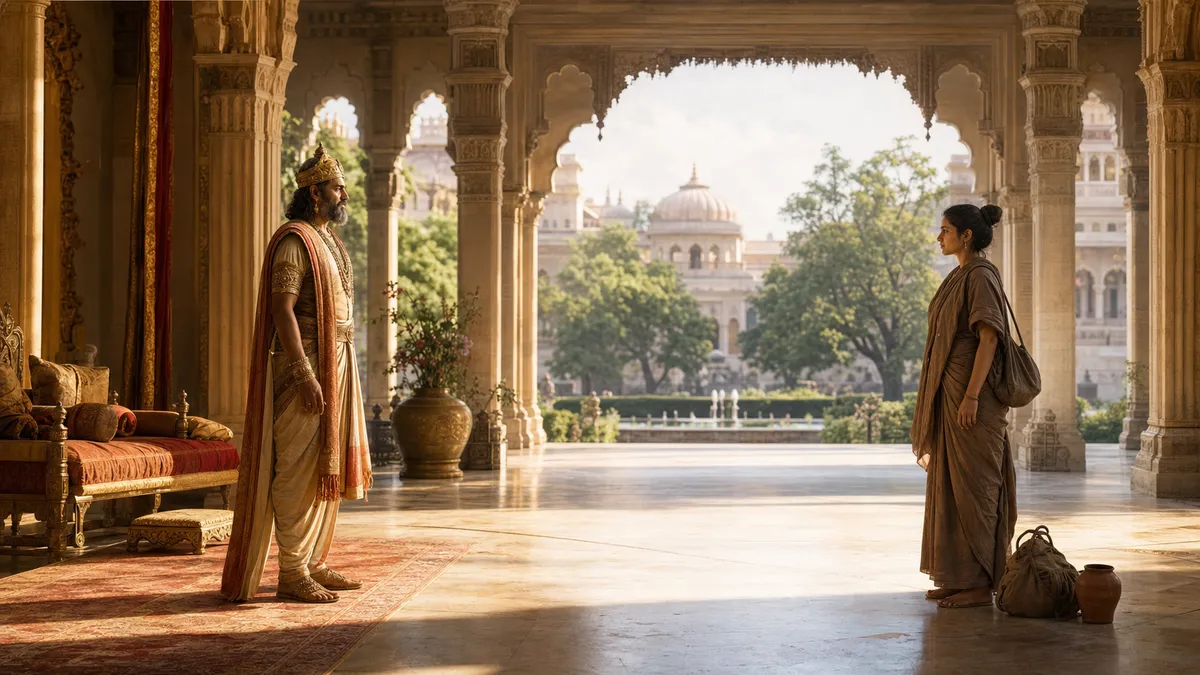
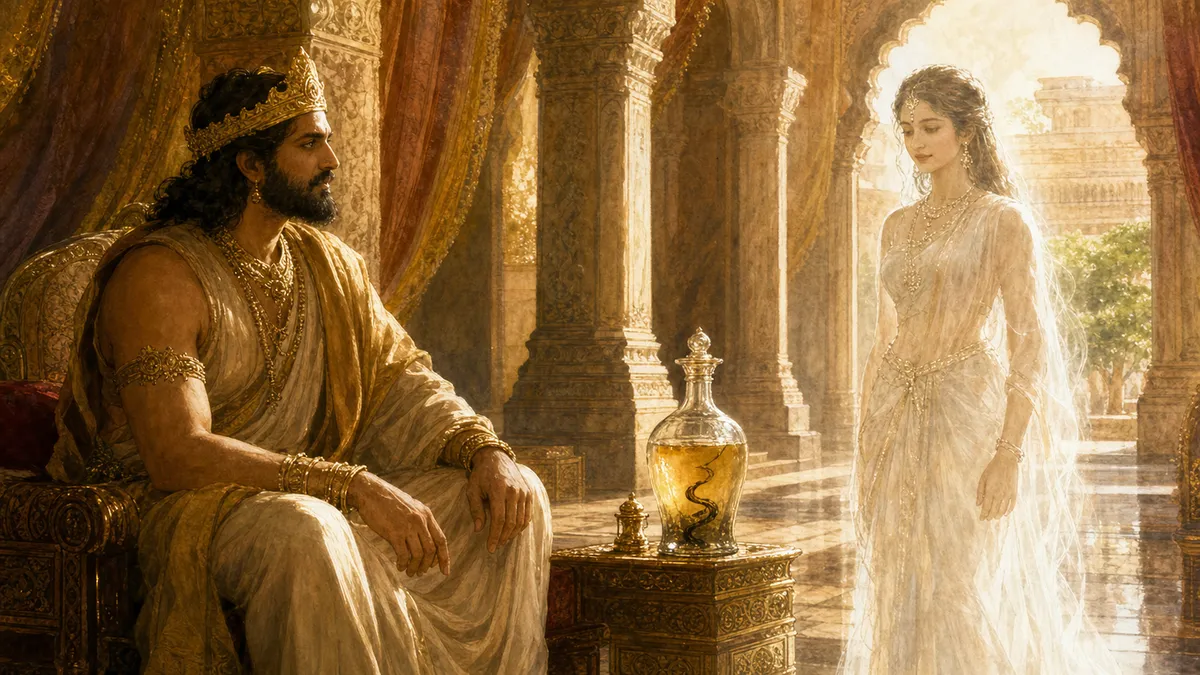
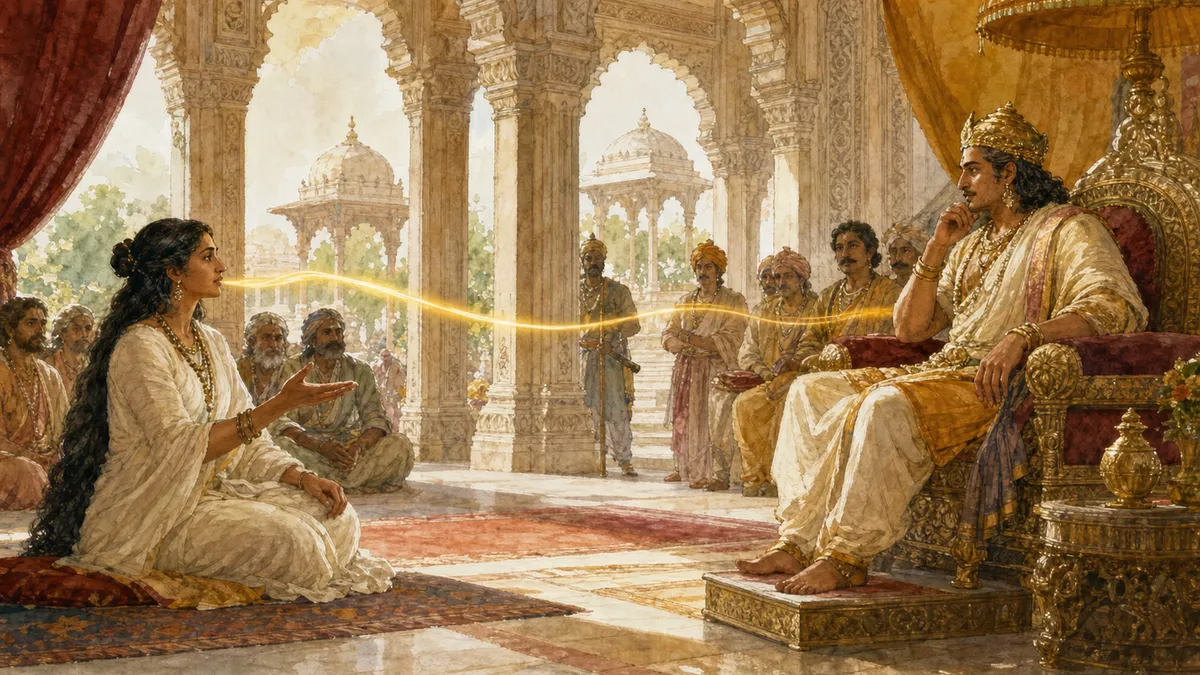
She wished to meet Janaka. To do so, she left her physical body and assumed the illusory form of an exceptionally beautiful young woman. When Janaka saw her, he was delighted by her and invited her to the palace. There he treated her to delicacies and began asking her various questions. Wishing to test King Janaka, Sulabha used the power of her yoga to enter his body and subdued his consciousness with her radiance. To overcome her power, Raja Janaka responded with a smile by enveloping her power with his own. Then he began asking her the following questions.
King Janaka’s Discourse on the Path to Liberation
Janaka said:
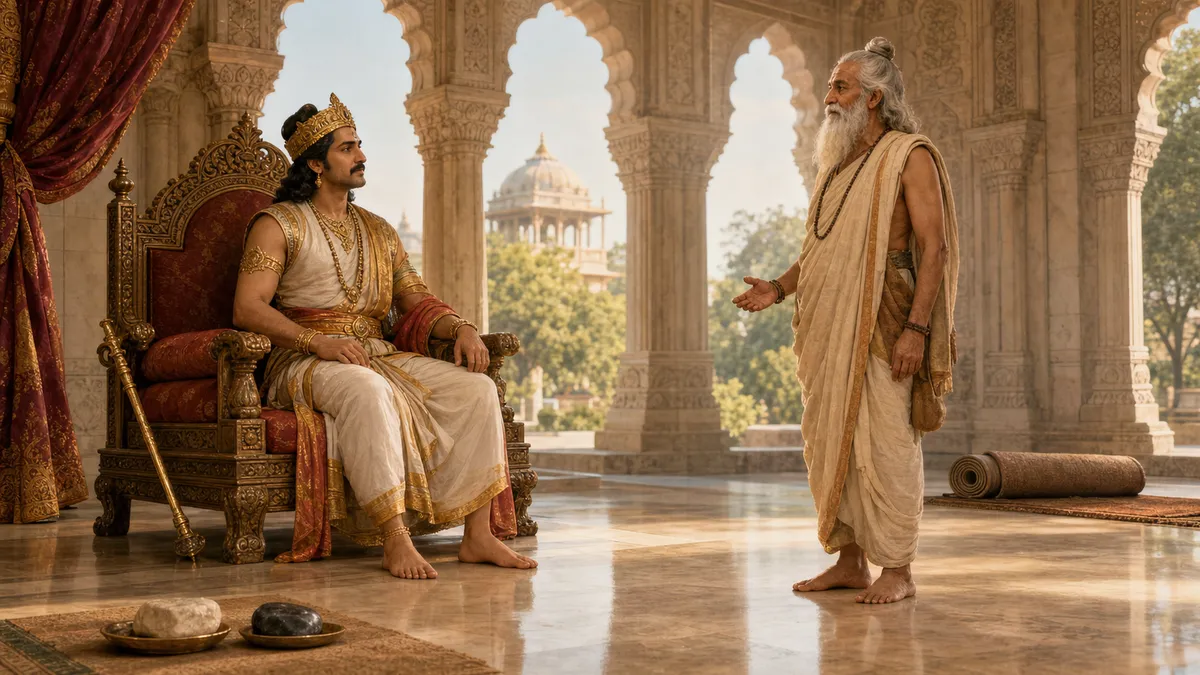
“Whence have you journeyed, lady, and where are you bound? Whose daughter are you? Where do you come from?” Thus the lord of the earth questioned her. “Indeed, I know nothing of your knowledge of the Shruti, your age, or your birth. Therefore, now that you have met me, tell me of these matters. Know that I have truly set aside the parasol and the other royal insignia so as to honor you. You are worthy of respect, and I shall show you respect. Listen also to me concerning the one from whom I received this outstanding and supreme knowledge, taught by no one else, and concerning liberation.
I am a disciple, highly esteemed by him, of the elder Panchashikha, a descendant of Parashara, the greatest mahatma and mendicant wanderer. I have become proficient in the duties of a protector of the earth, in the teachings of Sankhya and Yoga—in this threefold foundation of liberation—and have dispelled my doubts. Wandering his own path in accordance with the teachings of the shastras, Panchashikha happily spent the four rainy months here. From him, the head of the Sankhya school, who possessed excellent insight into the subject and the foundations of the doctrine, I comprehended the teaching of the threefold foundation of liberation, although I did not renounce my kingdom. Thus, free from passion, I fully follow this threefold conduct leading to liberation while remaining upon the same throne.
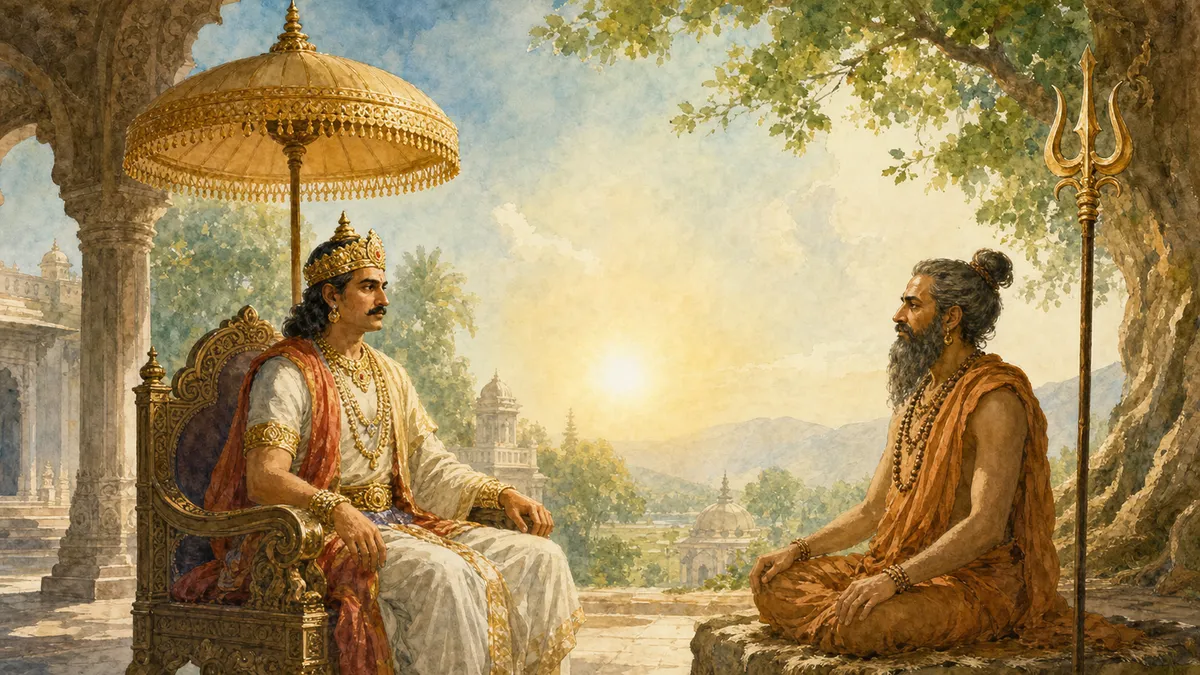
I repeat: the supreme law for this liberation is dispassion. Dispassion, indeed, arises from knowledge, and knowledge liberates. Through knowledge, effort is made; through effort, the great is attained; the great frees one from contradictions—this is the perfection that draws us out of samsara. I have attained such supreme understanding, free from contradictions: I wander here, as it were, having banished delusion and freed myself from attachments. Just as a field softened by abundant irrigation brings forth a crop, so deeds performed in the past lead people to repeated births. Just as grain roasted in some vessel does not sprout even when given the opportunity to do so, because it has lost that property, so too that mendicant wanderer, O ruler, whose name derives from flame, destroyed through the knowledge imparted to me the seed of my capacity to pursue objects. He feels no passion for either the desirable or the undesirable; and he feels no passion for them because both attraction and aversion are futile. If my right hand were anointed with sandalwood and my left hand were cut off, I would remain the same. I am that blessed one who has attained the goal, to whom gold, earth, and stone are equal; free from attachments, I nevertheless remain upon the throne, unlike other bearers of the trident.”
Three Views on Liberation
“Among the time-honored teachings on liberation, there are three views of liberation. Considering knowledge and detachment from all actions to be the highest things in the world, some people versed in the scriptures on liberation preach the doctrine of knowledge (jnana). Other ascetic mystics preach liberation through action, karma. Aloneness (kevala) is the abandonment of both action and knowledge; this third view is taught by that mahatma. The attitude toward self-restraint (yama) and the observance of vows (niyama), toward lust, hatred, acquisitiveness, deceit, pride, and affection is the same among mendicants and householders. If those who bear tridents and other sannyasins are liberated through knowledge, then why should there be no liberation for those who bear parasols and other royal insignia, since their goals are the same? Whatever reason a person has for performing actions here for the sake of his goal, in accordance with his goals, so too does he relate to objects.”
King Janaka says here that he follows the dharma of the inner path, the dharma of the single “taste,” detachment, and awareness, attaching no importance to any external attributes. He emphasizes that what matters is not the external attributes themselves, but the meaning with which we endow them. He says: “If you hermits carry a trident, regarding it as a symbol of liberation, that is merely a meaning with which we endow things. And if I carry a royal parasol, why can it not liberate me if I endow it with the same meaning? After all, everything depends on consciousness.”
The Teaching on External Signs and True Liberation
“One who, considering the householder state blameworthy, passes to another stage of life, abandoning one stage and moving to another, is not yet free from attachments. Since a king and a mendicant wanderer exercise equal authority in punishment and reward, why should they not be equal in liberation? Since their true sovereignty here lies only in knowledge, through it they are freed from all evils while abiding in the supreme body. Garments of matting, a shaven head, a trident, and a bowl are secondary things; they do not liberate a person, as I see it. If these are merely signs, and the true cause of liberation here is knowledge, then signs by themselves are useless for complete liberation from suffering. And if external signs are deemed important for the removal of afflictions, then why should a parasol and other royal insignia not be considered suitable, since the goals are the same? The absence of possessions is not yet liberation, and possessing property is not yet bondage. Neither the absence of possessions nor its opposite, but knowledge alone liberates. Therefore, in pursuing what is lawful, beneficial, and pleasant, in retaining royal power—within these things that contribute to bondage—there is something that stands above them. I have severed the bonds of sovereignty, kingship, and worldly attachment with a sword sharpened on the whetstone of liberation—this is how I became liberated.”
Exposing Yogini Sulabha’s Subtle Kleshas
“Now I wish to know about you, mendicant wanderer. Your appearance does not correspond to your purpose; listen to me, and I shall speak of this. Lady, your wondrous beauty and your maidenly appearance—all this you possess, but whether you possess self-restraint, I doubt. Here is the sign that your conduct does not correspond to your appearance: you secretly entered my domain to discover whether I had attained liberation.
For a yogi tainted by lust, there is no benefit in a trident. You have not observed the law that one who is fully liberated should preserve one’s proper appearance.”
Having justified his position, King Janaka, from the standpoint of awareness and self-liberation, points out to Yogini Sulabha the subtle lust that, as it turned out, was in her mind, as well as the curiosity and envy that brought her to his palace and the desire to test whether he was liberated or not. He says that even if you carry a trident or wear garments of matting, if you are driven by subtle inner desires, all of it is useless.
Reproaches for Violating Dharma
“Listen to what transgression you committed by coming to my country. You willfully entered my ancestral domain. Why did you come to my kingdom? To my city? By whose permission did you enter my heart? You belong to the foremost varna, you are a Brahmin woman, while I am a Kshatriya; do not bring about a mixing of the varnas: we must not unite. You live according to the law of the liberated, while I am a householder. This is your second, very grievous transgression: you are mixing the stages of life.”
Through her yogic power, the yogini entered his body in her subtle body. The king did not like this and reproached her for having done so without his consent. Moreover, they belonged to different stages of life: he lived the life of a householder, while she was a mendicant nun. He pointed out that it was improper for them to mingle their energies in this way, since they belonged to different statuses.
We often say that monks should not mingle with laypeople, just as laypeople should not mingle with monks. This does not mean that we claim laypeople are impure and monks exalted. Both statuses must be treated with respect, but it is important that they not be mixed. When different energies mingle in a disharmonious way, various obstacles arise from it.
“Whether we are of the same lineage or not, neither you nor I know. By entering a man of the same lineage, you have committed a third transgression—incest. Perhaps your husband is alive and has merely gone elsewhere. ‘Do not enter another woman’s husband’—such is the law; this is the fourth violation of the law. You have done these things for some purpose out of ignorance, wanderer, or merely to display your knowledge. Moreover, you are corrupt in your principal duty; if you possess any knowledge of the shruti, it has now become fruitless. Here is yet another, third reproach: you have touched my essence; the signs of a wanton woman are visible in you, and you display them openly. You intend not only to triumph over me alone; you have set out to overcome all these people surrounding me! Indeed, you have directed your gaze toward these venerable persons in order to cast down my position and elevate your own.”
Janaka says: “Besides this, you came in the guise of a seductive young woman, wishing to enchant me. You are attempting to do this in order to establish your superiority and humiliate me in the eyes of my courtiers.” All of this is a form of egoistic striving, of kleshas. With his discernment, he points out all these subtle states of this female yogini.
Practice as a Mixture of Nectar and Poison
“Blinded by delusion born of your own anger, you continue to act through the power of yoga—a mixture of amrita and poison. For women and men who desire one another, attainment is like amrita, while failure to attain is like poison to the lover. Do not stray from righteousness! Abiding by your own law, be wise! Your desire to know whether I am free or not has indeed been satisfied. There is no reason to conceal all these secrets of yours from me. Whether you are here on your own business or on that of another prince, tell me the truth. You have no reason to hide from me under another guise—with deceit one must never approach a raja, a brahmin, or a woman endowed with feminine virtue: one who comes with deceit invariably causes harm.”
Janaka recognized the stratagems of the yogini Sulabha. He realized that she had not come in a real body, but in an illusory one. And he tells her that it is improper for practitioners to behave in this way. He assumed that her actions were caused by subtle residual karmas of lust, envy, and anger, and therefore called her practice a mixture of nectar and poison. Dharma is the nectar that we put into practice. However, while the kleshas have not yet been pacified and continue to act like poison, practice often consists of both nectar and poison until the kleshas are subdued. The king says that her practice is in fact not yet profound and is a mixture of kleshas and the nectar of Dharma.
“Royalty is the power of a raja; Brahman is the power of one who knows Brahman; beauty and youth are the great power of women blessed with good fortune. By these powers, the strong person who strives toward their goal approaches honestly, having destroyed falsehood. Therefore, you should truthfully tell us about your birth, your knowledge of the law, your status, your nature, and the purpose of your coming.”
Bhishma said:
“Though greeted by the lord of the people with such merciless, hostile, and unfriendly words, Sulabha was not disconcerted. In response to what the king had said, Sulabha, with an enchanting appearance, then began to speak enchanting words.”
The Teaching on Right Speech
Sulabha said:
“Nine and nine flaws that corrupt speech and understanding must be absent from speech that is purposeful and endowed with eighteen qualities and five conditions of expediency, O king: subtlety, judiciousness, coherence, and clarity of reasoning and conclusions—such speech should be called rational. Listen to the signs of these requirements—subtlety and the rest—in the concept, in the word, and in the utterance of the word. If knowledge of various objects of cognition unfolds in different ways and the discerning intellect, buddhi, prevails throughout, this is considered subtlety of speech. If the qualities and shortcomings under examination are properly arranged and appropriate examples are given, this is considered judiciousness of speech. Taking into account what should be said first and what afterward concerning the subject under discussion is called coherence in the construction of speech by those skilled in eloquence. If, when reasoning about what is right, desirable, and beneficial, one concludes, ‘That is indeed so,’ this is called clarity of conclusions. If the arising of passion caused by attraction and aversion is revealed, and it is shown how inclination determines behavior, this is called the justification of actions. All that has been enumerated—subtlety and the rest—O king of the people, is directed toward a single purpose in my speech; understand this. I shall speak words that are purposeful, rational, not overly extensive, not aimed at sowing discord, not flattering, not wavering, but resolute; words unencumbered by awkwardness, directed toward happiness, not avoiding the three divisions (what is right, desirable, and beneficial), not devoid of elegance, free from falsehood, not empty, not arrogant, without foul language, requiring no additional explanation, not lacking proof of meaning, free from lust, unworthiness, despondency, greed, fear, and anger. Under no circumstances shall I speak timidly, dejectedly, or proudly. When speaker and listener are not at odds, O king, and the statement is complete, the meaning of the conversation is revealed. But when the speaker addresses the listeners without respect, speaking only for his own benefit while disregarding the benefit of others, the conversation fails. Or when a person speaks only for the benefit of others while disregarding his own benefit, he gives rise to doubts about his sincerity; such speech is also flawed.”
As Sulabha begins to speak, she demonstrates tremendous clarity regarding speech, conversation, logic, and other matters, indicating her astonishing power of presence. In other words, during the conversation she is in a very deep state of contemplation, which enables her to display such clarity.
Samkhya Philosophy on the Nature of Perception
“And whoever speaks in the interests of both, O king, without revealing any discord between listener and speaker, is eloquent, and no one else. Listen attentively, O king, to these purposeful words. Just as wood and lac, or drops of water and dust, adhere to one another, so too is the coexistence here of living beings, O king, sound, touch, taste, form, smell, and the five indriyas; like wood and lac, respectively, they adhere to one another, but there is no communication between the indriyas—this is entirely certain. The senses have no capacity to know either themselves or the other senses: the eye does not know the faculty of sight, the ear does not turn toward itself, and yet they do not transgress their boundaries or merge with one another; nevertheless, though unaware of it, they are intermixed with one another like water and dust. They are directed toward the qualities (gunas) of other, external objects; listen to this. Form, the eye, and color are the three causes of vision. Just as objects of cognition here act jointly with the other causes of cognition, so too is the highest quality (guna), called manas, directly connected with cognizing and cognition.”
Having learned that King Janaka is a disciple of the sage who founded the Samkhya school, the yogini Sulabha begins her conversation with him by explaining the principles of Samkhya philosophy as she understands them.
The Thirty Properties of Being According to Samkhya
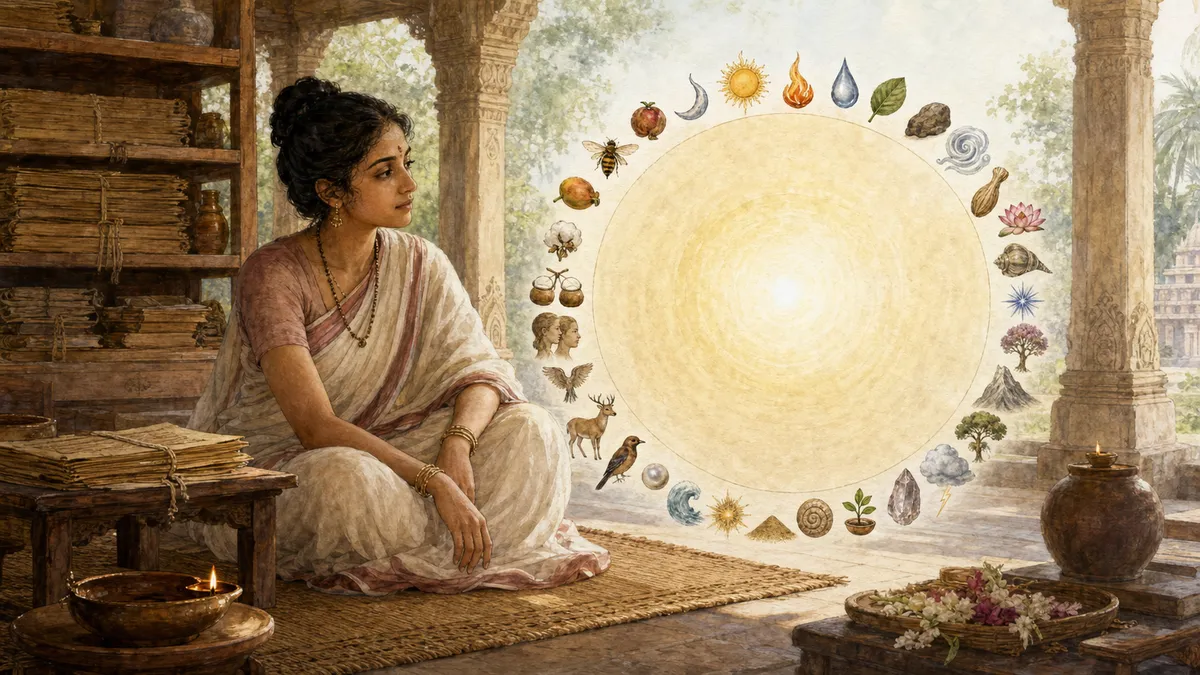
“To determine what is righteous and what is unrighteous, that which is regarded here as the twelfth and highest quality, called buddhi, comes into play. It resolves the doubts that have arisen concerning the object of knowledge. Then, above this twelfth quality (guna), there is a quality called sattva. A person, in essence, is defined by the abundance or scarcity of sattva. ‘I am the doer’—this is the name of yet another, the fourteenth quality. ‘This is mine,’ ‘This is not mine’—that is how this quality is defined. Then, above it, the fifteenth quality, rajas, is counted. It joins separate parts and is therefore called the aggregate. Then, above it, there is the sixteenth quality—union. Prakriti and the manifest (vyakta) are the names of two qualities that permeate one another. Happiness and unhappiness, death and old age, pleasant and unpleasant, success and failure—such is the nineteenth quality, which is considered duality. Above the nineteenth there is yet another quality, named Kala (time). The arising and destruction of beings, know this, constitute this twentieth quality. This twentyfold aggregate, together with the five gross elements (bhutas), exists. There are also two paired qualities—being and non-being. Such is the group of twenty. To this should be added the combination of the seven qualities already mentioned and the final three qualities: regularity (vidhi), generation (shukra), and strength (bala). Thus the count comes to twenty and ten—thirty; all the qualities have now been enumerated.
That in which they all abide together is called the body. Some see the first cause of these parts in unmanifest Prakriti. Others, dull-witted, take manifest nature to be their cause. Yet those who contemplate the inner Atman regard either the unmanifest, or the manifest, or both together, or the fourfold principle as the first cause of all beings. Owing to such a cause, unmanifest nature comes into manifestation in these thirty divisions.”
Analysis of the Samkhya Categories and States of Consciousness
Thus, this yogini enumerates here the principal categories of Samkhya while analyzing the states of the body. Proceeding from the state of the body, she gradually brings her analysis to consciousness and begins to examine the king’s questions from the standpoint of Samkhya and the categories of consciousness, as well as to answer them.
She says that everything in this world is continuous. Who, then, comes from where, or does not come from anywhere? Whose is this one or that one? From where does this one come, or does he come from nowhere? And what connection exists between beings or between the limbs of a single body?
She says that all beings are born from the combination of these thirty parts that she has enumerated, and therefore you behold yourself within yourself, through yourself. She says: “You also behold the Atman within yourself. Why, then, do you not behold that Atman in another? And if you see the Atman both in yourself and in another, why do you ask me, ‘Who are you? Whose are you?’ What kind of questions are these for one who is liberated?”
She says: “‘This is mine; this is not mine.’ O king, should one who is liberated from duality ask questions in this way? And what sense is there, then, in asking who you are, whose you are, and where you come from?”
She goes on to tell him:
“You are bound, O lord of the earth, to enemies, friends, and neutrals, to war, truce, and victory; what signs of liberation can there be in this?
What signs of liberation can there be in one who, while acting, cannot discern the threefold aim and is attached to that threefold aim? Therefore, you have no share in liberation; O king, this delusion of yours ought to be dispelled by your friends: for one who is impure, there is no cure. Having considered every possible state of attachment, O ruler of enemies, one must seek the Atman within oneself; can there be any other sign of liberation?”
The ascetic woman says that he has been premature in claiming liberation. That is, one must carefully reflect upon and examine the aspects of one’s consciousness and diligently continue seeking the Atman.
The Limitations of Royal Power
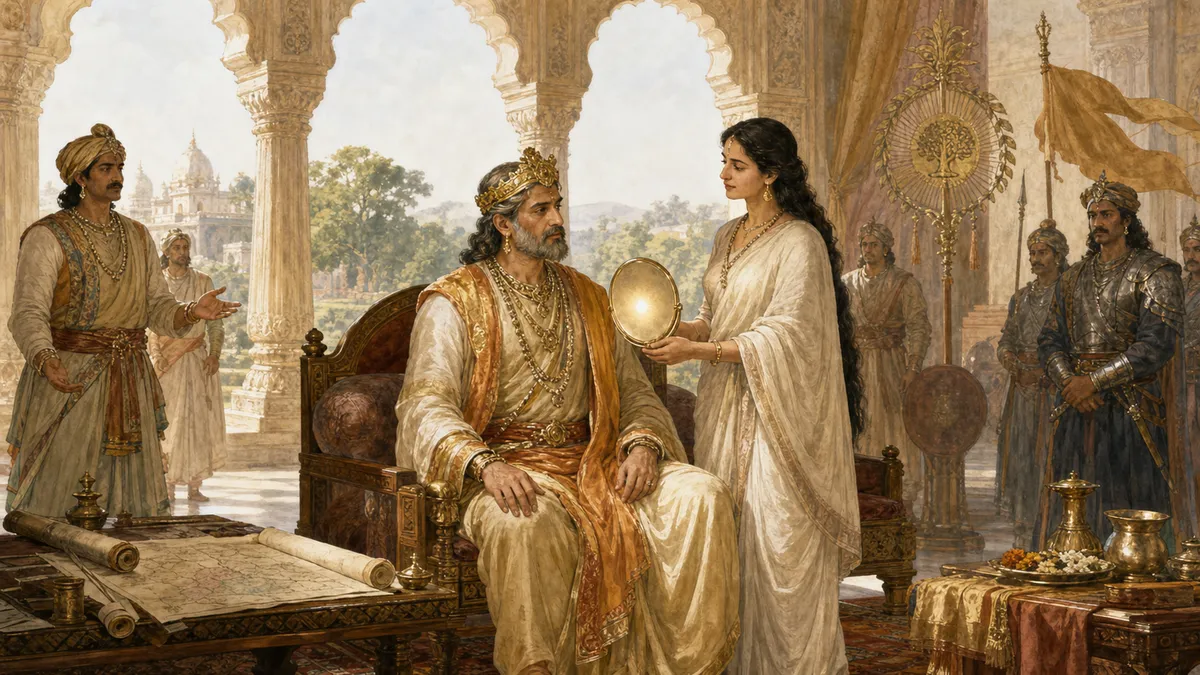
“Speaking of liberation and of these and other subtle connections arising from fourfold qualities, listen. Even one who sees this entire earth beneath a single parasol can still dwell in only one particular citadel, O king. And in that citadel he resides in one particular house, and in that house at night he lies upon one particular bed. Yet his wife has already occupied half of that bed before him. Thus, he can enjoy the fruits of his power only within such limitations. The same may be said of sensual pleasures, food, clothing, and the limitations imposed by the qualities of punishment and reward. A king is always dependent on external things even in minor matters, all the more so with regard to war or peace; where, then, is a king to find independence? In repose and amusement with women he is always dependent—where is his independence in conversation with a friend, in counsel? They say that his independence lies in commanding others. But even here, at every moment, he must act against his own will: wishing to sleep, he cannot fall asleep because of the people carrying out his orders. Even if he allows himself to doze off on his bed, he must wake against his will. ‘Perform your ablutions and make an offering,’ ‘Having made a libation to Agni,’ ‘Eat, drink,’ ‘Speak,’ ‘Listen’—thus others compel him to act against his will. People constantly come and come to him with requests, yet he is unable to bestow gifts even upon great men while safeguarding the wealth of the state; by giving, he depletes the treasury, and thus hostility toward generosity arises in him. Troubles that cause aversion to kingship instantly close in around him. He grows suspicious of a sage, a rich man, or a military commander, even when they have no supporters and stand alone; but if he does not fear them, he begins to fear those who constantly praise him.”
Sulabha says that the king is constantly immersed in limitations: he is compelled to conduct negotiations, make offerings, perform ablutions, and interact with a multitude of people. He does not belong to himself, but to the state, his advisers, and the people—all this can hardly be called liberation. This is a very subtle question that depends on one’s level of awareness.
She says: “You are not free from the sorrows of the heart or from desires as they arise; you are torn by various contradictions, yet you still cling to your coveted kingdom. ‘This is mine’—thus you think of the palace and the kingdom. But the military forces, the treasury, the advisers—whose are they? Or do they belong to no one? The allied council, the palace, the state, the military commander, the judge, the ruler of the treasuries and lands—now one, now another comes to the fore at one time or another.”
Critique of False Liberation
Thus, she discusses the king’s position and says: “How can the supreme law of liberation be present here when there is such conditioning? I, however, have no attachment to my own body. Why, then, would I need another’s domain? You reproach me for entering your domain and your body, but it is not fitting for you to speak to me in this way; perhaps you did not hear the whole teaching on liberation from your teacher. You probably did not fully hear what he taught you. Having understood liberation, how did you become caught in the net again? How did you bind yourself to the parasol and the other emblems of royalty? Either you listened without hearing, or you misunderstood what your teacher taught you. Or perhaps you attended only to the teaching’s outward form while inwardly listening to something else. Be that as it may, you remain bound by worldly notions, and your mind is entangled in attachments. How could the entry of the subtle body that I performed have harmed you if your mind were entirely free? If there were emptiness in your consciousness, I would have entered emptiness—so whom would that have harmed? And why would you reproach me if your consciousness were truly empty? I touched you neither with my hands nor with my feet nor with any other part of my body, and you should not have spoken as though I had attempted to commit some lewd act or seduce you. You have lost the state of a householder, yet you still have not attained liberation, which is so difficult to attain. You are circling between two stages of life, striving to become free.”
Sulabha’s Origin and Purpose
Regarding the varnas and castes, she said to him: “I am not of the highest Brahmin caste, nor am I a Vaishya or of lowly birth; I am of your caste. I come from a lineage of rajarishis (that is, of King Pradhana, the saint), and my name is Sulabha.” She names her ancestors: Drona, Shatashringa, Chakradvara, and Parvata. She says that she was born into this lineage but did not find a worthy husband and therefore entered the path of liberation, wandering alone and observing the vows of a silent female ascetic.
“I did not come in another’s guise, nor did I take what belongs to another; I do not confuse my dharma, and I am firmly devoted to my own dharma. I hold steadfastly to the decision I have made and do not speak rashly. I did not come to you without purpose, O king of the people. Having learned that you had attained liberation, I sought what is good; I came here to discern your understanding of liberation. I do not speak as an adherent of any doctrine, either for my own benefit or for another’s, nor do I seek to determine who is untranquil, who seeks tranquility, or who is free. Just as a mendicant wanderer spends one night in an empty house, so shall I remain this night in your body. Honored with tokens of respect, kind words, and hospitality, I shall sleep in a good refuge and, content, depart tomorrow, O Mithilan.”
Bhiksha said: “Having heard these thoroughly well-founded and reasonable words, the raja could find no further objections.”
Liberation
Atman
Moksha
Janaka
Detachment
Moksha-dharma
Sankhya
Sannyasin
Author Гуру
Read 18 times
Articles
Vidya AI
Search
Lectures
November 4, 2026
Mantra of the day
ОМ СИДДХАЙА НАМАХ ОМ Совершенному – поклонение!
Auspicious Times(Rome)
Brahma Muhurta:
04:55 - 05:50
Abhijit Muhurta:
11:33 - 12:14
Sayam Sandhya:
16:41 - 17:23
Mokshada Ekadashi (6 November)
Ekadashi of liberation. Helps to achieve spiritual enlightenment.