

The life of a sadhu unfolds in practice and reflections on God, on divine truth, and on the spiritual path. The entire life of a sadhu revolves around such things. It is unthinkable for a sadhu not to think of God, of the Absolute, at every moment. If he does not think in this way, does not direct his mind, then, of course, he is not a sadhu. This is the main difference between a sadhu and people who are not sadhus.
A sadhu is a person who lives in search of divine wisdom, divine truth, whatever it may be called. A sadhu is occupied with nothing else, inwardly, at least. Outwardly he may engage in various things, even things that resemble the occupations of worldly people. As long as there is a body, there is also a certain prarabdha for that body, but inwardly a sadhu differs very greatly from a worldly person: he constantly strives to direct his mind toward God.
Those sadhus who have succeeded in this live continuously in God, continuously abide in the divine. Indeed, they live as if in play; nothing in the external world disturbs them, they expect nothing from the material world, they have fully understood its nature, they expect nothing from relationships with other people, they have no ambitions in this world. They simply play, carrying out the Divine will and helping others realize divine truth, but inwardly they are in a very deep, sacred, holy state. Therefore their life is full of joy, love, harmony, and compassion. They have neither inner turmoil nor any conflicts with others. Others may have conflicts with them because of their conditioning, but the sadhus themselves have no such aspect.
A sadhu lives in such a way that he always relies on the Absolute, on the divine. Such hope, trust, and support is called Ishvara-pranidhana. Ishvara-pranidhana, along with other qualities, is one of the qualities of the niyama code. Shaucha, santosha, tapasya, Ishvara-pranidhana — these are all principles of yama-niyama that every sadhu follows.
The Labyrinth of the Soul’s Preferences
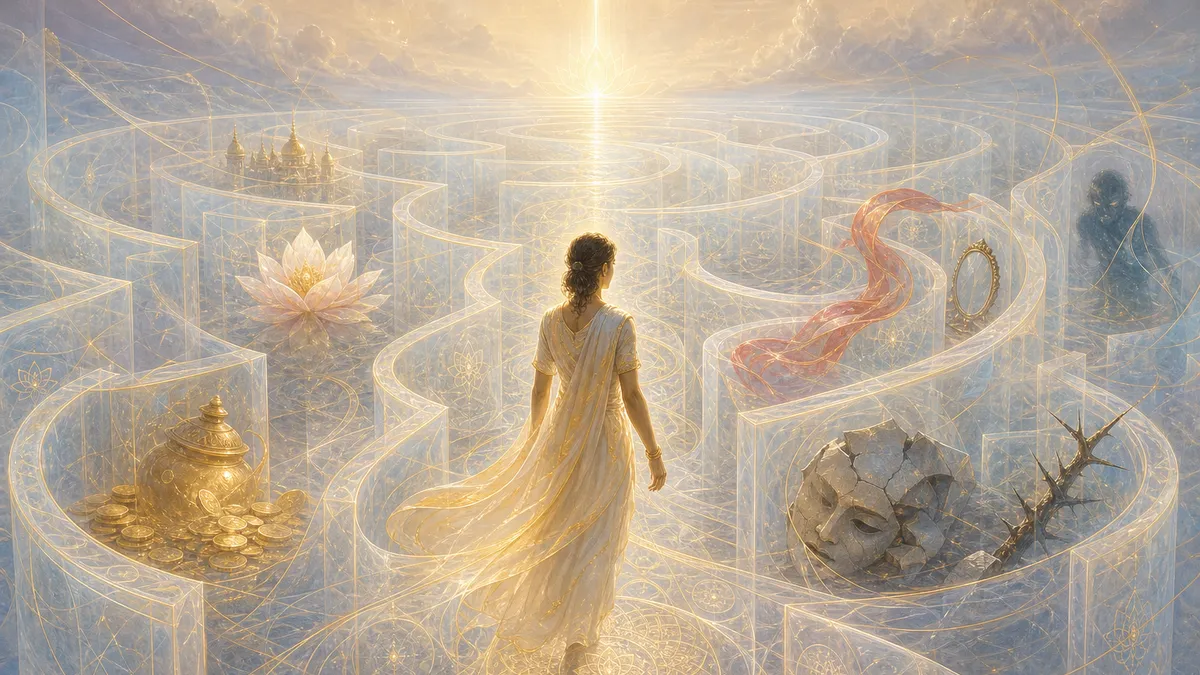
But it often happens that our desires, our mind, our preferences compel us to love one thing and hate another; to seek one thing and reject another without abiding in God. To seek the fulfillment of one’s own will and not to seek the fulfillment of God’s will — all this is the labyrinth of karma, the labyrinth of the soul’s preferences, its choices, assessments, and judgments.
Vasanas and samskaras are such inner preferences of the soul, coming from the distant past. We have accumulated a great many such preferences. Someone preferred to be rich, and this remained in the form of traces, in the form of imprints, and in this life the vasanas push him: wealth, wealth. He does not even know why he needs wealth; he knows that he needs wealth. Once, in past lives, his soul made certain promises to itself: I will always be rich, I will not be poor.
And someone seeks happiness in family relationships — these too are preferences of the soul, vasanas and samskaras. At some point he generated great energy, gave himself the resolve to be in a family, to be protected, to be loved, to be harmonious, to have a family: I must have a family, I must have children, I must feel good in this, and this is my happiness. All these are different preferences of the soul; they are based on choices and promises made in the past.
The soul of every person is seized by such preferences, and it strives to fulfill them, but all this is a kind of labyrinth in which it wanders, as an inexperienced traveler wanders at night in the sands, in a dense forest. Some preferences are exhausted, in some things it becomes disappointed, it begins to seek other preferences, and it begins to seek the fulfillment of its own will so that these preferences may be fulfilled — all these are labyrinths of preferences. These are old accumulated notions of the mind, and it is they that enslave the soul; they form the karma of the soul.
Those preferences that can be fulfilled right now, right here, easily, when the situation is favorable, are prarabdha karma. Some preferences cannot be fulfilled now; they seem to be sleeping deeply, they are frozen — this is sanchita karma. But moreover, new preferences are also born, that is, the soul makes choices, assessments, as if reinterprets reality, and thinks: perhaps these preferences are outdated, they are no longer needed, they have exhausted themselves, I have become disappointed in them — and it gives birth to still new preferences. This is agami karma, kriyamana karma — it creates certain projects in the mind, certain desired images of the future, and begins to strive toward them.
When they unite with the ego and the will, they begin to impel the soul to seek the satisfaction of its preferences and desires; they make this the main occupation of its life. That is, first, in the depths of the soul, a certain preference, a certain choice arises — this forms an imprint, a samskara; the samskara becomes a vasana, and then from them appears raga — the desire to satisfy this preference. And desire then kindles a certain energy, a certain passion, and it forces the soul to act for the sake of these preferences.
Then such actions, such passions enslave the soul; they, as it were, set it moving in the circle of birth and death, which leads to suffering. But the soul does not understand this; it is blinded by them, it considers these preferences to be itself because of weak viveka, it cannot recognize God, because God is without any preferences, He is completely free. The Absolute, Brahman, has no vasanas, no samskaras, no tendencies, but the soul does not understand this; it is in avidya (delusion), and it strives to perpetuate these preferences, to make them eternal, continuing, as it were, to draw joy and happiness from them.
Since the universe is infinite, the Absolute is infinite, delusions can also be infinite. The universe of the soul’s preferences can also be infinite, samsara can be infinite, maya can be infinite. And as many desires and preferences as people have, so many different universes can exist. There is an entire universe of lovers, where people are occupied only with that; there is an entire universe consisting of hatred; there is an entire universe consisting of greed for certain specific objects; an entire universe consisting of rivalry, and the souls that have ended up there, not knowing how to get out, can live in these worlds until the end of the creation of this universe.
When the soul is blinded by its preferences, its own will, separate from God, a special will, is born in it, which leads it away from the Absolute for the sake of its separate preferences and desires. The desire to fulfill this special will — all this is called both ego and karma. And this will lasts until these preferences are exhausted or until the soul becomes disillusioned with this will.
Service as a Path to Liberation
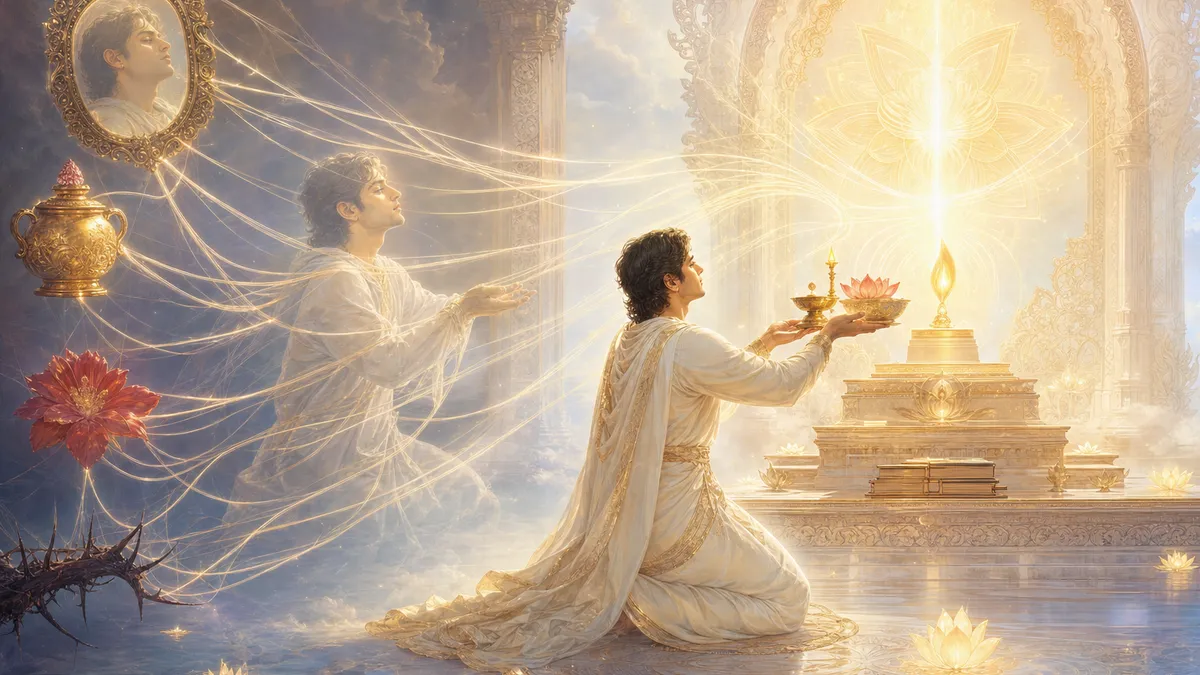
What is harmful about preferences? Preferences are a trap for the soul; surrendering them and submitting to the Divine will is salvation, it is the road to freedom. Why is it important to perform seva, service, nishkama karma yoga, karma yoga? Not merely because we need to heat our little houses, we need something to eat and a roof over our heads. First and foremost, service (seva) should be done in order to purify oneself of preferences, in order to resubordinate one’s egoistic tendencies, one’s preferences, to the Divine will.
It does not matter what you do; what matters is that you begin to resubordinate your personal will, your egoistic preferences, to the divine principle. This divine principle may be personified by anything; the main thing is that you understand that, for you, it is a manifestation of the divine principle. That is, if you serve a senior monk, a swami monk, the Guru, the altar, the image of the murti on the altar, the sangha as the third jewel, the dharma as sacred texts, scriptures, and the Tree of Refuge, and you clearly realize this, then your personal preferences, your personal will coming from the ego, from these preferences, is gradually resubordinated; it enters, as it were, the jurisdiction of other divine forces, that is, you tear your soul out from subordination to your karma, your vasanas and samskaras.
It is very important to understand why we perform service, karma yoga. To tear one’s soul out from the power of one’s own preferences, from the power of one’s prarabdha karma, in order to subordinate it to some other power, because the soul cannot be free in and of itself until it has dissolved in God; it is always under someone’s power. Because to be a soul means always to be under someone’s power: either under the power of maya, or under the power of Brahma the Creator, God, the saints, and certain holy forces. Because the soul is not the source of power; the source of power is Bhagavan. The soul is a subject that submits to power; it is always subordinate to something.
For example, a peasant is not the source of power; the source of power is the king, and a peasant, wherever he may be, is always subordinate to some king, because he lives on the territory of that king; he is not his own master. So it is with the soul: the soul may be either under the power of its karma, or under the power of some demonic forces, some spirits, the influence of the lower worlds, or under the power of illusions, or it may be under the power of divine forces, Anugraha.
The power of karma, the power of illusions always enslaves the soul, always captivates the soul, always imposes itself. It will enslave the soul until it has taken it completely under its control, completely drained it of power, and made it its slave. But Divine power never enslaves. It is such a sweet enchantment; it always gives a choice, it always gives freedom: if you do not want to follow, then do not follow; it is your affair, your choice, you are free. But the power of illusions, the power of maya, does not act this way; it constantly tries to impose itself. This is what distinguishes the energy of divine authority and power from the demonic, the illusory, from maya.
And divine power always gives you freedom; it says: you are a holy, divine being, you are free from the very beginning, you have a choice. And it is here that we must use our choice correctly; we must learn to surrender voluntarily all the time to divine power, to submit to this divine power. Because precisely such surrender makes the soul free, endows it with divine greatness, power, beauty, holiness, because this is divine power, the power of God. And because, in its depth, it is our inner, own power, that is, when we surrender and submit to our very selves. Whom should we listen to in the end? Of course, to our divine “I,” and not to some separate, demonic, illusory, conditioned parts of ourselves.
But often the soul does not understand this, because the vasanas and samskaras it has accumulated, and the preferences it has created, generate a certain movement of will, and this will already pulls the soul in a certain direction. And they enslave the soul, making it an obedient slave of the earthly and of its own will. And only the renunciation of preferences for the sake of serving the divine will leads the soul to freedom, making it in the future like God, Brahma the Creator of the universe. Karma yoga, bhakti yoga, and prapatti yoga are built upon this.
True Freedom from Preferences
One who follows his preferences is, in the spiritual sense, weak and without will; he is like a slave, he is not suited for the path of inner asceticism, because the path of inner asceticism is precisely to constantly pull out, to tear one’s soul away from all preferences of accumulated karma, and to resubordinate, to transfer one’s soul into the jurisdiction of the divine, into the power of the divine.
The more desires and preferences there are, the more burdened the soul feels. A soul mired in desires and preferences is like a beautiful butterfly that has fallen into a barrel of honey and become stuck in it because of greed.
What is the paradox of preferences? Preferences, desires, they show the soul an illusory prospect: they show: this is freedom — the freedom to satisfy preferences, the freedom to have whims, the freedom to have caprices, the freedom to follow one’s vasanas and samskaras, this is happiness. But in reality this is neither happiness nor freedom; it is simply a trap. It is like a candy in a beautiful golden wrapper, but this candy is in fact harmful to health, yet the soul, if it is not mature, eats this candy.
Often worldly people seek freedom for the individual, freedom to satisfy their preferences, not understanding that true freedom can be of another kind — it is the freedom to be free from all preferences, free from oneself. For example, liberal democracy, the philosophy of individualism in the West, is a kind of philosophy of hedonism, of satisfying one’s preferences without understanding their nature. They say that human freedom consists in satisfying all desires, living as one wants, doing what one wants. But in reality, this is not freedom, because the soul becomes more and more bogged down in these preferences. True freedom is found in God, in the divine; it is the freedom to be free from preferences.
Therefore a sadhu seeks liberation from all vasanas, from all samskaras, from all karmas; he does not need the freedom to fulfill his karmas — this is not freedom, it is the freedom of a slave to drag his chains. He needs freedom from all karma, from all chains.
A soul mired in preferences is like an animal caught in a trap: it loses freedom, joy, and will soon be seized by a fierce and merciless hunter — time. A soul sunk in preferences is like a struggling bird caught in a snare and trying to take flight.
These preferences manifest as “like — dislike,” “love — hate.” When you think: “I hate,” that is it, it means you have been caught. Or when people say: “I like him so much.” All of this is the disease of a foolish soul, all of this is chains holding the foolish soul captive in illusion. In reality, one must understand: everything that is dear to our soul is our walls, our limitations, and everything that is hateful and not dear is also our chains, our limitations. By fulfilling their preferences, souls wander in samsara until the end of the age, unable to get out of the chains of karma.
The Deep Nature of Preferences
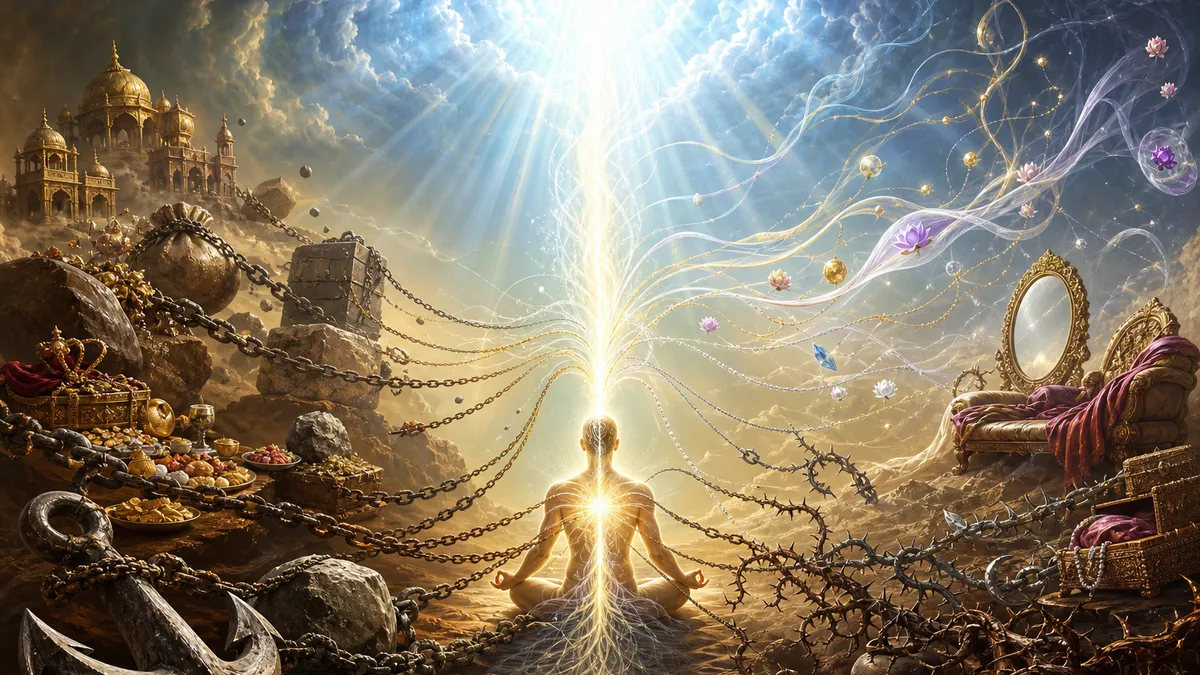
What needs to be understood? These preferences are energy; they are not thoughts, not words, but energy on a deeper level. Even at the level of words, we may say: I am Brahman, I am God, everything is an illusion; we may superficially perceive the truths of Advaita, as many neo-Advaitins do. But what we say plays no role. The preferences of the soul, the deep currents of karma, vasanas, samskaras are much deeper; they are simply energy. You may say one thing or another, but in reality, if all of this has not penetrated deeply—your meditation, your soul’s light—it plays no role. The preferences will still pull the soul precisely where they were created to pull it.
Vasistha, in the “Yoga Vasistha,” says that whatever the mind loves most, that it becomes. When our mind loves sweets, in the next life it creates a body in which those sweets can be eaten. For example, one may get a job at a candy factory. When the mind loves a woman (as a body, not as the Atman), in the next life such an opportunity will be provided to it: it will have a family in which it will enjoy marital relations. When the mind loves power, such an opportunity will be provided to it—to be a ruler, for example, the head of a local administration. That is, whatever the mind loves most, that it becomes. If the mind loves battles, quarrels, rivalry, such an opportunity will be provided to it: for an entire life it will receive a body in which it will be either a soldier or a person who is constantly in conflict with people. All of this is the mind realizing its preferences.
The only way to become free from these preferences is to stop carrying out the will of one’s ego, because the ego has a strong will directed toward satisfying these preferences. It is precisely because of this strong will that our rebirth most often occurred. The ego has already created a will; it is like a certain train that has picked up speed and is already moving by inertia.
The only way to oppose these preferences and weaken them is not to carry out their will, not to follow them. We must begin to resubordinate the power of our consciousness, our energy, to the Divine will—that is, not to our own will, but to the will of Brahman, the will of the Absolute, the Divine iccha-shakti. And those who fulfill the Divine will through seva, karma yoga, nishkama karma yoga, bhakti yoga, prapatti yoga in combination with the practice of awareness, they become liberated already in this life, because they block all their preferences, they do not follow all these currents, and then their soul, full of light, grandeur, and wisdom, nourished by the energy of Divine blessings, becomes free and begins to play beyond all preferences, just as the gods do.
The Path to Liberation from Preferences
It is precisely the preferences of our soul that have led us into this world of illusions and suffering, and it is precisely detachment from them that opens the path to Divine grace (Anugraha) and grants liberation. Therefore, a sadhu strives to cast aside his preferences in order to become an empty vessel of God. Such an empty vessel of God is called “upadhi” in Sanskrit—it is a conduit, a pure conduit. And then the nectar of Anugraha, Divine grace, will begin to fill this vessel, to fill it and liberate the soul.
Only an empty soul, free from preferences and whims, accepting everything as Divine grace, rejoicing in everything like a child, seeking nothing for itself except God, His will and grace, is worthy of abiding before God, worthy of being in samadhi, nididhyasana. To be before God means to be in the state of samadhi, in a state of deep contemplation, as if in dreamless sleep.
It must be understood that it is not some enemy outside, but our own desires and preferences that have led us into the dark labyrinth of samsara, the tangled labyrinth of samsara. Because it is precisely through preferring one thing over another that we have become entangled in illusions and found ourselves in the grip of samsara.
Until the soul frees itself from preferences, it will not become free in God; until it submits to the Divine will and renounces the will of its ego and its preferences, it will not be able to attain liberation. This is self-surrender—prapatti. The gates to the kingdom of God do not open to souls that live with preferences, if they hate one thing and prefer another, because this very duality deprives the soul of right knowledge (jnana).
Therefore, the right path is to purify oneself of preferences, as one cleans a ship that has sailed the sea for a long time. Many mollusks cling to it, and it loses its speed, but when it goes into dock, it is cleaned of algae, mollusks, stones, everything that has stuck to its bottom, and then it goes out again into the sea as if new. Our soul, when it is freed from preferences, becomes like such a ship.
Often a person, a worldly person, especially in old age, can be seen as having in his subtle body tens, hundreds of thousands of different threads that bind him (rnanubandhana, karmic threads) to people, to experiences, to events, to thoughts, and through these karmic threads his energy drains away. That is, his consciousness is completely attached to this and exhausted.
The Practice of Freedom from Preferences
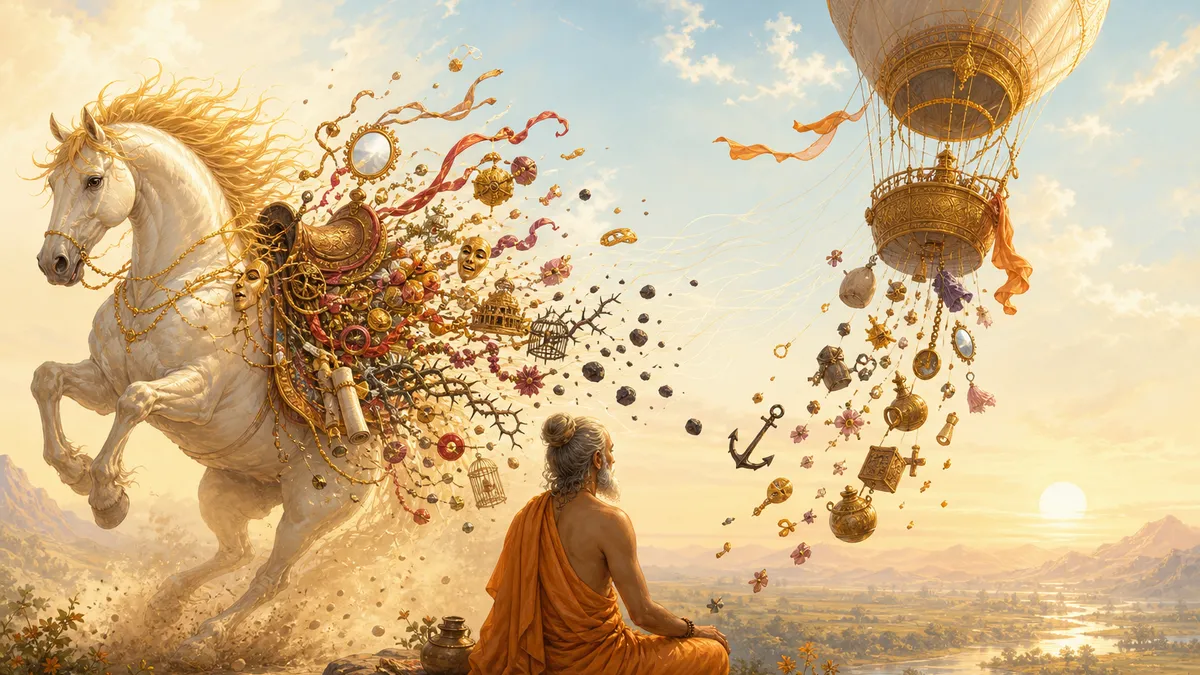
But one who follows the path of inner asceticism, the path of Laya Yoga, the path of awareness and contemplation, frees himself from preferences. Like a wild mustang, he tries to rid himself of the saddle that has been placed upon him, or like an aeronaut who wants to rise higher, he gets rid of bags of sand. And therefore a sadhu must constantly watch over his soul as if it were a small child, so that old preferences that he has conquered do not return, and new ones do not grow.
When such preferences grow, this is called anarthas (undesirable qualities) on the spiritual path. Preferences sleep deep within the soul, and at the proper time they unexpectedly enter the mind and awaken the life force of the body’s desires. And if they repeat again and again, they gain irresistible power, so that the soul cannot cope with them on its own.
Preferences sleep, but this does not mean that they cannot awaken, and when the corresponding planets enter the horoscope, these planets send impulses and awaken them; and, struck by the force of its desires and preferences, the soul first freezes, as if numb, and then begins obediently to follow them. It goes as if asleep, against its will, like a cow that is secretly led away at night from its owner’s yard.
And if a sadhu sees that some passion for preferences, other than God, has been born again in the soul, then such a sadhu, noticing this, must become indignant within himself; he must address his soul as he would a child. He must say: “O my soul, how much longer will you keep returning to your chains, for you seek God, not delusions. O my bird-soul! How long, in your foolishness, will you keep climbing into new snares and cages? For your destiny is to soar freely in the sky of God!”
When you have noticed this and said it to your soul, it indicates that you are beginning to free yourself from these preferences, and you stop blindly following them. Then you need to proceed to prayer to your deity, the holy teachers, and the Tree of Refuge, and ask for their blessing so that they may give you the strength to overcome all your preferences and become free from them.
Prayer and Connection with the Tree of Refuge
The path of contemplative presence, the path of Laya Yoga, does not contradict prayer. All saints and siddhas acknowledge the importance of the power of prayer, of appealing to the saints of the Tree of Refuge. But one must understand what prayer is, and how it differs from a mantra. Prayer, like mantra, is the establishment of a connection with high energies, high souls, and divine beings. And when we make offerings to them, we establish such a connection. And after the establishment of such a connection, a response inevitably follows, a return impulse from the saints, a descent, Anugraha, shaktipatha; and in the process of such a response we are purified, and our consciousness changes.
For example, during the Bhajan Mandala, from the point of view of visualization, what do we always begin with? Performing the mantra “Om,” we invoke divine souls who would bless us, and then we engage in visualizing the Tree of Refuge before us with the central figure of Dattatreya, or we look at the altar, directly seeing the murti of Dattatreya.
Having established a connection through visualization, we make offerings: flowers, incense, fire, other elements, bhajans. We try to remain in contemplative presence simultaneously with this visualization, and we single out the central figure of Dattatreya. And when we have already made such offerings, we imagine rays of blessing emanating from the central figure (it increases in size): one ray enters our brow center, white in color; another ray, red in color, enters our throat; and a blue ray enters the center of our chest.
These rays embody the energy of Dattatreya’s Anugraha, his Divine grace, which purifies us, our bodies, prana and consciousness, body, speech and mind. Here is the body (entry into the ajna chakra), here is the entry into our prana, speech (the throat), and here is the entry into our consciousness, the mind. And under the influence of this wave of blessings emanating from Dattatreya, we are transformed into the deity of meditation, into the Dhyan-devata (into Dattatreya in the form of a sixteen-year-old youth), and we are already sitting transformed before the Tree of Refuge. This is the result of our correct connections.
And after that we proceed to the meditation on the four immeasurables, when we ourselves spread a wave of energy over the entire Earth and transform it. These three stages: visualization of the Refuge Tree (the first); the second stage — transformation and receiving the rays of blessings; and the third stage — spreading these rays (the meditation on the four immeasurables), we always try to perform during the Bhajan mandala. It must be understood — this is also your form of prayer.
Practical Methods of Detachment from Preferences
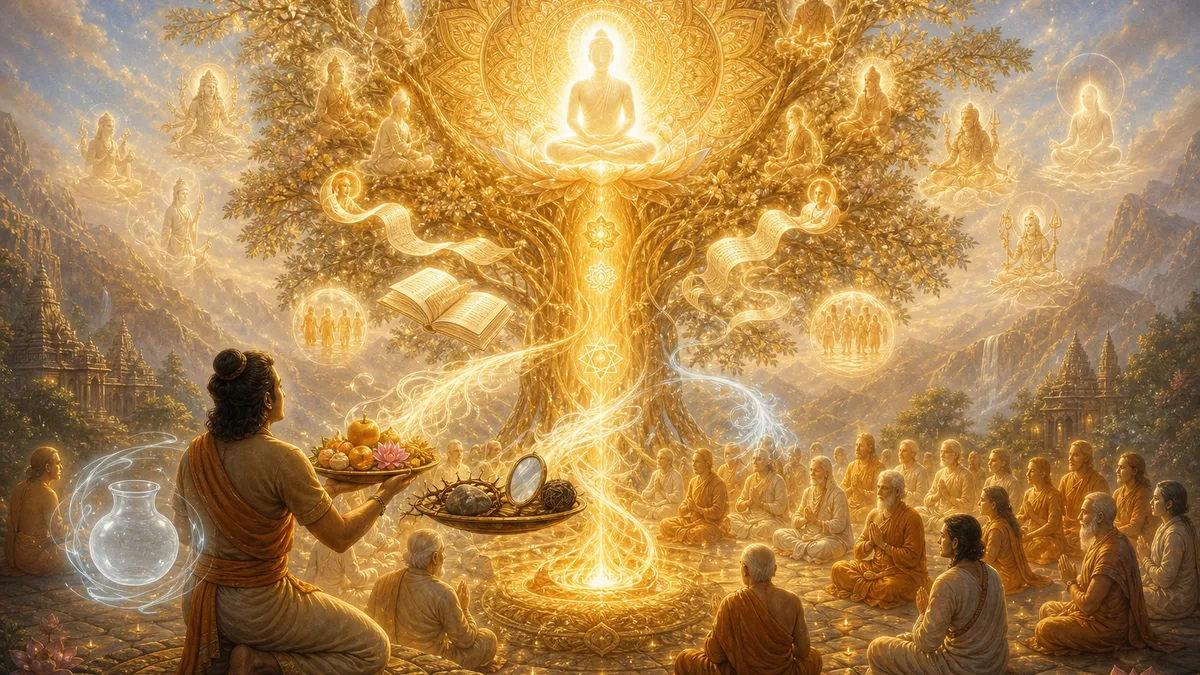
And if you can in this way invoke the blessings of the Refuge Tree, the blessings of the saints, then mentally dedicate to them, surrender all the desires of your soul, all its preferences, saying this: let not my desires be fulfilled, but the will of God and the saints; may I be empty, like a vessel, and free from preferences, as birds and stars are free from human concerns. If you pray, if you create such a sankalpa in your soul, sooner or later it will be fulfilled.
It is also necessary to constantly train yourself in order to get rid of preferences. For example: you need to find what you are attached to, what you like, and mentally give it to God, to the divine will, mentally offer it to the deity and to the saints of the Refuge Tree. For example, if you like some special prasadam, imagine it before the Refuge Tree while eating and mentally offer it and say: “Please, Lord Dattatreya, saints of the Refuge Tree, please, Supreme Source, enjoy this food; let it not be I who enjoy it, but you.”
It is also necessary to remember everything that we hate most of all and mentally accept it too as the Divine will, saying: “I will accept this in the name of self-surrender to God, in the name of fulfilling the Divine will.” For example, if you hate something, go and do it. Accept it as the divine will. If you do not like sweeping the floor, or you hate doing something else, accept it as Divine grace and do it, and you will see how free your soul becomes; you will see that what you hated was simply a wall created by your preferences, and you have removed this wall. For example, if you do not like some person, go and bow to him as a manifestation of the divine.
And when you act against your preferences, but not out of selfish will, rather by serving the Divine will, you begin to be purified of your vasanas and samskaras. At the same time, it is important to act not like an asura who acts against his preferences but creates a new powerful asuric ego, but to act as a conduit of the Divine will. That is, you purify your vasanas and samskaras through self-surrender, and not by splitting yourself into yet another strong asuric will.
If you like to talk, be silent; if you like to be silent, detach yourself from silence; if you love the forest, leave the forest; if you dislike crowds, go into crowds; if you love something, if you are attached to it, detach yourself from it — such is the main message if you follow the path of inner asceticism.
There is such a saying: Zen takes the sword from the samurai, and bread from the hungry. The samurai loves his sword very much, but the Dharma says: if you want to know the Divine Truth, give up your sword, which you love. The hungry person loves bread and food; the Dharma says: give up what you love, sacrifice it, because if you do not learn to free yourself from preferences, you will always be a slave to your whims, your vasanas, your impulses. This is what inner austerity consists of: perform inner austerity by overcoming your preferences, learn to love precisely what you do not like, but for the sake of God, and renounce what you strongly prefer for the sake of God; in this way you will rid yourself of all preferences.
The State of a Sadhu Without Preferences
For example, an experienced sadhu has no unloved services, no services that he loves so much and none that he hates so much; this is ridiculous. When I hear someone say, “Oh, I love this service so much,” or “I hate this service,” in my soul I cannot help but laugh, because for a sadhu such words do not exist; for him all services are beloved. Because he has removed himself altogether; another law operates in him: the law of self-surrender and the law of expediency. He as such, as a choosing, selfish personality, is not present in service at all; he is emptiness, he is a pure, empty conduit.
A sadhu thinks this way: who am I to prefer this service or that one? If it is necessary, I do this service. If it is necessary, I do that service; this is not a question at all. I listen to what the divine will is. If the Divine will needs me to dance the hopak, I will dance; if it is necessary to chop wood, I will chop wood; if it is necessary to rule kingdoms, I will rule kingdoms; if it is necessary to fly into space, I will fly into space.
A sadhu does not take into account his small selfish will, his small selfish personality at all, because he made his decision long ago: let not my will be done, but Yours. He says: “Here, Dattatreya, are my hands, my legs, my head; I lease them to You.” And such a sadhu is free from vasanas and preferences; he never has doubts, he is always in joy, because he lives in the greatest grace, he is always blessed by the greatest Anugraha.
And he knows: it does not matter what to do; what matters is to be and not fall out of this Divine grace. And in Divine grace one can be in ecstasy both with a plate and with a broom, with a pen and with a computer, or with nothing at all; it does not matter. From the state of Divine grace, it happens by itself: the pen writes by itself, the broom sweeps by itself, the fingers strike the keys by themselves; none of this matters, because this can no longer be called action — it is already God’s lila, the Play, and you are simply His channel, His conduit.
And as long as a sadhu lives in such a state of self-surrender without preferences, he is always happy and he is always in the play, in the lila; but as soon as ego arises in him, as soon as the mind begins to work: I like this, I do not like this, I want this, I do not want that; someone else has it better, I have it worse — immediately the channel of this grace will be blocked, because he will, as it were, hand over his soul to the authority of another jurisdiction, to the authority of his mind and ego.
The Story of the Three Demons and the Power of Preferences
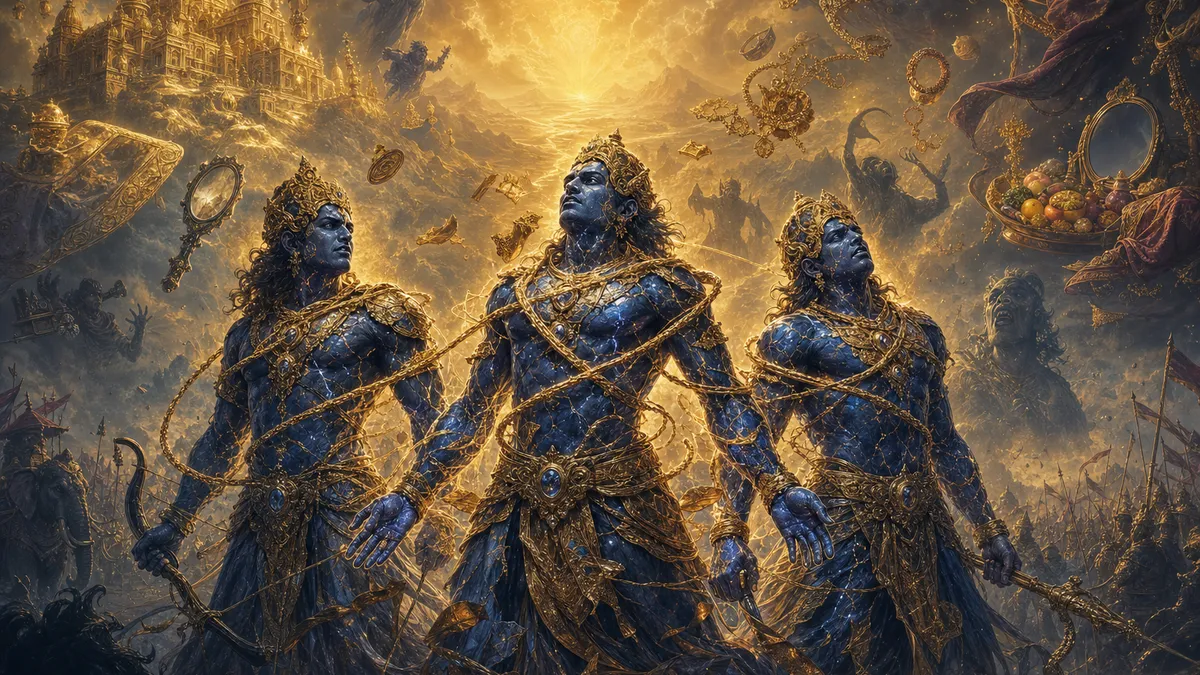
The story of the asura who created three demons to fight the gods speaks precisely about this. It is a well-known story from the “Yoga Vasishtha.” One asura, while waging war against the gods, decided to create three illusory bodies by his magical power. And these three illusory bodies were entirely his manifestation, and they had no preferences of their own: they had neither fear of death, nor thirst for life, nor worldly desires; they could not be defeated. They fought like enlightened beings. And the gods were defeated by these three magical emanations of this demon; I believe they were called Vrikastra.
And then the gods went to Vishnu and said: “What should we do? We are suffering defeat.” Vishnu said: “Wait a little, play upon their preferences, upon their desires; allow them to taste a little luxury, illusions, so that ego arises in them, so that they begin to fear death, so that a thirst for worldly life appears in them — then you will defeat them, but for now do not try to fight them.”
And so it happened: as soon as experience began to form in these demons, as soon as their own preferences, desires, and whims began to manifest, they suddenly understood that they were mortal; they began to fear death, began to fear defeats, wealth appeared among them, and so on, and they immediately grew weak; that is, the power of Anugraha ceased to bless them. And the gods attacked them, and they fled the battlefield in disgrace, and the asura who had created them was very angry that they had been defeated.
Fulfilling the Divine Will
In the same way, the soul suffers defeat. And we need not choose anything except the holy Dharma, not seek anything, and not choose anything except God and His will, and not follow anything except the instructions of the saints and the will of God. And when we reject preferences, we purify ourselves. In the depths of the soul, to contemplate means not to choose; and even if such an illusory, playful choice is made, then not to cling to one’s choice and one’s choosing will. It is said this way: do not choose, but if you have already chosen, then at least do not cling to your choice.
Always abide in faith, within God, in the presence of God, without choice, and learn to accept everything as the grace of God. Accepting everything as the grace of God is possible only if you are without evaluations and judgments, in contemplative presence, in naked awareness; only this gives you the eyes that allow you to see the grace of God, to see Anugraha in everything. It is impossible to do this from the mind.
And we as sadhus, like any sadhu, need not seek how to fulfill our preferences, but seek how to fulfill the Divine will. What does it mean to fulfill the Divine will? The Divine will does not manifest directly (ichchha-shakti); it does not manifest concretely: take this and do it. It has no specific materialization, no specific manifestations.
To fulfill the Divine will means, rather, to be in the constant presence of God, to be a conduit of Anugraha, of divine grace, to be in a state of unity with the Light, in the purest sattva, in a transcendent state, and to constantly conduct this transcendent state into this life. And exactly how to conduct this state is something we ourselves, with the help of instructions and with the help of the Dharma, understand in the relative dimension; we connect this transcendent, this purest sattva, with this relative dimension.
Do not consider your whims more important than other people, do not consider your preferences more important than Divine grace; part with preferences easily, just as a horse parts with a heavy load that it had to carry uphill for a long time.
One must understand: until a sadhu parts with preferences, he will not be able to enter the natural state; there can be no talk of sahaja-samadhi, or even of any serious attentive state—it is impossible. Because as soon as he begins to enter it, to try to contemplate, preferences will pull him out.
It often happens: a person tries to meditate, tries to sit in retreats, but something is wrong: I can’t. Then he needs to go somewhere—to Altai, to Kailash, to Zaporizhzhia, to Berdyansk, anywhere. Why he needs to go there, he himself does not know. He needs to go somewhere because the energy of preferences is pushing him somewhere: go, it will be better for you there—that is karma.
But if we have parted with our preferences and submitted them to God, then we feel that we have thrown off a heavy burden; we feel good always and everywhere; right here and now we are ready to remain for our whole life. Whenever I come somewhere, I always think: I can sit in this room, on this sofa, for my whole life; I will be very happy; I do not need to go anywhere. Sometimes it is necessary for the sake of others, for the sake of maintaining the Dharma—that is another matter, religious ethics, social policy—but personally, I always feel good in the place where I am; I have no preferences, I am not drawn anywhere away from the place where I am now. And from this state, where you are here and now, you will always be happy; from it, sahaja-samadhi is possible.
Life in God Without Preferences
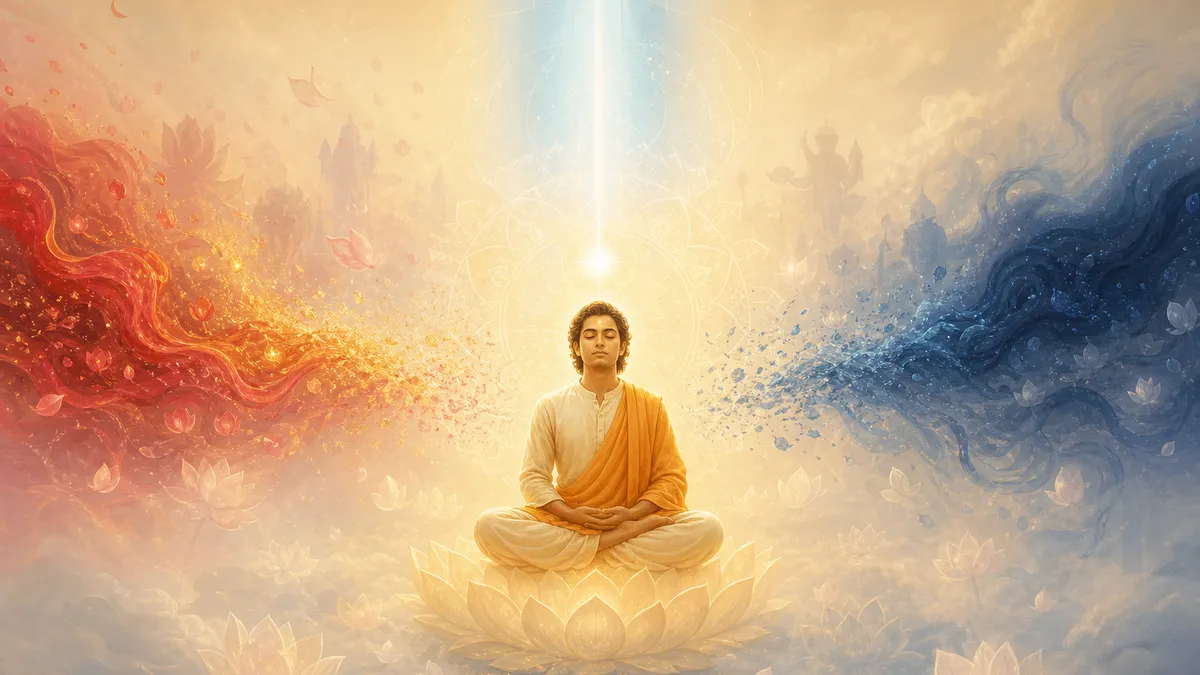
For one who lives in God, there are no preferences other than God Himself and His will, and there is no other fear or rejection except the fear of forgetting God. And if we reject something with hatred, disgust, indignation, this is forgetfulness and non-acceptance of God; or if we are drawn to something with passion, with greed, this too is the sleep of the soul, the loss of the goal and meaning of life. Because if you keep God in your mind, if you are in a state of self-surrender, contemplative presence, devotion to God, then neither passionate rejection nor attachment is possible.
For the sake of Divine love, we need to reject everything earthly, everything worldly, everything that has an image, name, and form, but without disgust and without hatred, and establish our consciousness in that place where there is nothing earthly, nothing worldly, no name, no form, nothing concrete. And when we know this point where it is to be established, when we know it at least at the level of understanding, it is said that we have mastered the right view. But the right view is not enough; in addition to what we know intuitively, we need to constantly abide there, to make this our method. And when we have mastered this method, then we abide in right contemplation, in right meditation.
Simultaneous Rejection and Acceptance of the Earthly
Abiding in God is the complete acceptance of everything earthly, but not in preferences and not in passions, but in the light of Divine grace and in the self-surrender of the soul. What does this mean? We must both reject everything earthly and accept everything earthly at the same time. How is this to be understood?
And to reject it, as I have already said, you must find that point of consciousness which is not connected with anything earthly; and to accept everything earthly means that, against the background of perceiving everything material, we must remove all our judgments, all our preferences, and we must recognize the divine in everything earthly.
It is possible to recognize divinity only if we continue to be in contemplation, if we continue to keep our mind in this point, in the point of the transcendent, where there is neither name nor form. And then, when we look at anything, it is no longer our mind with its judgments and preferences that acts, nor our ego with its will, when it likes something and dislikes something else; only this point acts, the point of abiding in God.
For example, if I (or you) previously disliked some person, I thought: oh, what a foolish person, a complete idiot—that was rejection. But as soon as you have found this point and have given all your preferences to God, you will be able to begin living in a completely different way. Because from that point there are no judgments: like, dislike; there is no bad–good; from that point one can see only God in a person, and then you say: “Namaste! I honor the divine!” It does not matter: like or dislike, none of this matters; I see only the Divine. If you have found such an ability within yourself and can see with such eyes not only a person, but all living beings on the planet and in the Universe, all situations, objects, and things, then you are close to being a good sadhu.
The Light of Divine Love and All-Acceptance
This is the acceptance of everything for the sake of Divine love. In this Light of Divine love and acceptance of everything, in the contemplative light of presence, everything dissolves: both the bad and the good, both the pure and the impure. In this Light of the all-acceptance of Divine love, everything is purified and loses its harmfulness and significance; it is like a stick burned in fire—this stick can no longer strike anyone.
Even if you had preferences, vasanas, samskaras, all of this begins to burn away, because you are no longer in preferences; you are in the point of God, in the transcendent, in the point of the Absolute.
Therefore, one must say to oneself: “Soul, leave behind your preferences and attachments, hatred and aversion, all cares and choices for the sake of God, for the sake of Divine love, for the sake of serving God and the Divine will, and live only by His grace, heeding and honoring.”
