

Commentary on the text “Pancha-Brahma Upanishad”
Vedic Gods. Shiva
Monday is the day of venerating Shiva, and we will speak about Shiva based on the “Pancha-Brahma Upanishad.” When we become sadhus, of course, at first we strive to solve our existential problems, our personal problems. All of us have confusion, ignorance, desires; we all strive for happiness, we want to be better than fate has given us—smarter, more beautiful, healthier, wiser, stronger. We lack many qualities, and the world in which we live does not always satisfy us either; it too could be better, more graceful, more loving, friendlier, more beautiful, cleaner. All these are our personal problems, and the initial motivation is to solve our own problems. We all come to the Dharma, to the spiritual Teacher, for the solution of problems. Sometimes people even want to become richer, happier in family life, in personal life.
We all begin to do yoga, to practice, to study the Dharma transmitted by the spiritual Teacher, in order to answer such existential questions: what is the meaning of life, who am I. Then we learn that there are high yogic states, samadhi, enlightenment, that there are high levels of holiness, states of pacification of the mind, the single “taste,” pure vision; they seem very inspiring, this is a great challenge for us. It turns out—and we did not know, we had no idea—that if we attain them, our problems will be solved. So the scriptures say, and the Teacher says, that we simply do not have the single “taste,” we do not have pure vision. We do not have awareness of divine majesty, we do not have enlightenment—so it turns out this is the root of all problems, where the crux of the matter lies. We simply do not have the vision of saints, we do not have a perfect instrument of the mind; what we lack are precisely the qualities of holiness, the qualities of a yogi.
This is a great challenge for us, the possibility of spiritual growth, of changing from that ordinary worldly state with which we begin, from the problematic one, and we understand that we must move forward, because time is passing. If we let this time slip away, our problems remain with us, as they say: “The clock is ticking; it is already time to start thinking.” We ourselves begin to say and think this to ourselves, and then we enter the spiritual path, strive to attain the state of enlightenment, the state of holiness, to cultivate qualities within ourselves, and we see what great work is needed. We compare ourselves with standards, with saints, with degrees of liberation, with qualities, and see that we fall short. Earlier, in worldly life, we could think of ourselves with great pretensions, with great aplomb, because we compared ourselves with people just like us.
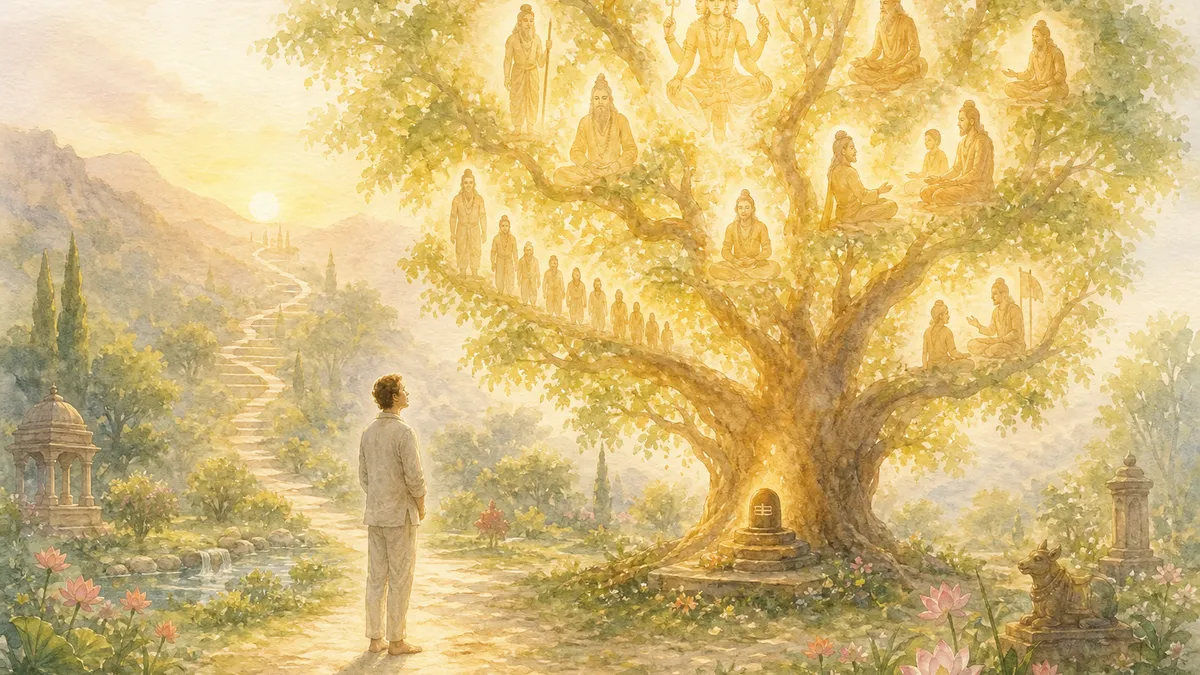
Here we suddenly saw the tree of Refuge, the Guru-shishya-parampara, Dattatreya, the seven rishis, saints, wiser sadhus, the Guru, gods, siddhas, and we began to compare again and suddenly see: “Oh, how much we lack,” that before the gods, before the saints, we are in need of great improvement. As the saints say: “I am as dirty as a dog compared with higher saints, great beings.” Then we think about how to pass along this path; this path seems so great, so lofty, long and prolonged, that it seems there is not a single chance. No matter how much you practice yoga, no matter how much you pacify the mind every day, contemplate, practice concentration, there would not even be enough time in a day if you did this continuously, because nature (Prakriti) yields very slowly to purification, to pacification. For every experience, for every insight, one has to toil to the point of exhaustion, for every small step; and besides this, forces are encountered that strive to roll us back in spiritual life.
Awareness of the Need for Divine Grace
We feel that this is not easy, that this undertaking into which we have entered is not an easy matter—to know God, to move toward enlightenment; we think: “Well, well, how did I get myself into this!” On the one hand, we feel: “How fortunate I am,” because to walk the path of liberation, to come to the Dharma, is to realize it deeply, not superficially; this is great good fortune, a great rarity, luck, to obtain a precious human birth. On the other hand, we understand: “What a great path we are walking, and how unprepared we are for it in various respects, according to various parameters.” No matter how much we prepare, no matter how much we change ourselves, it is very difficult, very hard to change our nature; tapasya is needed, an entire life turned into tapasya is needed—external in some ways, internal in others. Even when we undertake tapasya, we begin to understand: what are twenty years of tapasya?
Brahman is not even billions of years, not even quintillions, and not even googols of years; it is simply infinite in time. What are twenty years of tapasya, what are eighty years of tapasya for attaining the absolute state? Suddenly, when we understand that even our tapasya, even our refined qualities, are incomparable with divinity. Suddenly, great humility arises in us, along with the understanding that I cannot rely only on myself, on my personal qualities, on my efforts, on my tapasya. I can rely only on the divine Source that gave rise to me, on its grace, on its love, on its compassion; that I, as a human being, am so limited by my nature, by my karma, that even becoming a perfect human being, a yogi, a sadhu, even this will not solve my problems, will not grant me true happiness.
It will only improve me, make me a little better, a little more harmonious, a little more whole, but it will not fundamentally solve the problem. Then we begin to understand: “My true salvation is in God, my enlightenment is in God, my liberation is in God.” In Him, not in me, and the vector of our spiritual life turns away from self-centeredness, from focusing on our efforts, on our experiences, our problems, achievements — it begins to turn toward a cause that surpasses us. Our search begins to be transcended, and a certain truth opens up for us: “It turns out that it is not about us, it is about God. The world does not revolve around us, our personality, our ego, our problems; the world revolves around a certain invisible great divine center, and we revolve together with the world around this same center.”
It is precisely this center that we are to come to know, to clarify our relationship with it, and to make it the main center for ourselves. When we understand: “I do not belong to myself, I belong to God; the world does not belong to itself, it too belongs to God, and the matter is not about us, but about God,” then we truly understand such words as self-surrender, letting go of the ego, capitulation, and the vector of our sadhana also turns in a new direction.
Spiritual Egoism and Its Overcoming
We cease to be ego-maniacs centered on our own problems. You know, spiritual people can be very centered on their problems, no less than worldly people. Worldly people are simply absorbed in their problems: how to earn money, how to live well, how to establish their relationships, how to raise children, how to survive, how to defeat enemies, how to neutralize rivals, how to present their image, how to be better; they are constantly concerned with how to make things good for themselves.
Spiritual people can also be absolutely centered on their problems, only their level of centeredness is slightly different. How to calm the mind, how to develop concentration, how to purify the chakras, how to awaken kundalini, how to develop mindfulness, how to find the aham-vritti and maintain it, how to study texts, how to succeed in visualization, how to manage to recite the mantra. How to combine spiritual life and service, how to get up earlier, how to eat properly, how to work with the pranas, how to build harmonious relationships, how to improve oneself. Behind this improvement, a new level of self-centeredness grows again; subtle, spiritual egoism grows again. We are once again absorbed in some illusory, egoistic image of ourselves, and we again hold on to it, cling to it, and our hopes and fears can increase very seriously, even no less than among worldly people, because the stakes are higher.
By and large, what can a worldly person lose — their business may be taken away, money, health, nothing global; but for us the stakes are very high — liberation, enlightenment, holiness, knowledge of other worlds, divinity. Accordingly, hopes and fears can also arise in great measure, but when we understand that this is not the right path, that we need to change our egocentricity and turn our face toward God, and try to understand the divine Source, to establish our connection with the divine Source. When we decide to part with our personal hopes and fears, to offer them to God, when we decide to part with clinging and attachments, including spiritual ones, attachments to spiritual experiences. “I saw such a bija syllable, and I saw such a light, and this kind of light, such a bhava opened up, and I experienced such a space during the experience of sankalpa, and I this and that,” and the ego also accumulates spiritual experiences in its piggy bank.
It does not accumulate money, but it accumulates various states, lived experiences, and through this it becomes centered and grows. When we understand that we need not to appropriate, not to receive, but to give, and to turn our entire life into endless self-giving and through this self-giving to draw ourselves out, to transcend ourselves from the state in which we now abide, the path of self-giving opens up for us. This is the direct path of experiencing God, and Ramana Maharshi pointed to two main methods: atma-vichara and self-giving, as two direct paths.
Comprehending the Nature of God
On the path of self-giving we understand that the world does not revolve around us, around our personality, but it always revolves around God, and we discover that we need to understand the main object of self-giving, if it can be called an object. It can also be called the ultimate subject, the absolute subject of all subjects, the principle of any subjectivity in the universe, including our own, because God (the Absolute) is both transcendent and immanent, as philosophers say. When they say this, everything in me stirs a little; the words are very awkward—what does transcendent and immanent mean?—the soul simply opens, yes? This is for philosophers; Hegel, Kant, Spinoza might say it this way, but to an ordinary person these words say nothing, yet we still sometimes speak this way. Transcendent means that He is beyond everything, beyond everything objective, beyond all things; He is so invisible, intangible, unscented, on the other side of any concepts. Immanent means that He is within everything, He permeates everything, in every stone, in every speck of dust, in every body, in every soul.
Then we try to understand the nature of God, we try to understand: “What, then, is God? What is the highest substance, the highest essence, the highest being, the highest state, the being with which I must establish a connection, to which I must give all my egoism, all my hopes, fears, ideas, concepts, clingings? What is this great, infinite being?” When we study that God is the Absolute, Brahman, without qualities, without categories, or that He is Shiva, these are certain hints, these are signs, or, in other religions and traditions, what is said about God. God is like the cosmos; we begin to study Him, but we will never fully study Him, and any attempts at definition, any disputes, arise because people have only just begun to study Him and still understand nothing in Him, because the divine cosmos can one day be begun to be studied, comprehended, explored, but it can never be completed.
At the moment when we begin to study and comprehend Him, the divine universe, the divine dimension, unfolds before us very slowly. To comprehend the facets, aspects of manifestation, states, and modifications of the divine cosmos is precisely the destiny of a sadhu; in Sanskrit, this is called brahma-vichara. Brahma-vichara means the investigation of the Absolute, and all of us sadhus are researchers of the ultimate, divine reality; our destiny is to investigate the Absolute. Just as humanity explores something beyond in space, and within it there are detachments of cosmonauts who are trained for a long time and launched into orbit. In the same way, sadhus are like scientists, researchers who prepare themselves and who are then launched into orbit; they spend a long time there in the open space of God, the Absolute, in order to receive ever deeper, bottomless knowledge of the Absolute.
In the process of such research they receive bottomless knowledge of the Absolute, a revelation that changes them themselves. If space does not particularly change cosmonauts—people say that radiation affects them there, their bones become more fragile, their muscles weaken because of the absence of gravity. Sometimes a feeling arises, as if someone is watching them; many say that there is a feeling as if someone is constantly watching. I think that because the element of space predominates, the inner observer in all cosmonauts becomes sharpened, buddhi, a feeling as if you are constantly in the fullness of attention. The divine cosmos, in the process of being explored, begins to change the sadhu—this is true spiritual practice, when God (the Absolute), by the power of His grace, through various blessings and energies, liberates the sadhu, awakens and enlightens him.
Here it cannot be said that the sadhu awakens only by virtue of divine grace; effort is still required. Without effort, divine grace will not respond; it still has to be lured, attracted somehow. It responds to our efforts, to our tapasya, to our self-giving, and it cannot be said that liberation is attained only by one’s own efforts. This is joint work, in which each has their own part of the work to perform.
Vedantic and Tantric Traditions
When we comprehend God, we comprehend him in accordance with two traditions. In the Vedantic tradition, we comprehend him as the Absolute, as the Brahman of the Vedas and Upanishads, who has no personality, no attributes, gunas, qualities, or categories, invisible, imperceptible by smell, intangible, comprehended in samadhi.
When we comprehend him in accordance with the southern line, we comprehend him as Brahman as Shiva, as one who can manifest, because the Brahman of the Vedas, the Brahman of Shankaracharya’s Upanishads, is transcendent, static, not participating in the life of the universe, inactive. In tantrism, God is always God as Shiva, the one who can manifest energies, the one who dynamically participates in this world and permeates it entirely with his energies; therefore, for tantrism, there is energy. For advaita, energy is maya, with which one simply should not get involved, which one should simply regard as an illusion. In tantrism, energy is both maya and the divine power that manifests from the very source.
The Five Faces of Shiva
The “Pancha-brahma Upanishad” describes the five faces of Shiva, Brahman as Shiva, and Shaivism is the religion of Shiva as the Absolute, as the supreme God, Brahman. Undoubtedly, Shiva in human form may also have lived ten or twenty thousand years ago on Kailash, where the divine plays unfolded. Just as the Buddha lived, so Shiva lived; he was the greatest saint, a maha-siddha, had connections and relationships with rishis, with gods, manifested miracles, and there are already many myths, many stories. But Shiva, beyond this, is the Absolute, universal being, a being possessing various powers. So, the “Pancha-brahma Upanishad” describes the five faces or five aspects of Shiva. These five faces, five aspects, are connected with five primordial energies: creation, preservation, destruction, concealment, and divine grace, the liberating power.
Then Paippalada asked: “O Lord, who was in the beginning, who was born before all?”
Here the five faces of Shiva are listed, called Sadyojata, Aghora, Vamadeva, Tatpurusha, and Ishana (the lord of all gods, the lord of the past and the future, of all sources of the gods). Then Paippalada asks such questions: “What are their colors, what are their distinctions, what are their energies? Everything that is secret?” Lord Mahesha answers him: “Listen to the most secret of the secret. Thus, the first face is Sadyojata; it is the earth, Pushan, the gladdening energy of prosperity, it is Brahma, it is the Rigveda.” So, the first face, called Sadyojata, is connected with the element of earth; it faces east, this face of Shiva is turned to the east. In accordance with the faces of Shiva and each direction, in India there are temples dedicated to these faces. This face, Sadyojata, is connected with the energy of creation, with kriya-shakti (the element of earth). When we recite the five-syllable mantra “Namah Shivaya,” each syllable of the mantra is connected with one of the faces.
The syllable “Na” is connected with kriya-shakti, with the energy of creation and the face of Sadyojata, which looks to the east, that is, it is the face of Brahma, the creator of the universe, who carries out creation. There are five energies of creation connected with Shiva, with the Absolute: creation (kriya-shakti), preservation (sthiti-shakti), destruction (samhara-shakti), concealment (tirodhana-shakti), and liberation, the manifestation of divine grace (anugraha-shakti). Each of these energies corresponds to an element and to one of the faces of Shiva.
The next face is connected with the element of water, with the energy of preservation, and is called Vamadeva — this is sthiti-shakti. It faces south, and the syllable “Mah” (Namah) is connected with it when we recite the mantra; God Vishnu is connected with it. The next face of Shiva is called Aghora; it is connected with destruction, it is connected with Rudra, and it faces south, and jnana and samhara-shakti are connected with it; it is connected with the element of fire.
The next face of Shiva is connected with the element of air; it faces west, and in the mantra its syllable is “Shi”; it is also connected with Rudra, this is concealment, and this face is called Tatpurusha. The next face is connected with space; it is called Ishana, and divine grace is connected with it.
So, Sadyojata, Vamadeva, Aghora, Tatpurusha, and Ishana. Sadyojata is connected with creation, Vamadeva with preservation, Aghora with destruction, Tatpurusha with concealment, Ishana with divine grace, and each corresponds to the syllable “Na,” “Mah,” “Shi,” “Va,” “Ya.” The last syllable, “Ya,” is connected with Ishana, with divine grace, with Anugraha. By concentrating on each of the syllables while reciting the mantra, you strengthen one aspect or another, one shakti or another.
Sadyojata is the principle of Brahma, Vamadeva is the principle of Vishnu, Aghora is the principle of Rudra (destruction), Tatpurusha is the principle of Ishvara, and Ishana, as divine grace, is connected with the element of space and rules over all energies. Each syllable and each face of Shiva is connected with one of the elements. Sadashiva is connected with earth, his color is yellow; Vamadeva — his color is white, he is connected with water; Aghora — his color is red, he is connected with fire; Tatpurusha — his color is green, he is connected with air; Ishana — his color is blue, he is connected with the element of space.
How can one recognize these energies within one’s own body and mind? They are the five chakras, the five elements, and the five wisdoms associated with the elements, when we reveal these energies within ourselves. After all the previous faces of Shiva have been listed, the “Pancha-brahma Upanishad,” the Upanishad describing the five states of the Absolute, discusses Ishana.
The supreme Ishana should be known as the ruler, the witness of all states of consciousness, the essence of space, the unmanifest, adorned with the svara syllable “Om.” Consisting of all the gods, abiding in a state of peace and transcending peace, beyond the world of manifestation, the lord of the vowels beginning with “a,” the embodiment of fullness and space, governing the five actions, the Atman itself of the five manifestations of Brahman, pancha-brahma.
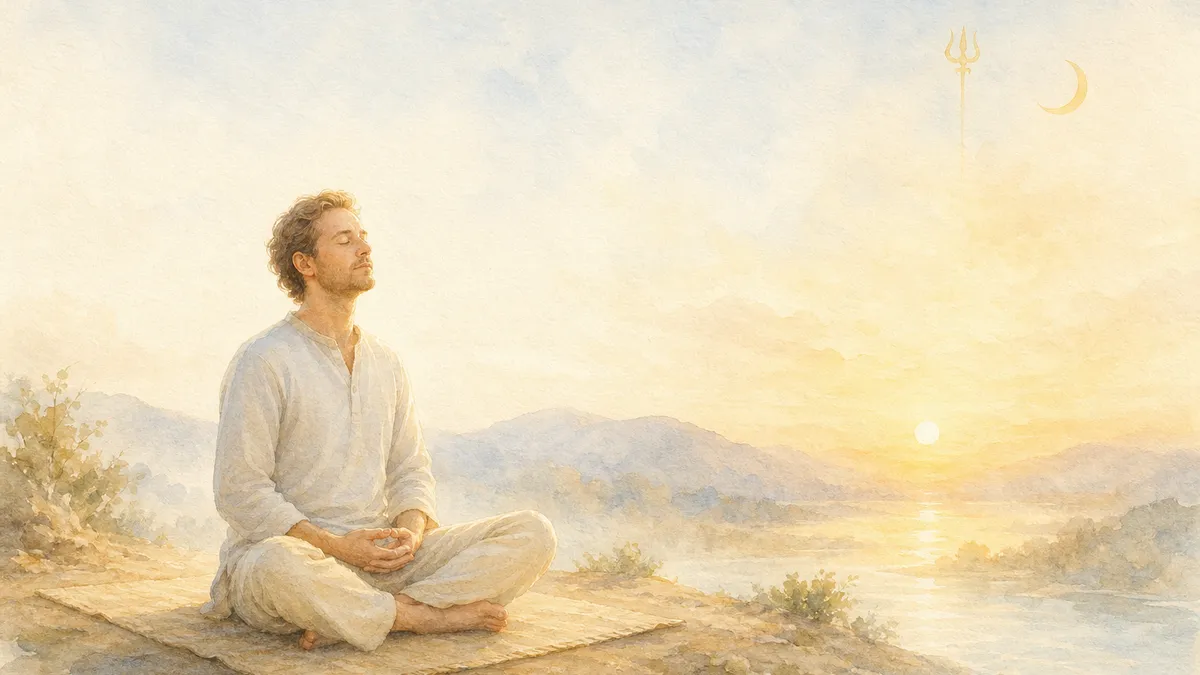
Ishana — the face of divine grace
The face of Ishana, the face of Shiva in the form of Ishana, is very important for us because it is connected with the element of space. Space for us is one of the very important faces of God; we also call it Datta Digambara (Dattatreya, clothed in the directions of the world). Clothed in the directions of the world points to the principle of Dattatreya as space. For us this is the most important face of God, on which we meditate as Dattatreya and as Shiva in the aspect of Ishana, because through space we cultivate within ourselves the principle of awareness, contemplation, and ultimately, through union with space, we come to know God. This face includes all the previous faces, just as the element of space contains the energy of all the previous elements. To know God means to expand one’s consciousness; it means to know akasha-tattva (the element of space).
When you master shambhavi mudra, you meditate on space. To open within yourself the space of pure awareness, unstained by thoughts, is precisely the principle of contemplating the divine Source. Usually our limitation is within us, because we have localization in space, we have false ideas about ourselves as consciousness enclosed in the body, and there is identification with the body. There is no breadth, universality, or scale in us; the mind is shriveled, and this limitation connected with space is one of the kanchukas, that is, when divinity is mixed with maya, a kanchuka appears. One of the kanchukas is specific localization in space, a specific connection with a certain location, one of the five kanchukas.
When we are localized in space, we are subject to the laws, causes, and effects of the space in which we are localized. Meditation on the principle of space, on the contrary, eliminates this entanglement, eliminates anava-mala (the idea “I am small,” “I am a small being”), maya-mala (the idea of multiplicity, that these objects are different from other objects), and the idea of karma-mala (“I am the doer, I act, my state changes in the process of acting, and the fruits and results belong to me”). Space dissolves all these three impurities, the flaws of our mind. To abide in the dimension of space means to touch divine grace with an open mind.
Having created the destruction of the five manifestations of Brahman, he abides in his own Atman; folding everything up by the power of his maya, he abides in self-sufficiency in his own Atman. Transcending the essence of the five manifestations of Brahman, he shines with his own light at the beginning and at the end, as well as in the middle, and shines not from any new source. Enchanted by the maya of the great god Shambhu, the teacher of the universe, all the gods do not know him, the cause of all causes. No one has such a form except the supreme Purusha, who manifests as everything in the universe, in whom everything comes into existence and in whom everything dissolves.
It is Ishana, the aspect of Shiva as grace, as the liberating energy Anugraha, that is very important for us; therefore we often say that we serve Anugraha, we serve the divine enlightening power. This energy is connected with the element of space; it grants mukti, and this gaze of Shiva, if all the other gazes are directed either to the east, or to the west, or to the south, or to the north, then here Shiva’s gaze is directed upward. Upward means transcendence, the Absolute.
The principle of space as a mirror
When we contemplate, both in the “Yoga Vasistha” and in the “Tripura Rahasya,” Dattatreya and Vasistha point to the principle of space, and they often compare it to a mirror. All objects in the universe that entangle samsaric beings are in space like a reflection that exists in a mirror. These objects are unreal, just as objects in a mirror are unreal.
For example, if we take some mirror-like surface, we will see many objects within any reflective surface. But if we become absorbed in looking at the objects, we will ignore the reflective surface itself; yet do the objects really exist right there? They do not exist. All that exists is the reflective surface, and it depends on us whether we pay attention to the mirror or to the reflection.
The principle of liberation begins to work—this Anugraha-shakti, the divine grace of Ishana, begins to work and inspire—when we pay attention not to objects, nor to reflections, but to the principle of the mirror as the pure principle of awareness. All living beings are absorbed in looking at objects; they are absorbed in chasing after objects.
For example, if you saw something here and wanted to obtain that object, and began thinking about how to get it, how to possess it, or if you saw yourself or another person, then you are abiding in an illusory reality, you are abiding in an illusory vision of the world. If you understood that it is only a mirror on whose surface a reflection is being played out, you would no longer chase after them; you would try to understand this principle of the mirror.
For example, there is an experiment in which a mirror was placed in a forest, in the jungle, and researchers began studying the reactions of different animals. It was amusing to see a dog approach, sniff the mirror, and want to meet another big dog. It pokes its muzzle into the mirror, nothing works, it gets angry—this is precisely the state of ignorance.
If the dog were smarter, it would not try to get acquainted with the dog it sees; it would understand the principle of the mirror and would investigate the mirror. All souls in samsara behave in much the same way: they understand nothing, they poke at the mirror, striving to possess the objects that are reflected, to get hold of them. But the principle of liberation and divine grace is connected with recognizing the space of that mirror in which all reflections arise.
The reflection is the material world, the universe, our body, home, family, all our desires, all our imagination in the subtle body, all five elements—all this manifold reflection. The mirror reflects them impartially, but it itself is not connected with them; it is not stained by them. Liberation means learning to separate the reflection from the mirror and to study, to become established in the understanding of this mirror. At the moment when we separate ourselves from the reflections, blessing begins to descend.
He is that Brahman, full of supreme peace. I am that Brahman, the eternal state of consciousness. One should know these five manifestations of Brahman, beginning with Sadyojata. Everything that is seen and heard is nothing other than the very essence of the five manifestations of Brahman. The five actions are considered the five duties of Brahman; through comprehension of the duties of the five manifestations of Brahman, Ishana is attained. Having immersed the essence of all five manifestations of Brahman in one’s own Atman, the knower of Brahman who affirms “he is I” becomes the immortal Brahman.
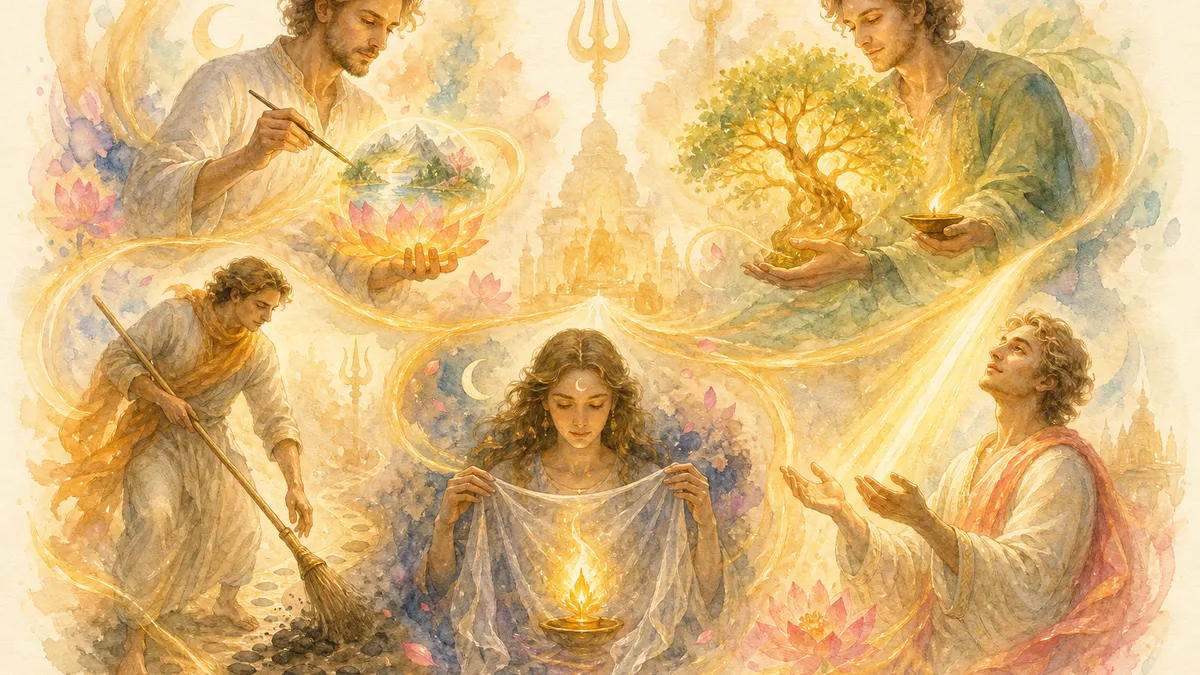
The Five Actions of the Absolute in Our Life
We can understand these five actions of the Absolute through the example of our own life. Srishti-shakti, or another name for it, kriya-shakti—that is, all these five energies are a fivefold kriya, and the energy of creation is srishti-shakti, but it is also called kriya-shakti. The previous four are connected with the doer, with doing, while the fifth is connected with divine grace and blessing.
For example, we all love to create, to make something; we all love to feel satisfaction from what we do—this is srishti-shakti, the energy of creation. We all take care to maintain something when we act: for example, we heat a house, prepare food, we sustain the existence of ourselves and others—this is sthiti-shakti at work.
We also destroy the obstacles that hinder us in life; if something hinders us in life, we remove these obstacles, we use samhara-shakti, without which it would also be difficult to live. We also all use various energies of concealment. The energy of the concealment of the divine means that divine grace exists, but it is hidden; that is, we fold certain things inward, conceal them.
For example, we learn to control the tongue and do not strive to say everything indiscriminately, because we know that if we say everything to everyone indiscriminately, it may lead to not very good consequences. It is right to tell the truth, but one must know to whom and how to tell it, because if you see a poor, suffering disabled person, you may think: “What a poor, unfortunate fellow.” If you say to his face: “You are a poor fellow, you are unfortunate,” you will not make him any happier, but you can remove, conceal your thoughts and say: “Come on, you are just as good a person as others,” — this is the action of the energy of concealment.
All these energies: creation, maintenance, concealment, destruction — they are connected with the sense of ego, the doer, attachment to fruits and results. But the fifth energy of divine grace is not connected with the sense of doership; it dissolves it, removes the illusion.
Whoever knows that Brahman in this way is liberated, without doubt. Having known Shambhu, filled with the five syllables of the mantra “Namah Shivaya,” the very inner image of the fivefold Brahman, one should utter the five syllables of the mantra from “Na” to “Ya.”
There is the six-syllable mantra “Om Namah Shivaya” (shadakshara), and there is the five-syllable mantra panchakshara “Namah Shivaya,” in which we do not pronounce “Om.” Whether you pronounce the six-syllable or the five-syllable mantra, when you recite these five syllables, you meditate on these five energies and the five faces of Shiva. For us, the last energy is especially important, connected with divine grace and with the syllable “Ya” (Namah Shivaya).
One should know everything as the fivefold Atman, which is the very essence of the fivefold Brahman. Whoever, in a state of devotion, contemplates the vidya that constitutes the essence of the fivefold Brahman, attains this fivefold essence and himself shines fivefold.
What does it mean to contemplate the fivefold vidya? Vidya means knowledge, that is, it is secret, hidden divine knowledge connected with the teaching on the five energies, and the task of a sadhu, in knowing God, is to learn to recognize these divine energies, to be able to distinguish them within oneself as in the microcosm. By studying them within oneself as in the microcosm, one studies them in the external world as in the macrocosm, separates oneself from them, and recognizes behind these energies the supreme energy of divine grace, the energy of liberation, Anugraha-shakti; therefore Anugraha-shakti is so revered among sadhus.
The energy of creation is important; without it nothing can be done. The energy of maintenance bestows stability and is also very important. The energy of destruction allows one to cast off old character traits, or to discard everything that hinders, to remove obstacles and limitations. The energy of concealment allows divinity to be concealed so that no hostile forces can interfere with it.
For example, you receive transmission, you receive the Guru-mantra during diksha, and the Guru says: “Keep this secret,” — for what purpose? So that your mantra may sprout in your consciousness as a blessing and no coarser energies may interfere with it. Then you recite your transmission, the essence and meaning of the mantra, in silence; you do not transmit it — this is the energy of concealment. Finally, the energy of divine grace is the most important — it is what we invoke when we worship Shiva and when we recite the mantra and sing arati to him.
Thus Mahadeva told Galava (the great soul); having bestowed grace, he returned to his inner abode. Through hearing about this, one who had not heard it before and was not learned becomes one who has heard and is learned; one who does not understand becomes understanding; one who has not known becomes knowing, O Shakala. Being, in essence, one, a lump of clay differs only perceptibly from all the clay vessels made from it. One piece of metal may be similar to others and one with other metal products, but is tested by scratching with a fingernail. Likewise, everything is known as non-different from its impelling cause, and the cause itself is not separate from the effect and the instrument of action.
Thus truth only appears to be dual, but this is only like a mirage; that cause is one, there is no separateness, and there is no basis for division. Division is always illusory, and the qualities of truth are indescribable; therefore the cause of everything is one, one without a second; the nondual cause is pure consciousness. In that city of Brahman there is a small dwelling, which is this world, O sage; in the midst of it is a lotus, and within it there is a small space. He is Shiva, being, consciousness, bliss; he is that which those thirsting for liberation desire. In this heart dwells the witness of everything without remainder; therefore this heart is called Shiva, the one who saves from samsara.
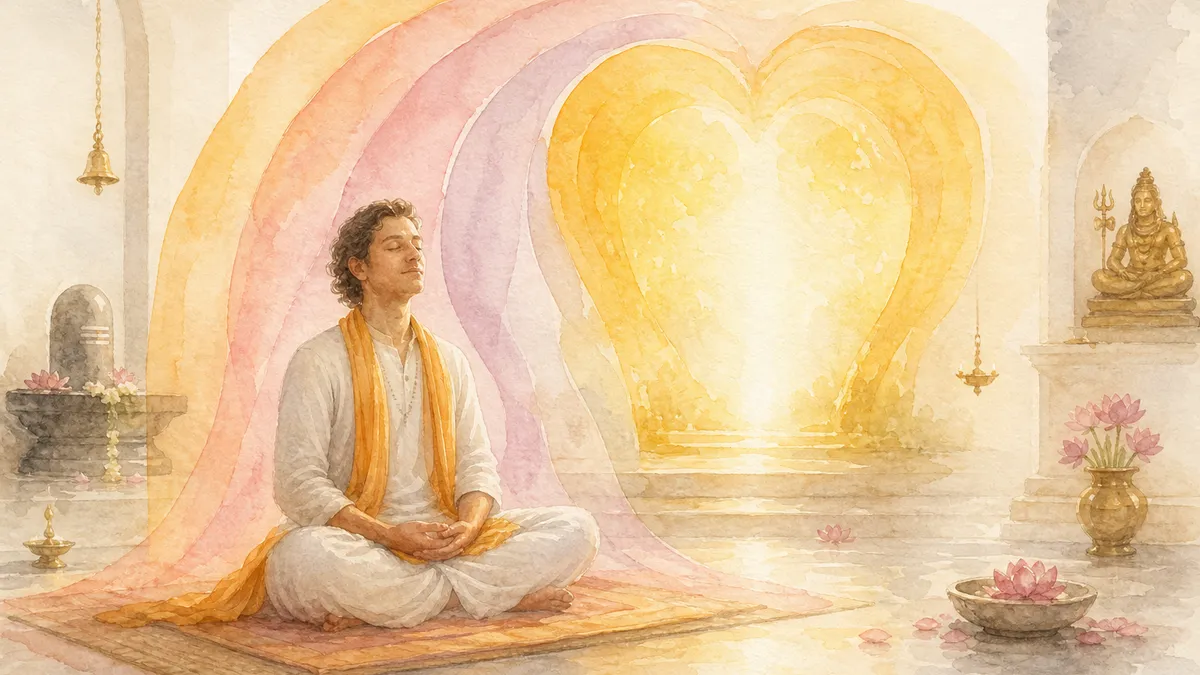
The Spiritual Heart and the Dimension of Turiya
What kind of heart is this? Hridayam is translated from Sanskrit literally as “this is the center,” the place of Shiva’s presence, of His abode. This heart, this truly spiritual heart, is connected with the dimension of turiya. The dimension of turiya surpasses the three previous dimensions of jagrat, svapna, and sushupti (wakefulness, dream sleep, and dreamless sleep); the true heart abides beyond these three. One can often hear of the path of the heart; the path of the heart is precisely the path on which we enter the transcendental abode of Shiva, the dimension of Shiva—turiya. It is in this dimension that the sat-chit-ananda (supreme being, consciousness, and bliss) of God abides. In other words, in order to enter the abode of God, we must reveal the dimension of turiya, pierce wakefulness with the arrow of our awareness, pierce dream sleep and dreamless sleep, and discover this radiant abode of God. Such is the “Pancha-brahma Upanishad” of the Krishna Yajurveda.
Love for God as the Path of Liberation
When we understand that walking the path of liberation means making efforts, purifying ourselves in order to establish a connection with the divine Source, we must teach the soul to aspire to this divine Source in such a way as to love it more than anything else, more than our desires, more than attachments, more than the ego. To love means to strive to be devoted with one’s whole soul, to rely on Him at all times, to think of Him, to direct one’s mind, strength, and emotions toward God. Therefore, when people ask the Guru: “How can one attain liberation?” I say: “One must love God very, very deeply.” One must love Him so strongly that there is no alternative in the other kinds of love that our “I” possesses, so that there is no competition, because our ego, after all, loves many other things as well.
For example, some love money, some love beautiful houses, some love themselves, some love their body, some love cinema, some love politics, some love family, some love their plans, projects, and ambitions. All of these are also various kinds of love that exist in our soul. Some love mystical experiences, but mystical experiences are not identical to God as the ultimate experience; therefore, the path to love for God is the path of renouncing mystical experiences in favor of God, not appropriating them for oneself. The paradox is this: in order to know God, one must learn not only to receive mystical experiences, but also, in the very process of receiving them, to give them away at once—a mystical sacrifice (yajna), so that we learn to give everything to God. Whatever there is, we must be strongly motivated to do this, to strive for God very intensely.
We must love Him very deeply, as our own life, even more strongly, because He is the essence of our relative life and of all lives. Then nothing in samsara can prevent us from going to God, from walking the path of liberation. That is, you cannot say: “I want liberation so much, I love God so much, but this thing is preventing me.” If it is preventing you, it means you love it more than God. For example, work is an obstacle—work provides comfort, which means you love comfort more than God if it is an obstacle. “I am busy with duties, with social obligations”—that means you love society with its false ideas about duty; otherwise it could not compete with your love for God. What else gets in the way: “I don’t have enough time, I’m always busy, busy collecting stamps,” or something else, some supposedly important matter—this means it is competition with love for God.
When you begin to love God, you discover that in samsara God has many competitors, other kinds of love. “I want to realize myself, launch this project, and then enjoy how creative I am”—this means you love this feeling of enjoyment in your own creativity, and it prevents you from truly loving God. This means it is a competitor on your path to God. Therefore, when we begin trying to love God, we discover a great many competitors that lay claim to our love, that constantly try to divide this love. And the attempt to share the love of God with all these competing things is already a kind of betrayal, and God cannot be betrayed with anyone or anything. One must be total in this love. Only when we are total in this love can nothing prevent us, no samsara can seize us; only then can we walk the path to God.
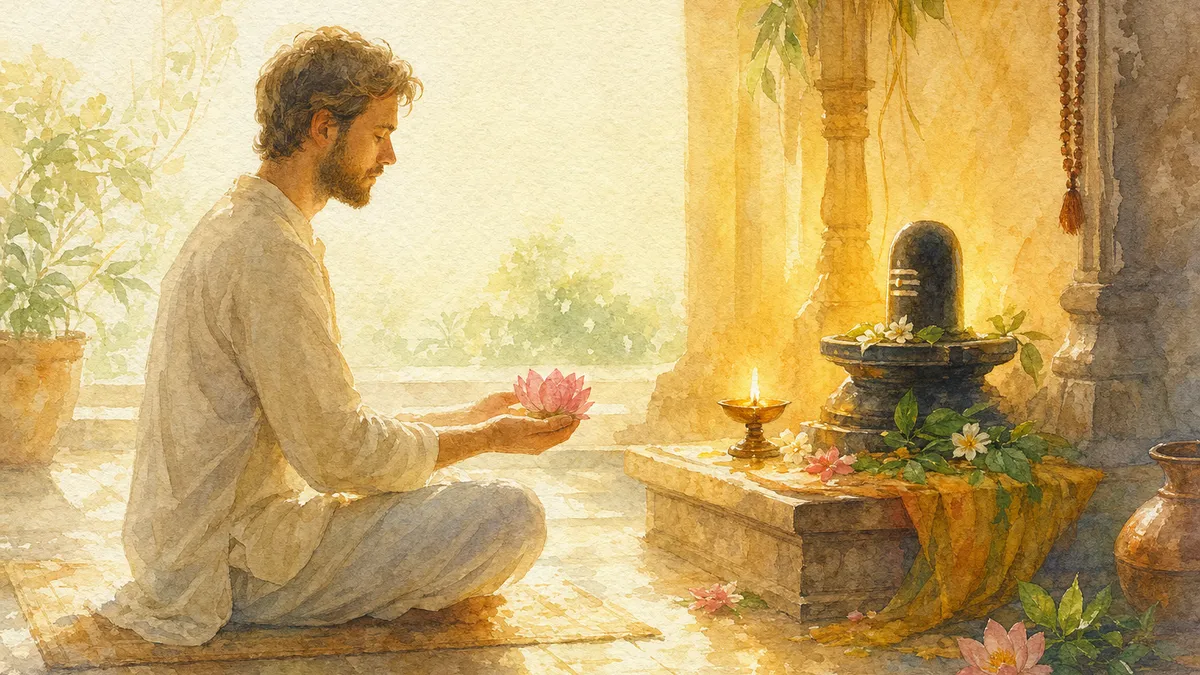
The Art of Love for God
Question: Perhaps the whole reason is that the qualities of God are not so clearly manifested.
The point is that love for God, as long as it is not steady, is like an idealistic, aesthetic love from a distance, which does not immediately give any particularly great sensations. We do not feel a great return from this love. After all, it is customary that if you invest, you receive something back, a return, and every ego understands it roughly this way: “I invested several years in God—study, worship practice, mantra recitation—where is the return?” If you invest in business, turn over money, there is interest. If you invest your attention, care, flowers, and sweets in a person in worldly life, they respond to you in kind. If you invest in science, you receive a candidate’s degree, a doctorate, respect, and honor. But here you invest, and God is in no hurry to reciprocate; for some reason He does not raise your status in the universe, does not grant those benefits, does not pour forth oceans of mercy.
Here the soul is required to have great patience, great humility, and the understanding that one should not arrange commercial bargaining with God at all; that as long as this desire exists, it comes from the ego. And what you want to receive in exchange for these investments is precisely your limitation, because true love for God is completely selfless. It is completely humble, completely pure, it demands absolutely nothing—that is complete self-giving. In truth, it is very difficult to live in such self-giving, by selfless faith alone, demanding nothing. Sooner or later the ego thinks: “But where is the return, where is the mercy, where is the descending grace, where are the signs of this love, where are the indications? God does not love me the way I love Him. I love Him, but there is no reciprocity, and He does not respond to me in kind. What else should I do? Either He neglects me, or He thinks I am unworthy of Him, or my love does not reach Him at all.
He is so distant, cold, transcendent, that He has no concern at all for my love. But if He is omniscient, He is wiser than I am; He should understand my situation, perceive my love. I am the limited one; He is omniscient, all-pervading, all-merciful, so He should enter into my situation, understand my aspirations.” This is the kind of process the soul finds itself in. The art of comprehending God, the art of love for God, is an art that must be learned, that cannot be mastered at once. In the process of such love, the soul begins to understand a great deal about God and about itself. It begins to understand very much—for example, that God always sends it His love, but it is not always worthy, not always ready to perceive it. Sometimes, out of love, out of compassion, God conceals His love for the soul, because its limitations do not allow it to come into contact with it—upon encountering divine love, an unprepared soul may be shocked.
It is like a certain priest who prayed to God:
— Lord, grant me paradise so that I may live in heaven.
An angel descends and says:
— The Lord has heard your prayers. That’s it, get ready, we are going to paradise.
— What, already? I am not ready; I still want to live this earthly life here.
The process of comprehending God, the process of the soul’s divine love for God, the process of self-giving, is a very subtle divine play, in which the soul comprehends divine love within itself to the extent that it is itself capable of giving divine love to God. Such great love requires great self-sacrifice, a great sacrifice, and that sacrifice is our ego. The great love of God, the great blessing, cannot happen without our own great sacrificial love. For God’s great blessing to come, great sacrificial love is needed, because this principle operates: do not ask, but deserve, as long as we are limited. When we overcome our limitations, the principle “deserve” no longer operates there; the principle “receive without any conditions” operates there—divine mercy is available without any conditions.
The Path from Limitation to Divine Mercy
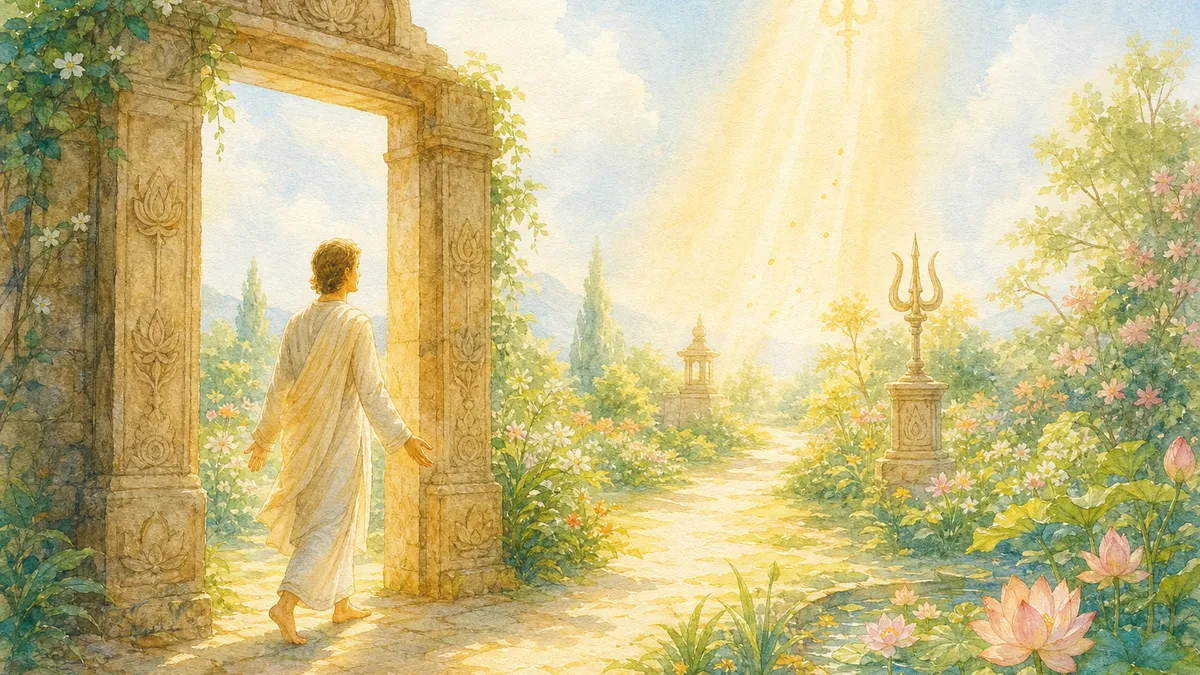
How can we pass through this state of limitation, when we must earn unconditional divine mercy? How can we leave the realm of karma, the realm of necessity, and enter a world full of freedom, divine play, and divine grace, which is conditioned by nothing—neither our self-discipline, nor practice, nor yoga? There is such a condition—the condition of complete surrender to God, complete self-giving, complete self-offering, becoming the hands and feet of God, becoming His illusory body. Then someone may say: “I am ready to become the hands and feet, the body; I am ready to become the illusory body—what should I do?” Indramantrin says: “Become a monk”—for someone, perhaps yes, quite so, but here the question goes deeper. Is this a question of doing? It is a question of non-doing, a question of being. But before we understand this, we must learn great humility, great self-giving, and great obedience.
