

Commentary on the text “Yoga Vasistha. Chapter 3. On Creation”
Rama asked again:
Who creates bodies, the mind, and so on? Who entangles beings through attachment, friendship, sympathies, and the like?
Vasistha replied:
O Rama, no one creates these bodies, and no one entangles anyone. Consciousness has no beginning and is therefore eternal. It alone exists as all these diverse beings. There is nothing outside this consciousness, although it appears external to itself. This appearance arises within it, as a sprout grows inside a seed. This universe exists in consciousness, like a statue in a block of marble. Consciousness, which is everywhere, within and without, extends as the appearance of the world because of time and space, just as fragrance spreads from a flower. Let the mental limitations that create another world come to an end. When one renounces the notion of another world, where can such notions arise? Only one’s own consciousness is real, one’s own essence, devoid of concepts, time, space, and other notions. This is not emptiness. This truth is realized only by those who are established in the supreme state, but not by those who dwell in the sense of ego.
The notion of the existence of the world arises in an ignorant person, just as awareness of its various branches might arise in the so-called mind of a tree. This illusory perception of the objective world, which is called ignorance, in fact does not exist; it is as real as water in a mirage. However, in order for the explanations to be understood, accept this ignorance as real and listen. Then you yourself will understand that it does not really exist.
From the point of view of my own understanding, I do not consider myself a teacher, I do not consider you students, I have nothing to speak about, nothing to ask, nothing to clarify, no one with whom to build relationships, nothing to do. But from the point of view of compassion, of helping others, concepts arise, relationships arise, the teacher, the student, ethics, self-discipline, methods and sadhanas arise, and all this diversity arises.
Creation as Brahma’s Thought-Form
From the point of view of Brahma, the creator of the Universe, the Universe does not exist. The entire Universe is his thought-form. We are Brahma’s thoughts. Brahma knows how to think with great power. If he thought something, it became large, dense. If we think something, it cannot materialize. Our thoughts do not fly anywhere beyond our consciousness. If a siddha possessing sankalpa-siddhi thinks, his thoughts can materialize. He does not need to build chains of cause and effect or strive to achieve something if he has a strong sankalpa. He can immediately create anything at all in his consciousness: any situation, any person, any ability, and generate a cause. In the Yoga of the Illusory Body there are many teachings on how to do this. But if Brahma thinks, he immediately creates the entire Universe.
We are not separate beings; we are Brahma’s thoughts. We are holograms, virtual characters with powerful artificial intelligence and our own will. It is as if, for example, you wanted to create a virtual reality, virtual characters, endowed them with freedom of choice, free will, gave them a certain level of artificial intelligence, and established complex connections.
Even now modern scientists are trying to do this. What, then, can be said of Brahma, who possesses boundless superintelligence, before whom all scientists simply cannot stand on the same level. For Brahma we are his game, the play of his thoughts, the play of his creativity. He created the body, created the astral body, breathed prana into it, connected all of this, set it on a conveyor, created the creators—Prajapatis, Manus—who watch over it and maintain balance; the great game began, the Universe began. One can rest.
He created a unique self-organizing system that reproduces and sustains itself. He set the cosmic rhythms, the law (Rita), the cosmic cycles: manvantara, pralaya, Satya Yuga, Treta Yuga, Dvapara Yuga, Kali Yuga. He appointed helpers who observe this and maintain balance: Manus, rishis. This creation of Brahma—that is what this world is, Brahma’s great entertainment, a great dream, a great illusion. Brahma established the cycles of reincarnation, created various beings, and through saints brought forth a system of ethics, culture, and sacred scriptures. Through certain deities he created expansions that came into this world, gave dharma, various kinds of religions, and prophets. He created various systems of lokas, worlds, hellish dimensions—Vitala, Sutala, Rasatala—up to Satya Loka, Jana Loka, Mahar Loka, the higher worlds of the gods.
This entire Universe is a great thought-form of Brahma. It is very complex; it surpasses the human being in degree of complexity. The human being plays a small role in it. Because forces greater than the human being created all this. Can we understand what time is and control it? Or can we abolish the law of gravity? We do not understand most of the laws from which this universe is created; we know very little. Where do stars, planets, black holes come from? Scientists only construct theories. Brahma has long been doing all this, while they only think about how it all is arranged. But Brahma knows how it all is arranged. Because he created it; these are his thoughts. You know the state of your own thoughts, after all.
Ignorance and Samsara
But ignorance is when we do not understand the essence of this Universe. We think that the Universe is something external, that we are the body, we identify ourselves with the character; then great maya, great illusion, great samsara arises. And we fall under some completely false, fake values, fake meanings of life; we live a wrong life, aimlessly, meaninglessly. Because we have not understood how this world is arranged, what the laws are that govern this world, and we spend our time on what does not benefit us. It is as if a person got involved with bad company: he was taught to smoke, to drink alcohol; bad friends led him off the path of development, and life went down the wrong channel.
Samsara is the world of conditioned existence. From the point of view of the devatas, the gods, this life has gone down the wrong channel. For all of us, life went down the wrong channel as soon as we received a body. From the point of view of the devatas, it is not a very successful undertaking. From the point of view of the lower worlds, it is a very fortunate birth. The beings of hell envy humans; pretas envy humans. One can eat as much as one wants, enjoy oneself. The beings of hell envy humans: no one torments or tortures them. Animals envy humans; for them, humans are like devatas. They eat any food, satisfy any desires, fly on airplanes; they do not understand how humans manage to do this. We are a mystery to animals; we are devatas, gods, for animals. We are very powerful beings to them. They are ready to serve us day and night so that we might satisfy at least some of their desires, just as people are ready to serve the devatas so that the devatas may fulfill their desires. Devatas are something incomprehensible, transcendent to them; it seems to them that they can do everything, know everything. In the same way, humans appear to animals.
But from the point of view of the devatas, human birth is a low form of life, not very fortunate; from the point of view of saints, it is fortunate for attaining Liberation. Some devatas consider it fortunate in the sense that, having received the experience of suffering, one can acquire a great aspiration for moksha, for Liberation, because even devatas have limitations. But enlightened devatas, of course, are much higher. All this happens because there is no correct understanding, no true view of how this world is arranged, what must be done, where to go; all this is simply chaos. This world lives and evolves chaotically, being subjected to certain collective currents, enormous mass currents. The human being in it is like a splinter of wood.
The Parable of the Theater
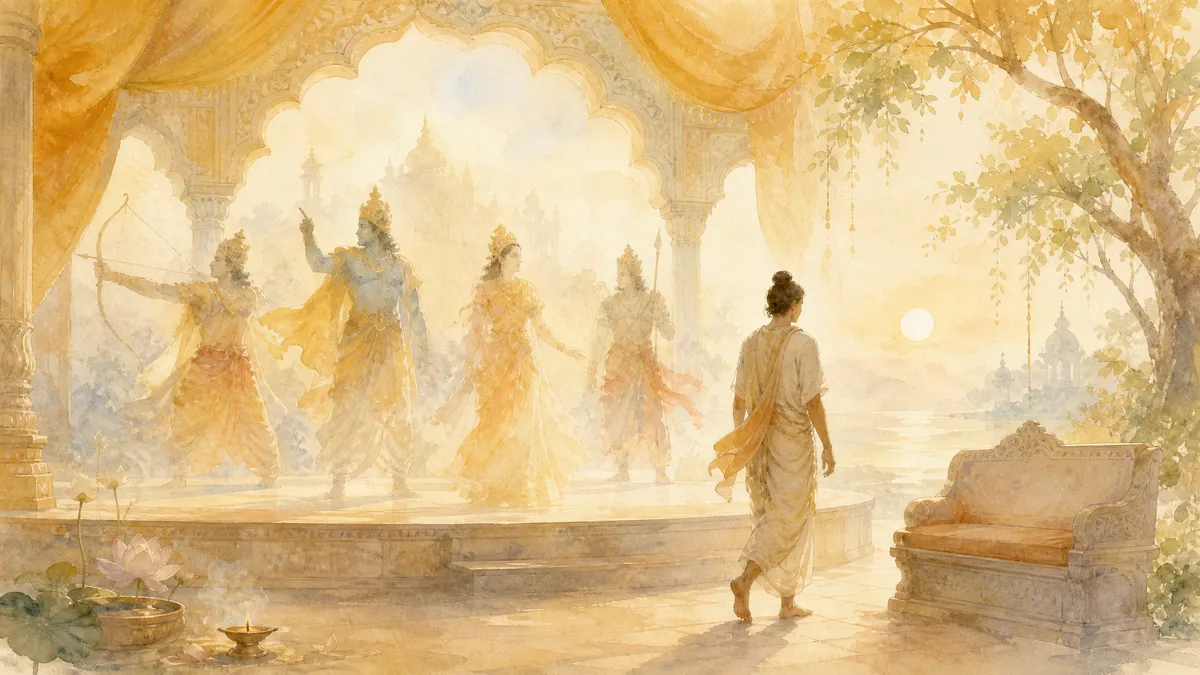
What can this be compared to? Imagine there is a performance in a large theater. In this theater, premieres are presented and various productions are staged. In this theater there are different categories of people.
There are those who come from outside and do not even know that it is a performance—simply people from afar. They look in and think that what is being acted out in this performance is all reality. They see soldiers, kings. When something terrible happens on stage, they become frightened. And when something joyful happens, they sincerely rejoice in it. They think that the kings in this performance are real, the soldiers are real, that love is real, attachment is real. They think: “How interestingly people live.” People from outside do not understand that it is simply a production. These are ordinary people. This is called eternalism, the eternalistic view: not understanding that maya is maya, that all of this is Brahma’s play. When something frightening happens in the performance, these people also become frightened. When someone there suffers, they get involved in these sufferings, empathize and suffer together with them. This is the life of the overwhelming majority of people.
There is another category of people: those who are spectators, theatergoers. They sit and simply watch the performance, enjoying the acting. Of course, they know that it is all a play, and under no circumstances do they get involved in the performance. If ordinary people come in and try to participate in this performance as well, they see that if a soldier is fighting, they think they must help him fight; and if someone speaks words of love, they think: “They have fallen in love with me.” They fall under the sway of all the feelings, not understanding that it is simply a play. The actors here are professionals, with well-rehearsed scripts. And the spectators are those who watch the performance. They know how this performance is arranged. They simply observe, contemplate; they cannot change the performance, cannot cancel it, but they watch it, doing nothing themselves, not getting involved. These are saints, jnanis; they take the role of sakshi, the witness. They witness everything that happens. They are not afraid of the soldiers or the wars in the performance, they do not become attached to the words of love spoken in the performance, to all the family scenes, scenes of power, or natural disasters. They understand that it is all a play. They simply witness and enjoy the play. These are saints, jnanis. Jnanis are like such spectators who observe this performance; they do not participate in it. It may seem as though a jnani participates, but it is his body that may participate, according to prarabdha. But their consciousness simply sits motionless and contemplates.
There is another type of jnani who does not particularly want to sit in the hall; they perform on the stage. These are good actors who enjoy the play. They sincerely play the roles of mothers, fathers, kings, soldiers, servants, anyone at all, but they know that they are actors. This is another type of jnani; they also do not identify. These are active jnanis, siddhas like Narada. Of course, it does not occur to them that the performance is reality. They are actors; they simply perfect their acting skills. There are such jnanis. They take on the role of teachers, create various missions and ashrams, gather disciples and teach them, playing at being teachers. All of these are different performances.
For example, King Janaka played the role of a king; Buddha was a great production called “Buddhism.” Rama—productions are still staged and films are still made based on this performance. Krishna took part in the colossal performance of the Mahabharata. But all these actors understand and are not deluded; these are games.
Finally, there are the scriptwriters of these performances. These are rishis, devatas, higher beings. They are the ones who write the script, receiving instructions from the theater director. There is a theater director: this is Brahma, who created all of this for his own entertainment. This is roughly how the Universe is arranged according to Vedanta.
But a person who is in ignorance is like someone who has come from a village and has never seen a theater, and does not know at all what theatrical art is. When he enters for the first time and watches the production, he thinks that all of it is real and gets involved in the games. And the actors play along with him and give him some role. He plays these roles until, finally, he begins to understand what is happening. The spectators, seeing how ingenuously he takes all of this “at face value,” amuse themselves by watching, seeing how he suffers, cries, falls in love, thinks he is a soldier or a king—they observe. But in the end, this common man begins to realize that something is not right here. Someday, one of the spectators will hint to him that all of this is unreal, that all of it is a play. He can take the position of an observer, a witness, sit down in the auditorium and calm down. Stop running from one actor to another. Or he can remain an actor, but he will understand the essence of this performance; he will simply play.
View and Spiritual Practice
View means that we understand how this world is arranged. We give rise to jnana within ourselves and try, from the state of common people who think that the performance is reality, to become witnesses, spectators, or good actors. Witnesses, spectators, are those who are more inclined toward monasticism, retreats, mauna, and contemplation. They simply enjoy the actors’ play from the auditorium. Those who have a lot of active prarabdha karma are good actors, those inclined to play different roles, karma yogis. Both possess knowledge, but karmas manifest in different ways.
Everything begins with such a view, with such an understanding.
The Laws of Brahma and the Path of Transcendence
The scriptwriter of this great theater called the Universe is Brahma the Creator. He established the basic constants, the basic principles of the universe, the laws. These laws are called Rita, niyati, the course of things, time, space, causality. These laws are very powerful. They operate cyclically according to Brahma’s sankalpa. Within these laws, as long as our consciousness is weak, we are part of these laws. Our task is to transcend Brahma’s sankalpa. We cannot abolish it; we can free ourselves from it or move into higher sankalpas of Brahma.
Our task is not to remain human. To remain human means to remain within limitations. If you want suffering, then you can continue to remain human. But a sadhu is one who does not want to remain a human being; he wants to transcend the human within himself, to become a siddha, a devata, and at the maximum—to become Brahma the Creator himself, to reveal his potential, to reveal his shakti. One who wants to remain human has not outlived his karmas, the karmas of the lower chakras, has not untied the Vishnu-granthi. The Vishnu-granthi creates human karma; if it is not untied, one wants to be human—if the Vishnu-granthi is not untied. But moksha means untying this knot and untying within oneself all limiting karmas, becoming a God-man, going higher. Therefore, under no circumstances may a sadhu remain human; he must constantly create the sankalpa to become higher than a human being. A sadhu who has stopped in his development and thinks: “I am human, I will be human and die human,” is a foolish sadhu. This is not a sadhu; this is a human being who has not yet realized the spiritual path. Because moksha, the path of Liberation, is the path upward, upward, upward, far upward, beyond the moon; it is like flying far away into space.
In childhood, the world of people did not inspire me. For a long time I wondered what to do with it. I had nothing in common with it. It seemed very low to me. For the first twelve or thirteen years, I was pursued by the thought: “How did I manage to end up here?” Because the work of consciousness was stronger, higher. I thought: “I need to become a cosmonaut and get as far away from here as possible, to the center of the galaxy.” In all seriousness, I was preparing to join the cosmonaut corps, to enroll in an aviation school; I studied astronomy and the autobiographies of great cosmonauts.
In the same way, a sadhu strives to transcend his humanity, to move toward divinity, to become a deity, a devata. This means he must rid himself of everything that binds him in this world of people and develop new qualities.
The Difference Between a Human Being and a Devata
A human being is a being limited by time, space, karma, causality, his body, and his mind. A devata is a being without limitations, an enlightened deity. A human being lacks jnana-shakti, the power of wisdom, because he cannot unite his mind with his source; it is very difficult to do this, the pressure of the sense organs is very strong, there is no jnana, and great tapasya is needed for there to be jnana. Devatas have very powerful jnana. All enlightened devatas possess very great jnana-shakti, great clarity and wisdom due to the fact that they are in unity with the source.
Since jnana-shakti is suppressed in a human being, svatantrya-shakti, the power of inner freedom, the power of self-liberation, is also absent, suppressed. Devatas, siddhas, and rishis have very powerful svatantrya-shakti, self-liberation. We often use the word self-liberation; this is svatantrya-shakti. By practicing contemplation, we strengthen our svatantrya-shakti. By practicing the View, we practice jnana-shakti, and then the View must work; it must not be philosophy. When we apply the View in life, this is svatantrya-shakti. Someone says: “I understand everything, but I cannot self-liberate.” This means there is not enough svatantrya-shakti. If there is some energy and we cannot be free from it, it captures us—the energy of thoughts, emotions, or the body—this is svatantrya-shakti.
But the gods possess very powerful svatantrya. They can enter the body of a bull or a donkey and not lose their jnana, possess siddhis, and be immortal. They can experience various sensations, enter the most incredible tamasic realms, but not lose their sankalpa, their jnana; they can descend into hellish dimensions and save beings from there. They are free, like a lotus that is stained by nothing.
The Source of Svatantrya-Shakti and the Development of Divine Will
Where does svatantrya-shakti come from? It comes from bhava, from jnana. If there is strong bhava, strong jnana, then svatantrya-shakti is also strong. Therefore, when a person feels that they lack the power of self-liberation, svatantrya, they need to return to jnana and develop the view, jnana-shakti, rely on the view, remember that the world is Brahma’s play, that all of this is an illusion, read texts, and generate the view again. Then svatantrya-shakti will begin to appear.
But since a person’s svatantrya-shakti is strongly suppressed, their will is also suppressed. Iccha-shakti is also undeveloped. Among the devatas, iccha-shakti is very strongly developed. The will of a devata is law, but the will of a human being is not law.
To be a sadhu means to develop one’s jnana-shakti, svatantrya-shakti, and strengthen iccha-shakti. If your will is strong, you can change much in this world; you can change your karma, moving from the human state toward the divine.
Transcending Human Limitations
People, as a rule, want to remain in the status of human beings, but a sadhu strives to enter another status, the status of a devata, a deity, and to remove the limitations that bind them. They do not value human life all that much; they do not consider the comfort or happiness inherent to a human being to be something valuable. Just as some great king does not consider a plot of land and a peasant’s small house to be something valuable. If he is told, “We are giving you a small house, a plot of land, and two oxen,” the king will say that this does not particularly impress him. It has no value for him.
In the same way, if we strive to transcend the human state, human values are not something we should pay attention to. They simply hinder us. To the extent that we can set aside human values and free the soul for divine values, to that extent our development will be faster, provided, of course, that we set the goal of becoming a sadhu and following the path of spiritual development.
What does a sadhu want to become? A sadhu wants to become a devata, a siddha, a deity who has transcended time, space, and causality.
The Limitations of the Human State
The human state that we observe now is a low state. Humanity at present, from the point of view of the devatas, is not in a very developed state. People have cultural limitations, intellectual limitations, limitations of the body, racial, religious, and ethnic contradictions, conflicts, and wars. The entire history of humanity is a struggle for scraps of land, for resources, a struggle for means and for influence. This is because there is a great deal of selfish will that is incapable of drawing energy from higher sources, that seeks to take for itself by suppressing others. There is a great deal of selfish consciousness.
But a human being could become immortal, go out into space, and attain limitless resources. They could remove religious, cultural, and any other limitations if they developed their jnana and svatantrya-shakti. Space is boundless; there could be enough for everyone.
The State of a Devata and Pure Vision
The state of a devata is a state arising from brahma-aham-bhava, from the experience of divine pride. In the state of a devata, this is pure vision. Then an entirely different tunnel of reality is born. And in this tunnel of reality, other laws, other physics, and other concepts operate.
A devata lives not in karma, not in cause and effect, but in the state of play, lila. A human being lives in karma, in cause and effect. For them, this world is an uncontrollable story, a cyclically repeating story created by Brahma. An uncontrollable story is samsara, where cause and effect operate, and they cannot understand that it comes from their consciousness and cannot manage it.
But for a devata, it is not so. There are no causes and effects outside their consciousness. Whatever causes and effects they wanted, they created; whatever they wanted, they canceled — history is managed in the state of a devata. There is no samsara for a devata. They step out of it.
Karma as a Manifestation of Human Foolishness
If a person, without managing history, without managing cause and effect, is subjected to karma, prarabdha operates, sanchita operates, and agami karma operates. Their own thoughts and their own actions act upon them. Such is this deplorable state. A person thinks, and then their own thoughts return karma to them. Because of this, they suffer. In truth, it is a very foolish state.
Prarabdha karma is nothing other than human foolishness. A person thinks, thinks, thinks, shifts himself into a certain reality tunnel, and then receives the karmic return of what he has thought; and, not understanding this law, he thinks incorrectly, thinks badly, various sufferings happen to him, and he thinks that this is fate, that this is God’s punishment. It is his own thoughts that punish him. This is an utterly foolish state. This is samsara — to think incorrectly, to be unable to self-liberate thoughts, and then to fall under their influence, to fall under one’s own prarabdha.
No other karma exists except prarabdha created by one’s own thoughts. But the devatas are amazed when they look at a human being. They say: “Why create prarabdha with your own thoughts? It is like building cages and then sitting in those cages.”
The Multireality of the Devatas
Devatas live in a state of multireality, multibodiness; they do not have just one reality, they can visit many lokas, they do not have just one body, they can create many bodies — the siddhis of the illusory body. Devatas possess sankalpa-siddhi. They can control reality through the power of consciousness.
Devatas do not live in the ordinary world; they live in a mandala. A mandala is a personal reality tunnel. A personal reality tunnel created by the power of consciousness — this is how a devata lives. This reality is created by the mind. Wherever a devata may be, at any point in the Universe, he creates a reality tunnel by the power of reason. He does not need a house, he does not need a planet. Wherever he appears, he creates the area in which he can live. They play in personal reality tunnels, control reality by the power of thought, possess many bodies, and travel through various worlds — these are the devatas.
Aishvarya Shakti and Power over Time
Such a state is due to the fact that the devatas have a highly developed iccha, the power of will; iccha endows them with omnipotence, with aishvarya. When the will gains strength, the next shakti manifests — aishvarya shakti, the power of divine authority, divine omnipotence, the power of divinity.
Aishvarya means that you can subjugate time, you can enter the past, you can enter the future, you can loop time, you can swap cause and effect, establish circular causality, you can stop it, make it cyclical, you can even create timelessness altogether. Time is not a problem for you. This is the state of a devata.
A devata can enter your mind, stop it, and send you to rest for two hundred years somewhere on islands with palm trees. You will enjoy yourself there, live there, live an entire life or a long time, you will grow tired of it, and then return back; the devata will bring you back, and in this world two seconds will have passed, and you will again find yourself at the lecture. One or two seconds will pass; you will not even have time to understand anything. But you will have lived an entire life. A devata can create such time for you, accelerate time or stop time.
There was a man in a Tibetan monastery who was carrying tea to the guests, to the teachers, on a tray. He stopped in the doorway and entered some kind of state. Everyone was wondering where the tea was, where the tea was. About eight hours passed; he got up as if nothing had happened and went on, carried the tea, he did not even notice, and he was very surprised that so much time had passed when he was told. But someone noticed him and said: “Do not touch him; the pranas have entered the central channel, filled the vishuddha chakra, and he has entered another dimension of time.”
There was another man. When several practitioners in the Himalayas went for a walk, one went to the stream for water, sat down by the stream — a good place, a cave — to meditate. He spontaneously entered deep meditation. The other people searched for him for three days, did not find him, and left — they thought he had disappeared. Fifteen years later he returned and said: “What is going on, why have such changes occurred?” They asked him: “Where were you, where did you disappear to?” He said: “I went and meditated for about fifteen minutes.”
Power over Space and Tapasya
A devata can freely control the state of time. He is not dependent on time. Time is subject to his aishvarya, because he sees: there is no time as such; time is a derivative of consciousness. The cycles of time are created by consciousness. However consciousness sets these cycles of time, so it will be. Time does not exist in itself; it is a subjective factor.
A devata is also capable of changing space; he understands that the dimensions, geography, topology of the world, coordinates, and space are not real; they operate only as long as there is human vision, human consciousness. If, through the power of samadhi, you can enter another loka, you will see that the laws of space operate differently there. Even in India they operate differently. Eighty kilometers in India is not eighty kilometers in Russia. In Russia you will travel eighty kilometers in an hour; in India it may take three hours. Even time in Russia and in India are different things. If in Russia they tell you fourteen hundred, it will be fourteen hundred. If in India they tell you fourteen hundred, it is fourteen forty-five, fifteen hundred, and so on. A different tunnel of reality, a different vision. But the devatas control this.
To transcend the human level and attain the state of a devata, tapasya is needed; great effort must be applied. Everything is born through tapasya, everything comes through tapasya. What kind of tapasya exactly is something the sadhu himself must choose. Inner tapasya (antar-tapasya) or outer tapasya. But in any case, everything must be reduced to tapasya. Through tapasya spiritual growth is possible. Even a small tapasya is capable of revealing many qualities within you.
Fivefold Kriya Shakti
Thanks to aishvarya, devatas possess immense kriya shakti, the ability to create, destroy, sustain, conceal, or manifest the divine. Mastery of these shaktis:
- jnana shakti
- svatantriya shakti — the power of liberation
- iccha shakti — the power of divine intention
- aishvarya — the power of divine omnipotence, lordship
- fivefold kriya
This is a sign of a devata, a sign that the deity possesses the fullness of all powers.
Unity of Essence and Difference in Shakti
In our essence we do not differ from the devatas, from the enlightened gods, from the lords of universes. We differ only in shakti; in essence we do not differ. Within the devatas is the Atman; within us is the Atman. All devatas are upadhis, vessels of Brahman; they are amshas, his expansions, partial manifestations, emanations. And we too are emanations of the Absolute. Qualitatively we do not differ in any way, but quantitatively we differ very greatly — in the level of shakti.
The Path of Developing Divine Qualities
Everything begins with our becoming rooted in the View, firmly rooted in the View, and acquiring the power of jnana, jnana shakti. Until we acquire the View, no other development is possible. All mantras, pujas, and rituals are needed only in order to understand jnana, in order to acquire jnana shakti.
When we become rooted in the View, the View begins to liberate us, to truly liberate us. Then svatantriya shakti develops. From svatantriya shakti we develop our own iccha, will. This will gradually gives us the opportunity to influence reality, to change our body, our destiny, our karma. All this is possible because there is nothing outside consciousness. Because the entire world is Brahma’s great dream. That is precisely why we can become liberated and influence reality. Because from the very beginning there is nothing real.
Vasishtha’s Teaching on the Nature of Reality
Vasishtha says:
Only the power of infinite Consciousness exists here as the impassable illusory power of delusion. This power is beginningless, infinite, and indestructible. Time, space, matter, movement, mind, intellect — all are merely particles of consciousness, like particles of stone. This mass of consciousness considers itself to be the world. Although it is infinite and beginningless, it thinks that it has a beginning and an end. By this, it seems to become so. This mass of consciousness has no form, yet it assumes form. There are no rivers here. There is no wheel of life and death here, and no matter that changes and transforms. All this is merely reflections in the space of infinite Consciousness. Just as in cosmic space there seems to exist a space called a house, and another called a pot, all these so-called “worlds” exist in infinity, which is indivisible and which is in no way diminished by this.
For example, if there is cosmic space, and we place a house in it, place a pot in it, then conventionally one can say that there is the space of the house, the space of the pot, but in reality it is one space. The space inside the house, the space inside the pot — it is one and the same space. The house and the pot do not create space; on the contrary, they enclose it, obscure it. But they obscure it only as long as we do not understand the nature of space.
When we understand the nature of space, we see that neither the house nor the pot obscures the true nature of space. When the house disappears, when the pitcher disappears, space does not disappear; it remains. When the house appears, when the pitcher appears, space again does not disappear; it also remains inside the house, inside the pitcher.
The Search for the True Nature
Our primordial awareness is space. Dattatreya is space; it is simply a name given to this space. Another of its names is Rama, or Vishnu, or Krishna. But no matter what we call it, space will not change its essence. There are many names that we do not even know, which existed in other kalpas, temporal cycles.
Babaji once spoke this way at a conference when we were invited to one of the temples: “You seek Buddha, you seek Krishna, you seek Vishnu, but you never seek yourself.” Because you do not seek yourself, you will not find God. Because until your search becomes inward, you will not go beyond form, you will not understand the essence of the devatas. The essence of the devatas and the essence of your consciousness are one and the same. You cannot run away from this search. In some lifetime, you will have to take it up.
Space as the Basis of Divinity
Everything begins with the understanding of this space. This space is the basis of jnana-shakti; it itself is jnana-shakti. You either have this space or you do not. As long as you do not have this space, you must concentrate in order to open it. This is not yet the end; it is only the very beginning. From this space the power of your jnana-shakti will be born, the power of self-liberation, svatantrya, will be born, the power of intention will awaken. You also have intention now, but it has no power whatsoever. Your aishvarya and your fivefold kriya will awaken. From here you will begin to become devatas. Space is the seed from which your divinity grows. If you know this secret, you transform from the human dimension.
The Analogy of the Mirror and Reflections
The example of a mirror and reflection is often given. If Buddha is reflected in the mirror, or a dog is reflected, the mirror is not stained in any way. It remains the same mirror. Various dualistic things are reflected in space, but it does not change its nature in any way. If nothing is reflected in the mirror, or if a billion objects are reflected, the mirror will not become dirty, will not grow tired. These are simply reflections; they do not stain the mirror in any way.
The mirror of our mind is space. It cannot be stained by anything whatsoever. The bad cannot stain it; the good cannot improve or purify it. To think that something can purify the nature of our Mind means to be mistaken. It is always naturally inherent in us. The perception of objects cannot obscure it. The absence of the perception of objects cannot manifest it. It always exists.
But our mind simply does not understand the difference between the mirror and the reflections. It does not see the mirror and is strongly attached to the reflection. It thinks that the reflections truly exist, while the mirror, as it were, is not there; it does not see it. Then it pays attention to the reflections in the mirror, to the connections between them, the sizes of the reflections, their color, their form. This lack of understanding makes everything wrong and leads us down the wrong path. Samsara begins from here, when we attach importance to the reflections and fail to notice the mirror.
The Practice of Contemplation
The process of contemplation, of self-liberation, means entering the state of the mirror and ignoring the reflections. The mirror is jnana-shakti, the source of jnana-shakti.
At first we simply have to read a great deal, and think about it. To read means shravana: to listen, to study. And to think means manana: to reflect, to perform analytical meditation. But later all of this must be discarded and one must simply enter into non-conceptual contemplation. Simply remain in it. This is called nididhyasana. Shravana, manana, nididhyasana.
To remain constantly in the state of the mirror, allowing it to gain strength, to take root, to deepen, to become stronger and stronger. To try not to be distracted.
Stages of Spiritual Development
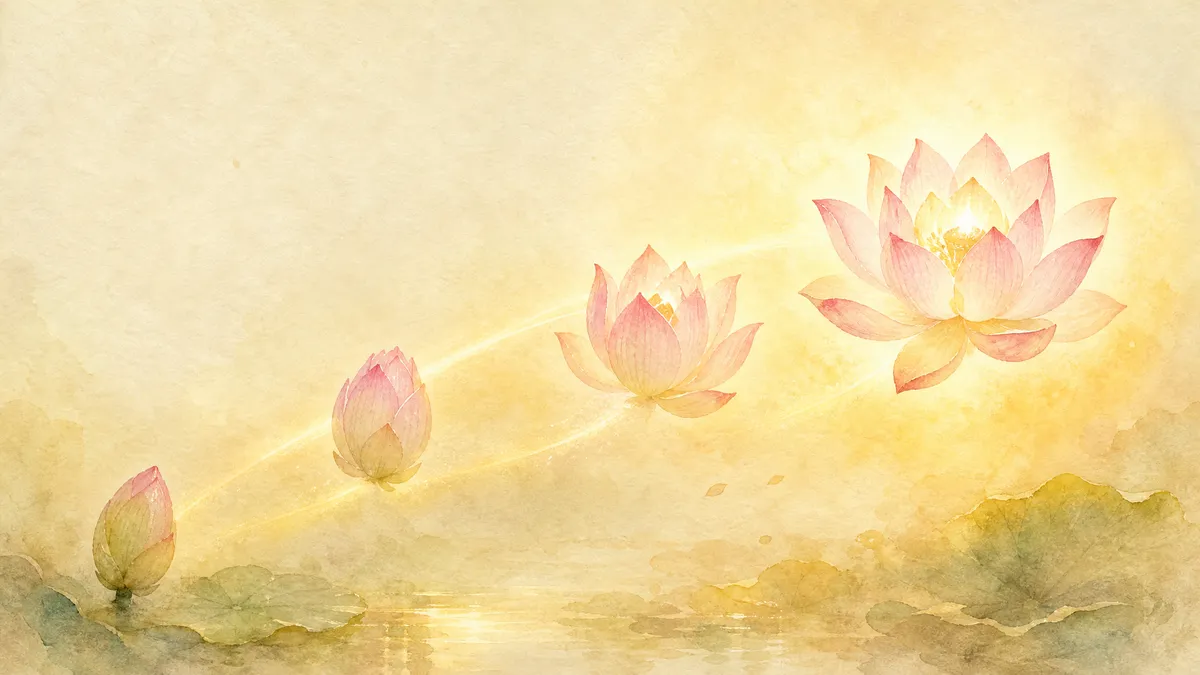
When you first entered the state of the mirror, this is called the state of “conception”: your inner immortal devata, your inner Buddha, received a seed within you. But it still has to be gestated; it will not be born immediately.
When we continuously practice contemplative presence — standing, sitting, lying down, speaking, while eating, walking, working — this is called “gestation, the stage of gestation.” If this is carried for a long time, one day “birth” will occur.
At the stage of “gestation,” it is very important not to be distracted, to become a master of contemplation. And at the stage of “conception,” it is very important to discover this space. Before that there is the stage of “transmission” — to receive transmission, inspiration from the master into this space.
If you work with this correctly, sooner or later you will receive transmission, the stage of “conception” will come, and you will begin to carry it. This is the path followed by all saints. Walking this path, all the saints of the past attained Enlightenment, all the saints of the future will attain Enlightenment, and all the saints of the present have attained Awakening. Without walking this path, it is impossible to attain Awakening. This is the path walked by the Buddha, Dattatreya, and all the saints. Krishna abided in it.
But when people do not understand the principle of space, the principle of the mirror, and pay attention to the reflections, religions, philosophies, rituals, mantras, and forms of devatas arise. All this creates great confusion. It is not bad as a method, but when it is confused with the mirror, all of it is ignorance, forms of ignorance.
The Separation of Method and Wisdom
Our task is to separate the mirror from the reflections. Such an approach in spiritual life is called separating prajna and upaya, method and wisdom. Let us say that prajna is the mirror, it is space, while method is mantras, forms of devatas, rituals, temple worship, philosophy, yoga — all these are methods.
It is necessary to understand clearly: this is method, and this is wisdom. When we practice method, this is called conduct. Conduct, that is, the way of life in sadhana, the way of manifesting in the relative dimension. And when we practice contemplation, wisdom, this is called view. We abide in the view of jnana.
Untangling this knot between method and wisdom, view and conduct, is very important for a yogi. Because if you do not untangle it, you will constantly confuse the mirror and the reflections. And you yourself will be confused about what to practice.
For example, people practice rituals, practice japa, practice temple worship of devatas, arati, puja, and may devote all their time to this. But if they do not understand the view, do not understand the mirror, all this will simply be good karma for the next life, merit, nothing more, not moksha. It is simply charya, good actions that create a favorable destiny in the next life. But it is not jnana.
Or a person may practice Hatha Yoga, Raja Yoga, Kundalini Yoga, do asanas, pranayamas, recite mantras, but all this is the practice of upaya. If there is no jnana, wisdom, prajna, no view through personal experience, this will be endless sadhana for many births. It is not moksha.
Two Extremes: Eternalism and Nihilism
On the other hand, there are jnanis, Advaitins, who say that none of this is Brahman, that it must be discarded. Ritual is not Brahman, so we discard it. Like Swami Dayananda Saraswati, who went around temples and said: “The Vedas say that Brahman has no form, so why have you set up all these forms, these gods?” And if someone could not defeat him in debate, he would smash all the forms. He said: “I am purifying the Vedic tradition. Shankara said Brahman is beyond form, the Vedas say Brahman is beyond form. You have set up forms here.” And everyone feared him. This is the other extreme, nihilism. When you have become so exhausted by all forms and methods, you think that everything must be discarded, and you should simply abide. Simply abide in space, do nothing, remain in non-action.
The first is eternalism, a deviation. It is when we are outwardly oriented and believe that everything truly exists, and instead of turning to our own consciousness, even in sadhana we pay attention to the external. We constantly perform karma-kanda, rituals, ablutions, pujas, arati, Hatha Yoga, and other things, but we do not understand the essence; we consider all this to be reality. This is eternalism.
The second is nihilism. It is when we grow tired of these forms and decide to discard everything. When we discard, we deny everything. Since Brahman has no form and cannot be attained through effort, there is no need to do anything; one should abide in non-action, be formless, and hold to that. Some Advaitins practice in this way. They avoid any forms, ritual worship, mantra recitation, any identifications, frameworks, rules, conventions, almost everything; they avoid communication, meditate only on the mahavakya Aham Brahmasmi, and contemplate the Absolute. If you ask them: “Do you do techniques, mantras?” They will say: “Neti-neti, this is not Brahman, this is maya, Shankara said: all this is maya. One must stay away from it.” In principle, this is a correct position. But if there is denial in it, then it is a form of nihilism.
The Path of the Jnani: the Unity of Method and Wisdom
You may do any sadhanas, mantras, asanas, go to temples, but do so correctly, beyond eternalism—not denying them, but remaining in contemplation, in presence, remaining in space. Then the main thing for you is space. And whether you recite a mantra or not is no longer important. It is a play. Whether you perform puja, arati, or do not perform them is no longer important; it is a play arising from presence.
Most importantly, eighty percent of your consciousness is in presence, in contemplation, and twenty, ten percent you may devote to mantra, the veneration of a devata, rituals, methods, and so on. But eighty percent abides in jnana, in space; this is how a jnani acts on the path of Laya Yoga. Any jnani acts in this way. He can accept everything, do everything, but as a play, without identifying with anything. Everything is self-liberated from the very beginning; he himself abides in presence.
Whether you speak ordinary words, whether you recite mantras, or even use foul language, if you do it in presence, all of it is one speech. It does not matter what is said; for saints and siddhas there is “one taste.” Bad words, good words, neutral words, worldly words, spiritual words, words of the devatas, words about the weather—all of this is one taste. Because no words can obstruct space, and none can improve it. Eighty percent of consciousness is in jnana.
Whether you think good thoughts, whether you think bad thoughts, whether you think neutral thoughts, if you abide in the state of space, bad thoughts will not pollute it, good thoughts will not purify it, neutral ones will not interfere. Everything self-liberates. It does not matter what you think. You are on another plane.
Whether you perform good deeds, whether you perform neutral deeds, whether you perform bad deeds, it does not matter, because the main part of your consciousness is in space, in presence. Of course, no sensible jnani will commit bad deeds, due to his sattvic nature and clarity. Because he will do nothing unnecessary.
He also knows that there are no good deeds, no bad deeds; these are human notions, dualistic ones. People like something and say, “This is good.” They dislike something and say, “This is bad.” But in the primordial space there is no morality, no ethics; all these are products of the mind, artificially created. That is precisely why the jnani understands that any actions self-liberate in space. Although he always acts in accordance with ethics and the circumstances of this world.
Then the nine self-liberations arise: speech, body, mind—everything self-liberates in the primordial space. Because there is jnana-shakti.
The Awakening of Jnana-Shakti
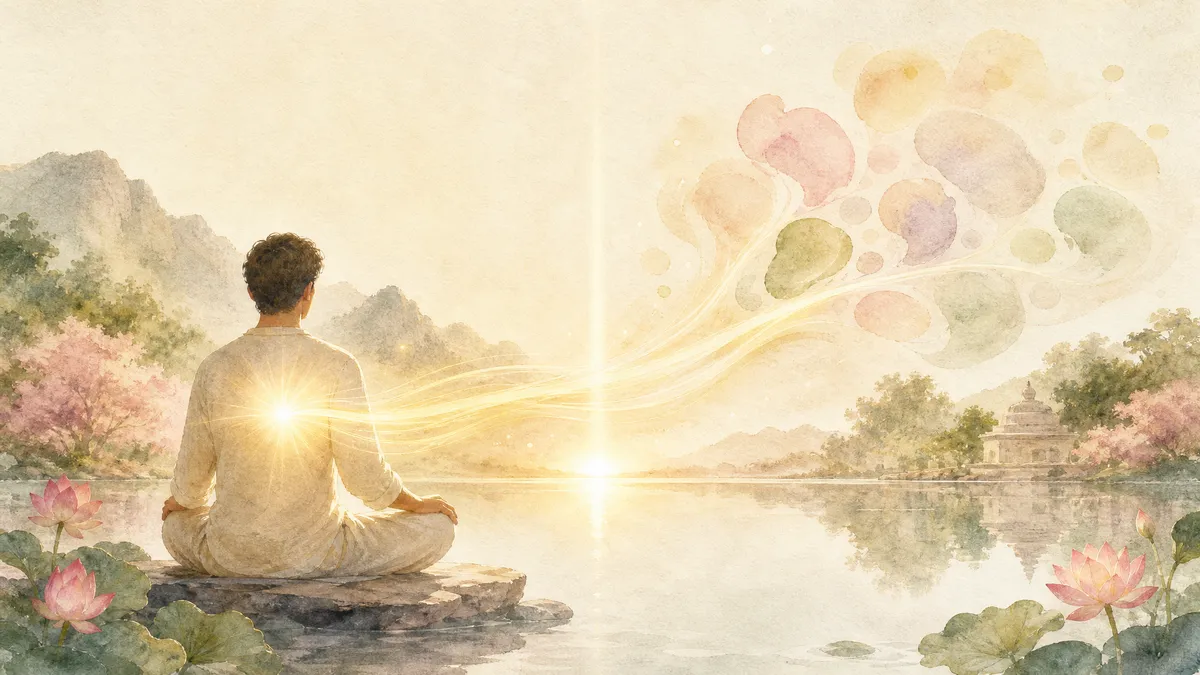
Our task, if we want to become awakened devatas, is first to awaken our jnana-shakti through the view, to establish ourselves in this space. How? There are methods. If you apply them, they work. Shambhavi Mudra, Atma-vichara.
The most important thing here is to awaken the consciousness of the witness, witnessing awareness—non-evaluative, choiceless, beyond concepts, in the state of amanaska. And from this layer of awareness, everything will begin to open and develop. This layer of awareness is the source of jnana-shakti, svatantriya-shakti, iccha, aishvarya, kriya, all powers.
If, however, we act from a lower plane of awareness, from conceptual thinking, from the level of evaluations, from the level of a labeled vision of the world, from duality, we have no access to this Source. Jnana-shakti then cannot be born. Svatantriya cannot appear, iccha is also weak, aishvarya cannot appear.
This Source is God, amanaska, niralambha, the beyond-thought, the supportless. It is the essence of Krishna, the essence of the Buddha, of Christ, that of which Muhammad spoke, the essence of any religious practice.
Religions as Interpretations of the One Source
Practically all religious practices are nothing other than a philosophical, conceptual interpretation of this state. But, not understanding this, people attach importance to conceptual interpretations and philosophical systems; contradictions arise, attachments to their own systems arise, and all of this greatly confuses people. Then Buddhists, Hindus, Christians, and Muslims appear.
When they appear, each has his own interests, taste, and preferences. Following this comes a struggle for influence, a struggle of interests, culture, a clash of cultures—all of it as usual. All of this is called samsara.
When you move away from this, you become free. Your path becomes individual. There is no collective path. The collective path is an illusion. We are not born together with someone, but individually. We also do not die as company, but individually. We also develop spiritually individually, come to the master individually, meditate individually. The sangha is important as a jewel, good company is important as an auxiliary means, but the spiritual path is individual.
The Individuality of the Spiritual Path
When you come to the nature of the Mind, you will see no one there except your own “I”; there will be no second one there to keep you company. Having arrived, you will not see Buddha sitting there, or anyone else. You will see that you have become Buddha there, you have become all living beings; all living beings are with you there as consciousness, but not as a person, not as an individuality.
You are one with all beings, but there are not two there, there is no multiplicity, no multiplicity at all. Multiplicity exists here, in the relative. Here you are a body, I am a body, you are a mind, I am a mind, you are an ego, I am an ego, and there are many of us. This is multiplicity. None of this exists there. The concepts of “you” and “I” are absent there. My body, your body are one; my mind, your mind are one. My will, your will, my ego, your ego.
Spiritual Sangha and Samaya
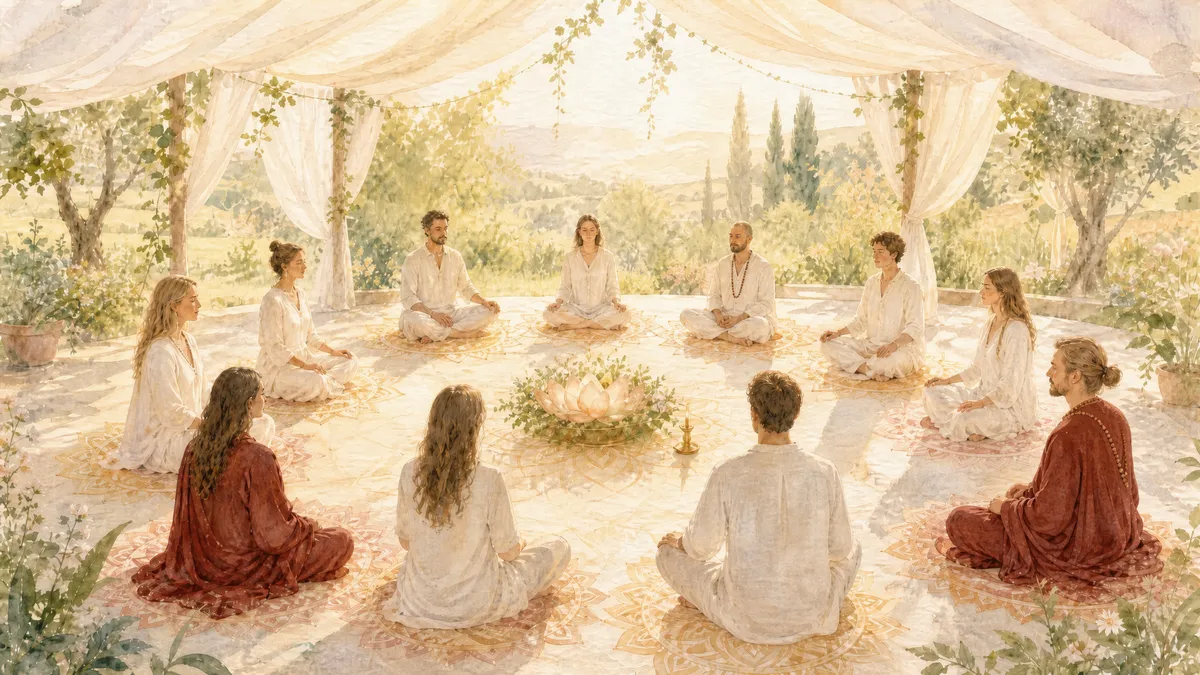
Spiritual people must unite, but this union is of another kind. It is a union directed toward the growth of self-sufficiency, of your personal divinity. When people unite, it is a sacrifice of individuality, of personality. But the spiritual union of people, the sangha, is a union directed toward your growth.
By uniting, you contribute to your own growth toward your own divinity, the blossoming of the personal mandala, the personal tunnel of reality, the divinity of each being. Such a union is the sangha, the buddha-kshetra, the field of awakening. This union has no goals, no projects, except to give each person their own blossoming, personal divinity. The union of spiritual people is your own goal. This is the meaning of the sangha as the third jewel.
Nothing can compare with the sangha; nothing can be such a jewel. Certain clan associations, political parties, families, lineage associations — none of this is the sangha, not a jewel. Because they provide you with protection, security, social support, ideological security, economic security, but they do not provide your awakening, the personal growth of divinity. The company of the awakened is the sangha, the buddha-kshetra. But even in such a union, your growth is always individual.
Individual means that awakening occurs through your personal experience, through your personality, not through something external, but through the inner. When relationships are established between sadhus, this is called samaya. These are very valuable relationships. Through these relationships, conditions for awakening are created. In these relationships there is no attachment, no selfishness; there is play, love, compassion, veneration of the deity in one another, pure vision, respect for the personality of each person — then this is the sangha.
Pure Vision and the Transition into the Mandala
When we attain jnana and understand that our main task is to abide in space, we learn to build other relationships with the entire world, to leave the old relationships behind, to enter the field of other relationships, to create samaya with the whole world, with the entire Universe. This is called pure vision.
Enlightenment is possible only in pure vision, in a pure dimension. In impure vision, in an impure dimension, spiritual success is in principle impossible. To contemplate, to be in the state of a mirror, of space, means — on the relative level — to deepen into pure vision, to deepen into divinity, to manifest divinity, to invoke divinity, to surround oneself with divinity.
Thus, gradually, a transition takes place from one dimension of impure karmic vision into the dimension of the mandala. The mandala is a pure world created by the power of the mind. The body then changes into the state of a devata, a deity, into an illusory body, a body of light in the form of a deity. Then the world changes, the body changes, the environment changes. This is what is called Liberation. The old world goes away, samsara with its connections goes away.
