

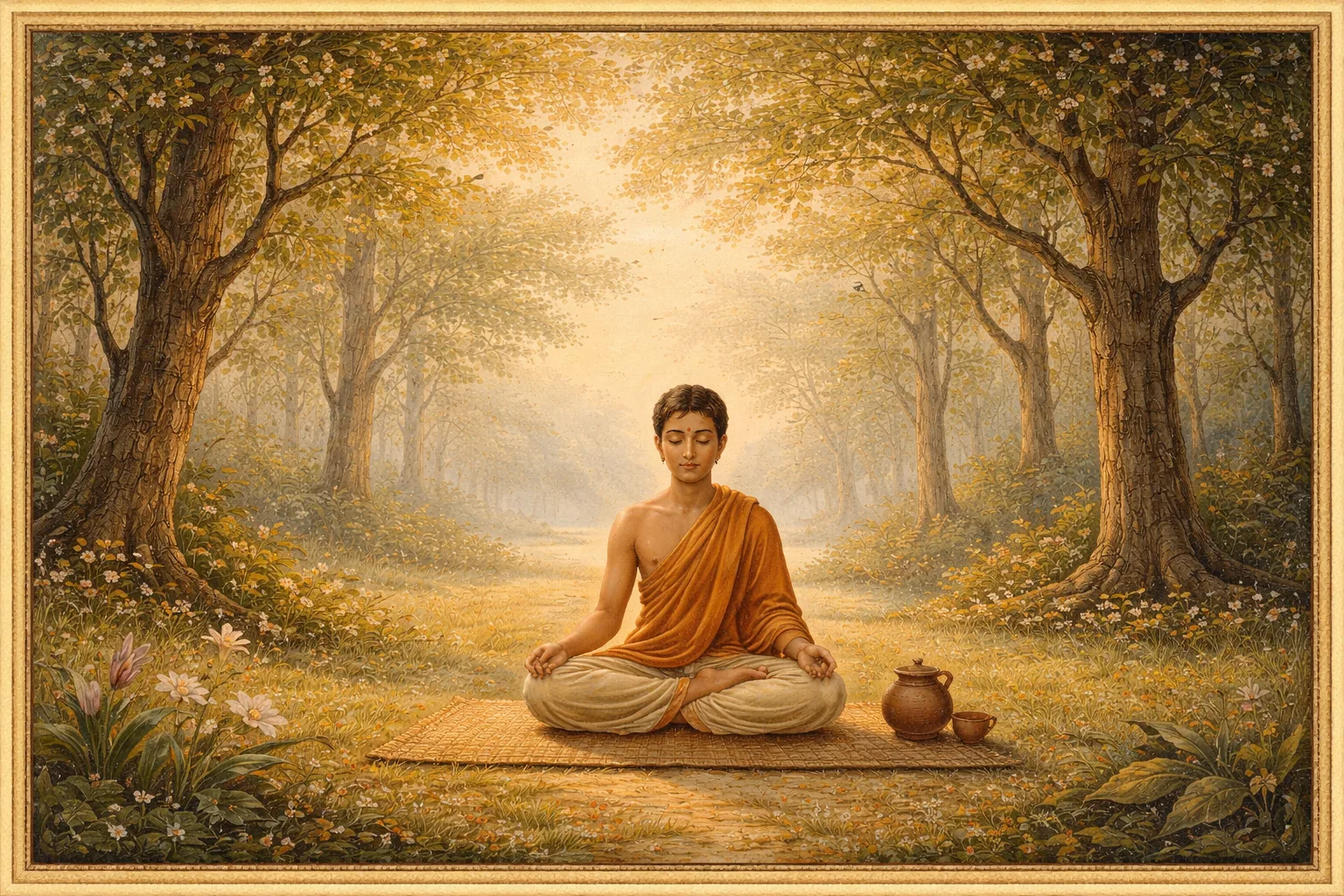
Commentary on the text “Ashtavakra Gita”
The text “Ashtavakra Gita” contains Ashtavakra’s instructions to King Janaka.
“Knowing that everything is an illusion, anyone becomes free from desire, becomes pure perception, and lives in the world as though nothing existed.”
The Practice of Discriminating Wisdom Through “Neti-Neti”
First, we must become firmly established in the perception of the world as illusory. Since clinging and attachments are very strong, one should reflect again and again on illusoriness. The Vedic mahavakya “neti-neti” (not this, not this) helps cultivate discriminating wisdom (viveka). At least on the level of logic, we must explain to ourselves that this is not Brahman, and this is not Brahman; that is, this is not truth, and this is not truth, and therefore consciousness should not cling to it.
For example, upon seeing something impressive, you can think as follows: “Brahman is without qualities, has no name or form, whereas this has name and form; therefore, this is not Brahman, and consequently there is no point in being impressed by it.” Having come into contact with anything that strongly affects you (concepts, images, other people, and so on), you repeat within yourself: “Neti-neti. This is not that, and this is not that. Brahman is without qualities, limited by nothing, formless, incomprehensible, whereas this is something relative that can be grasped by the mind, logic, and the sense organs. So what is the point of paying attention to it?”
Then your mind turns away from it and again aspires toward the truth, which lies beyond any perception. You must say “neti-neti” many times in order to become completely disillusioned with such a perception of the world, when you seek something other than the Absolute. Finally, when you become completely disillusioned with such a vision of the world (not with the energy itself, but with the tendency to cling to it), you will firmly understand that you need nothing except the absolute grace of Brahman, that no joys of this world, nor even the joys of the worlds of the gods, will any longer satisfy, entice, or tempt you.
It is important to understand that one should not fall into nihilism. Someone may take a rigid nihilistic position: “All this is not that, and therefore it is mara, the devil.” A desire may arise in the soul to shut oneself off from everything, to create a specific block in consciousness and in the pranas, and to recoil from all manifestations of this world like the devil from incense. But this too is incorrect. After understanding that we need to seek absolute wisdom, we must also necessarily understand that forms should not be denied, the external should not be denied; rather, all of this should simply be self-liberated, that is, dependence on it and clinging to it should be eliminated.

The Transition to “Iti-Iti” and Integration with Reality
When the illusoriness of everything has been understood, great detachment arises, and then one can move on to another mahavakya, which is called “iti-iti” (both this and that). Here we must see the concept of Brahman (the Absolute) on a new level, that is, in the entire diversity of manifestations.
When we have purified perception with the mahavakya “neti-neti” and generated a clear understanding that we do not need name and form, when nothing grossly material any longer leads us into illusions or seizes us, when we have become firmly established in pure consciousness, we must say “iti-iti” and once again open consciousness to external reality in order to learn to unite with circumstances. But now this is no longer a worldly view of reality, but the view of a yogi who, at the very center of matter itself, always discerns the one spirit, who discovers stillness in movement. Now we are fully integrated with reality, simultaneously realizing both the illusoriness of the world and the fact that the entire world is Brahman.
Shankara emphasized the illusoriness of the world, but at the same time he explained absolutely clearly that what is illusory is our vision of the world, not the world itself directly. The world itself is Brahman, and Brahman is not illusory, but real and transcendent.
The philosophy of Tantrism speaks not so much about the illusoriness of the world as about its divinity, emphasizing that name and form are the very same Brahman. However, one should not cling to name and form, but should discern the play of the Absolute in all names and forms.
When we truly understand this principle, it is said that we have awakened to vision. And then we no longer cling to anything. We glide over reality with an impersonal gaze, we come into contact with it, yet no clinging occurs. We live in pure consciousness, being in complete harmony with the external world of names and forms, with various circumstances, and we can unite with everything.

The main principle of contemplation in Laya Yoga (and in Anuttara Tantra in general) is the ability to unite. What does it mean to unite? It means being able to contemplate while moving and during any other actions, while perceiving various sensations, and during the process of thinking. In other words, it is the ability to be in contemplation always and in any situation.
The Unity of Being and the Philosophy of Strict Monism
Further, Ashtavakra says:
“Only one thing has existed, exists, and will exist in the ocean of Being. When you understand this, there is no bondage or liberation for you. Then live happily and realized.”
We are followers of the philosophical school of strict monism. Not monotheism, but precisely monism in the tradition of the siddhas. This should be understood. Monotheism is not necessarily monism. Monotheism is more connected with a personal perception of God and can be dualistic (for example, Islam, Judaism, Christianity), when it is considered that God is one, but the soul is separate from Him. Monism means “mono,” one; it is precisely the philosophical school of Advaita, which asserts that everything is only the Absolute, that there is nothing except the Absolute.
Classical conceptual Advaita is more connected with philosophy. We, however, are followers of Pratyaksha Advaita, or Shuddha Advaita, that is, the direct non-conceptual Advaita of the siddhas. Kashmir Shaivism also belongs to Shuddha Advaita; however, in Kashmir Shaivism too much attention is still paid to philosophy. We place the main emphasis not so much on philosophy as on the method of contemplation, and therefore we say that this is Pratyaksha Advaita, that is, Advaita that bypasses conceptual reasoning. Our specialization is direct introduction, contemplation, self-liberation. This is closer to Zen.
You may not understand the complex classification of Kashmir Shaivism, which speaks of thirty-six tattvas, but you must understand well the three principles of contemplation, the methods and rules for maintaining contemplation, possible deviations, and other things that concern non-conceptual Advaita. In other words, Pratyaksha Advaita is not so much a theoretical philosophy as work with the method.

Monistic Pluralism and the Principle of the One
Despite the fact that we are followers of the school of strict monism, nevertheless we have elements of monistic pluralism. What is monistic pluralism? “Pluralism” means diversity; “monistic” means that unity is nevertheless seen in this diversity. One could say that it is the principle of unity in diversity.
Traditionally, monistic pluralism can include, for example, Shaktism, where many gods are spoken of, yet all of them are in a state of Advaita. Paganism, which speaks of many gods but has no spirit uniting them, no common principle, can be classified simply as pluralism. And paganism that sees behind the multitude of gods one unifying spirit, while making no distinction between the soul and God, can also be classified as monistic pluralism.
Since we speak of siddhas, deities, and gods, we have elements of monistic pluralism. Although all of them abide in a diversity of forms, nevertheless behind them there is a single Consciousness. However, the main principle of our school is contemplation of non-duality, contemplation of the One. It is said: “Having known the One, you will know everything. Having become a master of the One, you will become a master of everything.” And we strive to become masters of the One. What is the One? It is the unique bindu, the single Sphere, the state of a single “taste.”
Instructions on Contemplation and the Yoga of Non-Meditation
Further, Ashtavakra says:
“Being pure Consciousness, do not disturb your mind with thoughts ‘for’ and ‘against.’ Be at peace and remain happily within yourself, the essence of joy.”
In fact, these are instructions on vision and contemplation. When pure Consciousness is open, no longer disturb your mind with judgments and any other things connected with the plane of the mind. Understand the entire illusory nature of what is created by the mind.
There is such an expression: “the dangerous gorge of dualistic concepts.” This expression concerns the strong activity of the mind, when a yogin is in retreat or simply trying to contemplate, but thoughts that he cannot self-liberate seize him and lead him off somewhere to the side.

Here Ashtavakra says: “Having discovered this consciousness, simply establish yourself in it, remain happily in yourself, the essence of joy.” When we discover this Consciousness, joy naturally settles within us. I have never once seen a dejected and sad yogi or saint, and if he did look that way, then most likely it was some kind of lila, to inspire others with the desire to save their souls. When a yogin discovers this Consciousness within, it is always the essence of boundless joy.
Next, Ashtavakra says very important words:
“Completely abandon meditation and hold on to nothing in your mind. You are already free in your true nature, so what will you attain by meditating?”
These are very important instructions. These are precious instructions, for the understanding of which one could give a great deal. But at the same time they are also very provocative, because an unprepared person who has not yet really learned to meditate, upon hearing such words, will think: “Yes, I need to completely abandon meditation,” but in his case this would be a mistake.
What is being described here is the stage of effortless presence, or the yoga of non-meditation. The teaching on contemplation is often called precisely the yoga of non-meditation. The yoga of non-meditation is the result of a rather long process of working on oneself, which includes several stages:
- First, you practiced concentration and succeeded well in it
- Then, moving on to meditation, you discovered the empty essence of the Mind and found peace
- Next, you learned to experience peace and emptiness during movement
- Finally, you penetrated the movement of thoughts while maintaining contemplative presence not only during formal meditation, but also in the post-meditative period

At the final stage, you are already in contemplative presence all the time. Moreover, if at this stage you get stuck in a one-sided state of meditation, you may even end up at a disadvantage, because you will not develop flexibility in behavior, nor will you learn to unite everyday life with the state of contemplative presence. Therefore Ashtavakra says: “Completely abandon meditation and hold on to nothing.” This means that at this stage it is necessary to unite with all circumstances while abiding in effortless presence.
I have already told you the story of how one yogin meditated in retreat and, after several years, clairvoyance opened in him; he could be in the samadhi of emptiness. When he told his teacher about this, the teacher said: “What a pity!” The disciple was struck by such a reaction. He sat in meditation for ten to fifteen hours a day without breaks and hoped to receive praise. At first he took offense at his teacher, but then he nevertheless asked why he had reacted to his words in that way.
The teacher said: “Now do not meditate at all. Live according to the same schedule and simply be in presence all the time.” This disciple said that he had to start everything over from the beginning. It was very difficult for him to remain in presence without meditating, because he was used to meditating all the time and entering the experience of emptiness in precisely this way. But after two years he nevertheless learned to maintain this state. When the teacher said, “What a pity,” with these words he expressed regret that the disciple still had not learned to sustain presence in the ordinary state, in surface consciousness, but had been captured only by formal meditation on emptiness.
Of course, if you have a distracted mind and no stable contemplation, it is extremely important for you to practice formal meditations, perform all the practices, and follow the other recommendations.
