

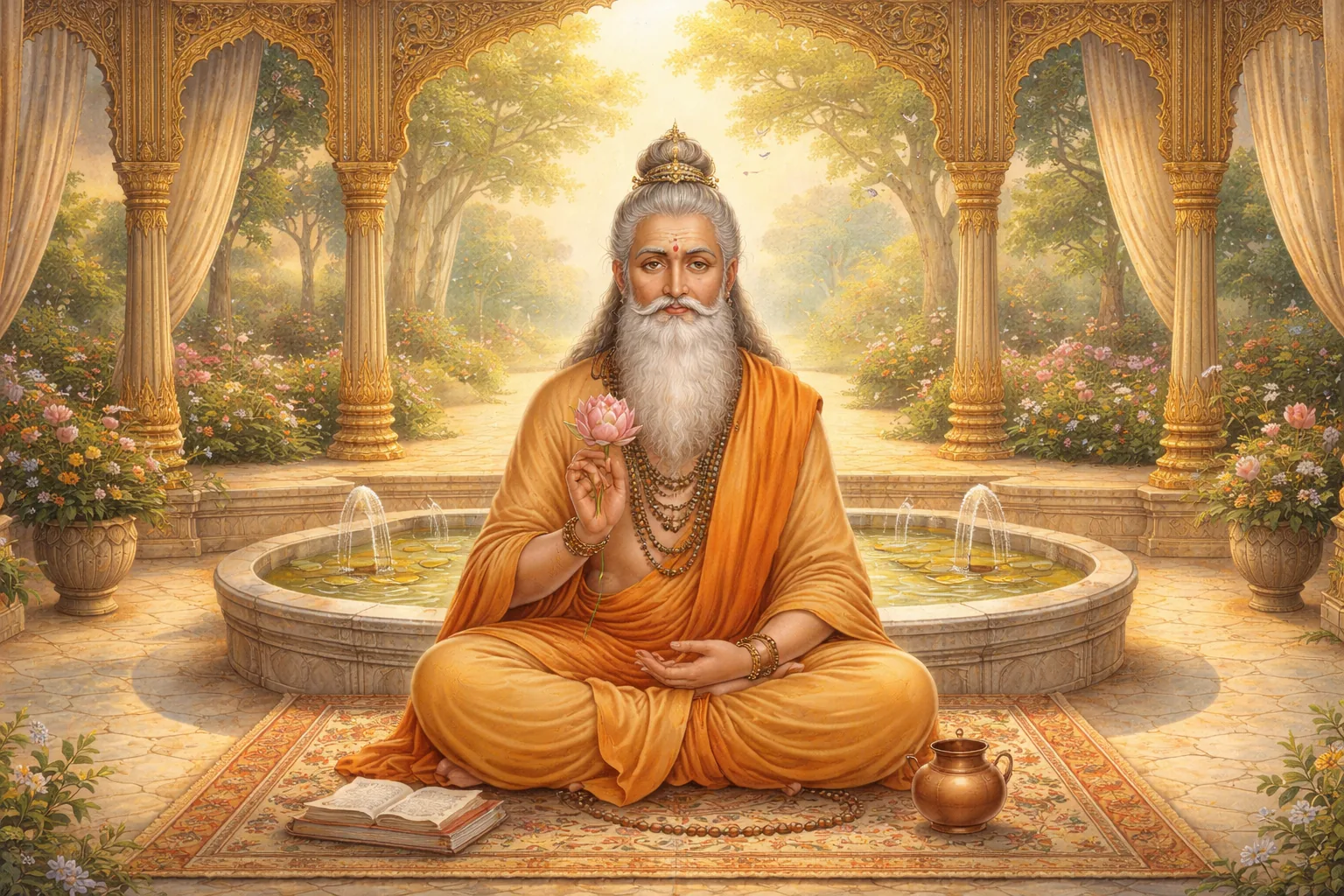
Commentary on the text “Tripura Rahasya,” Chapter 15, “What Must Be Known and What Need Not Be Known, and on the Nature of the Supreme Essence”
“Listening to Dattatreya’s account of the wondrous stories of the hill-city, Parashurama became more and more amazed. Possessing a clear mind, he immersed himself in contemplation of his teacher’s instructions, and then returned to him and asked him again:
“Lord, I have considered the meaning of your instructions, presented in the form of the magnificent stories you told me. I understand that mind alone is real and one, and that its objects are merely unreal images, like a city reflected in a mirror.
Her transcendent majesty, Maheshwari, is that consciousness, manifesting as mind and cognizing the entire range of phenomena, beginning with the unmanifest state of sleep and ending with this world.”
The Three Kinds of Sahaja State
In the teaching, we realize the one Mind through immersion in the state of sahaja. Three kinds of the sahaja state are distinguished:
- adi-sahaja (the primordial state that existed before birth);
- darshan-sahaja (received as a result of transmission and practice);
- purna-sahaja (fully realized and reunited).
Adi-sahaja — the primordial natural state — is the Supreme Mind, the boundless Mind as such in its essence, existing independently of our birth and enlightenment, which has always existed. Whether we want it or not, whether we know it or not, whether we agree or not, the Supreme Essence has always existed, independently of our enlightenment, and has always been perfect.
Darshan-sahaja is the state whose “taste” we receive through transmission; we are told about it, a connection arises in us, we establish a relationship, and a certain clarification occurs in our own consciousness. Darshan-sahaja is not connected with nirvikalpa samadhi or with savikalpa samadhi. It is connected with sahaja samadhi. In other words, concentration, savikalpa samadhi, and nirvikalpa samadhi can hint at it, but genuine darshan-sahaja appears when awakened awareness is brought into surface ordinary consciousness and when one remains in a continuous state of contemplation.
Purna-sahaja means that our consciousness returns to the Source. We return to the state of adi (the primordial), but the difference is that now our consciousness has been added to it. We return to the state of the unborn, but now we fully realize it; our essence reunites with the Source.

The Nature of the Supreme Mind and Liberation
“They are all, undoubtedly, conditioned by the self-sufficiency of that consciousness, and they arise without any immediate cause — this is what I understood after deep reflection. But this mind is considered to abide beyond cognition, because it always remains as pure knowledge itself. I do not understand how the mind can be realized if it transcends this knowledge. Without realizing this, the goal is not attained. The goal is liberation. What, then, is its nature? If someone can be liberated while living, then how is the course of his liberated life regulated, if this is possible at all?”
Manas, chitta, buddhi, ahamkara, Atman — these are, generally speaking, the main components of our “I.”
- Manas is the mind that accepts and rejects
- Chitta is the storehouse of mental tendencies, consciousness in general
- Buddhi is intuitive consciousness
- Ahamkara is the complex of an integral self-concept, the false ego
- Atman is the Supreme Essence itself
Of course, we also have the five karma-indriyas (organs of action), the five jnana-indriyas (sense organs, organs of cognition), and the five pranas. Taken together, all of this constitutes a human being.
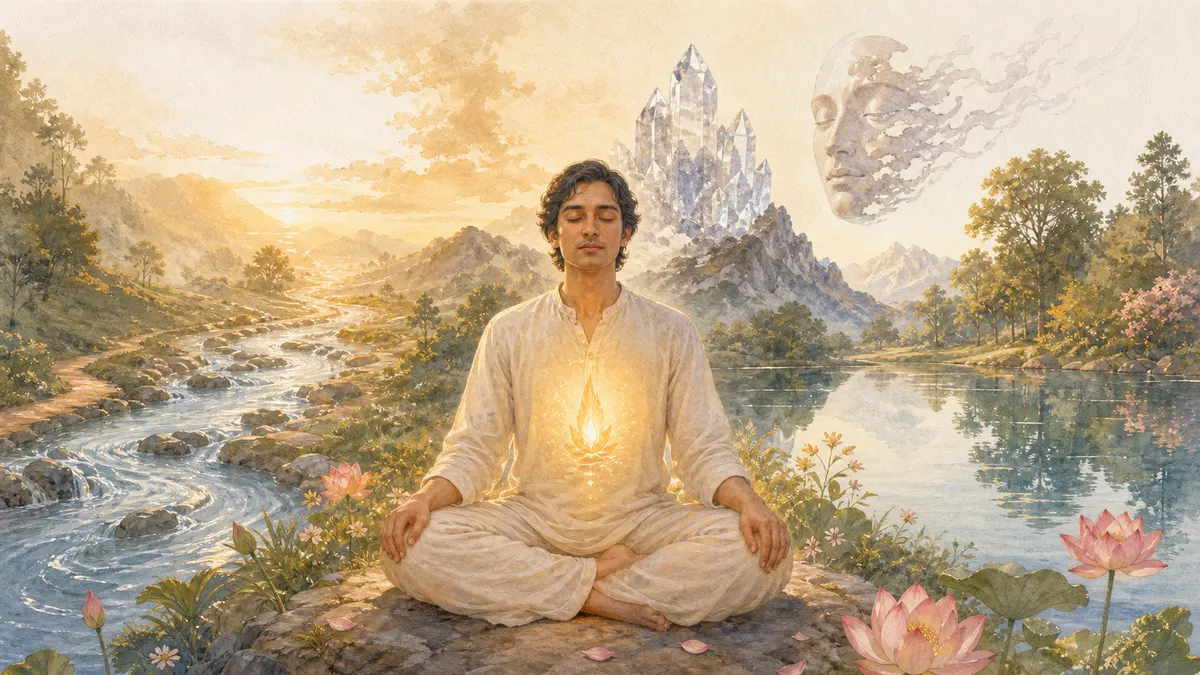
All the diversity of worlds arises from this self-sufficient consciousness. This diversity arises without any immediate cause. The entire world is a manifestation, a spontaneous play, the lila of the Absolute. There are no causes for the arising of the world other than the divine creative manifestation of the energy of the Absolute.
If a person creates by means of logic, then absolute Consciousness creates beyond logic. And the only name for this can be lila, vilasa, aishvarya — that which manifests spontaneously, playfully, creatively, self-liberatedly, causelessly.
The Activity of a Jnani and the Principle of Lila
Parashurama is perplexed:
“I do not understand how the Absolute (the supreme Mind) can be realized if it transcends this knowledge. Without realizing this, the goal is not attained. The goal is liberation. What is its nature? If someone can be liberated while alive, then how is the course of his liberated life regulated, if this is at all possible?”
These are very important questions that must be deeply clarified.
And further he says: “There are sages who engage in activity. What is the relationship between the world of activity and their pure conscious essence?”
Such a question is usually asked: “If everything is unreal, there is no doer, no agent, and all activity is meaningless, then what is the point of doing anything? What is the point, then, of engaging in all this, of practicing?” And then active jnanis cause confusion. But they cause confusion only for the unawakened, who judge from a subject-object point of view.
The point is that the jnani, his activity, and so on exist only in the mind of the one who judges him. For himself, the jnani does not exist as a doer. Nor does his doing exist; no activity of his exists. All that exists in the consciousness of a jnani is play, lila, which unfolds causelessly, beyond logical explanations.
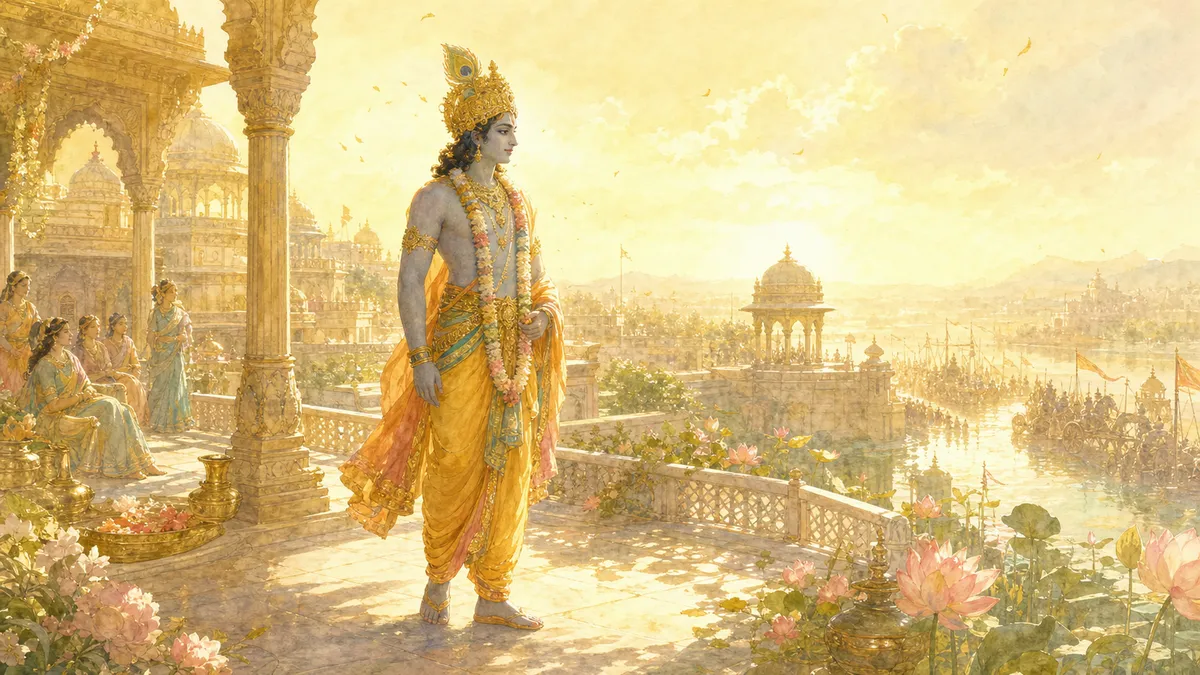
For example, Krishna was a king, took part in battles, engaged in various political games, had palaces and wives. The question arises: “Why does he need all this if he is beyond duality? Does he really have attachment to palaces and wives? Or is he interested in fighting and engaging in political intrigues?” However, such a question is valid only for one who is in duality. From Krishna’s own point of view, this question is invalid, because in Krishna’s own consciousness there exist neither palaces, nor wives, nor politics, nor war, nor he himself, nor the fruits and results of his activity; there is simply play, life in a state of brightness, bifurcation, a surge of multivariance, choice at every second, without causes, without goals.
An adequate example might be a sports game, such as football. If you ask the question: “What is the meaning of this game? What is the logic?”, you may be answered: “There is no logic. It is simply a surge of brightness, dynamism, and strength. It is simply entertainment, pleasure.”
It can be said that games are a reflection of the manifestations of the lilas of the Absolute in the higher worlds. Any causally conditioned activity is a property of the lower worlds, where karma, causes, and effects operate. Any higher activity is no longer a cause, not an effect, not karma; it is always play. For enlightened gods, even when they wage war, it is approximately the same as football for people or any other game. They do this in a completely different perception. Play is distinguished by multivariance, dynamism, freedom, unconditionedness, spontaneity, playful choice, playful manifestation, and non-attachment to results. It is distinguished by brightness, clarity, and the absence of clinging. Play has always been a characteristic of the activity of saints, the enlightened, and the Absolute in general.
To enter the state of pure vision, the mandala, means to enter the state of play. At the same time, play does not mean something frivolous or superficial. The games of the gods may surpass the most serious affairs in the world of people. These games are spontaneous, free, and self-liberated. In other words, gods or saints may play in the most serious manner, but for them it is play.
The further you advance in your practice, the more liberated, playful, clear, bright, spontaneous, and non-clinging your consciousness becomes. By playfulness I do not mean some kind of infantilism or flirtation. It is, rather, clarity, multivariance, emptiness, and liberation of consciousness. You can do any things, even the most serious, but the attitude toward them is different.
Karma and Lila: Two Ways of Acting
Karma is when you get upset because something is not working out for you, when you feel: “I am doing this,” when you enter into conflict, feeling yourself to be the doer. Lila is when all of this is absent in you, when you receive colossal pleasure and enjoyment in any situation. No matter how the situation develops, you are in the deepest joy and ecstasy.
For example, in 2001 we were choosing a place for “Divya Loka.” Sattva Sanatana and I traveled around six or seven cities (Vladimir, Moscow, and others) and looked at about thirty locations. We spent a whole month traveling from morning till evening, considering various places. When we finally chose the place for Divya Loka, something became clear and definite. But I even felt a little sorry that we had stopped choosing and traveling. I liked it so much that I could have done it my whole life. I did not feel that I was very tired or overworked. For me it was great entertainment, although I had to engage in service for about ten hours a day with great concentration. But I felt full of energy, rested, and very joyful. This is exactly how you feel when you perform service in a state of play. Sattva Sanatana, on the contrary, felt differently, although we were in roughly the same conditions.

If, however, you are not playing but acting as the doer, moving away from the center, then you become exhausted and tired; you are anxious about the result, and therefore your mind is always troubled. The only normal way to perform service is to live in a state of lila, vilasa, and then it is no longer felt as work, but as a dance or a song, a game. Whenever you identify yourself, you become tense and deadly serious, your mind shrivels up, you separate yourself from others, from the action; a false center is created in you, anxiety about the result, the desire to choose, some utterly unnecessary tension arises, and the channel of connection with the higher “I” is blocked. But whenever you let yourself go, remove the doer, everything suddenly and naturally becomes liberated, light, spontaneous, playful, and manifests in the very best way. When it manifests in this way, you act in the state of a deity playing in the mandala. When everything becomes tense, you leave the state of the deity and enter samsara, karma. Of course, the true play of a deity is much deeper.
If, for example, you do not understand this principle, many things can make you tense both in worldly life and in the monastery. The Vinaya code, the system of training, relationships, hierarchy may make you tense. All this may seem to you like some kind of framework limiting consciousness. But the point is precisely that it is necessary to relate to this from the standpoint of play.
In a game there are various conditions. If you understand where everything belongs, you never experience confusion or tension. Your mind always remains clear and self-liberated.
The Diversity of the Manifestations of a Jnani
“There are sages who engage in activity. What is the relation between the world of activity and their pure conscious essence?
How can they be involved in activity while remaining all the time in absolute consciousness? Such consciousness can only be of one kind, and liberation, in order to be effective, can likewise be only one.
Why then are these differences found in the lives of jnanis? Some of them are active; some teach the sacred scriptures; some worship deities; some abide in samadhi; some lead an ascetic way of life and mortify themselves; some give clear instructions to their disciples; some rule a kingdom very righteously; some openly debate with other schools of thought; some write down their teachings and experiences; others feign ignorance; certain ones even perform reprehensible and disgusting actions; yet all of them are known in the world as wise people.
Whence can there be such differences in their lives, when there can be no difference in the state of liberation common to all? Or are there stages in the attainment of knowledge and liberation?”
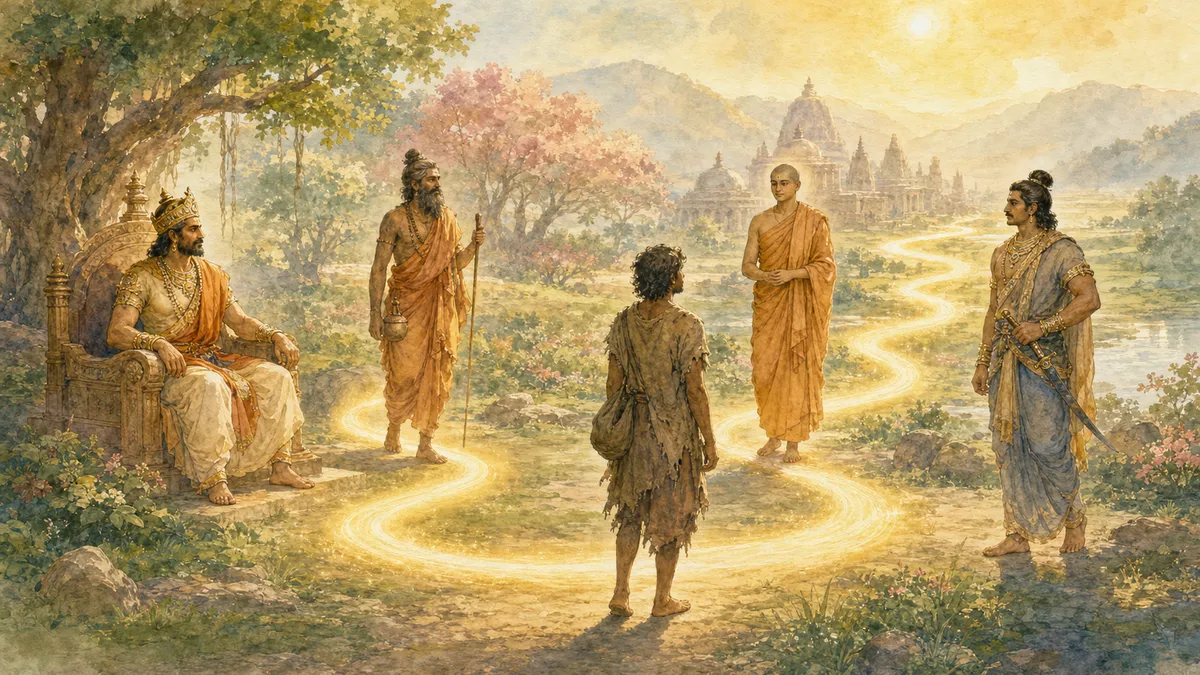
The state of enlightenment of a jnani always manifests creatively in accordance with his inclinations. King Janaka ruled a kingdom. Dattatreya appeared before some people as a saint performing Vedic rituals, before others as a hermit and ascetic, and before still others as a drunken, ragged beggar. Jada Bharata, so that strangers would not bother him, lay in his own excrement and in this way frightened others away. Buddha Shakyamuni was a traditional ascetic monk. Krishna was a king, ruler, warrior, and householder. Nevertheless, all of them attained the highest level of holiness. One may say that their primordial essence manifested its plays in accordance with circumstances and inclinations.
Parashurama, in bewilderment, asks: “Enlighten me regarding these questions; I bow before you as my only teacher.”
Signs of the State of Lila in Practice
The state of lila (play) grows in you day by day if you exercise correctly in practice. If the state of lila does not grow in you, then the state of karma may grow in you as a consequence of incorrectness in contemplation. A person who possesses vision, contemplation, is easy to recognize: his gaze is direct and clear, his energy is always high, his mind is spontaneous, released, and liberated. He is light, fluid, and unbiased; there is no tension anywhere in him, he is as if already in a state of play. If you communicate with a genuinely correct practitioner, you will always feel such lightness, fluidity, and self-liberation. Whatever he does, he has no problem. There is no contractedness of consciousness anywhere in him; he is always self-liberated and wide open. He can synthesize himself with any manifestations. He can turn everything into lila, into play. External circumstances, actions, and relationships cannot fool him. When you can do this, it means that the spirit of the Supreme Source begins to manifest directly through you.
Being in a state of play does not mean constantly smiling, laughing, or behaving unseriously. Rather, it indicates an inner state of clarity, self-liberation, and spontaneity.
Play begins when we have enough clarity and presence, and we can apply this clarity and presence to some situation. A situation that seems karmic, when we apply enough clarity to it, instantly self-liberates and appears in the guise of play. If we do not have enough clarity, we cannot shift the situation into the channel of play, and then this situation begins to strain us, becomes conditioning for us, we feel concerned, our mind contracts, we lose our connection with the Supreme Source.

At first we can be in a state of play in certain suitable conditions. For example, in the state of retreat or when we perform the walking technique, we have subtle awareness, but as soon as we leave the retreat, subtle awareness is lost; we seem to jump out of this mandala of clarity and play. But gradually clarity is brought into our actions; we learn to let go, not to be the doer, not to feel the doing, to be attentive, recognizing the play of the Supreme Source behind all phenomena, and then the state of play is brought into every action, that is, every action becomes art, magic, creativity; it is self-liberated and brings immense enjoyment. This happens because you have no choice, no center, no plans, no clinging either to the past or to the future; you are able to do every action totally, being in ultimate awareness. And ultimate awareness, applied to every action, is what makes it such a play.
Transformation of One’s Attitude Toward Practice
For someone who does not understand this principle, spiritual practice can become a great difficulty, an obligation, a yoke, some stern duty that he performs through gritted teeth. In the beginning this is, of course, necessary, but you cannot live your whole life on a sense of duty alone, because then you will have no inner joy, spontaneity, or spark of divine inspiration. But as your practice progresses, it must certainly appear, and then this element of play and inspiration will be brought into the practice.
If you are in a state of karma, you have a bargaining, clinging, doing mind; you have roughly this kind of vision: “Oh, more of this service? It would be easier for me to meditate, to do asanas. And how many additional days will they give me for retreat?” You walk around with a calculator all the time and calculate: “Was I shortchanged in the distribution of service? Why am I assigned as an assistant more often than he is? And will this be compensated for me during the three-month retreat?” You behave all the time like a spiritual vaishya: “Well, I have overworked here.” You have a rigid division of the world into meditation and work. You resemble a hired worker in a monastery who knows what he is paid for and how much.
But if you are in a state of play, everything is completely different: meditativeness permeates every action, and you fundamentally do not divide your activity into meditation, work, or anything else. Moreover, you have a continuous flow of this meditativeness, and you have great dedication to any play. You pursue no personal goals, and this significantly advances your practice. You have a genuine spirit of service: you are no longer working for your own ego, but are a conduit for higher divine energies, which, without interruption, work through you every second, regardless of whether you are meditating or performing service.
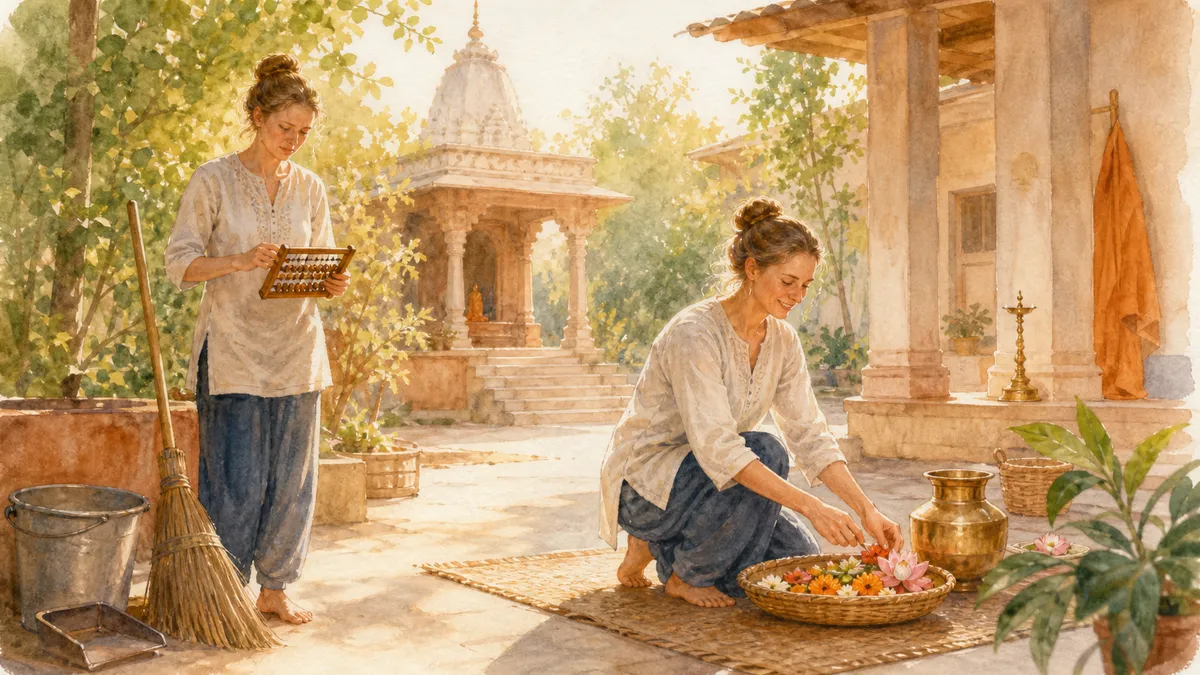
And when you become a conduit for these divine energies, your identification as “I am a person,” “I am the body” begins to be replaced by the identification “I am the Absolute.” You already understand clearly that your little “I” is, of course, not you. You act while constantly feeling behind you a mighty flow of universal energy, so that you no longer distinguish yourself from this flow, as if your body itself becomes its conduit. This mighty flow is uninterrupted and does not depend on any specific type of sadhana.
