

Commentary on the text “Brahma-samhita,” verse 56
The Principle of Pure Vision and the Sacred Dimension
“Where all trees are sacred wish-fulfilling trees, where the earth is made of spiritual precious gems and the waters are nectar, where every word is a song, every movement a dance, the flute the dearest friend and companion, sunlight and moonlight sacred ecstasy, and all that exists is spiritual and blissful; where from the udders of billions of wish-fulfilling Surabhi cows the great ocean of milk eternally flows, and divine time is eternally in the present. Almost no one in this world knows that place—only a very few exalted souls, who know it by the name Goloka.”
This shloka expresses the principle of pure vision, the principle of a sacred pure dimension, the transition into which is our goal. When it is said that the goal of our spiritual practice is the attainment of the rainbow body, this is only a certain part of realization, because the rainbow body is unthinkable without a transition into another karmic vision. That is, it is impossible to be in the rainbow body and at the same time remain in the karmic vision of the human world, in a state of ignorance.
It can be said that the rainbow body is one of the pleasant flowers on the path; it is one of the signs of a complete transition into another karmic vision, because the rainbow body does not exist outside the context of energies, of entirely different tattvas, although it can be effective in this world of phenomena and also visible and tangible. That is, the rainbow body is a transition into the state of a pure land, into the state of a mandala.
Therefore, our goal is not only the attainment of the rainbow body, but also the attainment of Datta-pitha—the pure, sacred place of Dattatreya. This is not a specific place, like pure lands such as Amitabha’s or the gods’ Tushita. It can be said that Datta-pitha is a pure state of consciousness (somarasya), which includes any manifestations in the universe. Only in such a state do we attain primordial wholeness (prabandha).
The Loss of Wholeness and the Three Rudras
We are now in a state of non-wholeness as a result of error (bhranti). Error means forgetfulness, the failure to recognize one’s own nature, and susceptibility to the gunas of the material world, strong identification and ignorance. As a result of such error, wholeness has been lost by us. And every moment of the life of a true yogin is an aspiration to return to this wholeness. But why has wholeness been lost? Why did such an error arise?
The texts say that this error arose as a result of the three rudras. Rudra is one of the names of Shiva, but it can also be used as a symbol of the ego, of false identification. In some tantric texts it is a symbol of confusion or ignorance; that is, Rudra can also appear as a lower spirit. And spiritual practice is the taming of the three rudras.
It is said that there is the rudra of the body, the rudra of speech, and the rudra of the mind. That is, the ego appropriates the body, speech, and mind, thus securing itself and expanding the sphere of its influence. It is precisely at the moment when identification with the appropriated body, speech, and mind takes place that confusion and ignorance arise; that is, the action of the rudra manifests.
The Rudra of the Body
What is the rudra of the body? It can be said to be the bodily side of consciousness, the connection between mind and body, which needs constant nourishment and reinforcement. It is the identification “aham dehasmi,” that is, “I am the body.”
For example, Tilopa gave Naropa very powerful transmissions, dispelling Naropa’s identification with the body. To this end, Naropa had to undergo the most incomprehensible trials. Only when he was already almost on the verge of death did Tilopa give him instructions. Naropa said, “I am like a deer caught in a snare,” and Tilopa said, “If you identify yourself with the body, the troubles will be even greater. Therefore, renounce identification with the body.”
From the point of view of tantric practice, renouncing identification with the body does not mean neglecting it or treating it disrespectfully. On the contrary, the body should be used as a sacred instrument. If you renounce identification with a car, this does not mean that you do not need to take care of the car; since it is important for service in the sangha, you look after it. In the same way, you also take proper care of the body. Renouncing identification with the body means the self-liberation of awareness of oneself as the body.
The Rudra of Speech
What is the rudra of speech? It is prana. Prana manifests as emotions, sensations, words, and the energy of the body. Whenever you become attached to prana, to your own emotions and speech, identification operates, obscuring the primordial essence of our “I.” This is the rudra of speech.
The Rudra of the Mind
What is the rudra of the mind? It is faith in salvation outside one’s own “Self,” faith in one’s own understanding, in one’s own clarity, in one’s own concepts, in one’s own efforts, in the idea that, by perfecting the mind, we can create something, rather than simply receive or remember what was there originally. It can be said that the rudra of the mind is faith in concepts, spiritual materialism, disbelief in divine grace.
All these three rudras are an error (bhranti). All living beings dwelling in both the lower and the higher worlds are, in one way or another, subject to this error. Only great saints and those who try to free themselves from these three errors are not subject to it.

Transforming the Three Rudras into Three Mandalas
In the process of spiritual practice, we strive to transform the three rudras into three mandalas. And it is often said that, in the state of realization, the yogin transforms himself into a deity; that is, he makes the transition into the mandala, into a state from karma to lila, to play. Such a transition is achieved precisely because the three rudras, that is, the three impure constituents, are transformed into three pure dimensions: into the mandala of the body, the mandala of speech, and the mandala of the mind.
In some practices of separating samsara and nirvana, we have practices of self-liberation of body, speech, and mind, where, by applying awareness, we perform certain actions. Such transformation means the self-liberation of identification with body, speech, and mind, that is, the discovery of the emptiness of the three rudras. Until the empty aspect of each of the rudras is discovered, we will remain in a state of error and will never attain wholeness.
What does it mean to gain an understanding of the emptiness of the rudra of the mind? It means understanding that any concepts, states, efforts, and experiences of clarity are merely a superficial play of the deep essence of space; that all of them are, by their very nature, empty, have no inherent existence, and no longer fall under their influence.
To know the emptiness of the rudra of speech means to understand that any emotions, sensations, even the energetic level, are empty, and that the true “Self” does not depend on them. There is a certain illness of yogins—captivation by energetic states, when these states begin to become more important than understanding. Captivation by emotions is not characteristic of yogins, but all these things are connected. For example, a person may be captivated by a certain type of food, diet, fasting, or he may be captivated by the processes of kundalini yoga, experiences of bliss, and so on. And he falls into strong identification with these experiences, begins to become attached to them, becomes a kind of spiritual addict, instead of self-liberating them. In reality, the radiant consciousness of the “Self” is higher than prana and the rudra of speech. And prana will truly be under our control only when we free ourselves from such captivation.
Finally, the rudra of the body is captivation by bodily consciousness. This is the most difficult thing that has to be self-liberated. Some ascetics in various schools try to overcome the rudra of the body through the practice of asceticism: tormenting their body, fasting, mortification of the flesh, severe tapas. For example, a person sits among four bonfires, while the fifth—the fire of the sun—shines on his head. But in tantra this path is not recognized as correct, because true self-liberation consists in controlling the five tattvas, not in suppressing the tattvas. Suppression of the tattvas in the form in which it is applied in most cases is an incorrect path from the point of view of tantra, although it can produce certain experiences. The correct path is not the suppression of the tattvas, but gaining control over them. Therefore, the practice of pancha-agni (the five fires) can be used in two ways: as suppression of the tattvas—this is simply tapas; and also as the revelation of control over the element of fire—this is a genuine practice that can produce experiences.
The Three Rasas and the Manifestation of the Deity
Thus, when the emptiness of the three rudras is realized, we begin to acquire wholeness. And such self-liberation begins to lead to the three rasas (three states). It is usually said that the yogin is transformed into a deity. But this deity can manifest in three aspects: peaceful, joyful, or wrathful. Deity means the state of transition into a pure dimension, where the laws of the single “taste” (samarasya), the natural state (sahaja), and lila (play) operate. What are these three rasas, or maharagas? They are:
- sattvika – compassion and calmness
- rajasika – love, courage, laughter, wonder
- tamasika – fury, terror, and disgust
Usually, energetic experiences and emotions on the path of sutra are not considered, since they are regarded as something harmful, and the only way to deal with them is to cut them off, sublimate them, or self-liberate them. But when the transition into pure dimensions occurs, they cease to be harmful, because they are fully self-liberated. On the contrary, they are expressions of certain qualities of deities or certain mandalas. At this level, the yogin is already in constant presence. Of course, this practice is not suitable for those who are not familiar with contemplation. That is, such a yogin already has the ability at least to be in presence during sleep, without losing presence in the dream. And then his energy becomes maharaga (great attraction); in his body, three mandalas and three pure states begin to blossom as deities, that is, peaceful, joyful, and wrathful mandalas, where he manifests in three aspects: as a peaceful, joyful, and wrathful deity.
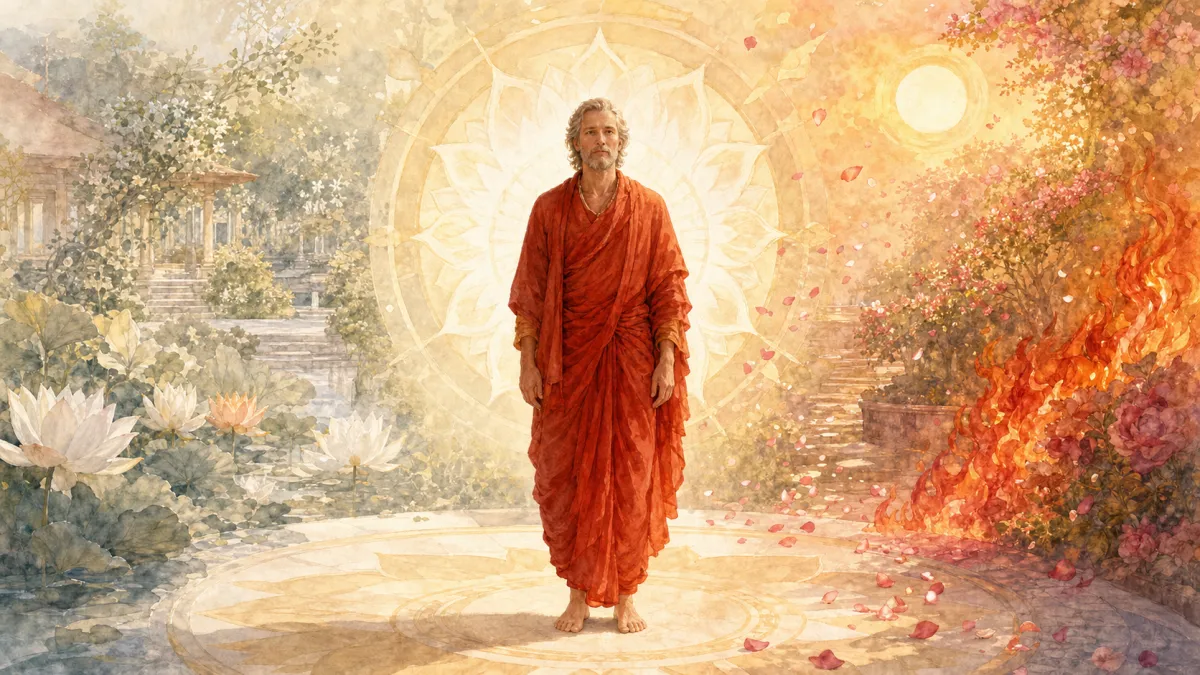
Who is a holy siddha? He is a triple deity playing in three mandalas, and his lila is a single process of the manifestation of the energies of his wholeness. Such a saint may manifest as a peaceful deity when he is in the sattva-guna and serenity is inherent in him. Or he may manifest as a joyful deity, in which case he acts in the state of rajas, uniting presence with the entire spectrum of rajasic energies. Or he may act as a wrathful deity, in which case his presence is united with tamasic energies. The further plays of saints consist in the unfolding of the natural state and its integration with the three primordial energies (maharagas), and the development of the three maharagas (the three great attractions).
Transmission of the Teaching and Stages of Training
Practices of integration with energies are always, as it were, closed and elite. They do not belong to practices that an inexperienced yogin can master, since they presuppose very high control of prana and consciousness. Nevertheless, when you are training, of course, you approach such a level when you receive the teaching on uniting presence with energies. There is a term: “guru – closed fist.” A “guru – closed fist” is one who conceals the teaching or conceals himself, hiding his guru-shakti if there are unsuitable conditions for its manifestation. But when you are in a monastery in the process of training, the guru is not a “closed fist”; on the contrary, he is an “open fist,” and only your ability to contain determines whether you can receive the teaching or not.
When you advance according to the stages of training and pass the examinations for the stages, this shows your ability to be a “vessel,” to contain certain teachings. As you move from one stage to another, your capacity to contain certain teachings is assessed, and these teachings are transmitted to you. If you are not suited to some stage, it means that for now you need to wait with them. This is precisely how the teaching is transmitted.
Classification of Rasas
According to Abhinavagupta, there are ten main rasas:
Rasas inherent in sattva:
- compassion
- calmness
- renunciation
Rasas inherent in rajas:
- eroticism
- love
- laughter
- irony
- courage
- amazement
- revelation
- kinship closeness
Rasas inherent in tamas:
- anger
- fury
- disgust
According to another classification, there is a different subdivision of rasas, and five main rasas are described:
- peacefulness
- service
- the friendly rasa
- the rasa of parental protection
- the rasa of divine consorthood
Rasa can be conveyed as a certain “taste.” And when we speak of a certain experience (of an aspect of energy), we always say that, in subjective perception, it has a certain “taste.” Bhava is a “taste” that has become established. For example, if you had an expanded, majestic state, this is rasa. If you practice divine pride for a long time, then this is already bhava (divya-bhava). And if realization dawns in you, then this is already a complete entry into vision (sakshatkara).
Thus, the five main rasas are: peacefulness, service, friendly rasa, parental guardianship, and divine spousal union. These are precisely sensations connected with energy. The seven secondary rasas are laughter, astonishment, pity or compassion, heroism, anger, fear, and disgust.
Working with the Energies of the Chakras
Rasas are mainly connected with experiences of various energies that are inscribed on the petals in the chakras. If you study shat-chakra yoga well, you will certainly see that certain chakras are characterized by particular rasas. For example, astonishment and mercilessness are inscribed on the petals of the svadhisthana chakra, while magnanimity is inscribed on the petals of the anahata chakra. All these are various energies that exist in our body.
Usually, if you do not work consciously with energies, you either block them or self-liberate them, trying to remain in the empty contemplative presence until the mirror of your mind is purified. And the experience of any energies is more harmful for you than positive. But at the level when you have opened the mirror of your mind, it ceases to be harmful, just as a snake whose fangs have been torn out ceases to be poisonous. And then, on the contrary, the experience of energy, united with contemplation, makes it possible for contemplation to gather strength and blossom. This is the meaning of experiencing various rasas.
Therefore, when your presence is stabilized, you necessarily experience this presence in union with some rasa. Such a rasa arises if you can unite contemplative presence with a tattva, with an element. Then the rasa inherent in some tattva begins to fill you and nourish your presence. If your presence is not nourished by energy, then it is very internal and does not possess great strength.
Eternalism and Nihilism in Spiritual Practice
There are types of religious practitioners who are in eternalist relationships with rasa. What does this mean? These are representatives of various religious teachings who do not appeal to the nondual experience of contemplation, but appeal to the conceptual description of their teachings, while relying on rasa. For example, they tell you: “It is very important to love God” or “God is love”; at the same time, love for God is defined conceptually, but the feeling of love is developed. One can say that such people use rasa, but they do not have nondual vision. In our terminology, this is defined as eternalism.
There are teachings that do not appeal to energy, but appeal to jnana, contemplation, and emptiness. These are all the sutra teachings, the Hinayana teachings, the teachings of the initial stage of Vedanta, where it is said that one must reject energy and establish oneself in an empty, nondual state. This is also the teaching of nihilists, adherents of shunya (emptiness). What is a nihilist, an adherent of shunya? It is someone who has acquired a certain view of emptiness and dreams of moving into this emptiness as quickly as possible, of moving into the unmanifest. But in reality, he does not possess the genuine capacity for integration and contemplation.
And only through the capacity for integration, through the unfolding of the fullness of contemplation, can you unite with energies and experience various rasas. That is, the eternalist dreams of love for God, of someday passing into his loka. The nihilist, captivated by emptiness, experiences emptiness while denying this external world. But the genuine experience of the single “taste” (somarasya) and the natural state (sahajya) is neither one nor the other. The experience of rasa means that you experience emptiness right now and unite energy with it. Anyone who has not understood this must clarify this question for themselves; otherwise, you will not grasp the spirit of samaya, the vision of the siddhas.
The Fullness of Realization and the Integration of Energies
Why is the state of nihilists flawed? Because their realization is emptiness without energy and without lila. It is like the state of someone who has recovered but remained disabled; that is, a person has been saved, has recovered, but still limps on one leg. Such a practitioner cannot be called realized, because in his state there is no creativity of energies, no play, no ability to integrate manifestations.
Imagine that such a person, established in the experience of emptiness, suddenly encounters experiences of energies or emotions: laughter, amazement, compassion, heroism, anger, fear, disgust, love, eroticism, courage. What will happen? They will simply knock down his empty presence. He will be so shocked by these energies that they will begin to overshadow his realization. If this takes place in the bardo, such a person will be drawn into the womb of a future mother, and all his spiritual practice will be weak compared with these energies. At best, he may somehow shield himself from these energies and enter the state of the unmanifest, if he has such tendencies. But even this will last only until some global universal processes begin.
By contrast, a person who has subdued the tattvas and learned to work with the experience of rasa easily integrates any energies and experiences into his state. Then, instead of losing awareness, his awareness will blossom as the manifestation of countless mandalas. Each rasa can develop and unfold into an entire universe, a mandala in which the presiding deity of that rasa will be supreme.
True Love for God as the Foundation of Monasticism
The most important thing for a monk is love for God. A monk without love for God is inconceivable. If a monk has no love for the Absolute, then it is not at all clear what this monk is doing studying the teaching.
But in reality it is not so easy to come to true love. To come to eternalist love, of which one can often hear, is quite simple, but this is not realization. True love consists in discovering the emptiness of the very process of love, the emptiness of any rasas, bhavas, and emotions, in becoming established in contemplative presence, in establishing the principle of non-doing, and then in conscious union with various energies. And then this will be true love for God.
Such love for God can manifest as calmness in one’s relationship with God—shanta-rasa; love for God—rajasika; and even as divine wrath—tamasika. That is, it manifests in all its fullness, because it is self-liberated, not fixed in some eternalist concepts.
Overcoming Pairs of Opposites
One Christian belonging to some non-traditional denomination once said to me:
“For us, the most important thing is love for God.”
I answered this statement from the position of my own vision:
“Love or hatred are simply our human notions. All of this is a manifestation of duality. Love and hatred are two sides of human emotions conditioned by nature.”
He thought about this and said:
“But our love is beyond human emotions, beyond conditioning by nature.”
“Then it must also include the opposite side, that is, hatred, disgust, and even anger.”
He agreed:
“In general, yes. We have such a concept: when you see God’s wrath and still perceive it as a manifestation of love toward you.”
And he and I agreed that true love for God consists in overcoming pairs of opposites even at the level of energies. Thus, when I say “love for God,” I do not mean the eternalist, ordinary concept of love; I mean a deeper state of contemplation that integrates pairs of opposites. It is precisely this kind of love for God that is the most important thing for a monk.
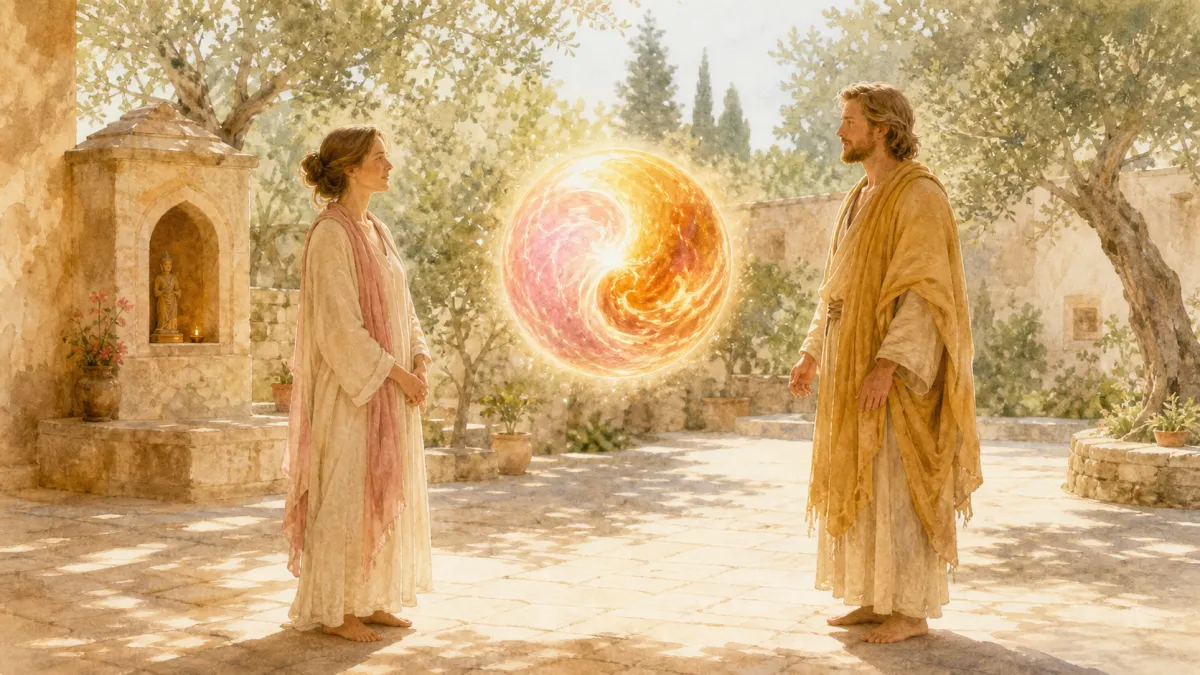
Unfortunately, it is not so easy to develop such true love, because it can include all experiences (rasas). In sattva it includes compassion, calmness, and renunciation. In rajas—laughter, irony, amazement, revelation, a feeling of kindred attachment. In tamas—anger, fury, disgust, fear, the ability to integrate them, not the ability to manifest them. Then your contemplation truly becomes whole and complete; you liberate the three impure states of Rudra, transforming them into three mandalas. This will be the elimination of error (bhranti) and a return to the state of wholeness (prabandha).
Signs of True Love for God
Very often, a beginning-level yogin is not in love with God, but in love with something else. And this can be noticed even simply by looking at the practitioner’s face. A person who directs his love toward God is, at the very least, peaceful and highly spiritualized. Like a blissful one, he is overflowing with joy and shines with emptiness, because love for God nourishes him every second. It manifests while eating, while working, walking, speaking, communicating. He is peaceful, gentle, benevolent, restrained, and controls his feelings. He does not dream or build some illusory worldly plans. Within, he is fulfilled and whole.
But if there is no such immersion in love for God, then, of course, it is very difficult for a person, because other experiences pull him out of this state, and he is already immersed in them. For example, while eating he becomes immersed in the state of absorption in food; while working he becomes immersed in absorption in doing; in communication he becomes absorbed in emotional attachments to the one with whom he is communicating. And then he no longer has wholeness; from morning until evening he is completely in a state of bhranti.
But the state of bhranti is erroneous; it is something that must be overcome. And such overcoming is a matter of struggle. It does not come all at once. Therefore, a monk is a spiritual warrior who stands guard over his own love with a sword. He constantly asks himself: “What is my love directed toward?”
Manifestation of the Pure Dimension
When your mind is constantly in such love, gradually the pure dimension, the mandala, will begin to manifest right here, in this life.
One monk once told me about his dream. He said: “I had a dream in which ‘Divya Loka’ turned into a pure dimension. There were large temples here, tall statues; everything was very exquisitely decorated. It was like a real pure dimension.”
But such a manifestation is only a consequence. The pure dimension is not external; it is a state of consciousness. And the transition into the pure dimension does not mean our teleportation into a parallel world, although that also happens. But the pure dimension is not there. The pure dimension is a state of consciousness, so there is no need to teleport anywhere; it is enough to be attentive, vigilant, and present in the moment. If you do this, such a transition into the pure dimension takes place imperceptibly for you, regardless of how transformations develop in the external world.

Life in the Ecstasy of Love
A true monk falls asleep with love for God and wakes up with love for God. With love for God he sleeps, eats, gets dressed, and works. He is very cheerful and joyful because such love accompanies him from morning until evening. He does not have even a shadow of inner conflict, uncertainty, doubt, or suffering—it is even difficult for him to imagine all this.
For me, for example, it is wild to have emotional suffering. To have bodily suffering is simply part of life; there is no escaping it, but that is something entirely different, and now we are speaking about the soul. It is wild to have inner conflict, disharmony in consciousness or in relationships, because all this is permeated with love, which leads to primordial wholeness. And this love is not artificial; it is a consequence of attentiveness, a habit of stable contemplation, and the orientation of contemplation toward energy, integration with it. And then all this becomes something very joyful and natural.
Once a monk came to me, setting out his problem. I said to him: “No, your problem lies elsewhere—you are not in ecstasy. If you were in ecstasy, would you have problems? You simply need to find a way to be in it. As soon as you enter this state, all your problems will immediately be resolved. If you were in ecstasy, would it matter to you what someone said about you? After all, that is not your problem. That is, your problem is that you are in an incorrect vision, so the only thing that will help you is a change in this very vision. Everything else is already a particular matter; it is simply a consequence.”
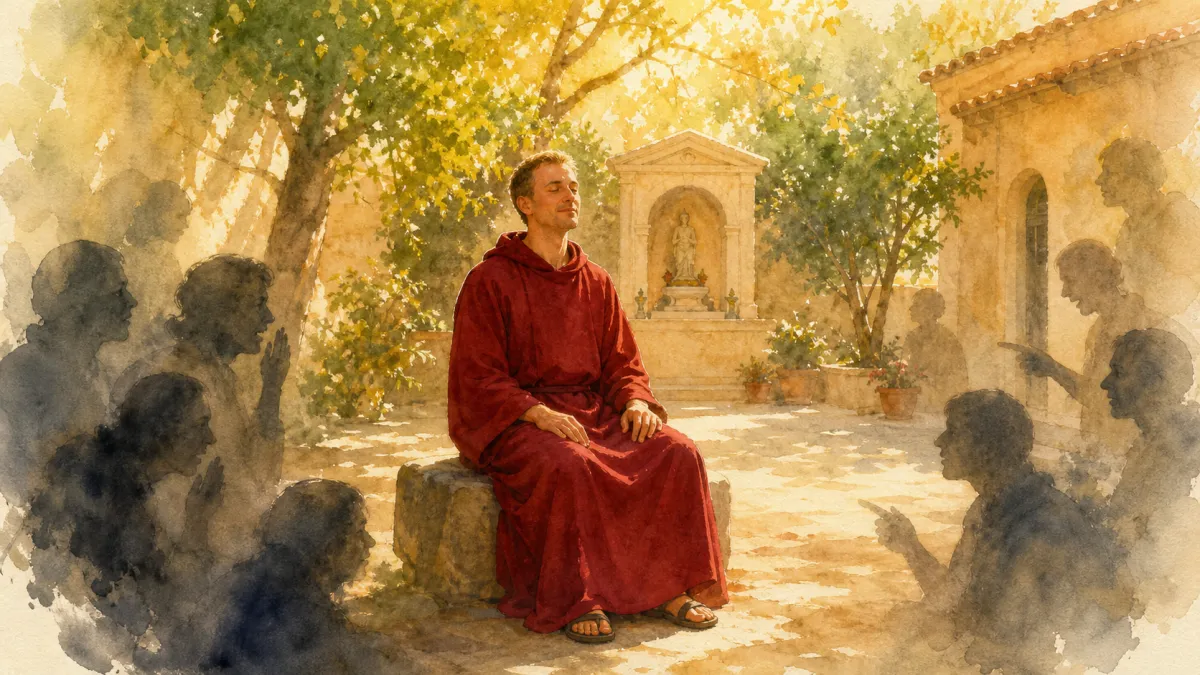
In the same way, when we acquire genuine love for God, we are in a different vision; even while alive, we are already in heaven. We do not need to seek heaven, dream about how we will reach it, or, grinding our teeth, say: “I will definitely reach it!” In fact, we are already there and grow into this vision more and more deeply with each passing day. And we are constantly nourished by the joy of this touch, of abiding in such an atmosphere. Increasingly becoming accustomed to and growing into such a vision is precisely the transition to the pure land.
It can be said of some monks that they possess such love; their souls are bright and peaceful. Some are approaching it, and some are seeking it.
