

Commentary on the text “Yoga Vasistha,” “The Story of Indu’s Sons”
After chanting the mantras, you try to remain in a state of presence for some time, usually performing shambhavi mudra and gazing into space, integrating with it. If you want to preserve a state of awareness and contemplation, you do not immediately get up and begin doing something after chanting the mantras; instead, you remain in contemplation, gazing into space for a while and observing the subtle intuitive ground of the mind and awareness.
You relax into this subtle intuitive ground and try to bring it to the forefront, outward. Your consciousness is bright, clear, and alert, but not tense. And you try to relax into this subtle intuitive ground of consciousness. This subtle intuitive ground lies beyond mental activity, beyond concepts. It is like a certain sense of spaciousness within. You try to trust it more, let go of yourself, and relax in order to allow it to emerge, while you remain beyond evaluations and judgments, gazing into the space before you—this is called shambhavi mudra.
The more you relax into this state of intuitive awareness, let go of yourself, and trust it, the stronger this experience becomes. After some time, you may discover a powerful bhava (a sense of the world), that is, a feeling of grandeur, expansiveness, vastness, and depth that begins to unfold within you. The more you relax and let go of yourself while remaining in this wakeful state, the more powerful the experience will be. At this stage, you simply need to remain aware, release attachment to effort, relax, and let go; then this experience grows more and more, as though you were becoming a kind of conduit, medium, or transmitter of this state.
Of course, at this level it is very important not to fall into deviations or lose your personality in it. Your personality should not be lost in this; on the contrary, it should blossom, and all your qualities, nourished by the light of this intuitive awareness, should blossom and manifest in the relative dimension. But if we lose ourselves in this experience, it is a deviation called the loss of action in the view or the loss of action in awareness.
In other words, we must not only unlock our potential but also know how to use it. It is as though you receive a precious pearl, as though a great treasure within you is revealed. It has always been within you, but you did not even know about it; and even if you did, you did not understand how to uncover it. Through contemplative practice, you discover this treasure and become convinced that it truly exists. You gain a certain experiential realization, but gaining such an experience is only the very beginning. It is like being given a magical device. Now you need to learn how to control, master, and use it, and mastering it is something you must learn throughout your entire life.
Stages of Spiritual Development
Discovering this space-like intuitive awareness, becoming established in it, and eradicating the kleshas, obscurations, attachments, and dualistic notions in the mind is only the very beginning. In other words, at first we work to discover the natural state; then, even when we discover it, we see that we are not yet able to sustain it. Yes, while there was practice, there was a flash; once the practice ended, the flash disappeared, and we fell back into ordinary life. And now we struggle to maintain the natural state.
Then, when we manage to discover it and sustain it deeply enough, we find that there are many factors working against it: our worldly desires, our karma, and our various dualistic notions. It takes a great deal of time to purify all of this until we truly free our minds from all constraints and attachments. This period may become a serious struggle and may last for years or even decades.
Many people come to a complete standstill at this point, yet even this is not some final phase. An important phase is the next stage, when we attain the purification of all our desires, karmas, and dualistic concepts and gain access to this purified, precious diamond of our natural state. Rather than seeking or sustaining it, we begin to actively use it. This is the stage of purushartha (active manifestation), the stage of siddhi. We use it without motivation, without a user, without desire, without ego, without attachment to the sense of “I,” and without dualistic concepts, because all our old motivations and old illusory dualistic concepts have long since been left behind and dissolved.
We could say that we use it because it is the nature of energy to manifest. By and large, when we reach this stage, it is no longer we, but the Absolute, that plays within our body. We call ourselves “I” or “we” merely as a form of play, as a kind of label or name for others, so that they do not confuse us with someone else.
Whenever a jnani says “I” in reference to himself, he is simply using a label for his body and mind; he does not imply that there is some self-existent person within his body. Rather, this is his form of vyavahara-vachana—conventional speech used for the sake of others.
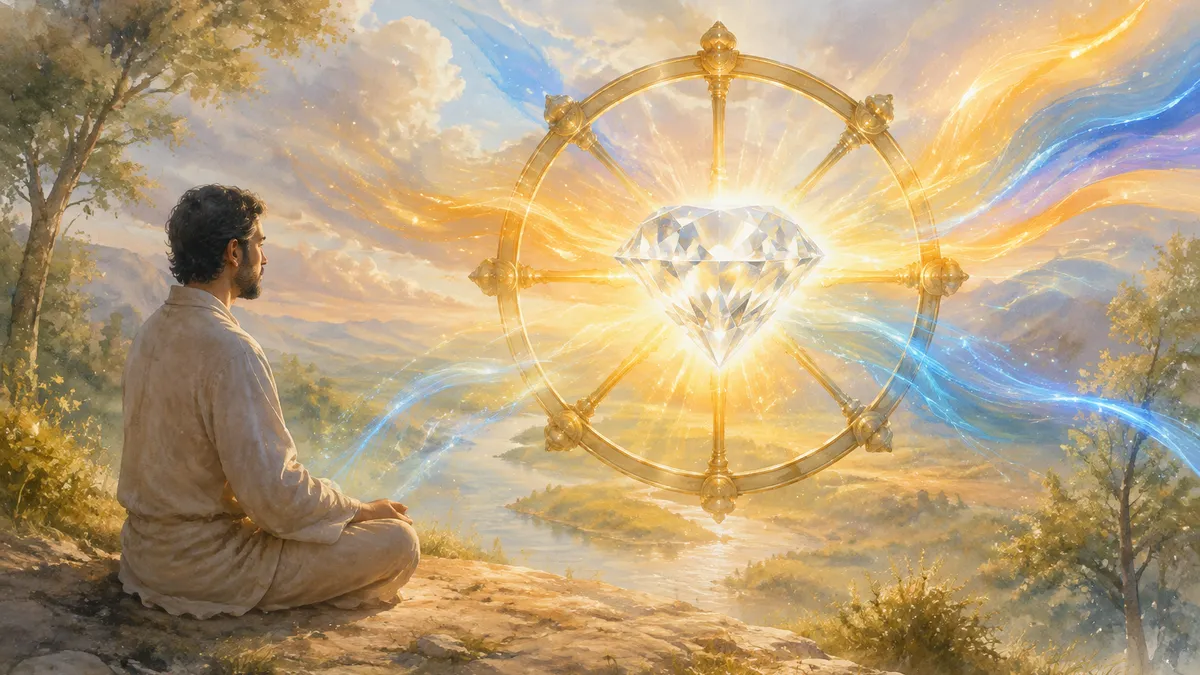
The Stage of Purushartha and Turning the Wheel of Dharma
For a yogi who has eliminated his dualistic concepts and finally attained the long-awaited freedom, the next stage is what is called “turning the Wheel of Dharma.” Turning the Wheel of Dharma means that, having obtained this precious diamond, we begin to turn it, to unite it with various universal forces, and to manifest diverse forms of play in this relative dimension. This happens as naturally as the sun shines and melts ice. It occurs spontaneously, without any goal or motivation at the level of logic. It comes from within, and through it all your subtle states and qualities blossom, leading to the development of the next stage. Subtle inner karmas, energies, and pranas begin to transform and be recast, and at this stage the yogi gradually approaches the state of a deity who, through the power of his mind, begins to alter space both externally and internally. This is the stage called purushartha—active manifestation.
In other words, it is as if someone told you, “There is a check for a million dollars sewn into the lining of your coat.” You did not know about it and lived the life of a poor person. Then some compassionate person came along and shared this joyful news with you. For a long time, you doubted it and did not believe it, and then you had to make a considerable effort to open the lining and retrieve the check. Yet even this is not the final phase. Then you begin to put it to use, to spend it. It is never depleted in itself. You begin to use it actively—this is the meaning of purushartha.
It is believed that a yogi who at some point stops at the emptiness of awareness, fails to integrate with the manifested aspect and manifested energies, and does not understand the principle of purushartha, or manifestation, has become definitively stuck somewhere in his practice, having stopped at the phase of unmanifest emptiness. In the teachings of the siddhas, such emptiness is regarded as an insufficient level of realization.
Brahma-Jnana and Transcending It
The stage of purushartha means that we begin to derive benefit from our contemplative practice even in the relative dimension. At first, through the contemplative practice of discovering the fundamental Mind, we merely eliminated our confusion, ignorance, and illusions. We eliminated dualistic concepts of ourselves as persons, recognized our divine nature, discovered the supreme Source within ourselves, and became firmly established in the understanding of ourselves as the supreme Source. We discovered the illusory nature of all existence and the world’s dependence on our consciousness, eliminated our deep existential confusion, eliminated all our attachments, fears, and hopes, and became completely empty—became, in a certain sense, realized.
Of course, even to reach this stage, many may need half a lifetime, and some perhaps an entire lifetime. But from the siddhas’ point of view, even reaching this stage is merely a certain beginning, since the siddhas are perfect beings with very high standards and levels of awareness. They say that even this stage is only a certain milestone. It is the stage of realizing Brahma-jnana.
Brahma-jnana means that we realize the Absolute and eliminate our own ignorance, the cause of future births. One of the criteria of Brahma-jnana is attaining uninterrupted awareness in dreamless sleep and, of course, in dream sleep. It also means attaining nonduality, the point of paradox that lies beyond time, form, images, concepts, and everything else; becoming established at this point and revealing various subtle aspects of this level of consciousness, such as space and light. All these are the most subtle nuances of the Dharma.
However, the saints do not recommend remaining at this point. They say that even the realization of the deepest levels of this subtle, nonconceptual, formless consciousness is not something at which one should stop, because a creative impulse, union with energies, and the play of these energies are necessary. It is precisely this creative impulse that will provide a powerful impetus for the development of a further level of presence. And since energy has its own laws, the yogi, without losing this state, once again returns to working with energies and with manifestation. But now this is no longer samsara, no longer a world of conditioned causes and effects that plunges one into suffering, birth, and death; now it is a play that proceeds entirely from consciousness, a creative manifestation of one’s liberated consciousness. It is a play beyond concepts, beyond cause and effect, and beyond subject-object connections and relationships, proceeding entirely from unconditioned consciousness.
It often happens that highly advanced saints encounter yogis who have stopped at this stage and persuade them to move on to the next phase, in a sense preaching the Dharma to them. If, in our human world, when preaching the teaching, we persuade people to abandon their illusions and embark on the path of nirvana, then at this level they are persuaded to leave nirvana and embark on the path of playing with material energy, with samsara—the path of uniting nirvana and samsara.
The line of divine pride is associated with unlocking our potential in the aspect of bhava, our sense of the world. The line of contemplation is associated with the development of subtle intuitive awareness. The line of space is associated with developing the capacity for contemplation through union with infinite space.
The Nature of Reality as a Virtual Game
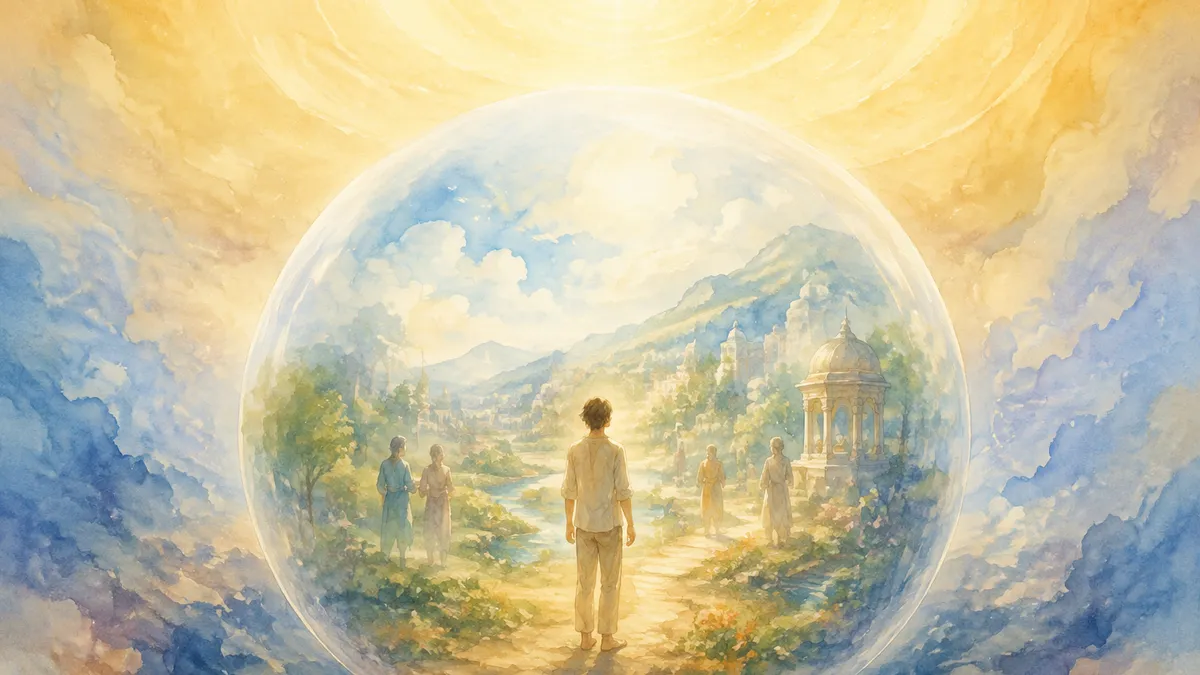
There is limitless potential within us. In essence, the world is not what it appears to us to be, and we are not what we appear to ourselves to be. We consider ourselves human beings, but in fact this is a certain identification arising from the conjunction of intuitive consciousness, the higher Self, the mind, and the body. In other words, all our notions are nothing more than the notions of certain virtual characters in a computer game.
Virtual characters in a computer game enter into complex connections and relationships. They have a predetermined role and are limited by their virtual reality. But there is always someone who created this virtual game, someone who is separate from it. To that person, the virtual characters in this computer game are unreal, since they know that these are merely characters whom they themselves endowed with artificial intelligence, a role, and complex connections and relationships. But the characters do not realize this; they are deeply absorbed in their role, their connections, and their relationships.
I would not be mistaken if I said that this is not even a rough metaphor, but a completely accurate one. There would be no mistake in saying that this metaphor is one hundred percent accurate. It is just that in this computer game, in this virtual reality, the graphics are much more sophisticated and the characters have more powerful artificial intelligence. But essentially there is no great difference, and I think that as information technology develops, it will become possible to recreate a reality in no way inferior to our human reality and to create characters with the same level of artificial intelligence. Then humanity will inevitably reach a point where it will have to examine deeply where true reality lies and what the true nature of consciousness is.
The Multiplicity of Worlds and Creators
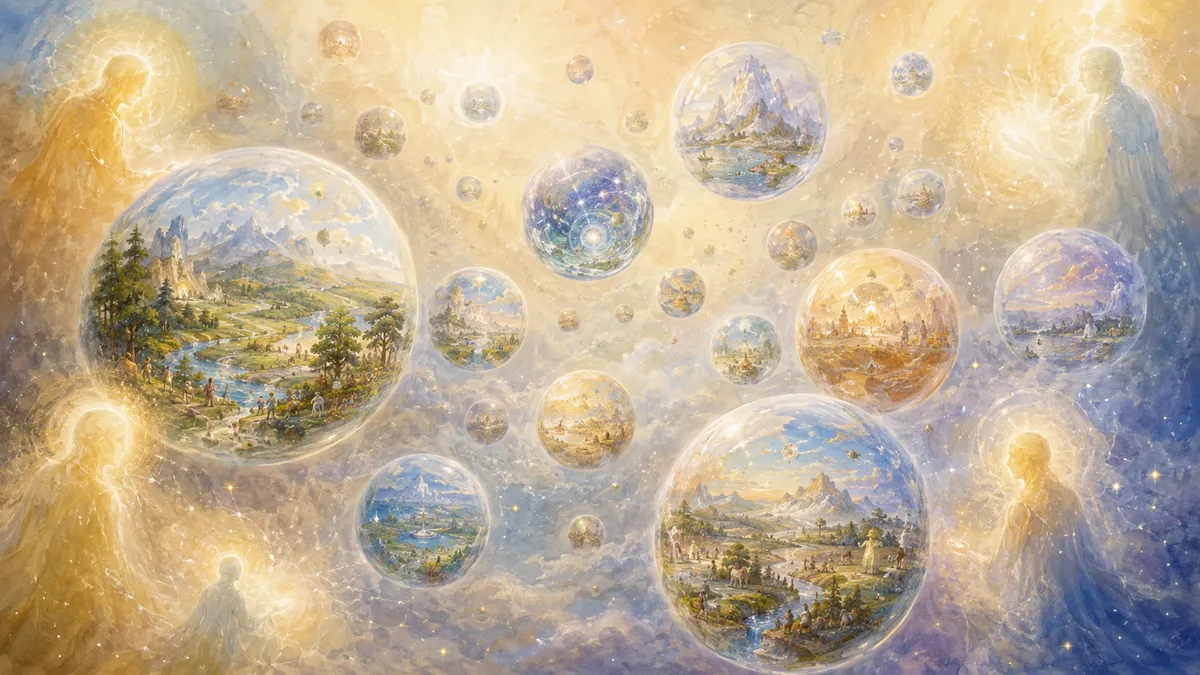
The teachings of the Vedas and Upanishads, as well as saints, rishis, and sages, say that all worlds are like such virtual realities. There are no fundamental physical laws governing their immutability. They are created spontaneously, stochastically, and probabilistically by the forces of consciousness of various creators. There is no interconnectedness between them. It is as though there are any number of creators in the universe—its sovereign, volitional operators. They generate any number of universes, their own worlds, which are populated by various characters and beings, among whom complex connections and relationships are established. And all of this arises purely from consciousness. There are no fixed parameters of time and space by which connections could be established or correlations drawn between them. All of this is entirely non-algorithmic.
If you have many discs on a shelf containing various films or computer programs, each of them represents an entire universe. And there is no significant connection between them, other than the fact that you selected them and placed them on the shelf, or that they were created by others. In the same way, our worlds—the worlds of gods, rishis, siddhas, gandharvas, yakshas, and vidyadharas—are diverse worlds created by the power of a higher consciousness. There are as many of them as there are creators. The concepts of time, spatiality, and causality within them are established arbitrarily on the basis of their own consciousness.
Humanity usually attempts to clarify and derive certain fundamental laws underlying the universe and to correlate causality, time, and space. That is, it tries to derive certain universal constants and extend this vision to the entire universe. But in reality, the universe is structured far more complexly, and it cannot be reduced to fundamental constants because there is no algorithmic order here. Consciousness is a probabilistic and stochastic element, free from any predetermination or algorithmic constraints, and therefore it creates in a far more unfathomable way. Likewise, our world is merely one such creation, brought forth by a higher consciousness. This higher consciousness is commonly called Ishvara, Brahma, the creator of our universe.
Brahma as the Creator of the Universe
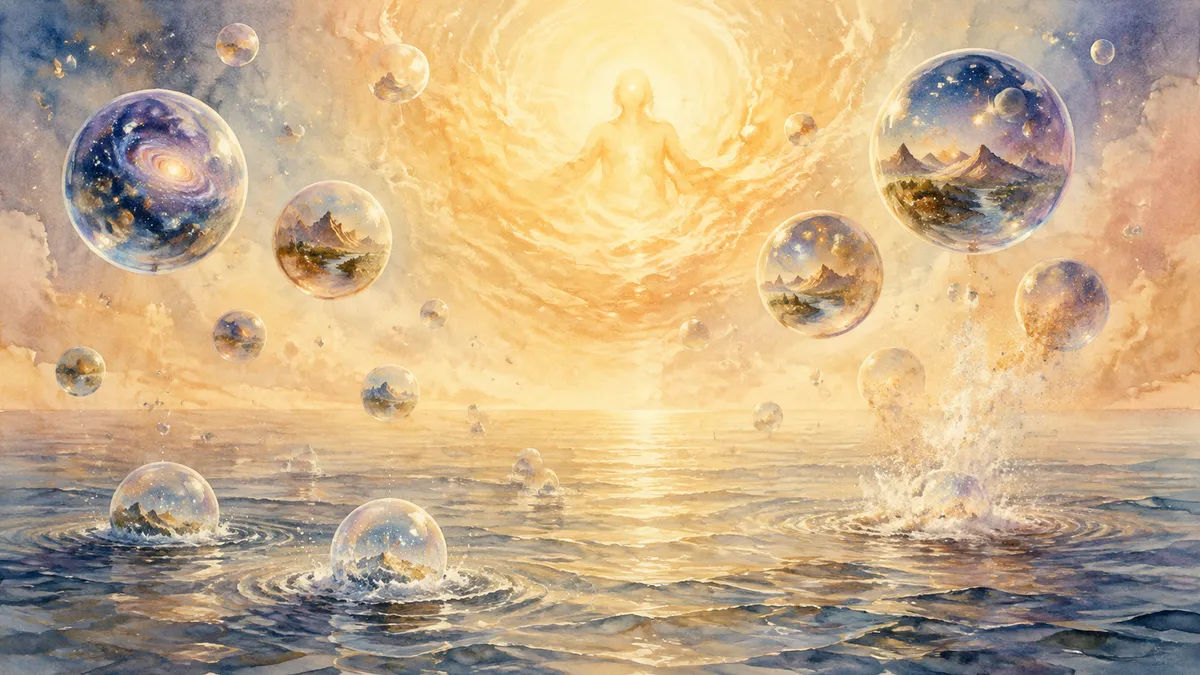
Our entire world is the intention, the sankalpa, of Brahma, the creator of the universe. It is his dream. It is said that when Brahma falls asleep and allows his energies to generate, these energies manifest as the visible universe. Brahma can be defined as the global creative consciousness. It is believed that there are infinitely many such Brahmas. They arise in the space of fundamental consciousness just as bubbles arise on water, and along with them arise universes created by their consciousness. Some universes are only being created, others are already being destroyed, while still others exist and are sustained.
According to the scriptures, by the time cycles of the creators of universes, the creator of our universe is fifty-one years old. But in fact, there is a limitless number of such creators. Accordingly, there is also a limitless number of universes. This world, with its laws and constants, is a manifestation of Brahma’s mind. This includes the laws of birth and death. Even the gods, with all their celestial realms and pure lands, are also part of the one global, vast mind of Brahma, the creator of the universe.
The Potential to Become a Creator of Reality
In the same way, upon reaching a certain level, each of us can also become a creator of reality. Cases are often described in which a particular yogi or rishi, having attained the highest level of consciousness through ascetic practice, became a creator of a universe, a Brahma. This means that within us lies the same potential as that of the creator of the universe. The creator of the universe has simply awakened and fully unfolded that potential, and it manifests far more powerfully than ours. But if we awaken our potential, we can free ourselves from Brahma’s laws, which exist in this samsaric universe for our class of human beings, and attain the higher status of divine beings; then we ourselves can become Brahmas and create universes according to the principles and ideas we hold.
The Yoga Vasistha describes many cases in which yogis attained such a level. The same is also described in the Tripura Rahasya.
In the Tripura Rahasya, a yogi asks his teacher:
If everything is created by consciousness, then why can my consciousness not create anything? Why does my intention not manifest?
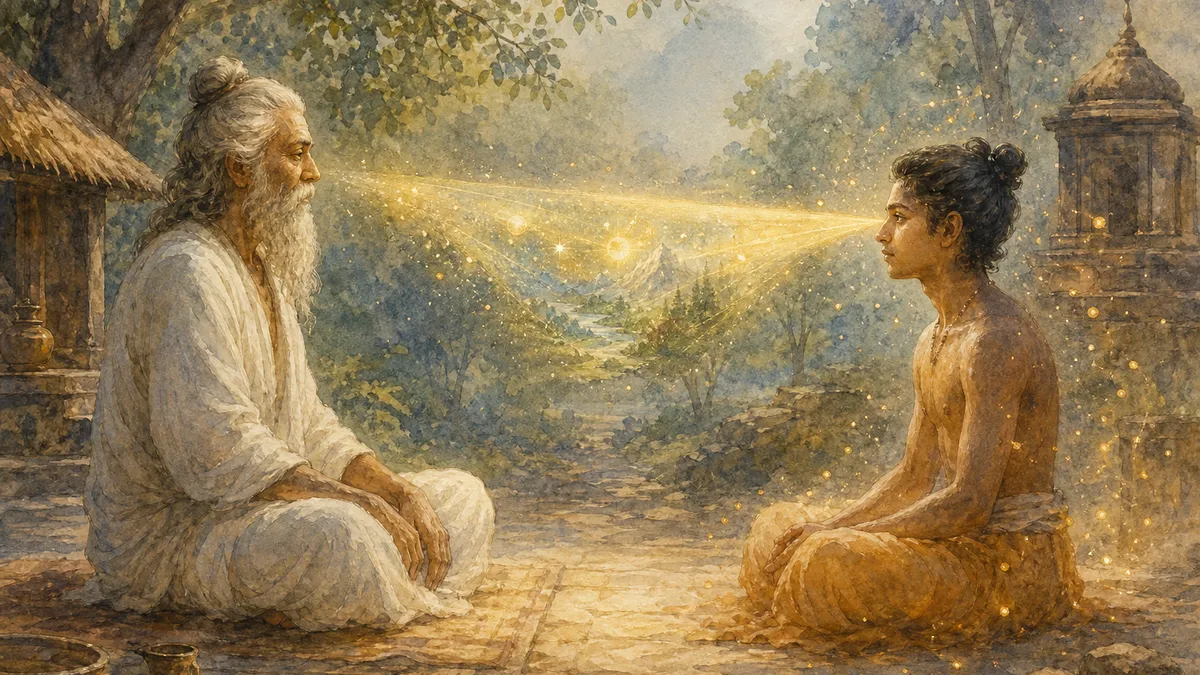
The teacher replies:
People’s intention is scattered; it is weak, not one-pointed, and lacks depth, so it does not manifest properly. But if you hone your intention, train your consciousness, and give it the necessary depth, rest assured that in time you will acquire the same power as Brahma and will be able to create your own universes.
Liberation from the law of karma, from suffering, limitations, births, and deaths means becoming established in such superconsciousness and fully unfolding its creative potential and creative activity. Liberation means that you live in a world created by your consciousness. To realize nonduality and become a deity means attaining a state of consciousness that enables you to create realities and universes yourself. For if you live in a reality that was not created by you, rest assured that this reality is not meant for you; it was not made by you. This reality, which always limits you, is samsara.
The Laws of Samsara and the Possibility of Liberation
Suppose there is the human world—one of the realms of samsara. Certain laws apply to it, according to which human beings are allotted a specific amount of time, after which they die and are then reborn. There are laws of physics, bodily biochemistry, and other laws that govern this world. These laws are generated by various manifestations of subtle consciousness—what are called “ruling deities.” And all of us are integrated into this system. We cannot overcome all these limitations because this world was created by a higher and more powerful consciousness that is incomprehensible to us. Yet we are compelled to live in this world because we have no other world. Although we did not create this world and it is not meant for us, we must obey its laws whether we want to or not.
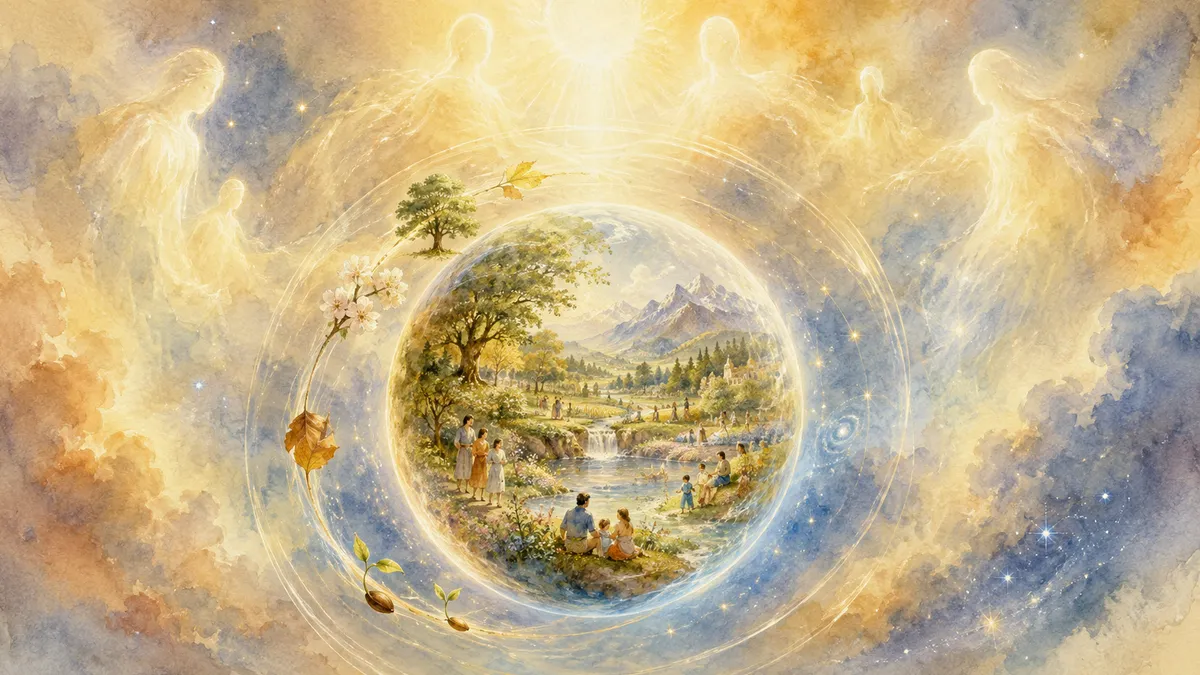
With regard to government laws, you can still say, “Government laws do not dictate to me,” but even those you are compelled to obey. The physical laws of the gods are even subtler, and whether you want to or not, you obey them nonetheless. For example, the laws of gravity, bodily aging, or the passage of time are laws established by divine beings of a particular realm of samsara who govern this world. When we understand this, we see that limitations exist on all sides. We may not want it, but time moves on and changes everything; our plans may vanish; we do not want to grow old, yet we do; death exists. These are the laws of a reality that was not created by our consciousness. This reality was created for a particular class of beings, a particular level of consciousness.
But as soon as we raise our level of consciousness, our consciousness allows us to be free from these laws. In fact, these laws are not absolute; they are not one hundred percent binding. There is always a possibility of becoming free from them, and as soon as you assert your capacity to be free of them, these laws no longer apply to you. Consciousness, our will, and our capacity for manifestation are precisely such liberating factors.
A monk once told me about an experience he had. During a lucid dream, he found himself in a subway, but it was a strange subway where the souls of sleeping or deceased people gathered, and all of them were unconscious. They were waiting to be assigned. In other words, it was something like an intermediate state, a bardo. From time to time, a large man resembling a guard, endowed with tremendous strength and a powerful bhava, entered the subway. He scanned each person’s consciousness, reading their thoughts, and all these people shrank and cowered even more from tension and fear. His consciousness was very quick, agile, and aware compared with the consciousness of those who sat there awaiting their fate. He would quickly make a choice, seize someone, and take them away with him. Being only semi-conscious, none of them understood what was happening to them; they were simply terrified of this guard as they waited to find out what would happen to them next. He was some kind of powerful spirit who appeared in this form. Because the monk was conscious, he felt that he had no need to fear him or await his fate, so he simply got up and left the subway car.
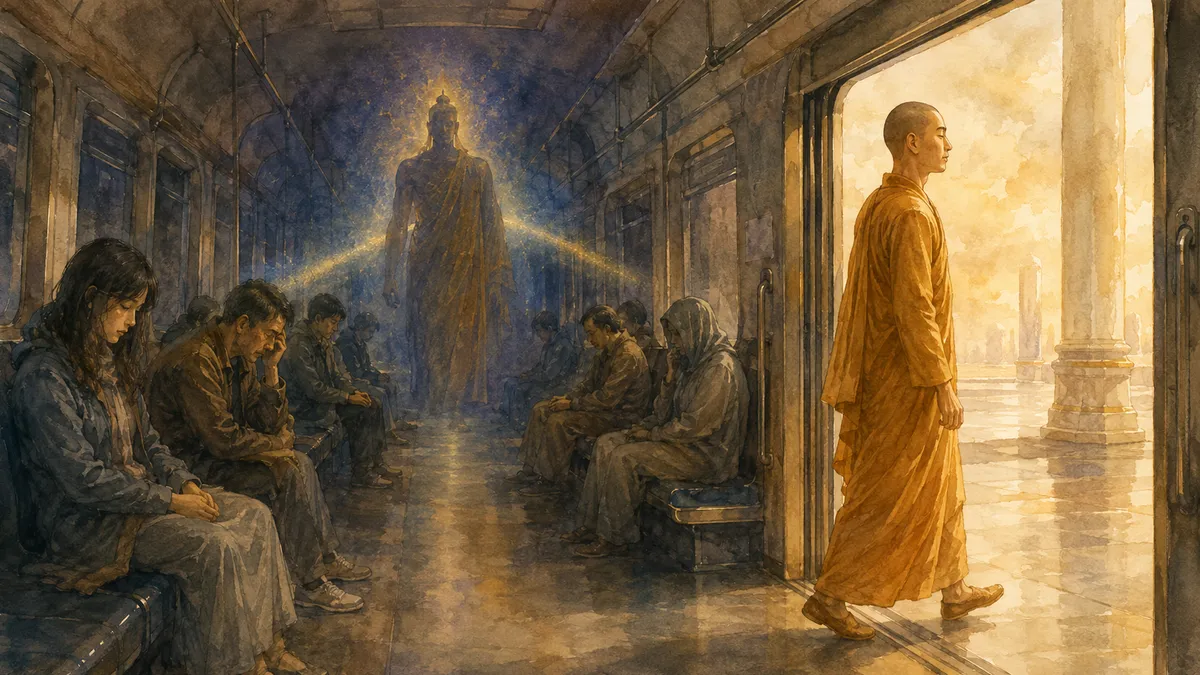
In the same way, samsara is a world of phenomena, something like a large railway carriage. In principle, you can leave it at any moment as soon as you demonstrate a slightly higher level of consciousness. You will immediately be told, “Sir, you do not belong here; this is not for you, it is for another class of beings.” But you must demonstrate this consciousness. To whom must you demonstrate it? To the various subtle energies that exist in the universe. These are the various guardians of time, guardians of the law of karma, guardians of the five elements, deities governing reincarnation, and countless guardian spirits and deities. They are, as it were, representatives of the supreme Source who perform various functions. These are superintelligent, creative, powerful forces that oversee the balance and equilibrium of forces in the universe and maintain and guide the overall evolution of the human system as a vast, intelligent, evolutionary system. But as soon as you demonstrate a higher level of consciousness, these energies cease to include you on this list; you begin to drop off their list of restrictions and move onto another list of higher consciousness, where your consciousness can manifest more freely.
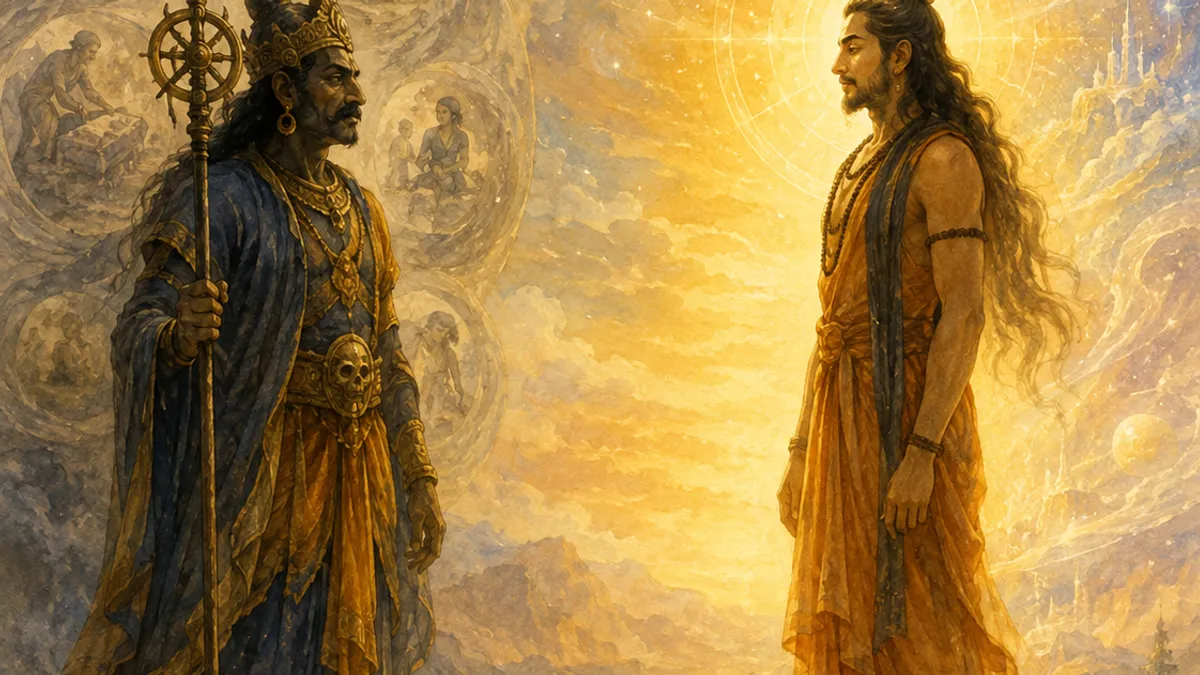
There is an episode described in the text “Gorokho Bijoy,” in which Saint Gorakshanath sets out for the realm of the god Yama after learning that Matsyendranath, his teacher, has been entered on Yama’s lists and has only three days left to live. When he arrived in the realm of the god Yama, Yama, who usually seizes people, stood up and greeted Gorakshanath very warmly. Gorakshanath said:
You made a grave mistake when you included Matsyendranath, my teacher, on the list of mortals. Although, as a result of a curse, Matsyendranath is now under an illusion and is enjoying himself with the Kadali women, he is my guru, and I warn you that you had better not do this—you know my power.
Yama replied with great respect:
Yes, yes, we will certainly correct this mistake.
Would Yama speak this way to an ordinary mortal? Of course not, because Yama’s function is to carry out reincarnation together with his numerous subordinate deities. But when Gorakshanath arrived, Yama treated him in a completely different way, because Gorakshanath’s level of consciousness was even more powerful and profound than Yama’s. Gorakshanath could generate other Yamas, because he himself was the creator of other realities. He had unlocked the potential of his own consciousness and gone beyond the laws governing mortals, beyond the laws of samsara. In the same way, as our consciousness develops, it can act as one that liberates itself from laws and can itself create new laws. This is the meaning of creative manifestation (purushartha)—the next stage after you discover the principle of the natural state and it gains strength within you. This stage is usually called the stage of attaining various siddhis, when, while remaining in unity with the supreme Source, you can invoke various universal forces and manifest different things.
Developing Creative Abilities
Why do you manifest them? In order to continue developing your consciousness. But at first, you may not manifest any extraordinary mystical abilities. Most likely, what may initially manifest is greater awareness and greater responsibility, while your mind and intellect become clearer. You become more intellectual, even brilliant in a certain sense. You can freely work with complex categories that you could not work with before. You develop various creative abilities that you did not have previously. Naturally, your compassion, love, inner harmony, and inner wholeness grow; various talents emerge, and your intuitive consciousness becomes stronger. You become a creative, gifted, and even brilliant person who can express yourself anywhere and succeed in everything.
At the very least, you attain complete success: your intention is realized, and all your thoughts, desires, and intentions that you seriously contemplate begin to come true. Such subtle, profound ideas are constantly generated within you—ideas capable of changing reality—and you surround your reality with these ideas in such a way that it begins to consist more of your ideas than of any crude laws of material nature or other people's ideas. It is like a brilliant musician surrounding himself with music of his own composition, with that music becoming a kind of environment that expresses his inner state. In the same way, as your contemplative presence grows and you are able to draw inspiration and strength from it, this also occurs in the world around you. You see that you have obtained a precious diamond of sorts, one that enables you to express or do exactly what you would like in your life. Of course, by then you no longer have any selfish desires, worldly desires, attachments, or illusions; rather, due simply to certain inclinations, you wish to manifest particular energies for the benefit of all living beings and for the sake of your own development.
This is precisely how the transition from the ordinary human state to the state of a deity begins, into the dimension of the mandala—a pure dimension woven from your own consciousness. This transition is preceded by the development of your creative powers. As soon as you acquire the capacity for creativity, as soon as your consciousness becomes intuitive, clear, and multidimensional, you begin to eliminate your suffering. You obtain the key to eliminating any problems and any suffering, because your intuitive, creative consciousness is capable of generating mandalas—complex structures that integrate entire arrays of different energies and transform the dimension into a purer one. And then you understand what it is all about. It turns out that to solve any problem, you need to generate a mandala. And as soon as you are able to generate a mandala, some complex structure from consciousness, and this mandala integrates different energies harmoniously and at a high level, you can solve any problems, even those in which you are not an expert. Ultimately, your clarity enables you to identify the problems that exist in samsara and successfully resolve them both for yourself and for others.
The Inner Sun and the Transmutation of Reality
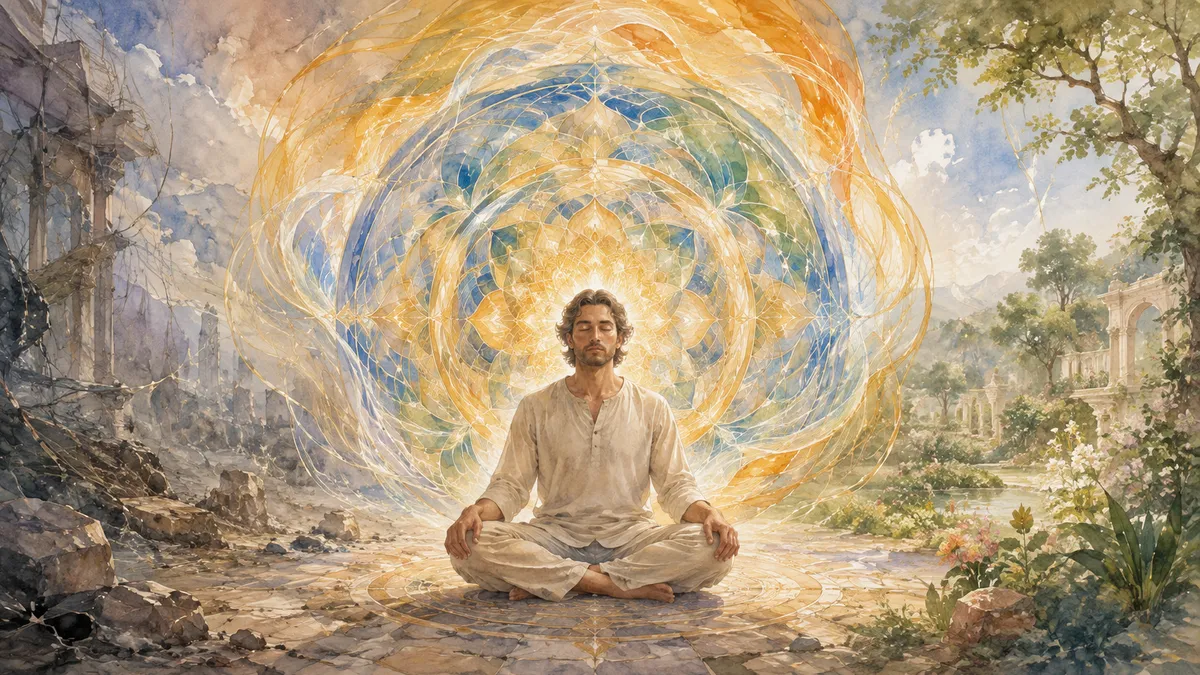
It is as if a powerful searchlight has appeared within you, an immense million-watt source of light, an inner nuclear reactor, an inner sun emitting a beam that you can direct anywhere. As soon as you direct this beam, external reality melts and is reforged under its influence, becoming purified and acquiring depth and purity. You simply illuminate everything with this beam. Just as the sun begins to shine, you begin to shine in the same way. And wherever you shine, reality begins to be sanctified by your inner sun.
The rays of this inner sun are clarity; the light of this inner sun is the pure awareness of the natural state; and the process of reforging means uniting clarity with the various energies that arise when attention is directed toward any experience. Over time, the more you shine around you, the more the world and your surroundings change.
For example, if you have chronic illnesses and possess clarity, you reason as follows: “There are chakras and channels. I simply need to work on them, and then I will be able to eliminate the cause of my illnesses.” You begin to understand everything as it truly is; you are no longer confused. You do not need doctors, examinations, or pills; you understand that simply through the power of your practice and clarity, you can eliminate all chronic illnesses. Then you understand: “I have old karmas, karmic debts, the ancestral karma of my forebears, and my own samskaras from past lives, but the beam of my clarity turns toward them and purifies everything.” And then you can say that you have no old debts and that your karma is pure. After all, it can be changed if you penetrate it with the beam of your clarity. Then you think: “What about the future?” You reflect: “Oh, this is the future that lies ahead, but I can change it. I can construct my own model of the future and, through the power of my clarity, shape a different future—the future I would like.” Then you turn your attention to the world around you and think: “There are such-and-such problems in this surrounding world,” but if you apply your own clarity, you can change or solve them; at the very least, you can try to do so.
Thus, through the power of your clarity, you notice any manifestations of impure vision and transform them into pure vision. It is as though you illuminate everything around you with a powerful searchlight. True practitioners—those who are saints, siddhas, rishis, and teachers—possess such a powerful beam of light. They stand at the boundary of chaos, at the boundary of entropy, and continually illuminate this entire reality as if with flamethrowers, transforming it into a purer dimension. And when chaos, entropy, the tendency toward the lower worlds, and a decline in order and level encounter their powerful light, transmutation and transformation take place: everything is transformed into a pure dimension, into a mandala, and divinity grows.
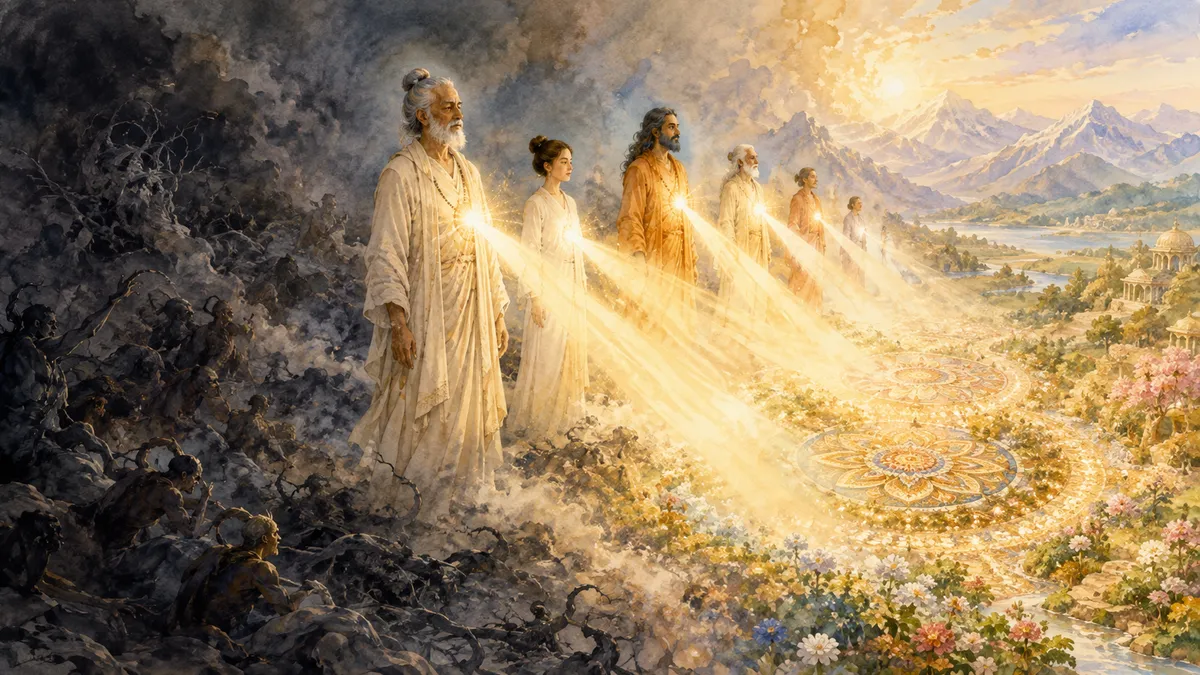
This is a further stage for the practicing yogi, when they continuously transmute various energies, continuously transforming them both within and without. Internally, they transform their remaining impure energies—the energies in the channels and chakras, various pathogenic energies, and obstacles—which continue to exist until the elements are completely purified. Externally, they transform various outer connections and relationships because their consciousness constantly generates clarity, creating various mandalas, and these mandalas, as localized areas of pure vision, cover various chaotic, disordered energies. This continues until nothing impure or disordered remains in the body, in the energies, or in the external world. And when nothing impure or disordered remains, the physical body is transformed into a subtle, divine, energetic body, the so-called rainbow body; the external world is transformed from one limited by samsara into a mandala of pure vision, into a pure land, into a pure dimension. All relationships and connections are transformed—that is, there is a complete transition, an absolute transition into a totally pure divine state.
Purushartha (the manifestation of energies) means understanding this active principle of transformation. If we fail to understand this principle and work only with contemplation within, then for a long time we deprive ourselves of the opportunity to develop such maturity. Of course, someone may say: “In order to transform, one must have something with which to transform; one must develop some basis of the natural state.” This is so, because if you have no basic contemplative presence, then, of course, you will have nothing with which to transform. In other words, this light has not yet been kindled within you, so you must seek it and kindle it. But we are speaking specifically about the stage when the light has already begun to ignite and when it has already been fully kindled.
The Story of Indu’s Ten Sons and Their Aspiration to the State of Brahma
In the “Yoga Vasistha,” there is a story about the sons of Indu. It begins with Vasistha recounting how he asked the creator, Brahma, to describe how our universe was created. Brahma replied to Vasistha:
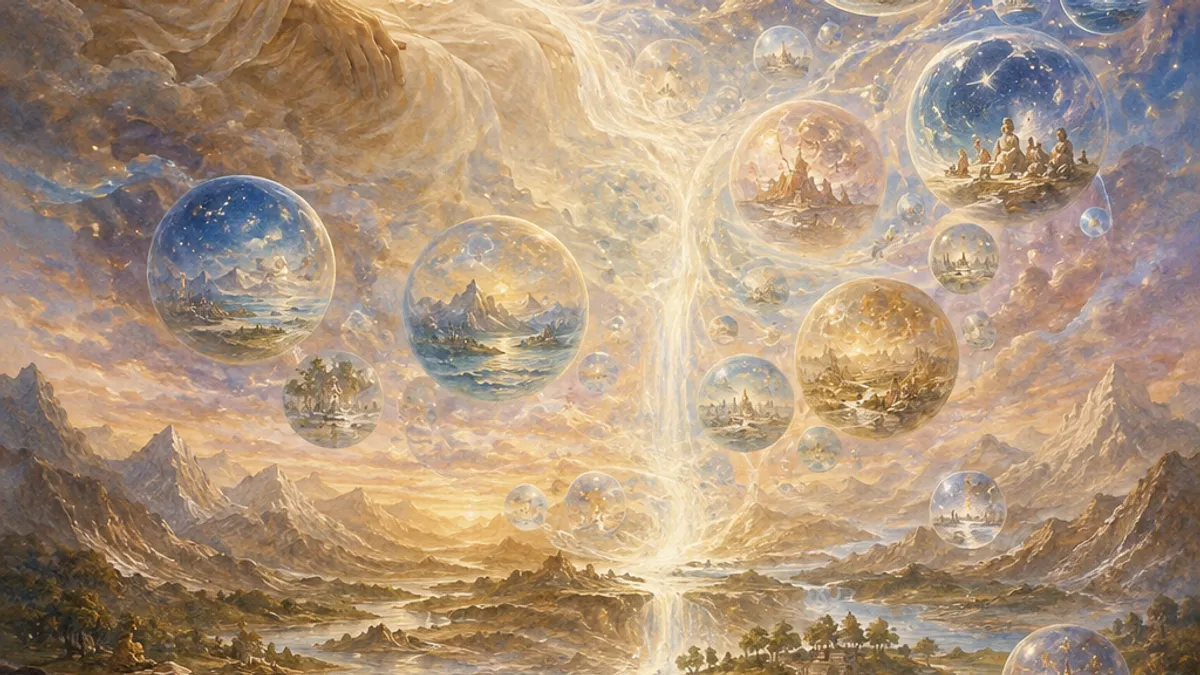
Here, everything is mind alone. I shall tell you what happened to me at the end and beginning of creation. At the end of the previous age, there was a cosmic night, and as soon as my mind awakened at the end of that night, I prayed and looked around, wishing to create the universe. I saw an infinite nothingness that was neither light nor darkness. And because the desire to create was present in my mind, I began to see subtle visions within my heart. In my mind, I saw several independent universes. In each of them, I saw my counterparts—other creators. In these universes, I saw all kinds of beings, mountains, rivers, oceans and winds, the sun, celestial beings, and an underworld inhabited by demons. In all these universes, I saw sacred texts, rules of moral conduct that defined good and bad actions, heavens, hells and their descriptions, as well as texts describing the paths of enjoyment and the paths of liberation. In all these universes, I saw humans and gods striving toward their own different goals. I saw seven worlds, mountains and oceans heading toward destruction in other universes; I saw time and its division into ages, cycles, days, and nights. I also saw the sacred stream of the Ganges, binding together the three worlds—heaven, earth, and subtle space.
What is meant here is not the River Ganges, but a subtle astral current that the siddhas call the Ganges. The Ganges as a physical river is already a manifestation of a subtle spiritual current flowing from the world of the gods. It can be projected onto any river. Some prominent Russian researchers claim that the original Ganges is in fact the Volga, citing various linguistic studies, referring to the names of springs in the Mahabharata and the similarity between the names of more than two hundred springs mentioned in the original Sanskrit texts.
Brahma says:
Like a castle in the air, this creation shone with its heavens, earth, and oceans. Looking at all this, I was surprised and delighted. My mind is in the void, and I see all this, although I have seen nothing with my eyes.
Brahma pondered the principle underlying the existence and creation of the universe. He was greatly surprised, since the universe appeared to him as an illusion created by consciousness, yet this illusion was real.
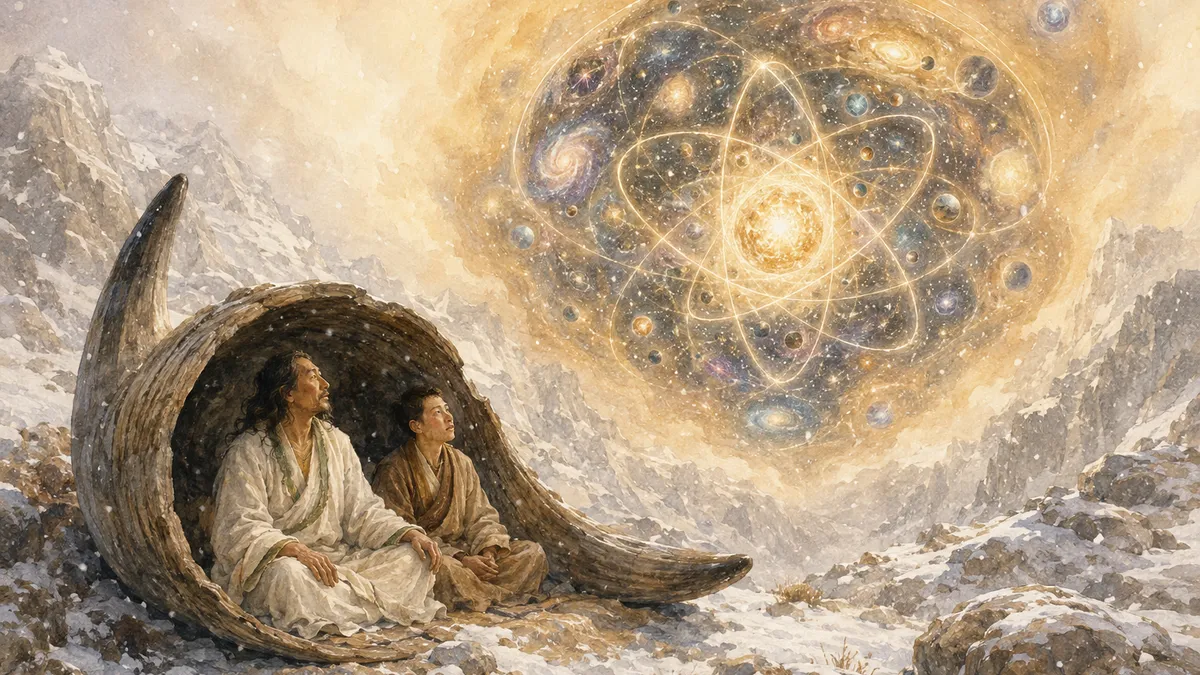
One often encounters the following statement: “Even the smallest atom may contain billions of universes.” Of course, this is difficult for us to understand. There is also a story about how Milarepa, while traveling with a disciple and caught in a snowstorm, hid inside a yak’s horn, yet the yak’s horn did not grow larger, nor did Milarepa become smaller. From our point of view, this is impossible. But if we consider that the world is not physical in nature, but has a subtler nature—a quantum nature, in scientific terms—then this is entirely possible. After all, you are not surprised that a small box can hold ten discs containing different films or computer games. A single game is an entire universe inhabited by various personalities with their own character; it contains vast spaces, yet all of them fit inside your very small box. And if we consider that universes have an even subtler nature, then it is entirely possible that, at such a level, even a single atom can contain billions of different universes, with room for all of them. This was precisely the problem Brahma was pondering.
Looking at all this, I was surprised and delighted: “How is it that I see all this in my mind, in the void, although I have seen nothing with my eyes?” I pondered this for quite a long time and eventually asked one of the suns in one of the solar systems to come closer to me. I asked it the question that troubled me.
The Sun said:
O Great One, being the omnipotent creator of all this, you are God Himself. It is only the mind that manifests throughout this endless whirl, which confuses everyone and makes them wonder whether it is real or unreal. You undoubtedly know the truth, but since you have asked me, I shall answer obediently.
To answer Brahma’s question about the nature of reality and the nature of the universe, the Sun god related the following parable, a legend.
The Sun said:
Near the sacred Mount Kailasa, there once lived a holy man known as Indu, a descendant of the sage Kashyapa. He and his wife were blessed in every way except that they had no children. One day they went to the sacred mountain to perform rituals in order to receive the blessing of children. There they subsisted on water alone. Eventually they came to resemble trees, for they stood motionless.
For some time they performed ascetic practices and observed a fast, drinking only water. They performed an ascetic practice that consisted of standing on one leg, reciting a mantra, and remaining in contemplation with a specific sankalpa while invoking the gods. All this was accompanied by a severe fast and little sleep. They stood motionless in contemplation for so long that they came to resemble trees. Since they were invoking Shiva, Shiva was pleased with their ascetic practice.
Shiva was pleased with all this and appeared before them, asking what they desired most. They wished for ten sons who loved God, and Shiva promised to fulfill their wish.
Since they were householders, they had such a desire. They wished for sons who would be devoted to the spiritual path of liberation. Shiva promised to fulfill their wish and disappeared.
Soon afterward, his wife gave birth to ten handsome and healthy sons. The boys grew up, studied all the scriptures, and became young men. After some time, their parents left their bodies and attained liberation.
The ten young men were deeply saddened.
Although they had acquired some knowledge of philosophy and yoga and engaged in spiritual practice, their minds had not yet become clear.
One day, they gathered together and decided: “Brothers, what is the most desirable goal here, what should we strive for, and what will not lead to suffering? Being a king, an emperor, or even the ruler of paradise is meaningless, for even Indra rules the heavens for only an hour and a half of the Creator’s lifespan.”
They concluded that neither worldly attainments nor the attainments of semi-worldly divine beings would satisfy them, since all of this was temporary and offered no understanding of the truth.
Aha, then the best thing for us is to attain the level of the Creator, because only that will last for an entire age. And, of course, there is neither old age nor death there.
Brahma does not die. Since he possesses the consciousness of nondual Brahman, he simply passes into an unmanifest state, then awakens again, and the universe is created anew. The brothers concluded that it was best to attain the highest position—the position of Brahma, which would remain unaffected by anything. Naturally, in the world of Brahma there are neither limitations, old age, nor death. They thought that many yogis performed sadhanas in order to become Indra in the heaven of the thirty-three gods, pass into the worlds of the asuras, or become some being in the higher world of forms, but none of this satisfied them. They considered such positions limited, and therefore concluded that the best position was to attain for themselves the same immense potential as that of God the Creator.
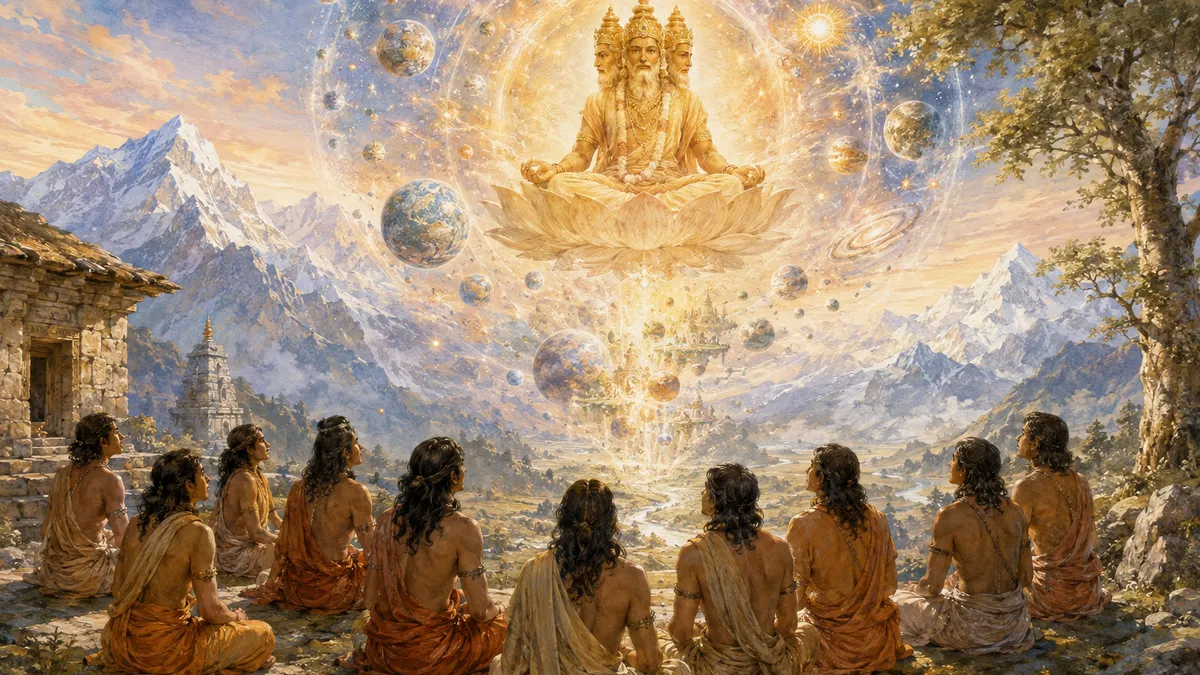
Meditation on Divine Pride
Then the eldest brother said: “I will transmit to you a practice that I already know. If you follow it, you can truly fulfill your desire.” He gave them the following meditative sankalpa, the following transmission:
Meditate in this way: “I am Brahma, seated upon a lotus.” All the brothers began meditating in this manner: “I am the creator of the Universe, the Creator, Brahma. Within me are all the sages and gods in their respective forms. Within me are the heavens with all their creatures. Within me are mountains, continents, and oceans. Within me are demons, demigods, and asuras. Within me the sun shines, the process of creation unfolds, and creation is sustained. Now is the time of destruction; now an age, a kalpa, a cycle has passed. The night of the Creator begins, and then a new creation arises. I am omnipotent, possess the fullness of knowledge, and am completely free.”
The eldest brother initiated them into this meditation as a practice for attaining the level of Brahma the Creator. In essence, this is one illustration of the practices of divine pride, which form the cornerstone of the Laya Yoga teaching.
By meditating on this with their entire being, they became precisely that.
There is such a law: you become what you think about.
Deep in meditation, their bodies withered away, and what remained was devoured by wild beasts. Yet they continued to stand there in their bodiless state for a very long time, until the end of the age came and the heat of the sun and terrible gusts of wind destroyed everything. The holy ones continued to stand bodiless, with the sole intention of becoming creators of the universe.
At the dawn of a new cycle of creation, these disciples continued to stand in the same place, just as before, still holding the same intentions.
Thus, an immense amount of time passed. In the end, they truly attained the greatest depth of samadhi and became like Creators, like Brahmas.
The Sun said:
Those were the ten Creators whom you saw, and you saw their universes as well. I am one of the suns that shines in one of the universes they created.
O Sun, then the universes have already been created by these ten creators; what am I to do now? What should I do?
The Sun replied:
Well, you have no desires, nor do you have any motives of your own. Naturally, there is no need for you to do anything.
He meant that this creator was beyond doing, the doer, and the action itself, since his mind was completely unconditioned. He had neither attachment to the creation of the universe nor any pleasure in it.
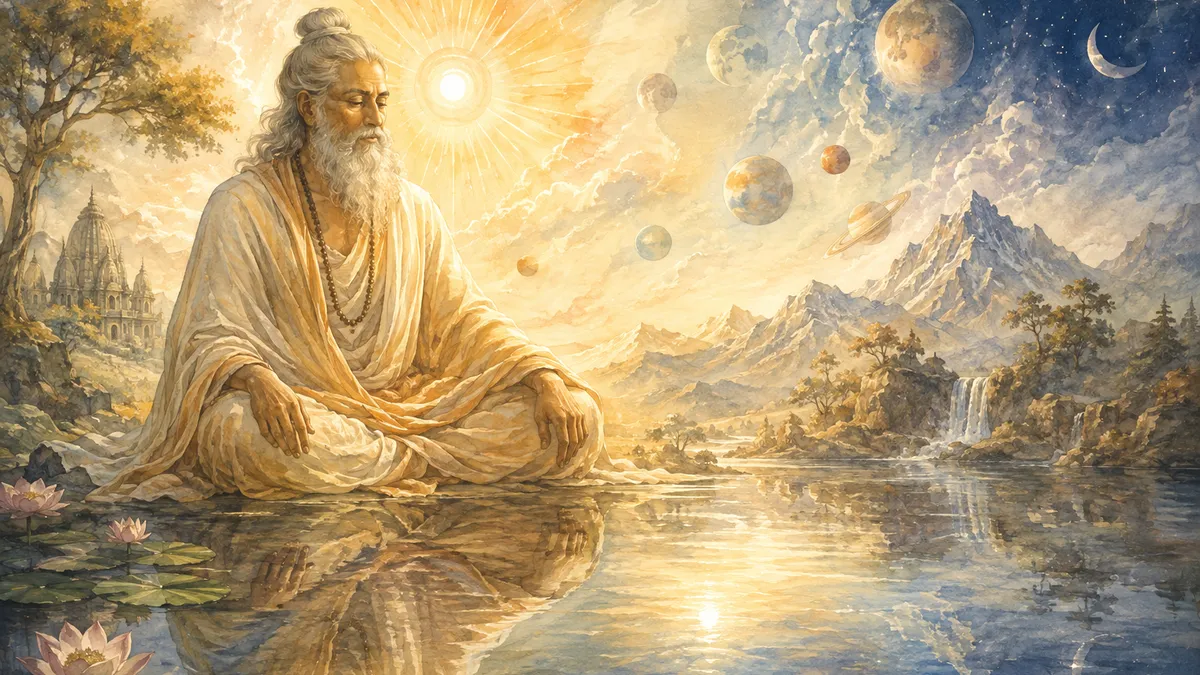
What joy do you derive from creating the universe? Surely, creating the universe is merely motiveless play for you. Creation proceeds from you, free from the slightest desire or motive, just as the sun, without intending to shine, is reflected in a pool of water that likewise has no intention of reflecting it. Without intention, the sun causes day to follow night, and in the same way you create beings without intention. What joy would there be for you if you abandoned your natural creative functions?
Sages have no desire to do anything, nor do they have any desire not to do anything.
With your inner vision, you see the universe created by these saints. With the physical eyes, a person can see only those objects that have been created in their mind, and nothing else. These objects created by the mind are indestructible. Only objects made of material parts are destroyed. A person is made of what has become established in their mind as the truth about them; that alone is what they are.
The Creator, the Mind, is the sole creator of the world, and the Mind alone is the Supreme Being. What is done by the Mind is action; what is done by the body is not action. O powers of the Mind, directed by thought, the saint’s sons became Creators of the universe! But if one thinks, “I am the body,” the Mind becomes a mortal being.
The Principle of Awakening Divine Potential
This is precisely the principle of divine pride meditation. If you contemplate, “I am a small mortal body, I am a human being,” then naturally your mind also becomes constrained, and the level and status of your worldview are lowered. When you meditate on the principle of divine pride, you contemplate, “I am the Absolute, I am Brahma the Creator.” You engender bhava, a worldview that you seek to uncover within yourself as a potential, and then you cultivate and strengthen it more and more. Through this, your contemplative presence and creative powers gradually begin to manifest.
From the perspective of self-recognition, one could say that we already possess this potential. This potential already exists within us; it simply needs to be awakened. It has always existed. Whether we knew about it or not, it remains unawakened. The point is to awaken this potential. It is not a matter of creating or attaining it, but of awakening it; we must gain faith in it and then allow it to manifest in all its splendor.
It is like this: imagine a young man who holds the status of a prince, but does not give it much thought or does not even know it; his entire life consists of going to parties and trying to amuse himself. His advisers come to him and say, “My lord, you must perform your duties of state; you must demonstrate all that befits a prince.” But he replies, “I am no such thing at all.” They say, “You have great authority and opportunities; our entire state depends on you.” And he says, “I do not care about any of that; I would rather go to parties, have fun, and meet other people.” They try to persuade him: “You must elevate your consciousness, because you have been given so much; you could exist on an entirely different level.” But the young man does not fulfill his duties and fails to meet the expectations of either his advisers or his ministers. He leaves his state unattended, and so it develops chaotically.
This young man is our consciousness: it does not reveal or make use of its potential. It does not believe in its potential and makes no serious attempt to awaken it. This is what life in samsara is. But as soon as, thanks to his advisers or his own reflection, such a young man begins to think, he discovers immense authority, energy, responsibility, and, most importantly, opportunities for development. He sees that all of this was given to him from the beginning; the only question is whether he will acknowledge it and begin to work with it. And gradually he comes into his own.
In other words, each of us is a potential deity, a potential Brahma the Creator. The point is that this potential must be purified, liberated, and allowed to realize itself. These are true creative abilities.
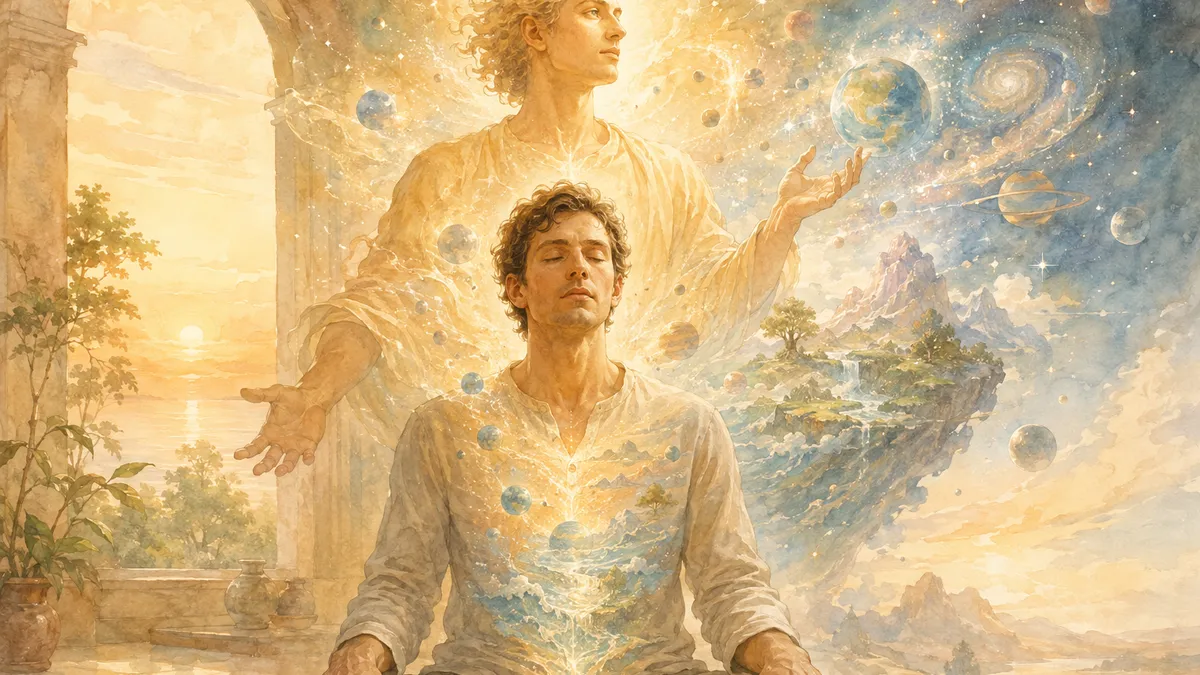
Liberation Through Creative Abilities
It is precisely at the stage when our creative abilities awaken that we can say we are becoming free from samsara, suffering, the law of karma, and death. Creative abilities based on an understanding of the emptiness of all things are the very principle of liberation. It is your consciousness, actively manifesting itself and eliminating dependence on any limiting laws, that is the liberating factor.
If many people on Earth could awaken their primordial potential and their creative consciousness, then everyone would attain the status of a deity, and everyone could generate clarity and create a mandala. The world would then consist not of limited individuals, nor of laws of cause and effect or physical laws that restrict our lives, but would become a divine mandala governed not by physical laws but by processes of consciousness. Then, one day, we would discover ourselves living in a pure dimension, in the pure land of saints or gods, in a mandala, in a pure dimension where the gods dwell.
