

Commentary on the text “Ashtavakra Gita”
Janaka said:
– O Teacher, tell me how to acquire knowledge, how to attain dispassion, how to achieve liberation?
Ashtavakra said:
– Child, if you wish to become free, avoid the objects of the senses as you would poison. Seek forgiveness, sincerity, compassion, joy, and Truth as nectar. You are not earth, not water, not fire, not air, not space. You are the witness of this, the inherent Self, Awareness. Understanding this is Liberation.
To separate one’s mind from the jnana-indriyas, from the body, to discover the witnessing consciousness... When we discover the witnessing consciousness, this corresponds approximately to the fifteenth, fourteenth tattva. The sixteenth tattva is manas-tattva, the fifteenth is ahamkara-tattva, the fourteenth is buddhi-tattva. The witnessing consciousness within us is buddhi (the fourteenth tattva). And this process of discovering the witnessing consciousness and establishing oneself in the identity of the witness is the transition from the sixteenth to the fifteenth and fourteenth tattva. This is a clear elevation of the level of consciousness, of one’s evolutionary status in the universe, in society.
Those people who are rooted, established in manas are superficial people, people manipulated by society and external data. But there are those who are not even established in manas. These are mahapashu—people with animal consciousness, who possess an instinctive mind and simply follow the sense organs.
When a person is established in ahamkara-tattva (the fifteenth tattva), he asserts himself, he is at the stage of personal growth, self-assertion. But when a person finds the inner observer, engages in search, self-inquiry, and resolves spiritual questions, including deep and fundamental ones (questions of life and faith), this is the fourteenth tattva (buddhi-tattva). Buddhi-tattva is also called maha-tattva. Maha-tattva is always an element of consciousness. Maha-tattva comes immediately after the fifth element—the element of space.
The discovery of the witnessing consciousness means that we have begun to perceive maha-tattva, the Omnipresent Consciousness, through our own “I”; we have singled it out. For us, the witnessing consciousness (saksha) is an object of discovery and investigation. However, there is a great difference between discovering it and becoming established in it. One can discover the witnessing consciousness and still remain established in ahamkara or manas-tattva. Even an ordinary worldly person can discover the witnessing consciousness in a fleeting samadhi, for example, by smoking drugs, parachuting, or at the peak of some ecstasy, the bliss of a musical work. He can break through for a while into maha-tattva (the element of consciousness) and discover the witnessing consciousness, but he cannot benefit from it because he does not work with it.
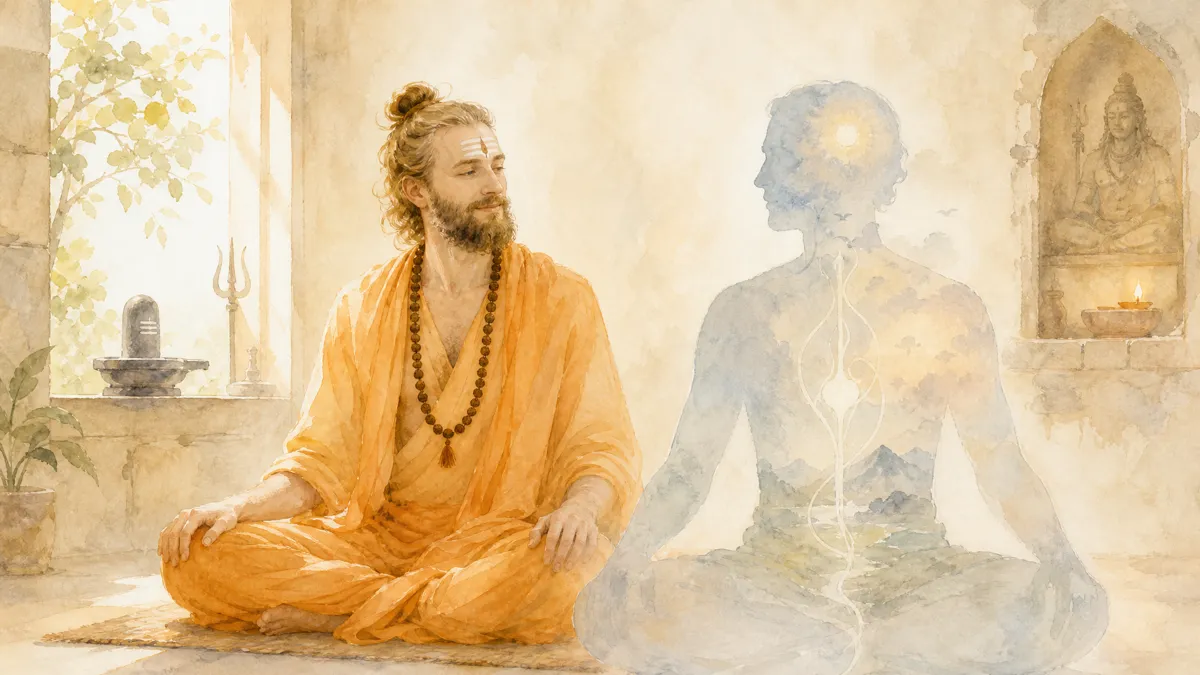
In psychology and psychiatry there is such a concept as depersonalization, when a person comes and says: “Doctor, I don’t know what is happening to me. It seems to me that I am not myself. That I can observe my body and mind from the outside.” The psychologist diagnoses him: “Depersonalization syndrome of the personality,” and says: “Here is your medicine, take it three times a day, lead a healthy lifestyle (swimming, physical exercises), take sedatives.” That is, there it is considered abnormal. Why? Because the person is not ready for it, and it is perceived as depersonalization. He is established in his persona as in the ego, and with the new reality that has opened up he does not know how to work, and this is considered a disorder, a deviation from the norm.
But for a sadhu, the cultivation and discovery of the inner witness rests on an entire culture, and it is accompanied by a change in meanings and values, the birth of faith, a connection with the Refuge, Ishtadevata Yoga, Ishvara Yoga, and Guru Yoga. When a sadhu discovers the inner witnessing awareness, he has an entire philosophical foundation for how to work with it. He understands that even if the witnessing awareness has been discovered, we are not yet established in it; our identity is connected with ahamkara.
The process of shifting identity from ahamkara to witnessing awareness is precisely the path of developing the fullness of attention and contemplation. But it must always be accompanied by bhakti yoga, charya and kriya pada, the observance of the commandments, devotion, and faith, because witnessing awareness alone is not enough; it will not carry the burden of our karma, it is still very weak.
Thus, Ashtavakra says to Janaka: “If you abide as awareness, having abandoned identification with the body, you immediately become established in happiness, peace, and liberation.”
Awareness is God. God is not a neutral being; He is ananda, happiness. The entire fullness of happiness that any person seeks is God. The entire fullness of wisdom, the entire fullness of the fulfillment of desires—everything a person seeks—is found in God. All of a person’s worldly desires arise from the fact that, in reality, his soul is seeking God, but it does not know this; it seeks Him according to habitual patterns and stereotypes. In other words, a person seeks family, wealth, power, fame, a wife, children, relationships with others, and comfort only because he has a sense of God, but he does not understand where to find this sense. He searches through the habitual karmic connections available to him.
But when we discover awareness, we discover that the source of all this enjoyment does not depend on the body, does not depend on the sense organs; it is transcendent, as if otherworldly. And awareness is the key to discovering happiness that is separate from all of this.
Witnessing Consciousness and Spiritual Practice
“You are not bound by the laws of castes and the stages of life. You are the witness of everything, devoid of form and attachment, beyond the perception of the senses. Realize this and be happy.”
Cultivating the witness means that we must learn to witness everything that happens to us. For example, it is raining. We can reflect on this and express dissatisfaction with it. But we have the possibility of witnessing. We can observe the rain and observe our reactions to the rain. Then this will be spiritual work. Sometimes sadhus deliberately place themselves in conditions where their reactions are provoked in some way by nature (heat, rain, pancha-agni, tapas) and witness their reactions.
Question: “Guruji, where is the boundary at which witnessing already gives bhava, gives ananda? What intensity is required? And by what means does this transition occur? Is it first manas or buddhi that witnesses?”
It is always buddhi that witnesses. Manas cannot witness; it can reflect.
“But buddhi by itself, it turns out, cannot receive ananda?”
It receives the reflected light of ananda from the Atman. By itself, buddhi does not possess luminosity. Luminosity belongs only to the Atman. Buddhi merely reflects and conducts this light further, but witnessing consciousness is present in it. And bhava arises as the result of buddhi becoming saturated with the light of the Atman, when the greater part of our self-identification shifts from ahamkara-tattva, manas-tattva, from the indriyas—that is, from the body and from perception—into buddhi-tattva. When we are eighty percent in buddhi (even fifty percent), then bhava begins to arise. The initial experiences of bhava arise, because you are no longer simply witnessing what is happening; the witness begins to turn toward the Source of its witnessing. Because if you simply witness, there is a certain evenness, observant awareness, fullness of attention in this, but there is not yet contact with God. The witness must turn back upon itself, upon its own Source. It must understand that it has a Source, and that this Source is independent of it. It must understand that the witness depends on the Source, while the Source does not depend on the witness.
“You are not bound by the laws of castes and the stages of life. You are the witness of everything, devoid of form and attachment, beyond the perception of the senses. Be happy.”
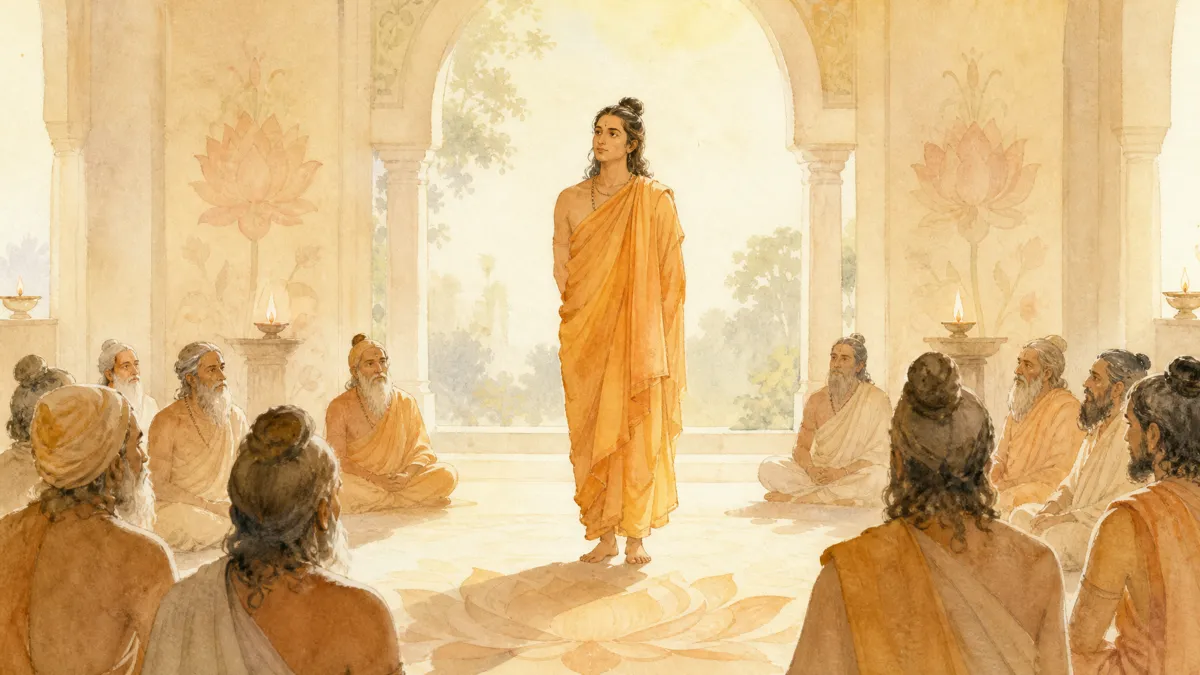
When Ashtavakra spoke in the assembly, he had a deformed body. Ashtavakra means “bent in eight places.” His spine was curved, as we would say today. But he was a jnani; he was realized. He had such a spine because of his father’s sins—that was his karma. And when he left the assembly, the brahmins began to laugh at him. Then he said: “In fact, I see an assembly here, but it is not an assembly of brahmins, but of shoemakers.” The brahmins were outraged and said: “You must justify your words. Why do you say that?” He replied: “If you see only my body and judge by the skin, but do not perceive my spirit, then how are you better than shoemakers, who see nothing except shoes and leather? Since you laugh at my body and cannot understand my realization, what is the value of this assembly?” Ashtavakra was a jnani.
Overcoming the Limitations of Witnessing Consciousness
“Right and wrong, pleasures and sufferings—all this is only in the mind; none of this is yours. O All-Pervading One, You are not the doer, You are not the enjoyer; You are eternally free, You are the sole witness of everything! In essence, You are eternally free, but Your conditioning lies only in the fact that You see someone else as the witness.”
When we discover the witnessing consciousness, this is buddhi-tattva (the fourteenth tattva), and after that we still have fourteen more stages to pass through in order to discover the first tattva.
Many stop at the witnessing consciousness, not knowing what to do next. They attain a certain vairagya, viveka, but their spiritual life is not illumined by grace. Therefore, sooner or later they lose enthusiasm in spiritual life, having simply stopped at buddhi-tattva. They have become accustomed to witnessing, and a kind of nihilism develops in them, or a certain state of pralaya-kala, indifference to spiritual life—without the Deity, without inspiration, without tears, without life, without love.
Such indifference means that a person has stopped at buddhi-tattva; he has learned witnessing awareness, but he has not unfolded and transcended his witnessing awareness toward God, and therefore cannot rise to the higher tattvas. He does not understand what the matter is, why there is no progress in spiritual life. And then he turns again to sensory pleasures, to worldly enjoyments, to the ego, now witnessing this as well. Why? Because there is simply nothing left to do, because there is a dead end in spiritual life.
Often, many practitioners of Advaita stop in their spiritual life in this way. Here a person needs devotion, needs faith; he needs to lower his pada, because he has exhausted the jnana-pada, he can no longer grow with its help, he needs to descend a little, to switch to the third (yoga) pada. But enthusiasm for yoga also fades, because yoga gives energy, gives development, but one must understand where to develop, and this understanding is absent, because he has stopped at buddhi-tattva. Yes, the witness is there, it is subtle, it is subtler than everything else. But what is to be done with this witness, where should it be directed, how should one handle it? It does not give inspiration.
Not everyone can perform such tapas all their life simply for the sake of the witness, while one wants to live now beautifully, well, and joyfully. And then the person turns back toward worldly life. He begins to enjoy more subtly, to be egoistic more subtly.
I have often heard of Buddhists who went through three-year retreats, and then came out of them and became good businessmen. Our monks also went through six-month retreats, and then went into the world to open companies producing computers, to work out their karmas. Why? Because witnessing awareness exposed the karmas; it opened subtle unworked-out karmas, subtle structures of consciousness, but it did not give inspiration, did not give strength, devotion, faith, and vairagya in order simply to cast off all these karmas in one stroke and continue upward.
Here the yogi must lower his pada. If his witnessing consciousness does not break through, he must lower his pada to yoga-pada or even lower to kriya-pada and begin to practice worship, faith, devotion, Guru Yoga, bhakti yoga, Ishtadevata yoga, Ishvara yoga—to cultivate them within himself. He must open his heart within himself. Without the opening of the heart, his subtle awareness will only be a stopping point; he must truly reflect: “Where am I going? What is God? What is my connection with God? What is it like to surrender to God? What is it like to give everything to God? What is it like to carry out the divine will?”
He must admit that besides his witnessing awareness there are higher and greater forces, and that the world does not revolve around his superficial witness; that there are tattvas, gunas, stars, planets, gods, and that all of them have emanated from some great Source, while his witness is not yet such a source. It is merely the fourteenth tattva. And he must truly begin to invoke the blessings of the Refuge Tree, truly cultivate faith and devotion, and then a new spiritual breakthrough awaits him, a new discovery of spiritual power and spiritual grace. Then he will be able to rise from the fourteenth tattva (buddhi) to higher ones, to the level of prakriti-tattva, to the level of liberation from the kanchukas, to the level of purusha-tattva.
Overcoming Egoism and Perceiving the World as Divine Play
“You have been bitten by the huge black snake of egoism: ‘I am doing this!’ Drink the nectar of faith: ‘I do nothing,’ and be happy!”
The feeling “I am doing this!” (kartritva buddhi) is specifically kala-tattva (kala-kanchuka), that is, the limitation connected with activity. In the highest dimension of awakening, doing and knowing are one and the same. But we have the notion that doing is one thing, and knowing is another. When doing and knowing are one and the same, then doing and knowing unite, there is no karma, but there is lila (divine play).
The difference between those beings who are established in the higher tattvas and those who are limited and abide in the lower tattvas is their attitude toward doing and the doer. Those established in the higher tattvas have opened the dimension of non-doing and abide in play; they see divine play everywhere. They understand that the entire world is divine play and that there is nothing but divine play. Whatever happens, whatever they may be engaged in—all of it is lila (divine play). Divine play means that we look at the world through the eyes of the higher tattvas, for example Ishvara-tattva, Shiva-tattva, or at least through the eyes of maya-tattva. We do not perceive the world through the ego, through the eyes of the lower tattvas.
Perceiving the world as divine play is a completely different perception. When we do not perceive the world as divine play, we constantly strive to enjoy the fruits, to appropriate the results for ourselves. This behavior is similar to how a foolish slave tries to appropriate the glory and property of his Master, while in fact having no such possibility. We constantly try to become attached, to establish ourselves as the doer, to fix some participation of our own. But instead, perceiving the world as divine play means that we observe everything in all-acceptance and receive darshan, without becoming attached either to the fruits or to the results, without desiring either fruits or results. And without feeling ourselves to be the doer at all.
For example, a person who experiences something good that happens to him will become attached to it. But a person who perceives the world as divine play will think: “This is the play of the Absolute, the play of God, the play of Shiva! This is His blessing.” He will see only a blessing in it; he will not want to receive the fruits or appropriate the results even from good, pleasant things.
When bad fruits and results come, an ordinary person who is in the lower tattvas begins to worry, to suffer from ahamkara-tattva, to reflect, to make various value judgments. But one who sees the world as lila does not reflect, does not make value judgments, abides in awareness, and perceives the world as play.
Such playful consciousness is inherent in gods and siddhas; they do not live in the ordinary dimension, they are always only playing. And they play from morning to evening, continuously. Children also play, because they intuitively feel the rightness of it, but their games are closer to those of animals. But siddhas and gods, abiding in playful consciousness, create diverse worlds, guide people, and manifest powers. And they play wisely, carrying out the divine will, following the principle of Rita (the law of the Universe).
People, however, do not play; people do. And having done something, they lay claim to possessing it. And when it is taken away from them, they suffer. For example, if a person builds a house, he feels: “This is my house!” And if this house is taken away from him, he will suffer. He will not think: “Oh, divine play, lila, ecstasy!” He will suffer.
By this attitude of theirs, people themselves create the causes for suffering, because they do not recognize the divine play of the Absolute. But it is a play, and in the process of this play some forms are created and others are destroyed; yet if one becomes attached to them, suffering is inevitable. It is precisely the non-recognition of God’s play in the creation of the Universe, in one’s own body and outside it, that leads to suffering. Recognition, however, leads to the eternal darshan of bliss.
Therefore, to learn to play continuously and always, in any circumstances to see the darshan of God and to perceive everything as the darshan of God, while abiding in open, quantum-probabilistic, non-judgmental, non-reflective, pure and expansive awareness, is the path to freedom, the path to deliverance from suffering.
The Path to Liberation Through Self-Surrender
“Burn the forest of ignorance with the fire of understanding. I am the One. I am Pure Consciousness. Free yourself from sorrow and be happy!”
It is easy to say: “Free yourself from sorrow and be happy!” But in order to free ourselves from sorrow, we must become established above emotions, above the experiences of the body, and learn to recognize divine play. We must direct our witnessing awareness toward the Supreme Source, toward the higher tattvas. And how can this be done? Through self-surrender, through devotion, through faith. We must learn to offer everything to God.
Understanding God at Different Levels of Perception
For us at this stage, at the level of witnessing awareness, God is the highest experience of faith, devotion, and love. Witnessing awareness that is turned toward the Supreme Source and the higher tattvas is, at this stage, God for us, because the very concept of God changes in different tattvas. God as perceived in the fifteenth tattva and God in the first tattva are completely different kinds of God. And for each of us, God is accessible to the extent that we are able to perceive Him.
Self-surrender means that we listen to the divine will, divine purity, and divine wisdom within ourselves in the form of witnessing awareness turned toward God. And gradually we learn to submit to Him, to cut off clinging and hopes.
“You are bliss, supreme bliss! You are that Awareness in which this Universe appears, like the mirage of a snake in a rope. Be happy!”
When, in the process of self-surrender, we discover the inner God, the inner Atman, we find that He is always blissful, He is bliss and nothing other than bliss. That is, God is not a neutral state. All the happiness that occurs in worldly life is happiness occurring in God.
Vairagya (detachment, freedom from desires) comes at the moment when we discover this fact—if we experience bliss, then what do we need to be attached to, why do we need great worldly desires, why do we need ambitions, why do we need anything at all except God? And when a person understands this, he becomes self-sufficient. Self-sufficiency means that we can be happy within, without everything, without most of what ordinary people need. Because bliss comes as a result of a simple understanding of this fact, simple self-surrender, and simple self-realization.
The View of Freedom and Perfection
“He who considers himself free is free. He who considers himself bound is bound, for the saying is true: ‘What you think, that you become!’”

In the view, we must all consider ourselves free. For example, the view “Aham Brahmasmi” is the view “I am free!” It is not the view “Aham dehasmi”—“I am bound by the body.” In the view, we must become accustomed to the thought that we are free, pure, and perfect, that we are beyond the dream state, deep sleep, and the gross world, that we are pure turiya.
It is not easy to become accustomed to such a view, because our mind and sense organs constantly say the opposite. The mind says: “You are the body. You are imperfect. The world is imperfect.” The indriyas say something else; they want to enjoy. The ego says: “And I want to assert myself.” That is, you have many misguided advisers who send signals and, together with these signals, transmit their own picture of the world. But we must become established in the view of freedom and perfection, at least intellectually to begin with. This is jnana-drishti—the view of the Absolute, the view of nonduality, the view of the jnani. And then we must grow accustomed to such a view, reinforcing it with awareness, with contemplative presence. Then we begin to recognize the higher tattvas on which the bhava of God’s freedom is manifested. Gradually, God’s freedom, God’s bliss becomes ours. This happens very slowly, little by little.
The Nature of Illusion and the Ways to Overcome It
“I am the Witness, Fullness, the One, Awareness, Peace. I am inactive, unattached, Omnipresent, desireless, free. Because of illusion, He appears to be involved in the cycle of worldly life.”
Illusion is a special force. It cannot be said that maya (illusion) does not exist at all. Illusion is a special energy (maya-tattva). Beginning with the sixth tattva (maya-tattva), various illusory forces manifest. It cannot be said that these illusory forces do not exist. They are energies; they truly exist. They cover our higher “I,” veiling our wisdom and consciousness. Where do these illusions come from? These illusions come from ourselves, from within our “I,” from our pure space of consciousness.
Imagine that you fell asleep at night, wake up in the morning, and your head is heavy, your faith has almost disappeared, and you do not feel like practicing. Something has happened: a bad dream, or the subtle body has entered some lower realms; the body aches and the day is inauspicious. What does this mean? It means that from the depths of your “I,” certain illusory energies have emerged, certain currents of the subtle body have come out; they have enveloped you and clogged your channels, made the body inflexible and the mind uninspired. You feel that there is no inspiration. But you simply need to get up, wash, and make your way to the Sutra, and there simply sit down and look into Dattatreya’s eyes.
When you sit down and look into the eyes of Dattatreya and Shiva on the altar, suddenly something within you begins to change. That is, you have come under the compassionate gaze of Dattatreya. Even through a murti, even through a bronze statue, He works. And something within you begins to gradually come into alignment, your mood changes, inspiration arises. This means that the supreme tattva of Dattatreya, his anugraha (grace), his compassionate power has touched you, and the kanchukas that emerged during the night and entangled you begin to weaken; that is, you have received some small darshan. Therefore, sitting before the Deity is always darshan, even if you are not singing anything. Your first action in the morning, your first impression, should be from the altar, not from the computer. That is, you should go and sit before the altar, look for some time into the eyes of the Deity, receive darshan. And from this state you can already engage in other affairs, practices, and so on.
Question: “Guruji, how can this clogging of the channels be prevented? Perhaps sleep less, or do viparita-karani for half an hour before sleep, or something else? How can this mechanism be outplayed?”
Pranayamas purify the energy body, but they do not purify the mind, karma. Mantra is good for purifying the mind. Mantra, mantra, mantra!
Question: “Before sleep?”
Before sleep as well. If you have not yet become established in contemplative presence so that contemplative presence grants grace and purification, then mantra yoga. You can recite the mantra in the style of ascending the Tree of Refuge, as I transmitted it: the Guru mantra, the mantra of the param-guru Brahmananda, the seed mantra of Dattatreya, the mantra “Om Namah Shivaya,” the Brahma mantra (for those who received the transmission), the mantra “OM.” When you have recited these six mantras in sequence, that is one cycle. Those who have karma-sannyasa diksha may recite from one to three cycles a day.
The Sword of Knowledge and Self-Liberation
“I am the nondual Supreme Consciousness. Free yourself from the illusions that your ‘I’ is a reflection of what happens within or without. My child, you have long been bound by the fetters of identification with the body; cut them with the sword of knowledge: ‘I am Pure Consciousness,’ and be happy!”
In fact, this is not only about identification with the physical body; it means identification with all bodies: the energetic, astral, and mental bodies. All of this has one name: body.
Many think that disidentifying from the physical body is not so difficult, but even disidentifying from the physical body is not easy. Disidentifying from the astral, energetic, and mental bodies is even more difficult. And what is the way out here? Ashtavakra says: “Cut them with the sword of knowledge: ‘I am Pure Consciousness!’” That is, we must obtain this sword, “I am Pure Consciousness!”—obtain a small experience of direct introduction or fleeting samadhi, a small experience of sushupti or turiya. The experience of sushupti or the experience of turiya gives this knowledge. And when you have at least a small memory with this knowledge, this is your sword. It is the sword of viveka, discriminating wisdom, with the help of which you can cut these fetters of identification with the physical and other bodies.
This cutting is the very process of self-liberation. And how should one cut? When something appears in the field of your perception or consciousness and conditions you, you remember your supreme state, the experience of turiya or the experience of sushupti, and instantly change the focus of your consciousness, place it again in that state, and then from that state look directly at the thought, at the sensations, at the perception until the sensation and perception cease to affect you. And when you support this with Guru Yoga, this is the path of self-liberation.
The Aspiration for Enlightenment as Divine Will
“You are free from attachment and actions, devoid of flaws, self-luminous. Truly, you are bound only by the aspiration for Enlightenment.”
The aspiration for Enlightenment is a special sankalpa (sat-sankalpa) that comes from Paramashiva himself. It seems to us that it is we ourselves who seek Enlightenment, that it is we ourselves who seek God. In reality, it is Shiva within us who seeks Enlightenment and Liberation, who seeks Himself through his shaktis. In another way, one can say that it is shakti (meaning shakti as our mental body, our ahamkara, and all our grosser tattvas) that seeks Shiva and desires to reunite with him.
Three Levels of Practice: View, Contemplation, Conduct
“By nature, you are Pure Consciousness. This Universe is filled with you. All that exists is contained within you. Transcend the limitation of the mind.”
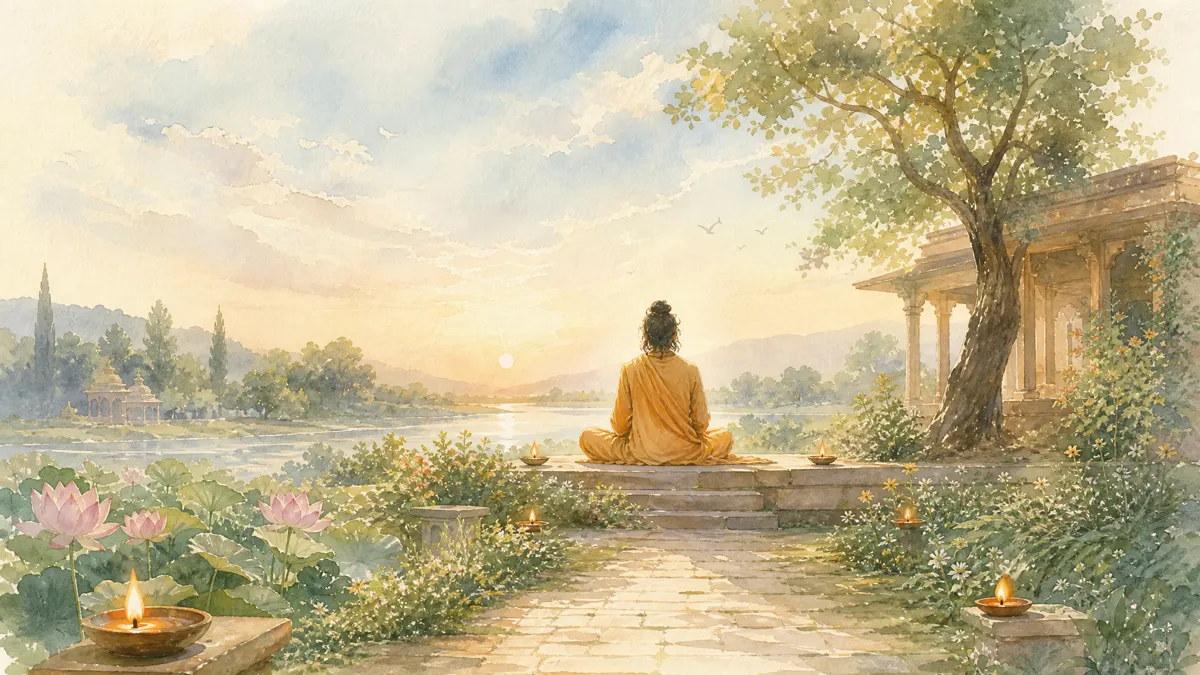
In the view, the mind is like the sky; in contemplation, the mind is vigilant and wide open; in conduct, we take the relative dimension into account and act according to time, place, and circumstances. In the view there are no distinctions (abheda); in awareness, distinction-non-distinction exist simultaneously (bheda-abheda); in conduct, distinction exists (bheda). This is how a sadhu practices, avoiding the traps of eternalism and nihilism.
If we say, “Only the view, only non-distinction (abheda),” we inevitably slide into the trap of nihilism. If we say, “Only distinction (bheda),” we slide into the trap of eternalism. When we have an understanding of how non-distinction, distinction-non-distinction, and distinctions are combined together. That is, if all these three points of view are naturally combined, then it is considered that we are an experienced sadhu-contemplator.
For example, in the view I can understand that all of this, right at this moment, can be nothing other than Brahman, that nothing is happening anywhere right at this moment. In contemplation, I observe the play of energies, I see that besides Brahman there is the play of Shakti’s energies, there is the non-distinction of subject and object, and at the same time there is the recognition of distinction. In contemplation, the mind is open, observing, vigilant. But in conduct I know: “Water is water, a movie camera is a movie camera, a novice is not a monk, a monk is not a karma-sannyasi,” that is, in conduct I distinguish everything, I do not confuse things. If I start confusing things in conduct, what will happen? Nihilism will occur.
Question: “And if a yogin gets stuck in emptiness, becomes a pralaya-kala, and another forces him to incarnate, does he become his Teacher, Guru? Is it always like that?”
It may be so. This does happen. Yogis who are stuck in emptiness, roughly speaking, may appear as luminous spheres of rainbow light (five-colored), abiding in the sphere of the causal world. And the saints who seek such beings are present in the form of the all-encompassing Light of the higher tattvas, which detects such auras of the mental or causal bodies of the pralaya-kalas who are stuck. And in some way they transmit a blessing power, give transmission and grace to such beings, and they awaken again from their slumber. In this way, a pralaya-kala receives the sankalpa and instruction to incarnate. That is, this Light (the consciousness of a saint, the consciousness of a god, rishi, or siddha) acts for him in the role of Guru, and it says: “Enough of sitting here already. You need an incarnation in order to progress further. You have stopped in this blurred state. You have lost the path. Incarnate on Earth in order to restore the correct contemplation and the correct view of Advaita.” Yes, this can happen.
Question: “You mentioned that there is Guru-tattva. You spoke about all the tattvas, but what is Guru-tattva?”
Guru-tattva is not included in the list of the thirty-six tattvas of Shaivism. Guru-tattva is the general name for the principle of the Guru, and it can begin with the first tattva and below. That is, Guru-tattva is not a category of the Universe, as in the thirty-six tattvas of Shaivism; it is rather a term indicating the energy that awakens you, helps you, and transmits blessings and the Teaching.
“That is, Guru-tattva is a consciousness that is higher in terms of tattva?”
Yes. And not simply higher, but that with which you have a connection, which guides and helps you. There are many gods and saints who are higher according to the tattvas, but there is no connection with them, and therefore they are not Guru-tattva in relation to you.
“That is, attunement on the part of the disciple is needed?”
Yes.
