


Commentary on the text “Tripura Rahasya,” Chapter 10.
How Hemachuda, through further instructions from his wife, attained samadhi and, despite continuing external activity, abided in liberation while still alive.
“Therefore, I tell you that your judgment, ‘I will lose this if I open my eyes,’ or ‘I know this,’ is a knot that must be cut; then there will no longer be any need for attainment, for remember that a state which can be attained cannot be perfect if it may also remain unattained in the event of failure, since samadhi is the result of the cessation of all effort, not of making one effort or another.
Hemalekha instructs him to abandon the notion that he will lose the primordial state by opening his eyes, perceiving the external world, and integrating with it.
Before receiving such instructions, a disciple must become mature enough for them. In fact, sahaja samadhi, letting go of oneself, and so forth are extraordinarily difficult; a yogi does not arrive at them immediately. First, one must learn to be a disciple, to be a proper monk or novice, simply to become an empty vessel and study the teaching, because without developing certain qualities and forming the so-called spiritual yogic ego, it is impossible to aspire to higher stages of realization—enlightenment and so forth.
If a person wants to ascend to the greatest heights of spiritual practice, they must always begin at the beginning, developing the qualities they lack: concentration, willpower, detachment, and the capacity for self-surrender.
A Sufi master tested his disciples in the following way. He would say:
“Go to the market and buy some greens for such-and-such a number of rupees.”

The disciple would do as he was told, return joyfully, and say:
“I bargained and bought them for less! I found a place where the same greens are sold more cheaply.”
The teacher would say:
“Well, you are a fool. Did I tell you to bargain and look for a lower price? I told you to buy greens for such-and-such a number of rupees. Do you think I need your greens? I need you to be able to do exactly what you are asked to do. I need your understanding. How can you carry out my assignments concerning spiritual life if you cannot even buy greens for the amount I told you?”
The Position of a Student in a Monastery
When we come to a monastery, we do not fully understand this and often become involved in habitual activity, not realizing that we are being trained, but believing that we are doing something. In fact, this is a serious misconception. Very few people in a monastery actually do something—the guru, the Dharma guardian, the administrator, and the administrator’s assistant. Everyone else is being trained. But when we forget that we are being trained through activity and other things, we too think that we are doing something. Then a desire to act and attachment to it arise within us, along with confusion when things do not turn out as expected; we begin making judgments and think, “This person is doing it wrong. It could have been done better. And that person knows nothing and understands nothing.” But were you given such an assignment? This is not yours at all; it is not your mandala.
For example, there are officials in the monastery—one might call them the local deities of the mandala—so let them deal with it. If the guru believes that they are doing it well, then everyone is satisfied, and so is he. This is not your area of responsibility at all. But if you have been given the task of learning to develop certain qualities within yourself—emptiness, self-surrender, humility—that is an entirely different assignment. You must not confuse the two. You must feel precisely like the disciple whom the Sufi master sent to buy greens for forty rupees—not fifty and not thirty.
When you can develop such qualities, you begin to understand a little of what emptiness of the heart means. Of course, if during your service you are told, “Think about how this can be done. Exercise your will, creativity, and initiative,” then that is a different matter. But if the assignment is the opposite, you must be very vigilant in this regard, because you may indeed buy the carrots more cheaply, but you will lose God, since you will not learn to cast aside your self, and the process of training will have been in vain.
While living in a monastery, you should always feel that you are first and foremost a student, and only then someone who does things. This is because the learning process differs from ordinary worldly life. It requires a special attitude, a special stance in which you are a student, receptive and open; you attune yourself to something and, through this attunement, try to cultivate certain qualities within yourself.
When a yogi has cultivated certain qualities and the learning process is complete, they can then adopt a different position, for example, that of transmitting, radiating, teaching others, passing on their wisdom, sharing their experience, or expressing themselves creatively in some way. This is the next stage. But creative self-expression can only arise from emptiness, from a state of self-surrender. If such emptiness has not been realized, creative self-expression will be utterly immature and will bring little benefit, since it will arise from an egoistic view of the world.

Instructions on the State of Non-Doing
“What you regard as a state of happiness attained by the movement of your eyelids cannot, by its very nature, be perfect, for it is undoubtedly unstable and conditional. Is there any place, my lord, where the fire blazing at the dissolution of the universe would not burn? Everything will vanish in that fire, and nothing will remain. In the same way, the fire of realization will burn away your entire sense of duty, and then there will be nothing left for you to do.”
Hemalekha gives instructions on the state of non-doing. At first, it seems that to attain realization we must do quite a lot and cultivate various qualities within ourselves—and this is true. If you have not cultivated certain qualities within yourself, you cannot attain realization. Even if a person sits in the light, this does not yet mean that the light is their own or that they can merge with it. True light means the elimination of all duality, of all grasping in perception.

Knowing this, Hemalekha gives Hemachuda the following instructions:
“Be strong, eradicate your thoughts, and cut through the knots deeply rooted in your heart, such as ‘I will see,’ ‘I am not this,’ ‘this is not the Supreme Essence,’ and others like them.”
“To be strong” means to acquire the consciousness, the sankalpa, the resolve to attain the goal. It means that no external events or spiritual experiences, no emotions, can shake you.
Often, when you practice, you pay too much attention to others and think, “This person said this, and that person is like that.” Your state of mind depends greatly on how others behave. But in reality, none of this matters. A true yogi thinks: “Although we live together, the question of liberation and realization concerns me alone. No Buddha can attain liberation for me, and therefore it is I, not someone else, who must practice diligently and be impeccable in my practice.”
“Eradicate your thoughts” means learning to contemplate, self-liberating all thoughts and theories.
Three Types of Yogis

There are yogis who do not know the empty, nonconceptual nature of consciousness. One could say that these yogis are like people who are asleep, even if they perform many asanas and pranayamas or practice concentration very diligently. They have yet to clarify the empty nature of consciousness. One could say that they are still ordinary people.
There are other yogis—those who have discovered the empty nature of consciousness. They have realized their own emptiness and seen that everything they took themselves to be is unreal; what they regarded as the world is likewise unreal. All the old notions they clung to are also illusory. But they cannot maintain this vision in the ordinary state.
Finally, the third type of yogis are those who know that the mind is empty by nature, yet are able to function in the relative dimension without becoming entangled. Such yogis are the best.
The Vision of the One Supreme Essence
“Wherever you look, behold everywhere the one, indivisible, eternally blissful Supreme Essence; also observe this entire reflected universe.”
“Wherever you look, observe the Supreme Essence everywhere”—these words contain the essence of all instructions.
If we analyze ourselves, we will see that when we look at chickens, we see chickens; when we look at snow, we see snow; when we look at prasad, we see prasad; when we look at a person, we see a person. This is because we look with ordinary eyes. But when a saint looks at chickens, a person, or prasad, he sees God everywhere.
Why does a saint see God first and foremost? Because he does not look through worldly, ordinary eyes, but through the eyes of awareness, the eyes of contemplation. One might say that he is always in the state of shambhavi mudra. This does not mean that when a saint looks at chickens, he sees clucking deities. Of course, he sees chickens too, but he sees them differently, just as a person looking at various gold ornaments understands that their essence is gold. The form of the “ornaments” may vary, yet they are all the same “gold”: prasad, people, chickens, houses, snow, and stars.
Therefore, to be in a state of presence is not to see houses or people, but first and foremost to see the Supreme Essence, and then you see everything. But if you do not see the Supreme Essence first and instead see a multitude of objects, consider that you see nothing, even though your eyes are wide open.
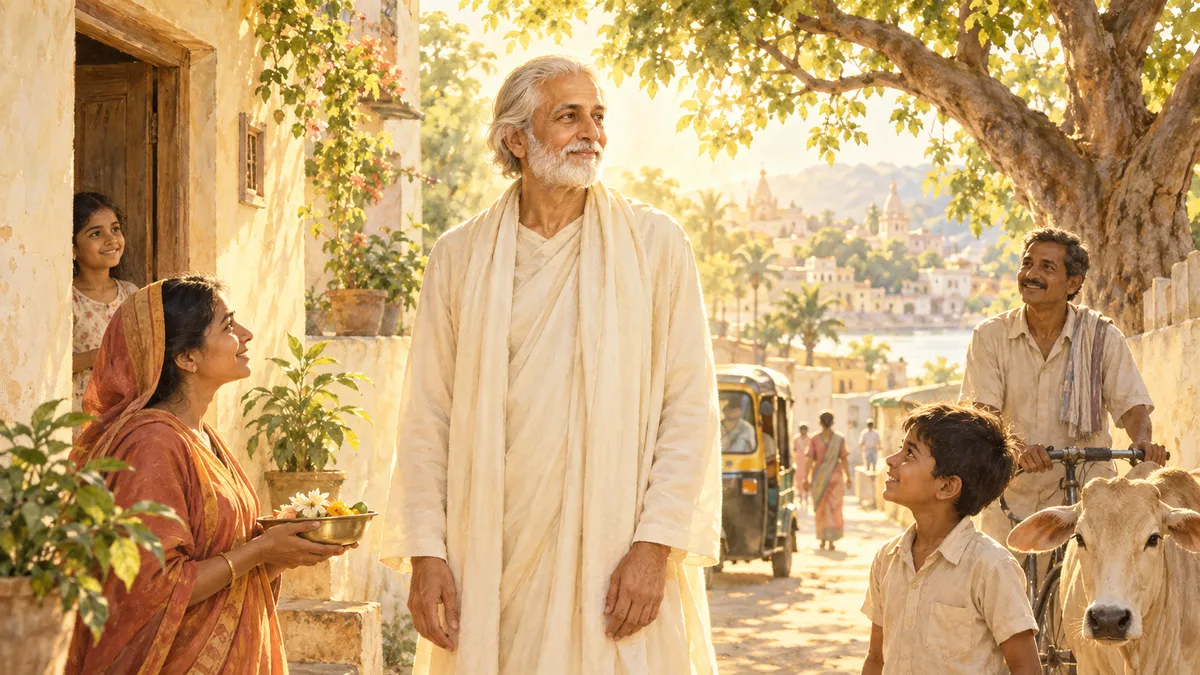
A true saint sees the Supreme Essence, but at the same time he also sees prasad, trees, people, houses, and cars. He sees them as inseparable. When necessary, he can adopt the relative view and understand that one thing differs from another; nevertheless, his vision of the Supreme Essence is never obscured, because he sees that all things are like ornaments made of gold, yet everything is one and the same gold.
The Principle of All-Encompassing Sacredness
For example, if a statue is made of clay, people will bow to it, regarding it as something sacred; but if a spittoon is made of the same clay, people will spit into it. In reality, the clay has not changed; only its form and people’s attitude toward it have changed, while the clay itself has always remained the same. People consider a statue of the Buddha wonderful and a spittoon something repulsive, but this has nothing to do with the true state of affairs. Both the statue of the Buddha and the spittoon are sacred, because sacredness is an inherent quality of all things in the universe. Sacredness is the nature of reality.
A saint always sees everything as absolutely sacred. But when we are in duality, we see some things as sacred and others as not very sacred, because we are accustomed to imposing our own interpretations on our perception of the world. Yet our concept of the sacred must expand to encompass the entire universe, including the most evil demons.
People’s concept of the sacred is generally very narrow and associated with external things. Only a practitioner who abides in contemplation understands the principle of all-encompassing sacred Consciousness.
For example, when Christian missionaries tried to preach in India, telling people about Christ on the cross, many found it very unusual and blasphemous, thinking, “How can one worship a man who was crucified? Gods should be joyful, cheerful, and dancing!” For a very long time, they could not understand the Christian point of view. Conversely, when Christian missionaries entered Hindu temples, they saw a Shiva lingam placed within a yoni and worshiped with pujas. When they were told that these were symbols of the sexual organs, they were utterly horrified. They thought, “How can this possibly be considered sacred?” And when they saw the goddess Kali in one of the principal temples, holding severed heads, curved knives, and a skull-bowl dripping with blood, they concluded that Indians worshiped demons and, with sincere hearts, resolved to save them from a demonic religion.

In fact, this is simply a cultural difference regarding what is traditionally considered sacred and what is not. It is merely a point of view dependent on perception. A true saint who has realized the state of Advaita will say, “Both are sacred.” Moreover, even the so-called mundane is also sacred if you look at it through the eyes of contemplation. The issue is that we do not have enough awareness to see this.
Pure Vision in Action
Once I was sitting in a hotel, talking with one of my disciples. At that moment, someone began hammering and drilling into the wall, making a very unpleasant noise. The disciple grimaced because the sound was unpleasant. I tried to explain to him, “In pure vision, try to imagine this sound as a blessing mantra or as a bhajan sung to you by a deity. Perhaps it is simply a sign for you from some deity, the king of all sounds. If you trace this sound back, it originates from the primordial sound, and behind the primordial sound there is a deity that governs all sounds. It is associated with nada and has peaceful and wrathful manifestations. Its wrathful manifestation governs all unpleasant sounds, and so this sound is simply its magical manifestation, its sound body. Try to attune yourself in this way and see this deity. Perhaps this is simply its darshan, pointing to something.” As soon as I had explained this to him, and he seemed to understand it for a moment, the sound stopped instantly.
In the same way, if we adopt the position of pure vision toward any problem, trace it back to pure vision, and discover a deity behind it—that is, something sacred—we suddenly see that the problem has left us, as though we have received and learned a certain lesson, and therefore there is no longer any need to return to it. But if we reject the problem, struggle against it, fail to understand it, or hate it, it continues—that is, the deities continue to teach us, seeing that we have not yet learned this lesson. And we have to return to it again and again; we are shown this problem over and over, and this will continue until we understand something.

The main lesson of all perceptions in the world is that everything is sacred.
To perceive the entire world as sacred means to abide in bhava. When you have bhava, a sense of the world as a very subtle vibration, you abide in contemplation, in nonduality, in pure vision, in the state of divine pride, and in the single “taste.” You follow all the teachings’ instructions without particular difficulty.
