From Effort to Effortless Contemplation: The Path to the Supreme Essence
20.07.2026
0 мин. чтения
0
Share
copy
search
add
share
Commentary on the “Tripura Rahasya,” Chapter 9
How Hemachuda realized his Supreme Self after analyzing his own mind.
Hemalekha’s Instructions
“Form, taste, smell, touch, sound, suffering, pleasure, the act of attaining, or the object attained—all these have no place in that Transcendence which is the foundation and support of all that exists.”
In fact, the “Prajnaparamita Hridaya Sutra” says the same thing:
“In this emptiness there is no name, no form, no color, taste, or smell.”
Only when we discover this emptiness beyond name, form, color, taste, and smell do we truly come to know the heart of reality.
“She is the Supreme Lord, the Creator, Preserver, and Destroyer of the universe, and the Eternal Being.
Now do not allow your mind to turn outward; turn it inward; keep it under control with very little effort and abide in contemplation.”
Two very important lines are omitted here:
“All these have no place in that Transcendence which is the foundation and support of all that exists and the essence of everything; yet it is not exhausted by this alone, for it transcends all of it.”
Transcending Emptiness
The Self is not exhausted by emptiness. It is said here that it transcends even emptiness. If we adopt a stance of negation or nihilism, having concluded that nothing exists or having experienced this firsthand, that would be an extreme view.
It is said that it transcends all of this. The Supreme Self transcends both emptiness and manifestation, while permeating them both equally and in the same measure.
First, we experience emptiness firsthand in meditation. Then we turn our experience outward and realize the emptiness that permeates all names and forms. When our understanding of emptiness is reunited with manifested names and forms, we begin to understand something about the essence of spiritual realization.
Turning the Mind Inward
Hemalekha says:
“Now do not allow your mind to turn outward; turn it inward.”
Usually, when we turn the mind inward and maintain a certain sankalpa while perceiving external objects, this is called Vaishnavi Mudra.
The teaching of the nine sankalpas described in the book “The Path of Divine Consciousness,” and all the practices you perform, such as atma-vichara while walking in contemplation, infinite space, divine pride, and light, are all varieties of the ancient Siddha technique known as Vaishnavi Mudra. The essence of this technique is that we concentrate on something within while perceiving the external world.
The Heart of the Teaching
“Keep the mind under control with very little effort and abide in contemplation, striving to behold the Supreme Self, always remembering that the seeker is himself an integral part of being and the Supreme Self of the Supreme Self.”
I recommend that you memorize this shloka (shloka 98 of Chapter 9) as the essence of the teaching. If you want to understand the very heart of the teaching, it is precisely what is described in this shloka. It tells you directly what to do in any situation.
“Keep the mind under control with very little effort” means abiding in awareness with reliance on the secret friend, that is, attentiveness and vigilance.
“Abide in contemplation, striving to behold the Supreme Self” means being attentive while discerning, behind attentiveness, the transcendent nondual consciousness.
“Remember that the seeker is himself an integral part of being and the Supreme Self of the Supreme Self” means not merely remaining at the level of witnessing awareness (sakshi), but penetrating into this witnessing awareness and discovering its identity with Parabrahman.
Freedom from Mentalization
“Also be free from the thought ‘I see’; remain serene and motionless, like the gaze of a blind person.”
Also be free of thoughts when engaged in contemplation. Any mentalization, effort, imposing any kind of constructs on thoughts, and identifying with them are not genuine practice.
The Story of King Janaka and Ashtavakra
Once, after receiving transmission from Ashtavakra, King Janaka practiced So-Ham meditation. The mahavakya So-Ham is translated as “I am He” or “I am That (Brahman).” This mahavakya is no less well known than the mahavakya “Aham Brahmasmi.”
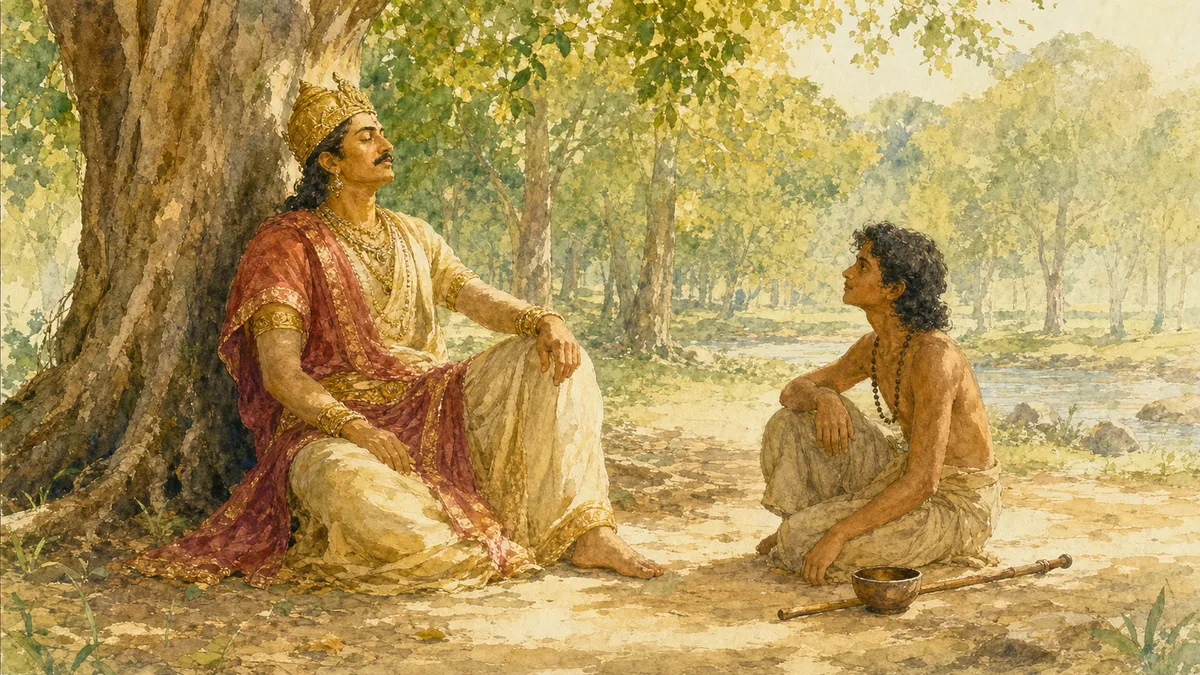
Whether sitting in the jungle or walking about while performing his royal duties, King Janaka constantly practiced this meditation, identifying himself with the Supreme Essence. One day, Ashtavakra, his spiritual teacher, happened to pass by and heard Janaka walking along and silently chanting to himself, “So-Ham, So-Ham.” Ashtavakra decided to follow him. He saw the king enter the jungle, sit down in a deep meditative trance, and chant, “So-Ham, So-Ham.” Then Ashtavakra approached him, sat down beside him, and began repeating (he had a begging bowl and a staff), “This is my bowl, this is my staff. This is my bowl, this is my staff.” Janaka was immersed in trance, so for some time he paid no attention to him.
Then he was forced to emerge from contemplation and asked:
“Respected Ashtavakra, what are you repeating? What nonsense are you talking?”
Ashtavakra said:
“This is my bowl, this is my staff. This is my bowl, this is my staff.”
Janaka asked Ashtavakra in surprise:
“Are you out of your mind? Here I am repeating the great mahavakya, ‘So-Ham, I am He.’ What kind of foolish practice is this?”
Ashtavakra repeated again:
“This is my bowl, this is my staff.”
Finally, Janaka could no longer bear it and became angry. He said:
“It is obvious to everyone that this is your bowl and that is your staff. There is no need to keep muttering it.”
Then Ashtavakra said:
“But if your contemplation is genuine, it is obvious to everyone that you are He. There is no need to keep muttering it.”
At that moment, Janaka was seized by an instantaneous state of fleeting samadhi. He suddenly abandoned effort, abandoned external mental practice, and entered deeply into the state of presence. From then on, he no longer needed to repeat So-Ham aloud or mentally. Thanks to his extraordinary abilities, he immediately understood what Ashtavakra had told him. He instantly entered the state of identity, and his contemplation was no longer associated with effort. He abided in continuous effortlessness. The practice of repeating the mahavakya So-Ham had now reached the level of inner identity and no longer required external expression in the form of mantra repetition.
This is a very important instruction through which Janaka attained enlightenment.
Many centuries later, Ramana Maharshi also said on this subject: “Do not think that you are That; you already are That. Everything is only That. Being That, how can you strive for That? Do not meditate; simply be.”
One who can penetrate the meaning of these words can make a great leap in one’s sadhana, moving from the stage of a beginner who contemplates with effort to the stage of a highly advanced yogi established in effortless contemplation and identity. One who is in a state of effortless contemplation and identity works directly with bhava, with one’s perception of the world. One who is in a state of effortful practice, however, works with technique.
Hemachuda’s Attainment
“That which transcends seeing and non-seeing is what you are. Do not delay.”
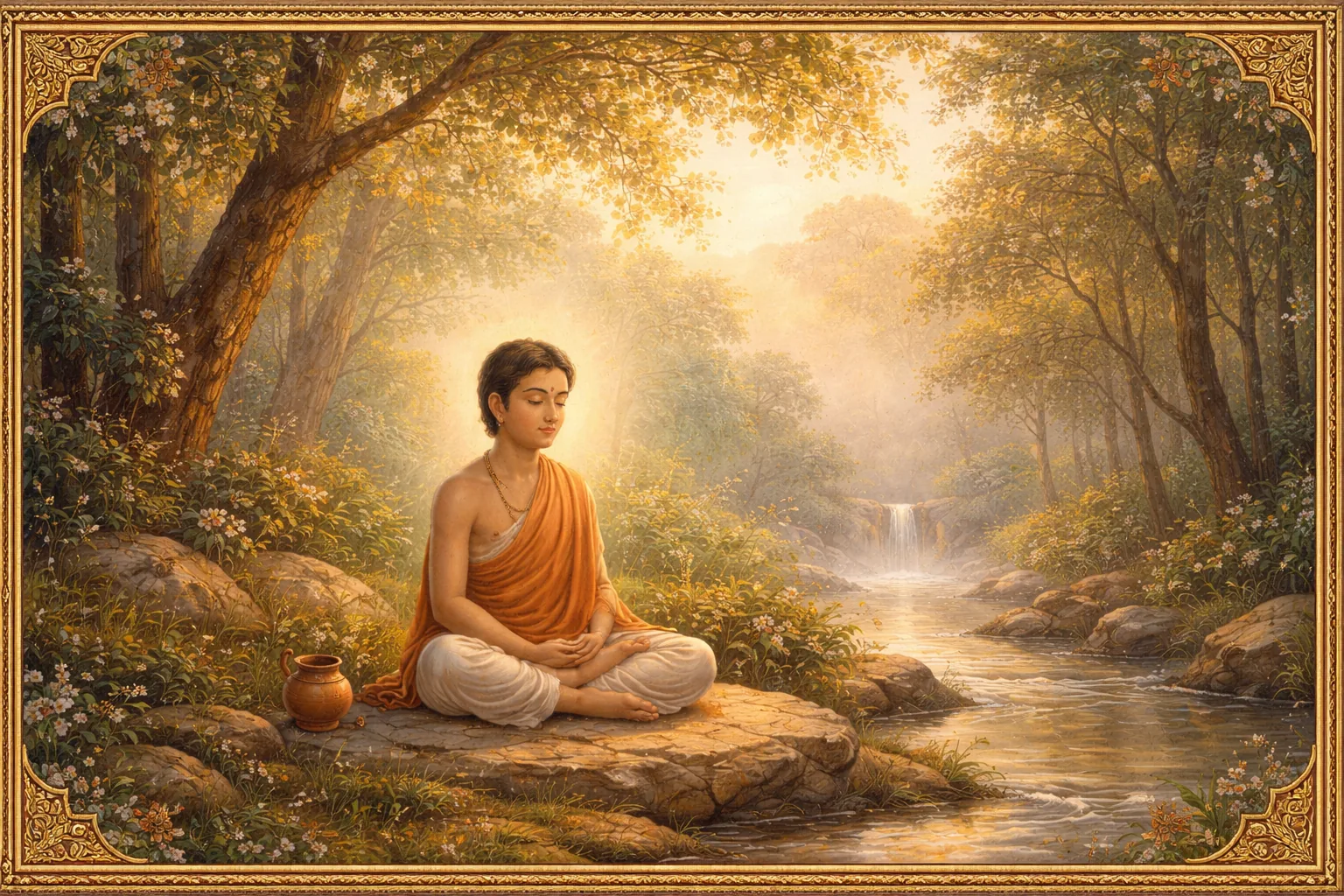
“Hemachuda acted accordingly, and, entering the state of which his wife had spoken, he remained at peace for a long time, aware of nothing but the Supreme Essence.”
Thus ends the ninth chapter on Hemachuda’s attainment.
In the tenth chapter, Hemalekha gives him further instructions, once again pointing out his mistakes and teaching him how to unite natural contemplation with the everyday state.
Ramana Maharshi
Tripura Rahasya
Janaka
Ashtavakra
Emptiness
Supreme Being
Effortless Contemplation
Vaishnavi-mudra
So-Ham
Read 15 times
Articles
Vidya AI
Search
Lectures
November 4, 2026
Mantra of the day
ОМ СИДДХАЙА НАМАХ ОМ Совершенному – поклонение!
Auspicious Times(Rome)
Brahma Muhurta:
04:55 - 05:50
Abhijit Muhurta:
11:33 - 12:14
Sayam Sandhya:
16:41 - 17:23
Mokshada Ekadashi (6 November)
Ekadashi of liberation. Helps to achieve spiritual enlightenment.