

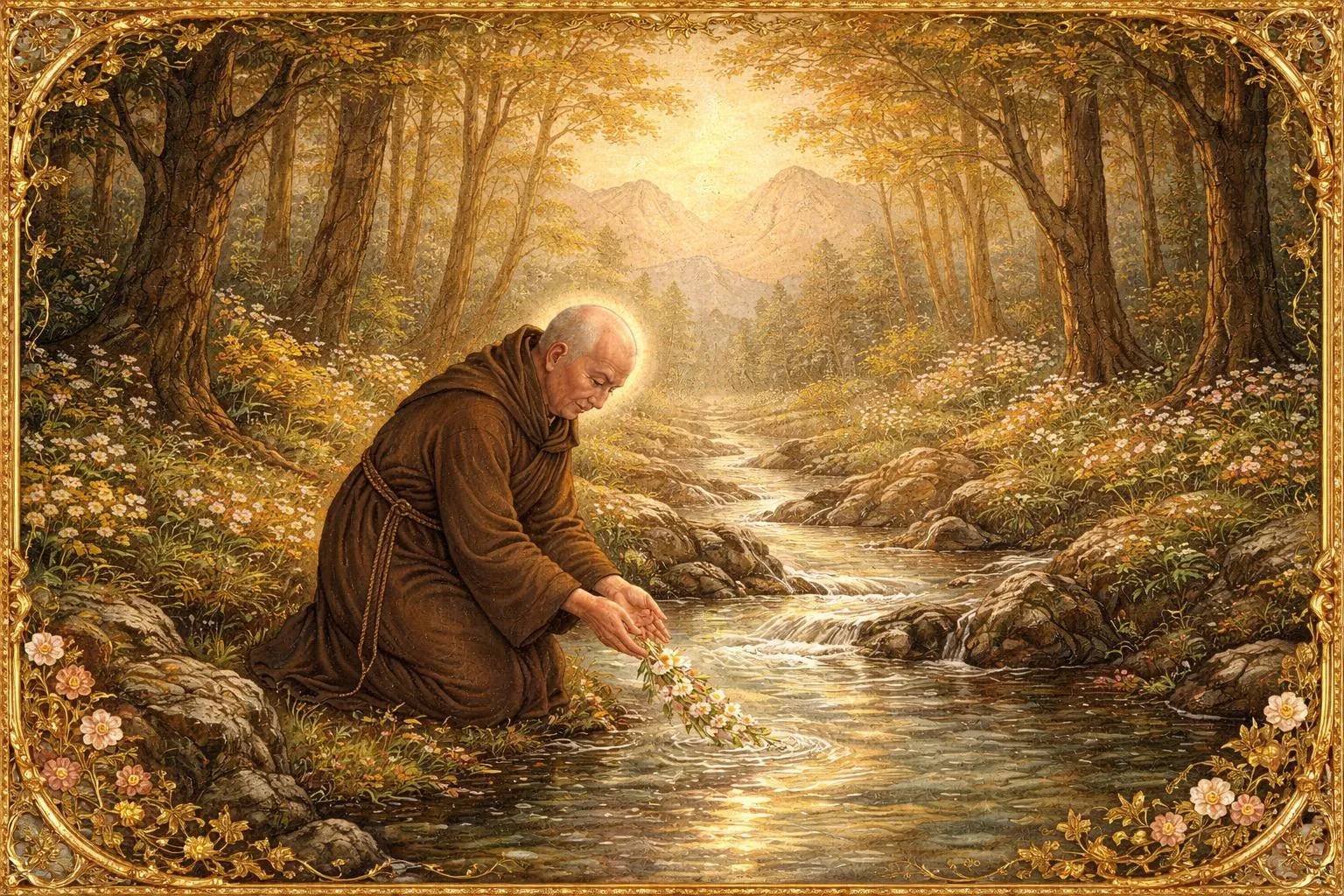
Commentary on the text by Sri Ramana Maharshi “Be As You Are,” the chapter “Self-Enquiry and Surrender”
Question: Constantly wishing to surrender, I hope that I will receive great grace.
Maharshi: Surrender yourself once and for all and put an end to desire. It persists only as long as there is the sense of being the doer, that is, the personality. If it goes away, the Atman is revealed, shining in purity. The limitation is the sense of being the doer, not the actions themselves.
Be still and know that “I am God.” Here stillness means complete self-surrender without a drop of individuality. Silence will prevail and there will be no agitation of the mind, which is the cause of desire, the sense of being the doer, and the personality. If it is stopped, peace is present. Here knowledge means being.
When we develop our mindfulness, it can reach a deep level. We can be continuously aware, and we may even be surprised ourselves: “Wow, I have become a completely different person! Previously I did everything unconsciously, but now it is as if I have gained another ‘I,’ a new way of seeing the world. I do everything consciously: moving, eating, opening or closing a door, speaking. Everything is continuously accompanied by attentive practice; nothing slips out of my control: not a single uncontrolled action, not a single unconsciously uttered word, not a single bite is put into the mouth chaotically.” It is as if all the details of the pattern of your life become visible.
It is said that once, when the Buddha was speaking with Ananda, he waved his hand, driving away a mosquito; then he raised his hand a second time and did the same thing. When Ananda asked why he had done this, the Buddha said: “The first time I did it unconsciously, so I repeated it the second time.”
When we practice mindfulness with applied effort, such mindfulness becomes constant, and we feel that we have obtained a certain real result from the practice. And we see that the minds of those who have not developed this mindfulness are loose and chaotic. When any thoughts arise, by applying mindfulness to them, we can disperse them; the same is true with emotions and desires. Previously, we were ordinary people; emotions overwhelmed us, our mind raced wildly, or desires overflowed within us; we satisfied them and simply wasted our precious prana, our life force. Or our mind was filled with thoughts and plans, and we were always losing ourselves in them. Now everything is different: there is an even observation, like the flow of a river, and everything is included in this observation. We become serene, concentrated, immersed in ourselves. Even thoughts, having arisen on the periphery, are absorbed by this mindfulness after some time. However, we feel that mindfulness is ourselves; we feel that this is not the end or some highest point of our realization. It is something we have realized within our body and mind. It may be an excellent state, yet it is not clear to us what will come next if we deepen and develop it, when it becomes very deep and continuous. We still remain in confusion, in ignorance regarding the nature of consciousness itself, even when we apply mindfulness to the actions of the body or maintain a certain awareness.
Self-Transcendence
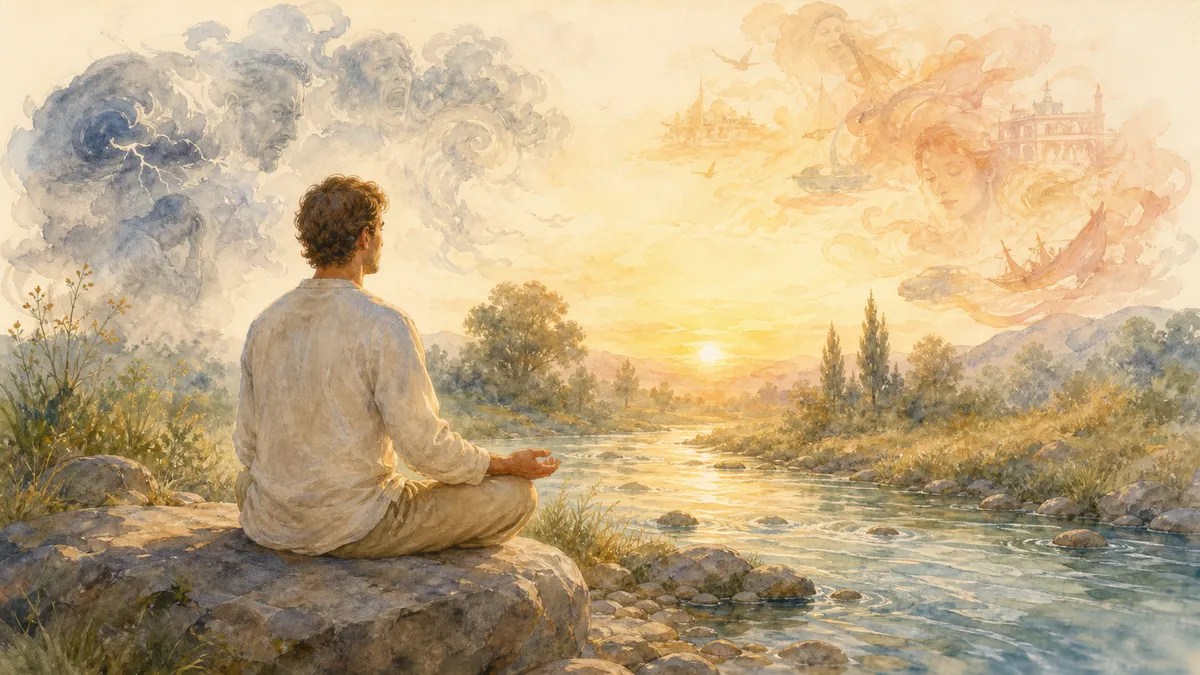
Self-transcendence is the next stage, when our mindfulness seems to break the jug or tear the cocoon of our ordinary perception. Self-transcendence means that we make a leap; now our mindfulness is no longer tied to the body, does not require effort, is neither inside nor outside, and is not based at all on our own individualistic action.
Rather, our mind opens wide and turns toward something incomprehensibly immense, incomprehensibly surpassing it in every respect, incomprehensibly incomprehensible, transcendent. It is also attentive, deep, and concentrated, but now for it there is no fixation, no limitations, no effort, and no sense of “I” that applies this mindfulness. Many people think that the knowledge of enlightenment is connected with the personality, the ego, and say: “Oh, I will attain enlightenment,” or “I have received some enlightenment.” Or they understand literally the meaning of the mahavakya “Aham Brahmasmi,” thinking: “I am Brahman.” Sometimes they may even speculate with a Vedantic understanding, justifying licentious behavior. This is a great delusion. One who truly realizes will understand this one day. “Aham Brahmasmi” has nothing to do with aham. Realization does not occur in individualized consciousness. Enlightenment does not occur in the “I.” This means that enlightenment comes only when aham completely disappears.
Therefore, self-transcendence is a process in which we open our mind so widely that our ego can fully open up to it. It is continuous self-giving, self-giving to the end, to complete fullness, until nothing remains of the “I,” not even a drop of individual perception, until it is absorbed by this great universal Source. That is why saints laugh when they hear the word “I”; they say that, in the absolute sense, there is no “I” at all. Of course, there is a body, thoughts, and so on, so one can say “I.” But the “I” exists for those who dwell in ignorance. There is no enlightenment for the “I,” no freedom for the “I,” no liberation for the “I.” Samsara, suffering, old age, illness and death, the bonds of karma, and new bodies are prepared for the “I.” Liberation, however, exists for the “non-I.” At first we do not quite understand this. But when we understand it fully, we see that our “I” has no value whatsoever, except that if we remove it somewhere, we will help ourselves; that is, it has a negative value. If we cast it aside and manage to open ourselves to the great Source, it will disappear as something unreal.
After we have mastered mindfulness, the path of self-transcendence or self-disclosure begins, the path of going beyond the cocoon of limited individualistic perception. Self-transcendence in terms of spiritual practice is much more joyful or much more interesting than mere mindfulness, because even when we practice mindfulness, we are still fixated on ourselves; clarity develops in the process, yet we are in the body and in this world. Self-transcendence is when we open ourselves to the great forces of the Universe, understanding that these great forces of the Universe are nothing other than our mind; when we open our mind to infinity, including within it stars, planets, and galaxies; when we feel that we are walking along the Milky Way and swallowing the sun and the moon. Self-transcendence is when we restore the lost unity with all Being, when the outer space that we previously ignored and that seemed to us not important at all or merely an illusion suddenly becomes identical to the inner space; that is, the inner and the outer begin to merge. Suddenly we feel that the most distant star is literally at our fingertips; everything depends on our level of awareness.

Self-Giving and Concentration on the Supreme Source
Self-giving means constantly abiding in awareness of the Supreme Source. In essence, the entire root of spiritual practices lies solely in concentrating on absolute Being and continuously keeping the mind in it.
Question: Is the thought “I am God” or “I am the highest Being” useful?
Maharshi: “I am that I am.” “I am” is God, not the thinking “I am God.” Realize “I am,” but do not think: “I am.” It is said: “Know that I am God,” not think “I am God.”
If we merely reflect on these themes mentally, it does not help; what helps here is something else—self-giving and complete surrender of oneself to this Supreme Source. In other words, one must constantly keep the mind concentrated on God. Whatever you may be doing, if your mind is thus continuously concentrated, you are in the correct presence, your contemplation is correct. When the question arises, “What, then, is God?” this is where one must recall all the instructions on presence. For a bhakta, there is a ready-made set of answers to this question: it is name and form, connected with mythology. Someday he too will go beyond name and form. But from the point of view of Laya Yoga, God is the contemplative presence beyond name and form that we realize. When we realize it, we should continuously fix our mind there, not allowing it to be distracted anywhere else. One must have strong faith in this state. When you have an image made of name and form, it seems easier to have faith; to have faith in that which possesses neither name nor form is difficult. However, without reasoning much about this, one must simply have it, and that is all. If it is strong, then the concept of God, the natural state, will become clear by itself. The mind must be immersed in it, like a straw that, plunging into a flame, is engulfed by that flame. When the mind is immersed in it in this way, the kleshas, vasanas, and illusions of dualistic perception melt away, and our absolute nature is revealed.
Maharshi: The best thing is to say: “Until now I mistakenly regarded as mine what belongs to You, but now I have realized that all this is Yours. I will no longer act as though they were mine” (this refers to the body, the soul, property, and so on). Such knowledge that there is nothing except God, or the Atman, that “I” and “mine” do not exist, and that only the Atman exists, is jnana. Thus, there is no difference between bhakti and jnana. Bhakti is jnana mata, or the mother of jnana.
Therefore, when our mindfulness is developed, when we practice the path of the natural state where there is no longer any effort, faith in this state as the absolute, as the very highest, is very important. When you have such strong faith, you have neither suffering, nor despondency, nor tamas, nor spiritual fluctuations, nor problems. You have continuous contact with the great Source, and transcendent joy settles forever in your heart. It feels as though you are the Absolute, as though the Absolute lives in you. The truth of Advaita begins to ignite within you in such a way that even you are amazed.
Faith and Surrender to the Divine Will
Question: We are worldly people; various sorrows and misfortunes pursue us, and we do not know how to get rid of them. We pray to God, but we are not satisfied with the result. What should we do?
Maharshi: Believe in God.
Question: We have relied on Him, but help has still not come.
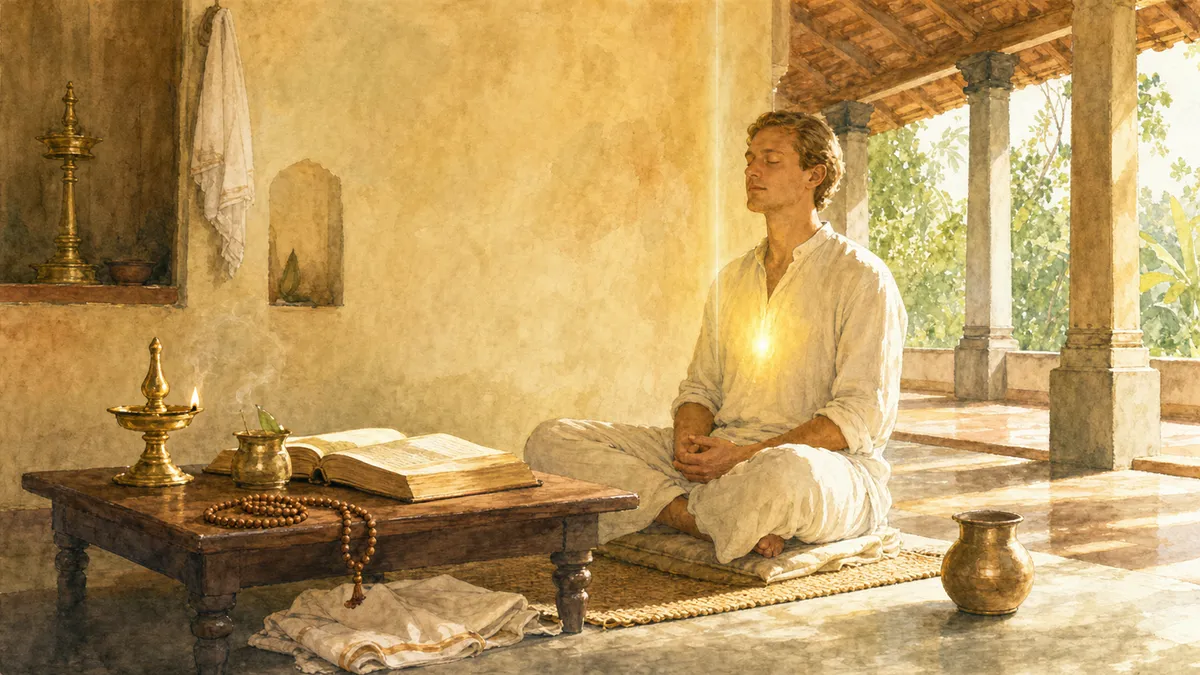
Maharshi: Yes. If you have surrendered to God, then you must be able to live by His will and not take offense at difficulties. Everything can turn to another side. Suffering often leads people to faith in God.
Here Maharshi does not explain presence to worldly people, since for them this is a difficult term; he simply speaks in terms of faith. The worldly people here say that they would simply like to get rid of suffering, that they pray in order to obtain results. But on the path of Laya Yoga the view is different: simply trust this presence, and if your trust is total, then no other results are needed. If you surrender your little “I” to this presence, what more do you desire? What other result can there be if this result is the highest?
Question: We cannot ignore everything and submit ourselves to the Divine will without retaining at least a grain of individuality within ourselves.
Maharshi: This means that you have not surrendered as you profess. You must believe only in God. Surrender to Him and hold firmly to His will regardless of His appearance or disappearance.
When we open wide, open ourselves to absolute individuality, we must not lose ourselves in the process. Our integrity as a person must remain, but identification with the person must go. If we open our mind wide in self-surrender and lose ourselves as a person, this is called “loss of action in awareness.” In India there were such bhaktas who were called masta, or madmen. They forgot themselves so much out of love for God that they rolled in the dust, roared, sobbed, wept, and nine people could not restrain them. In India this is considered normal: a person simply loves God very strongly; there is nothing unusual in this. These bhaktas would say: “You go mad over worldly things, and I go mad over God. Why is my madness worse than yours?” But from the point of view of the teaching, we do not lose our integrity as a person when we perform such self-surrender; that is, the outer shell and everything else remain, but self-identification disappears, and the subtle part of the mind is constantly absorbed in this great Source. It is as though you are looking into a vast abyss and, standing before it, you understand that all your efforts to show off and prance about are useless. This is the Abyss, this is Eternity. All you can do is merge with this Eternity and allow it to live within you. Then suddenly you discover that this Eternity becomes you yourself. Therefore it is said that God can be brought under control in only one way—by surrendering to Him; then He Himself will submit to you. Or it is said that Krishna becomes the slave of his devotees. In other words, through our self-surrender, our wide-openness, our openness, we entice Eternity and the Absolute, and then He enters into us. Suddenly our individual “I” unites with the absolute; complete integration, unity, takes place. The individual “I” dissolves in the absolute; the Absolute becomes inseparable from the individual “I.”
By practicing such a path of self-surrender, you free yourself forever from all your problems. Problems arise from the mind, from the false “I,” which always wants something. When it wants something, it is not satisfied. But when self-surrender has occurred, it wants only one thing — self-surrender. And since it performs self-surrender, there is nothing more to desire; it is always fulfilled, it always receives what it wants. Then great joy arises.
One mataji, having become a disciple, immediately began to set conditions for me:
“So, I want enlightenment. I want this kind of retreat and that kind.”
I advised her:
“Mataji, figure out what you want: do you want liberation or a retreat?”
She answered:
“Liberation, of course, because liberation is more important, but I also want a retreat.”
I asked her:
“Do you realize what you are saying?”
She thought and said:
“Actually, I want liberation.”
I said:
“Since you want liberation, if you practice as you should, you will receive it. But do not confuse it with anything else anymore. Stop worrying about other things; since you want liberation, entrust all of this to the Three Jewels: the Guru, the Dharma, and the Sangha. Just do as you are advised, but do not interfere in this process. It is better to try to practice self-surrender. Then everything will happen faster.”

If you are too impatient, however, it is like invoking eternity while glancing at the clock now and then. You must settle down; you are calling eternity, yet you keep looking at the clock. You invoke eternity, infinity, and at the same time set conditions for it under which you agree to accept it. This is impossible; you must change your approach. There must be openness, expansiveness, selflessness, and absence of conditions. Therefore, without setting any conditions or deadlines in the mind, one should simply direct one’s mind continuously toward the Supreme Source. Whatever you are doing, you should continuously direct it there and acquire great trust in this. When one practices in this way, it is said that one is in the natural state of presence.
The degree of advancement of a practitioner is determined by whether his mind is directed toward God every second or not. If it is directed toward anything else, it is like the needle of a compass, which should point north, beginning to point east. If this has happened, it must be brought back. This is the meaning of our spiritual training. When the needle of the compass is continuously directed in the right direction, the need for self-analysis, repentance, and self-control of desires, feelings, and so on disappears. All of this is realized automatically.
Those who do not practice self-surrender and are bound to personal effort, realizing after some time that their personal efforts do not bring quick results, remain dissatisfied or feel sad. Those who direct their mind toward the Absolute Source are in great joy from the very beginning; they have no great doubts or difficulties.
During the bhajan mandala, the lower part of your body should open up as if you are merging with a vast ocean. In the lower part of the body is energy; in the upper part, consciousness. These two must always unite. This principle is called mahasukha (great bliss). Even if you do not quite understand how this happens, it is enough that you think they should unite. Therefore, in the bhajan mandala, while practicing contemplation, we try to feel the energy in the area of the coccyx and mix contemplation with this energy. If you are not in contact with your energy, if your mind soars in the heavens while the energy and the body are on their own, then this is a disconnected state; that is, you are not in harmony with the world and with yourself. Proper presence presupposes that these two parts unite. Therefore, when you sit, you should always feel as though the lower part of the body is one with the entire universe, as though you are immersed in a great ocean of energies.
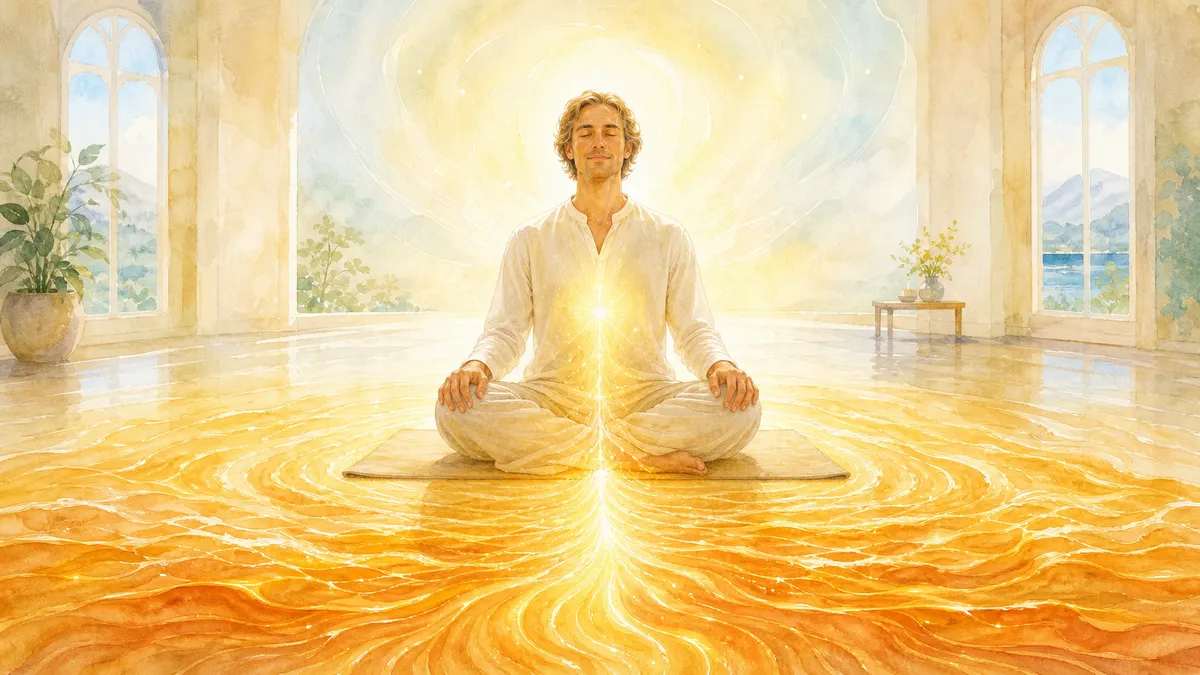
A true yogin, during practice, feels comfortable in body and mind. He possesses tremendous vitality; he abides in harmony with the universe and with himself. To be in such harmony and to be in the natural state are one and the same.
