

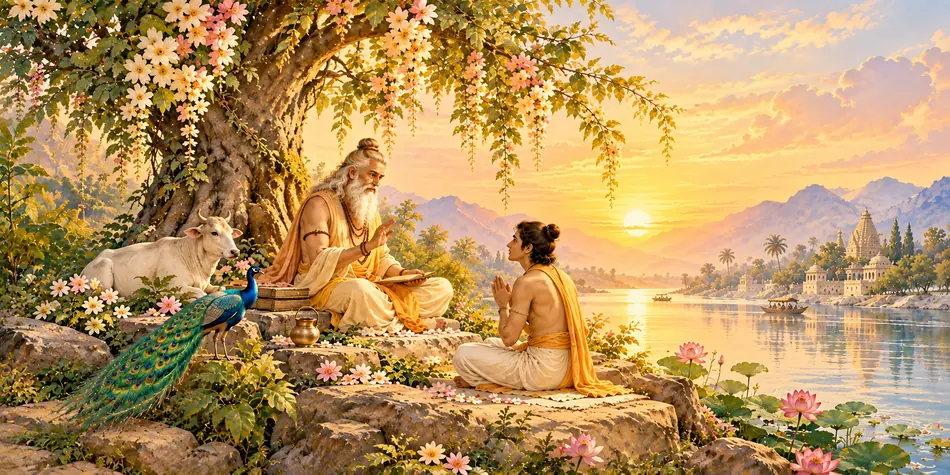
We have been caught in the web of impermanence. Something must be done about this. We must be resolute and goal-oriented; we must not be distracted or inattentive, or think as though we have no time. There is no time to waste here; we must act decisively, like a beautiful woman whose hair has caught fire. She does not stop to adorn herself; she immediately puts out the flames.
What does it mean to be resolute? To enter contemplation right now, decisively. To direct your mind toward God right now, thinking that there will never be better conditions at all. Perhaps there will be, perhaps not—no one knows. It must be done right now. We have a unique human birth, despite the fact that we have become caught in the web of impermanence and have karma.
And karma is the energy, the force of rajas and the force of tamas, that carries away the souls of all living beings. The soul does not want to be reborn in the lower worlds or in human worlds; it wants to go to the heavens, to paradise. But karma compels it. It is like a current of vasanas and samskaras flowing from its depths, pulling and pulling, impossible to resist. In the physical body, we can somehow resist a gust of wind, for example, or the powerful current of a river. We can somehow exert ourselves through the strength of our muscles. But in the subtle body there are no muscles. And the current of karma is something very subtle; it pushes the soul along a particular current, in a particular direction.
But if the soul is strong, it can focus on its inner faculties and develop within itself a subtle will, subtle wisdom, and subtle strength: invoke God, invoke the Guru-parampara, which is also a subtle will and subtle wisdom within. It can resist this current of karma: recite a mantra, enter into presence, give rise to a sankalpa, transform into a deity. Then there will be a struggle: subtle karma will pull it into a new womb, because within the soul there will be attachment, greed, lust, desire for a body, and desire for earthly pleasures. Subtle karma will draw it into a womb, into a new birth. And another part of the mind, resisting, will invoke deities, the ishta-devata, the Guru-parampara, recite a mantra, transform itself, or remain in indivisible contemplation; it will enter ecstasy through remembering God or through Guru-yoga. The subtle power of jnana-shakti and ichchha-shakti. There can be different methods. It will counteract this pulling force.
Then, they say, the gates of the womb will close, and a new birth will be prevented. In the intermediate state, many such gates arise for the soul; they open and close. If the soul is strong, it passes through and overcomes them all, establishes itself in its natural state, and then itself decides where to go: to paradise, to the Pure Land, to the Pure Light, into infinite space, or to earth as a liberated, playful soul. This will already be its own decision, because it will be free from tendencies and from this prana that carries it away. This is one of the forms of Liberation.
Does it need to be born at all? Either it enters the Pure Light, becoming infinite space; or it enters the body of Ishvara; or it enters the body of Dattatreya; or it transforms into a deity and attains sarupya-mukti. Or, through the power of sankalpa and concentration, it goes to the Pure Land of the ishta-devata. There are different ways of closing the gates of the womb. This is the soul that has risen above impermanence, recognized the unique and precious human birth, acted decisively, severed its karma, and conquered its karma.
The Battle with Karma
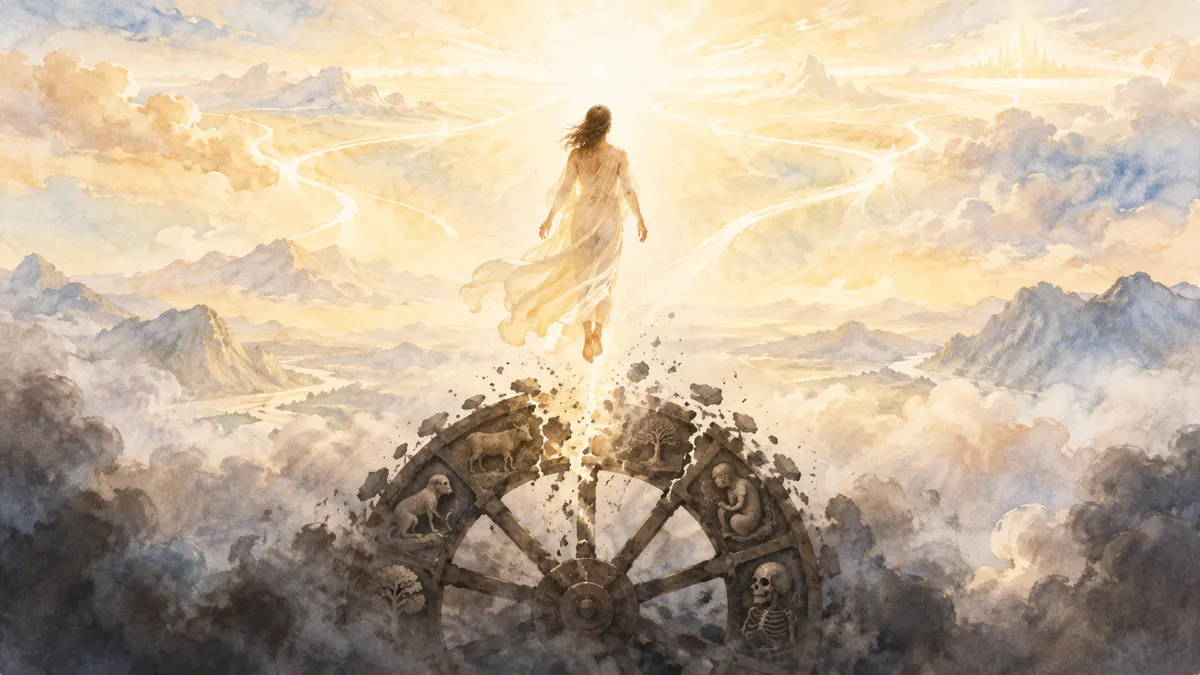
The battle with karma continues every second. Karma is our opponent; it is a force. It is within us: the force of universal rajas, the force of universal tamas, and the force of impure sattva. Such is karma. The force of pure sattva is not karma. The body of Ishvara consists of pure sattva. Every time we free our body, mind, and speech from karma, if, as sadhus, we act decisively, purposefully, and vigilantly.
What does this involve? In time, we remember the Guru’s instructions and the instructions of the shastras, and apply the antidote, the upaya. That is the whole point—to remember the instructions immediately. There is no need to engage in intellectual speculation. Intellectual speculation alone cannot solve the problem.
Sometimes people study Advaita, read the texts, and say: it is all an illusion, there is nothing to be liberated from, and there is no one being liberated. Excellent, Gaudapada says the very same thing; I cannot contradict you, I acknowledge your words. But if there is no power behind your words, if you do not believe in them, then you are simply a nihilist. Nihilism means that you speak in the words of the shastras, denying energy, but there is no equivalent power of faith in those words behind what you say. Or you say: I am Brahman; nothing else interests me. But if there is no power of faith behind your words, no power to transcend karma, then your words, your conviction in Vedanta, are merely mental; they mean nothing and will not free you from karma.
Let us suppose that streams of karma arise: anger, lust, attachment, greed, envy, egoism. They arise, and you must say: yes, this is all an illusion; I am not subject to my karma. And remain calm. That will be the power behind your words. This means that your realization is not merely in words; there is energy behind it, and you believe in it. Or you say: Aham Brahmasmi. It is all an illusion; I am the blissful Atman. In other words, the words of Vedanta and Vedantic expressions must have power behind them. What kind of power is this? It is the power of faith and conviction, the power of self-surrender, the power of realizing spiritual self-awareness, and subtle prana. Then it will not be nihilism; it will be realization.
The Nature of the Sufferings of Samsara
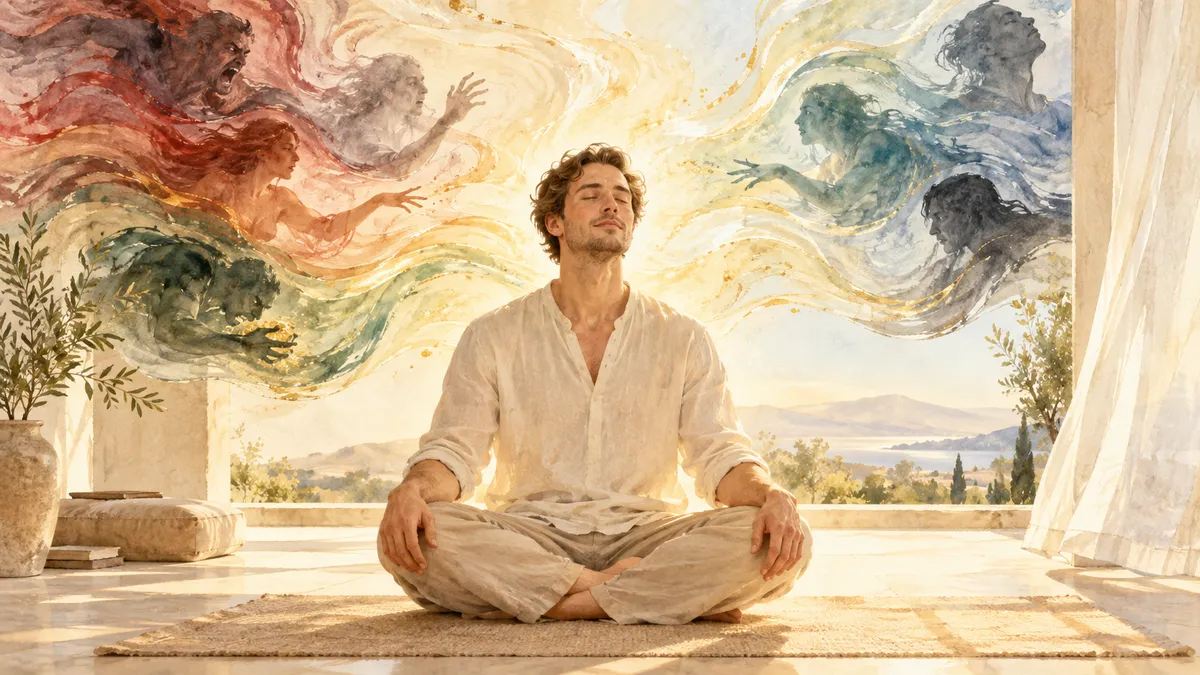
Suffering is inherent in this samsara. At first, this is not understood. The soul does not understand where karma has lured it. There is such a joke. When the soul chooses where to be born, angels, deities, and servants of Yama, in our terminology, show it the heavenly realms. Everything there is very quiet, orderly, and beautiful; angels play harps, as if in a symphony concert hall. Somehow, the soul is not inspired. It is too quiet and peaceful; everyone is serene. There is no drive at all. Then they show it another place: everyone is dancing and having fun, expressing their feelings—such a drive. There, thinks the soul, must be paradise. What is that? No, that is not paradise; it is hell. And why is everyone having so much fun there? After all, hell is suffering. No, come to our hell; there is such joy and merriment there. Someone has been filling your head with all sorts of fairy tales. The soul thinks: all right, if hell is like that, why not choose it? It goes to this hell. There, demons meet it, seize it, drag it away, tie a noose around it, force it to work and carry firewood to throw into a cauldron, where sinners are immersed in boiling tar. It says: How is this possible? They showed me such a wonderful life in hell. They reply: that was an advertising campaign.
When we are born into the material world, we do not understand the essence of the sufferings of samsara. The material world itself, human civilization itself, and human culture itself conduct a fairly effective advertising campaign. They show us that there is happiness in this world, but it is worldly and material; it must be attained, and one must strive for it. Models of behavior for obtaining this happiness are provided immediately. But the side of suffering is carefully veiled, carefully hidden, as though old age, illness, and death did not exist at all.
In Eastern culture, it is neither veiled nor hidden. There, everything is intermingled. Nowadays, Western tendencies have appeared there as well. Western tendencies mean making everything glossy and hiding suffering. Everyone is young, everyone is happy, almost everyone is immortal. Glossy advertising magazines and advertising banners. And the entire negative side of life is hidden. Eastern culture is somewhat different. Therefore, for a long time the soul does not understand that this world, if one becomes attached to it and identifies oneself with it, inevitably leads to suffering. Precisely if one becomes attached. If one does not become attached, there will be no suffering. If one practices, there will be no suffering. But if one becomes attached, if one follows its goals, its models, its meanings of life, its life values, patterns, and stereotypes, then there will inevitably be suffering. But the living soul does not understand this immediately.

The Essence of Renunciation
When Totapuri was teaching Ramakrishna, Ramakrishna asked him to explain a passage from one of the Gitas. Totapuri said: repeat the word “Gita” ten times, and you will understand the essence of any Gita. Ramakrishna was surprised—how could that be?—and began repeating: Gita, Gita, Gita. When you repeat “Gita” for a long time, it becomes tagi, or tyagi, which means “renunciation.” Totapuri said: renunciation is the essence of the Gita. There is no need to study it extensively. Whatever you do not understand, repeat it ten times, and this word will appear within you; meditate on this word. And Ramakrishna understood what Totapuri was teaching.
We must renounce samsara if we want to be happy, if we do not want to suffer. But we must do this correctly. There are incorrect forms of renunciation of samsara, and there are correct forms of renunciation of samsara. Incorrect renunciation means external renunciation, without understanding the inner tapasya, the inner vairagya; correct renunciation of samsara even includes its total acceptance, because natural awareness includes the total acceptance of the energies of the Absolute. But only in God. Incorrect renunciation erects dualistic barriers between us and reality. Yet renunciation of samsara is necessary. It may seem that this is self-evident, but in fact it is not clear to the mind; the mind needs to be constantly reminded of it. If it is not reminded of this, the mind will constantly become engrossed in things, constantly cling and become attached, because this is an endless process.
We have been drawn into samsara by the force of karma. But we have a precious human birth, and we can renounce it. Correct renunciation leads to realizing God within ourselves, becoming free from suffering, and attaining happiness. A precious human birth. One who has renounced is always happy. One who has not renounced will always find a reason to be unhappy.
Tolstoy had an expression: all unhappy couples are unique in their unhappiness, while all happy couples are happy in the same way. The same can be said of people in general. All happy people are happy in the same way because they are happy in God, and God is one. It is something homogeneous; therefore, every happiness has its root in God, and all happy people experience divinity in one form or another. All unhappy people, however, are unique in their unhappiness because their “unhappiness” is conditioned by different minds and different complex karmic configurations. One person is unhappy because of relationships, specifically because of those relationships; another is unhappy because of bodily illnesses, specifically because of particular unique illnesses that arise precisely in that locality. A third is unhappy because of unrealized creative potential, and a fourth because of a lack of money. Countless configurations. Unique configurations of suffering. Very many living beings suffer. It is even difficult for us to understand what configuration their mentality has and why they suffer until we step into their shoes.

Therefore, there is a saying: do not judge another person until you have entered their soul and body and taken millions of steps just as they have. If you have not taken and walked even a single step along their path, do not judge another person. You cannot understand them. That is the way it is. Therefore, in order to help others free themselves from suffering, we must understand other people. How to make them happy. The teaching says: learn to renounce, learn to live in renunciation. It is impossible without renunciation. No matter how much we may want to, it is impossible. But we must do it correctly.
Correct and Incorrect Renunciation
Correctly means that when we renounce the samsaric view, the ego, karma, and everything that is an illusion, we open ourselves to God. There is an alternative; there is something positive. This is not “shushka-vairagya,” not dry renunciation. There is “shushka-vairagya,” dry renunciation. Renunciation without an alternative. This means that you renounce mentally, by your will, or in some other way, but there is no alternative of the bliss of God, faith, devotion, love, or being imbued with divine grace. Then you feel that you have renounced, but the suffering has not gone away. On the contrary, there is even more suffering. At least before, there were some small outlets through which the ego could feed and remain in a more or less happy state. But now you have taken even that away from the ego, while the ego has not found God. Then even more suffering arises. This is incorrect renunciation: renunciation without a positive alternative, without devotion, without love for God, without opening to divine grace. Negative, negating renunciation.
True renunciation is positive. Everything inevitably grows into its opposite. True renunciation is absolutely positive. True complete renunciation is filled with incredible bliss, incredible happiness, incredible delight and ecstasy because it leads to God. Then no attachments, no clinging, no fears, and no hopes hold us back; only God remains, and the only one to hold on to is God. And God is the source of absolute grace. Paradoxical as it may seem, true renunciation leads to complete acceptance, complete bliss, and complete happiness.
This renunciation is internal, not external—above all, internal. There are, of course, external methods that promote inner renunciation, but these methods must be applied correctly, under the guidance of a Guru, within the appropriate status. This is what the statuses are for.
For example, in the naga baba tradition, there is a training process in which the person who assumes the “naga” status first meditates on soft, thick cushions so that he is comfortable, so that his legs do not hurt, and so that he does not think about the body. Then the cushion becomes smaller, smaller, smaller. And then there is some hard animal hide. He sits on it. In the same way, they gradually reduce the number of things they use. At first there is a dhoti, then the dhoti is removed. Then only a langoti remains, then a kaupina. Then only a kamandalu, a trident, and prayer beads remain. Then the kamandalu is removed, then the trident is removed, then the prayer beads are removed, gradually, gradually. When he has fully become a “naga,” he renounces his inner conditioning: the idea of caste, the idea of homeland, the idea of pure and impure, the idea of pride. But this is a gradual, gradual process. When one must renounce the inner, it is even more difficult. Throwing away a pitcher and drinking or eating from one’s hands is not so difficult. But throwing away one’s ego is truly difficult.
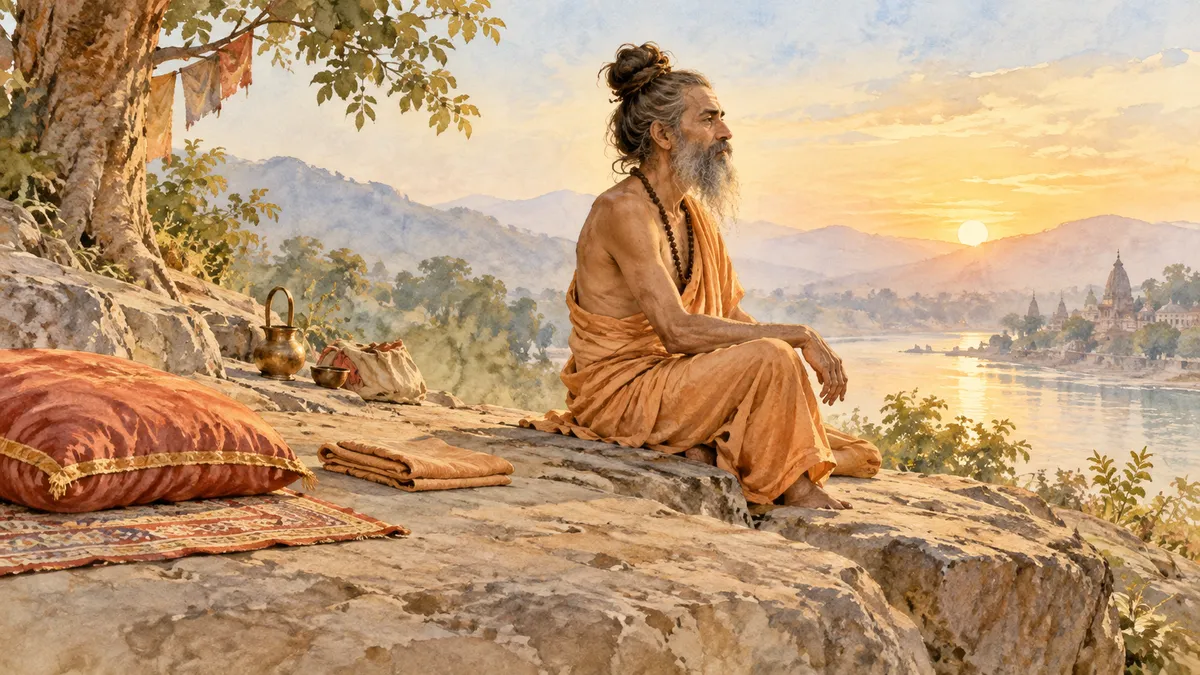
Finally, when the soul has renounced everything completely, it is instructed to undertake pilgrimage in this renounced state. There are no more actions apart from contemplating, being in God, reciting mantras, and undertaking pilgrimage. In the process, various karmas are developed. Then one is instructed to leave the mantra, leave every method, leave meditation, and move on to non-meditation yoga, the yoga of the natural state, laya yoga, the yoga of natural awareness, anupaya, the yoga of non-meditation. And to remain in a nondual state throughout one’s life. To leave everything altogether.
What remains for such a yogi? He has one vow, external and internal. One inner vow: the natural samaya of contemplation, to remain in nondual awareness. The single samaya of awareness. And one external vow. What is it? To live in the body. The vow of the body. To remain in the body throughout one’s life. He has no others—neither vows nor obligations. To be aware and fulfill the vow of the body—to live, walk, eat, sleep. That is all; there are no obligations or vows whatsoever. He is free like a bird, provided that he remains in nondual awareness day and night, in the single samaya of contemplation, remaining in God. He is completely naked, clothed in the directions of space, like Dattatreya. His mind is empty as well. No concepts, no thoughts, no scriptures, no external human religions, no mantras, no methods, no meditation—only presence in God. He is in the body. That is all. This is enough. His entire life is in sahaja samadhi. A very free life. But first we must reach this state. Reach it.
In Christianity there is a tradition: when a Christian sadhu reaches a certain level, he asks for a blessing to become a holy fool. One cannot act as a holy fool without a blessing. If he does so without a blessing, it means that something is wrong with him. He needs treatment. But if he asks for a blessing to become a holy fool—that is, if he has gone beyond certain prescribed boundaries, and his inner spirit of holiness guides him freely—he asks the elders to bless him to become a holy fool. And he begins to act as one. How? In different ways. An avadhuta. He may crow during a church service or do something else. But if he acts as a holy fool correctly, the younger ones receive a blessing through his foolishness, and he does not introduce anything destructive into the monastic sangha. Everyone respects him; he is not considered insane. His foolishness is full of grace, and this grace is transmitted to others. But sometimes, if someone acts as a holy fool incorrectly, the blessing to do so is revoked. That is all. Behave like an ordinary person. It is too early for you to be an avadhuta. This also happens sometimes.

These are all different forms of inner renunciation. First, we must arrive at inner renunciation. This inner renunciation must also be accompanied by external renunciation. It need not be like that of a naga baba; our culture does not permit this. This must be understood. It is not the same culture; it is different. But our inner renunciation consists in following our commandments, principles, and precepts; in total self-surrender in seva and sadhana; and in flawless practice of contemplation. Then the bonds of karma and samsara are overcome, the precious human birth is realized, suffering disappears, and there is only the bliss of abiding in God.
Commentary on the text “Shri Siddhanta Shikhamani” by Shivayogi Shivacharya. Chapter 17
The sthala of the disciple.
One who is constantly instructed by a Shiva yogi who has attained the state of the body of the Supreme Essence, and who, through the grace of the Shiva yogi, aspires to liberation, is called a disciple. One who is unfailingly devoted in thought, speech, and action to the guru, the embodiment of virtues, is called a disciple.
Having once received diksha, generated samaya, taken Refuge, received a name and a mantra, and become disciples, we establish a very important bond. It is like a second birth. The first is given by our parents, the second by the Guru. We must respect this bond. Once this bond has been established, it must always remain pure. If we respect this bond and it remains pure, it awakens the satguru within us, and we are born for the third time from within.
The third birth is the attainment of Enlightenment, when the inner deity is born within us through the transmission of the deity’s form and mantra, and when the infinite space of natural awareness is born within us. This occurs through direct introduction, explanations, satsangs, and the entire practice of learning. Then the inner satguru is born within us. This is the true, third birth. The third birth signifies the beginning of the great state of awakening.
We must be born as an awakened being as a result of diksha from the Guru. Our parents gave us the first diksha. What kind? The diksha of the body: they conceived us and raised us. The Guru gave us the second diksha. The third diksha is given by the Guru, God, and the ishta-devata together, along with our own Atman. All of this is called the satguru. As a result of the third diksha, we are fully born as a divine being.
Those who have been born only once cannot be called fortunate souls. They are called karma-bandhikas, bound by karma. The scriptures call them dukha, mudha, in various ways, and duratma—insufficiently fortunate souls who have been born only once. Those who have undergone diksha are called “dvija,” the twice-born.
Traditionally in India, the term “dvija” referred only to Brahmins, the highest caste, sages who had undergone the naming ceremony. It also applied to Kshatriyas. But it was still attributed primarily to Brahmins. From the perspective of the Tantric tradition, caste is irrelevant. What matters is whether diksha has taken place, whether the soul has entered into a relationship with spiritual life, into a relationship of initiation, into a Guru-disciple relationship.
The Importance of the Guru-Disciple Relationship
This is a very important relationship. There is nothing higher than this relationship. Only the relationship between the soul and God is higher. And the Guru-disciple relationship, as it were, models and replicates that relationship. Therefore, being born a second time is very important.
Those who have received karma-sannyasa diksha or diksha as monks have been born a second time. Perhaps they are not yet aware of this, but that is not a problem. This awareness comes later. Just like a child. A child is born, but does not yet fully realize that they have been born. They simply say: I want a toy, I want to eat, I want to go outside. They are not concerned with questions of metaphysics, birth, or death. Later, when they come of age and become full-fledged members of society, they begin asking such profound questions.
In the same way, at first, when we receive diksha, we do not fully realize that it is a second birth. But as our practice progresses, if we follow the logic of our diksha, we realize the depth of this birth. This depth of birth comes later.
The second birth must necessarily lead to the third if it is applied correctly. If it is applied incorrectly, it may lead to it, or it may not; this is unclear. But if it is applied correctly—that is, if the principles are observed, samaya is observed, sadhana is performed properly, and the mind and heart are purified—it leads to the third birth. This is the meaning of diksha.
The second birth has meaning only if we fulfill the duties of our status. It must not be merely formal. We must genuinely follow the eight principles of karma sannyasa, the principles of vinaya, the principles of Tantric vows, and the unified samaya for monks, purna sannyasis.
Diksha is a beginning, but behind diksha lies the commitment to maintain the status of spiritual life throughout one’s entire life. Different statuses entail different principles. One must know the obligations associated with one’s status. Why? Not in order to restrict oneself, but in order to draw strength and benefit from them. Status and diksha make it possible to draw greater strength from them. It is precisely this strength that we draw which, over time, leads us to the third birth. This is the state of a disciple.
Two Oceans: Samsara and Brahman
Calm, self-controlled, practicing austerities, honest, even-minded toward all, and showing equal reverence to the teacher and to Shiva—such is the best of disciples. The wise disciple regards the teacher as Shiva and Shiva as the teacher. He sees not the slightest difference between them. Thanks even to the brief instructions of the master, the disciple gains the strongest faith in the practices of the Shaivites, in contemplation of Shiva, and in the pure knowledge of Shiva. In the great ocean of illusion, maya, worlds arise and disappear like foam. The compassionate glance of the guru, like an underwater flame, swallows this abyss in the blink of an eye.
The ocean is used in Tantric and Vedic scriptures in two meanings. First, they speak of the ocean of samsara. Something immense, something all-pervading. Samsara is not merely the external world; it is energy, all material energy, the vast universe with its energies, laws, time, space, and subtle forces at work. All this is the great ocean of illusion in which we exist as individual souls, and this ocean often carries us along in its own direction.
In another sense, the ocean is used to refer to the Absolute, to Brahman. Brahman is like an infinite ocean. Brahman is also an ocean. Water is everywhere: water to the right, water to the left, above, below—only water. As if you had entered an infinite, multidimensional ocean that extends in every direction. This is Brahman. Liberation means that water sinks into water. Our inner consciousness, like water, sinks into other water and merges with it.
The task of the Guru is to explain the all-pervading nature of Shiva, Dattatreya, the nature of the infinite Ocean of Consciousness as Brahman. So that the disciple may become sufficiently imbued with this understanding, so that an investigative interest awakens in him, a curiosity to explore this ocean, seek it, question it, and feel his way toward it by applying the methods. In other words, this is love of God. Because God, Brahman, is this very ocean.

What do the sacred scriptures say about this? Brahman is discovered where discursive thinking ceases. We do not perceive this ocean because of the intensity of our discursive thinking. And discursive thinking is conditioned by vasanas and samskaras. When we stop discursive thinking, awareness, buddhi, comes to the surface and takes center stage. With the help of awareness, buddhi, we can gradually explore this divine ocean of Brahman. Therefore, we must apply methods that cultivate our awareness.
Churning the Ocean: Poison and Nectar
The external world of samsara exists in the mind, and it disappears in the mind as well. When discursive thinking ceases, awareness comes to the forefront. At the same time, something else emerges. Many neo-Advaita teachers do not speak about this. What else emerges? Deep-seated karmas and various energies.
When the cosmic ocean was churned, Lakshmi, the horse Uchchaihshravas, Dhanvantari with the nectar of immortality, and the other divine magical elements did not emerge immediately. What emerged first? Poison. The Halahala poison, which began poisoning everything around it; only Shiva could drink it. What does this mean? The gods began to be poisoned by it, and the asuras began to be poisoned by it. The gods represent the sense organs, the organs of perception, jnana-indriyas, karma-indriyas, the inner gods. The asuras represent various kleshas, impure energies. And this poison is the kleshas, impure karma. Shiva could drink it. Shiva represents transcendental consciousness. Only transcendental consciousness can absorb it.
Therefore, various karmic poisons and kleshas emerge alongside awareness. We must be prepared for this. If we possess the strength of jnana, the strength of vairagya, and the strength of devotion, they will dissolve; we only need to remain steadfast in faith, we must remain steadfast in faith. We must not be fainthearted, we must not waver in our faith. We must remain steadfast in devotion, be strong, and be completely devoted to the Guru-parampara, the Guru, the chosen deity, God, our own Atman, and our path.
The Principle of Acquiring Qualities Through Prayer
Steadfastness, strength in faith, comes when we pray to become steadfast. In other words, we want to be steadfast, and we ask for it. Then we become steadfast. If we want to be steadfast in faith, we need to desire it. If we are not steadfast in faith, we need to desire it. If we are not steadfast in faith, we simply need to want it. The moment we want it, we become motivated to ask for it. When we ask, after some time it is granted to us. We need to understand this principle.
<
Once, Bhairavi Brahmani brought a beautiful girl, seated her on a throne, and told him to perform worship and recite the mantra. He began to pray to the Mother: “Mother, why are you tempting me like this? What is this that you have come up with?” He immediately began reciting mantras and praying to the Mother with tears, and entered samadhi. Then Bhairavi Brahmani awakened him from samadhi and said: “Well done, you have passed the test. Few are capable of passing this test. Usually, lust arises, impure thoughts distract a person, and one is unable to recite the mantra under such conditions. But you attained the state of samadhi.”
On another occasion, she prepared fish in a human skull and then gave Ramakrishna some to taste. Ramakrishna again said: “Mother.” His mind was the mind of a Brahmin. This was not the mind of a worldly person. You might give an ordinary person fish to taste, but not in a skull. But Ramakrishna was a Brahmin by caste, and ideas of purity and culture were deeply rooted in him. He prayed, entered that state, took the fish, ate it, and had no problems.
On another occasion, she prepared an offering to Kali from rotting human flesh and said: “Here, lick it.” He replied: “I cannot.” “But I can.” She licked it. “Here, you lick it.” His mind again became overwhelmed by revulsion. There was no sense of one taste, of non-duality. “Mother...” That was all; he entered samadhi, licked it, and had no problems, because in that state there is one taste, and there are no problems. Pure, impure, flesh, not flesh—all of this is transcendent. Through self-surrender, the dualistic notions of the mind, attachments, pure and impure, duality, and all identifications are overcome—everything through self-surrender.
Ramakrishna always turned to the Mother in this way. Once he turned to her and said: “Mother, I am a fool; please teach me everything contained in the Vedas, the Puranas, and the Tantras.” The Mother replied: “The essence of Vedanta is that only Brahman is real, while the world is an illusion. That is the entire teaching.” Ramakrishna understood everything; it was all clear. Only Brahman is real; the world is an illusion. Then he entered samadhi. He remained in samadhi for six months. A monk who brought him food realized that if he did not awaken him, it was impossible to know where he might go, since he was not eating. So the monk would bring food and hit Ramakrishna with a stick to bring him back to his senses a little. Ramakrishna would come to, the monk would put food into his mouth, he would eat a little, and then enter samadhi again. He received the Mother’s blessing that everything is an illusion and only Brahman is real. And he meditated in nirvikalpa samadhi.
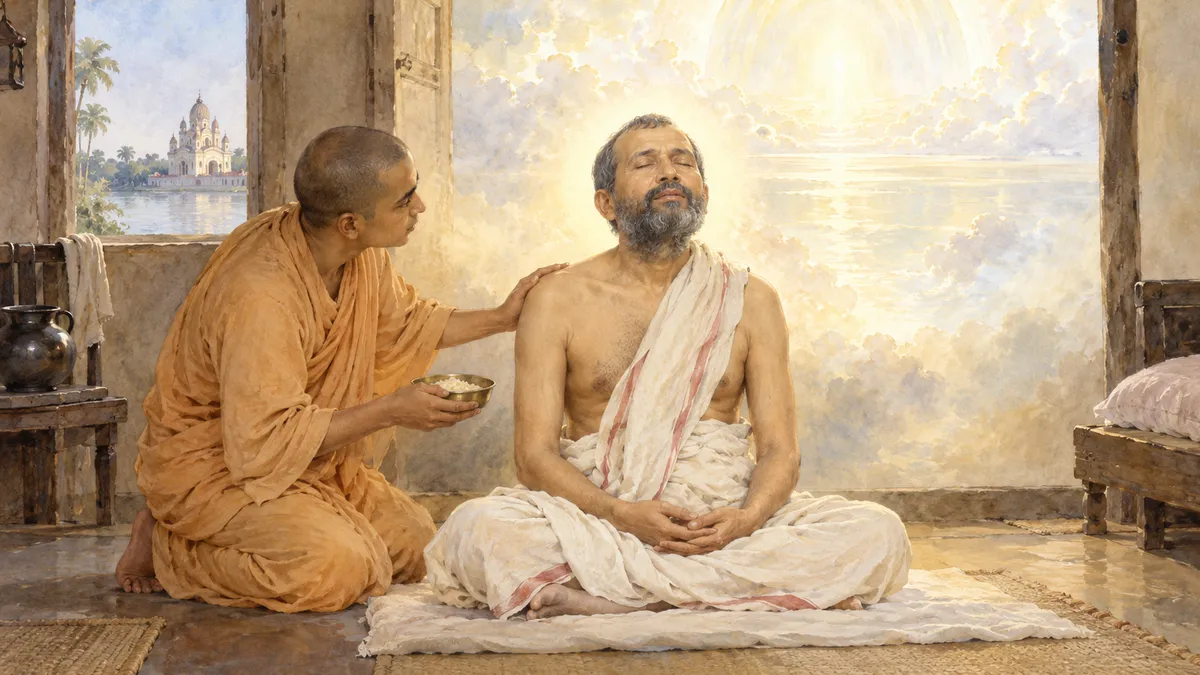
The great knowledge of unity with Shiva is the medicine for the disease of samsara. The serene and fortunate one who has received this knowledge from the guru attains Liberation while still alive. There is no doubt about it.
The Unity of Traditions and the Transcendent View
The stage of obedience.
The guru, whose body is the form of the Supreme, always encourages the disciple toward realization. And the disciple devotedly serves the guru and listens to him; such a disciple is called a novice, literally, one who strives to listen. What is truth? And what is not truth? What is the Atman? Who is the Supreme Shiva? A disciple who wants to hear the answers to these questions stands out among others. Listening again and again to the guru’s explanations leading to the realization of Shiva, the disciple attains inner peace. Such a person will attain liberation.
The disciple’s mind will not awaken without the teacher’s instructions. How can a lotus bloom without sunlight? As soon as the sun rises, the suryakanta stone immediately begins to shine. As soon as the teacher looks at the disciple, the disciple begins to shine with awareness.
The disciple should approach a worthy guru with palms joined in prayer and hear from him the means that gives direct experience of the bliss of non-duality with Shiva. What is this supreme truth, the supreme reality that should be known? Who sustains all this, the direct perception of which is called liberation? Tell me briefly. After the self-controlled disciple asks these questions, the guru should reveal to him the truth that destroys the cycle of rebirth. Shiva is the supreme truth, manifesting as consciousness, bliss, and being. He is eternal...
Sat-chit-ananda Brahman and Sat-chit-ananda Shiva are one and the same. The Vedantic tradition says, “Sat-chit-ananda Brahman.” The Tantric and Shaivite traditions say, “Sat-chit-ananda Shiva.” There is no division between them.
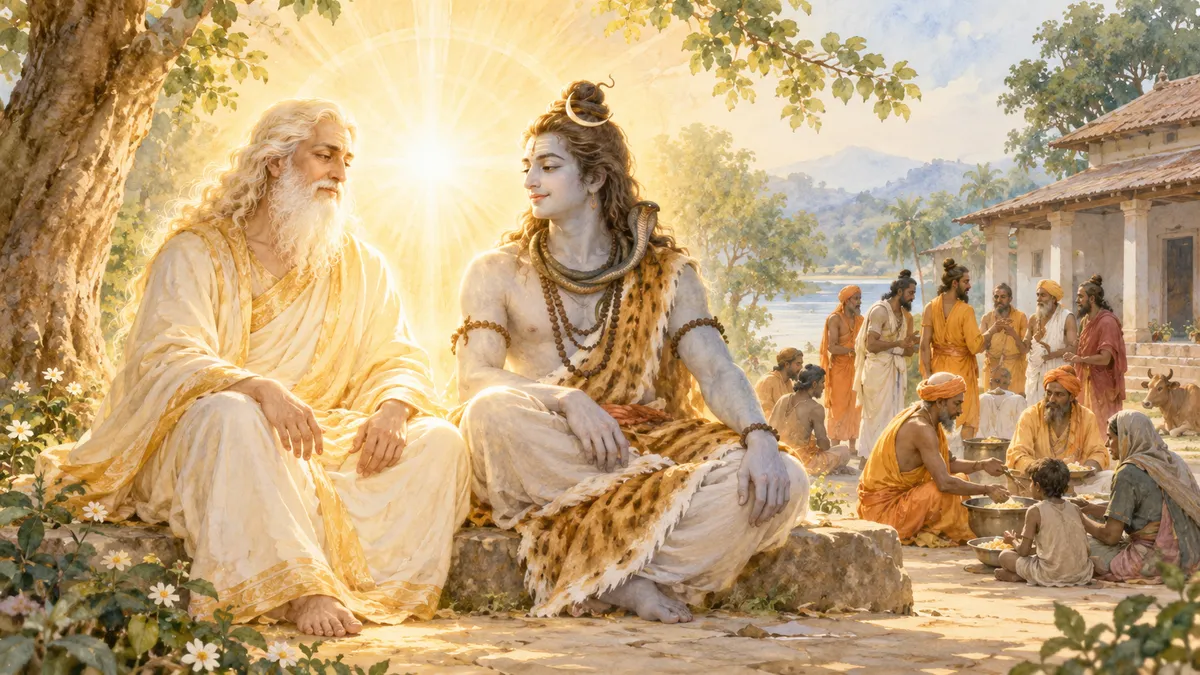
Sometimes, sadhus of different traditions are deeply divided, and each one is convinced that they are right. Once, perhaps in the nineteenth century, there was such an incident: it was decided to hold a large bhandara for sadhus of various traditions. Many sadhus gathered. But most likely, they were not saints, but simply ordinary sadhus, each believing that their school understood better than all others what Truth was. And they began to argue. They believed that since their school understood better than all others what Truth was, they should be served food first at the bhandara. Debates and philosophical disputes arose. They could not agree on who should receive food first at the bhandara. The donors grew tired of this, left, and simply distributed the food to the poor. The sadhus also dispersed because they could not reach an agreement; their minds were deeply divided.
The Guru’s task is to give the disciple a vision of unity: the unity of Brahman, the unity of all views, all points of view, all conceptual traditions, all deities, and all saints. This vision of unity is the transcendent view.
The view of the transcendent perspective does not mean that we lose our discriminating wisdom, disregard our tradition, or mix it with others—certainly not. The vision of unity means that, while preserving a non-dual view, we work from this non-dual view of unity, refining contemplation and acting within the relative while respecting our tradition. This is the harmonious combination of view and conduct.
Shiva is the supreme truth, manifesting as consciousness, bliss, and being. He is eternal; there is nothing else eternal in the world apart from him.
