


Commentary on the text “Yoga Vasistha,” Chapter 6
“The world is not material; emptiness cannot be seen. The mind becomes nothing. What remains is truth, indescribable yet existing. The intellect becomes completely confused by contradictory statements, but when truth is investigated by the proper methods, it is realized. One whose intellect is awakened is called a knower of truth. He has become established in the state of nondual consciousness and does not perceive the world as the world.”
An awakened intellect, an awakened mind, means that as a result of practice there is viveka-vidya, discriminating wisdom has been attained. Just as a lamp can illuminate all the darkness in a room, regardless of how long the darkness has been in the room (a hundred years, a thousand years, or even billions of years), at the moment of illumination all the darkness disappears. In the same way, discriminating wisdom (viveka) illuminates our inner darkness. Regardless of how long it has been there (ten lifetimes, a thousand lifetimes, or a billion lifetimes), this darkness immediately begins to recede.
“The apparent world arises only when infinite Consciousness sees itself as an object—and it would be better if this did not happen! But as soon as the world arises, it appears as something seen externally and materializes. Awareness of matter is the mind, and it becomes attached to the body. But all this is only concepts and verbal descriptions; these distinctions are imaginary. Consciousness never becomes an object or matter. When a person becomes established in self-awareness, even ‘consciousness’ and ‘non-consciousness’ become meaningless words. The material body arises from the subtle mental body because of repeated thoughts; therefore matter is unreal.”

Spiritual Upbringing and Responsibility
Each of you is like a prince or princess destined to become a king or queen. You will certainly become one if you do everything correctly. And the guru is a kind of tutor to the young prince. And although this prince, by lineage, blood, and hereditary right, has every legal basis to inherit the royal throne, nevertheless even he needs training and upbringing.
I read about how the Karmapa was raised—a tulku in Tibetan Buddhism, a reincarnate, that is, one who consciously reincarnated, indicating the place of his rebirth. His father was an influential official in Tibet. As was customary, this reincarnate was found and entrusted to the care of a strict lama, a teacher. He raised the Karmapa, taught him to read and write, sometimes gave him slaps on the back of the head, and sometimes even punished him. His father was indignant: “How can this be? My son is the wish-fulfilling jewel, the Karmapa, so there is no need to give him slaps on the back of the head; he does not even need to be taught.” But others said: “Because of this he quickly learned to read, and if he had not been treated this way and taught, he would not have learned to read.” But his father was still against it; he removed this teacher and found another mentor. Then it so happened that a third mentor appeared. This mentor was also strict; he taught the Karmapa philosophy and also periodically gave him slaps on the back of the head, even more often. This greatly outraged his father. He thought: “How can this be? The wish-fulfilling jewel, my son, the Karmapa, and his regents give him slaps on the back of the head! They are just ordinary monks, far lower in status.” They said: “Even the reincarnate Karmapa, a tulku, needs to be taught to read and write, to be taught etiquette and philosophy. He has this potential, but this potential still needs to be revealed and unfolded; and if the appropriate conditions are not created, it will not unfold.”
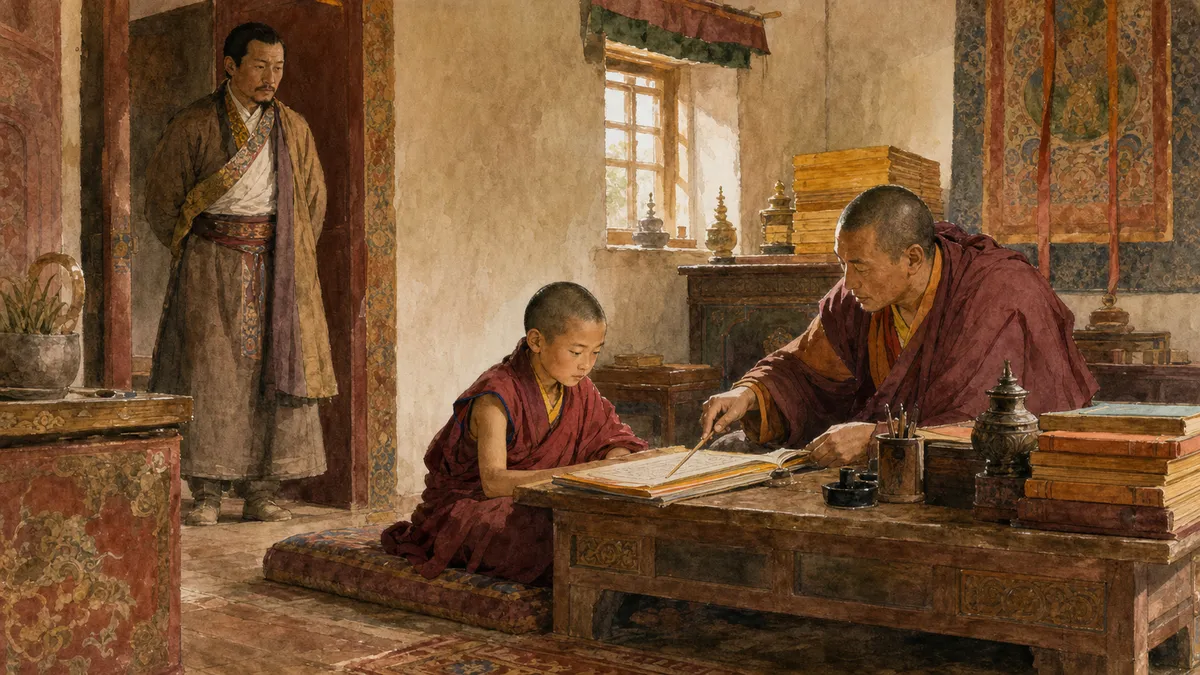
In the same way, each of us has such potential. This does not mean that only the chosen have it; perhaps in reincarnates and avatars it is expressed much more strongly, but qualitatively it is no different. We simply need to cultivate it within ourselves.
The Teaching is so precious and so great that you will attain everything if you do everything as it should be done. If you want to live in a palace, you will live in a palace; if you want to rule the heavens, you will rule the heavens; if you aspire to attain rebirth in a pure land, you will attain rebirth in a pure land; if you want to create a universe, you will create a universe; if you want to become Brahma, you will become Brahma. Provided, of course, that you actually practice and apply the teaching. It is only a matter of practice and effort. But for this, you must be ready to take responsibility for your spiritual life. Even a spiritual teacher cannot take responsibility for your spiritual life. Just as he cannot eat food for you, in the same way he cannot take responsibility for your spiritual life.
The Spiritual Warrior and Inner Sankalpa
Responsibility for spiritual life means a personal inner decision to purify and transform oneself. It happens that a person thinks he has taken responsibility upon himself. But time passes, and he sees that the measure of responsibility he has taken is insufficient, that a completely new level is needed.
If a person becomes angry, takes offense, sees impurely, then this is the result of the fact that the person simply has not taken responsibility. He is still a samsarin, an ordinary person, very tightly bound by his karmas. He is not even yet a spiritual warrior.
You cannot “fool a spiritual warrior with chaff.” Try to seduce, anger, entice, confuse, upset, or lower the mood of a spiritual warrior so easily. He has an inner core, an inner sankalpa. A spiritual warrior is an entirely different being. You can do anything you like with him, but you cannot change his spirit, his mood, his sankalpa. Rather, he himself will change yours. If you come into contact with a spiritual warrior, then be ready to encounter vira-bhava, and this vira-bhava is uncompromising, so you will have to respect it. You will say: “Yes, you cannot be shaken. You are a vira.” Why? Because the spiritual warrior has accepted responsibility; deep within himself he has made a decision. And this is not someone else’s decision, but his own decision, which he constantly remembers.

When you have made such a decision deep within yourself, then you are your own master. Other people and circumstances can no longer shake you. You yourself decide whether to be angry or not, whether to suffer or rejoice, whether to experience something or not to experience it. Others have absolutely nothing to do with it.
The Subjectivity of Perception and the Five-Part Formula
As long as a person has not accepted spiritual responsibility, other people, external circumstances, and so on are always to blame. That is, he always looks for the cause outside himself. But in reality, to depend on all of this and live in such a universe means not yet having taken true responsibility for one’s life. And there is a saying: “If you want to criticize someone, criticize yourself.”
In the five-part formula, the first link is to reduce everything to the mind. And to many it seems that this is some abstract philosophical formula. But it is a formula of life, which means that everything must be reduced to oneself, to the one who sees, who evaluates, who thinks.
There was once a classic of Marxism—Vladimir Lenin. In his writings, in one of the hundred volumes of his works, analyzing the political situation, he gave such upadesha: “When you see a certain political action, you must immediately ask the question: ‘Who is behind this? Who benefits from it?’”

In the same way, when you hear someone’s judgment or the judgment of your own mind, you must immediately ask yourself: “For whom is this so? Who is saying this?” And you will immediately see its subjectivism, because subjectivism is present in absolutely everything. In principle, there are no objective things; there is only subjectivism. What seems objective is simply a large mass of different subjective points of view, that is, it is still subjectivism. This is very clearly visible in certain large-scale processes.
For example, in worldly life people say: “America is a superpower that imposes its influence on other countries.” One may ask: “For whom is this so?” America does not think so; it thinks differently.
Or someone says: “Russia is such-and-such a country.” One may ask: “For whom is this so?” For Russians it is so, but for other beings it is not so at all. Everything is very subjective, very relative.
China believes that the Dalai Lama is not a good person, and therefore they do not want to negotiate with him. In China they are very displeased when the Dalai Lama is recognized anywhere in the world, while many living beings, on the contrary, consider the Dalai Lama to be an embodiment of Avalokiteshvara (a deity incarnated in a body).
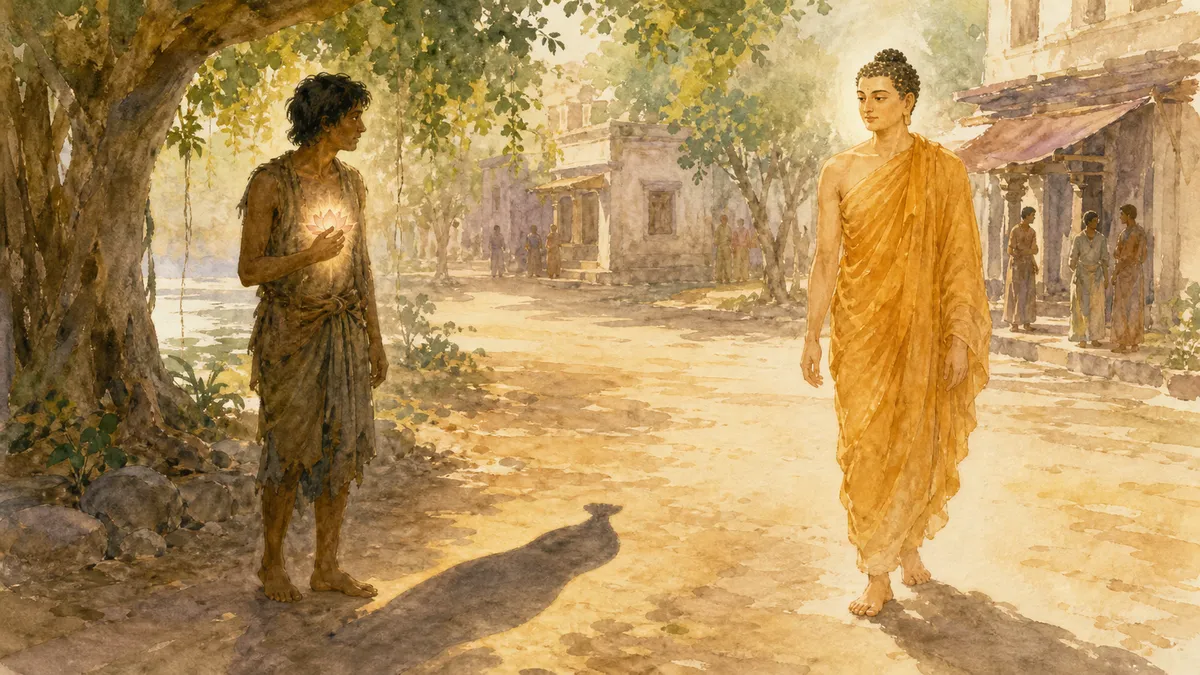
A thief, seeing the Buddha, regards him from the standpoint: “How could I best rob him?” And the Buddha, looking at the thief, sees in him a potential saint, someone who is on the path of becoming. That is, everything comes down to karmic vision, to one’s point of view.
And when we ask: “For whom?”, all these numerous points of view, age-old prejudices, national and cultural boundaries, frameworks, stereotypes, patterns, conventions—all of this begins to collapse. All of this no longer matters, because we discover the subject, we see the root. And the root is your own consciousness. For whom? For me, because there is no one else. And if it is for me, then this means that everything unfolds inward, and then any external problem turns into a question of contemplation, self-inquiry, self-liberation.
All our activities and difficulties in the external world are a consequence of our samskaras. When self-liberation does not occur at the level of samskaras, it moves to the physical level. If your self-liberation is so deep that all of this is resolved at the level of consciousness, at the level of the subtle body, then on the physical level there remains no karma that must be experienced; only games remain.
The Mechanism of Self-Liberation
“Constantly thinking, ‘I am confused, I have become angry,’ a person truly begins to get angry. Realizing, ‘I am not angry,’ he regains the lost equilibrium.”
The mind has the ability to engage in projection. Such projection occurs constantly; we can live without projecting. To live without projecting is precisely to abide in naked awareness. But the problem is that projection is a property of the mind. The samskaras residing in the subtle body strive to be embodied, to unfold. If we are not vigilant and do not track them, they inevitably manifest. And when this happens, it is called karmic activity. Living beings cannot but follow the law of karma. Certain periods of life arrive when samskaras simply push them toward particular thoughts, words, and actions.
But a yogin who has turned the mind inward and engages in inquiry sees how all of this happens; the entire mechanism is visible to him as if in the palm of his hand and is well understood. Then samskaras do not compel him to act and speak. He learns to “shoot down” these samskaras in midair with the help of discernment (viveka-vidya).
At the moment when a samskara is noticed, awareness separates from the samskara, consciousness does not leave pure awareness, and therefore the samskara becomes a “blank shot”: it comes out, but awareness has not identified with it, and it no longer causes harm. When this happens, the samskara is significantly weakened. If the samskara is not weakened, it excites vrittis (fluctuations of the mind), which begin to move the winds through the channels, and vibration begins in the corresponding chakra. This vibration changes the biochemistry and physiology of the body, giving rise to various vasanas (impulses) and prompting action. But if the samskara is noticed and pure consciousness has freed itself from it, it still passes through, but in a significantly weakened form. And when it gives rise to vrittis on the surface of the mind, these vrittis are extinguished because the greater part of the mind is nevertheless established in pure awareness, and pure awareness has a greater mass or greater gravitational weight than the samskara.
At an even higher level of self-liberation, a samskara is like a small asteroid that is drawn to a large planet. If a small asteroid in space enters the gravitational field of a large planet, it is captured by this field and, as a result, changes the trajectory of its movement. The gravity of the large planet attracts the asteroid, and the asteroid falls onto it, raising millions of tons of dust, and then comes to rest, that is, it no longer flies on. In the same way, pure consciousness attracts the samskara; the samskara as if “falls” into this consciousness, dissolves, and no longer generates any movements.
The Practice of Self-Liberation at the Level of Images
“When a dream is recognized as a dream, it can no longer deceive a person. Just as the subtle body becomes a dense material body because of repeated thoughts, so too can the reverse process be initiated by true knowledge.”

There is a practice that helps deepen self-liberation, when you train your discriminating wisdom by recognizing the subtlest samskaras that arise in consciousness. The essence of the practice is that you relax and allow the mind to move in any way it likes, to create any thoughts and judgments, to experience any perceptions. But at the moment when some initial vibration appears in the mind, your task is to stop and analyze it deeply.
For example, you are walking, and your gaze falls on the shower door. You may not yet have even verbalized or realized it in your mind, but a subtle desire has arisen in you: “Yes, it would be good to take a shower.” You do not let the mind develop this thought further, but instead try to investigate it more deeply and notice how the image of a certain desire has arisen in consciousness. And at the moment when you notice it with the help of discriminating wisdom, you separate this image from pure consciousness itself. And then this image is liberated.
Or you are walking, and something displeases you on a very subtle subconscious level. But if you quickly notice this and stop the mind, then you see the image that has already been created. Your task is to notice this image, distinguish it from pure consciousness, and separate it. And then this image disappears.
Such an ability for deep self-liberation at the level of images is a high level of nididhyasana. It is believed that it can be achieved only at the stage called the “iron chain,” not before. The “iron chain” stage means such absorption in natural awareness that you can penetrate to this level. Such a person is not attached to his own stereotype of thinking. His mind is very free, and therefore he can very easily change his state.
Transmutation of the Physical Body
Vasistha says: “Just as the subtle body becomes a dense material body because of repeated thoughts, so too can the reverse process be initiated by true knowledge.” These are very important words that express the essence of the esoteric practices of divine pride and the illusory body.
The higher stages of the sadhana of divine pride consist in uniting bhava with prana and the physical body, and in the transmutation of the physical body. Just as the subtle body, having condensed, became dense (physical), in the same way, as a result of the sadhana of the line of divine pride, the physical body becomes decondensed and turns into a subtle, immaterial body. Here six special sadhanas are performed. Three of them are called “the wind of bhava,” “the string of Narada,” and “the body of Datta.” Three other sadhanas are also performed, called “bhava,” “spanda,” and “shakti.” These are special methods of advanced contemplation that make it possible to unite the bhava of contemplative presence so deeply with the physical body and the pranas that the physical body changes the frequency of its vibration. This is the stage for attaining siddhi.

For example, by changing the frequency of vibration, such a physical body moves to the level of water, then to the level of fire, then to the level of wind. At the level of wind, one can levitate and pass through walls. When moving to the level of space, one can teleport and move about, and do so effortlessly, simply by the power of intention, since the qualities of the body’s vibration become different. These are practices of the laya-siddhi section.
