

Question: Guru, please shed light on the issues of practice in the world. Anava-marga (the development of the ego and personality), the formation of qualities necessary for further practices—how should one act if practice intensifies the very qualities that need to be overcome?
If practice intensifies qualities that need to be overcome, one must cultivate pratipaksha-bhavana (the opposite quality). For example, if anger intensifies in you, practice the four immeasurables and love. If lust intensifies in you, practice brahmacharya. You must nurture and cultivate an opposing force that will balance it. You need to seek what will balance it: a mantra for a particular aspect of the deity, a specific meditation. If you concentrate on the opposite, whatever is intensifying will become balanced. Basically, as protection against various such unbalanced qualities of personality and character, one should practice the four immeasurables and bhakti yoga, worship (upasana), and cultivate love and devotion.
Close Relationships and Spiritual Practice
Question: How should one practice in close relationships when negative karmas manifest?
In close relationships, you need to have enormous patience. If you do not have such patience, simply do not enter into close relationships. Enormous patience and the four immeasurables. Close relationships are the art of maintaining harmony, equilibrium, and balance when you come into contact with the energy of other people or another person. If you interact not through the four immeasurables, not through love, not through compassion, not through purity, but through the ego, and not through patience, but through your character, such close relationships will always bring problems and may even be destructive. In this case, close relationships should be made a little more distant. When the object of your relationship is farther away, there are fewer problems; increase the distance somewhat—not break off the relationship, but simply increase the distance—and you will feel better.
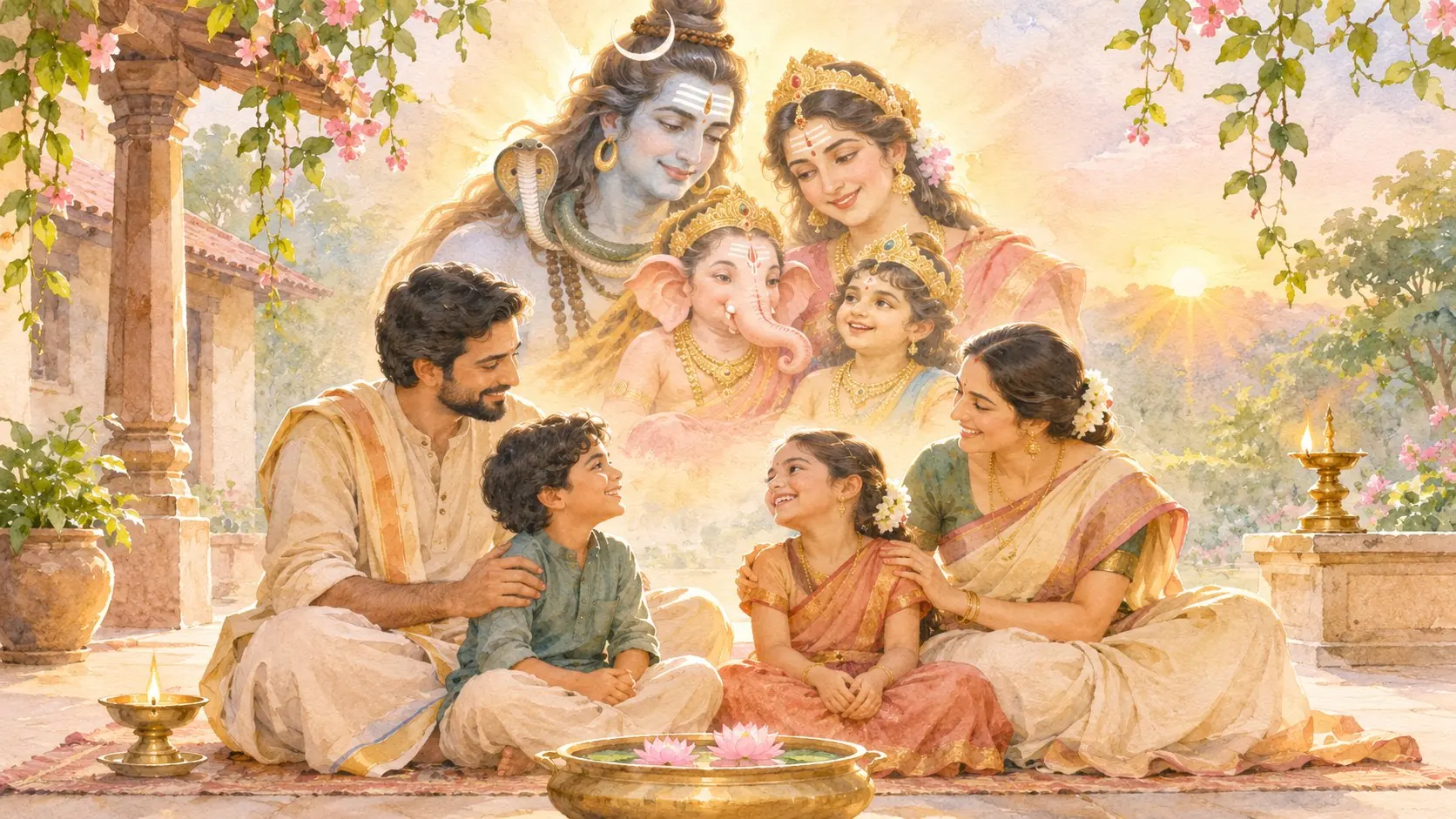
But if you are an ocean of patience, an ocean of love and compassion, then close relationships will not be a problem for you; they too will be harmonious. For this purpose, you can worship Dattatreya in the form of a family, that is, Dattatreya and Anasuya, or Shiva in the form of a family, with Shiva, Ganesha, Karttikeya, and Parvati. Worship such family and paired deities, who embody sthiti-shakti, the energy of harmony and sustenance. Pray to your ishta-devata (Dattatreya), to Shiva, asking for harmony in relationships, since all siddhas and deities are highly harmonious. Especially Lakshmi, Vishnu, Dattatreya, and Shiva with his family. The ascetic Shiva gives a different blessing, but Shiva together with Parvati and his family will grant you the blessing of such harmony; that is, perform pujas and recite stotras, addressing these deities.
An Individual Approach to Practice
Question: How can one determine one’s individual approach to practice, taking time, circumstances, and place into account, and how can one choose the most favorable balance between the spiritual and material?
Just as you choose food. You try one thing, it does not suit you; you try another, but sooner or later you know what suits you and how. This is impossible without trying. You can observe how more experienced sadhus live. Literally observe their way of life and daily routine—those who have a status similar to yours. That is, if you are a businessman, you need to find a businessman who is a karma-sannyasin, communicate with him, and see how he manages to practice and combine everything. In this sense, it is useless for a businessman to learn from a sannyasi—it will not work. A sannyasi can help, but in this regard you need to learn from a karma-sannyasin like yourself. Then, through experience, you should write out schedules for yourself and try them to see what suits you and what does not. There is no other way. There is a training program: nitya-sadhana, dina-sadhana, sahaja-sadhana—that is, constant practice. Practice according to a schedule, natural practice, and you must test all these levels in your life and experience them. Without testing them, it is impossible to know what suits you and how to create a schedule.
Eliminating Negative Impressions of the Mind
Question: What is the means of eliminating the poisonous flower of desires, which grows from the seeds of gross impressions on the stem of habits, from the bud of mental fluctuations, and which gives the fruit of action—the source of new seeds of impressions?
I will tell you briefly—just remain beyond thoughts. All these poisonous seeds, impressions, buds, and stems, if encouraged, grow very strongly. Look directly at the root of these thoughts, focus on the feeling of “I,” and remain without thoughts. Even if they want to sprout, they will not sprout. Learn to contemplate beyond the mind, and when thoughts bother you, shout: “Hum!”—but do not do this often, in public, for example, because it tears apart the hearts of minor spirits. Shout it inwardly specifically for your thoughts, so that they disperse, and remain in a free, pure, empty, transparent state of awareness.
Helping Parents in the Post-Mortem State
Question: Guruji, namaste. I watched the pre-New Year satsangs about the description of the soul in the bardo; thank you very much. According to the Vedas, it is believed that through their son, parents can be saved from post-mortem suffering. In this regard, what does the son need to do, and how can he help his parents on their final journey? Is it necessary to read a book containing texts—the Vedic or Tibetan Book of the Dead—or, in our region, is it sufficient to perform a traditional ritual with an Orthodox priest?
Of course, it is better for parents to practice and become independent of any rituals, developing their consciousness. In the Vedic tradition, a son was necessary in order to perform shraddha (memorial rites) for the souls of the ancestors, so that the souls of the ancestors could be reborn on earth. Moreover, in the same caste and gotra, reincarnation and the guarantee of receiving a physical body were thereby ensured. Brahmins performed the rituals, the son made offerings and paid for them—this was an entire cultural system that is difficult to reproduce in our reality. It is better to practice oneself, in order to be confident and not dependent on whether certain rituals are performed after death or not. Be confident in the nature of the Mind, confident in your deity, in your mantra, in awareness, and accumulate sufficient merit.
But if this is not the case, the son can read texts for his parents. Reading sacred texts throughout the entire forty-day period is always auspicious, as is distributing offerings (money, food, and things) in honor of deceased parents, with a sankalpa, visualization, and mentioning the name of the person for whom it is done—this always works and always helps. Reading sacred texts in front of a photograph, attuning oneself to the mental image, and dedicating the merit from reading the texts. There are important sacred texts, reading which in itself generates merit: when you read them, merit arises, and this merit—that is, the sattvic energy of grace—can be offered, transferred to someone to whom you wish to send it. This also helps spirits in the intermediate state.

The Nature of Energy and Consciousness
Question: Everything in the universe is energy. Is all energy—electrical, atomic, and so on—also thinking and intelligent like God, humans, and animals? Is all energy capable of thinking?
No, not all of it. Energy (prithvi) is an entire domain ranging from the earth element; thinking activity is so suppressed there that, compared with humans, animals, and deities, it is almost nonexistent. All solid stones and minerals think with such great difficulty that it is hard to detect their mental activity. The gross tattvas are inert; they do not recognize themselves as subjects. All this is called tamasic Prakriti. Rajasic Prakriti and sattvic Prakriti—yes, they are capable of thought. Nevertheless, even if stones and minerals lack such mental energy or a complex thinking apparatus (antahkarana), the essential consciousness of God is present within them.
Life’s Trials and Karma
Question: Is it necessary to undergo life’s trials, or can one attain perfection through practices and meditation?
Life’s trials are prescribed by destiny (karma). If your horoscope contains prescribed life trials, then regardless of whether you practice meditation or not, you will undergo them; prarabdha karma cannot be canceled. But through the power of tapas, these life trials can be purified: you can undergo them not on the physical plane but, for example, through dreams, or experience illnesses not through the physical body but through the subtle body. They cannot be canceled, but the way you experience them can be changed. However, if the power of your tapas is so great that you can purify all of this, then you will not have to undergo them.
But this is the case only if you can truly penetrate the subtle body through the power of samadhi and purify all vasanas and samskaras. Alternatively, your attitude may change, and what seemed like a trial will no longer be one. For example, according to your horoscope, Saturn enters your chart, and you are destined to lose your home, success, power, and wealth—this is a trial for a worldly person. But if you yourself are practicing at that time and Saturn arrives, you think: “I need to practice well in general. Will I become a monk or a hermit?”—and you lose your home, power, and wealth, but you are happy about it. You have simply changed your status, and you no longer need these things; your goals have changed. This means that your karma has caught up with you, but you have transformed your karma into merit; you have turned it into a spiritual path to liberation because, before that, you had done a great deal of work and prepared yourself for it.
The Names and Forms of God
Question: I am convinced that God is spirit, the transcendent, intelligent source of all sources. I accept what you say, Guru, but I am convinced that God has no name. How do you assess this category of people?
Our beliefs coincide. God has no name; he is beyond name and form. But this does not mean that he is forbidden to assume names and forms if he wishes, and since we humans are attached to names and forms, he also assumes names and forms. For example, he assumes the form of Shiva, the form of Dattatreya, the form of Saraswati, the form of Ganesha. That is why it is also said that he not only has no names and forms, but that he has an infinite number of names and an infinite number of forms. He has energy, and with the help of this energy, playfully responding to the minds of living beings, he can assume any form and any name; that is, he is not limited. There are no prohibitions imposed on him, as though someone once forbade him: “That’s it, you are not allowed to have either a name or a form—nothing.” No, he is svatantra; he acts as he wishes: “If I want, I have a form; if I want, I do not. If I want, I assume one, and if I do not, I do not.” But in essence, yes, in Advaita Vedanta he is Nirguna, Shiva, Brahman. He is the one who has neither name nor form.
Leo Tolstoy’s Teachings and Ahimsa
Question: Guru, what do you think about Leo Tolstoy’s philosophical and moral teaching of non-resistance to evil by violence? Does a utopian theory have the right to exist for society?
Leo Tolstoy read the Bhagavad Gita, and he was imbued with the spirit of ahimsa. He also read the Upanishads, I believe, and he even mentioned this somewhere. His theory of non-resistance to evil by violence is nothing other than ahimsa in Sanatana Dharma, so I view it positively. He simply did not have enough time to become a sadhu in depth. After all, toward the end of his life he had already embraced something like sannyasa: he began giving away his possessions, began living simply, dressing as the serfs dressed, and then left home altogether and traveled somewhere, eventually leaving his body at a railway station. Toward the end of his life, he renounced the world and even said: “All my novels are just worldly vanity, written to earn money. But the path that I preach as the path to God—this has value.” Therefore, Tolstoy truly was a great man, because within the environment of the corresponding culture surrounding him, he nevertheless managed to follow the spiritual path himself, even in defiance of secular society and the dominant religious culture. He simply did not reach the end; he did not have enough time.
Atma-vichara: Beginning the Practice
Question: Guru, please advise: can one begin practicing atma-vichara immediately, or does this practice require preparation? I would especially like to practice it while living in the world, within my usual way of life.
You can engage in Atma-vichara from the very beginning if you understand how to practice it and have a strong desire to do so. But you must be prepared for the fact that once you begin practicing Atma-vichara, you will have to practice it for the rest of your life; and having taken it up, you must be ready for it to change you and your attitude toward life. If you accept this as your responsibility, then you may begin. You must also diagnose yourself, understand who you are, and determine whether you possess the qualities of a pashu, vira-yogin, or divya-yogin, or whether you are a maha-pashu. If you are a maha-pashu, Atma-vichara is contraindicated for you, because a maha-pashu is someone who has strong desires and a bad character. But I think you are not a maha-pashu, but rather a dharmic pashu—a layperson who practices confidently—and from this point onward you may practice Atma-vichara. If you are a vira-yogin, then Atma-vichara is very favorable for you; and if you are a divya-yogin, then through Atma-vichara alone you will open the path and move toward liberation. In general, one can begin with Atma-vichara, but later you will come to the need to take Refuge and undertake additional practices, and it will set processes in motion within you through which all of this will naturally also come to you.
Protecting Atma-vichara from External Influences
Question: O venerable Guruji, I bow before you. Please answer the following questions. How can one prevent ripened karma, samskaras, and other external manifestations from encroaching upon the practice of Atma-vichara in worldly life?
If your Atma-vichara is strong and you are unconditionally and totally devoted, then the very process of self-remembrance and returning to Atma-vichara will not allow anything else to encroach upon it. For example, desires arise, distracting thoughts arise, and you must be very vigilant in order to intercept these thoughts and desires and return to the feeling of “I.” Someone has angered you, and the energy of anger is ready to burst forth, but at that moment you seize the initiative because you are awakened and possess vichara-spanda—investigative activity directed toward “I.” You do not release the energy of anger; instead, you seize the initiative and ask at that moment: “Who is angry?” At the moment of this question, the mind is reoriented toward the feeling of “I.” Then you investigate more deeply: “Who am I?”—something formless, something empty, something transparent, clearly aware, something open, something pure, something detached, something very profound. Thus, gradually, you grow into Atma-vichara.
When your train of thought has turned toward this, anger is no longer of interest to you; you have seized the power of anger and transformed it into the power of Atma-vichara. When this happens, it is said that the yogin possesses the technique of self-liberation. He can liberate himself from coarse energies, kleshas, and disruptive energies, and he must develop his mastery. But such self-liberation is often insufficient, so alternative methods (upayas) must also be applied. For example, bhakti-yoga: cultivate worship, devotion, and love for God. Recite the mantra “Om Namah Shivaya” and worship at the altar every day. Reinforce your Atma-vichara, saturate it with divya-bhava, divine purity and love, devotion, and faith.

Pray to the Refuge and to the saints; that is, perform tantric upasana practices—worship and purification. Observe the vows appropriate to your status: karma-sannyasi—eight, grihastha—six vows, and a monastic sannyasi—eleven. Periodically practice scheduled sessions. Learn nitya-sadhana: practice the obligatory nitya-sadhana three times a day, sandhya-upasana, that is, worship three times a day during sandhya. Recite the mantra “Om Namah Shivaya” daily, or, if you have received diksha, the five mantras that I have transmitted. All of this will support you on the path. Practice karma-yoga, learn to act without attachment, practice seva, service to God. The very awareness that I am serving not myself and my ego, but God, is a very powerful factor that turns one away from the energy of the ego toward Atma-vichara, because service does not contain the hopes, fears, and attachments that are present in worldly activity.
Service is like a game, and in a game it is easy to contemplate. Practice bhajans at the altar. All this will nourish your atma-vichara; we will help protect and preserve it. Atma-vichara is like a very weak, tender sprout; it must first be grown in greenhouse conditions, like a good gardener would, so that it can grow. At the beginning, you must create such a greenhouse atmosphere. When atma-vichara has taken root and become a strong tree, the greenhouse atmosphere is no longer needed; you can even expose it to the winds of karma, test it in certain places. For example, go to the market’s meat section and practice walking—chan kramanam—in contemplation, and you will not lose awareness; both the market and the meat section will be transformed into a palace of the deity, and you will feel as though you have visited a temple, filled with reverence, while your atma-vichara will deepen. But until it has become such a mighty tree, protect it by every available means; come to the ashram and spend at least one week there each year. Look for ways to establish your practice so that you have your own separate place and separate time for daily practice; follow a routine in your practice and keep a practice journal. In general, create the lifestyle of a sadhu.
Question: Can Brahman evolve or develop beyond the human, non-conceptual plane? Are there limits to infinite consciousness, limits to perfection?
On the Limits of Brahman and the Evolution of Consciousness
Question: Can Brahman evolve or develop beyond the human, non-conceptual plane? Are there limits to infinite consciousness, limits to perfection?
There are no limits. The very concept of a limit is human, and it is connected with karmic limitations. There are no limits for Brahman, because it is beyond even the concepts of limits—it is inconceivable. When we speak of development, we are not speaking of Brahman. It is incorrect to speak of development or becoming and to use the concept of “Brahman.” Brahman is not something that develops; it is not something that becomes, nor something that evolves from one point to another. It is boundless being itself, always complete, perfect, and homogeneous, in which it is impossible not only to evolve, but even to evaluate or to be that which has defined itself as evolving. It is this inconceivable, integral being as such, but it has energy.
If Brahman is Shiva (prakasha), then the energies are Shakti (vimarsha), and energy can evolve, manifest, and express itself. When Brahman manifests as energy, it becomes Ishvara, the creator, preserver, and destroyer God. It becomes that Shiva who performs the panchakritya (the fivefold act)—creation, preservation, destruction, concealment, and so on. Here we can speak of becoming, of the unfolding of the universe, and of its evolution. Here we can speak of hierarchy, levels of attainment, and cycles of creation. All this is physical reality, subtle reality, and here all of it is possible.
The Importance of Spiritual Support and Shiva’s Family
Question: Om. I meditate a lot on my own. I have dreams in which something is shown to me about this world, as it seems to us, where there is pain and everything that surrounds us. Once I was shown that everything must be overcome in order to be liberated. Of course, it is very difficult for me to do everything by myself.
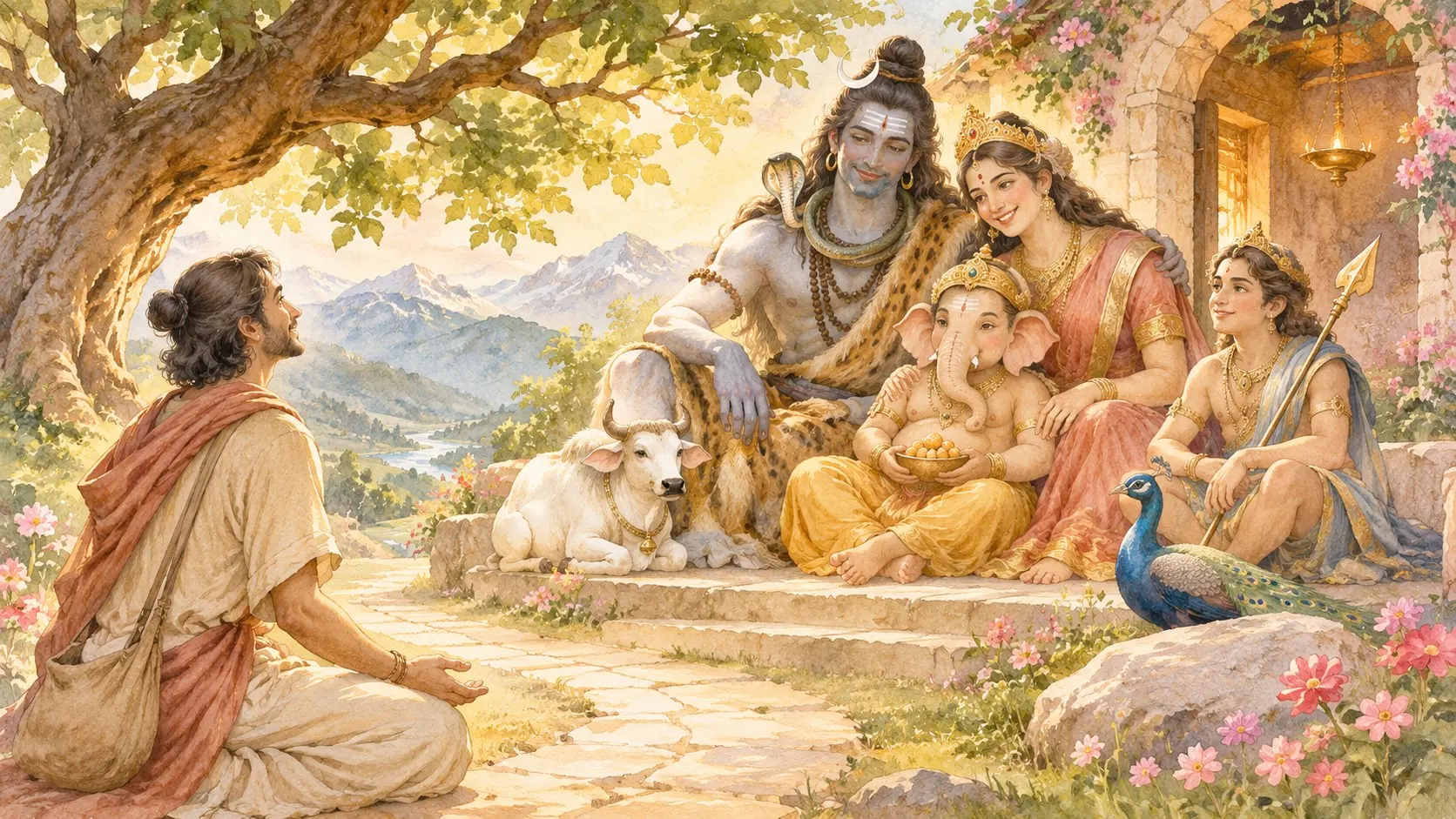
Then do not do it alone. Enter Shiva’s family. Shiva says: “Leave your gotra”—that is, the human clan—“and enter my family.” Do it together with God and begin with Refuge, with invoking the saints of the Refuge Tree, and with the daily mantra “Om Namah Shivaya.” Then there will always be support. The soul needs support. This is not support in the form of words of consolation, but support in the form of methods of teaching and, above all, grace, sattvic strength, strength, and wisdom.
Secret Methods for Working with Emptiness
Question: I can easily feel emptiness. It is not necessary for me to meditate for this, but I understand that this is far from awareness. How can I look beyond emptiness?
Secret methods are needed. That is precisely why ancient traditions exist, possessing a very powerful toolkit for intensifying this emptiness. Emptiness comes in different forms: there is emptiness experienced while awake, emptiness experienced in dreams, and emptiness experienced in dreamless sleep. But in order to break through to the true, deepest forms of emptiness and the nonduality of clear light, one must practice the teachings of tantra, the teachings of anuttara tantra—the entire complex they entail—in order to make a profound breakthrough. In other words, one must go through a process, an algorithm; then it becomes possible. The ancient traditions of the transmission line have their own know-how, their own methods (upayas in Sanskrit). They are extremely subtle; it is even difficult to imagine how sophisticated and subtle the work with the winds and inner visions is, or the revelation of clear light—you simply have to go through these practices. You must receive transmission and initiation into them and practice them; in other words, you must enter this culture, immerse yourself in it completely, and become a sadhu.
It is like this: if you aspire to become an Olympic champion and feel that you have already outgrown the level of a neighborhood team, then you need to go to a sports training center where Olympic champions train, buy a new tracksuit, approach a coach, adopt a champion’s regimen of nutrition, schedule, and lifestyle, and train under new conditions, in a new group, at higher speeds.
When I was a child, I played football in the neighborhood, and I liked football. Then I thought, “Why not play more and join some team?”—and a friend of mine played on one. I thought I would manage there too. It was called the “Victoria” team, but it turned out to be the city’s 1967 team, my year of birth.

I approached the coach and said that I played football and could play for them. He said, “All right,” and the morning warm-up began; I came to the training session. “Come to practice; here’s a tracksuit.” When the training began with a warm-up and they so effortlessly ran about ten kilometers, I realized that I had overestimated my neighborhood abilities. After ten kilometers, I was already completely exhausted, so to speak, while for them it was only the warm-up, the beginning. Then they began practicing shots, working with the ball, passing, combinations, and so on, and I changed my attitude. This was the city team—professionals, albeit children; children, but professionals who surpassed my expectations. I began wondering whether I needed football at all. One must make a choice: if you want to immerse yourself in something, you must truly immerse yourself, make a choice, and move to a professional level—this applies here as well. A new level of self-discipline is required; then everything will unfold. Immersion, tapasya, and devoting attention to practice reveal everything we want to reveal.
Choosing a Spiritual Tradition and Signs
Question: Guru, please tell me, how can I understand whether I should follow this particular tradition rather than another?
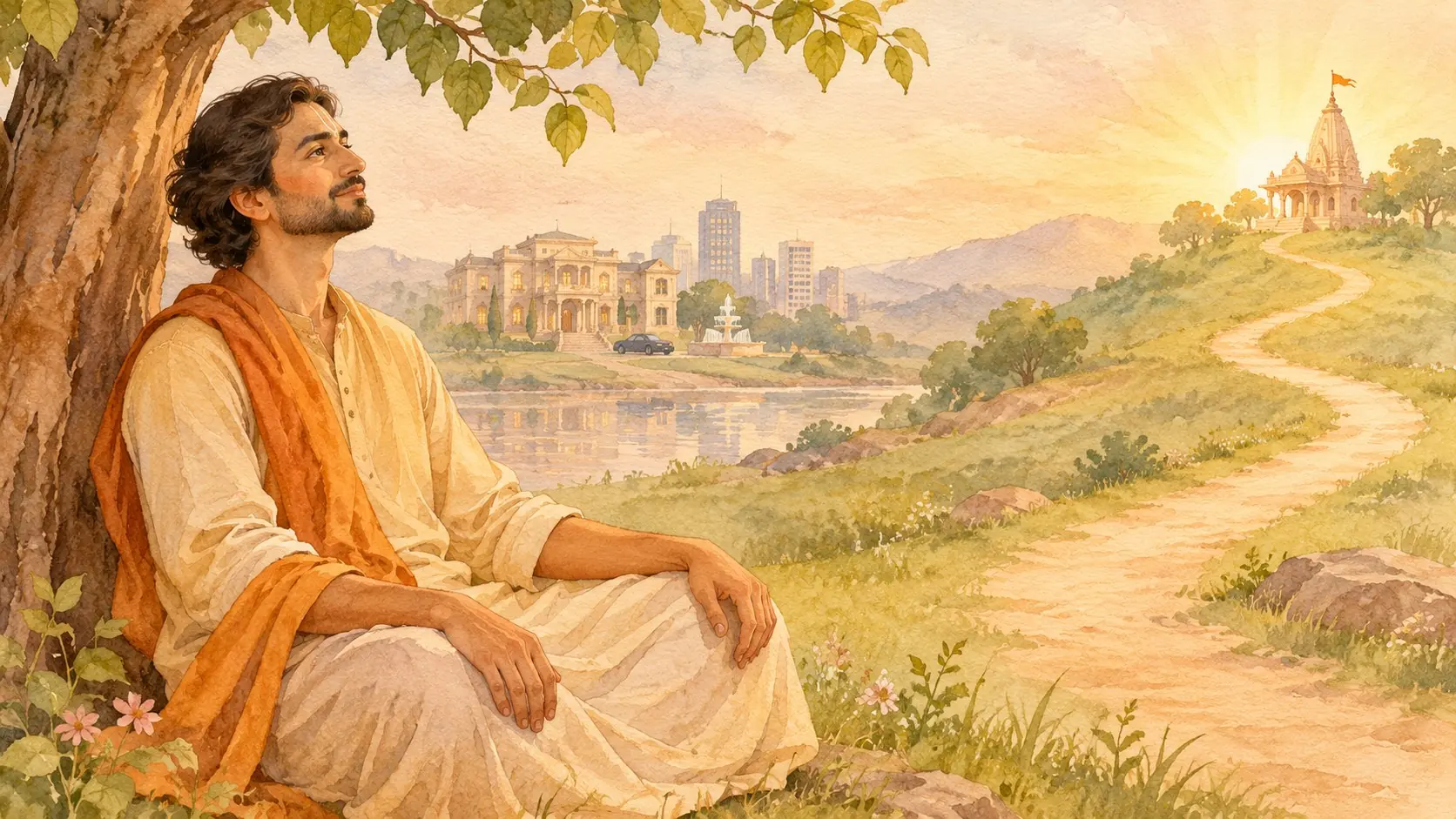
If you have a chosen deity, Shiva or Dattatreya, pray to him and make an offering during the day, and then before going to bed when the moon is waxing. If it is Shiva, do this on Monday; if Dattatreya, on Thursday or Wednesday. Recite his mantra, make an offering on the altar, recite his mantra, and repeat the prayer before going to bed; then, at night, once you fall asleep, watch for signs and remain attentive. If favorable signs appear—for example, you are ascending, or you see a clear sky, the sun, and the moon, or you are washing yourself in the shower, or you find some beautiful object—there can be various signs—it means that your choice is correct. But there is another way: study the texts, train your understanding of Dharma, and understanding will come from within on its own; ask your heart, and it will guide you.
Reasons for the Soul’s Incarnation
Question: Why does the soul come here from there to undergo these trials, all these sufferings and searches? It is good there, isn’t it?
Only souls who consciously come from a place where it is good are those who control their reincarnation and have an evolutionary or life purpose. They need to undergo certain earthly trials in order to raise their spiritual level. They consult with their spiritual teachers, and the spiritual teachers recommend a gross incarnation to them so that they may develop the qualities they lack. But these are souls that have not attained complete holiness yet, although they aspire to it, and in this life they are born consciously with a specific mission.
Another type of soul is born due to attachment. Although it may be good in the heavenly worlds, the power of attachment and the tendencies of consciousness compel them to be born. They are born practically not of their own will, but by the will of karma; they are ordered to be born. By whom are they ordered? By deities, by the influences of karma. The inner deities issuing this order possess irresistible power—this is karma that draws them in, and they are born not of their own will, but according to this command of karma. They can do nothing; they are drawn to the place of their new birth.
There are also souls that have not been in the heavenly dimensions; they did not fare well as spirits in the subtle world and suffered. For example, souls from hellish worlds, souls of pretas and animals—and for them, being born in the physical world is happiness, it is a blessing. One might say that they simply escaped, fled from the lower worlds into the human world. In this human world, at least there is no intense suffering, and the senses can be satisfied.
Success in Society and Spiritual Development
Question: Guru, please tell me. I meet people who are successful in society and consciously spiritual, aware of their true “Self,” and who know their soul’s plan for life. Is success in society a lesson that one must go through?
Success in society indicates the presence of karma, merits, the karma of society, and merits in relation to society—it is simply karma that must be lived through. As long as this karma remains, liberation is impossible. Liberation becomes possible when the soul detaches itself from what it is experiencing, when it does not strive for or seek anything except God, when it is devoted only to God. It serves only God, and everything that happens still happens, but there is neither attachment to it nor a desire to receive its fruits and results.
One who truly realizes oneself does not strive for success in society. But sometimes this success simply comes to them; this happens, though rarely. If they cultivate detachment, this success will dry up; they will stop seeking success in the human world and begin seeking God. But if they become attached to this success, it may become their karma for the next incarnation. Everything depends on the soul’s choice. It is impossible to avoid prarabdha karma, but one can change one’s attitude toward it, and we become sadhus and jnanis when we change our attitude toward karma, cultivating awareness, vairagya, and contemplation.
Untying the Granthis and Practice
Question: Guru, how long does it take to untie the granthis? I am especially interested in the Rudra knot. The back of my head, around the first vertebra, and the area between my eyebrows have been hurting for almost a year.
It is individual for each person. If you practice anuloma viloma, pranayama, sahita kumbhaka pranayama, and Chandali Yoga, you can untie this knot in six months or three months. But sometimes conflicting thoughts and obstacles prolong the process, and it may stretch out over thirty years—this is individual.
The Nature of the “Self” and the Two Truths
Question: Who am I—God or a particle of God?
At present, you are a particle of God, because you are asking a question—a question signifies the desire to understand, the desire to know. This desire arises from the acknowledgement of the facts that there is no understanding and no knowledge, and this is ignorance, which is inherent in every soul. Ignorance is inherent in the soul, but even while being in ignorance, the soul is a particle of God; therefore, at this point in your identity, you are a particle of God. But the question is that identity changes through practice. Perhaps you will change your identity when you surrender your soul to God and realize yourself differently: that God and I are one. But for this, the soul must dissolve into Shiva.
And then this question: who are the other people? The Atman or particles of God?
The other people are the Atman, but at the level of their identities and your relationships, they are also particles of God at the same time. In terms of vision—they are the Atman; on the relative level—they are particles of God. We must always bear in mind that we do not live in a mono-reality, but in a dual reality, a binary reality, in which there are both vision and behavior, with a layer of our contemplation between them. We must always bear in mind that there is absolute truth and relative truth. There is neither only absolute truth nor only relative truth—they always go together, like left and right, up and down, and you cannot separate one from the other.
Taking absolute and relative truth into account—this is called samvritti-satya and paramartha-satya—two truths in one—this is wisdom, which is why the answers are as they are. It depends on the perspective from which we answer: from the standpoint of absolute truth—Atman, and from the relative standpoint—a human being, a spark of God. That is why the saints say: “Even if your mind is like that of a Buddha, behave like an ordinary person,” or: “Let your mind be boundless like the sky, but let your conduct be as meticulous as sifted flour.” We must always take this duality into account.
The last part of the question: Am I alone everywhere and in all places, or am I one among many?
In your view, you are everywhere and in all places; in your behavior, you are one among many.
Purification from Negative Karma
Question: Hello. How can one purify negative karma?
Begin upasana, worship of God. If you recite the mantra “Om Namah Shivaya” every day, at least one round, then two or three rounds, five rounds, apply sacred ash to your forehead, and sing bhajans—this is already the beginning of purification. Begin meditating on the Four Immeasurables every day for at least five minutes, then fifteen—this is already purification. Gradually begin practicing karma yoga, doing something for God, for Dharma, for sadhus—your karma in the physical world will begin to be purified.

Purification is a highly multifaceted process taking place on different levels, but one has to begin with something concrete. Do not begin with meditation; meditation without concentration skills will not purify you. Begin with worship, with mantra, with karma yoga.
Caring for Future Lives
Question: Gurudji, please tell me, why should we worry about future lives if we do not remember our past lives?
We need to be concerned about them because the mind does not remember, but the soul remembers, and consciousness remembers. In other words, you would not want to be born as a dog—you specifically would not remember that you had been a human in the past, but the soul would retain awareness and consciousness, and the dog’s suffering would be accessible to you. You specifically would not remember your past lives, but you would experience everything related to the dog’s fate and all its insecurity, suffering and depression, anger, and canine problems. But I wish for you to be born not as a dog, but as a deity or a human being; I gave that example merely for illustration.
We need to care about our future lives because if we do not take care to purify our karma, karma will take care of us. This is not a controllable process, but it is better to manage it. It is the same as asking why we should receive treatment and why we should care for our health. We need to care for our health because if we do not, illness will take care of us. Even though we forget our past lives, the soul remembers everything, and we reap everything; self-awareness, our identity with the soul and with the “I,” remains, and it feels and perceives everything—both suffering and everything else. If we strive for happiness, we need to care.
On Vegetarianism and Contentment
Question about vegetarianism: Thank you. There are lapses in my diet, which leads to self-reproach. I am aware of this, observe it, and try not to scold myself, but I still feel dissatisfied with myself. I do not want to proceed through violence in relation to food, but I cannot eat as I used to either, and all of this is happening at the same time. I would be grateful for your advice.
Learn satisfaction and contentment with the food you have. It is impossible to control either your diet, your energy, or your physical body when you are dissatisfied with yourself. Internally, do not be overly obsessed with food. Vegetarianism is good, but it should not be overestimated. Ultimately, the mind should be directed toward God. The mind should still be directed toward devotion, love, and ananda (divine bliss), toward peace and tranquility. It is from these states that control over one’s diet becomes possible. But dissatisfaction makes it difficult to control one’s diet. As the classics say: “Do not turn food into a cult.”
Forgetfulness of Past Lives and the Evolution of the Soul
Continuation of the question: Why did God not give us the ability to remember our past lives?
Upon incarnation, the soul remembers past lives only in intermediate states; in Tibetan they are called bardo, and in Sanskrit antirbhava, that is, when the soul is a spirit. But when it enters the womb—and not only in the human world, but in another world as well—it still remembers in the mother’s womb, but gradually forgetfulness begins: it acquires flesh, blood, a brain, neural structures, and the subtle body becomes obscured. When it is born, a special type of prana—Vaishnava prana—begins to operate, and this type of prana simply erases memory.

This is necessary so that the soul may have a period of childhood purity and innocence, a period of God, so that its vasanas and samskaras do not burden it with the past, and so that it may be given a chance to make a new choice in life. Because if it remembered everything, evolution would not be possible; it would immediately act according to old patterns.
As we know, patterns do not manifest immediately; they do manifest, but slowly, so there is an opportunity to change something, to make a choice, and therefore evolution is possible. If a person remembers, for example, that in the past they were some influential magnate who desired business, money, women, and power—that was their credo—and then they are born again and remember: money, women and power, business—and what kind of evolution is there, where is the choice? The soul has no chance, and this is precisely why Vaishnava prana operates: for a while it freezes the activity of vasanas and samskaras, memory weakens, and it gives the opportunity to choose to do something differently, to activate other tendencies within oneself.
On the Nature of Faith and the Beginning of Practice
Question: Namaste, Guruji. Could you please explain how one should deal with faith? On the one hand, faith is accepting that which lies beyond your immediate perception, but how can one accept and believe if everything within resists and demands factual confirmation and experience? Thank you. Om.
Ask for faith; ask for an understanding of faith. Faith is a mystical thing; it must be felt. But in order to feel it, you must begin, and in order to begin, you must believe. A vicious circle. Simply begin your practice as if you believed, as if you had faith, and in the course of this practice faith may awaken if your intention is sincere. Sincere intention is necessary.
You can begin practicing even without faith, but with sincere intention. In this case, your sankalpa, iccha-shakti, your will, your sincere intention—this is the only thing you can believe in, so believe for now in your will and in your sincere intention.
Begin with something you can believe in without doubt—in yourself, in your intention, in your sincere search. Your sincere search will open the depths of faith, true faith, and faith in God, so that nothing resists. Find something you can believe in without your soul resisting.
For example, some people believe in themselves—which means they must rely on their reason and their understanding. Some people believe in the shastras, in scriptures, in philosophical texts—which means relying on philosophical texts. Some people believe in the Guru’s instructions—relying on the Guru’s instructions. Some people believe in creative intuition—you can rely on that. But you have to begin somewhere, and then true faith will awaken. Some people believe in deities in temples, exclusively in them. You begin somewhere, and then faith will awaken. Some believe in the saints of the lineage. Begin with what you believe in now. Some people believe in their success, in their lucky star—in anything at all—but you believe in it.

On the Nature of Energy and Matter
Question: How can energy turn into matter—is it the same thing?
Energy turns into matter through a process of becoming coarser, and this path is described in the teaching of the thirty-six tattvas. Energy in itself is the principle of Shakti. Shiva is the first tattva, and Shakti is the second tattva. As the universe unfolds, energy becomes denser and denser; the fourth tattva, the fifth tattva, the sixth, and so on emerge. At a certain stage, energy becomes dense and condenses. This process is called the densification of the tattvas.
It is described in the texts of Shri Shankaracharya and is called “Pancha-karana”: how the gross five elements come into being, how they arise from energy, and how energy arises from consciousness. Study this question—it is such a profound question. There is a text by Shri Shankaracharya called “Tattva-bodha,” and if you study this text and the principle of pancha-karana, how the dense elements and the thirty-six tattvas arise, some things will become clear. It is difficult to answer such questions briefly within the framework of answering questions—they are complex metaphysical questions.
Question: How can energy be intelligent?
Within energy, within any matter, there is pure consciousness, there is luminous emptiness. This is Lord Shiva, pervading everything. Shiva, who pervades everything, is called vyapakatva. He is also sarvajnatva (all-pervading). After all, energy does not exist by itself—it is a kind of crust on Shiva’s body. In fact, it is Shiva’s body, and Shiva is supreme intelligence; naturally, energy is intelligent because at its foundation lies luminous shunya, the luminous pure consciousness of Shiva. Since Shiva is intelligent, energy can also be intelligent. It is directed by Shiva, divinized and illumined by Him. Energy is unintelligent in itself, but it is intelligent as that which is filled by Lord Shiva, and Lord Shiva is luminous, pure, divine consciousness.
On Material Well-Being and Spiritual Practice
Question: Greetings, Gurudev. Please tell us what practices should be performed, by whom and how, in order to acquire the material shakti needed to visit Kailasa?
On Fridays, during the waxing moon, recite the Lakshmi-stotra, perform Lakshmi-puja, and chant the hymn to Lakshmi, “Indra uvacha.” Every Friday, make a good offering on the altar before the murti of Lakshmi. On Mondays, offer worship to Shiva; since this concerns Kailasa, also perform Shiva-puja, recite the Shiva-stotra, and chant mantras to Shiva. Specifically for Shiva, you should choose the name that corresponds to acquiring material benefits and wealth, for example, “Om Shrim Vardanaya Namaha” (To the One Who Bestows Prosperity). You can also choose other names from the Shiva-sahasranama-stotra.
On Taking on the Suffering of Others
Question: Gurujī, please tell me, if one takes other people’s suffering upon oneself, is it possible to attain liberation?
If you know how to remain in contemplation and how to transform suffering into bliss, then yes. But if you are not confident in contemplation and do not understand how suffering is transformed into pure bliss, then you should not rush to do this. The point is that suffering can be transformed—it is energy, and suffering can be turned into nectar. But you must be certain that you can turn the suffering of others into nectar.
The attitude itself is unselfish in one’s view—that is good; being unselfish in one’s view at the inner level and wishing to help others is very good, and that is how it should be. But at the relative level, you still need to understand what equilibrium, the balance of energy, and samyoga are, and understand which suffering you can take on beneficially and which you cannot. Do not take on what you are unable to handle, so as not to bring problems upon yourself.
But if the suffering is minor, you can take it on; it may be beneficial for you and serve as an anti-ego practice. A yogin usually takes on small amounts of suffering at first; if he remains balanced, grows wiser through this, and matures, he then gradually expands the amount of other people’s suffering he can take on. Suffering is prana, the energy of the subtle body—tamasik, rajasik prana. By interacting with tamasik and rajasik prana from a state of natural awareness, one can cultivate the power of this natural awareness, but it must be done in balance.

On Nirvana and the Further Path
Question: Peace and understanding came, and I experienced nirvana through the Buddha. Sometimes, during meditation, you enter such a level that it is difficult to return to the body. What next? Whatever I wish for comes true, but I have no desires.
There are desires, but they are not gross; they are subtle. For example, this very question, “what next?” also indicates that there is a desire to know what comes next. You need to become aware of the subtle layer of desires—that is the first thing. Second, even if you have experienced nirvana in meditation, you should understand that the practice of liberation truly begins when you experience the state of nirvana in jagrat (waking consciousness) in everyday life as contemplative presence and can unite it with life. You need either to become a hermit or a sadhu.
There are processes, and if we are to speak about what comes next—study the teaching of the seven lands of wisdom and the teaching of the sixteen stages of contemplation. The teaching of the seven lands of wisdom is set forth in the Yoga Vasistha. The first land of wisdom is the desire for enlightenment (shubheccha). The second is investigation (vicharana). The third is the refined mind (tanumanasa). The fourth land is called self-realization, sattvapatti. At each of the levels, we realize one layer of consciousness or another. The fifth land is non-attachment (asamsakti). The sixth land is non-perception of objects (padartha-bhavana). Finally, the seventh is called turyaga (transcendence), and we ascend through the seven lands of wisdom.
First, you need to find a knowledgeable spiritual Teacher and determine what level you are at; that is, your experiences must necessarily be confirmed. Is this true nirvana, false nirvana, not nirvana at all, or genuinely true nirvana—you need to sort this out. When you receive confirmation, the spiritual Teacher will say, for example: “You are at the third land of wisdom, while there is a fourth land and a fifth, and your path ahead is to move through these lands,” or they will say: “You are at the stage of transmission, or meeting with the light, and your next stage is, for example, conception or gestation.”

We must establish some scale of values and clearly understand our step on this hierarchical ladder of the growth of awareness. There are infinitely many steps on the spiritual path, and in one lifetime we pass through only a few. We simply need to see this ladder and scale and understand which step we are on. Then it will be clear what comes next.
Study the teaching of the thirty-six tattvas and determine approximately which tattva you are at, and at which tattvas enlightened living beings reside. For example, the buddhi-tattva or even the Purusha-tattva are very high tattvas, as is the ahamkara-tattva. What comes next means that you need to realize the next tattva. The next tattva by number is your next path; therefore, there are the seven lands of wisdom, the thirty-six tattvas, and the sixteen stages of contemplation. All of this is a kind of ladder by which we determine our level. But do not evaluate yourself; find a master to evaluate you, because self-assessment is not always accurate.
On Family Life and True Fulfillment
Question: Hello. Please tell me, if there is contentment with one’s life, but watching children brings joy and delight, does this mean that one should start a family and work through one’s samskaras?
Analyze yourself and how long this contentment will last. If it is true contentment arising from the depths of enlightenment, you are free to do whatever you want: start a family or do something else, play at power, fame, or wealth, become a king like King Janaka—it is not essential. The question is not what to do; the question is who to be, and who to be means what consciousness to abide in, in what state of awareness.
But if this contentment is destructible—for example, if it is absent in dreams with dream imagery, if it depends on many factors—then the value of such contentment lasts exactly as long as it takes for malefic planets in the horoscope to become active, or for the situation to get out of control, or for the mind to change direction, or for you to remain living in this world.
You must seek true contentment that is not connected with the material, that is based on enlightenment, God, and liberation. In general, attachment to worldly joy, bliss, and contentment is a path in the next life to the heavens of worldly gods. Attachment to subtle contemplative clarity is a path to the heavens of spiritual gods, while attachment to formless clarity is a path to the worlds of formless gods. These three realms correspond to our three types of attachment—to bliss, clarity, and emptiness. According to the extent of your being captivated by them, you can determine where the soul is headed, which world it is oriented toward. But there is also attachment to negative states—this tendency is a path to the lower worlds.
On Life in the World and Secret Practice
Question: How can one continue living in the world and behave like an ordinary person while practicing these methods and following the retreat rule?
You need to become a secret yogi, learn flexible conduct, the art of play. A yogi has outer, inner, secret, and transcendent levels. There is even a saying in the Kularnava Tantra, I believe, or in the Maha Nirvana Tantra: “Outwardly a Shaiva, inwardly a Shakta, and in assemblies behaving like a Vaishnava”—that is, a sadhu is an ambiguous personality.
You need to understand what I present outwardly as my social face, as my image, if you live in the world; what I practice inwardly as a practitioner; what constitutes the secret of God in my heart; and what is transcendent for me. These are the four levels of your life. You need to practice sadhana in the world, but not display it too much.
Set up an altar so that you have a place for meditation, communicate with other sadhus, write out a daily routine, practice the methods every day, observe the precepts, and receive diksha. This is your life as a sadhu—your inner level; while on the outer level, work and fulfill your duties without becoming attached to them. This is your outer life; on the secret level, abide as the nondual space of consciousness united with Shiva (“Shivoham”); and on the transcendent level, explore it, study what God is and what Brahman is, and move deeper. Thus, develop these four levels.
A sadhu must be flexible, fluid, and adapted to any environment, free from identification and detached from the world and worldly energy, but not rejecting them—instead, acting within them in accordance with his status.
On Pilgrimage and Mantra Practice
Question: Om. How does the pilgrim’s path, Kailash, the Kora, as well as pilgrimage to such sacred places as Kedarnath, Badrinath, and so on, influence spiritual realization?
It is very auspicious, especially Kailash. Creating good samskaras, purifying old negative samskaras, and generating sankalpas at Kailash change one’s destiny. If at Kailash you perform a simple ritual, recite a mantra, and generate a sankalpa (intention) to change something in your life for the better, this is auspicious for your destiny.
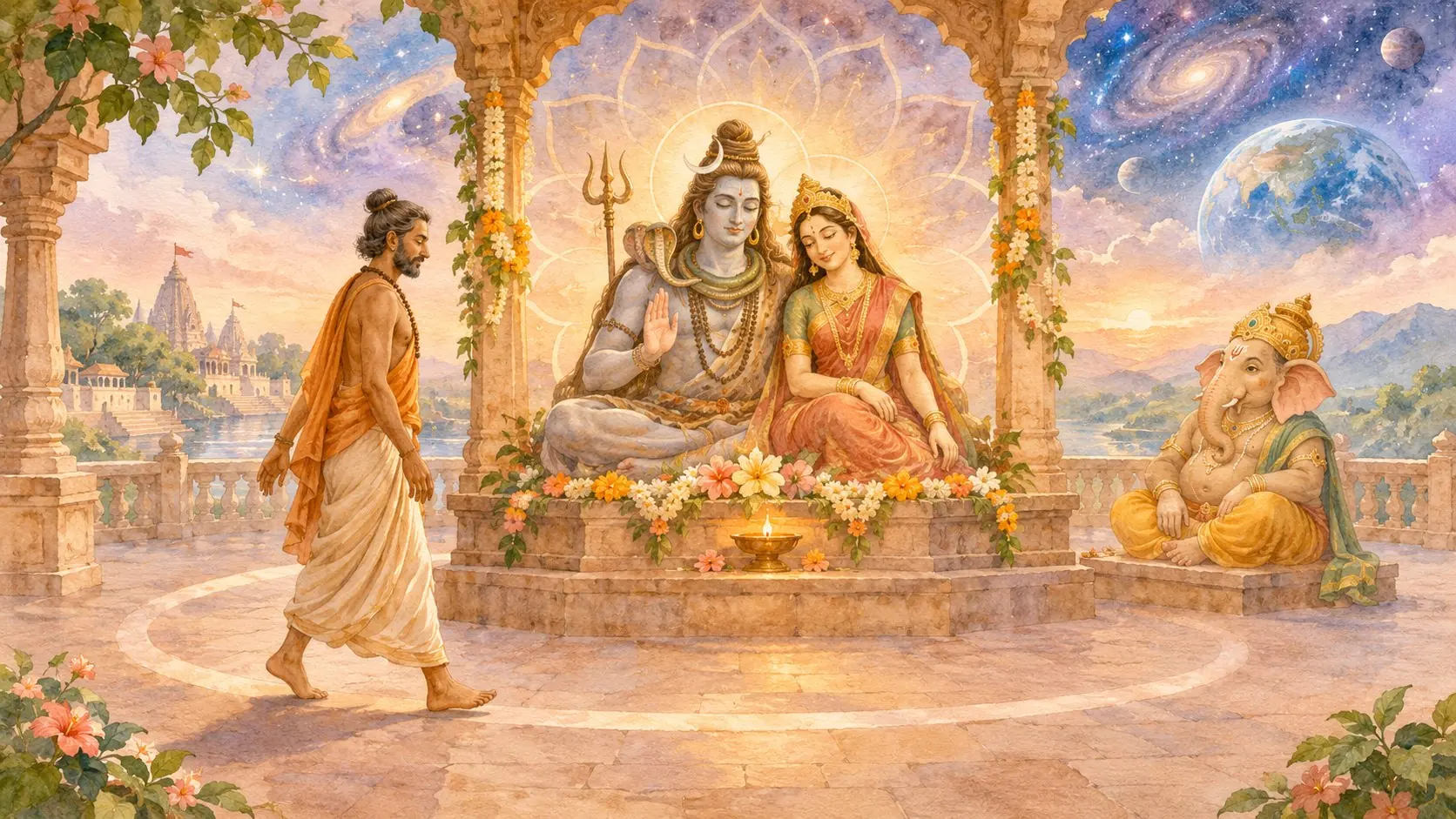
If you are a master of nondual contemplation, then the entire pilgrimage is internal. You are like Ganesha, who circled around Shiva and thereby circled the entire universe, saying: “You are my parents, therefore you are God. Shiva is the supreme God”—so why fly around the universe when it is enough to circle Shiva and Parvati: “I will circle the entire universe.” But if you do not see it this way, then of course you should undertake a pilgrimage; it is very auspicious.
Question: I lack concentration and attention when repeating mantras. How can I overcome the constant wandering of the mind? Also, late in the evening I repeat them more calmly than in the morning, when the mind is occupied with worldly affairs.
Repeat the mantra while moving, as you walk.
On Forgiveness and Karma
Question: Namaste. When we forgive someone, do we take on another person’s karma?
If you are in an exalted, pure state—no.
On the Multidimensionality of Experience and Purpose
Question: Is it true that we experience things simultaneously in many worlds, and that through us the Creator comes to know itself—the joy of knowing?
In general, yes, that is true, as long as we identify ourselves with the soul that is reborn and gains experience. When the mechanism of identification dissolves, there are neither rebirths nor other worlds. Everything is one consciousness. Thus, everything depends on which point of view you adopt—the relative or the absolute. From the relative perspective, you are a soul wandering through worlds. From the absolute perspective, you are Shiva himself, Brahman, the one luminous, nondual consciousness. Both points of view are valid, but the absolute is deeper.
Question: Hello. Does a human being have a purpose?
Of course. Ishvara nurtures us, placing us in different bodies and different worlds like seedlings—potential seedlings of future creator-gods, new creators—and we are such seedlings of Ishvara. He will place us in different settings until we fully reveal our potential; therefore, the purpose of a human being is to realize their likeness to God, to actualize their divine qualities, and to merge with God. There is no other purpose. To serve God, carry out divine deeds, realize divine wisdom, carry out the divine will—this is their true purpose, and to realize themselves as one with God.
On Practical Questions of the Spiritual Path
Question: Guruji, please tell me, is it possible to begin the practice of non-doership before attaining nididhyasana?
This is impossible. But one can try to practice karma yoga. Karma yoga helps with non-doership. One can try to practice bhakti yoga and seva; they help one understand the principle of non-doership, so one can try in this direction. But one truly realizes non-doership at the stage of nididhyasana.
Question: Om, Guruji. How would you comment on the current fires in Australia and the ecological situation in the world in general? What can practitioners do to prevent this?
Any fire is a disturbance of the fire element. To prevent this, one should practice pratipaksha-bhavana (concentration) on the opposite—the water element; invoke rain, pray for rain and precipitation. Pray to deities such as Shiva or Dattatreya in the aspect of the water element. The fires in Australia themselves indicate that they are a consequence of an imbalance in the fire element. What is the cause? This requires meditation.

Question: Namaste. The mind tries to attach itself to concepts and is afraid to let go of control. Material desires arise. How can one trust in the Divine will and live in harmony instead of falling into the trap of the mind?
To trust, you must feel love for God. You can trust only what you feel clearly and tangibly, what you are imbued with. If there is no such love, it is difficult to trust. Develop true devotion, true love for God. Alongside this, develop contemplative awareness. These two things are called divya-bhava and brahma-aham-bhava—then you can trust, and it will work.
On Life in an Ashram and Karmic Connection
Question: Pranam, Guruji. Is it possible to come to your ashram and undergo some practices, perhaps retreats, or live there and serve?
Yes, of course; ashrams exist precisely for this purpose. Contact the monks, and they will tell you the conditions. Usually, the condition is accepting the Symbol of Faith. Unfortunately, we cannot accept everyone without the Symbol of Faith as they do in India. But if you accept the Symbol of Faith, yes, it is possible.
Question: Om. Tell me, how can one ascertain a karmic connection with you?
You listen to me, we communicate—this already means that a connection exists. What comes of it next depends largely on you. The point is that things will be as the mind envisions them. If you invest in this connection a beneficial, liberating understanding, such a connection will grow into a spiritual path, into Guru Yoga, into Refuge. Much still depends on you.
It is enough for a karmic connection simply to see or simply to hear—there, that is already sufficient. The karmic connection does not need to be something miraculous, unusual, mystical, or magical. It is enough that you briefly saw Shiva—there, you have a connection; or briefly saw Dattatreya in a picture, heard the name—there, you have a connection. It depends on you how you can develop it—this depends only on you.

The same applies to the Guru: the Guru has already done everything that needed to be done—here he is, speaking, sitting, giving teachings; that is all, his work is already being carried out and is present. Everything else depends solely on you. It is like when a dish is brought to you in a restaurant—the waiter has done everything he could. What to do with the dish next is entirely your decision.
Question: How can one forgive in one’s heart a person who is no longer alive? I have read about many forgiveness techniques and tried them, but they did not help.
Study the meditation on the four immeasurables and practice it every day; direct the attention of love and joy toward the situations you cannot forgive, and work with them until they are transformed. Send rays of light toward these situations. These are powerful practices for working with the mind. There are audio recordings—perhaps a hundred of my broadcasts on meditations on the four immeasurables—on the website and with the monks.
Question: Guruji, which body is associated with the feeling of drowsiness that arises, and how can it be overcome?
With the physical body. In general, this happens when udana-vayu arises: udana-vayu transfers consciousness into the subtle body. Sometimes a person becomes drowsy when he hears spiritual matters, certain philosophical ideas; he falls asleep because udana-vayu is activated, but he is not aware of himself. Conversely, sometimes the body is inert, there is a great deal of tamas in the body, and the fire element is weak; this simply happens because of the body.
If you want to overcome drowsiness, you need to reduce mucus in the body and cleanse the kapha dosha, by practicing, for example, gaja karani, shankhaprakshalana, jala neti, sutra neti—that is, cleansing yoga kriyas can reduce mucus in the body. Energy will begin to circulate through the channels, and the drowsiness will go away.
Question: Namaste, Guruji. Is it worth demonstrating to the public the ability to enter samadhi, for example, as Pilot Babaji does? Thank you.
If it is a powerful saint who understands what he is doing, the causes and effects, then sometimes, in order to awaken faith—yes, it can be done. One must possess the strength to demonstrate this in front of others, because other people’s thoughts may interfere and your meditative experience may disappear. But if one is as powerful as Pilot Babaji, a maha-yogin, then it is possible. This decision should be made based on the blessings of the saints, one’s own will, and the blessings of the deities.
Question: Guru, I have no questions for you. I am simply expressing my respect for you.
Om, my blessings to Lisa.
