

2021-05-01
Blessing and Request for Guidance
Question: Pranam. I have a small request—I am a Jyotish and Vastu consultant, and before entering the tradition, I interpreted sacred texts and wrote about the path of yoga. I ask for your blessing so that I may be a conduit for God's will, love, and knowledge for the benefit of the whole world, and so that His will may reach the hearts of those who turn to me for help.
Om, my blessings. This is a good request.
Shiva and Shakti: Unity in the Pure Tattvas
Question: There are two energies—Shiva and Shakti (awareness and grace), divya-bhava. Based on my experience, I venture to suggest that in the causal body we experience both of them. You say that they can be experienced separately. Am I correct in understanding that they can be experienced separately as follows: in the astral body, we feel grace through the open anahata, while in the mental body, we experience awareness through contemplative sankalpa? Such experiences of the astral and mental bodies are short-lived, so one must break through into the causal space. And astral and mental experiences do not provide a sense of unity—unity begins with the causal body. Is my understanding correct?
Yes, that is correct. When we experience them separately, it is either ignorance, when Shakti alone is experienced, or an unstable state of dhyana, when Shiva alone is experienced. In the higher dimensions, Shiva and Shakti are inseparable—they do not perceive themselves as separate.
All five pure tattvas are the love story of Shiva and Shakti, a feeling of complete inseparability. Although there are various nuances: Shiva says, “I”—Shakti emerges and says, “and I am.” Then further interaction follows: “I” am “this”—Shiva begins to discover Shakti as slightly separate. Then Shakti begins to realize within herself: “All of this is me.” Then they move even further apart, and there is “I” and “this”: “I” is always Shiva, “this” is always Shakti, but they are always one, they are always merged. The five pure tattvas are the unity of Shiva and Shakti.
Buddhi and Atman: Their Relationship to the Subtle Bodies
Question: What are buddhi and Atman? Your disciple explained to me that buddhi and Atman are levels of consciousness, not bodies. In your lectures, the mental body and buddhi sometimes sound like the same thing. Can buddhi and Atman somehow be correlated with the subtle bodies?
Atman is our essential nature; it is not a body. It is Brahman as perceived by our consciousness when it is realized. It is our divine “Self.”
Buddhi is spiritual intelligence. The location of buddhi is as follows: part of it resides in the mental body, and part in the causal body. Buddhi reflects the light of Atman. When buddhi is projected into the mental body, it is part of the antahkarana, an instrument. The enlightened part of buddhi perceives Atman and is connected with the causal body. It cannot be called a body—it is a particular capacity of our sheaths to perceive the light of Atman, to think about highly abstract and profound subjects, and to realize things very deeply. This is what is called spiritual intelligence.
Will and Concentration: How to See Things Through
Question: I have a very unpleasant tendency not to see things through. I cannot seem to overcome this problem on my own, and it greatly interferes with my sadhana as well. What practices will help me?
Concentration will help. Things are not seen through because there is insufficient concentration. Concentration means that we engage iccha-shakti—the will. Concentration trains the will. Will is very important; it must be strong and honed. Hone your will through concentration. When you undertake something, do not take on major tasks that require a long-term commitment. Learn to see small tasks through, and gradually, as your will becomes honed, it will also be able to see fairly large tasks through.
In fact, what does it mean to “see something through to the end”? To what end? To pralaya? What is meant is the logical completion of something, but this logical completion is no more than an illusion, no more than a convention. The right thing to bring to completion would be awareness and contemplation, and to attain liberation—only that would be the proper end.
All other kinds of “ends” are relative. No one brings anything to completion. Which great kings and rulers saw everything through to the end? The Soviet project to fly to the Moon—who saw it through? Hitler wanted to establish his empire—it did not work out. Did Alexander the Great see his plans through? Genghis Khan?
No one brings anything to completion because this concept itself is incorrect. The end will come only when our conditioning in samsara comes to an end—this is called liberation. When we attain the fourth bhumi, we exhaust our vasanas and samskaras—this is something that can be brought to completion. It is possible to exhaust one’s karma. No worldly undertaking can ever be brought to completion.
That is why I say: bring small tasks to completion. If you start cleaning your apartment, finish it. If you start preparing prasada, finish it. Everything else is conditional, and the concept of training the will must be transferred to the path of liberation.
Negative Emotions, Karma, and Contemplation
Question: Why did I never take offense before and forgive everything? Now I cannot free myself from this feeling, and in general, many negative emotions were unknown to me in my youth, but as I grow older, it is as though I become encrusted with negativity. How can I purify myself?
You need to look at your horoscope. There are periods of sade sati that exacerbate our karmic tendencies. Karmic tendencies are present, but they lie dormant; when the planets enter certain positions in the horoscope, they activate these tendencies, and they begin to flourish wildly. Here, one needs to apply an upaya.
Besides that, ultimately, one must look deeper. Does our essential consciousness—the one that perceives offenses, the one that is the subject—contain anything of this kind? Does it not remain free regardless?

If we remember that against the backdrop of all this there is atma-vichara, and that it is always experienced, this is an effective path. The next stage of atma-vichara is the space of awareness that neither takes offense nor clings. Shifting attention from problems to the consciousness of the observer, and revealing the observer’s consciousness as the space of awareness, is an effective way to resolve this problem. Contemplative practice, jnana yoga, and bhakti yoga.
In other words, during periods of sade sati, it is difficult to cope on one’s own with the influence of the grahas and various karmic tendencies, but if we bring in God and jnana, it happens by itself, even if you are going through sade sati.
Defining Consciousness: The Limits of Conceptual Thinking
Question: Philosophy, psychology, and science have been struggling unsuccessfully with the problem of human consciousness for a thousand years, attempting to provide a single concise definition of it. From the standpoint of the nondual teaching of Advaita Vedanta, is it correct to define what dualistic profane sciences and philosophies are seeking—that is, the phenomenon of awareness: the observer, jiva, sakshin, referring to the Atman concealed by the primary coverings of the upadhis?
A definition can be given, but any definition is fraught with subjectivity and limitations. If there is an observer, then the observer observes something—which means there is inevitably something observed. And if there is an observer, then there is someone who noticed and defined that observer—yet another observer. And that one implicitly presents itself as the observer of the observer. All this already unfolds and expands within consciousness into duality, into trinity—this is the flaw in any definition.
Jnata, jnana, jneya: jneya is that which is observed, the external world; jnana is the process of perception and observation; jnata is the one who observes. Shiva is called para-pramatri, and any observer is called pramatri, while Shiva is para-pramatri, meaning the highest, supreme perceiver. Here, even though words are used, it is said: “There is no one above him, and he perceives only himself”—this is consciousness.

Whatever definition you give at the conceptual level, someone will be found who wants to refute it. Some teaching will be found that detects flaws in it. For example, there was a man who found either 46 or 76 errors in Sri Shankaracharya’s philosophy of Advaita Vedanta and described them in detail. These are the flaws of conceptual thinking, because conceptual thinking can only ever be understood through the mind of another. But these were not Shankara’s errors—they were the errors of the person who was looking for them. He wanted to find them, and he did, because consciousness finds whatever it seeks. And Shankara remained a liberated soul, as he had always been.
Therefore, we approach conceptual consciousness with a degree of critical scrutiny: we use it, but we say, “Experience, method, and experience.”
Samadhi and the Awakening of Kundalini
Question: Is it possible to enter samadhi without awakening kundalini? Or up to which dhyana can one progress without awakening kundalini, but with a pacified mind and more or less purified channels?
Possibly even to the highest dhyana. Some meditative traditions do not work with prana, but in the course of diligent meditation, the subtle kundalini awakens anyway—solely through meditation; that is, the kundalini of light moving through the chitrini nadi.
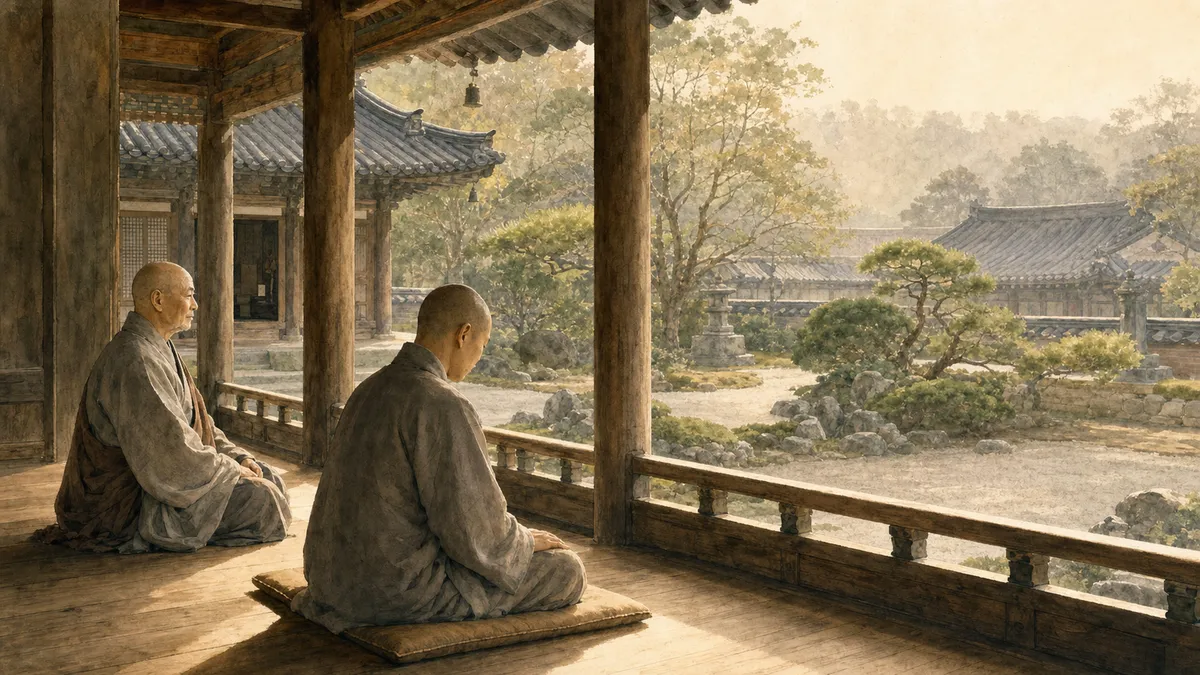
For example, Zen monks do not practice asanas or pranayamas, but they do practice meditation—yet not all of them attain samadhi. Once, another monk came to see Seongcheol Sunim, a saint of Korean Buddhism, and said: “Things are going fairly well with service, monastic discipline, and the study of texts, but meditation simply does not work out”—meditation on emptiness is difficult, even though it is their main practice. It is difficult everywhere; everyone has their own difficulties with meditation.
But if a person achieves a breakthrough in meditation, their subtle kundalini of light begins to move through the sushumna nadi, through the brahma nadi. The gross kundalini remains asleep—the kundalini of heat and the kundalini of wind, moving through the vajra nadi and the sushumna nadi—but the subtle one awakens. If you meditate very well, it rises anyway: the ajna chakra and sahasrara are activated, and they activate the muladhara chakra, activate the sushumna, and draw kundalini up through the sushumna.
Question: Could you give examples of how practitioners awakened kundalini without deliberately practicing kundalini yoga?
Through meditation, through concentration. Sometimes it can even awaken spontaneously. In some people it awakens during sexual desire, if their channels are pure—but they cannot handle it, and it is then dissipated. During service, self-surrender, or contemplation.
You cannot bypass kundalini. The point is that you eat prasad—and your kundalini is active. Kundalini is not something that gives you phenomenal experiences. Kundalini is that which operates within you as prana; it is simply not strongly awakened. All experiences of contemplation, all experiences of worship—all of them activate kundalini in one way or another, as do all meditations.
Consciousness should not be separated from energy—energy and consciousness always go together. Energy is like a horse, and consciousness is like the rider. The rider can see but is lame—this is the mind, consciousness. The horse moves well but does not know where to go—this is energy. They are always in tandem, always together.
Therefore, you can awaken kundalini by practicing contemplative walking or concentration, or by reciting a mantra—if you are diligent, if you perform tapasya. If you conserve sexual energy and follow a yogic diet, it is possible. And if you practice mula bandha, vajroli mudra, ashvini mudra, and sahita kumbhaka, all the more so.
The Ten Sannyasi Orders and Juna Akhara
Question: From an esoteric perspective, what are the ten orders, one of which is Juna Akhara? Am I correct in understanding that specific deities stand behind them?
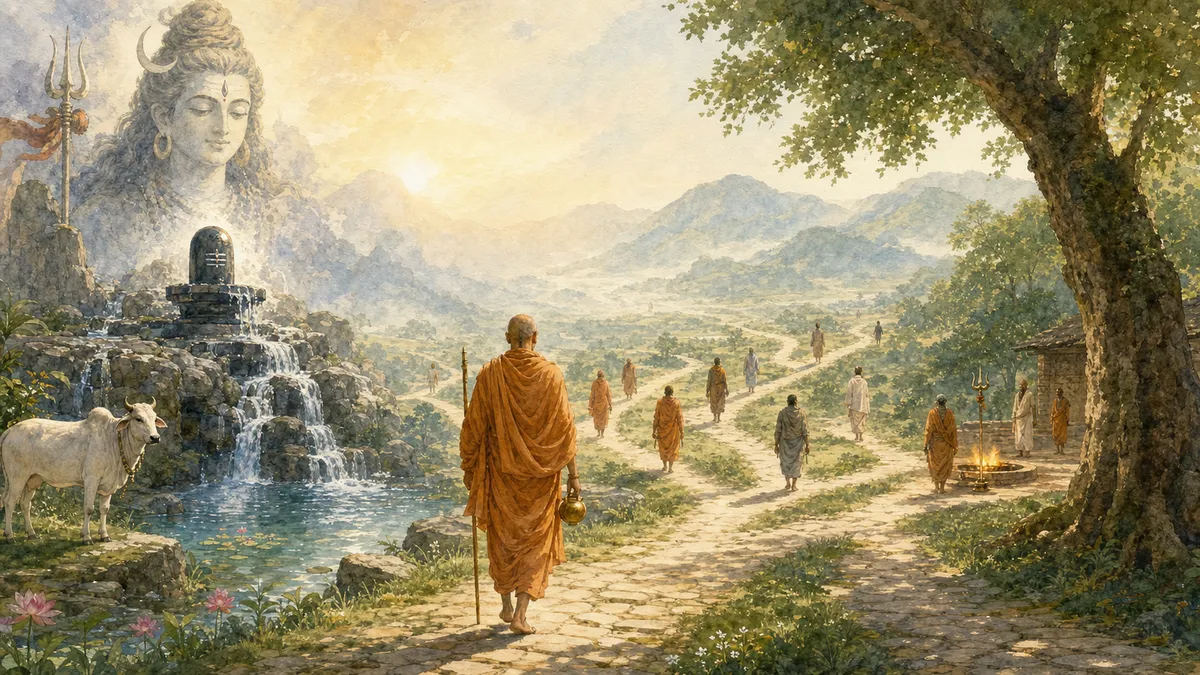
Dashanami Sannyasa—the ten sannyasi orders—was established by Shankara. From an esoteric perspective: Shiva came to earth, bestowed his blessing upon people, and expressed the intention that his energy and his teaching be sustained in the human world. The ten orders appeared. Shankara is an avatar of Shiva; his sankalpa has been at work for millennia. There are different monastic orders—akharas—but they all follow the teaching of nonduality, Shankara’s nondual Shaivism. These are not Vaishnava teachings—they are specifically the teachings of Advaita Vedanta and Shaivism. In Juna Akhara, Dattatreya is the chosen deity, although it too is a Shaivite akhara. Juna Akhara was formerly called Datta Akhara.
Identifications, Kanchukas, and the Yoga of the Illusory Body
Question: On the sixth ground of wisdom, is there any slipping back into the self-identification “I am a human being”? If so, for how long, measured in terms of the relative dimension?
On the sixth ground of wisdom, there is nothing of the kind at all—no identifications, no slipping back. This is a level of sainthood, and indeed of transcendent sainthood. There is no question of self-identification whatsoever.
Question: If a saint has dissolved the identification “I am a human being” without using the practice of the illusory body, will they need it later?
The point is that merely dissolving the identification “I am human” is not enough. This identification pertains to the current prarabdha karma, but deep within the subtle body there may be seed identifications: “I am a spirit,” “I am a deity,” “I am a naga.” You have dissolved the identification “I am human”—but what about dissolving the other identifications? That is not the end of it. If the identification “I am a deity of the world of forms” has not been dissolved, you will be reborn as a deity of the world of forms. If the identification “I am a spirit” has not been dissolved, you will be born as a pitri.
The question is how to dissolve all identifications, how to dissolve the ego that creates identifications—this nexus of chitta, manas, and ahamkara—and how to dissolve the seeds of the ego present in the causal body. The yoga of the illusory body—Ishta Devata Yoga—is intended precisely for this purpose. It is not a matter of visualizing yourself in a human form resembling a deity. The yoga of the illusory body goes much deeper: it is intended to dissolve the karmas of the causal body, unite emptiness with nondual awareness, and dissolve the kanchukas.
Identifications arise from the kanchukas. A kanchuka is a conditioned state of the energies known as dikchari, bhuchari, khechari, and gochari: by binding us, universal forces create these kanchukas. Kanchukas are different modes of perception:
- perceiving oneself as the doer;
- perceiving oneself as bound by cause-and-effect relationships;
- the perception of limited knowledge: kala-kanchuka, vidya-kanchuka, raga-kanchuka;
- perceiving oneself as incomplete without the fulfillment of desires.
All of this lies deep within the causal body. The yoga of the illusory body eliminates these deep-seated problems.

Of course, it is necessary—but only if you choose the path of tantric sadhana. If, however, you follow the path of Anuttara Tantra, relying solely on presence, and you are capable of dissolving the kanchukas, the limiting energies, and all identifications through awareness alone, then you may focus exclusively on Laya Yoga. Here, the choice is yours.
The Fifth Bhumi: Yoga of the Illusory Body Without a Doer
Question: Does a saint who has reached the fifth ground of wisdom engage in the highest practice of the illusory body? And is such a practice possible without nama and rupa?
If he chooses to abide in the subtle world, then he does—but differently, without a doer. For example, if a saint is in a physical body, he practices the yoga of the physical body: he eats and walks—this is the yoga of the physical body. He practices it because he has a body and certain roles to play in this world, but his attitude toward the body is different. The same applies to the subtle world. A yogi of the fifth bhumi can engage in anything—no one will forbid him from doing so if he has the appropriate sankalpa. But whatever he engages in, he does so from nondual awareness, without ego. It is like lila—a game.
At the level of the fifth bhumi, he has a body in the form of a deity. He spontaneously emanates illusory bodies, bestows blessings, sends illusory bodies into other worlds, and can generate one, ten, or a hundred illusory bodies. He can manifest various types of magical activity: shanti karma—pacifying action, paushti karma—enriching action, subjugating action, taming action—various kinds of illusory, playful activity. He already possesses an illusory body; he is in a state of attainment—at the fifth bhumi, he is a liberated soul.
