

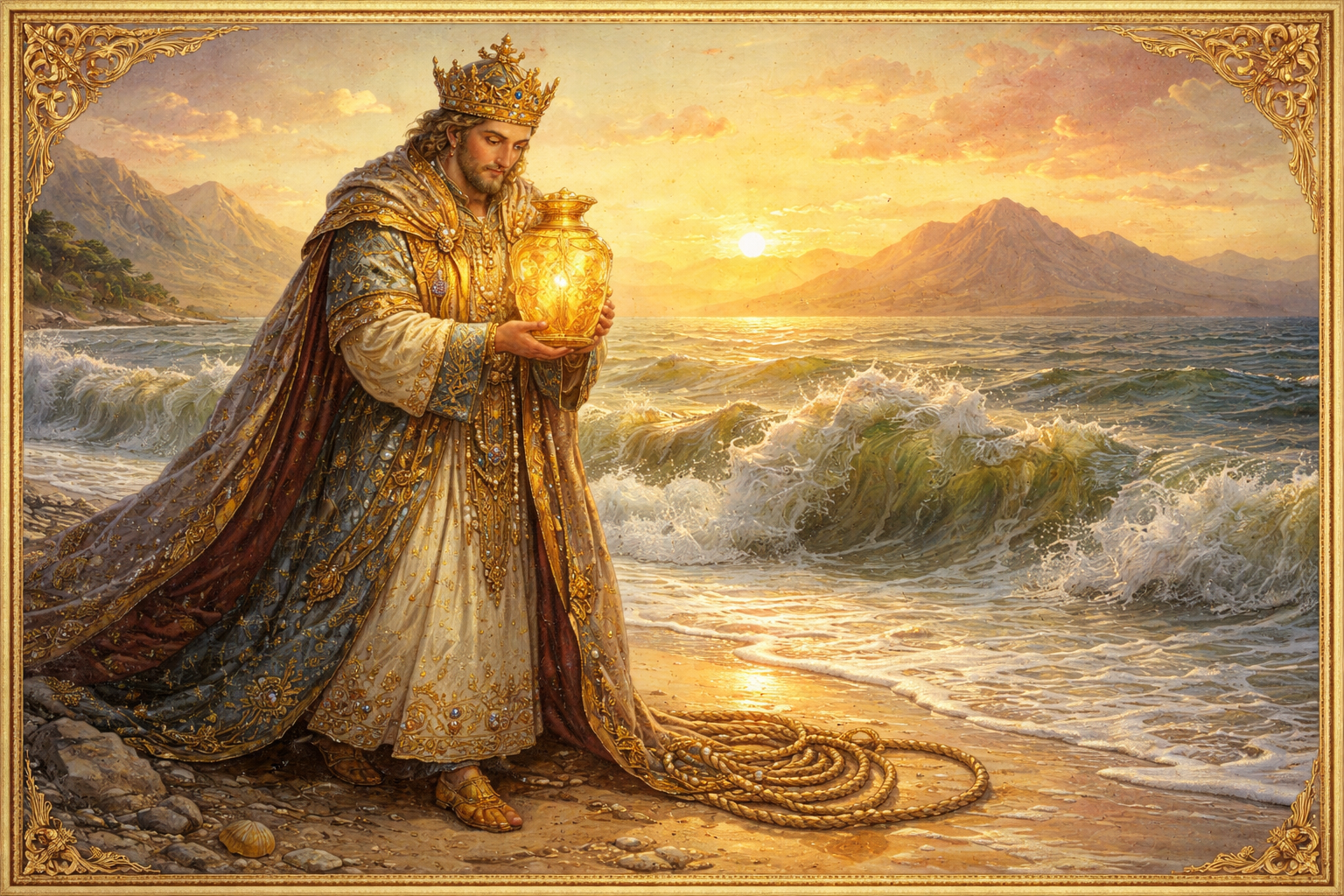
Commentary on the “Mahabharata”
We continue with the passage from the “Mahabharata” about how the gods obtained amrita.
Yesterday we discussed how Durvasa Muni, while visiting an assembly of rulers, received a garland from them as a gift. Then, as he was returning to the world of the celestials, he decided that Indra was the most worthy and presented the garland to him. Indra passed it on to his attendants, and eventually the garland ended up on one of the ceremonial elephants. When, by chance, Durvasa Muni returned, he saw the elephant playing with the garland. Durvasa Muni flew into a rage, believing that Indra had no respect for him as a holy sage if he treated his gift in such a manner. He then cursed all the gods, causing them to lose all their spiritual power.
Someone might wonder, “How could a perfect sage fly into a rage?” In reality, however, his rage was a transcendental play. In essence, he himself had planned it in order to initiate the process of changing the dimensionality of the universe with the help of the gods and asuras; in other words, it was a subtle lila that he set in motion through this curse.
The gods, shaken by the fact that they had been cursed by a siddha who possessed tremendous spiritual power (and this was merely one of his illusory projections), resolved to restore the balance. To do so, they gathered for a council on Mount Meru.
Now let us tell the ancient tale,
Of how the gods obtained amrita.
In this world stands steep-sloped Meru,
Beyond all measure and compare.
In beauty beyond this world, in realms inaccessible,
It gleams in golden splendor.
Its peaks blaze with the radiance of the sun,
Beasts dwell upon it and herbs bloom there.
There tree stands beside leafy tree,
And birds ring out in many-voiced song.
Bright rivers and lakes are everywhere;
The sinful shall never reach the mountain,
Those who spurn conscience and forget the faith
Could not ascend Meru even in their thoughts!
Its summit is adorned with pearls,
Its summit is veiled by clouds.
Upon that summit, in a palace of pearl,
The celestial gods once took their seats.
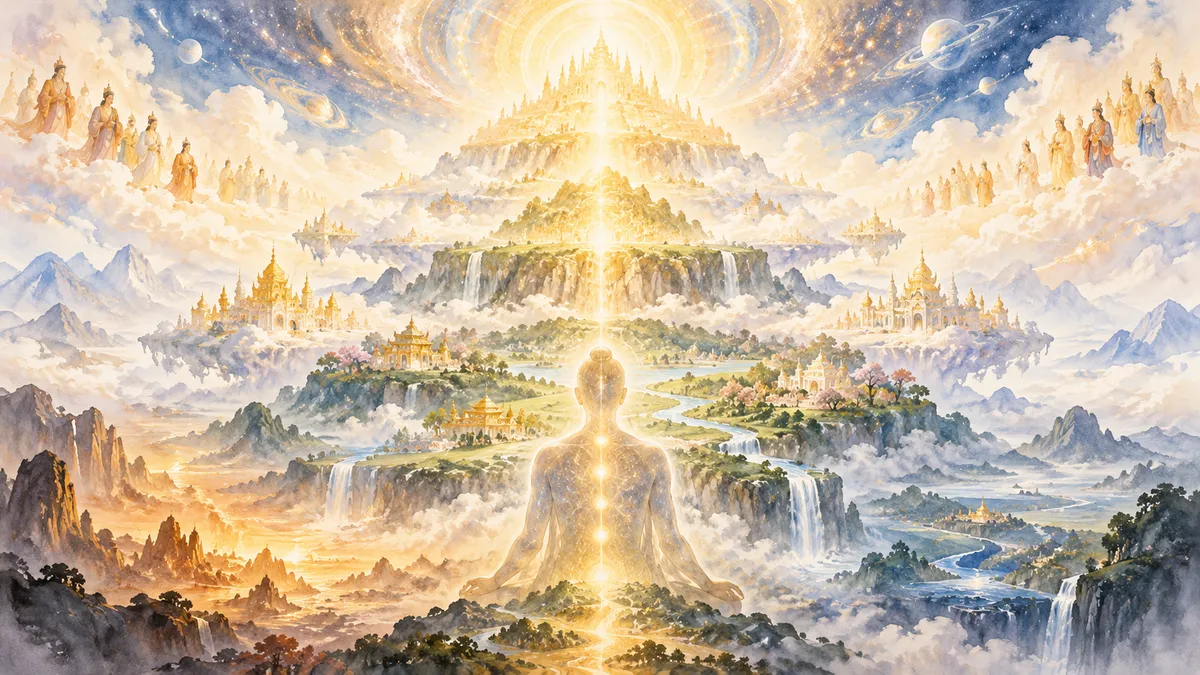
Mount Meru as the Axis of the World
What is Meru? It is, of course, not a physical mountain; rather, it is the axis of the world of our collective karmic reality tunnel. It is identical to the central channel. One might say that the central channel in our body is a projection of this world axis—Mount Meru. Depending on the loka and one’s karmic vision, Meru is perceived differently. In the higher dimensions, it is seen as a pillar of light where the dimensions of space and time collapse. In the lower dimensions, it is seen as the center of the Pure Lands, around which families of gods are clustered.
Why do we study ancient myths? After all, someone might think, “It is enough simply to meditate.” But this should be regarded precisely as a practice of purifying and recognizing our past, which is stored in the subconscious, because the past, present, and future are not actually separate from one another. If we change our past, our present changes as well. If our life story includes a communist past, those identifications will continue to live within us for a very long time as subconscious memories, even while we practice. But if we restore the connection between the ages, knowing that we are descendants of the gods and that our past is something immense and majestic with which we are connected through the lineage, then, naturally, our identification in the present is purified as well.
Contemplating the Puranas and ancient myths makes it possible to view reality in an entirely different way and to engender pure vision and divine pride.
The Council of the Gods and the Search for Amrita
Upon that summit, in a palace of pearl,
The celestial gods once took their seats.
They discussed a matter of great import:
They wished to obtain the drink of immortality.
Narayana said, “Let us tirelessly begin
To churn the ocean’s vast expanse,
Let gods and demons, driven toward the good,
Churn the ocean’s waters as one churns cream.”
When the gods became powerless, a second problem arose: Bali, the king of the asuras, declared war on the gods and advanced on their divine city of Amaravati with a vast army. Since the gods had been weakened and had lost their siddhis and immortality as a result of the curse, they were bound to suffer defeat.
In fact, blessings and curses are common in the spiritual world. The power of a curse can destroy an entire reality tunnel, while the power of a blessing can open one if the yogi abides in deep presence, because the non-physical worlds are governed by the laws of information, and will and information are the creative forces there.
Then the gods went to Shiva and told him about the misfortune that had befallen them. Shiva said that he could not revoke Durvasa's curse because he himself had vested him with certain powers. But in truth, Shiva understood what lila was unfolding and simply did not want to stop it prematurely, although he could have done so. He sent the gods to Brahma. But Brahma also declined to intervene, offering some pretext. Then they went to Vaikuntha-loka, where Vishnu dwelt, since it was Vishnu's duty to maintain the balance of forces in the universe.
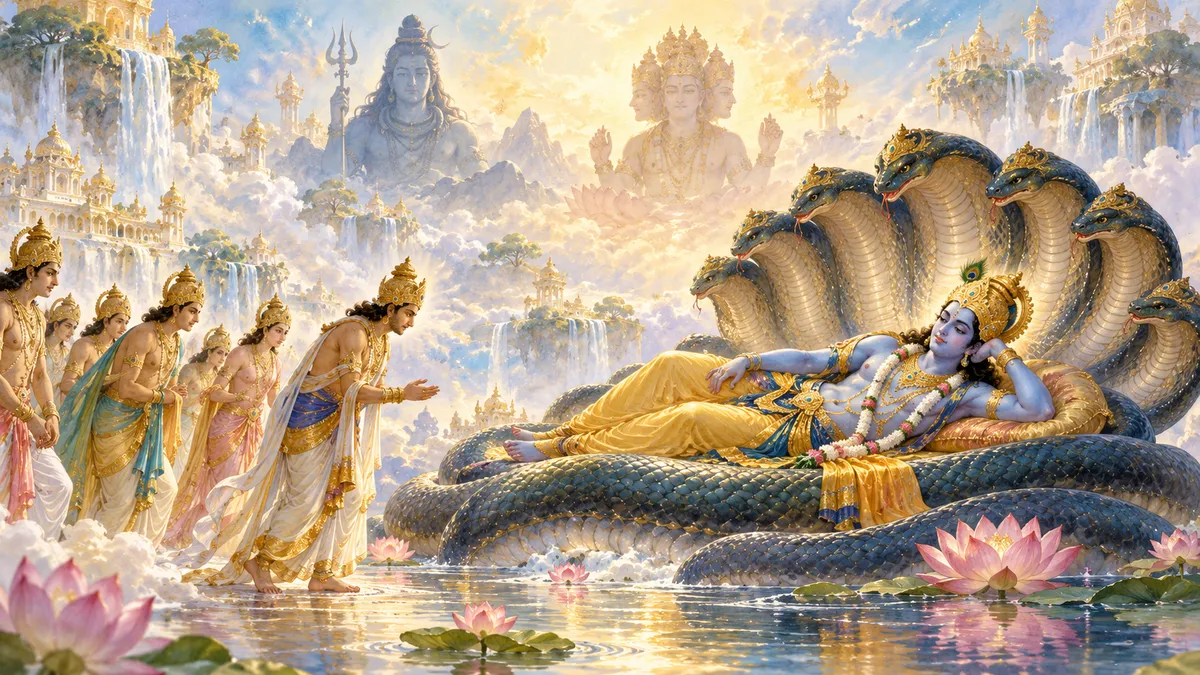
Vishnu was immersed in transcendental samadhi, reclining upon the thousand-headed serpent. The gods began to praise and invoke him through song, uttering thousands of his many names. Then Vishnu manifested himself and asked, “What do you need?” The gods told him about the problems they had encountered. Vishnu entered meditation and afterward said that only a certain portion of the nectar of immortality (amrita, the cream of the Cosmic Ocean) could restore their former qualities.
Amrita, that magical drink, we shall gain,
Together with herbs that can heal every pain.
Come, let us churn the ocean's vast tide!—
Thus Narayana, guardian of worlds, replied.
There stands in the world a mountain, their queen;
No height to compare with her summit is seen.
On Mandara dwell both plants and birds,
On Mandara roam the wild animal herds.
A hundredfold chorus resounds all around,
Her crags form a jagged crown, lofty and proud.
In the earliest age, the celestial host
Sought to uproot that great mountain's vast bulk.
The Churning of the Cosmic Ocean
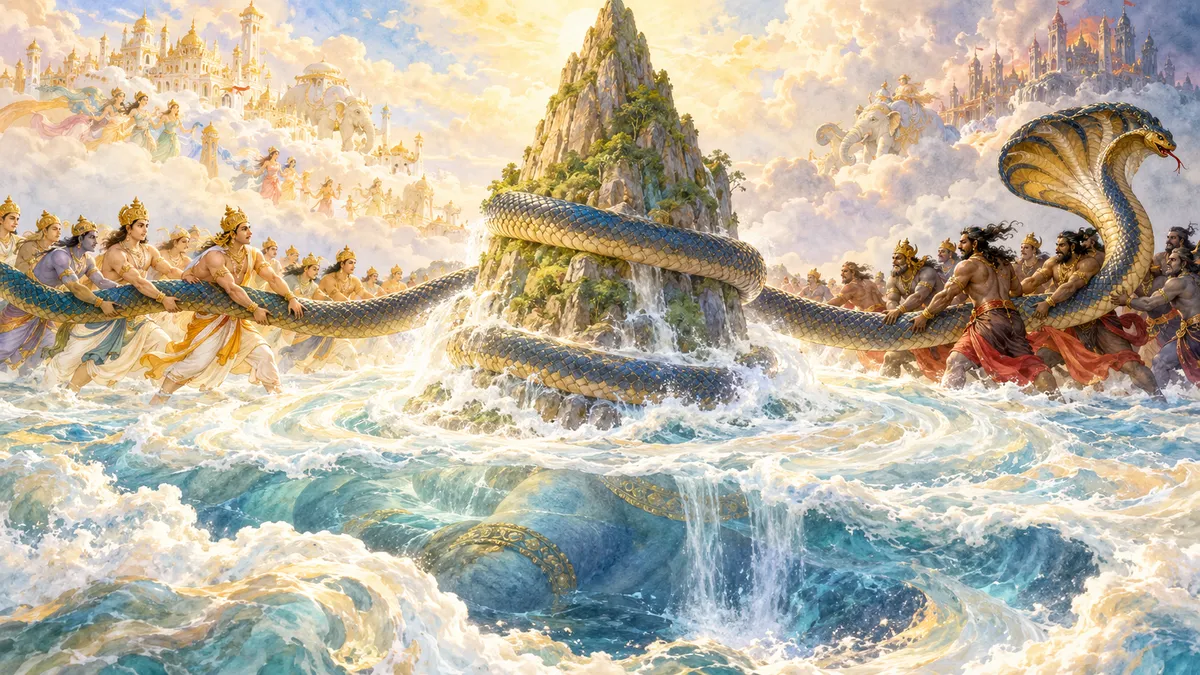
What does it mean to “churn the Cosmic Ocean”? The Cosmic Ocean is, one might say, the primordial energy of chaos in an unmanifest state. The rishis told and described this story using terms familiar to people several thousand years ago. “Churning the Ocean of Milk to obtain cream” was natural for that time. If they were writing today, they would say something like: “They attempted to alter the dimensionality of a particular reality tunnel in the universe in order to establish new parameters, laws, and constants.” And since this space had to be stirred up, as it were, for this purpose they took what is referred to here as Mount Mandara. The gods alone were unable to lift it, so Vishnu asked Indra to make a truce with the asuras, promising them an equal share of the amrita. Indra doubted whether the amrita should be shared with the asuras, because in that case they too would acquire great spiritual power and might defeat the gods. But Vishnu told Indra not to worry about it. Then the gods and asuras made an agreement, uprooted Mandara, and lowered it into the primordial cosmic ocean.
With proud Mandara ceaselessly to churn
The ocean's boundless blue expanse.
But toil as they might, the mountain held fast.
To Narayana and eternal Brahma they came at last:
“Though wondrous amrita is what we seek,
Alone we cannot accomplish this difficult feat.”
The omnipresent gods, inclined toward good,
Then summoned Shesha, the mighty serpent.
He rose and tore the mountain from the earth,
With flowers, beasts, and green grass upon it.
The gods set forth with the mighty mountain
And addressed the sovereign ocean:
“With this mountain we shall churn your waters,
And obtain amrita, the draught of immortality.”
The ocean said, “I do not fear the turmoil,
But grant me a share of the amrita, O gods!”
And when they began to combine the element of earth with the element of space, they had to come to an agreement with the deities governing these elements, since without their support they would not have succeeded. The elements have presiding elemental spirits and ruling forces that possess great spiritual power.
It is then said that the gods seized Vasuki, a huge serpent who lived in one of the hells. They wrapped him around the mountain in place of a rope. What does this mean? It means that they enlisted the aid of an extremely powerful spirit—an elemental ruling the depths—who could apply this force. Vishnu suggested that the gods stand at the serpent’s head, but the asuras, being suspicious by nature, thought they were being deceived. The gods then yielded to them and stood at the serpent’s tail, while the asuras stood at his head. As a result, the scorching breath issuing from Vasuki’s mouth weakened the asuras.
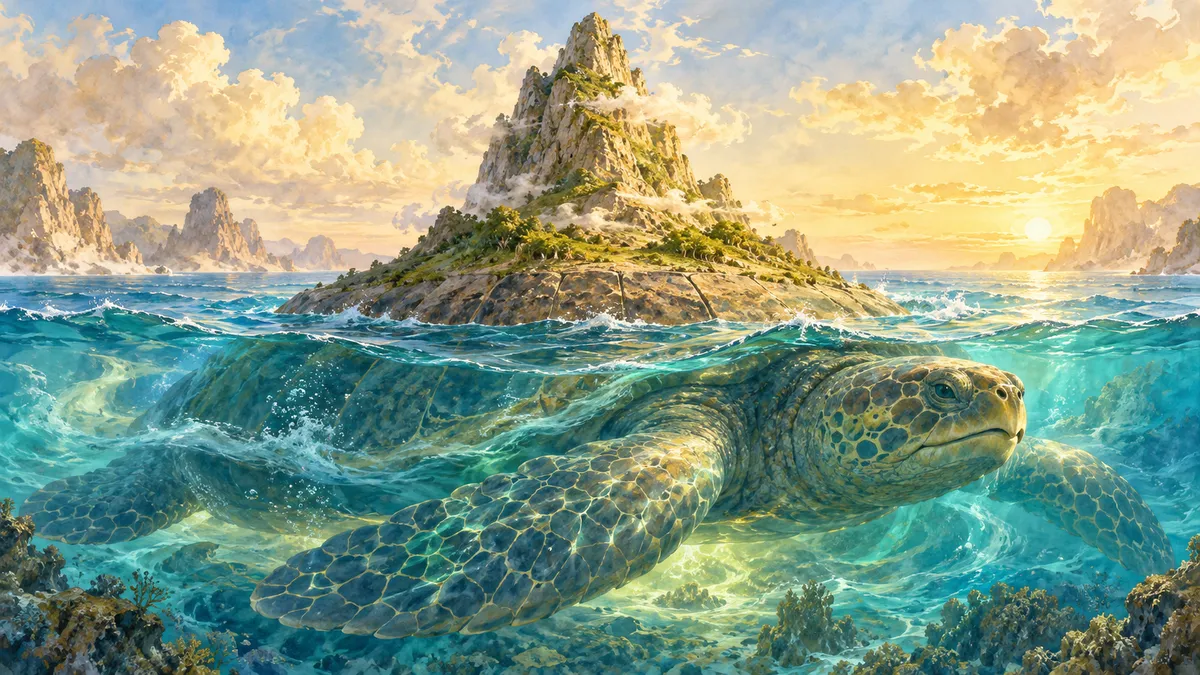
Then to the king of turtles, upon whose shell
The universe rests, they came to tell—
Both gods and demons: “Grant us this favor,
Let this mountain rest upon you forever.”
The turtle then offered its back,
Supporting both mountain base and peak.
It is said that in the course of this transformation of space, the mountain began to sink into the ocean’s liquid bed. In other words, some destabilization of the elements of earth and water occurred, making it impossible to keep the process under control. Vishnu then entered the very lowest strata of the gross elements and infused his consciousness into the spirits ruling the depths—the densest regions of matter. Because he began to move them through the power of his intention, these dense spirits governing the lower regions of matter were able to restore the process. This is why the Kurma Avatar—Vishnu’s incarnation in the form of the primordial cosmic turtle—is often mentioned. This does not mean that it is literally a turtle. It should be understood as a spirit governing the densest processes of matter.
Alchemical Transmutation
The mighty ones made the mountain a churning rod,
And Vasuki, the long serpent, their rope.
And longing for the life-giving water,
They churned the boundlessly vast ocean.
They churned as housewives churn butter
From the finest cream in a tub.
Together they began to pull the serpent,
The wise ones at the tail, the demons at the neck;
The god ceaselessly raised its head
And lowered it again into the ocean depths.
From the serpent’s mouth, roaring above the waves,
Burst forth winds, smoke, and flame,
And the smoke formed a vast, floating cloud,
Immense and pierced by lightning.
Upon the demons tormented by fierce heat,
It poured down in a boiling torrent;
From the mountain peak, as it revolved,
Flowers and plants streamed down like rain.
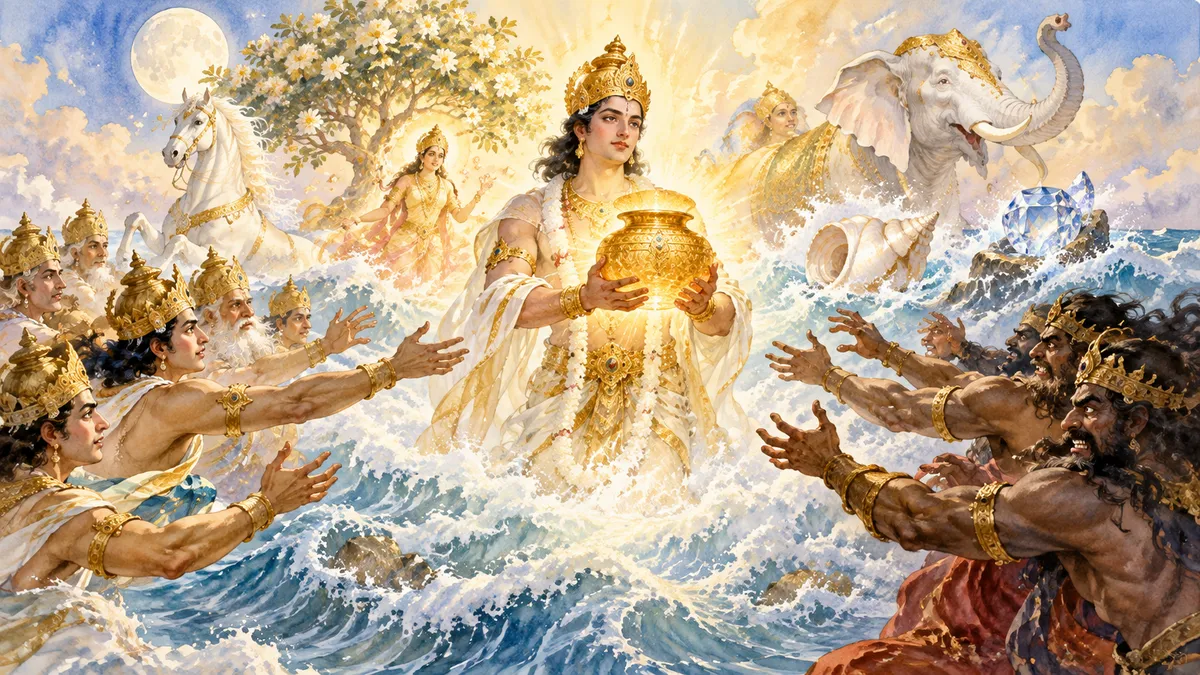
This describes a process of alchemical sublimation, or transmutation. After they began altering the dimensionality of space and combining the elements, signs of realization began to appear. This is called chaturdasha-ratnam, meaning fourteen precious objects. One might say that these were various subtle-material objects possessing tremendous spiritual power. Symbolically, they are called the Moon, the Parijata tree, the elephant Airavata, the cow Surabhi, Varuni (the goddess of wine holding a vessel), the apsaras, the white horse, the goddess Lakshmi, the conch shell, the mace, the treasure called Kaustubha, and Dhanvantari (the god of the medical science of Ayurveda) holding a vessel containing ambrosia. All these manifestations were distributed among Indra, Vishnu, Bali, and the seven rishis.
As soon as Dhanvantari appeared with the vessel of nectar (ambrosia)—that is, with the desired product of alchemical sublimation—the gods and asuras stopped churning the ocean and attempted to seize the nectar. A rivalry arose between them over who would claim it. And the asuras managed to take possession of it by deceit.
From the mountain peak, as it churned,
Flowers and plants streamed down like rain,
Flowers intertwined their petals in the heights,
Falling in garlands upon the radiant gods.
The mountain revolved; those doomed to die,
The mighty waters’ violent churn engulfed,
The earth trembled, as did the moisture and air,
Trees fell with feathered creatures in their nests,
And tree against tree, and stone against stone,
Colliding, gave birth to a furious flame.
Like a blue cloud ablaze with lightning,
It spat sparks and raced like a wildfire.
In those flames the righteous and the wicked perished,
The ravenous beasts and the tender grasses alike.
But Indra, playing with thunder, bravely
Quenched the fire with torrents of water.
Then into the deep ocean rushed
The fragrant juices of herbs and trees.
The water first turned into milk,
Then absorbed the beneficent juices
And finally became churned butter—
For a while, the gods’ work came to a halt.
The wise ones pleaded: “O Giver of Gifts,
See how weary we are, O Brahma the Creator!
We have lost our strength; it pains and grieves us
That the wondrous amrita is still nowhere to be seen!”
The primordial Brahma said to Narayana:
“Give strength to those who labor tirelessly.”
The unangered celestial being breathed strength into them,
And the moon arose, like a cherished friend.
It poured its rays across the boundless expanse,
Burning with a cool and gentle light.
The goddess of wine appeared in the ocean,
Then, in her snow-white raiment,
Appeared the goddess of love and beauty.
After the wondrous goddess, a divine white steed appeared,
Mighty as a fortress,
Born of foam, it touched the foam.
The healing god appeared, raising
A vessel: it was amrita—the water of life!
